



Abstract
Research on the urban process of capital accumulation has typically examined the state and capital as separate actors. This distinction is problematized by a long-standing, increasingly prominent but largely overlooked attempt by state institutions to drive urban development through venture capital (VC) investments. Conceptualized as urban state venturism in this paper, state-driven VC investments reflect at once a riskier extension of urban entrepreneurialism (through their speculative construction of place) and a transposition of state institutions into firm-level drivers of capitalist urbanization (through their roles as profit-oriented investors). To advance research on the urban process of capital accumulation through examining these imbricated state roles, this paper presents a new research agenda that comprises three dimensions, namely (i) the rationale of urban state venturism, (ii) the distribution of profits and risks, and (iii) the extent to which urban state venturism reflects state institutions’ intrinsic commitment to a ‘developmentalist’ ideology. In turn, the agenda foregrounds the value of assessing ‘new’ state capitalism through urban state venturism.
Keywords
Capital accumulation, when considered as a geographical process from the very start, tends to produce distinctive urban regions within which a certain structured coherence is achieved and around which certain class alliances tend to form. – Harvey (1985: 156)
Existing VC [venture capital] studies in geography are predominantly on North America and Western Europe, and the focus has been on the spatial operation of mature VC firms in established VC centers, rather than on the formation of new VC funds and centers. – Zhang (2011: 1562)
Introduction
The process of capital accumulation has been premised on and driven through urban regions. This phenomenon intensified after WWII through state spatial strategies to attract capital to strategically selected cities. Herein lies a dynamic logic at work: urban regions have become key platforms for the reproduction of capital, but political leaders at multiple levels must also consistently create attractive conditions for these regions to secure capital investments. To Harvey (1978: 113), this pro-accumulation approach constitutes the urban process under capitalism, namely ‘the creation of a material physical infrastructure for production, circulation, exchange and consumption’. To this end, state institutions began to embrace what Harvey (1989) famously term urban entrepreneurialism, ‘a public-private partnership focusing on investment and economic development with the speculative construction of place’. The outcome is a state rescaling process in which urban regions become ‘new state spaces’ of/for accumulation (Brenner, 2004). While these efforts generated sharp growth in some cities, their limitations in many others raise a question of both conceptual and empirical significance – how far can urban regions go in successfully capturing and reproducing capital?
Emerging research suggests more need to be done on top of regularly re-assessing the evolution and mutation of urban entrepreneurialism (He, 2020; Wu, 2020). As Phelps and Miao (2020) demonstrate, the urban process of capital accumulation now includes specific characteristics known as urban diplomacy, namely efforts to brand, market and promote cities, and urban intrapreneurialism, namely innovation and invention within public organizations to enhance the capital accumulation process. Yet these new characteristics may be insufficient for driving growth. Urban entrepreneurialism, Phelps and Miao (2020: 314, emphases-in-original) explain, has engendered a distinct feature known as ‘urban speculation’, namely ‘the way in which national and local governments are complicit in what could only be regarded as forms of rent seeking with regressive redistributional effects’. Particularly manifest in the real estate sector, such speculations do not refer to the intrinsically speculative basis of entrepreneurialism, but a specific willingness to engage in speculative activities that benefit ‘big business’ without expecting them to bear high levels of risks. While urban speculation is socially regressive (i.e. benefits go to businesses, losses to the taxpaying public), its popularity worldwide suggests there are increasingly lesser avenues for a fairer reproduction of capital. Channeling scarce fiscal resources into speculative pro-capital investments has therefore become a popular policy goal.
These observations are highly germane to the debates on the limitations and future potential of urban entrepreneurialism to the urban process of capital accumulation. Specifically, they reinforce Peck's (2014: 399) argument that Harvey's conceptualization of urban entrepreneurialism ‘provides a critical benchmark of sorts against which subsequent transformations can be evaluated’. At the same time, however, the multi-dimensional roles of the state in the urbanization of capital remain under-theorized. Insofar as state-linked institutions figure in the urban process of capital accumulation, a distinction between the state and capital is apparent. What this means is the state (at the national and subnational levels) could engage with urban diplomacy and intrapreneurialism through explicit or implicit spatial strategies, but its primary role is still to attract and facilitate non-state capital investments to cities. Even when national and municipal governments assume quasi-investor roles in the realm of urban speculation, the objective predominantly veers towards the interests of ‘big business’. In short, then, existing research on urban entrepreneurialism has largely presented the state as a facilitator and/or enabler of capital accumulation. What happens, however, when the state – and particularly governments in urban regions – becomes capital?
Addressing this question is highly pertinent within a contemporary global economy wherein competitive strategies have moved beyond nurturing national ‘champion’ firms to establishing national ‘champion’ cities (Brenner, 2004; Crouch and Le Galès, 2012). While the production of globally competitive urban regions entails proactive state support through infrastructural provision, low corporate tax rates and flexible labor market policies, it could also occur through state investments in firms that have the potential to be the next ‘champions’. How the state directly drives the urban process of capital accumulation as an investor deserves focus because there is no presupposition that states need to exist apart from capital. Indeed, as Alami and Dixon (2023) argue, state capitalism is now integral to producing global-scale uneven and combined development. And many state institutions are now embedded in incorporated entities worldwide, further accentuating how the state can also be capital (Babic, 2023; Su and Lim, 2023). State institutions may therefore accumulate capital by investing in companies with operations in targeted urban regions (which in turn intensifies the urbanization of capital). In doing so, these urban regions become potential national champions that could then attract new rounds of investments. A more advanced exploration of this dynamic and multi-scalar process could begin by considering the state's manifestation as capital.
Crucially, the state's role as a direct investor in the urbanization process is not an historically novel development that is only emerging in the current conjuncture. As this paper will show, state institutions proactively launched venture capital (VC) investments to drive urban growth and development since the 1950s. Understanding the emergence and evolution of state-driven VC (hereafter SVC) investments could offer a concrete avenue for examining the state's overlapping roles in the urban process of capital accumulation. In turn, it calls for a re-assessment of what Alami and Dixon (2023: 87) term ‘the deep-seated capitalist transformations which have fundamentally underpinned the historic arc in the trajectories of state intervention on a global scale’. A crucial transformation is the integral role of SVC investments in the urban process of capital accumulation – a role this paper conceptualizes as urban state venturism.
Urban state venturism refers to the transposition of state institutions into venture capitalists to strategically select and finance firms with innovative potential in targeted urban regions. National governments have played a significant role in bolstering their respective domestic VC markets through interventional tools such as tax credits, regulatory changes and, as this paper will elaborate, state-led VC investments. 1 These tools collectively constitute what Klingler-Vidra (2018) terms a VC state that both creates conducive business environments for private VC firms and functions precisely like private venture capitalists by purchasing equity in portfolio firms 2 with fast growth potential. These firms could simultaneously generate positive spillover effects – high economic returns, new industrial clusters, and well-paid jobs – for urban economies, outcomes not typically considered by private venture capitalists.
This paper builds on this expanding – and potentially most ambitious – aspect of urban development through presenting a new research agenda on the state's existence as and outside of capital in the urban process of accumulation. Comprising three interrelated questions, the agenda illuminates a hitherto overlooked empirical domain that could advance knowledge on the connections between state spatial strategies and capitalist urbanization:
Why have state institutions chosen to become VC investors in targeted urban regions and firms despite high commercial risks? How would the distribution of profits and losses shape the economic development of urban regions? Do these speculative investments represent an emergent form of urban state developmentalism, or are they actually more risk-laden expressions of debt-fueled growth?
This agenda connects two major fields of research in geographical political economy: urban economic development and ‘new’ state capitalism. First, it will add new dimensions to the prevailing conceptualization of the urban process under capitalism. For Harvey (1978: 124), this process is a way in which ‘Capital represents itself in the form of a physical landscape created in its own image, created as use values to enhance the progressive accumulation of capital’. Yet, when the state's role as capital is conceptualized as integral to this process, the act of representation through urban spaces goes well beyond the creation of use values through infrastructural provision: it includes creating the direct capacity to create and valorize exchange value. Through explaining the urban process of capital accumulation via SVC investments, this article's second contribution is to illustrate how the multifaceted relationship between the urbanization of capital and state capitalism could engender uneven and combined urban development. Insofar as an aggregate expansion of the state's role as ‘promoter, supervisor, and owner of capital’ has occurred through what Alami and Dixon (2023: 85) term uneven and combined state capitalism, it is necessary to understand how this expansion is constituted by the investments of state capital – and, in the context of this paper, of state VC – in urban regions.
The subsequent discussion will be organized in four parts. The next section will re-conceptualize the urban process of capital accumulation by focusing on one specific aspect – the evolving and multi-dimensional role of the state. In doing so, the section highlights how the state's function as capital becomes imbricated with both firm-level drivers of capitalist urbanization and ‘entrepreneurial’ initiatives that facilitate this urbanization. The third section will discuss the emergence and evolution of urban state venturism. It posits this phenomenon as multi-scalar state developmental initiatives that are not simply superimposed on but are actualized through urban regions. Three future research directions that critically assess the rationale and effects of urban state venturism will be presented in a new research agenda in the fourth section. The contributions of this agenda to debates on urban political economy will be addressed in the conclusion.
Reconceptualizing state involvement in the urban process of capital accumulation
The urban process of capital accumulation has engendered a plethora of state initiatives to create conducive conditions for investors. As Logan and Molotch (2007: 49) demonstrate in their seminal book, Urban Fortunes, American urban economic elites formed coalitions with politicians to ‘maintain privileges for their locations, often at the expense of the lesser locales’. Producing these privileges entail ‘entrepreneurialism’ from municipal governments, Harvey (1989) observes, because a competitive dynamic has shaped relations between major cities in advanced economies following deindustrialization and economic restructuring during the 1970s. Exploring the global-scale impact of this competitive dynamic, Jessop and Sum (2000: 2295) identify the emergence of ‘glurbanization’, an attempt to ‘secure the most advantageous insertion of a given city into the changing interscalar division of labour in the world economy’. In parallel with glocalization, a process through which transnational corporations (TNCs) leverage local differences worldwide to increase profit margins, glurbanization occurs through initiatives to enhance city-specific competitive advantages by capturing and retaining TNCs’ investments.
These conceptualizations underpinned subsequent explorations of state involvement in the urban process of capital accumulation. ‘To understand specifically how urban entrepreneurialism emerges’, Wu (2018: 1384) argues, ‘the changing role of the state in governing urban transformation should be contextualized with appropriate attention to particular institutional settings’. Working across the variegated contexts of Chinese cities, Wu (2018: 1394) develops a concept of ‘state entrepreneurialism’ to accentuate the role of ‘planning centrality’, through which state institutions ‘modify, change and adjust its governance practices’ to facilitate capital accumulation. Also focusing on how state institutions proactively shape the urbanization of capital is Brenner's (2004, 2019) work on the production of new urban spaces through state spatial strategies. As Brenner (2019: 11) puts it: New urban spaces have been actively forged through the aggressive, and often socially and politically regressive, rescaling of state space during the last four decades [i.e. since the 1970s]. More specifically, the production of neoliberalized regimes of urbanization has occurred in large measure through spatial and scalar transformations of statecraft that have extended, institutionalized, and normalized market discipline across the urban fabric while also targeting certain strategic sites within each territory for intensified transnational investment, advanced infrastructural development, and enhanced global connectivity.
To follow Peck and Whiteside (2016: 237), financialization is ‘a historic process of systematic financial intensification, which is reflected, inter alia, in an increased reliance on (and resort to) financial inter-mediation and financial engineering, along with a host of financial logics, metrics, and rationalities’. Non-financial firms have consequently increased their involvement in financial market transactions while municipal governments are incentivized to collateralize land for bond issuance. Underpinning financialization is a specific outcome of state strategies that prioritized deregulation in financial markets – the debt machine. Debt-machine strategies have been implemented to finance urban governance and reshape the governing rationalities of US cities such as Detroit and Chicago within a broader national context of slow economic growth (Peck and Whiteside, 2016; Weber, 2010). Key characteristics of these strategies, Peck and Whiteside (2016: 263, original emphasis) demonstrate, are ‘invasive processes of financial colonization, often realized at the nexus of bondholder-value pressures and imperative programs of neoliberal restructuring’. Two parallel processes in Detroit – the empowerment of financial sector institutions and agents, and the control of local fiscal budgets – engendered a landscape of debt-machine dynamics after the 2008 global financial crisis, while the Chicago municipal government established the Tax Increment Financing scheme to bundle and sell off the rights to future property tax revenues from public services (Peck and Whiteside, 2016; Weber, 2010).
Similar impacts of debt-machine dynamics have emerged in Europe. In Paris, France, the local authority has limited financial capacities to complete mega urban redevelopment projects and must rely on private sector developers that operate in line with the demands of modern portfolio management (Guironnet et al., 2016). Examining urban regions across France, Wijburg (2019: 209) shows how ‘the French state has created a financialized urban governance regime in which REITs, of which one is publicly owned, exercise considerable autonomy’. Through in-depth interviews with more than 50 key actors in municipal governance and the finance industry across England, Pike (2023: 9) shows how financialization has permeated local statecraft to the extent that financial innovation is now construed as ‘a potential fix for local governments facing fiscal stress’, in turn triggering ‘the emergence of new and complex financial ideas and instruments alongside weakened local transparency, scrutiny and accountability’.
Perhaps the most unlikely expression of the debt machine is its impact across fast-urbanizing China following the turn to market-like rule during the 1980s. While the Chinese financial system remains relatively insulated from the global financial system, its fundamentals have been modelled on financial practices worldwide that, in many aspects, enabled deepening connections with global financial centers. What is unique to the Chinese urbanizing context is the structural reliance of Chinese urban authorities on land-based financing for their fiscal budgets. With or without permission from their administrative superiors, city governments across China have been harnessing state-guided investment corporations, known as Local Government Financing Vehicles, to finance massive urban (re)development projects (Feng et al., 2022). Urban investment funds or chengtou rely heavily on collateralizing state-owned land to raise loans from domestic commercial banks so that they can act as first-class developers to prepare leasehold land for second-class developers to launch commercial projects such as building hotels, shopping centers, residential housing, or office. For instance, the Shanghai government was directly responsible for liabilities totalling 326.16 billion yuan (∼US$48 billion) in 2014, most of which was borrowed by chengtou (Feng et al., 2023). Whether these loans can be repaid is largely contingent on whether the land leases generate profits.
Involving myriad coalitions of real estate developers, banks, local governments, and retail stock investors, this speculative and rent-seeking approach to urban development in China has been widely described as ‘land-leverage-infrastructure’ (Tsui, 2011), ‘rolling development’ (Jiang and Waley, 2020), or simply, land financialization (Wu, 2023). These developments collectively reflect how urban financialization has become a global phenomenon today. The rationale may differ within the Chinese political economy where local governments confront colossal structural pressure to generate extra-budgetary funds, but the method on and desired outcome of urban development are identical: value creation through place-making and/or real estate projects that are largely underpinned by debt and are unconnected to non-financial industrial competitiveness.
What the foregoing empirical evidence reveals is sustained attempts by urban governments around the world to identify and extract value predominantly through real estate development and place marketing. However, this mode of urban entrepreneurialism remains premised on the state's role as a facilitator of land-oriented speculation; the state's direct role as a driver of capitalist urbanization is not apparent. Spotlighting this direct involvement would therefore advance a holistic conceptualization of the urban process of capital accumulation. By extension, it addresses Alami and Dixon's (2023: 75, 82) concern about the ‘anaemic geographies’ of state capitalism by highlighting urban regions as vital and vibrant geographical avenues that collectively constitute state-driven capital accumulation. Indeed, if ‘the determinants of the expansion of present-day state capitalism must be sought in the historical-geographical transformations in the material forms of production of (relative) surplus-value on a world scale’ (Alami and Dixon, 2023: 87), examining the emergence and effects of urban state venturism offer new historical-geographical avenues to determine how, when, and why state capitalism is expanding. To this end, a dynamic framework for assessing the urban process of capital accumulation becomes especially helpful.
Expressed in Figure 1, the framework considers the possibility that this urban process can be constituted by capitalist urbanization in tandem with state spatial strategies that are targeted at urban regions. The emergence of urban state venturism exemplifies this cross-cutting state role that incorporates both the facilitative and investor aspects of urban development. With reference to the left box in Figure 1, urban state venturism represents a state spatial strategy to allocate surplus capital in VC markets to support potentially fast-growing firms. It involves risk-taking by VC firms – private or state-owned – to invest in emerging firms identified as having huge developmental potential. In doing so, the invested firms also become new drivers of capitalist urbanization (see the right box in Figure 1).
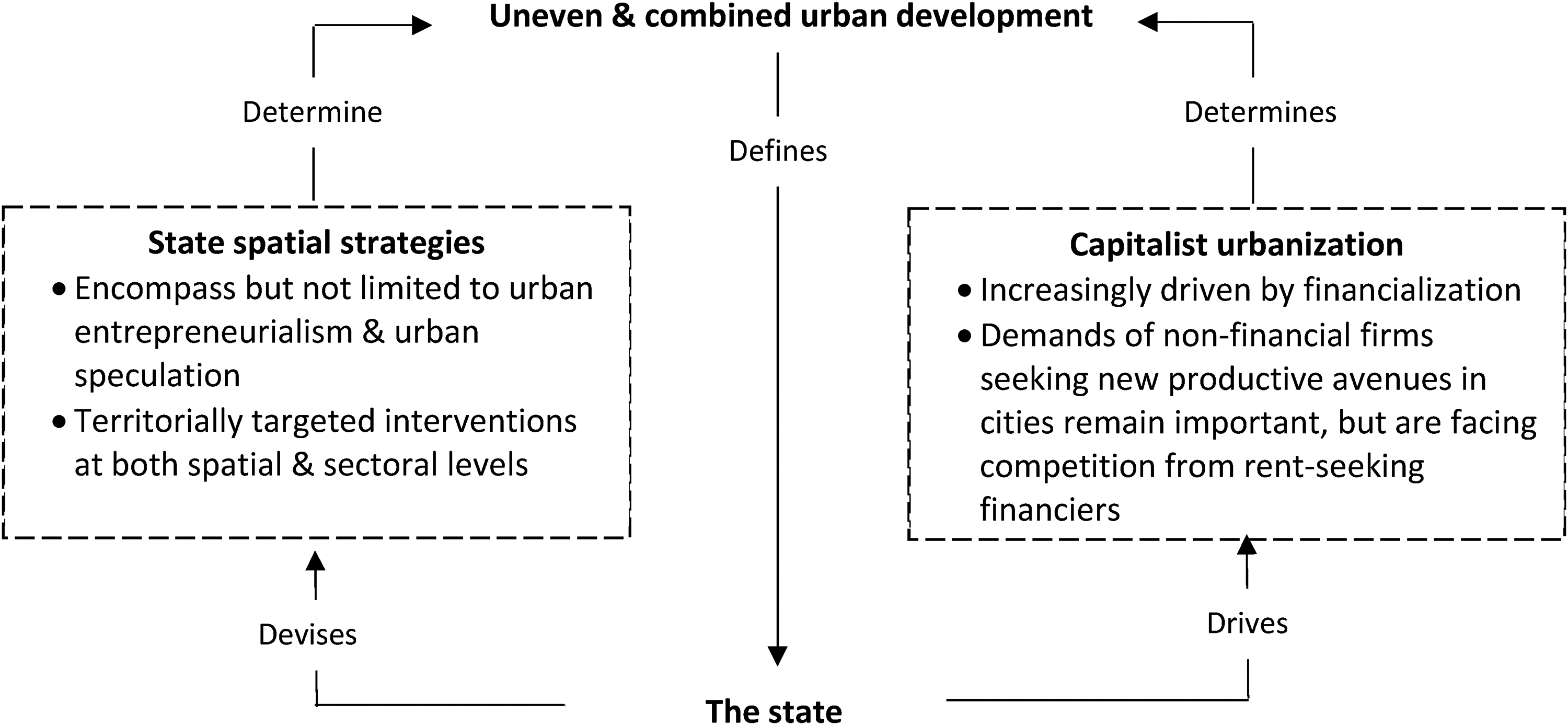
The state as capital in the urban process of capital accumulation.
State-driven VC investments are entwined with the urban process of capital accumulation partly because urban regions have been long-standing centers of capital accumulation and partly because innovative start-ups tend to locate in urban regions and possess the potential to become unicorn companies 3 and/or global market leaders. As the next section will elaborate, the state's role as a direct investor in VC markets is not an historically novel phenomenon. Indeed, SVC investments have existed for several decades in tandem with emergent neoliberal regimes of urbanization. Understanding the evolution of these investments and their manifestation in urban regions is therefore important for exploring the growing contributions of urban state venturism to global-scale uneven and combined urban development (see the top of Figure 1). These contributions then generate new impetuses for state institutions to devise state spatial strategies and drive capitalist urbanization.
The emergence and evolution of urban state venturism
Equity investments by VC investors have become an important tool to finance high-risk commercial projects after WWII. Equity differs from debt because it does not require a pre-specified rate of return within a fixed time period and remains flexible in response to future strategic adjustments (Inoue et al., 2013). Investors can provide the necessary support to ensure that selected firms can succeed at different stages of production – from the formulation of initial ideas to pilot products and, finally, market share capture. Fundamental to this support is the generation of economic returns through exits from these investments. In short, to follow Gompers and Lerner's (2001: 145) definition, VC investments support ‘high-risk, potentially high-reward projects, purchasing equity or equity-linked stakes while the firms are still privately held’.
The first true VC firm, American Research and Development, was established in 1946 by then MIT President, Kal Compton, together with Georges F. Doriot and local business leaders in Boston (Gompers and Lerner, 2001). The VC industry subsequently grew in the US and flourished in the 1990s, with investments concentrated in information technology industries, mostly in California, New England, and the Great Lakes. A defining characteristic of these investments is strong innovative potential. On average, Gompers and Lerner (2001: 165) estimate, ‘a dollar of venture capital appears to be three to four times more potent in stimulating patenting than a dollar of traditional corporate R&D’. Between 1983 and 1992, for instance, VC investments accounted for less than three percent of corporate R&D, but was responsible for about 10 percent of US industrial innovations, giving rise to what Gompers and Lerner (2001) call the VC revolution.
A significant but relatively under-focused point in the US context is the importance of Federal Government support for VC investments in technological innovation and marketization (see Table 1). Even the rise of Silicon Valley, an industrial region in the south of the San Francisco Bay Area that is widely recognized as the global beacon of VC investments, was an outcome of substantial support from US government policies (Klingler-Vidra, 2018). As Weiss (2014) demonstrates, research grants, regulatory changes, and tax credits introduced by US governmental agencies contributed directly to the success of the American technology sector in Silicon Valley. Many national governments subsequently attempted to build their own VC markets with an explicit aim to emulate the high-profile global success of firms from Silicon Valley. Klingler-Vidra (2018) observes at least 45 countries have harnessed public policies to foster their own Silicon Valley-like VC markets to boost innovation and entrepreneurship. This combined emergence of SVC investments across and beyond US urban regions reflect how state initiatives directly benefit from and in turn determine uneven and combined urban development.
Public venture capital initiatives in the United States, 1958–1997.
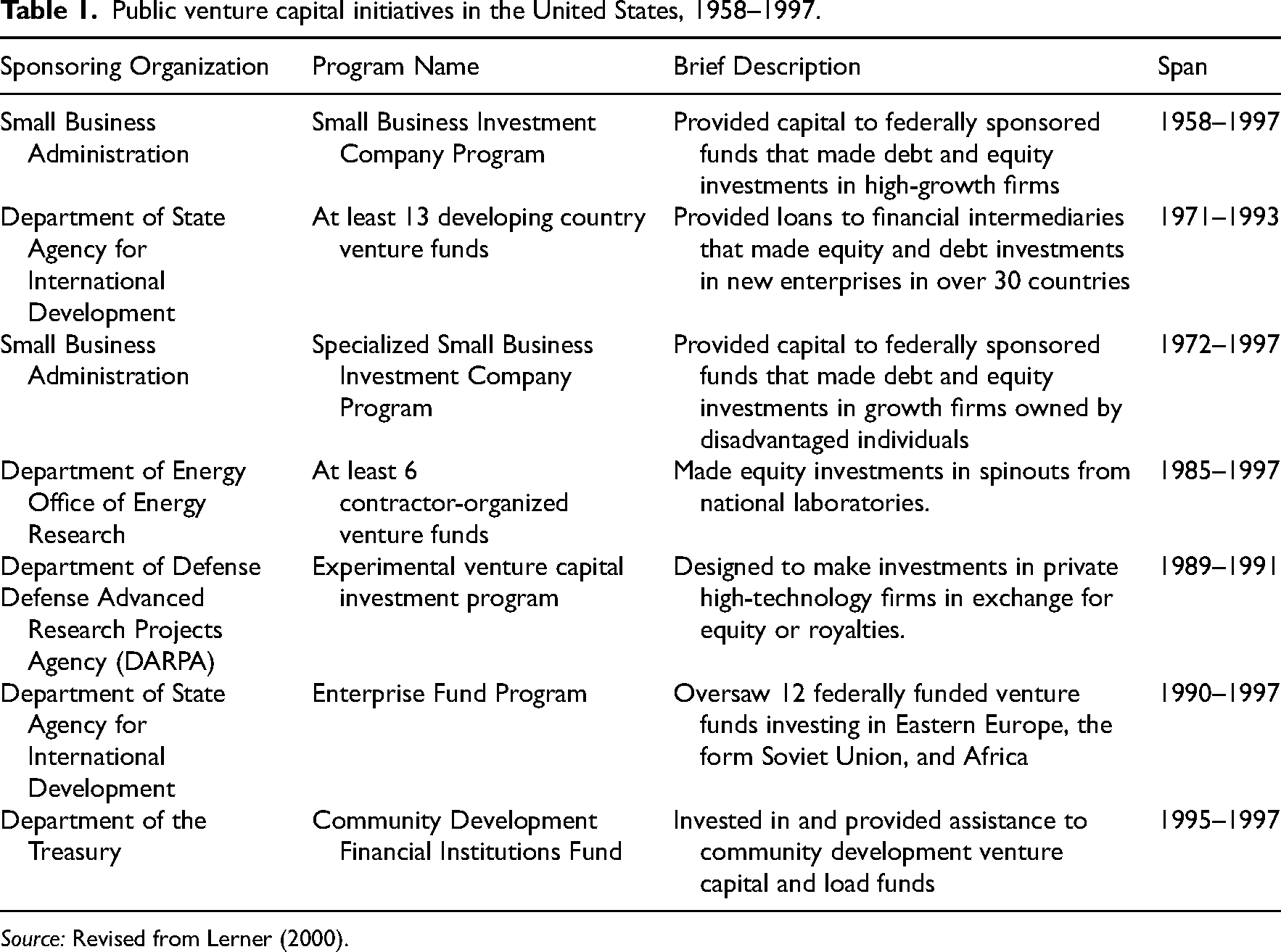
Source: Revised from Lerner (2000).
One major example of adaptation is found in New York City. In 1991, the New York City government created the New York City Economic Development Corporation (NYCEDC) as its primary platform to promote strategic sectors that included bioscience, media, and the Internet communications. The NYCEDC supports startups and offers infrastructure to high-tech firms in the city by negotiating growth-oriented deal structures through its Strategic Investments Group (SIG). Managing a US$180M + aggregate fund portfolio that invests across a variety of sectors, including real estate, VC, energy, and infrastructure, the SIG is pivotal in ‘improving access to finance for underserved groups and catalytic investment capital to strategic sectors’ (https://edc.nyc/finance-solutions). This portfolio includes the Industrial Development Loan Fund, the Not-for-Profit Loan Fund, the Early Stage Life Sciences Fund 1 and 2, the LifeSci Expansion Fund, the Emerging Developer Loan Fund, the Neighborhood Credit Fund, WE Venture, and WE Fund Credit. Fundamentally, NYCEDS is tasked to implement a city-level industrial policy that enables the growth of innovation districts (Zukin, 2021), a task it fulfills through urban state venturism.
VC was adopted and promoted by European state institutions in direct response to US private VC hegemony. Business development and growth are explicit objectives of European SVC investors (Grilli and Murtinu, 2015). Some well-known SVC investors include Biotech Fonds Vlaanderen in Belgium, SITRA in Finland, CDC Innovation in France, Axis Participaciones Empresariales in Spain, and Scottish Enterprise in the UK. The allocation of fiscal funds to SVC investments includes three main modes: direct public funds, hybrid private-public funds, and funds-of-funds (Block et al., 2018). The main goal of establishing SVC investments is to alleviate the regional disparity in financial investment and pursue projects that can yield positive social benefits. These investments were similarly established in Asia's newly industrializing countries to drive economic growth at different scales. During the 1990s, the growth of high-technology industries in Israel, Singapore, and Taiwan has been attributed to SVC initiatives (Lerner, 2000).
SVC investments grew substantially across China after the municipal governments of Beijing, Shanghai, and Shenzhen began launching VC investments to guide local high-tech industries and invest in innovative start-ups (Miao, 2018; Zhang, 2011). For instance, Shenzhen Capital, established by the Shenzhen city government in 1999, has achieved results that are comparable with top private VC firms such as IDG Capital and Sequoia Capital. It is now ‘a comprehensive investment conglomerate major in VC/PE with registered capital of RMB 10 billion [∼US$1.44 billion] and total asset under management of approximately RMB 423.9 billion [∼US$61 billion]’ 4 Among Shenzhen Capital's 972 recorded investment projects, portfolio firms are mainly located in Shenzhen (253), Beijing (131), and Shanghai (86). 5 In Shanghai, the municipal government first established Shanghai Venture Capital Co. in 1999 to support high-tech firms before subsequently launching the Venture Capital Guiding Fund of Shanghai in 2010 and the Shanghai Angel Capital Guiding Fund in 2020 to collaborate with private VC firms. The latter guiding funds are financed by the Shanghai municipal government with a clear goal to shape ‘the flow of private funds into key industrial fields in Shanghai, especially in strategic emergent industries’. 6
An overview of key SVC investments in selected economies beyond the US is presented in Table 2. This overview is not comprehensive, to be sure, and does not exhaust the variety of state venturism in different geographical contexts. What the paper seeks to highlight is the long-standing existence of SVC investments, many of which were embedded in and/or originated from urban regions to begin with, and its relationship with the urban process of capital accumulation. Venture capital investments in value-added manufacturing in urban regions exemplify risk taking that aligns with Harvey's (1989: 4) observation that ‘urban governments had to be much more innovative, willing to explore all kinds of avenues through which to alleviate their distressed condition and thereby secure a better future for their populations’. The crux here is existing research has not adequately conceptualized ‘all kinds’ of state roles that drive the urban process of capital accumulation. Indeed, as the foregoing examples demonstrate, SVC investments have existed in urban regions for more than five decades but have never figured centrally in research on urban entrepreneurialism and state spatial strategies. There are two possible reasons for this lacuna.
Major government venture capital funds in the UK, Canada, and China.
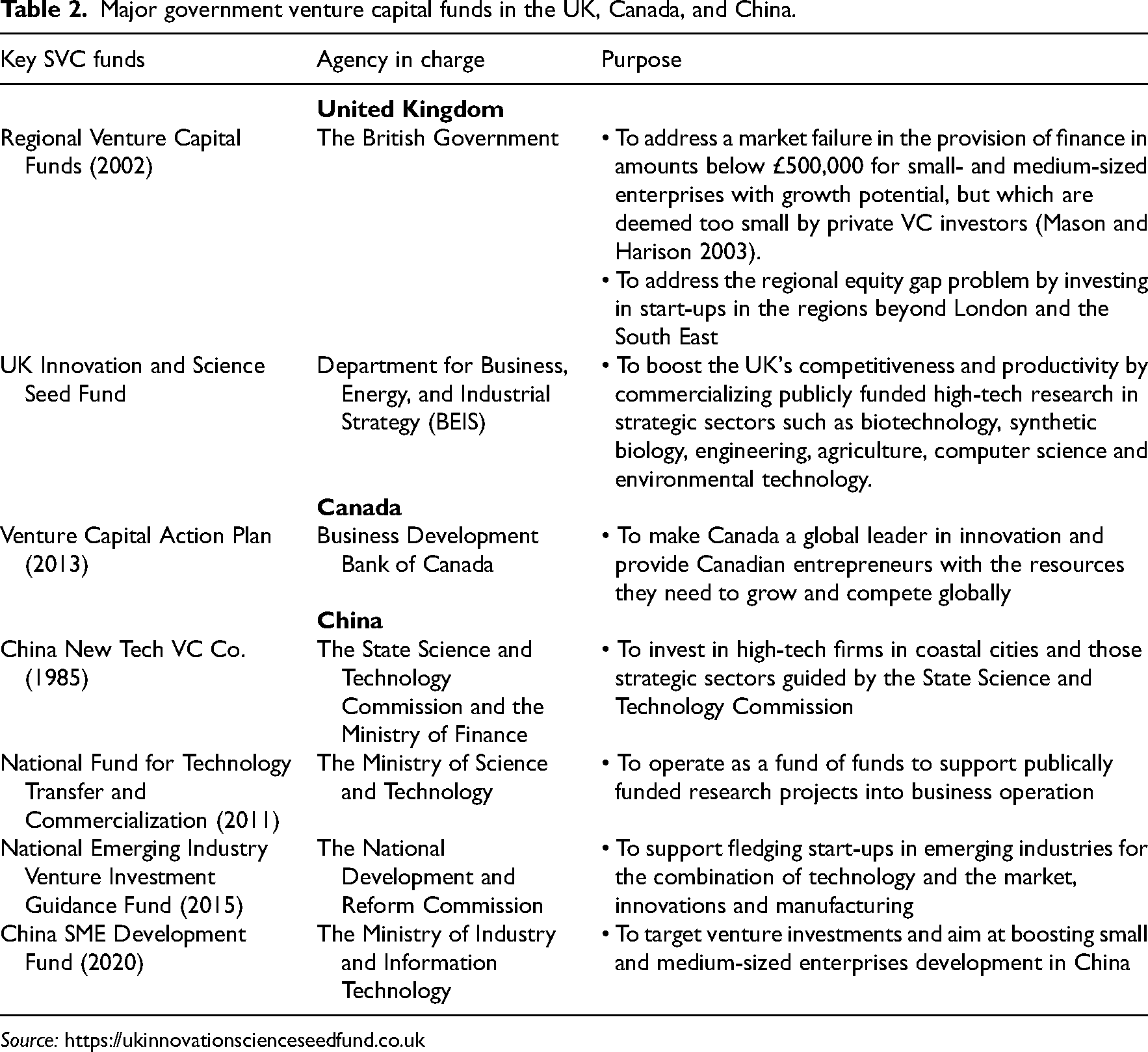
First, the state and capital have been construed as ontologically separate entities. Existing research on state-driven initiatives predominantly focuses (a) on how urban authorities build partnerships or alliances with private investors (Austin and McCaffrey, 2002; Goldstein and Mele, 2016), and (b) on a narrow range of projects such as place marketing and land-based urban regeneration and gentrification (Holmes, 2022; Lees, 2022). Less known are the ways in which SVC investments are launched within and across different urban contexts. Second, SVC investments could be positioned across different scales and are therefore not exclusively based within the urban level. As this section has illustrated, national governments with more surplus capital to invest strategically in start-ups in different cities are key drivers of VC investments. This said, city-regional governments have also created their own VC investments, as shown in the examples of New York and Shenzhen, to boost high-tech start-ups in their respective jurisdictions. The logics and implications of SVC investments as an urban developmental tool require further investigation, both as a significant empirical phenomenon and as a platform for conceptualizing overlapping state roles in the urban process of capital accumulation.
Urban state venturism: A new research agenda
The emergence of urban state venturism highlights at once the limits to preexisting urban entrepreneurial strategies and an attempt by state institutions to transcend these limitations. As the second section has explained, urban regions are dynamic outcomes of the interactions between state spatial strategies and capitalist urbanization. These strategies have not only become less capable of generating surpluses but have also become sources of fiscal and financial crises. Amid these pressures to sustain capitalist urbanization, urban state venturism has come to the fore as an increasingly prominent strategy. This paper proposes three questions that collectively constitute a new research agenda to examine the logics and limitations of this strategy:
Why are urban governments emulating the private VC logic of high-risk investments? How are profits and risks defined and redistributed when urban governments drive innovation and economic development through VC investments? Is urban state venturism a form of ‘developmentalism’ that characterized the rise of East Asian developmental states, or is it simply a more extreme version of the debt machine?
The rationale of high-risk urban state ventures
Speculative urban investments have proliferated globally alongside the consolidation of neoliberal capitalism after the 1970s, but the rationale of speculation varies in different geographical contexts and through different projects. Indeed, effective income redistribution, infrastructural improvements, and high-quality labor markets are required to advance urban ‘development’, broadly defined. What is unclear is the willingness of state institutions to undertake high risks to generate these conditions rather than rely solely on the private sector. While private VC investments provide high-growth potential, they may either overlook urban regions in need of growth or not generate positive spillover effects within the urban regions they invest in. Three clear limitations may warrant SVC investments to drive urban and regional development.
First, private VC investors develop a very narrow band of technological innovations that could potentially generate high and rapid economic returns. The time frame for redemption by fund providers, usually five to ten years, means these private investors prioritize investment opportunities that can realize value through successful exits within this relatively short period. Second, a small number of private VC investors shape the geographical concentration of investments in technological change and could affect the geographical spread and impact of spinoffs. In the United States, three urban regions – the San Francisco Bay Area, Greater New York, and Greater Boston – account for about two-thirds of VC investments deployed by firms each year. Similarly, the Chinese city-regions of Beijing, Shanghai, and Shenzhen account for over 70% of all VC investments (Pan et al., 2016; Yang and Zhu, 2023). The concentration of these investments in a small number of major urban regions suggests VC investments may not be a universal developmental tool for other urban regions without strong state involvement. Third, a relative lack of emphasis on corporate governance and management skills exposes VC firms to higher risks once firm founders fail to secure steady revenues after investing substantial sums of money. In addition, VC firms charge fees high enough to impel public investors to invest directly in portfolio firms either independently or in partnership with private VC firms. This transition from a fund of funds to a direct VC investor further diversifies the financing of innovation and creates more synergies and competition between private and public VC investors.
The discursive justifications of risky VC investments by state institutions offer an avenue to examine the rationale of these investments. Juxtaposed against these justifications are claims of SVC investors’ operational inefficiency. To Florida and Kenney (1988), public equity funds possess limited potential in VC networks by public equity funds. While some SVC investments can succeed in financing high-tech firms in cities where private VC resources are already abundant, as in the case of Boston, whether these investments could perform equally in the absence of these resources cannot be predetermined (Florida and Kenney, 1988). State-driven VC investments are often criticized for financial inefficiencies due to management problems, low returns on investment, and poor financial performance (Lerner, 2000). Johansson et al. (2021) show that SVC investors undertake more superficial financial analyses of small and medium enterprises’ business potential than private VC firms, while Grilli and Murtinu (2014) doubt the ability of governments to support high-tech entrepreneurial firms in Europe after identifying no positive impact of SVC investments on these firms’ sales and employee growth in Europe. These cumulative evidence on inefficiency is significant not because they reinforce the perception that SVC investments are inefficient; rather, they raise a critical question why, despite this apparent inefficiency, has urban state venturism remained a distinct and even increasingly important component of urban development?
There are at least three plausible reasons. First, SVC investments could boost national competitiveness in strategically selected high-value sectors. For instance, the Small Business Investment Company (SBIC), one of the pioneering SVC firms in the US, contributed substantially to VC investment infrastructure after its launch in 1958 vis-à-vis criticisms of its low financial returns and fraud associated with some funds (Lerner and Watson, 2008). Notwithstanding these criticisms, Lerner and Watson (2008: 8) explain, the officials in charge persisted with the program and their commitment paid off when the SBIC went on to stimulate ‘the proliferation of many venture-minded institutions in Silicon Valley and Route 128 – the nation's two major hotbeds of venture capital’. The profit-making goals of portfolio firms may not be achieved most efficiently, but the socio-political goal of a dynamic VC market in the selected urban regions was achieved successfully. Of particular interest is whether urban governments are uniformly justifying VC investments based on broader socio-political goals. If so, the identification of these goals would further enhance knowledge on the rationale of urban state venturism.
Second, SVC investments offer a relatively faster way that simultaneously boost fiscal revenues (via profits) and drive urban development. This intertwined objective exemplifies the dynamic interaction of state spatial strategies and capitalist urbanization as outlined in Figure 1. One typical example is the Business Development Bank of Canada (BDBC), which calls itself ‘a patient and stable investor unafraid of risk, here for firms in underserved sectors’. 7 By 2021, this SVC is the largest and most active VC firm in Canada: it oversees over C$3 billion worth of assets under management, invested in over 200 portfolio firms, and operated seven direct investment funds. One VC program operated by BDBC is the Venture Capital Action Plan, which has raised over C$1.4 billion from pension funds and the governments of Ontario and Quebec since its launch in 2013. Whether urban governments are similarly seeking to expand their fiscal budgets through VC investments demands further research attention.
Finally, SVC investments can contribute to rebalancing urban development across state territory (see Figure 1's focus on the imbrication of state facilitation and investment). As Vogelaar and Stam (2021) demonstrate, state economic involvement through SVC investments is not confined to fixing market failures; rather, Dutch provinces intervene in the regional VC market because provincial governments emulate others in new development policies and are even impelled to maintain local competitiveness through SVC investments. During the 2008–2012 and the 2013–2017 periods, Vogelaar and Stam (2021) reveal, over two-thirds of all private VC investments were concentrated in three highly urbanized provinces: Utrecht, Noord-Holland, and Zuid-Holland. Meanwhile, rural provinces in Holland lag far behind in terms of private VC investments. This regional disparity demonstrates how private VC is primarily driven by economic vibrancy and profit returns, two dimensions closely associated with economically competitive cities such as Amsterdam and Rotterdam.
A contrast between the number and value of portfolio firms provides further insights into the role of VC investments as developmental tools in Holland. In numerical terms, these four rural provinces accommodate the majority of portfolio firms invested by SVC firms. In terms of value, however, wealthier provinces such as Gelderland, Limburg, Noord-Brabant, and Overijssel accounted for over 70% of total SVC investments during the 2008–2012 period and over 50% during the 2013–2017 period (Vogelaar and Stam, 2021). This difference indicates how governments in less affluent Dutch provinces established SVC investments to address the investment gaps left by private VC firms, but their investments are still constrained by their financial capabilities. An open question at this conjuncture is whether urban governments are seeking to enhance their relative economic positions within a broader uneven economic-geographical landscape through SVC investments.
The distribution of risks and profits
One major issue pertaining to urban entrepreneurialism – and, more broadly, state spatial strategies targeted at urban regions – is the disproportionate concentration of profits in businesses and, conversely, the disproportionate impact of losses on the taxpaying public. Whether urban state venturism generates similar challenges spotlights power imbalance between different stakeholders. As this paper has argued in the second section, state roles need not be confined to market regulators or passive partners of private investors in urban (re)development: state-linked institutions can also assume direct risks as investors (see Figure 1). Herein lies the question of profits, benefits, and risks: as state institutions at different levels (national, provincial, municipal, etc.) proactively shape the transnational flows of capital towards strategically selected firms and urban regions, how they secure and redistribute monetary profits through SVC investments have become key questions for understanding urban state venturism as a socially sustainable process for urban development.
Four aspects of profit generation and redistribution via urban state venturism require further attention. First, how state institutions develop the monetary and professional capacities to invest in, oversee, and evaluate high-tech startups. Second, how high-tech and high-risk innovative firms are identified and selected by SVC investors. Third, how SVC investors compete and/or cooperate with private investors in the identification of investment targets. Last, but not least, how or whether profits generated from successful exits would be reinvested into socially progressive programs. Research on these four aspects would advance knowledge on the operationalization of SVC investments and, in turn, provide data for evaluating their effectiveness as developmental tools.
Like their private counterparts, SVC investments are fraught with risk and their governmental linkages do not guarantee better portfolio returns. For instance, in Wuhan, a major city in central China, local governments invested about CNY 200 million (∼US$30 million) in Wuhan Hongxin Semiconductor Manufacturing Co. for a 10% equity stake. In addition, these governments offered public subsidies to Hongxin in 2018 and 2019, but the corporation failed abjectly even before it started to manufacture chips in 2020. All Hongxin-related VC investments by local governments in Wuhan morphed into a real loss. 8 This example of a failed SVC investment demonstrates how, in a high-risk market, state authorities (and therefore the taxpayers) could easily be exposed to substantial losses.
Indeed, the common failure to generate successful exits in many SVC projects raises a question on the definition of risks: are risks only ascertained based on profits, or do SVC firms incorporate other factors in their risk assessments? Political leaders in charge of these investments may have their accomplishments evaluated through non-profit metrics, such as their ability to establish strategically important industries that could augment urban development in ways that are both tangible (e.g. income, employment, increased logistical flows) and intangible (e.g. attracting high-quality workers, stimulating place-specific competitiveness through new firm formation).
Research has identified a difference between private VC investors, who prioritize profits, and SVC investors, who work towards generating positive social impacts that transcend the maximization of efficiency and profit (Block et al., 2018; Johansson et al., 2021). For instance, Block et al. (2018: 243) observe that SVC investors aim to ‘alleviate the financial gap problem as well as the same time to pursue investments that will yield social payoffs and positive externalities to the society’. For this reason, state institutions tend to possess different tolerance zones vis-à-vis private VC firms. As Avi Hasson, Israel's chief scientist and a former venture capitalist, puts it in a 2014 presentation, ‘governments are more tolerant of real risk than venture capitalists can be’ (cited from Klingler-Vidra, 2018: 418).
While more real risk tolerance could engender more speculative investments, this is not an intrinsically negative approach. Writing about the effectiveness of industrial policies, Rodrik (2010) argues that what distinguishes good performance from bad performance is not the presence or absence of these policies but the skill in implementing these policies. Following Rodrik, this paper emphasizes that the key question is less about the size of the risk in SVC investments and more about how this risk is managed. Risk management is entwined with a range of related challenges, including information collection and analysis, incentive identification (both economic and non-economic) for effective decision making, and finally, a functional mechanism for allocating fiscal resources to selected investments. Holding SVC investors accountable therefore needs to consider both firm profitability and effectiveness in advancing social and economic development in urban regions. Whether there are sufficient legal and regulatory mechanisms to track and evaluate urban state venturism is therefore another major research question.
Beyond focusing on individual cases within urban regions, the question of risks and benefits could also be addressed in terms of urban regions’ spatial positioning within the global system of capitalism. Existing evidence suggests urban state venturism actively leverages innovative ideas, high technology, and finance to create a new ecology of economic development that benefits a very small number of urban regions, or so-called VC centers, at the heart of the global economy and further sidelines those urban and national institutions that cannot cultivate such an ecology for high-tech startups (Chen et al., 2010; Pan et al., 2016). Inevitably, urban state venturism exacerbates domestic and global uneven development and economic polarization (see Figure 1). These outcomes raise questions about how real benefits from SVC investments in booming high-tech sectors can be distributed across the globe and whether the accompanying risks will be sufficiently serious to generate systemic crises. The challenge, as Harvey (1985: 159) presciently identifies nearly four decades ago, could rest in the political-economic power amassed by the ruling class alliance comprising both state and non-state actors: The political power of a ruling class alliance is not confined to an urban region: it is projected geopolitically onto other spaces…The power that a ruling-class alliance projects depends in part upon the internal resources it can mobilize. Financial and economic leverage is crucial. This in part depends upon the urban region's competitive position. But competition is not always between equals: urban regions with enormous and complex economies cast a long and often dominant shadow over the spaces that surround them…Those urban regions, like New York and London, which command power within the realms of credit and finance (the central nervous system of capitalism) can use that power across the whole capitalist world.
Urban state venturism as urban state developmentalism?
The transposed role of SVC investors at the urban level exemplifies a specific form of state-led development. This raises two interrelated conceptual questions that are first outlined in Figure 1. Does the incorporation of high-risk VC investments in state spatial strategies exemplify a form of state developmentalism that is analogous to the approach in so-called ‘developmental states’? If so, how would this developmentalist ideology shape capitalist urbanization and contribute to uneven urban developmental outcomes at the global scale? Addressing these questions collectively would illuminate a major blind spot – the constitutive role of capital accumulation in and through urban regions – in existing research on state developmentalism and state capitalism more broadly.
The ‘developmental state’ concept gained popularity following Chalmers Johnson's (1982) research on Japan's post WWII economic resurgence. This state formation comprises a specific institutional ensemble of planning, operations, and strategies that support domestic firms in mediating and combating competition in the world market. A core approach of the developmental state is to create conducive environments that nurture ‘national champions’ (i.e. global leading firms), an approach that corresponds with the overarching aim of urban state venturism to produce new ‘champion’ firms to drive urban development. Yet the ‘classic’ prototype of East Asian state developmentalism is one that reflects a key issue identified earlier in this paper – the dichotomous distinction between the state and capital, such that the state is embedded in society with the aim of enhancing social well-being while simultaneously remaining autonomous from capital (Evans, 1995; Johnson, 1982). Adding to this issue is the widespread state-centrism of research on developmental states that largely overlooks processes occurring at the subnational levels. An open question on urban state venturism, then, is what developmental philosophy is adopted by state institutions in a way that both justify the facilitation of and participation in the urban process of capital accumulation.
Crucially, this question is applicable to urban regions beyond East Asia. As Block (2008) demonstrates, the US Federal government's interventions to support the national innovation system and private high-tech firms exemplify a ‘hidden developmental state’. ‘Consistent with ideas of the ‘knowledge economy’ or postindustrial society that stress the economy's immediate dependence on scientific and technological advance’, Block (2008: 170, original emphasis) asserts, ‘governments have embraced developmental policies that support cutting edge research and work to assure that innovations are transformed into commercial products by companies’. This ‘hidden’ developmentalism has become more visible today after the US federal government passed three legislations (the Bipartisan Infrastructure Law, the CHIPS and Science Act, and the Inflation Reduction Act) since late 2021 to improve national economic competitiveness, innovation, and industrial productivity. Underpinning these legislations is a planned federal expenditure of US$2 trillion over the next decade to support high-tech sectors such as chips, electric vehicles, and green energy.
State developmentalism in East Asia currently encompasses the use of VC investments as strategic tools. Public policies and funding in Hong Kong, Singapore, South Korea, and Taiwan have been harnessed to foster VC markets through start-ups and high-tech innovation. Despite their variegated strategies, three general policies have been introduced that correspond with what Klingler-Vidra (2018) terms the ‘venture capital state’: investing in start-ups through private VC partners, improving national regulatory environments related to innovation and entrepreneurship, and providing tax breaks. They reflect, specifically, Klingler-Vidra's (2018: 389) observation that ‘more state involvement, not less, has propelled the global spread of a supposedly archetypal manifestation of laissez-faire: venture capital’. This paper adds to Klingler-Vidra's (2018) conceptualization by considering state institutions’ role as capital – these institutions create their own VC firms to invest directly in start-ups for equity instead of brokering public funding through private VC firms. As emerging developments in Chinese urban regions and the city-state of Singapore reveal, SVC investments have become a major tool to transcend growth limitations.
State institutions at different administrative levels across China are creating various state-funded Industrial Investment Funds (IIFs) to channel investments in urban regions. One of the biggest IIFs in China is National Integrated Circuit Industry Investment Fund Co., Ltd. Created in 2014 by the Ministry of Finance and other state funds, this IIF raised funds in two phases. Phase I generated 138.7 billion yuan (∼US$19.9 billion) and Phase II, launched in 2019, raised a further 200 billion yuan (∼US$28.7 billion). By the end of 2021, over 1400 state-guided or state-funded IIFs valued collectively at 2386 billion yuan (∼US$342.2 billion) were established across China, of which over 80 percent were created by municipal governments (Liu et al., 2022). Under the Interim Measures on Managing State-funded IIFs introduced by the Chinese National Development and Reform Commission in 2016, IIFs must serve as funds of VC funds, and government investors are not allowed to participate in the daily operation of fund managers or fund custodians. In reality, however, many IIFs created by municipal governments act as VC firms that invest directly in portfolio firms that could potentially contribute to the attainment of developmental goals.
In Singapore, the Infocomm Development Authority in 1996 created Infocomm Investments Private Limited (IIPL) as a wholly owned subsidiary to promote VC investments. Unlike private venture capitalists, IIPL works to support and complement state efforts to build a globally competitive Infocomm industry in Singapore. In 2015, IIPL launched a new initiative – Building Amazing Startups Here – to provide all-in-one startup facility to build an ecosystem of start-ups and tech companies (The Straits Times, 11 Feb 2015) 9 . Meanwhile, IIPL collaborates with state-owned entities such as Singapore Power or Singapore Press Holdings to promote and accelerate the growth of startups in energy, media industry, and so on. Similarly, Singapore's Economic Development Board has its own investment branch to create Bio*One Capital, a state-owned venture fund targeting biomedical startups in Singapore and other Asian countries.
Two specific characteristics can be discerned from these examples to distinguish urban state venturism from conventional East Asian state developmentalism. First, the venturist approach is much more firm-focused (i.e. it targets specific firms with prodigious potential and seeks to attract them to drive innovation and entrepreneurship in targeted urban regions). Second, the state is transposed into a capitalist through its VC investments (hence the state as capital), which differs from developmental states that largely stand autonomous from non-state firms. These two characteristics underscore how state institutions are not exempt from the risks of capital devaluation from their VC investments: there is every chance that these investments may not generate positive returns and could consequently trigger urban fiscal crises. Of relevance for further studies on urban state venturism (both as urban-oriented case studies and as a combined entity at the global systemic level) is the extent to which new SVC investments are imbricated with industrial policies, a core characteristic of developmental states, that are targeted at the subnational, national, and/or supranational scales.
Whether urban state venturism represents a speculative extension of state developmentalism requires further research because it would illustrate why and how states handle the limits to ‘entrepreneurial’ policies (see the introductory section). Indeed, if urban state venturism entails what Miao and Phelps (2019) call state intrapreneurship in guiding industrial priorities, then this guiding process is not confined to innovating new plans and policies; innovation must also encompass ascertaining and investing in firms to realize these priorities. Because state capacities and regulatory objectives differ, the ability and willingness to exploit the opportunities of VC are more apparent in some economies such as China, the US, and the EU than in others. The key question here is whether existing conditions, both political and economic, would enable urban governments to shape developmental outcomes through VC investments.
Towards a dynamic research agenda on urban state venturism
The foregoing three-pronged agenda raises fresh questions about the rationale and impacts of urban state venturism. In line with Figure 1, the overarching goal of this agenda is to stimulate debates on the urban process of capital accumulation through SVC investments. It presupposes the production and combination of uneven urban development to drive global economic development as new public-private coalitions are formed to facilitate technological innovation, entrepreneurship, and profit making (see also Figure 1). Consolidating the key features of this paper's analysis, namely (i) the urban aspects of the accumulation process, (ii) the state's multiple roles in territorializing capital, (iii) inter-scalar connections and, last but not least, (iv) spatial positionings, Table 3 lists specific new research questions that could advance research on urban state venturism.
New research agenda: The rationale and effects of urban state venturism.
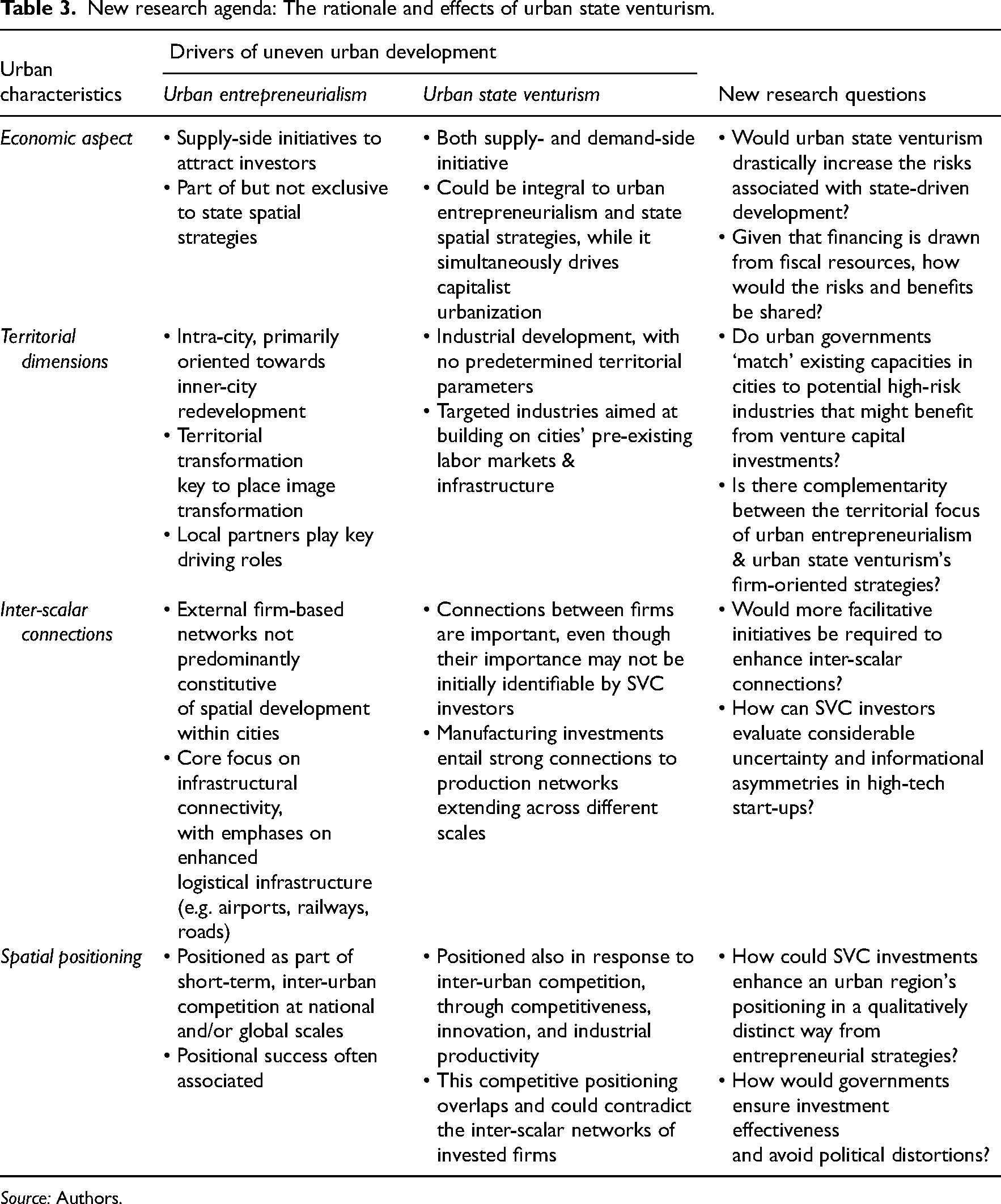
Source: Authors.
Undoubtedly, considerable empirical investigation is needed to articulate the dynamic aspects of urban state venturism and analyze how much it can promote high-tech sectors and enhance urban competitiveness. This simultaneously engenders new research opportunities and challenges, particularly in cross-national comparison. However, through highlighting varying degrees of state involvement in VC investments, from low-risk regulatory changes to high-risk direct investments, this agenda enables more fine-grained discussions on the imbrication of state spatial strategies, of which urban entrepreneurialism is a key manifestation, with capitalist urbanization, a process that augments demand for goods, amenities, and services (see Figure 1). Institutional rules and capability ranging from tax regulations and funding supply to investment mandates and risk bearing shape the uneven approaches to generate innovation and entrepreneurship in urban regions. Here is where the facilitative aspect of state institutions becomes pronounced in shaping capitalist urbanization through SVC investments. Understanding urban state venturism in different geographical contexts entails an analytical focus on the continuity and transformation of the state's roles as and outside of capital in the global competition for capital, technology, and markets. This focus will build critical dialogues with ongoing debates on the role of financialization in economic development (Aalbers, 2015; Christophers, 2015; Lawrence, 2015; Poovey, 2015), the assetization of urban political economy (Birch and Ward, 2022; Chiapello, 2023), and the rise of state-led financial networks (Lai, 2018; Töpfer, 2018).
Conclusion
‘[C]ities can and should participate directly in the venture-capital world by tapping into the ebullient energy of urban startups. These firms are developing disruptive, scalable solutions to some of society's trickiest challenges, including housing, mobility, logistics, food production, water treatment and renewable energy’.
Innovation…calls for venture capital and specific labor skills in its development, access to distribution systems for marketing, and openness on the part of recipients which may entail the redesign of consumer markets and the transformation of taste and fashion.
– Harvey (1985: 157)
This paper has spotlighted urban state venturism as an entry point for evaluating the overlapping roles of the state in the urban process of capital accumulation. States facilitate capital accumulation in urban regions through spatial strategies that cater to the demands of capitalists, yet they also generate these demands simultaneously by existing as capitalists. Research has demonstrated how state institutions have been involved in and supported VC markets to engineer innovation and entrepreneurship to drive urban economic development since WWII. Exemplifying a geographically specific form of VC state as identified by Kingler-Vidra (2018), urban state venturism is underpinned by the investment of public funds in portfolio firms for equity. With reference to Figure 1, these investments underpin capitalist urbanization (right box) that interact dynamically with state spatial strategies (left box), often underpinned by urban entrepreneurialism, to shape uneven and combined urban development (top of diagram).
In this regard, urban state venturism can be conceptualized as an extension of urban entrepreneurialism. Both approaches speculatively promote what Brenner (2004: 16) calls the ‘localized territorial competitiveness’ of particular territories within a national and/or global context. At the same time, however, urban state venturism has been less, if at all, about land-based (re)development, place marketing and/or infrastructural provision for privately oriented development projects; it is more about state-linked institutions’ deployment of VC investments to achieve three distinct but interrelated objectives: enhancing urban regions’ economic competitiveness through establishing more high-tech firms, generating higher returns on public surplus capital, and rebalancing urban and regional development.
These developments collectively complement and complicate Schindler et al.'s (2023) critical evaluation of the so-called ‘Wall Street Consensus’. Under this new accumulation regime, state authorities allow greater space for private market actors to shape developmental outcomes and correspondingly undertake less risks (i.e. the state provides ‘de-risking’ support for private actors). While urban state venturism exemplifies the state's embrace of market regulatory logics, it marks an increase in capital investments in itself. What is at play, then, is not a process of state ‘de-risking’ private enterprises’ investments in urban regions; rather, state institutions have been actively engaging in ‘re-risking’ through VC investments in these regions. And as this paper has shown, this risk-taking commitment stretches further back along the ‘historic arc’ of state interventionist trajectories that engendered what Alami and Dixon (2023: 87) term ‘new state capitalism’. In this regard, the new agenda proposed in this paper could critically engage with the ‘newness’ of new state capitalism by foregrounding the long-standing imbrication of state roles that produced urban state venturism (see the third section). Indeed, the burgeoning literature on ‘new’ state capitalism has largely under-focused, both historically and geographically, the urban process of capital accumulation. Examining the logics and impacts of urban state venturism would offer a distinct and dynamic avenue to sharpen this focus.
An additional research question that would be of immense policy relevance is whether the pursuit of state objectives through urban state venturism places residents of participating cities at greater economic risks. Indeed, if residents/citizens are expected to bear the costs of failure, how socially equitable is urban state venturism? Addressing this question is politically and practically crucial if SVC investments, increasingly embraced by urban governments as they seek to transcend the limitations of urban entrepreneurialism, do not generate equitable outcomes. While it could be argued that the proportion of SVC investments is small relative to other forms of investments, it does not reduce their significance: more funds are being risked from tight fiscal budgets across multiple states and urban regions for transformative but risky breakthroughs in economic advancement that could easily exacerbate indebtedness and fiscal austerity. Ascertaining the rationale and outcomes of these investments would lend greater clarity on how uneven and combined urban development is shaped through urban state venturism.
Footnotes
Declaration of conflicting interests
The author(s) declared no potential conflicts of interest with respect to the research, authorship, and/or publication of this article.
Funding
The authors disclosed receipt of the following financial support for the research and authorship of this article: The National Natural Science Foundation of China (grant No. 42071182).
