




Abstract
COVID-19 has fundamentally changed workplace geographies with large proportions of people working at home during the ‘Great Lockdown’. This commentary argues that working at home has emerged as a key policy response and one in which inequalities are embedded. We outline the nature of these social and spatial inequalities by examining existing evidence and data for the Global North, and consider some of the economic and policy challenges ahead.
Introduction
With tight restrictions on the movement of people and closure of businesses, the COVID-19 public health crisis has quickly developed into an economic crisis. While working at home got relatively little attention before the crisis, it has become a key policy instrument used by governments across the world as a means of minimising the spread of the pandemic.
This commentary focusses on the socially and spatially uneven distribution of the ability to work at home and the economic consequences of the ‘new’ homeworking phenomenon in the context of countries in the Global North. It argues that the inequalities related to the ability to work at home and the experience doing so need to be exposed and understood.
Social inequalities of working at home
Working at or from home was slowly but steadily increasing before the COVID-19 crisis even began (Felstead and Henseke, 2017). What was more common at that time was working occasionally rather than wholly from home, hence the label ‘telecommuting’ or ‘teleworking’ (Ory and Mokhtarian, 2006). In the United Kingdom, for example, just over 5% of the total workforce reported in 2019 that they mainly worked at home, but by the second week of the ‘Great Lockdown’ this proportion had jumped to 46% (ONS, 2020a, 2020b).
Prior to the COVID-19 pandemic, telecommuting was largely implemented as a flexible working arrangement to enhance worker productivity and well-being (Menezes and Kelliher, 2011). However, as the term ‘telecommuting’ implies, the ability to work from or at home is associated with the high use of information and communication technologies (Burchell et al., 2020; Ojala and Pyöriä, 2017) and therefore varies substantially across sectors. Jobs in financial, professional, and technical services are more likely to be performed at or from home as communication with co-workers and customers can be done electronically. In contrast, low-skilled, high service, and labour-intensive work is less likely to be done at or from home (Felstead and Henseke, 2017). Furthermore, the opportunity to do so is unevenly distributed with men, the better educated, the higher paid, and those in higher skilled jobs more likely to have the ability to work at home if they choose (Felstead et al., 2002). Surveys that have been carried out during the COVID-19 crisis suggest that working at home continues to be skewed towards these groups (Adams-Prassl et al., 2020; Mongey and Weinberg, 2020).
Spatial inequalities of working at home
Besides specific socio-economic characteristics, working at home varies spatially which means that some places may be better able than others to adapt to the COVID-19 crisis. Dingel and Neiman (2020) predict large spatial variations across metropolitan areas in the US with the greatest share of jobs that can be moved into homes in the San Francisco area. This geography is shaped by the spatial concentrations of sectors that are less affected by the economic crisis such as financial and professional services in large cities. There is also some evidence that teleworking is higher in metropolitan areas since large organisations which allow employees the opportunity to spend some of their working time from home tend to be concentrated in urban areas (Vilhelmson and Thulin, 2016).
As a proxy for the feasibility that work can be performed at home, if required, we examine Eurostat data on the proportion of workers who say that they have worked at home in the past. These data come from a survey carried out before the crisis, but it is indicative of the spatial variations within Europe. Notably, this proxy may be an underestimate as some people may be able to work from home but have not done so before the crisis. We cannot directly infer from Figure 1 how national economies will be affected by the current crisis as this will depend on multiple factors including pre-COVID-19 sectoral composition, the management of the COVID-19 outbreak as a public health crisis, length of strict distancing measures, and the means that have been introduced to provide buffers for firms and the self-employed to cope with the sudden drop in demand. However, it provides important insights into the differential capacity to implement working at home during the outbreak of the coronavirus pandemic.
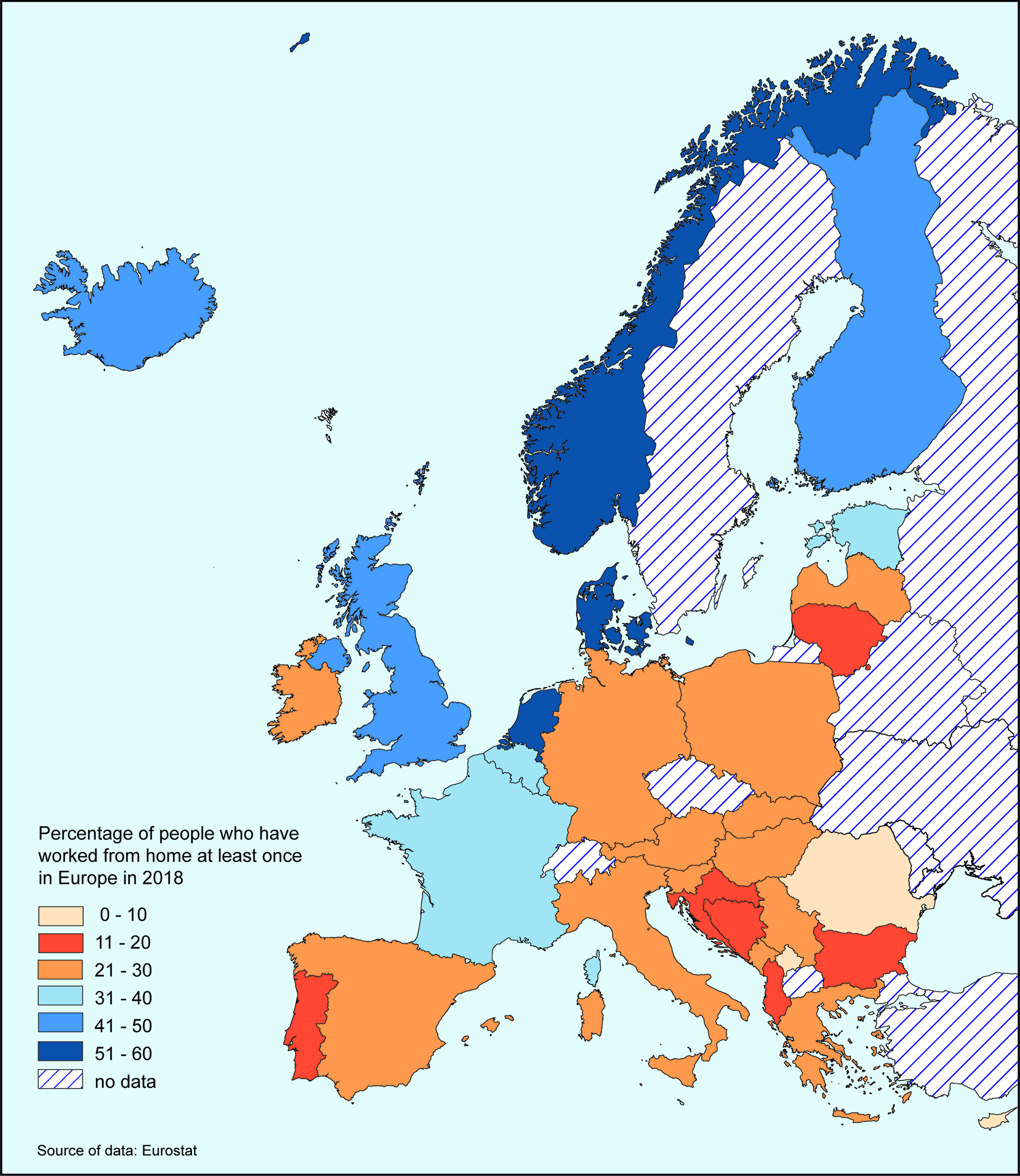
Percentage of people who have worked from home at least once, Europe 2018 (Source: Eurostat Labour Force Survey, Table: isoc_iw_hem. Map produced by Lyn Ertl, University of Southampton).
The country-level variation in the ability to work at or from home is substantial across Europe. It varies between transitional economies (e.g. Romania) having only small portions of workers who may be able to work at home, on the one hand, and high-income countries in the North (Iceland, Denmark, Norway) and the Netherlands where half or more of the workforce has worked at or from home in the past. Proportions are also strikingly low in some Southern Mediterranean countries. The picture that emerges is similar to differentials in Gross Domestic Product (GDP) and social welfare reported previously (Rodríguez-Pose and Tselios, 2015).
These differences in working at or from home are unlikely to be solely sectorial effects. Burchell et al. (2020) found that within European urban areas there is a significantly greater likelihood of working from home in Scandinavian countries (including in Sweden for which we do not have data in Figure 1) and a lower likelihood in the Mediterranean and transitional countries when industry sectors were held constant. It is much more likely that high proportions of workers who can potentially work at or from home coincides with national policies of flexible working and gender equality legislation. Rodríguez-Pose and Tselios (2015) observed that the most efficient policy to reduce differentials in social welfare between countries is to promote women’s participation in the workforce. However, the current crisis suggests that a reduction in gendered occupational segmentation is also needed since sectors that are directly affected by distancing measures and restrictions on mobility (accommodation and food services, entertainment, and other personal and domestic services) are predominantly occupied by women (Joyce and Xu, 2020).
Inequalities in the working-at-home experience
The privileged socio-economic profile of homeworkers before the COVID-19 crisis is associated with living in well-off neighbourhoods, in particular inner-city neighbourhoods with high proportions of professional workers as well as suburban areas with large properties and high proportions of homeowners (Moos and Skarbursis, 2007). While privileged residential living will have facilitated high job satisfaction reported in previous studies (Reuschke, 2019), many of the ‘new’ homeworkers in this current crisis are likely to work in an environment that is less suitable for homeworking. This is likely to be true for those in small accommodation, especially in expensive metropolitan housing markets, and those in family households without a spare room that could be used as office space. Moreover, many ‘established’ homeworkers may find themselves in a new situation with partners also having to work from home and/or home-schooling. These new circumstances are likely to have an impact on the experience of existing homeworkers. Boundaryless working may also lead to work intensification and workers may be placed under greater surveillance as more work moves into the home (Mosendz and Melin, 2020).
Conclusion
The ‘Great Lockdown’ has changed homeworking in a number of ways. It has been enforced upon large parts of the workforce – a situation that is unprecedented. The ability to work at home is unevenly distributed by occupation, sector, skills level, and income as well as being profoundly shaped by welfare policies and housing markets. The spatial variation of working at home has received attention as a predictor of the vulnerability of national and local economies to this crisis. Yet the country-level variation of the feasibility of working at home calls for more attention in order to fully understand the economic consequences of the crisis. The difficulties of working at home during the lockdown are likely to have become more acute with many working adults competing for the same space and resources while also having to provide childcare and home-schooling.
With many workers being told to work at home, there is an urgent policy need to investigate what effect enforced, as opposed to voluntary, homeworking is having on productivity and the mental health of workers. This will have consequences for how working at or from home could enable workers and firms as well as local and national economies to adapt to economic shocks in the future. The COVID-19 crisis raises other important issues such as the future of the collective, open-plan office where desks and equipment are shared and the future viability of promoting co-working spaces where different workers and businesses share the same premises. It also raises questions about the need for increased investment in transport and the expansion of airports if many people and businesses decide that homeworking is here to stay.
Footnotes
Declaration of conflicting interests
The author(s) declared no potential conflicts of interest with respect to the research, authorship, and/or publication of this article.
Funding
The author(s) disclosed receipt of the following financial support for the research, authorship, and/or publication of this article: Darja Reuschke’s time working on this commentary was funded by the European Research Council (ERC) through the WORKANDHOME Starting Grant (ERC-StG-2014 639403).