




Abstract
Stories of nature’s resurgence during quarantine have been dangerously conflated with an alarming narrative contending ‘Earth is healing, we are the virus’. Deploying a more-than-human perspective, we show how this discourse arises from biocultural decontextualisation that assumes nature has an inherent capacity to resurge. Such fetishisations distract from the need for urgent environmental action and obscure what resurgence actually is: a multispecies endeavour requiring cultivation and nurture.
Introduction
During worldwide COVID-19 quarantines, images circulated online showing animals ‘reclaiming’ or ‘returning’ to spaces associated with human practices: such as wild boars on the streets of Barcelona, macaques brawling at a deserted temple in Thailand, and wild goats eating the hedgerows of Llandudno (Figure 1). Quarantine physical distancing measures reduced anthropogenic activity in normatively ‘human spaces’, which led to many celebrating ‘nature's return', a glimpse into a post-Anthropos Earth. An alarming discourse emerged in parallel, claiming ‘Earth is healing, we are the virus’. This narrative suggests nature’s apparent ‘recovery’ during quarantine shows ‘human civilisation is the real virus, not SARS-CoV-2’, dangerously imbuing nature with a vengeful morality atoning for anthropogenic environmental sin.
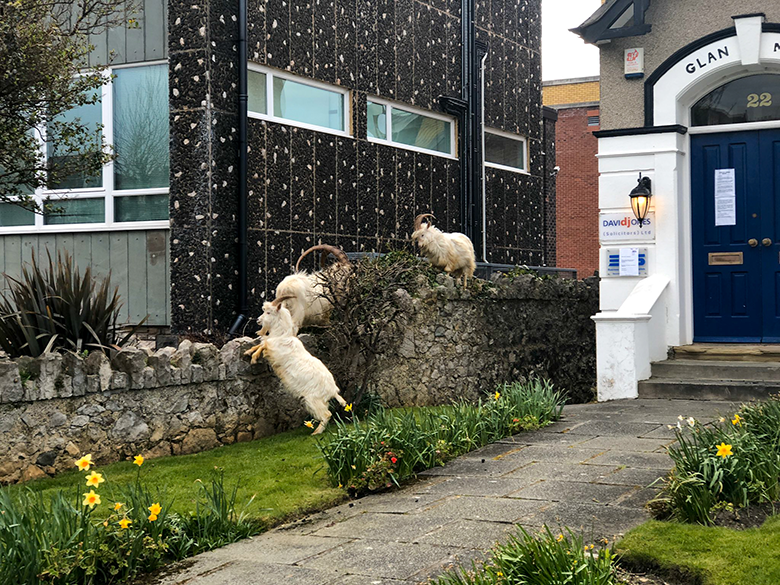
Wild goats in Llandudno, North Wales. Photo: Andrew Stuart.
Various iterations of this discourse label the coronavirus a vaccination in a strange twist of logic echoing Agent Smith from The Matrix when he condemns anthropogenic impact on Earth: There is another organism on this planet that follows the same pattern. Do you know what it is? A virus. Human beings are a disease, a cancer of this planet.
Quarantine resurgence narratives have specific histories, beyond the scope of this commentary. Generally, though, they stem from colonial visions of a nature as devoid of humanity (Brockington and Igoe, 2006), neo-colonial practices of ‘fortress conservation’ (Adams and Hutton, 2007), and, more recently, charismatic romanticisations of abandoned ecologies where nature has ‘returned’ in humanity’s absence to places like the Chernobyl Exclusion Zone. All of these narratives rest on a firm binary between human/nature and presence/absence that in all cases has been shown to be delusional in both theory and practice. Nature’s return to Chernobyl, for example, is the subject of an ongoing scientific controversy as to whether its wildlife is ‘healing’ or ‘harmed’, complicating the idea that nature simply flourishes in spaces of human abandonment. Moreover, holding that nature will always resurge in the immediate absence of humans propagates the dangerous idea that centuries of Anthropogenic environmental abuse will be automatically remediated someday. This accommodates the slow violence of business-as-usual, in turn engendering spatiotemporal displacement of culpability and consequence (Nixon, 2011). Rather, natures continually emerge. Novel ecologies, temporally bound ecologies, and ecologies of abandonment are not to be confused with evidence of ecologically valuable resurgence. Humans often play an active role in resurgence and the cofabrication of worlds which emerge after crises.
Cultivating ecological potentialities
Resurgence is neither neutral nor automatic; it is cultivated, emerging cooperatively between diverse lifeforms. Imaginaries of rebounding natures vary across cultures. For instance, it is not exceptional to see ‘wild’ animals present in particular urban spaces; but detached from their biocultural contexts, spectacular animal images circulate rapidly as novel evidence of nature healing, which obscures the reality of the everyday-ness of certain ecologies. 1 The human and nonhuman labour necessary for resurgence, moreover, is fetishised by narratives celebrating nature’s automatic return. Stories of multispecies cultivation and conviviality are overshadowed by false accounts of resurgence during quarantine.
When we talk about nature healing or resurging, what is it we really mean? A story of return – but to what? Restoration unavoidably requires particular reference to ecologies of the past. Yet, the abilities of particular ecologies to persist is a political and ethical matter, dependent on the ways we identify, respond to, and cultivate specific ecological milieus. In this regard, Anna Tsing (2017: 62) suggests that ‘if we have any dreams of handing a liveable world to our descendants, we will need to fight for the possibilities of resurgence’.
More-than-human labour is a crucial aspect of resurgence. Resurgence concerns the potential for specific rejuvinations of nature through ‘the work of many organisms, negotiating across differences, to forge assemblages of multispecies liveability in the midst of disturbance’ (Tsing, 2017: 52). Capacities for nature’s resurgence, recovery, or return – however it is packaged – are under threat from what Tsing calls Anthropocene proliferation – simplified or stripped-down ecologies like factory farms, designed to create assets for future investments. In contrast to resurgence, Anthropocene proliferation threatens life on Earth by removing organisms from their multispecies life worlds, alienating them. Claiming ‘the Earth is healing’ fetishises the problem of Anthropocene proliferation and the work required to prevent the ‘blocking of resurgence’ by assuming nature’s automatic capacity for renewal. Resurgence – contra its depiction in quarantine narratives – is not inherent to nature but rather a process that emerges through ecological relations in which humans often play constructive and laborious roles. Resurgence, therefore, must be protected and nurtured as a more-than-human endeavour.
Celebrating the pandemic as somehow beneficial to the natural world is a dangerous discourse reliant on biocultural decontextualisation, which fails to acknowledge the socioeconomic, ecological, and cultural agencies of COVID-19’s ‘viral cloud’ (Lowe, 2010). We must see COVID-19 as related to, and emerging from, forms of Anthropocene proliferation if we are to deal with it properly, by materially and semiotically situating it. Quarantine ‘ecologies of abandonment’ (Turnbull et al., 2020) are circumstantial to pandemic conditions. Their temporal ephemerality is slowly being revealed as lockdowns ease around the world. To overlook their ephemerality – over-celebrating their occurrence – detracts from the labour required for a more sustained process of ecologically meaningful resurgence. Furthermore, animals that rely on anthropogenic commensalism have, in some cases, not fared well during the lockdown as animal feeders were confined to their homes (Thomas, 2020). Ben Garlick (2020) points to British red kites going hungry due to the reduced availability of roadkill, highlighting how quarantine impacts species differently. This further challenges the notion that nonhuman nature will automatically flourish in the absence of humans. The differential effects of quarantine are obscured by resurgence narratives that depict nature as universally benefitting from lockdown measures. Correspondingly, this risks overlooking the dangers of Anthropocene proliferation and its cascading ecological effects, such as invasive species going unmanaged during quaratine. Seeing quarantine ecologies as evidence of resurgence fetishises the multispecies work that goes into maintaining ‘Nature’. Finding relief in this falsified imaginary of resurgence in response to humanity’s confinement engenders political neutrality and inertia at a time when real ecological action is urgent. Resurgence, therefore, must be reinstated as an active multispecies labouring endeavour, brought about through an ethical commitment to the worlds we strive to maintain, support, and create.
Ecological emergence and future directions
Eben Kirksey (2015: 215) invites us to consider emergent ecologies as those flourishing ‘in the aftermath of order-destroying disruptions’ that are ‘shaped by a multitude of creative agents’. Emergent ecologies are hybrid ecologies, sometimes characterised by ecologists as recombinant ecosystems (Rotherham, 2017). Recombination is a process of ecological, ontological, and political hybridisation. Viewed in this way, we might ask how and why ecologies of abandonment emerge in cities and investigate the configuration of more-than-human bodies that make them possible. In doing so, we are pushed to consider which configurations of bodies and activities are most convivial, harnessing stories of ecological change during quarantine to actualise the change we now know is possible, instead of disguising conservatism by celebrating nature's apparent recovery. Ethical commitments to multispecies conviviality require continual nurture to proliferate the prospects of diverse biotic resurgence. In this light, the emergence of quarantine ecologies becomes an ethical projection of hope for future convivial alliances.
COVID-19 shows us that our economic, social, and ecological systems are not only not immutable, but also that they can be reshaped much faster than we thought. Noticing this mutability during COVID-19 does not mean any of the apparent environmental ‘benefits’ during this period can be celebrated for anything other than their circumstantial occurrence at a time when people are dying and coming to terms with the personal and socioeconomic effects of a global pandemic. Importantly, glossing over COVID-19 as a purely biological event, rather than an unevenly distributed naturalcultural phenomenon (Fuentes, forthcoming; Haraway, 2003), obscures differences at national and international scales, and across lines of gender, race, and class due to bio- and necro-political governance that values profit over life.
Understanding COVID-19 as a naturalcultural entanglement must not leave actionable politics at the wayside, though. To do so would be to play into the hands of a neoliberal ethic that suspends obligations to communal life (Swyngedouw and Ernston, 2018). Amidst crises and their aftermath, we risk conservatism gaining a stronger foothold, in which our relations with the nonhuman world are implicated. Following our call to recognise the importance of multispecies work for fostering resurgence, and to embrace ecological emergence, we point to future research directions related to the more-than-human geographies of COVID-19, posing the following questions: Will narratives of nature’s resurgence persist as quarantines unwind? Are they mobilised to justify further environmental harm, or will these stories have the potential to initiate change and publicly reimagine ‘human spaces’ as multispecies compositions? What are the differential effects of the COVID-19 quarantine across species, ecologies, and other relations to the nonhuman world (e.g. pet keeping, diets, environmental governance)? If COVID-19 is showing that political, economic, and social change is possible at the scale required to act on climate change, how might resurgence be cultivated through direct action?
Our relationships with the nonhuman world – our food systems, healthcare systems, the climate, conservation – are now more in-focus than ever due to COVID-19. We have argued that stories claiming that ‘Earth is healing, we are the virus’ must be resisted to recognise the work required to nurture nature’s real resurgence. Thinking with emergence provides fruitful avenues for post-COVID-19 environmentalisms: requiring multispecies cooperation, cultivation, and care to foster more liveable futures.
Footnotes
Declaration of conflicting interests
The author(s) declared no potential conflicts of interest with respect to the research, authorship, and/or publication of this article.
Funding
The author(s) received no financial support for the research, authorship, and/or publication of this article.