




Abstract
Speaking directly to economic and political geographers working on uneven development, this article critically examines the deployment of two key concepts, mechanism and process, as analytical tools for causal explanation in geographical analysis during the past two decades. Drawing upon critical realism to develop a theory of mechanism, this article clarifies the conceptual distinction between mechanism and process. Whereas process is conceived as a contingent change in the sequential series of entities and their relations, mechanism serves as a necessary relation to connect an initial causal condition with its particular socio-spatial outcomes in context. This analytical distinction between a contingent process of change and a necessary mechanism for an outcome requires a careful specification of the concrete outcomes to be explained and the working of various mechanisms. Illustrating my case through existing studies of neoliberalization and, briefly, path dependence, I argue that there is a tendency in the literature to conflate mechanism and process in different meso-level theories of socio-spatial change. This conflation, in turn, distorts the causal links in core concepts and reduces their explanatory efficacy in accounting for uneven development. Rethinking mechanism and process can therefore help revitalize systematic explanations of uneven development as one of geography’s core intellectual projects and contributions to the social sciences; it can also allow geographers to engage more productively with the rapidly growing mechanistic thought in analytical sociology, political science and the philosophy of social science during the past two decades.
Keywords
Introduction
As one of human geography’s key contributions to the social sciences, contemporary geographical analysis of uneven development has focused primarily on uncovering diverse processes of spatial formations in late capitalism. Eschewing the deterministic grand theories of the earlier era in the 1970s and the 1980s, economic and political geographers are concerned with understanding the dynamics of capitalist production through variegated social and institutional practices and uneven spatial processes in context (Clark et al., 2018; Peck, 2016; Sheppard, 2011, 2013). When geographical processes are theorized through mid-range concepts in recent decades, such as neoliberalization (Castree, 2008; Green and Lavery, 2018; Peck, 2010; Peck and Tickell, 2002), path dependence (Boschma, 2004; Boschma and Frenken, 2006; Martin and Sunley, 2006, 2015), strategic coupling (Coe et al., 2004; MacKinnon, 2012; Yeung, 2005, 2016) and financialization (Christophers, 2015; French et al., 2009; Ioannou and Wójcik, 2019; Pike and Pollard, 2010), they are often used as heuristic devices for explaining socio-spatial changes and institutional practices leading to uneven development. But what is the explanatory efficacy of these process-based concepts, and is it fundamentally the same as mechanism – another key conceptual building block for coherent causal explanation? How can a clearer conceptual distinction between mechanism and process strengthen causal explanation in geographical analysis?
In the spirit of constructive dialogues in human geography, I aim to engage directly with these economic and political geographers working on the causal analysis of uneven development. This article is therefore primarily epistemological in nature – it is about how to theorize and explain uneven development in a more robust manner on the basis of clearer explanations through mechanism-based thinking (rather than stopping at the kind of processual analysis as often is the case now). In this way, I believe such studies, many in the field of economic and political geography, can achieve more effective analytical purchase in human geography and engage better with the wider community of social science. This epistemological (re)examination is perhaps timely in light of recent heated exchanges in Environment and Planning A (2018: 1496–1545; also Gibson, 2019) in response to James et al.’s (2018) concern about economic geographers in the UK drifting into business schools and Martin’s (2018) critique of the subdiscipline’s ‘emasculation’. In these exchanges, one might detect a sense of déjà vu in economic geography’s ‘identity crisis’ first prompted almost two decades ago by Amin and Thrift’s (2000) epistemological intervention (see responses in Martin and Sunley, 2001; Yeung, 2001). While this alleged recent crisis is rather multidimensional in nature – linking to career advancement preferences, disciplinary boundary policing and national context (UK higher education), one can fathom something in economic geography’s core intellectual project being ‘lost’. To James et al. (2018: 1363), it is about ‘a core focus on explaining systematic patterns of uneven development’. To them, this loss is ‘not just in the UK’ and the project, if revitalized successfully, ‘now must be an increasingly global project that necessarily engages with the global South’. Pointing out ‘a retreat from “big picture,” systemic accounts, underpinned by the analytically strong geographical, political economy’, they argue for a pressing intellectual need to account better for patterns of uneven development both within and across countries that are critical to understanding contemporary economic and political debates (e.g. crisis of globalization, unbalanced growth and inequality, corporate power, trade disputes, etc.).
While I concur with several commentators (e.g. Barnes, 2018: 1498; Gibson, 2019: 2; Martin, 2018: 1505) that asserting an essential subject matter as a core to the subdiscipline is neither feasible nor effective, I do think the search for clearer and more robust explanations of ‘big issues’ such as uneven development and the crisis of globalization can strengthen the analytical purchase of economic geography (and human geography for that matter). In this sense, my article seeks to offer a conceptual clarification of the analytical difference between mechanism and process and to theorize different types of mechanisms that might be deployed in causal explanation. More specifically, this conceptual effort is motivated by two observations of geographical work and the wider social sciences: (1) the need to differentiate between different analytical levels and concepts (e.g. process and mechanism) in developing causal explanations and (2) the desire to strengthen causal analysis through mechanism-based explanations.
First, the mushrooming of mesoscale or mid-range conceptions of geographical phenomena during the past two decades sometimes exhibits a lack of analytical rigour and therefore potentially weakened explanatory power. In a trenchant critique of earlier radical political economy, Sayer (1995: 4) argues that its fading by the 1990s occurred because ‘researchers became more interested in middle-range theory of the particular institutional forms of capitalism’. To him, mid-range concepts, such as post-Fordism, cannot supplant the need for ‘abstract theory of the general mechanisms of capitalism and other economic systems’. More recent work in the geographical analysis of uneven development has deployed the terms ‘process’ and/or ‘mechanism’ to describe influential mid-range concepts, such as neoliberalization and path dependence. Their followers in these large genres of literature tend to use process and mechanism interchangeably, as if these two concepts refer to the same causal connection in specific empirical events or geographical episodes. Sometimes influenced by and couched in critical social theory, this common linguistic and/or conceptual slippage can erode the explanatory power of mid-range concepts because of the differential analytical specificity embedded in the two terms. Their possible conceptual conflation thus requires rethinking and further clarification in order for geographers to develop more coherent and causal explanations based on these mid-range concepts.
Second, geographical work during the past two decades has undertheorized the role of mechanism in causal explanation and its relationship with context. This neglect is partly responsible for the above semantic and conceptual slippage and, as noted in James et al. (2018) and Martin (2018), the possible weakening of the wider analytical strength of economic geography. It might be useful to point out that the earlier and much more intense theorization of causality and mechanisms in critical realism during the 1980s and the early 1990s can offer some useful lessons for advancing the explanatory goals of geographical analysis. Some of these insights might have been forgotten or ‘lost’ and their renewal is perhaps overdue (cf. Allen, 2012; Cox, 2013a). In particular, the concept of causal power exercised through generative mechanisms in critical realist thinking has thrown into sharp relief the fundamental relationality in cause and effect in socio-spatial dynamics (Hudson, 2003; Sheppard, 2008; Varró, 2015; Yeung, 2005). As argued by Sayer (2012: 184; original italics), even such a relational/networked conception of space and place must explain ‘what it is about the relata and the relations that make things happen’. Contributing towards such a renewed effort in theorizing causal mechanism, I argue that explanation in current geographical analysis cannot be adequately performed by the thick description of socio-spatial processes, no matter how nuanced and contextualized they are (e.g. in a large swath of geographic literature purportedly ‘explaining’ the process of neoliberalization itself and related lived experiences). To increase the explanatory efficacy of mid-range concepts describing these processes, more careful analytical specification is required to identify causal mechanisms for the empirical phenomena under investigation.
Drawing upon the distinction between necessary and contingent relations in critical realism (Sayer, 1992; 2000), I develop a theory of mechanism that conceptualizes process as a contingent change in a general recurrent series of related actions/events and mechanism as a particular and necessary relation connecting initial causal conditions such as actions/events with concrete outcomes in specific contexts – a mechanism can be a particular kind of process, but it is distinct from general processes. This particularity in mechanism is premised on the time-space specificities of the empirical phenomenon in question. These specificities in turn refer to the unique context in which one or more necessary mechanisms can be specified for a concrete outcome. In other words, specifying concrete mechanism(s) is an indispensable analytical procedure to work out how processes unfold and relate to geographic outcomes in particular contexts, that is, make things happen. It entails careful empirical and substantive theoretical analysis to move towards more coherent and integrated causal explanations.
While grounded in critical realist thinking, I should point out that this discussion of process and its conceptual distinction from mechanism is largely missing in the original philosophical and methodological works by two leading critical realists – Roy Bhaskar (1975, 1986, 1989) and Andrew Sayer (1984, 1992). However, my article is not about the reinvigoration of critical realism in human geography. It is neither a blanket call for resurrecting everything in critical realism for human geography nor a claim to critical realism as the way forward in resolving the alleged crisis of ‘hollowing out’ in economic (and perhaps political) geography. In a more modest way, my (re)conceptualization of the mechanism/process distinction seeks to offer a focused discussion of critical realism’s call for causal explanations and to reconcile both process-based thinking and mechanism-based explanation for future geographical analysis. 1 This conceptual distinction between general processes and particular mechanisms also allows economic and political geographers to contribute to the wider conceptual development in the social sciences during the past two decades that have witnessed the rapidly growing significance of mechanism thought in analytical sociology (Gross, 2018; Hedström and Swedberg, 1998a; Hedström and Wittrock, 2009; Manzo, 2014), political science (Checkel, 2006; Elster, 1989; Falleti and Lynch, 2009; Gerring, 2008, 2010; Sil and Katzenstein, 2010; Tilly, 2001) and the philosophy of social science (Bunge, 1997, 2004; Reiss, 2007, 2015; Stinchcombe, 1991). As a substantial intellectual movement in the social sciences, this strong interest in mechanism represents a concerted effort to develop a more robust and explanatory form of contemporary social science to which human geography can make meaningful contributions. 2
Cognizant of the highly diverse literature on uneven development in economic and political geography, I have chosen one influential strand – neoliberalization and the political-economic production of capitalist uneven development – to illustrate the possible and perhaps unavoidable conceptual conflation of mechanism and process and to showcase how my distinction of the two concepts might help improve its explanatory efficacy. 3 Indeed, process and mechanism are sometimes used interchangeably in this literature that leads to its explanations being more gestural than carefully constructed and exemplified. As Peck (2013: 152–153; original italics) concludes, ‘[c]iting the process of neoliberalization must not be a substitute for explanation; it should be an occasion for explanation, involving the specification of particular causal mechanisms, modes of intervention, hybrid formations, social forms and foibles, counter-mobilizations, and so forth’. My literature choice reflects its rapid emergence since the late 1990s and its significant impact in human geography and adjacent social science fields. My intention is not to evaluate or even summarize the vast geographical literature on neoliberalism, as distinct from its process-based conception in ‘neoliberalization’, in substantive and empirical terms – an almost impossible task in itself (though see focused critiques in Birch and Siemiatycki, 2016; Ferguson, 2010; Green and Lavery, 2018; Hayter and Barnes, 2012; Venugopal, 2015; Weller and O’Neill, 2014).
The remainder of this article is divided into two main sections. In the next section, I develop my conceptual frame by theorizing mechanism in relation to the critical realism and social mechanisms literature. My argument for incorporating both process and mechanism in coherent geographical explanations is consistent with and complementary to human geography’s current infatuation with variegation/conjunctural/assemblage thinking. As outlined in note 1, this kind of thinking tends to focus perhaps too much on contextualizing socio-spatial changes and thereby often underspecifies the causal ‘work-out’ of key processes and/or relationality. Section 3 then puts my conception of mechanism and process ‘back’ into the discussions of neoliberalization and, to a lesser extent, path dependence in geographical studies. Referring to a working example of neoliberalism ‘with Chinese characteristics’ – a phenomenon popularized by Harvey’s (2005: 120–151) well known book, my analysis illustrates the problematic tendency towards the mechanism/process conflation in the literature and elucidates how my mechanism/process distinction can alleviate some of the shortcomings and improve the existing explanations. The concluding section offers some implications for future research in human geography.
Theorizing mechanism: Particular and necessary relations in context
There is now a very substantial body of social science literature on mechanism as a conceptual apparatus for developing causal explanations in the fields of analytical sociology, political science and the philosophy of social science (e.g. Demeulenaere, 2011; Gross, 2018; Hedström and Swedberg, 1998a; Hedström and Wittrock, 2009; Manzo, 2014). Gerring (2010: 1500) calls it ‘social science’s current infatuation with causal mechanisms’. What is mechanism in this literature? Gerring (2008: 163, 178) argues that his minimal (core) definition of mechanism as a ‘process’ is consistent with all contemporary usages and practices within the social sciences. In what Gorski (2015: 28) calls a ‘connector’ approach to defining mechanism, cause and effect are typically defined in positivist terms of temporal linearity (cause preceding effect), and causal mechanisms are the chains or links that connect them. To Zürn and Checkel (2005: 1049), these chains or causal mechanisms are ‘intermediate processes’ that ‘connect things; they link specified initial conditions and a specific outcome’. This ‘intermediary process’ view of causation and mechanisms is quite common in political science and sociology (e.g. Gerring, 2005: 166; 179; Gross, 2009: 363; Mahoney, 2001: 581; 2008: 413) and the philosophy of social science (e.g. Bunge, 1997: 414; 2004: 191; Mayntz, 2004: 241, 253; Reiss, 2007: 166).
Indeed, this conception of mechanism does not deviate from Hedström and Swedberg’s (1996: 288; 1998b) influential definition of social mechanisms as theoretical or analytical constructs connecting observed relationships between explanans and explanandum. Their own explanatory approach is to address ‘a further and deeper problem: how, i.e. through what process, was the relationship actually brought about?’ This process-based conception of mechanism, however, is not the only established definition of social mechanisms. Table 1 summarizes different conceptions of mechanism offered by philosophers, political scientists and sociologists. These different understandings of mechanism in the social sciences tend to revolve around defining mechanisms variously as processes, structures, systems, chains, links, patterns, constellations, events, entities, activities, parts or components and so on. And yet even this vast social scientific literature on mechanism also exhibits a tendency to conflate mechanism and process. This in turn leads me to rethink the two conceptual tools in light of critical realist philosophy.
Alternative definitions of mechanism in political science, analytical sociology and the philosophy of science and social science.
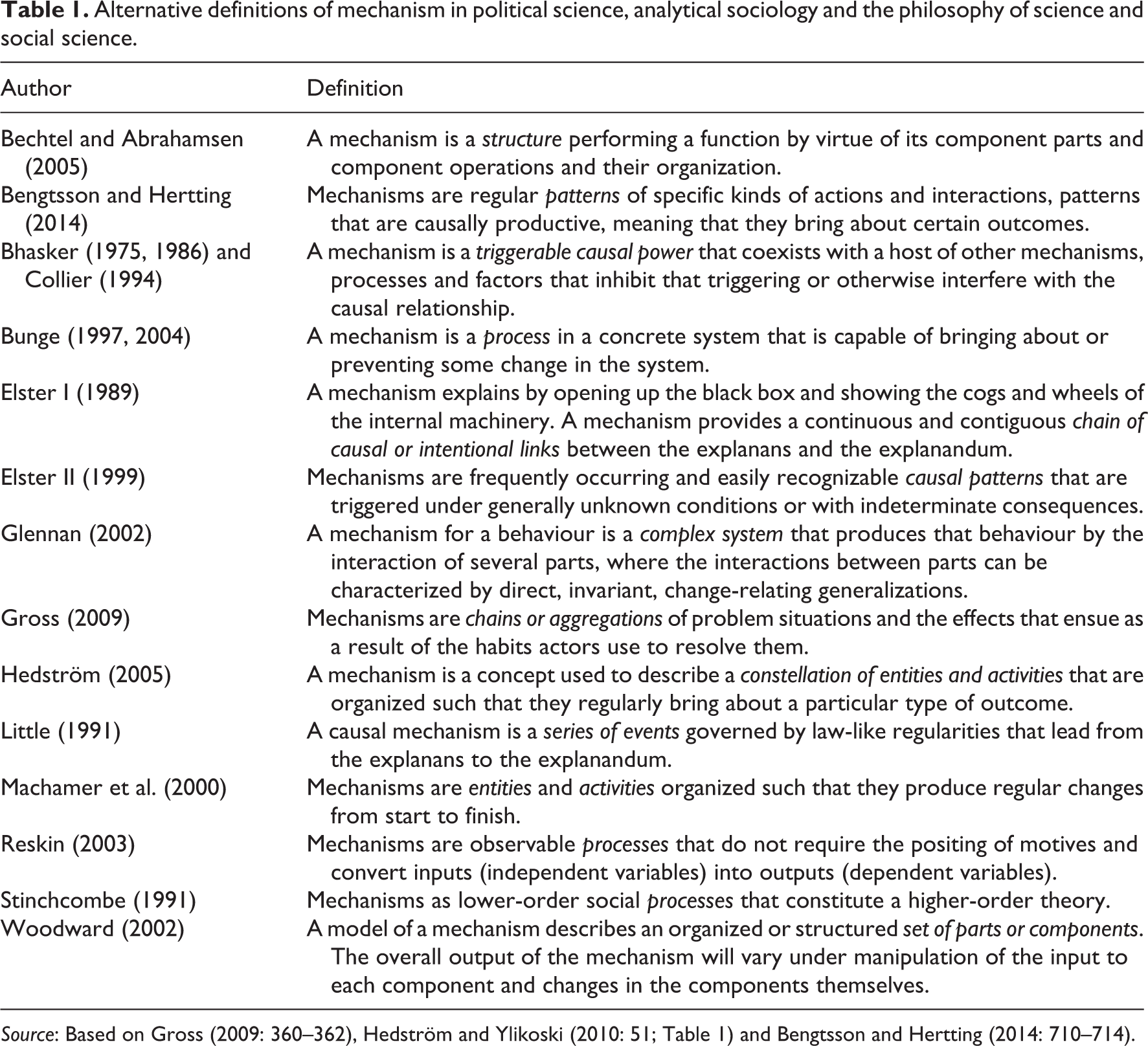
Source: Based on Gross (2009: 360–362), Hedström and Ylikoski (2010: 51; Table 1) and Bengtsson and Hertting (2014: 710–714).
This conceptual section offers a theory of mechanism that differentiates it from process in novel ways that can inform geographical research and afford greater precision in its causal explanations. My approach is not meant to produce a single universal definition of mechanism. Instead, I argue that (re)conceptualizing mechanism allows for a better and more robust form of theorizing. As noted by Hedström and Swedberg (1996: 299; original italics) in one of the earliest works on social mechanisms, ‘it is not so much the definition per se that is important, as the type and style of theorizing it encourages’. By ‘theorizing’, I follow Sayer’s (1992: 81) advice that it involves a process of ‘normative explication’ through which ‘problematic concepts’ are explicated and concise definitions are given to ‘important but vaguely understood terms through re-working their relations with other terms in the network’. To me, ‘process’ and ‘mechanism’ are these problematic concepts and vaguely understood terms in the network of causal explanation that require reworking/theorizing in order to link better their sense relations in geographical analysis.
My argument here is developed in three major steps. The first step reprises very briefly the treatment of mechanism and, if any, process in critical realism – a social scientific philosophy that underpins this article’s effort in theorizing mechanism. The second step involves a clear definition of what mechanism and process are – the former a necessary relation with the outcome and a more specific kind of the latter. The third step entails the introduction of actors and their action into the specification of mechanisms for producing concrete outcomes in the socio-spatial world. Because of this critical role of actor-specific intentions, social mechanisms are often different from those operating in the physical/natural world (e.g. in biology and physics).
Reprising mechanism and process in critical realism
Ever since the major works by Roy Bhaskar (1975, 1986, 1989), Andrew Sayer (1984, 1992) and others in the 1980s and thereafter, critical realism has emerged as an influential philosophy for the social sciences. Human geography is no exception, with many geographers explicitly or implicitly practicing realist research in their work (see reviews in Cox, 2013a; Mäki et al., 2004; Pratt, 1995, 2009; Roberts, 2001; Yeung, 1997). Many early ‘adopters’ of critical realism named in Cox’s (2013a) recent reprise remain as the most influential human geographers today. Even though they no longer make explicit reference to critical realism in their current work, I argue that their thought has often implicitly internalized some realist ontological assumptions (e.g. existence of reality independent of human ideas) and certain elements of realist methodology (e.g. abstraction and intensive research). This continual relevance of realist thought will be more evident in the next section when I examine causal explanations in contemporary studies of neoliberalization and path dependence in economic and political geography.
Since its heyday during the 1980s and the early 1990s, however, critical realism has now seemingly gone out of favour in human geography, to the extent that Cox (2013a: 3) declared in this journal that ‘[i]n human geography today one hears very little about critical realism’. This might be attributed to the rise of the ‘cultural turn’ in human geography in general and in the geographical analysis of uneven development in particular (Allen, 2012; Barnett, 1998; Castree, 2002; Hudson, 2003; Thrift and Olds, 1996), represented by a multitude of ontological and epistemological shifts towards understanding and interrogating the discursive (de)constructions and performativity of identities, positionalities and representations in the (co)constitution of society and space, and away from critical realists’ preoccupation with uncovering causal mechanisms for explaining empirical phenomena.
Pratt (2013: 28) further attributes this (cultural) turn – away from critical realism – to the ‘faddishness’ of human geography and the increased turnover in the ‘market in ideas’ in search of the next ‘big idea’. In radical Marxist geography in which critical realism exerted its greatest influence in the 1980s and through to the mid-1990s, the debate has since moved on to engage with trenchant critiques from poststructuralist, feminist and postcolonial interventions (cf. Sayer, 2001; Storper, 2001). In economic-geographical debates on urban and regional economies, critical realist geographers have switched gear to focus more on institutional approaches (Amin, 2001; Cox, 2004; Cox and Townsend, 2005; Peck and Tickell, 2002; Storper, 2009), relational analyses (Bathelt and Glückler, 2003, 2014; Yeung, 2005) and evolutionary conceptions (Grabher, 2009; Martin and Sunley, 2006) of urban and regional economic change. 4 Nevertheless, the influence of realist thought and methodology on these geographers remains significant, particularly among those concerned with causal explanations of urban and regional economic change. Against the backdrop of those faddish turns, certain elements of realist thought continue to be taken for granted in their empirical research.
While the enormous corpus of realist work cannot be easily reconciled and integrated, Bhaskar’s version of critical realism can be succinctly described as a social scientific philosophy that recognizes the existence of material reality independent of human consciousness (realist ontology), ascribes causal powers to properties/potential in objects and human reasons and their activation through generative mechanisms such as enduring social structures (realist ontology), rejects relativism in social and scientific discourses (realist epistemology) and reorientates the social sciences towards its emancipatory goals (realist epistemology). This version of critical realism makes its strongest claims at the ontological level: the independent existence of reality and causal powers ascribed to objects/human reasons and their activation through generative mechanisms that strengthen the possibility of reclaiming reality through an emancipatory social science.
In realist philosophy, mechanism occupies an important epistemological role in its ontological conception of the world as being structured, differentiated and changing. Realist ontology recognizes the existence of causal powers and their activation through generative mechanisms that produce differentiated social or physical phenomena in nature. To Bhaskar (1989: 18), these mechanisms are the intransitive objects of inquiry because without their existence to activate causal powers, explanations and subsequently social emancipation are simply unknowable and impossible. But to develop social knowledge, the concept of mechanism serves an epistemological role in that the identification of mechanisms and their connection to other intransitive objects can form an important basis for theory construction and knowledge production. In short, mechanism has an intransitive dimension at the ontological level (its existence) and a transitive role in epistemology (our knowledge of its connection to an actual phenomenon such as uneven development). One key aim of substantive social sciences is to theorize and investigate the mechanisms at work that generate empirical events and discourses. As noted further by Bhaskar (1989: 2), these generative mechanisms and social structures ‘are irreducible to the patterns of events and discourses alike. These structures are not spontaneously apparent in the observable pattern of events; they can only be identified through the practical and theoretical work of the social sciences’.
Critical realist works by Bhaskar, Sayer and others, however, have surprisingly far less to say about process, another key concept often conflated with mechanism in the literature (e.g. in Table 1). In fact, Bhaskar’s philosophical work has hardly examined process as an ontological and epistemological object, let alone distinguishing it explicitly from mechanism. In Method in Social Science, Sayer’s (1992: 103–108) theorizing of mechanism in causal analysis also does not offer a clear conceptual distinction between mechanism and process. Instead, he sees process merely as ‘change’ that needs to be explained by different causal mechanisms. For example, he argues that ‘[p]rocesses of change usually involve several causal mechanisms which may be only contingently related to one another’ (Sayer, 1992: 108). He also sometimes uses ‘causal processes’ (p. 104) interchangeably with causal mechanisms.
Reconceptualizing mechanism (and process)
While causal explanation is important in social science and the identification of mechanism is a necessary step, we cannot realistically claim process-based mid-range concepts, such as neoliberalization and path dependence, as causal mechanisms unless we can clearly differentiate mechanism from process. In fact, I argue that both mechanism and process are integral to any causal explanation and thus this conceptual issue matters far beyond their semantic distinctions. To resolve this issue, I go back to Sayer’s (1992: 89–92) useful distinction between necessary/internal and contingent/external relations of connection in critical realist thought. This necessity is material or natural and does not refer to logical necessity. 5 The connection between two objects, such as people, institutions and practices, is necessary and internal if one cannot exist without the other (e.g. slave–master or landlord–tenant relations cited by Sayer). Otherwise, such connection is contingent and external in nature (e.g. British governments and North Sea oil). This realist conception of necessary relations differs from the kind of assemblage thinking in human geography today in which necessary relations are deemed socially constructed and contingently framed through specific historical processes. But causation in this assemblage thinking remains vague and indeterminant due to its social ontological commitment to unravelling processes of assembling a wide range of heterogenous social entities to form wholes or assemblages (Allen and Cochrane, 2010; Higgins and Larner, 2017; Jones and Clark, 2018; Ouma, 2015).
Applying the above realist conception of necessary relations to the mechanism/process distinction, we can define mechanism at the simplest level as a particular and necessary relation that connects a specific cause with its eventual outcome in broadly similar contexts. A cause can be an action or a practice by an actor, institution, object or their combinations. Without activating this mechanism through powers embedded in a causal condition, the concrete outcome will not happen. In short, this mechanism is necessary and specific to a particular outcome; their cause-and-effect relation is not contingent on something else external to such relation. Sayer (1992: 105) thus argues that ‘[t]he particular ways-of-acting or mechanisms exist necessarily in virtue of their object’s nature. The nature or constitution of an object and its causal powers are internally or necessarily related’.
On the other hand, process refers to a recurrent series of changing configurations and relations among its constitutive elements or entities over time and space that can relate to intended and unintended outcomes. These entities can be individual actors or broader collectives (e.g. firms, states, social groups and institutions). This change in relations is neither internal nor necessary to specific outcomes though. The term ‘process’, such as neoliberalization and path dependence, is often used to describe this sequential change in recurrent configurations and relations among its constituents. But it is not, and should not be, used to connect causally this change with its eventual outcomes, intended or otherwise. A process of change itself requires unpacking and explanation that may draw upon other mechanisms. Its outcomes cannot be specified a priori because this specification requires a causal analysis of change in the form of a necessary mechanism or multiple mechanisms.
In addition, an object cannot be a process and a mechanism at the same time because the latter is specified from the former and is internal or necessary to a concrete outcome. Often, the causal working of a mechanism entails a process-like sequence of change (cause) and outcome (effect). In this sense, a mechanism can be derived from a process, but it is a particular kind of process because of its necessary role in connecting change and outcome. Meanwhile, a process cannot be derived from a mechanism since a process needs not be a necessary connection between cause and effect – it may simply represent change in recurrent configurations of entities and this change in itself needs explanation. Mechanism also operates at lower levels of abstraction than process, with which it has a many-to-one (or many-to-many) relationship; it illuminates the explanatory pathway through which particular relation operates in specific context(s). The constitutive elements of a mechanism are also real entities or objects with emergent powers and potentialities. A mechanism therefore cannot be a pure idea or an abstract object, as in logic, mathematics and general linguistics (Bunge, 1997: 418). This particularity in mechanism helps us distinguish clearly process (of change) from mechanism (for purpose-specific, directional and causal outcomes) in social science analysis. In this sense, Bunge (1997: 416) is right to assert that ‘[e]very mechanism is a process, but the converse is false’. Some processes may never be specified into particular mechanisms for causal explanations and thus not every process is and can be a mechanism.
Figure 1 illustrates the above theorizing of mechanism and process. Operating at the more general level (external/contingent) and a higher level of abstraction, process represents change in recurrent series of relations that brings about new series of relations and constitutive elements. To account for outcomes at the concrete and ‘lower’ level, we need to specify the causal necessity of an object or a process for a particular purpose of connecting change or recurrent events at the general level with its specific outcomes at the concrete level (middle boxes in blue). This specification can transform a more abstract process into a concrete mechanism and demonstrates how a causal change works out to produce its specific outcomes. However, it should not be read as mechanism being ‘caused’ by process. The ‘downward’ arrows between ‘process’ and ‘mechanism’ refer to the methodological process of specification, not causal power flowing from one to another. This conceptual move from a general process of change itself to a concrete/necessary mechanism or several mechanisms for an outcome requires careful specification of the outcomes to be explained and the working of the causal power through this mechanism(s). Missing out this crucial step of specification will render process to remain as a descriptive tool at the general/contingent level (upper section in Figure 1).
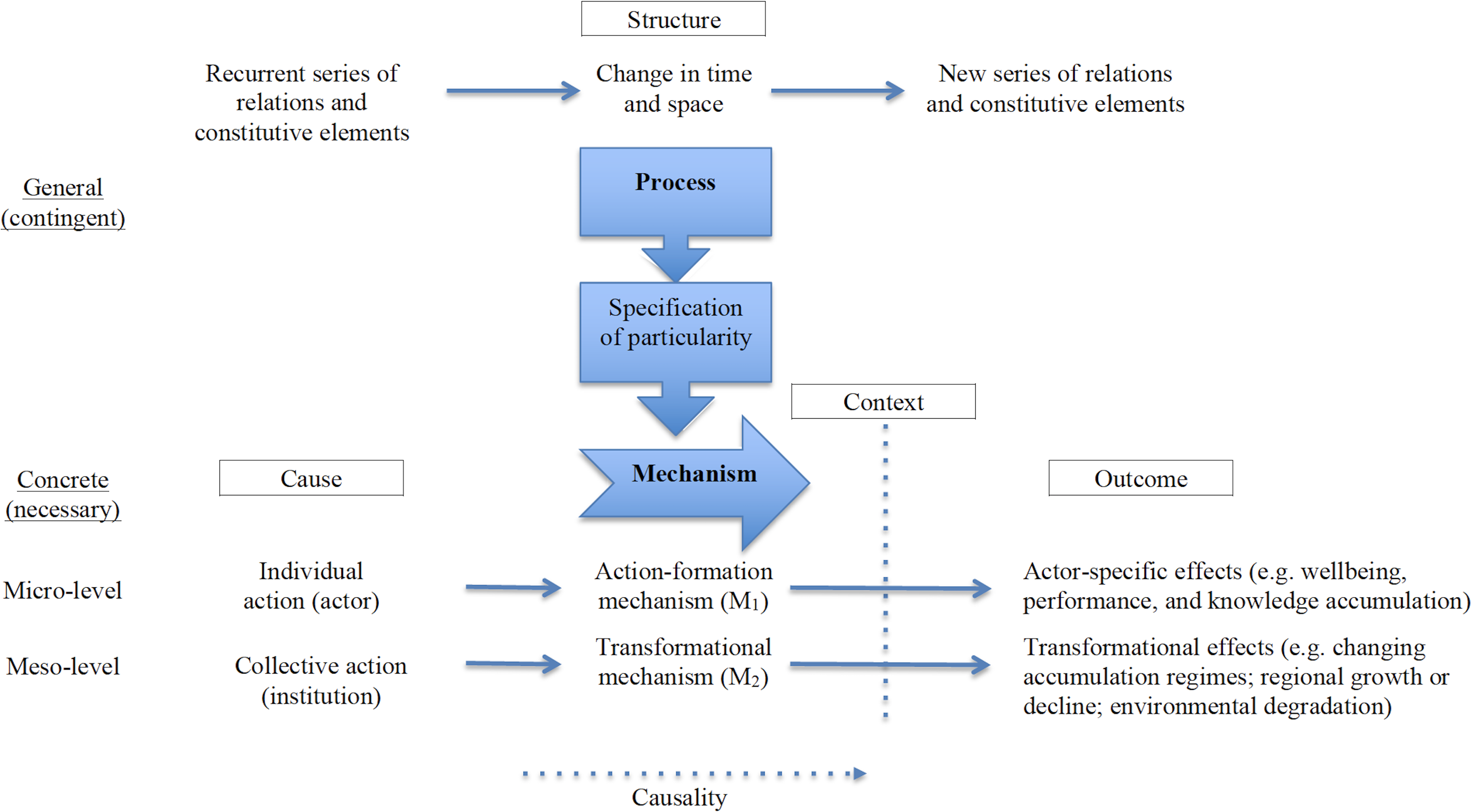
Structure, process and mechanism in causal analysis.
This formulation of mechanism and process allows for meso-level concepts (processes) to be situated in multi-scalar analyses involving multiple actors and institutions at the general level. And yet the concomitant requirement of specification in the production of causal explanations tends to reduce the temptation of simply identifying a large list of factors and interactions in these process-like concepts. This exercise will likely limit the number of causal mechanisms to just a few. 6 As such, any causal explanation needs to specify one or more mechanism(s) necessary to the concrete phenomenon under investigation. This phenomenon can be an object or a process that forms the beginning of our investigation. A political-economic phenomenon such as neoliberalization is a process. But if its necessary relations with concrete outcomes such as geographical uneven development can be specified, it is reconceptualized from a process of change to become a mechanism for these outcomes. As a cover concept (e.g. neoliberalization), a process in itself is insufficient in specifying these changes triggered by the interactions of elements or entities in a necessary mechanism. This specification of concrete outcomes and their causal connections to changing entities affords greater analytical precision and explanatory power to mechanisms than processual descriptions of change that are neither internal nor necessary to these concrete outcomes (see note 1). As noted by Mayntz (2004: 239; original italics), ‘to use a terminological label merely to allude to a process that remains unspecified has no more explanatory value than the simple statement of a correlation’.
This conceptualization brings to the fore the importance of context because particularity in mechanisms is often dependent on the existence of the ‘right’ context in which a causal force can operate and produce its expected outcome(s). Context is integral, not external, to the subjects/objects under investigation, and therefore serves as the relevant broader setting for a mechanism to operate and produce its expected outcome. In Figure 1, context serves to enable the causal power of mechanism to act upon and produce an empirical outcome. In short, context is not outside this operation of causal power at the concrete level – from cause via mechanism to outcome. My approach is similar to the arguments in support of context in human geography (cf. Barnett, 1999; Sunley, 1996; Yeung, 1997) and political science (Falleti and Lunch, 2009). A useful causal explanation is constituted by the specification of mechanisms and their interaction with operating contexts. Falleti and Lynch (2009: 1144) thus contend that ‘credible causal social scientific explanation can occur if and only if researchers are attentive to the interaction between causal mechanisms and the context in which they operate’. In critical realist thought, Sayer (2000: 15) notes that ‘the same mechanism can produce different outcomes according to context, or more precisely, according to its spatio-temporal relations with other objects, having their own causal powers and liabilities, which may trigger, block or modify its action’. As political and economic action takes place contingently within a socio-spatial world, there is no reason why this action can be ontologically separated from the same world as a separate category for description and analysis. In other words, context sets the contingent conditions in which economic action can be realized and analysed (Yeung, 2003: 445). 7
This mechanism approach to causal explanation therefore does not endorse the universal applicability of mechanisms in all empirical contexts; mechanisms are not deterministic and do not always produce the same expected outcomes in different contexts. In fact, abstraction requires us to remove the contextual material in order to reach the causal properties of an underlying mechanism and to make inference in similar contexts. As argued by Sayer (1992: 86), this realist method ‘must “abstract” from particular conditions, excluding those which have no significant effect in order to focus on those which do. Even where we are interested in wholes we must select and abstract their constituents’. To Hedström and Swedberg (1996: 290) the operation of a postulated mechanism can only be tested by logically deriving the effects that should be observed if the mechanism was operating as assumed in the theory, and then comparing these theoretical expectations with what actually is being observed.
Causal theory and actors
A causal theory describes why and how certain variable relationships conceptualized in one or more mechanisms operate to produce the expected outcomes from the initial conditions – it is fundamentally explanatory in nature. While these conditions and outcomes are empirically observable, their causal mechanisms are not necessarily amenable to direct observation. Developing causal theory therefore requires an analytical procedure to render these mechanisms visible and intelligible to our empirical analysis. In critical realism (e.g. Brown et al., 2002; Pratt, 1991, 1995; Sayer, 1982, 1992), this methodological procedure is commonly known as abstraction that refers to the analytical specification of causal mechanisms in relation to the existing processes of socio-spatial change. To Cox (2013b: 50), human geographers have taken for granted this crucial realist method to an extraordinary degree. This explains my earlier contention that certain elements of realist methodology are well and alive in human geography today, despite fewer current renditions of its philosophical underpinnings. A brief revisit is necessary here.
In Bhaskar’s (1986: 11, note 26; 1989: 19) realist philosophy, this procedure is embedded in the broader realist conception of retroduction in which an argument ‘moves from a description of some phenomenon to a description of something which produces it or is a condition for it’. It necessitates an iterative and reflexive methodology involving analytical movements between understanding the empirical phenomenon, its underlying necessary and contingent conditions, and abstraction and specification of causal mechanisms (see Pratt, 1995; Yeung, 2003). In the social mechanisms literature, Hedström and Swedberg (1996: 290; 1998b: 15, 25) also argue that ‘It is through abstractions and analytical accentuation, however, that general mechanisms are made visible’. Instead of focusing just on ‘providing theoretical accounts of what happens as it actually happens’, they believe firmly in the value of analytical abstractions (Hedström and Swedberg, 1998b: 14). Others social scientists in analytical sociology and political science call this highly popular method ‘process-tracing’ for reconstructing causal explanation (e.g. Checkel, 2006; Gerring, 2008; Hall, 2013; Kittel and Kuehn, 2013; Mayntz, 2004).
The transformation of a process of change into a causal mechanism for an outcome requires abstraction and specification of its necessity to these outcomes (see Figure 1 lower section). In this conception, action is one of the core principles in understanding mechanisms. This conception relates specifically to the social world in which actors are the conscious agency whose action – intentional or otherwise – can produce concrete outcomes. As argued forcefully by Hedström and Swedberg (1998b: 24), ‘it is actors and not variables who do the acting. A mechanism-based explanation is not built upon mere associations between variables but always refers directly to causes and consequences of individual action oriented to the behavior of others’. Similarly arguing for this action theory of causation, Cox (2013a: 12) notes that socio-spatial [c]hange occurs because people act. They act on and with other things or conditions, but these too should be seen in their relation to human agents: as products of a human action that also transforms them and gives them new properties.
In geographical analysis, this particularity can produce different types of mechanisms connecting social and/or institutional action with their individual and collective outcomes. At the micro level (Figure 1), individual action by actors can produce concrete outcomes through what sociologists commonly call ‘action–formation mechanisms’ (M1). Grounded in James Coleman’s (1986, 1990) well-known schema of sociological explanation, Hedström and Swedberg (1996, 1998b) suggest that specifying a mechanism requires articulating the purposive action of actors in a specific social situation, through which a variable produces necessary change in another variable. This micro-level mechanism is known as a situation mechanism or an individual action–formation mechanism, such as cognitive dissonance. But when actors interact with each other and individual actions are transformed into a collective outcome, a micro- to meso-level transition is deemed to have taken place, and the resultant mechanism is known as a transformational mechanism (M2), for example, the tragedy of the commons. At this more meso level, collective action beyond individual actors can bring about transformational effects in society and space.
In economic and political geography, a good number of these actor-level and institutional-level mechanisms can be identified in the existing studies of uneven development. At the actor level, we can think of adaptive learning and emulation as particular mechanisms (M1) for ‘fast policy transfer’ among regulatory authorities (Peck and Tickell, 2002) or for knowledge spillovers among embedded firms (Boschma and Frenken, 2006). Martin (2010) also describes three micro-level mechanisms for institutional change: layering, conversion and recombination, whereas Yeung (2016) proposes several firm-specific mechanisms of strategic coupling for promoting national industrial transformation: strategic partnership, industrial market specialization and lead firm formation. The operation of these mechanisms entails both specific action on the part of these authorities and firms and necessary changes in the configurations of their relations with other entities in order to produce the eventual outcomes of changing local/national governance or innovative activities or new path formation in regional/national development.
At the more meso level, transformational mechanisms (M2) can take the form of particular collective action through privatization, commercialization, commodification, (re)regulation, financialization and political constructions of markets that transform existing socio-spatial relations into neoliberal patterns of institutional shifts and regulatory restructuring. A similar mechanism-based approach can be pursued to identify the transformational mechanisms at work that explain the path dependence or self-organization – a process – of uneven regional evolution. These mechanisms may be product diversification or ‘branching’ at the collective firm level (Frenken and Boschma, 2007) or convergence and increasing returns to capability development at the institutional level (Martin and Sunley, 2006, 2015). Inter-organizational networks are also important meso-level mechanisms for regional growth (Hamilton-Hart and Yeung, forthcoming; Huggins and Thompson, 2014) and global economic development (Coe and Yeung, 2015, 2019; Yeung, 2016). In all of these instances, certain political–economic processes of neoliberalization and uneven regional evolution can be explained by individual action–formation mechanisms (M1) or transformational mechanisms (M2) that connect causal forces with their particular empirical outcomes.
From process to mechanism: Re-examining geographical analyses of uneven development
As noted in Introduction, an analytical focus on processes at the general level is inadequate without specifying precisely how these processes can become mechanisms for uneven development under specific conditions or contexts. Just like how social relations of production – as a key process in Marxian political economy of capitalism – ‘need’ mechanisms such as exploitation, commodification and dispossession to produce concrete outcomes, neoliberalization – as a process of neoliberalism – cannot be the precise mechanism for a particular form of uneven geographical development. The lack of internal/necessary relations between neoliberal tendencies and these changes can render neoliberalization a ‘chaotic’ concept in the critical realist sense. And this is more troubling than the idea of neoliberalization as a ‘rascal concept’ (Brenner et al., 2010: 184; Peck, 2013: 133) or as a ‘deeply problematic and incoherent term’ (Venugopal, 2015: 165). As critiqued by Markusen (1999: 871) almost two decades ago, this kind of ‘process-preoccupied writing’ can easily lead to ‘fuzzy’ concepts because ‘The analysis is reduced to characterizing the process, with no clear attribution of power, responsibility or range of possible response on the part of actors’. To address her concern (e.g. with ‘flexible specialization’, ‘world cities’ and ‘networks in industrial districts’ as fuzzy concepts), we need better and more concrete specification of causal mechanisms that can make a concept and/or a process ‘work’, that is, creating the possibility of and responsibility for socio-spatial change. 8
In more specific terms, whereas a general process such as neoliberalization or path dependence (or even labour process) can exist independently of particular geographical outcomes (e.g. local unemployment or rise of high-tech clusters), there is no such thing as a ‘general’ or a ‘universal’ mechanism without its purpose and outcome(s) clearly identified and theorized; a mechanism is always a necessary mechanism for something – connecting cause and effect as identified in a robust explanatory analysis. This is why the mechanism/process distinction matters much in the efficacy of causal explanations. Indeed, the key problem or ‘fuzziness’ is that these ‘general processes’, not well-specified mechanisms, are often presented as causal explanations of geographical outcomes. The conflation is about using process as an explanation in itself. For an explanation to be causal and complete, concrete mechanism(s) must be specified in relation to general process(es). The issue is not just that outcomes are glossed as processes, but rather processes are glossed as mechanisms that are necessary and particular in context. In economic geography, for example, too much of this glossing over through process-based thinking alone, or what Markusen (1999) terms ‘fuzzy concepts’, is partly responsible for the loss of its core intellectual project of explaining systematic patterns of uneven development (James et al., 2018).
This section first begins with some of the canonical works on neoliberalization, starting with Peck and Tickell (2002), as part of the ‘process-tracing’ of the emergence of this influential body of literature. This mid-range concept was originally developed in the context of a post-Fordist regime of accumulation. As other researchers adopt the concept, often uncritically, in their supposedly ‘causal’ analyses of different contexts and geographical outcomes over time, neoliberalization – as a process of neoliberalism – gets conflated with causal mechanisms for specific forms of uneven development. Certainly not intended by such pioneers as Peck and Tickell (2002), this conflation by followers reflects a key problem of under-theorization of mechanism/process in the existing geographical studies of neoliberalism. The second subsection discusses a tailored example from China’s recent market transition, a possible site of neoliberalization at work according to Harvey (2005), and shows how my conceptual distinction can alleviate some of the shortcomings and improve existing explanations of uneven development. A third brief subsection provides another example of this mechanism/process conflation in the evolutionary analysis of ‘path dependence’ in economic geography and regional studies.
Neoliberalization: What’s in a process and what can go wrong?
In their highly influential paper on neoliberalizing space, Peck and Tickell (2002: 380) explicitly call for a ‘process-based analysis’ of neoliberalization that has subsequently stimulated much debate in the geographical analysis of urban and regional governance and uneven development. To them, ‘neoliberalization should be understood as a process, not an end-state. By the same token, it is also contradictory, it tends to provoke counter-tendencies, and it exists in historically and geographically contingent forms’ (p. 383; my emphasis). Conceptualized as a process of neoliberalism, neoliberalization refers to a dominant political–economic project of regulatory restructuring emanating from North America and Western Europe that has its creative and destructive moments; it is ‘driven by a family of open-ended social processes and associated with polymorphic forms and outcomes’ (Peck et al., 2010: 101). Responding to the caricatured critique of neoliberalization as monolithic unity by scholars in the varieties of capitalism approach, Peck and Theodore (2007: 757; my emphasis) argue further that ‘process-based conceptions – sensitive to conjuncture, contingency, and contradiction – are less vulnerable to such blunt critiques, since they are explicitly concerned with the manner in which (partially realized) causal processes generate uneven and divergent outcomes’. Many subsequent geographical studies have focused on the ‘rolling out’, ‘rolling back’ and ‘rolling with’ phases in these ‘causal processes’ and their variegated temporal-spatial outcomes (see Craig and Porter, 2006; England and Ward, 2007; Park et al., 2012; Springer et al., 2016).
While this process-based conception of neoliberalization as both an ‘out there’ and an ‘in here’ phenomenon can be useful for understanding neoliberalism’s planetary diffusion, I argue that the concrete mechanisms constitutive of this process have not been adequately specified in subsequent geographical studies, leaving the causal claims about neoliberalization sometimes underspecified and fuzzy. In short, we know quite a great deal about the unfolding of neoliberalization as a set of geographically variegated processes, but we are less certain of its operationalization through specific causal mechanisms that can connect hegemonic regulatory transformation (cause) with its intended and unintended socio-spatial change on the ground (geographical outcome). As argued by Barnett (2005: 9), this process-based conception of neoliberalization lacks any clear sense of how consent is actually secured, or any convincing account of how hegemonic projects are anchored at the level of everyday life, other than implying that this works by ‘getting at’ people in some way or other.
Lacking clear referents such as the political origins of modern liberalism, many geographical studies of neoliberalism and neoliberalization are far too general in their process-based analysis and much more circumscribed in their causal explanation of how the critical intersections between this general process of political change and everyday socio-economic life are governed. This has led to what Ferguson (2010: 166, 171) calls ‘empty analysis’ yielding ‘an unsurprising conclusion’ in much progressive scholarship: ‘neoliberalism is bad for poor and working people, therefore we must oppose it’; it serves ‘as a kind of abstract causal force that comes in from outside (much as ‘the world system’ was reckoned to do at an earlier theoretical moment) to decimate local livelihoods’. The normative outcome of these studies tends to be about denouncing neoliberalism rather than thinking through what can be done about it (see also Venugopal, 2015; Weller and O’Neill, 2014).
Let me illustrate this analytical conundrum with reference to David Harvey’s (2005) extremely influential book A Brief History of Neoliberalism.
9
Without really specifying how neoliberalism moves from being a particular theory/doctrine of political–economic practices – ‘incorporated into the common-sense way many of us interpret, live in, and understand the world’ – to becoming a multifaceted set of causal mechanisms, he argues that this process of neoliberalization has, however, entailed much ‘creative destruction’, not only of prior institutional frameworks and powers (even challenging traditional forms of state sovereignty) but also of divisions of labour, social relations, welfare provisions, technological mixes, ways of life and thought, reproductive activities, attachments to the land and habits of the heart (Harvey, 2005: 3, my emphasis; also Harvey, 2006).
It is unclear, however, whether this ‘very complex process’ of uneven geographical development is synonymous with the process of neoliberalization. If so, what are its explanatory determinants and forces of ‘creative destruction’, that is, causal mechanisms? How can the process of neoliberalization serve as the explanans of spatial outcomes (the explanandum), such as uneven development? Pointing to the difficulty of constructing the moving map of neoliberalization, Harvey (2005: 87; my emphasis) argues further that ‘The general progress of neoliberalization has therefore been increasingly impelled through mechanisms of uneven geographical developments’. In this account, the causal relationship seems completely reversed such that uneven developments become the causal mechanisms ‘impelling’ the process/progress of neoliberalization. While this possibly reciprocal or dialectical form of causality (outcome feeds back on cause) may appear ‘normal’ to a Marxian theorist like Harvey, its unintended conflation of process and mechanism can lead to a certain degree of analytical vagueness and misattribution of causality because neoliberalization is constructed in one broad stroke as a cause, a process and an outcome.
To retain the explanatory power of neoliberalization and to prevent it from becoming a catch-all phrase to account for ‘everything that has happened since the 1990s’, it is necessary to translate this abstract political–economic thought and ideas of neoliberalism at the conceptual level into a concrete set of institutional practices in the empirical domain that interact with preexisting social-spatial conditions (context) to produce uneven developmental outcomes (see Birch and Siemiatycki, 2016). Extending my earlier theorization of mechanism, this analytical translation requires careful specification of internal and necessary relations that turns the general process of neoliberalization into concrete mechanisms on the ground that can ‘get at’ people and (re)shape their everyday life. Otherwise, neoliberalization-based explanations will suffer from the same fate as ‘class reductionism’ in earlier radical political economy (see Sayer, 1995) because not all (uneven) geographical outcomes can be reduced to neoliberalization.
Notwithstanding some uncritical applications of the abstract and processual conception of neoliberalization, I argue that greater conceptual clarity between mechanism and process can resolve partially this analytical problem. To Ferguson (2010: 172), ‘Such insistence on specificity and precision would undoubtedly improve the analytical clarity of many of our discussions’. One key missing link in reconciling this analytical divergence between neoliberalization as a macro-hegemonic process and its relationship – contingent or necessary – with micro-individual collective action is the lack of a clearer theory of the concrete mechanisms through which neoliberalization is actually put to work in shaping everyday life. Much of the literature focuses on the hegemonic ideas, macro-practices and assemblages of neoliberalization rather than the specific ‘mechanics’, or what Ferguson (2010: 173) calls ‘governmental mechanisms’ for socio-spatial changes on the ground. As well noted by one of its pioneers, the concept is often used ‘as a no-more-than approximate proxy for a specific analysis of mechanisms or relations of social power, domination, exploitation, or alienation. The forms and registers of the phenomenon can seem almost without limit’ (Peck, 2010: 14). 10
In principle, a causal explanation may comprise multiple mechanisms that connect initial conditions or changes with empirical outcomes. While the same process may lead to many possible outcomes because of their contingent relation, this causal path is specified in a few necessary mechanisms that operate in particular contexts. A mechanism-based explanation is therefore a mid-range theory that draws upon meso-level concepts and analyses to intermediate between pure description/story-telling in empiricism and universal laws in positivism and grand theories. Some of these mechanisms can indeed be ‘components’ of particular mechanisms at the higher level of abstraction. As argued by Stinchcombe (1991: 367), a mechanism usually ‘gives knowledge about a component process (generally one with units of analysis at a “lower level”) of another theory (ordinarily a theory with units at a different “higher” level)’. These context-specific mechanisms interact with one another and constitute what Gambetta (1998: 104) calls ‘concatenations of mechanisms’ or what McAdam et al. (2001: 8) term ‘component mechanisms’ of the overall process. To Sayer (2000: 14; original italics), ‘many mechanisms are ordinary, often being identified in ordinary language by transitive verbs’.
Putting this conceptual distinction back into neoliberalization studies, we can broadly identify neoliberalization as a contingent political–economic process of evolving hegemonic projects instituted in different places and contexts. This recurrent process of change needs to be theorized, historicized and substantiated, as evident in the existing literature on the history and (re)constructions of neoliberalism (see Harvey, 2005; Peck, 2010, 2013). But the actualization of this political–economic process on the ground necessitates the careful specification of the relevant actor- and institutional-level mechanisms illustrated in Figure 1. This specification procedure can potentially transform the process of neoliberalization into a series of necessary mechanisms for producing concrete outcomes. These mechanisms must demonstrate how causal forces work in specific instances and/or contexts to create intended and unintended consequences. If well specified (i.e. not to be conflated with process), these mechanisms can be the substantive answer to Peck’s (2010: 276; original italics) call for ‘grounded assessments, not blanket pronouncements’ that show ‘[h]ow social formations and relations are neoliberalized, and with what path-forming consequences, really makes a difference’.
Explaining neoliberalism ‘with Chinese characteristics’: How might the mechanism/process distinction work?
Revisiting Harvey (2005: 120–151), let me briefly examine the case of China since he has devoted an entire chapter to its contemporary transformations and pointed to the apparent parallels of neoliberalism in China’s post-1978 economic reform, such as the move towards ‘free’ trade, the privatization of former state-owned enterprises, the ‘growth-first’ phenomenon and the rise of the market economy. Calling this a form of ‘neoliberalism “with Chinese characteristics”’, he has identified competition and privatization, a democracy of consumption, the massive proletarianization of workforce and urban speculation, as the key logics in this process of ‘economic neoliberalization’. In particular, he argues that ‘In so far as neoliberalism requires a large, easily exploited, and relatively powerless labour force, then China certainly qualifies as a neoliberal economy, albeit “with Chinese characteristics”’ (Harvey, 2005: 144). Still, his analysis remains mostly descriptive of the broad historical transformations in China under socialist market reform. It is unclear how such transformations are necessarily caused by neoliberalization as we know it. Attributing China’s uneven geographical development – itself a complex process comprising different dimensions (e.g. the emergence of wealthy coastal regions, the domination of mega cities and the exploitation of a large army of surplus labour from rural areas in inner provinces) – to such neoliberalization ‘process’ reflects a possible conflation of process and mechanism.
As a process of change characterized by market-based capitalist logics, certain elements of neoliberalization might well have occurred in contemporary China (see Horesh and Lim, 2017; Lim, 2014; Peck and Zhang, 2013; Wu, 2008, 2010; Zhang and Peck, 2016). Even though Harvey (2005: 81) found it ‘interesting to note how neoliberalization in authoritarian states such as China and Singapore seems to be converging with the increasing authoritarianism evident in neoliberal states such as the US and Britain’, I argue that the concrete working of this convergence process on the ground in China differs substantially from its political origins in the United States and Western Europe. This is because the resemblance of China’s economic opening up with the ‘syndromes’ of neoliberalization may well be impelled by other counterfactual forces, such as the political regime’s legitimization imperatives and strategies. However ‘neoliberal’ look-alike or ‘family resemblances’ of its economic reforms and uneven outcomes, China’s economic transformations are likely to be driven mostly by internal political forces premised on the reproduction of the Party’s monopoly power and the complicated and yet evolving political dynamics of central-local state relations (see Ang, 2016; Dickson, 2003, 2008; Lim, 2019; Shirk, 1993; Yang, 2004). Wu (2008: 1095) thus argues that ‘the market was initially introduced as a survival strategy for the state’ to break the impasse of capital accumulation under state socialism and its efficacy ‘relies very much on the state’s ability to maintain social order’. Even though neoliberalization is clearly a political project often constituted by disparate actors and forces, a point well recognized by Harvey (2005: 19) and others, his book has not examined in any detail the crucial role of party politics in China’s ‘neoliberal turn’.
More specifically, the Communist Party state in China has been well theorized as the causal mechanism of economic transformation through its adoption of marketization and neoliberalizing practices. 11 Exercising its control over ideology, polity, economy and society through coercive and even violent means, the Party state confronted its own crisis of legitimacy since the late 1980s through further economic reform and marketization during the 1990s (Wang, 2003, 2009). This politics of reinventing the market and remaking the economy with Chinese characteristics, such as the consolidation of state-owned enterprises alongside the proliferation of town and village enterprises and private firms, was orchestrated by the Party state for its own regime reproduction, political stability and modernist nation-building (Naughton and Tsai, 2015; Tsai, 2007). As such, it was the Party state that activated and turned the process of neoliberalization in China – identified by Harvey (2005) and others – into a specific and necessary set of social relations for the (re)production of geographical uneven development.
In short, the devil is really in the details, and this is where specification of mechanisms and their concrete contexts of operating efficacy matters much (though this important task is beyond the scope of this article). 12 This specification can respond effectively to Peck et al.’s (2010: 96) question on contemporary China as a key frontier in, or even a bold exception to, neoliberalization and serve as ‘a kind of radical Rorschach test, separating those prone to divine neoliberalizing tendencies (however contingently expressed) from those inclined to focus on the kinds of exceptions that ostensibly disprove the (neoliberal) rule’. In practice, marketization is fundamentally shaped by China’s unique political–economic structures and socio-spatial contexts, such as the political domination of its one-party central state (Dunford and Liu, 2015; Wang, 2009), the highly corporatist nature of the local state (Ang, 2016; Breznitz and Murphree, 2011; Huang, 2008; ten Brink, 2019), the extensive role of interpersonal networks in everyday life (Nee and Opper, 2012; Yang, 1994), the land-based logic of development (Hsing, 2010; Lin, 2009) and the continual domination of state-owned enterprises (Naughton and Tsai, 2015; Norris, 2016).
These specificities in China’s contemporary political economy or ‘socialism with Chinese characteristics’ mean that the apparently same process of neoliberalization can work out very differently through particular mechanisms that in turn (re)produce uneven geographical development. This is where the mechanism/process distinction becomes critical in our causal explanation of China’s contemporary uneven development. It may render neoliberalization, as a process-based concept, less useful than mechanism-based explanations in causal accounts. In China and under the domination of its Party state, the redistribution of urban land and the pervasiveness of local corporatism and social networks are some of the concrete and necessary mechanisms for diverse socio-economic outcomes on the ground (e.g. the incessant drive for mega projects in large cities and the plight of rural-urban migrant workers). This urban-biased development also reflects the continual vested interest of large state-owned enterprises that have substantial de facto control of urban assets and easy access to the state-led financial system. In the absence of specifying these concrete mechanisms at work, the socio-spatial outcomes of China’s uneven geographical development cannot be easily reduced to (and let alone explained by) the logics of neoliberalization.
What might then be some plausible examples of such necessary mechanisms connecting causal forces with concrete socio-spatial outcomes? Short of an in-depth empirical analysis, let me be a little speculative here. To be fair, most causal explanations are elliptical to some degree and tend to gloss over multiple component mechanisms. Still, a good number of actor-level (M1) and institutional-level (M2) mechanisms can be identified from the existing studies of neoliberalization – these two types of mechanisms are not necessarily sequential to each other, but they can be combined or treated separately in an actual empirical study. At the actor level (see Figure 1), we can think of adaptive learning and emulation as action–formation mechanisms (M1) for ‘fast policy transfer’ among regulatory authorities (Peck and Tickell, 2002; Peck and Theodore, 2015). Instead of defining the process of neoliberalization as policy diffusion in itself, it is conceptually more useful to think of such diffusion as but just one mechanism of the general process. In turn, this mechanism of policy diffusion can be constituted by the concatenation of component mechanisms, such as adaptive learning and inter-agency emulation (e.g. best practices, consultancy and benchmarking). Once this problem of aggregation is resolved through this distinction between process as the general/contingent and mechanism(s) as the particular/necessary, geographical analysis of uneven development can gain better explanatory traction by linking the causal powers of neoliberalization as a broader process of capitalist change with the dynamics of socio-spatial life on the ground. For example, specifying such actor-level mechanisms (e.g. regulatory and planning mechanisms and rent-seeking mechanisms) in the context of changing urban policy regimes in China can add much value to linking neoliberalization tendencies with concrete outcomes in its urban governance and rural transformations (e.g. the emergence of rural industrialization, the rapid rural-urban migration and social [in]justice and the right to the city).
Action–formation mechanism can also connect the ground-up accommodation and negotiation by actors (however contingently) with top-down forces of neoliberalization. In China, populist tendencies such as the massive shift towards consumerism and materialistic experience and the politics of (in)difference to wealth and inequality are constitutive of this mechanism of action formation. This kind of bottom-up sociocultural change produced through particular actor-level mechanisms may make top-down neoliberal ‘fixes’ (e.g. national policy shifts and market opening) look like highly coherent and effective in their operationalization when it may in fact be these actor-level mechanisms that do the actual work on the ground. This analytical focus on the actor-level mechanisms of neoliberalization can bridge the macrospatial orientation of the existing studies and the key concern of some critics with the governmentality of everyday socio-economic life. It also brings actors and their intentionalities into the causal explanations of socio-spatial outcomes associated with neoliberalization.
At the more meso level, transformational mechanisms (M2) can take the form of particular collective action, such as privatization, state redistribution and political constructions of markets. In Harvey’s (2005: 159–161; 2006: 153–155) analysis of neoliberalism, some of these are conceived as features of ‘accumulation by dispossession’ – the main mechanism through which the outcomes of neoliberalization can be achieved, such as redistribution of wealth and income. A mechanism-based approach, however, must specify each of these as a particular mechanism for specific outcome(s) of neoliberalization. In this operationalization, transformational mechanisms serve as the analytical tool to give explanatory substance to such a general process as neoliberalization. A causal explanation of these outcomes in China therefore necessitates a (re)combination of all these differentiated component mechanisms, and this explanation cannot be reduced to the process of neoliberalization alone. In all of these instances, neoliberalization as a political–economic process can be (re)made necessary through the specification of its individual action–formation mechanisms (M1) and/or transformational mechanisms (M2) for connecting causal forces with their particular empirical outcomes.
From neoliberalization to path dependence: Another example of meso-level conflation?
To broaden out my selection of cases, let me offer very briefly a second and tighter example of the tendency towards mechanism/process conflation. In evolutionary economic geography, researchers have paid significant conceptual attention to the role of path dependence in regional evolution and economic change. Developing further this concept emanating from institutional and evolutionary economics (Arthur, 1994; David, 1985), historical sociology (Goldstone, 1998; Mahoney, 2000), corporate law (Bebchuk and Roe, 1999) and political science (Pierson, 2000), this highly influential geographical analysis of regional evolution focuses on explaining the adaptive transformation of the economic landscape and the uneven process of regional development (Boschma and Martin, 2007; MacKinnon et al., 2009, 2019; Martin and Sunley, 2015). As the central plank in the call for evolutionary theory as ‘a truly new and promising paradigm in economic geography’ (Boschma and Frenken, 2006: 295), path dependence has become the core organizing concept to denote place-dependent processes that in turn require geographical explanation (also Martin and Sunley, 2006; Martin, 2010). Conceptually, path dependence is viewed as a process in which the past influences the present (and the future). Causal explanation is clearly the raison d’être of this evolutionary economic geography. To Martin and Sunley (2006: 402–403, original italics), path dependence is a probabilistic and contingent process: at each moment in historical time the suite of possible future evolutionary trajectories (paths) of a technology, institution, firm or industry is conditioned by (contingent on) both the past and the current states of the system in question, and some of these possible paths are more likely or probable than others. The past thus sets the possibilities, while the present controls what possibility is to be explored, which only becomes explained ex post.
In this burgeoning and highly cited literature on evolutionary economic geography, there is a common tendency to conflate mechanism with process such that particular mechanisms leading to the agglomeration or spatial concentration of firms are couched in the same fashion as broader evolutionary processes such as path dependence. This conceptual conflation has led to three explanatory shortcomings. First, circular reasoning tends to prevail because of this imprecision in distinguishing the general process of path dependence from the concrete mechanisms connecting this process to spatial change. For example, Boschma and Frenken (2006: 279) conceive agglomeration economies as a ‘selection mechanism’ (vs. selection as a process) and knowledge spillover as ‘transfer mechanisms’, whereas Frenken and Boschma (2007: 642) and Frenken et al. (2007: 687) treat gains from related variety or product diversification at the firm and the urban levels as the central ‘feedback mechanism’ of economic development. Martin and Sunley (2006: 408–409) subscribe to the view that path dependence and ‘lock-in’ are explained by more ‘fundamental’ evolutionary mechanisms, such as selection and adaptive learning; some of these ‘basic mechanisms’ of path dependence, such as increasing returns and external and network economies, are also local in form and operation. In these circular conceptions, path dependence/creation, as an evolutionary process of change, becomes dependent on place-dependent mechanisms (agglomeration economies) – the explanandum is now the explanans itself!
Second, conflating process with mechanism reduces the explanatory power of even well theorized mid-range concepts such as path dependence. In Martin and Sunley’s (2015: 722; my emphasis) recent reappraisal and further development of evolutionary economic geography, they argue that ‘self-organization and emergence are key mechanisms in the evolution of economic landscapes’ and, later in the same paragraph, that ‘[s]elf-organization in the economic landscape is quintessentially a power-inflected evolutionary process…[and] is closely bound up with various processes and forms of emergence’. As evolutionary processes, self-organization and emergence have become both mechanisms of evolution and processes of such evolution. And yet these processes are also bounded up with others unspecified processes. Adopting this loose language of mechanism and process, they further argue that path dependence acts as ‘a key mechanism by which the spatial forms of that landscape themselves emerge’ (p. 723; emphasis omitted). Instead of being a process of spatial change subject to careful specification of concrete mechanisms effecting such change, path dependence is now a mechanism for spatial emergence. Clearly, this common form of conflating mechanism with process and processes with other processes may reduce the explanatory power of this form of evolutionary analysis of the economic landscape, as the causal properties of any process (e.g. spatial agglomeration) tend to get dissipated in this conceptual conflation of recurrent events (path dependence as process in itself) and their causal connections to concrete outcomes (mechanisms through which path dependence effect spatial change).
Third, the historicity of path dependence as process tends to be subsumed under its concrete mechanisms, rendering it much more difficult to distinguish past events as causal forces and/or as historical contingency. This mode of evolutionary analysis often traces regional outcomes back to past events and processes of variation, selection and replication or retention. But the causal properties of these events and processes are rarely well established through the careful identification and specification of concrete mechanisms, whether they are place-dependent or otherwise. In his critique of historical sociology, Mahoney (2000: 507) argues that ‘[w]hile this kind of historical research may employ various modes of “path analysis” in which relationships among temporally sequenced variables are considered, it does not necessarily examine path-dependent processes of change’. Specifying concrete mechanisms of path dependence requires not just the tracing of regional development outcomes back to their contingent historical events (path dependence as process). More importantly, it necessitates theorization that differentiates some past events as causing these outcomes and others as their contingent conditions. As well argued by MacKinnon et al. (2009, 2019) and Bathelt and Glückler (2014), it also compels us to pay significant conceptual attention to the institutional mechanisms of spatial change that mediate the unequal power relations between social structures and human agency. A robust path-dependent explanation of regional outcomes as uneven development therefore needs to specify the causal mechanism(s) in an evolutionary process that transforms the initial conditions of change into self-reinforcing tendencies or ‘inertia’ triggered by contingent historical events and/or particular geographical contexts.
Conclusion
This article has argued that theory in geographical analysis needs causal explanations underpinned by a clear distinction between process and mechanism. This call for revitalizing explanation as a central purpose of geographical analysis of uneven development has come a long way since Harvey’s (1969: 173–174) caution against ‘intuitive perceptions’ as the raison d’être of human geography. I have advocated a non-deterministic and mechanism-based approach to causal explanation and theory development. This epistemological approach can serve as a possible zone of engagement with other reflexive and critical approaches in human geography. Geographical theory can be explanatory in nature – my argument in this article is that its explanatory power depends on the identification and specification of generative mechanisms connecting cause and outcome. While performing a necessary role in causal explanation, however, mechanism can be conflated with process even in canonical works by the most influential geographers on neoliberalization and path dependence in the existing economic and political geography literature. This conflation in turn reduces the analytical efficacy of geographical analysis and its potential contribution to theory development in social science.
In particular, I have explained the critical importance of conceptually distinguishing mechanism and process in order to develop more realistic mid-range concepts and explanations that can account for individual action and emergent powers connecting initial causes and their concrete outcomes and, yet, offer analytical clarity and explanatory precision in this procedure. As a contribution based on certain elements in critical realist thought, I have demonstrated that the conception of mechanism as a particular and necessary relation for producing outcomes in context is a robust and pragmatic one. In this conceptualization, a mechanism is central to causal explanation because a general and contingent process of change, while integral to this explanation, may not be causal ‘enough’ to explain concrete empirical outcomes. By explicitly developing a mechanism-based approach to account for uneven geographical development, geographers can avoid what Hedström and Ylikoski (2010: 54) call ‘lazy mechanism-based storytelling’ or what Gerring (2010: 1504) and Kalter and Kronberg (2014: 100) term ‘mechanism talk’ (i.e. a mechanistic application of mechanisms). Identifying and specifying these mechanisms in relation to the general processes of socio-spatial change, such as neoliberalization and path dependence, can go a long way to advancing such geographical knowledge of uneven development. It can also contribute to the renewed purpose of explaining the ‘big pictures’ of uneven global development as a core intellectual project in economic geography (James et al., 2018; Martin, 2018) and other subdisciplines in human geography that are concerned with critical understandings of major contemporary political and economic debates.
Looking forward, many of our mid-range theories of the capitalist society and space need to specify better and more explicitly their underlying mechanisms and component mechanisms for understanding particular outcomes of uneven geographical development. This specification of mechanisms will also enable geographical analysis to be more compatible and comparable with those mechanism-based analyses in other social science disciplines. It allows for a more reciprocal form of ‘engaged pluralism’ emergent in economic geography (Barnes and Sheppard, 2010; Hassink et al., 2014; MacKinnon et al., 2019; Pike et al., 2016) and political science (Hall, 2013; Sil and Katzenstein, 2010). Ultimately, this article’s conceptualization intends to serve as such a mechanism for an explicit shift towards causal explanation in future geographical research.
Footnotes
Acknowledgements
The writing of this article has been a long and convoluted process. But its causal mechanism is premised on my particular interactions with Peter Katzenstein during different stages of revising my book manuscript for his Cornell Studies in Political Economy. I thank Peter for pushing me hard to think through and clarify this crucial issue of mechanism versus process in causal analysis. Kurtulus Gemici’s expert inputs as an economic sociologist are immensely helpful. I have also benefited from further discussion of these two concepts with Neil Coe, Jamie Peck, Jessie Poon and Michael Storper on different occasions. My colleagues and students in the Politics, Economies, and Space research group of NUS Geography read the very first draft, and their initial reactions and comments were instrumental in getting the article going. The eventual publication of this article in the present form has taken a much longer journey through several journals! I gratefully thank Jeremy Crampton for shepherding me through a very productive review process and the four referees of this journal and various commentators of the article for their highly engaging comments and suggestions. None of these individuals should be held responsible for the opinions expressed in this modest outcome.
Declaration of Conflicting Interests
The author(s) declared no potential conflicts of interest with respect to the research, authorship, and/or publication of this article.
Funding
The author(s) received no financial support for the research, authorship, and/or publication of this article.