




Abstract
In view of the discrepancy across studies and the absence of a relationship between behavioural inhibitory control and cognitive control tasks, there appears to be a need, and hence our study purpose, to explore the relationships between inhibitory behavioural control and attentional cognitive control, and possible associated metacognitive variables, in affective contexts of displeasure and arousal. Forty-five people (40 females), aged between 18 and 71 (M = 21.9; SD = 8.03), volunteered to take part in research on cognitive intrusion. The instruments they made were GAD-7, MCQ-30, TCQ and two experimental tasks: An Emotional Go/No-Go and an Emotional Flanker Task. This study has sought to use behavioural tasks to discover whether the capacity for behavioural inhibition when faced with potentially anxiety-provoking stimuli (i.e. unpleasant affective images with high arousal) is mediated by metacognitive variables or by attentional cognitive control. The results suggest the following: (1) worry and anxiety predict errors in the emotional Go/No-Go task and (2) shorter RTs in the flanker task increase the errors in the emotional Go/No-Go task when viewing unpleasant images with high arousal.
Introduction
One of human beings’ defining traits is their ability to inhibit. Although impulsivity is a key concept in psychopathology and plays a prominent role in the diagnosis of many developmental disorders, it does not have a standard definition, not even in handbooks on clinical diagnosis (Gay et al., 2008; Moeller et al., 2001). Sundry studies have confirmed its multifactorial nature (Barratt, 1985; Enticott et al., 2006; Nigg, 2000), although there is no consensus on its component factors or whether these change during development.
Inhibitory control has been described as a cognitive process aimed at suppressing a predominant response and controlling interference during the selection of a stimulus or a response (Sastre-Riba et al., 2007). Inhibition is not a unitary process but rather made up of different aspects that can be dissociated from each other, such as the application of inhibition of attention or action (Capilla et al., 2004). Inhibition of attention refers both to the selection of a focus of attention, which requires inhibition of irrelevant stimuli, and to the change of this focus, which requires the inhibition of one perceptual dimension to focus on another. On the other hand, inhibition in action includes the change from one response pattern to another and the suppression of a dominant response (Durston et al., 2002).
A great deal of research has been conducted on cognitive control (Egner et al., 2007; Engle, 2002; Kane & Engle, 2002; Kane et al., 2001, 2007; Milham et al., 2001; Simon & Berbaum, 1990; Tiego et al., 2018; Zhang et al., 1999). Most scholars have used different tasks to study cognitive conflict, including the Stroop task (Stroop, 1935), the Eriksen flanker task (Eriksen & Eriksen, 1974) and the Simon task (Simon, 1969), and variations thereof, in which the subject is required to ignore distracting stimuli to focus on the target stimulus and provide the appropriate response. A review of studies on cognitive control found studies that used the interference effect obtained from the performance of the Stroop and Simon tasks to measure response inhibition and variants of the Flanker task to measure attentional inhibition (Forstmann et al., 2008; Friedman & Miyake, 2004; Kane et al., 2016). Other studies have attempted to clarify the distinction and empirical relationship between response inhibition and attentional inhibition (Friedman & Miyake, 2004; Kane & Engle, 2002). But no study was found that linked cognitive control to metacognitive variables and emotional state.
This process includes the active management of attention, memory, reasoning and other cognitive functions. In turn, metacognition involves knowing and adjusting one’s own cognitive processes, together with the ability to plan, monitor and evaluate one’s own performance (Flavell, 1979). There is a close relationship between cognitive control and metacognition. For example, the ability to regulate attention and switch between different tasks is associated with metacognitive awareness of how these tasks are undertaken (Miyake & Friedman, 2012). Furthermore, metacognition plays a crucial role in self-regulated learning, as it enables individuals to adapt their study strategies to the task’s demands and assess their effectiveness (Winne & Hadwin, 1998).
Excessive attention to one’s own thought processes has been considered a characteristic of some pathologies such as OCD and GAD. Some research has reported relationships between dimensions of metacognition and proneness to pathological worry and OCD symptoms (Cartwright-Hatton & Wells, 1997; Wells & Papageorgiou, 1998). A precise evaluation of metacognition is essential for understanding how individuals monitor, control and adjust their mental processes when undertaking cognitive tasks. Several questionnaires have therefore been drafted to measure different aspects of metacognition. These questionnaires provide a means for evaluating meta-beliefs and cognitive self-regulation. Two of the more widely used examples are the Thought Control Questionnaire (TCQ) and the Metacognitions Questionnaire (MCQ) (Wells, 2000; Wells & Cartwright-Hatton, 2004).
Behavioural conduct is a topic that has been widely discussed regarding afferent motor functions. It has been defined as the ability to adjust and modify one’s own behaviour to adapt to the demands of the environment, and it is manifested through the selection and application of coping strategies that enable individuals to deal effectively with stressful and threatening situations (Skinner, 1996). Nevertheless, anxiety disorders may interfere with this process, compromising an individual’s ability to regulate their behaviour in an adaptive manner.
Anxiety is characterised by excessive worrying, feelings of tension and physiological changes, undermining behavioural control and emotional regulation (Mennin et al., 2005). Overly anxious individuals may experience difficulties in inhibiting automatic responses to fear or controlling avoidance behaviours that perpetuate the anxiety cycle (Barlow, 2002). Moreover, anticipatory anxiety and emotional hyperactivation may compromise the ability to objectively assess situations and choose effective coping strategies (Mennin et al., 2005).
The emotional valence of stimuli in attending and responding to a conflict interferes with cognitive processes (LeDoux, 2000). Several studies have reported that deficits in this function are commonplace in numerous clinical disorders such as anxiety, panic, chronic pain and the post-traumatic stress disorder (Eccleston & Crombez, 1999; Vythilingam et al., 2007).
It should be noted accordingly that greater use is now being made of ‘emotional’ versions of traditional behavioural inhibition tasks, such as ‘Go/No-Go’; this task has been amended in several ways since Reynolds and Jeeves (1978) used faces to replace the usual stimuli in these instruments (i.e. letters or words). Elliott et al. (2000) replaced the stimuli ‘traditionally used’ with emotionally charged words to evaluate the neurological basis for processing the emotional characteristics of words among mentally healthy individuals. Their results confirm the prefrontal medial region’s importance in the processing of emotions. In addition, in a study involving an adolescent population, Schulz et al. (2007) have found that both behavioural control and emotional regulation are inhibited in the affective version of the ‘Go/No-Go’ task, measuring accuracy and speed in the processing of emotional images. These scholars conclude that reaction times (RTs) are shorter and fewer errors are made with happy faces compared to sad ones, whereby they contend that happy faces arouse a positive emotion creating empathy and thereby inhibiting the response, especially at a younger age. As regards emotional processing, and given their survival value, it is also proposed that negative stimuli draw more attention and restrict their displacement to another point or image, thereby increasing RTs and the number of errors (Lipp & Derakshan, 2005; Öhman et al., 2001). Other studies, however, find that the arousal prompted by emotional stimuli leads to shorter RTs and more errors, regardless of their affective valence (Brosch et al., 2007; Schimmack & Derryberry, 2005).
In view of the small number of studies and the absence of a relationship between attentional control and beliefs about cognitive control, there seems to be a need, and hence the purpose of our study, to explore the relationships between attentional control and cognitive control, and the possible associated metacognitive variables, among affective stimuli.
Method
Participants
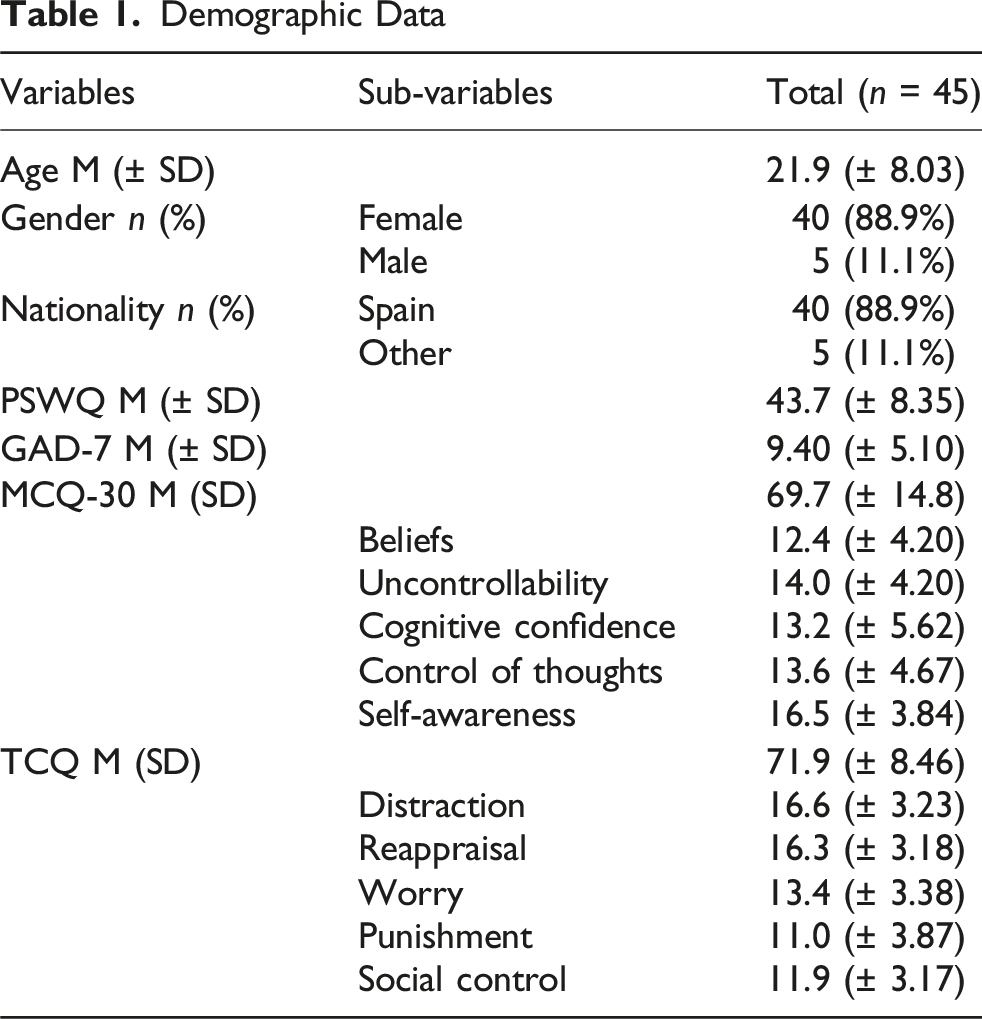
Forty-five people (40 females), aged between 18 and 71 (M = 21.9; SD = 8.03), volunteered to take part in research on cognitive intrusion, which included this study, following each individual’s prior acceptance. Each individual was assigned a numerical code, thereby guaranteeing their anonymity and the confidentiality of their data. No individuals under the age of 18 were considered.
Instruments
The assessment involved the following questionnaires:
First, an ad hoc questionnaire was used to gather each patient’s personal data. The instrument contained sociodemographic variable such as gender, age, nationality, psychological complaint diagnosed, medication and visits to a psychologist (number of sessions and type of psychological therapy received).
Anxiety was measured through the self-administered Generalised Anxiety Disorder Questionnaire (GAD-7; Spitzer, 2015) in which subjects are asked if they have been distressed by anxiety-related issues over the preceding 2 weeks, with their responses involving seven items on a four-point Likert scale. The overall scores ranged from 0 to 21. GAD-7 has a cut-off score of 9, with 89% sensitivity and 82% specificity for detecting GAD compared to a structured psychiatric interview (Spitzer, Kroenke, Williams, & Löwe, 2006).
The next step involved the Penn State Worry Questionnaire (PSWQ; Meyer et al., 1990), which is an anxiety trait measure designed to assess the general tendency to experience worried feelings. It consists of 16 items that individuals rate according to a five-point Likert scale that ranges between 1 = ‘not at all common in me’ and 5 = ‘very common in me’. The instrument used here was the Spanish version drawn up by Sandín (Sandin & Chorot P, 1995).
The following questionnaires were used to measure meta-beliefs and thought control: • The Metacognitions Questionnaire 30 (MCQ-30; Wells & Cartwright-Hatton, 2004). This instrument measures individual differences in metacognitive beliefs, judgements and monitoring trends. It has five subscales with 30 items overall. The responses to each item on the MCQ-30 involve a four-point Likert scale, from 1 = ‘I do not agree’ to 4 = ‘I fully agree’. The scores on the MCQ-30 range between 30 and 120 points, with the highest scores indicating greater pathological metacognitive activity. The five subscales measure the following dimensions: (1) positive beliefs on worry (e.g. ‘worrying helps me to deal with the situation’), (2) negative beliefs on uncontrollability and danger (e.g. ‘once I start worrying, I cannot stop’), ( 3) cognitive confidence (e.g. ‘my memory sometimes plays tricks on me’), (4) the need to control thoughts (e.g. ‘Being unable to control my thoughts is a sign of weakness’) and (5) cognitive self-knowledge-awareness (e.g. ‘I pay a great deal of attention to the way my mind works’). • The Thought Control Questionnaire (TCQ; Wells & Davies, 1994) is designed to identify the strategies that individuals use to control their thoughts. It consists of 30 items that are scored on a four-point scale (1 = never, 2 = sometimes, 3 = often and 4 = almost always). The results for the factors Distraction, Reappraisal, Worry and Punishment are given by the sum of their direct scores, while the results for the factor Social Control are given by the sum of the inverse scores for three of the items (5, 8 and 12) and the direct ones for the other three. Example of Go in the Emotional Go/No-Go Task. Example of No-Go in the Emotional Go/No-Go Task. Example of an IAPS Image in the Experimental Flanker Task. Example of a Condition in the Experimental Flanker Task.



The following experimental tasks were used to measure cognitive control and inhibition capacity: • Emotional Go/No-Go: This involved an electronic version created with E-prime software, designed to measure the participants’ RTs in milliseconds. The stimuli were images with affective valences that were pleasant, unpleasant and neutral, chosen from the International Affective Picture System (IAPS; Lang, Bradley, & Cuthbert, 1999), surrounded by frames in different colours. When the frame was yellow (Image 1), the subjects had to click the mouse as quickly as possible; when the frame was purple (Image 2), they had to refrain from doing so. The images were displayed randomly and they all appeared with the frames in both colours. The images were displayed for 400 ms with pauses between them that varied randomly between 400, 450, 500, 550 and 600 ms. The pleasant and unpleasant images had similar arousal levels as per the Spanish grading of the IAPS (Moltó, 1999; Vila, 2001). • Emotional Flanker Task: the design of this experimental measure involved a selection of 60 images from the IAPS (Image 3) and the creation of different conditions (Image 4) to which the participants had to respond. All these images were chosen considering their arousal and valence. Once the image had been randomly displayed on the screen for 500 ms the subjects were presented with the task they had to perform, which involved a sequence of seven letters ‘s’, ‘c’, ‘h’ and ‘k’, and depending on whether the middle one was an ‘h’ or a ‘k’ they had to click on the right button on the mouse, and if it was an ‘s’ or a ‘c’ they had to do so on the left button.
Procedure
The study was conducted in a single session in which the users were fully evaluated. The subjects began by answering the selected battery of questionnaires and then performing the two experimental tasks. This assessment process was attended by a psychologist, who answered any queries. All the data were recorded anonymously in a database. The overall task lasted around 30 min. The experimental tasks evaluated cognitive interference and attention and sensitivity to negative emotions.
Data Analysis
The first step involved a descriptive analysis for calculating means and standard deviations.
A Spearman’s correlation was performed to discover any association between the variables, considering those values below 0.3 to be a low effect, those between 0.3 and 0.5 to be medium and those above 0.5 to be a large one.
Finally, a stepwise linear regression was used to discover any variables that predicted impulsivity in the behavioural tasks. The significance was p < .05 in all the analyses.
Results
Sample Characteristics
Demographic Data
Pearson Correlation Coefficients for the Displeasure Arousal Dimension.

Note. *p < .05, **p < .01 and ***p < .001.
Input and Output Variables for the Linear Regression.

Note: Dependent variable: NoGo__unpleasant_arousal_errors.
Summary of Regression Models.

aPredictors: (Constant), MCQ-30_NEEDTOCONTROL, Flankers_unpleasant_arousal_rt, PSWQ, TCQ_TOTAL, GAD-7.
bPredictors: (Constant), MCQ-30_NEEDTOCONTROL, Flankers_unpleasant_arousal_rt, PSWQ, GAD-7.
cPredictors: (Constant), Flankers_unpleasant_arousal_rt, PSWQ, GAD-7.
Coefficients of Linear Regression Models.

Note: Dependent variable: NoGo__unpleasant_arousal_errors.
Collinearity Diagnostics of Linear Regression Models

Note: Dependent variable: NoGo__unpleasant_arousal_errors.
Discussion and Conclusions
This study has sought to use behavioural tasks to discover whether the capacity for behavioural inhibition when faced with potentially anxiety-provoking stimuli (i.e. unpleasant affective images with high arousal) is mediated by metacognitive variables or by attentional cognitive control. The results suggest the following: (1) worry and anxiety predict errors in the emotional Go/No-Go task, and (2) shorter RTs in the flanker task increase the errors in the emotional Go/No-Go task when viewing unpleasant images with high arousal.
These results are consistent with other studies on worry, whereby individuals with high scores in the PSWQ record longer RTs in the flanker emotional task (Berggren & Derakshan, 2013). This might be because more feelings of worry may trigger mechanisms of awareness of anxiety-provoking stimuli, whereby viewing images with a negative valence and high arousal may mean that the individual requires more time to adjust and perform the task correctly.
Certain prior studies have revealed the importance that metacognitive variables have in regulating cognitive and emotional processes (Spada & Wells, 2005; Wells & Matthews, 1994). Individuals with high scores on the TCQ worry scale (Wells & Davies, 1994) tend to focus on unwanted thoughts and feelings of worry that are characterised by their unpleasant nature and high arousal, although in our model, while being part of it, they are not significant.
Nevertheless, the relationship between strategies for controlling thoughts in general (i.e. the cognitive control strategies measured by the TCQ; Wells & Davies, 1994) has not been studied from this perspective. Accordingly, the ability to focus on relevant stimuli while disregarding irrelevant distractions plays a crucial role in the capacity to resist impulses (Enticott et al., 2006). This research suggests that individuals with higher levels of impulsivity may record deficiencies in selective attention, thereby rendering them more prone to click on No-Go when presented with unpleasant and arousing images.
There are numerous studies in the field of cognitive neuroscience that have found a relationship between greater cognitive control and reduced impulsivity (Schneider & Shiffrin. 1977; Tajik-Parvinchi et al., 2021; Tottenham et al., 2011), which is consistent with our research, where a longer RT in the flanker task means fewer errors in the emotional No-Go task, indicating that cognitive control explains a greater capacity for inhibition in these tasks.
Finally, it is worth outlining this study’s practical implications. The modification of cognitive and belief strategies for increasing behavioural controls has implications for impulsivity, whereby an impulsive individual should increase their need for control.
It is also important to note the study’s limitations. Firstly, the use of a non-probabilistic sample means the results cannot be extrapolated to a larger population, and the dominant presence of females in the sample rules out the possibility of drawing comparisons.
In view of these limitations, future studies could use larger samples and consider other relevant variables, such as those proposed by schema therapy. It would also be pertinent to include more males.
Finally, the study’s contribution involves furthering our understanding of how these variables interact with each other and with other cognitive and emotional processes, providing valuable information for the development of more effective therapies for treating impulsivity.
Footnotes

Ethical Statement
Funding
The author(s) disclosed receipt of the following financial support for the research, authorship, and/or publication of this article: This project was financially supported by Universidad Camilo José Cela through publication funding assistance.
Declaration of Conflicting Interests
The authors declared no potential conflicts of interest with respect to the research, authorship, and/or publication of this article.
Data Availability Statement
Data is provided within the manuscript or supplementary information files. If any author or reviewer requires the database, it could be sent to them.