




Abstract
Preliminary evidence suggests reductions in emotion recognition accuracy to mask-wearing faces compared to no-mask-wearing faces in healthy volunteers. In socially anxious individuals, who tend to interpret positive or neutral facial expressions as more negative, emotional decoding biases might be even more compromised. This study aimed to replicate and extend previous findings on the impact of mask-wearing on emotion recognition in a Western sample while also examining the impact of social anxiety symptom severity. One hundred eleven university students completed a computerized emotion recognition task depicting gender and race-balanced faces, each modeling one of the six basic emotions and a neutral expression, with and without a medical mask. Using repeated measures ANOVAs and ANCOVAs, we investigated the effect of facemask condition and social anxiety severity on emotion recognition performance. Consistent with earlier research, the results of this study replicated the finding that wearing face masks led to decreased accuracy in emotion recognition across all emotions tested. Contrary to expectations, social anxiety symptoms did not moderate this effect. Despite the observed reduction in emotion recognition accuracy associated with mask-wearing, socially anxious individuals did not appear to be at a higher risk of experiencing impaired emotion recognition compared to their less anxious counterparts.
Introduction
Humans rely on a combination of verbal and nonverbal cues as part of social development and communication. These cues are part of social cognition, which refers to how individuals observe, recall, and use information in social contexts to understand each other’s feelings, intentions, desires, and mental states (Fiske & Taylor, 1991). One conceptualization of social cognition is composed of higher-level processes, which are slow, flexible, and explicit processes (e.g., theory of mind), and lower-level processes, which are fast, relatively inflexible, automatic, and implicit processes (e.g., emotion recognition; Frith & Frith, 2008). Humans use facial expressions to carry meaning across contexts (Elliott & Jacobs, 2013) and have become communication signals to foster conversations and relationships (Frith, 2009).
Full facial expressions yield better emotion recognition abilities than blocked or limited facial cues, yet evidence suggests that the mouth region is used more than the eye region to discriminate emotions on static and dynamic facial expressions (Blais et al., 2012). Empirical studies suggest that facial regions are differently involved in the distinction of emotions from facial expressions. Emotions recognized best from eye information include anger, fear, and sadness, while happiness and disgust are better recognized from the mouth region, and surprise is equally recognizable from both regions (Bassili, 1979; Schurgin et al., 2014; Wegrzyn et al., 2017). Furthermore, individuals from Eastern (e.g., Japan) compared to Western countries attend to the eye region more than other facial regions during emotion recognition (Jack et al., 2012).
With the advent of the COVID-19 pandemic, face mask-wearing was encouraged or mandatory across various settings. Face masks protect against airborne agents, yet emotional recognition could be negatively impacted. Studies using different stimuli and tasks (e.g., The Korea University Facial Expression Collection, an adapted version of the Vienna Emotion Recognition Task, the FACES stimuli) agree that face mask-wearing decreased accuracy in reading basic emotions in healthy volunteers (Carbon, 2020; Grahlow et al., 2022; Grundmann et al., 2021; Kim et al., 2022). Face mask-wearing reduced perceived emotion intensity, interpersonal closeness, and face mimicry (Grundmann et al., 2021; Kastendiech et al., 2021). The current research suggests that besides emotion recognition accuracy and speed, central social aspects such as closeness and emotional intensity are disrupted by face mask-wearing.
As such, this study’s first aim was to replicate prior investigations’ findings on impaired facial emotion recognition in a sample of young adults. Based on prior research findings, we posited that wearing face masks would diminish accuracy in recognizing emotions compared to scenarios without face masks across all emotional expressions.
While most individuals easily identify facial expressions accurately, emotion recognition can be impaired in those experiencing heightened symptoms of social anxiety. Social anxiety is marked fear or anxiety about one or more social situations in which an individual may feel negatively judged (American Psychiatric Association, 2022). The cognitive model of social anxiety (Clark & Wells, 1995) posits that attentional biases, such as the avoidance bias (i.e., avoidance of stimuli that are perceived as negative or threatening, including eye contact with emotional faces [Günther et al., 2021]) promote the onset and maintenance of social anxiety. Findings from a recent meta-analytic review show that socially anxious individuals, including those meeting subclinical criteria, are also more likely to interpret ambiguous social situations (e.g., stimuli, conversations) more negatively than non-socially anxious individuals (Chen et al., 2020); overall supporting previous individual studies. The avoidance bias and negative interpretation bias are thought to be driving factors in maintaining social anxiety by influencing social cognition processes, such as emotion recognition.
Research examining the relationship between valence-specific emotion recognition skills and social anxiety reveals inconsistent findings. For instance, a systematic review by Alvi et al. (2022) reported that social anxiety severity had a) a significant positive association for accuracy in detecting negative stimuli (i.e., static faces, morphed faces, video interactions, or pseudo-words) in 60% of studies, b) a significant negative association for the accuracy of positive stimuli (i.e., static faces, pseudo-words, or verbal segments) in 75% of studies, and c) a significant negative association for the accuracy of neutral stimuli (i.e., static faces) in all the studies that examined this association.
Taken together, the majority of studies report that individuals with social anxiety are more accurate at detecting negative stimuli (e.g., Mohlman et al., 2007; Torro-Alves et al., 2016) and less accurate at recognizing positive and neutral stimuli (e.g., Bodner et al., 2012; Oh et al., 2018). Face masks may heighten ambiguity in facial expressions, potentially amplifying the negative interpretation bias observed in individuals with social anxiety.
Increased ambiguity in facial expressions due to masking may worsen the positive correlation between emotion recognition accuracy and negative stimuli as well as exacerbate the negative correlation between emotion recognition accuracy and positive or neutral stimuli. In a 2024 study, Ikeda investigated how wearing face masks impacts the inference of facial expressions in a Japanese sample and whether social anxiety and social sensitivity may act as a mediator. The author described a difference in overall mask interference for emotion recognition accuracy compared to Western samples (e.g., accuracy for happy and neutral expressions remained unaffected, and accuracy for angry expressions increased). As the author suggests, individuals from Japan were more familiar with the daily use of facemask-wearing, even prior to the COVID-19 pandemic, and thus more experienced in inferring facial expressions from masked individuals. There was no effect of social anxiety on emotion recognition accuracy, yet higher social sensitivity was associated with higher accuracy for emotion recognition with and without masks. No study to date has assessed the effect in a Western sample.
As such, our second aim was to extend our investigation to examine whether the difference in emotion recognition accuracy of face mask-wearing compared to no face mask-wearing faces varied as a function of social anxiety symptom severity in a Western sample. Given the negativity interpretation and avoidance biases in social anxiety, we hypothesized that as social anxiety symptom severity increased, the effects of the biases would be greater (i.e., more bias) when faces are masked than no face mask-wearing faces. In other words, higher social anxiety symptoms would yield smaller difference in accuracy between masked and unmasked negative stimuli, but greater difference in accuracy between masked and unmasked positive stimuli.
Materials and methods
Participants
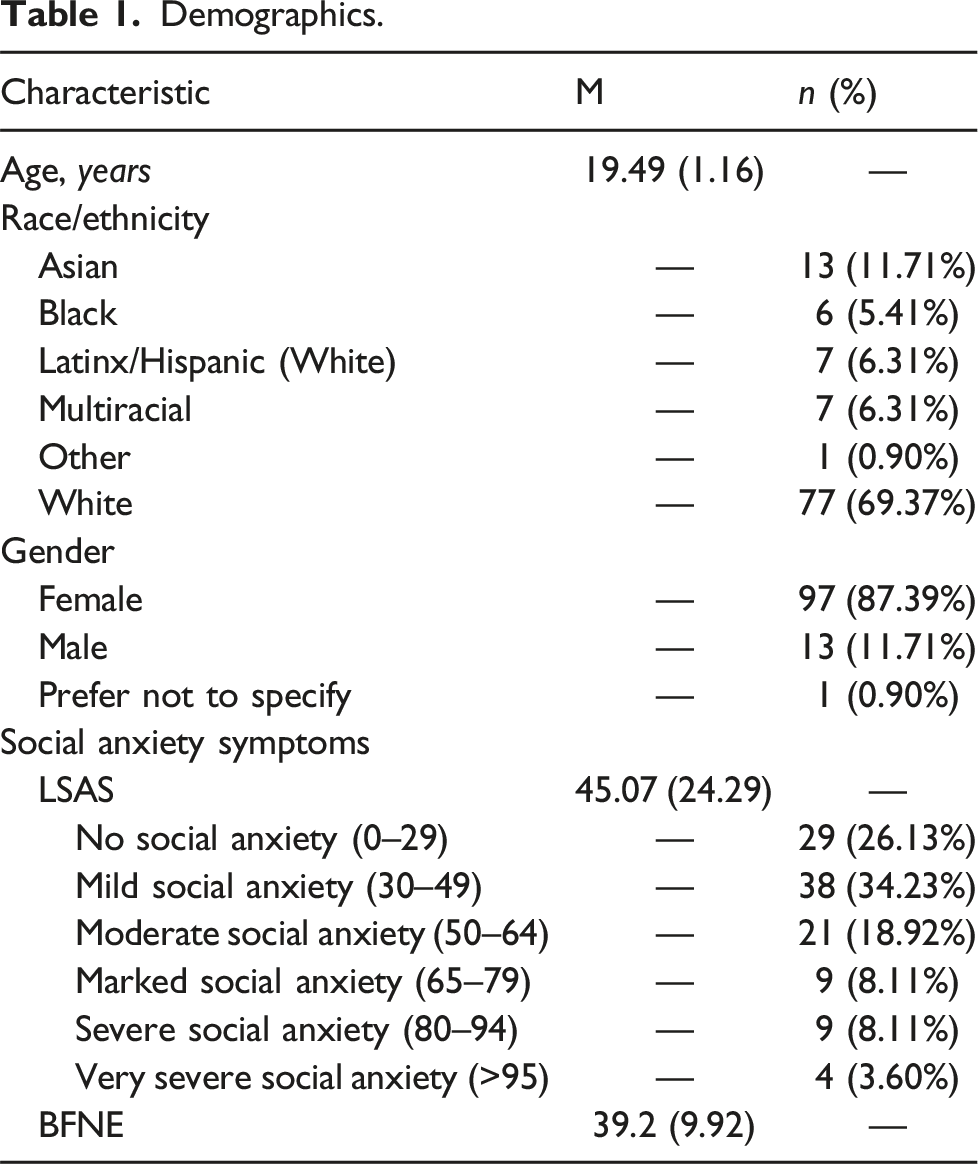
The sample consisted of 111 undergraduate students (M age = 19.49, SD age = 1.16) recruited from a southern university college population. Students received research course credit for psychology courses and participated between February and April 2022. The sample was predominately female (n = 97, 87.39%) and White (n = 77, 69.37%).
Procedures
Study participation took place online via REDCap and PsyToolkit (Stoet, 2010, 2017) lasting 20–30 minutes. The virtual design facilitated participation while reducing in-person contact during the ongoing pandemic. Participants were sent a one-time link to a REDCap survey where they consented to participate in the study and completed a demographics form and two social anxiety measures. Participants then completed the emotion recognition computerized behavioral task. Students were compensated with one class research credit. This study was approved by the Southern Methodist University Institutional Review Board Committee (protocol number: 21-164). This study was not preregistered.
Measures
The Liebowitz Social Anxiety Scale – Self-Report (LSAS-SR) is an adapted version of the Liebowitz Social Anxiety Scale (Liebowitz, 1987). It is a 24-item self-rated scale used to assess fear and avoidance symptoms of social anxiety across a variety of social situations. For each item, the participant is asked to answer two questions. First, they rate how anxious or fearful they feel in a situation on a 4-point Likert scale from 0–None to 3–Severe and second, how often they avoid the same situation on a 4-point Likert scale from 0–Never to 3–Usually. The items include a variety of social situations such as “Using a telephone in public” or “Working while being observed.” All items are summed to create an overall score ranging from 0–144, with higher scores indicating more severe symptoms of social anxiety. The LSAS-SR has good psychometric properties (Baker et al., 2002). Cronbach’s alpha for this study was 0.96.
The Brief Fear of Negative Evaluation Scale (BFNE; Leary, 1983) is a 12-item scale used to measure cognitive features of social anxiety. The items include different situations, such as “I am afraid others will not approve of me.” and “I am usually worried about what kind of impression I make.” Participants indicate how characteristic of them is each item using a 5-point Likert scale from 1 = Not at all characteristic of me to 5 = Extremely characteristic of me. Total scores range from 12–60, with higher scores indicating greater elevated fear of negative evaluation. The BFNE has good psychometric properties (Duke et al., 2006). Cronbach’s alpha for this study was 0.79.
Emotion recognition task
Participants completed a computerized facial expression recognition behavioral task using the RADIATE Emotional Face Stimulus Set (Conley et al., 2018; Tottenham et al., 2009). Of the 1721 face stimuli available, 56 images were chosen based on demographic characteristics. The chosen stimuli included four females and four males, two of each of the following races/ethnicities: Asian, Black, Hispanic, and White, corresponding to the racial/ethnic distribution of the region where the study took place. Each stimuli modeled the six basic emotions with a closed mouth as well as a neutral expression for a total of 56 images. The same 56 images were modified with a medical face mask covering the actors’ nose and mouth (experimental condition) for a total of 112 images.
The experimental task was configured and presented online using the PsyToolkit platform. The 112 images were presented in a randomized order. After a face stimulus was presented for 2 seconds, a screen with the seven facial emotions options (e.g., happy, surprised, neutral, etc.,) appeared and the participant chose one option within 5 seconds. Accuracy, mask condition, and reaction time were recorded for each trial. Three attention checks which consisted of a statement indicating to select either “Happy,” “Sad,” or “Neutral” and were randomly presented in between experimental trials. The attention checks were added after 31 participants had completed their participation in the study. The task lasted approximately 13 minutes.
Statistical analysis
For each participant, we calculated the unbiased hit rate (Hu; Wagner, 1993) for each mask and emotion condition (i.e., 2 mask conditions × 7 emotions), like McCrackin et al. (2022). Hu represents the joint probably of a) correctly identifying a stimulus (e.g., selecting fear for a fear stimulus), and b) correctly deploying the emotion selected (e.g., only selecting fear when a fear stimulus was shown but not when other emotions were shown). Unbiased hit rate values consider biased responding (e.g., selecting fear for most emotions). It allows us to incorporate bias into a participant’s performance outcome measure, compared to percent accuracy which does not adjust the performance score if the participant exhibited a bias in responding. We calculated Hu based on Wagner (1993)’s calculation as the product of both probabilities. This calculation yields a number from 0 to 1, indicating the emotion recognition performance while adjusting for response selection bias (e.g., selecting fear for all stimuli). We also conducted two additional sets of analyses. First, we used signal detection index, response criterion (C) to extend our analyses by using a bias measure as the outcome. Secondly, we used percent accuracy as the outcome measure to compare our findings to previous studies (e.g., Carbon et al., 2020; Grahlow et al., 2022); see Supplemental Material.
We conducted a 2 (mask condition) × 7 (emotion) repeated measures analysis of variance (ANOVA) on the Hu values (Wagner, 1993) to test our first aim. We compared the Hu values (Wagner, 1993) based on each emotion separately (instead of grouping by valence) given previous findings where face masks impair emotion recognition for different emotions within the same valence group (e.g., positive emotions). Given the violation of the test of sphericity (i.e., Mauchly’s test was significant), the Greenhouse–Geisser corrected results were reported. Follow-up were two-tailed t-tests. For our second aim, we added social anxiety symptom severity as a covariate and performed a 2 (mask condition) × 7 (emotion) repeated measures analysis of covariance (ANCOVA) on the Hu values for each social anxiety symptom measure. We used Benjamini–Hochberg (Benjamini & Yekutieli, 2001) corrections to control for multiple tests. All statistical analyses were conducted in IBM SPSS version 26. Data is available by contacting the corresponding author.
Results
Descriptive analyses
Demographics.
Effect of face mask-wearing on emotion recognition
Based on a two-way repeated measures ANOVA, there were significant main effects of mask condition F(1,89) = 503.19, MSE = .03, p < .001, η2 = .85, and emotion F(4.52,402.72) = 141.98, MSE = .03, p < .001, η2 = .62.
1
In line with our hypothesis, emotion recognition was significantly reduced in face mask-wearing stimuli (M = .26, SE = .01) compared to no face mask-wearing stimuli (M = .49, SE = .01) for all emotions (all ps<.001; Figure 1A). Effect of face mask-wearing on emotion recognition. (A) Unbiased hit rate for each emotion for face mask-wearing and no face mask-wearing faces; Error bars = standard error of the mean; *p < .001 (B) Difference scores for no face mask-wearing—face mask-wearing unbiased hit rate.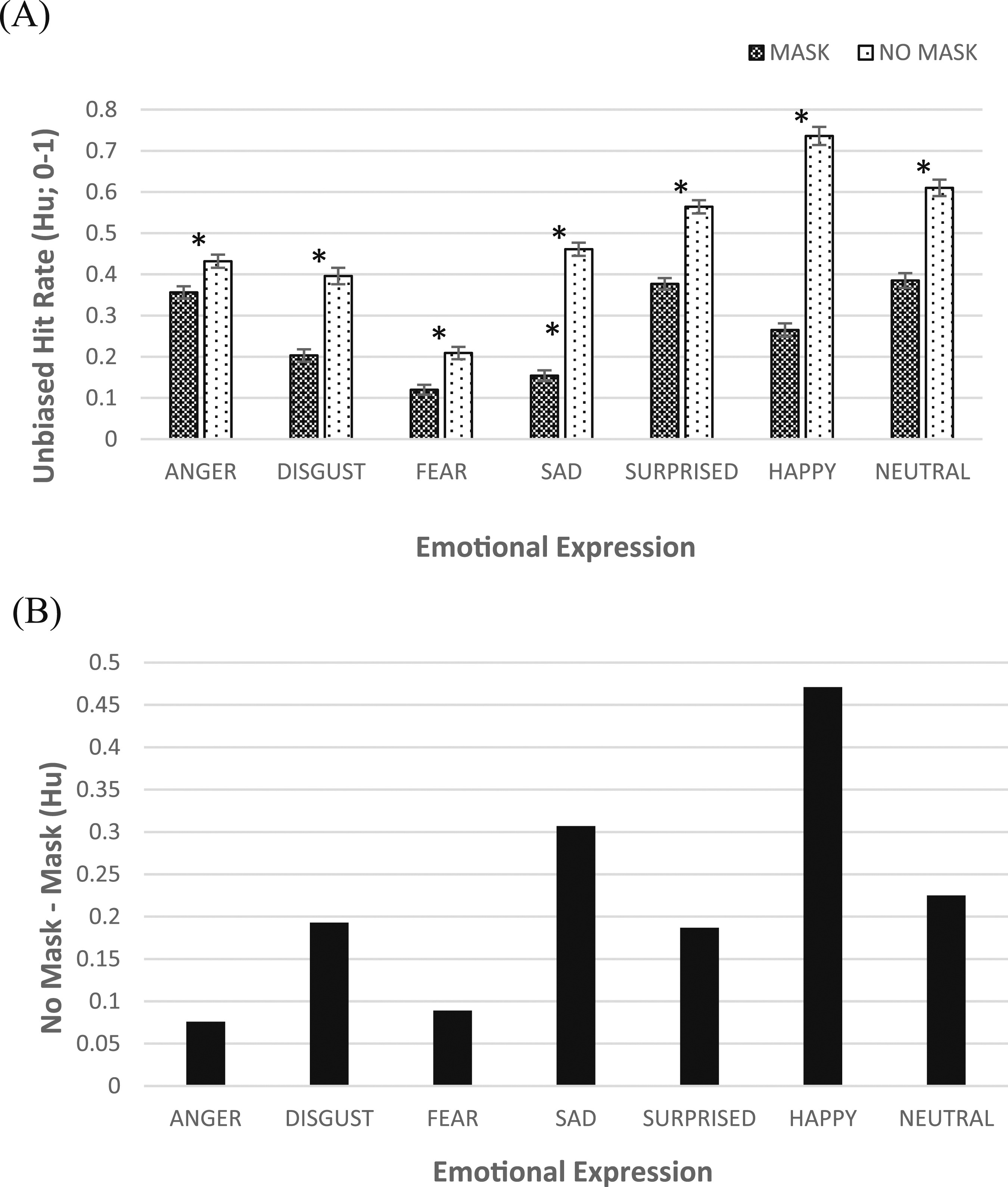
There was a significant mask condition by emotion interaction, suggesting that face mask-wearing impacted emotion recognition differently for some emotions, F(5.18,461.29) = 58.74, MSE = .02, p < .001, η2 = .40. 2 As a visual representation, the difference between the face mask-wearing and no face mask-wearing Hu for each emotion is presented on Figure 1B.
The role of social anxiety severity
The findings from Aim 1 remained consistent when controlling for social anxiety severity. There were significant main effects of mask condition, F(1,88) = 23.97, MSE = .03, p < .001, η2 = .21 and F(1,88) = 112.29, MSE = .03, p < .001, η2 = .56, and emotion, F(4.45,390.40) = 15.80, MSE = .03, p < .001, η2 = .15 and F(4.45,391.53) = 40.48, MSE = .03, p < .001, η2 = .32; and also a significant mask condition by emotion interaction, F(5.19,456.26) = 2.31, MSE = .02, p = .041, η2 = .03 and F(5.18,456.21) = 14.41, MSE = .02, p < .001, η2 = .14, when controlling for both the BFNE and LSAS, respectively. However, contrary to our hypothesis, social anxiety severity did not influence the mask condition by emotion interaction, when using the BFNE, F(5.19,456.26) = .14, MSE = .03, p = .99, η2 = .002, or the LSAS, F(5.18,456.21) = .22, MSE = .02, p = .96, η2 = .002. Similarly, social anxiety severity did not moderate the mask condition by emotion interaction when using response criterion (C) and percent accuracy as the outcome measure. 3
Discussion
Understanding the effect of face mask-wearing on facial emotion recognition is timely since adequate interpretation of facial expressions is crucial to social interactions and relationship formation. To our knowledge, this study is the first to replicate and extend the effects of mask-wearing on facial recognition in a Western sample of young adults with varying levels of social anxiety severity. We hypothesized that as social anxiety severity increases relative to no face mask-wearing, face mask-wearing will yield greater biases.
Our results demonstrated a decrease in accuracy in emotion detection in mask-wearing faces for all emotions, as found by Grahlow et al. (2022). Although within-face mask condition differences in emotional recognition were not part of our hypotheses, it is essential to note that accuracy rates varied significantly across these conditions. This observation is consistent with prior research, indicating that the impact of face masks on emotional recognition varies depending on the emotion being expressed. In particular, the difference in unbiased hit rate between the mask and no mask conditions was highest for the happy expression, followed by the sad, neutral, and disgusted expressions. The greatest difference for the happy stimuli is associated with previous research suggesting that the mouth is the primary facial region to detect happiness (Wegrzyn et al., 2017). However, we did not see a similar pattern (i.e., a large difference) for the disgust expression as we would expect, given the reliance on the mouth region for recognition (Wegrzyn et al., 2017). One potential reason for the discrepancy is that the unbiased hit rate for the unmasked disgust stimuli was smaller than we would expect (e.g., significantly smaller than happy); thus, the effect of the mask was not as large. However, the unbiased hit rate for the masked disgust stimuli was one of the smallest, as expected. The smallest differences for anger and fear align with previous findings (Grenville et al., 2022), which may suggest that the eye region may be a more prominent feature in those expressions. Previous studies have not reported a significant mask effect for fear and neutral expressions (Carbon et al., 2020; Kim et al., 2022), nor for sad expressions (Nayes et al., 2021). However, one study did find improved recognition in masked conditions for anger and fear expressions (Grenville et al., 2022). The differential effects of face mask on the various expressions may be a result of the use of heterogeneous stimuli (e.g., FACES database [Ebner et al., 2010] vs. RADIATE database [Tottenham et al., 2009; Conley et al., 2018], which is the database we used, or stimuli that were digitally manipulated to wear a mask, as we did, vs. stimuli with models using face masks). Nevertheless, the majority of studies report lower accuracy rates for happiness and disgust, which rely more on mouth cues.
Our results suggest that the severity of social anxiety symptoms did not exert a significant influence on the interaction effect between mask condition and emotion on emotion recognition. We measured social anxiety symptoms by examining symptoms associated with fear of negative evaluation and fear and avoidance of social situations separately. Social anxiety symptoms do not appear to pose a higher risk of bias in masked facial expressions. Similar findings were observed in an Eastern sample (Ikeda, 2024), where social anxiety symptoms did not show a differential impact emotion recognition accuracy in masked faces. The absence of a social anxiety association may be attributed to the clinical composition of our sample, which primarily comprised individuals with low to moderate levels of social anxiety severity. Greater biases for masked faces might only be seen in individuals with more severe social anxiety severity. In addition, we used static faces as stimuli, which yield mixed findings on the valence-specific social anxiety effects of emotion recognition (Alvi et al., 2022); and thus, the effects of social anxiety might be present in dynamic stimuli. Yet, these speculations warrant future research. While our findings suggest that emotion recognition in mask-wearing static faces is unlikely affected by social anxiety symptom severity, other social cognitive domains may play a role. A recent study (McCrackin et al., 2022) examined the role of social competence and personality traits on emotion recognition in masked versus unmasked individuals. Individuals with higher overall social competence had higher accuracy in identifying unmasked expressions, while individuals with lower trait extraversion and higher trait agreeableness had higher accuracy in identifying masked expressions.
Several limitations deserve to be mentioned—first, our emotion recognition task format comprised static images and a forced choice response format. Several contextual factors, including voice and body language, will likely influence real-life emotion recognition. Replication with static versus dynamic emotion recognition tests (e.g., morphed faces) is recommended. A second limitation is the lack of generalizability due to our predominately female, White college sample with an average mild social anxiety severity. Therefore, these findings may not replicate in a sample with high social anxiety symptom severity. In addition, we did not control for other psychological symptoms (e.g., depression), which may have also impacted emotion recognition performance. Lastly, personal or political views of mask-wearing may influence emotion recognition.
In conclusion, our study replicates prior findings on decreased emotion recognition accuracy in static mask-wearing faces. However, face masks did not increase the risk of emotion misinterpretation in individuals with higher levels of social anxiety severity. Body language and voice intonation should be considered to facilitate emotional expression while wearing masks for safety reasons.
Supplemental Material
Supplemental Material - Examining the influence of social anxiety biases on emotion recognition for masked versus unmasked facial expressions
Supplemental Material for Examining the influence of social anxiety biases on emotion recognition for masked versus unmasked facial expressions by Sofía Uribe and Alicia E. Meuret in Journal of Experimental Psychopathology
Footnotes
Acknowledgements
The authors would like to thank Dr. David Rosenfield for his consultation and feedback in statistical analyses, Dr. Thomas Ritz for his feedback on the design, and Joshua Venus, Olivia Woodson, and Hannah Wahl for their help with the study preparation, data cleaning, and literature reviews.
Declaration of conflicting interests
The author(s) declared no potential conflicts of interest with respect to the research, authorship, and/or publication of this article.
Funding
The author(s) received no financial support for the research, authorship, and/or publication of this article.
Ethical statement

Data availability statement
The data is available by contacting the first author.
Supplemental Material
Supplemental material for this article is available online.
Notes
Author Biographies
References
Supplementary Material
Please find the following supplemental material available below.
For Open Access articles published under a Creative Commons License, all supplemental material carries the same license as the article it is associated with.
For non-Open Access articles published, all supplemental material carries a non-exclusive license, and permission requests for re-use of supplemental material or any part of supplemental material shall be sent directly to the copyright owner as specified in the copyright notice associated with the article.
