




Abstract
Patients with social anxiety disorder appear to display aberrant gaze behavior across a variety of social situations. In contrast, the gaze behavior of high socially anxious (HSA) individuals from the community seems to depend on the type of situation and the aberration might be limited to gaze avoidance. This study investigated the differential effect of social situation—a face-viewing task and a public speaking task—on gaze behavior in HSA participants from a community sample. Participants’ eye movements were tracked using a wearable eye tracker. Two aspects of gaze behavior were measured: (1) gaze avoidance was assessed by total fixation time, fixation counts, and mean fixation time on faces; (2) hypervigilance was assessed by scan path length and mean distance between fixations. The results confirmed a moderating effect of task on total (though not mean) fixation time on faces and fixation counts. Compared to low socially anxious participants, HSA participants looked less frequently (hence shorter) at the audience during the speech only. This indicates that visual avoidance in HSA individuals does not occur by default, but only when risks of (negative) social consequences are perceived. High and low socially anxious participants showed no difference in hypervigilance in either situation.
Introduction
Overwhelming fear or anxiety and avoidance of social situations are diagnostic criteria of social anxiety disorder (SAD; American Psychiatric Association (APA), 2013). Existing literature from theoretical and clinical perspectives claims that socially anxious individuals tend to avoid looking at faces and eyes (e.g., Clark & Wells, 1995). However, experimental research has produced inconsistent results, ranging from clear visual avoidance of faces to no avoidance whatsoever; indeed, some findings suggest more eye gaze behavior by socially anxious individuals (for reviews, see Bantin et al., 2016; N. T. M. Chen & Clark, 2017; Schulze et al., 2013; Staugaard, 2010).
A recent systematic review (J. Chen et al., 2020) concluded that the extent of visual avoidance of faces depends on the severity of social anxiety symptoms as well as the type of social situation. Adults with SAD appear to display avoidance of faces in virtually any social situation, be it a face-viewing task on a computer screen or an actual social interaction. Socially anxious individuals from the general community do not exhibit consistent avoidance in face-viewing tasks, whereas they more consistently show this avoidance in social interaction and public speaking tasks. In other words, they seem to adjust their eye gaze behavior on the basis of the social context. The greater flexibility of avoidance in socially anxious persons from the community was found across various samples and studies (J. Chen et al., 2020). However, to our knowledge, it has not yet been demonstrated within the same sample and with the same procedure. Different eye gaze findings between studies may in part be due to the different samples and study designs. Therefore, it is worthwhile to compare gaze behavior between distinct types of social situations within a particular sample from the community. This is the primary aim of this study.
In addition, indications of hypervigilance are examined. Three recent studies using a public speaking task have complemented fixation-based measures (i.e., fixation time and fixation counts) with scan path length: the distance covered by the eyes during stimulus presentation. N. T. M. Chen et al. (2015) proposed that a longer visual scan path is an indication of hyperscanning, characterized by “saccades of greater amplitude, and attenuated fixations with regard to duration and quantity” (N. T. M. Chen et al., 2015, p. 668). Although attenuated fixations (on faces) would also be in line with avoidance, hyperscanning is interpreted as a sign of vigilance (N. T. M. Chen et al., 2015). Specifically, N. T. M. Chen et al. (2015) found that SAD patients showed longer scan paths during a public speaking task than control participants, although the relative contributions of the distance between fixations and the number and duration of fixations remained unclear. Wermes et al. (2018) also found longer scan path lengths for persons with SAD than for controls during visual search tasks when participants were anticipating a public speaking task (in control conditions without anticipatory threat, there was no difference). In contrast, Lowe et al. (2012) did not find a difference in scan path length during public speaking between high and low socially anxious participants (selected based on whether or not they suffered from stuttering, a risk factor for social anxiety). Taken together, these studies have provided some initial data on hyperscanning when multiple faces in the audience were present and further suggested that hyperscanning may be dependent on the type of social situation (Wermes et al., 2018). Hence, as for avoidance, it would be helpful to clarify to what extent hypervigilance depends on the type of social situation.
Although most studies on gaze behavior in social anxiety have used face-viewing tasks (J. Chen et al., 2020), visual avoidance of faces has been demonstrated most consistently with public speaking tasks (e.g., N. T. M. Chen et al., 2015, 2016; Farabee et al., 1993; Kim et al., 2018; Lowe et al., 2012, though see Hofmann et al., 1997). The main difference between the two situations seems to be social-evaluative threat, that is, the risk that “an important aspect of the self-identity is or could be negatively judged by others” (Dickerson & Kemeny, 2004, p. 358). According to Dickerson and Kemeny (2004), this is a key characteristic of public speaking situations. First, the situation requires exposing oneself (e.g., by disclosing personal information, sharing one’s views, or demonstrating one’s ability to tell a coherent story). Second, the evaluative nature of the situation is usually highlighted by the (suggested) presence of an audience and/or recording the performance. In short, public speaking triggers fear of negative evaluation, which is central to social anxiety (APA, 2013).
Social-evaluative threat may lead to visual avoidance of faces in two ways. First, it prompts the use of safety behaviors, which aim to hide oneself in a (counterproductive) attempt to minimize the risk of negative social evaluation (Clark & Wells, 1995). Avoidance of eye contact is considered as a safety behavior. Second, social-evaluative threat induces state anxiety. In public speaking situations, elevated state anxiety has been observed in the general population (e.g., Westenberg et al., 2009) and it is positively related with social anxiety (Crisan et al., 2016; Harrewijn et al., 2016). Although state anxiety is associated with increased attention to verbal threat cues (Heinrichs & Hofmann, 2001), there is some evidence that the combination of high trait and state anxiety is associated with consistent avoidance of faces with a negative expression (Singh et al., 2015). This may be particularly relevant because audience perception seems to be biased. High socially anxious speakers judged the attitude of a prerecorded audience to be more negative than low socially anxious speakers (Blöte et al., 2014; Perowne & Mansell, 2002).
The present study investigated the moderating effect of social situation on two aspects of gaze behavior in high and low socially anxious individuals from a community sample. Gaze avoidance was assessed in terms of fixation time and fixation counts; hypervigilance was assessed in terms of scan path length. We created two distinct situations—a face-viewing task and a public speaking task—using identical stimuli: a prerecorded neutral audience, sitting in a classroom and facing the camera (i.e., a multiple-faces viewing paradigm). In the viewing task, the participant was instructed to simply look at the audience. Next, they were asked to rate the attitude of each audience member. In the public speaking task, participants were instructed to hold a speech in front of the same audience. Subsequently, they rated their overall impression of the audience. The current design allows for a direct comparison between two types of social situations while ruling out potential confounding by different general circumstances. Based on the conclusion of the review by J. Chen et al. (2020) that HSA persons may show consistent avoidance in social-evaluative public speaking situations but not in face-viewing situations, we expected to find an effect of social anxiety in the speech task and a smaller or no effect in the viewing task. Based on the only previous study that investigated hypervigilance in a community sample (Lowe et al., 2012), we expected no difference in scan path length between HSA and LSA individuals.
Method
Participants
Eighty-eight female undergraduates (M = 20.75 years, SD = 2.19) of Leiden University with self-reported normal vision were recruited for the study. The sample consisted of 45 Dutch students and 43 international students (including 9 Germans, 5 Italians, 5 Greeks, 3 British, 3 Americans, 2 Turkish, 2 Chinese, and 14 participants from other countries). Leiden University offers parallel psychology programs in Dutch and English. Dutch students can be enrolled in either program and they were allowed to do the study in either language: 27 participated in Dutch and 18 in English. International students always participated in the English version. Ten were native speakers of English. All nonnative speakers enrolled in the English study program had passed an English proficiency test as an entry requirement. All participants were requested not to wear eye make-up on the day of testing. Participants gave written informed consent and were fully debriefed afterward. They received either two credits or €7.50 for participating in the experiment. The university’s ethics committee for psychological research approved the study protocol.
Materials
Questionnaires
Each questionnaire was available in both Dutch and English. Twenty-seven participants completed the questionnaires in Dutch and 61 participants completed the questionnaires in English. In the latter group, the nonnative speakers (n = 51) were asked to rate their fluency in English on a scale from 1 to 10, where “10” was defined as “as fluent as your native language.” Their mean rating was 8.02 (SD = 0.88).
Liebowitz Social Anxiety Scale (LSAS)
The LSAS consists of 24 items, including 11 items about social interaction (e.g., “Meeting strangers”) and 13 items about social performance (e.g., “Telephoning in public;” Liebowitz, 1987). The instrument uses a 4-point Likert-type scale to rate both anxiety (0 = none, 3 = severe) and avoidance (0 = never, 3 = usually) in each of these situations. The LSAS demonstrates high internal consistency (α = .96; Heimberg et al., 1999). The internal consistency in this study is excellent for both language versions (α = .93 for Dutch and α = .96 for English). The LSAS-Anxiety subscale also demonstrated good internal consistency (α = .92 and α = .94 for Dutch and English versions, respectively).
In line with other studies using the LSAS with community samples, where the LSAS-Anxiety subscale was used to make groups (e.g., Kret et al., 2017; Lange et al., 2011; Vrijsen et al., 2010), high and low social anxiety groups were created by doing a median split on the sum scores of LSAS-Anxiety subscale. Cases scoring on the median were assigned to the low social anxiety group. Scatter plots are provided in the Supplementary Materials.
Personal report of public speaking anxiety (PRPSA)
The PRPSA is a 34-item instrument that assesses fear of public speaking (McCroskey, 1970). An adapted version (Blöte et al., 2015) consisting of 19 items (e.g., “My hands tremble when I am giving a speech,” “While preparing for giving a speech, I feel tense and nervous”) was used in this study. The PRPSA uses a 5-point Likert-type scale ranging from 1 (strongly disagree) to 5 (strongly agree). The sum scores were used in this study; the possible range of scores is 19–95. The adapted version has a good internal consistency (α = .89; Blöte et al., 2015). In the current study, the values of α are .93 and .94 for the Dutch and English versions, respectively.
Audience perception list (APL)
The APL assesses how the participant perceives the audience (Blöte et al., 2014). It consists of four questions: (1) Did you think the audience was interested? (2) Did you think the audience was friendly? (3) How pleasant was it to speak in front of this audience? (4) How at ease did you feel when giving a speech in front of this audience? The items were rated from “−2” to “+2.” For example, Question 1 was scaled as follows: −2 = uninterested, −1 = somewhat uninterested, 0 = neutral, 1 = somewhat interested, and 2 = interested. The score was recoded into a score from 1 to 5; thus, higher scores represent a more positive perception. Blöte et al. (2014) reported an internal consistency of α = .74. In this study, the internal consistency was α = .65 and α = .59 for the Dutch and English versions, respectively.
Stimuli and apparatus
The prerecorded audience of the Leiden Public Speaking Task (Westenberg et al., 2009) was used in this study. The video was presented on a projection screen, depicting a natural scenario commencing with an empty classroom (about 20 s) and an audience (a female teacher and eight students) gradually walking into the scene and taking seats in different rows (about 20 s). Subsequently, the nine life-size audience members remain seated, facing the speaker. They behave naturally and display relatively neutral expressions all the time.
We utilized a Tobii Pro Glasses 2 wearable eye tracker (Tobii Technology AB, Sweden) to record participants’ gaze behavior toward the audience. The eye tracker is equipped with four eye cameras which track people’s eye movements in relation to the external environment they’re watching. It records eye gaze at a sampling frequency of 100 Hz and a scene video at 25 Hz. An embedded microphone records the audio scene.
Procedure
After reading and signing consent forms, participants completed two self-report questionnaires, LSAS and PRPSA, respectively. The study consisted of two tasks: the public speaking task and the face-viewing task. Participants were randomly assigned to one of the two orders (i.e., first speaking and then viewing vs. first viewing and then speaking). Except for the order of the tasks, the procedure in this study was identical for all participants (see Figure 1). The public speaking task went as follows: participants were fitted with the eye tracker and the eye tracker was calibrated. Then participants were instructed to introduce themselves in front of a prerecorded audience for 1 min while gaze behavior was being recorded. They stood in front of the projection screen and watched the classroom as the audience members entered and took their seats. After 40 s, a beep indicated that they should start speaking. Exactly 1 min later, a second beep indicated that they should stop. Following this, participants were seated and completed the APL (as in the study by Blöte et al., 2014), which concluded the public speaking task. For the viewing task, participants were asked to stand and the eye tracker was calibrated. Participants were informed that they would watch a video of an audience and that they would then have to rate the attitude of its members. The same video was used as during the speaking task to make the visual data from the two tasks comparable. After watching the introduction (40 s) and the first minute of the audience facing them, the participant remained standing in front of the screen and rated the behavior of each audience member on a 5-point scale from positive to negative. The video kept playing and each audience member was identified in turn by a number displayed over their head for 4 s. The participants marked their ratings on a form on a clipboard. After completing both tasks, all participants were debriefed about the main purpose of each experimental part and then reimbursed.

Overview of the procedure.
Data Preparation
Two 1-min segments of eye tracking data were analyzed, one for each task. The beginning of the segment was aligned with the end of the introduction of the video of the audience (i.e., when it had played for 40 s). Pictures of the video being displayed on the screen were used as reference images. Areas of interest (AOIs) on the reference images were hand drawn shapes of each audience member’s face. The hair was excluded, as this region does not contain social information. AOIs varied in size because the audience members in the video were seated in three rows at varying distances from the camera (see Figure 2). Fixation counts and fixation time were cumulated across AOIs.

A snapshot of the audience displays presented in the two tasks; colored circles AOIs. AOI = area of interest.
Eye tracking data were processed using Tobii Real World Mapping software. An attentional filter was applied and participants’ fixations were automatically mapped on designated reference images. Subsequently, these mappings were checked by a human observer (J.C.). The software calculated fixation-based parameters: the total fixation time on faces in seconds and the number of fixations on faces. The mean fixation duration was computed by dividing the total fixation time on faces by the number of fixations on faces. In addition, raw data were exported to derive scan path length parameters for each task. Total scan path length in pixels was computed by taking the Euclidean distance between the X and Y coordinates of successive fixations on the scene video and summing them. The mean distance between fixations was computed as the total scan path length divided by the total number of fixations in the 1-min period. We calculated these eye tracking outcomes for each segment from the two tasks.
Data Analysis
To compare gaze behavior of high and low socially anxious participants in the two tasks, two mixed-models multivariate analyses of variance (MANOVAs) were performed. The first MANOVA tested the visual avoidance hypothesis and included the total fixation time on faces, the number of fixations on faces, and the mean duration of fixations on faces in seconds as dependent variables. The second MANOVA tested the hypervigilance hypothesis and included total scan path length in pixels and mean distance between fixations in pixels as dependent variables. Task was a within-participants factor (viewing vs. speech) and social anxiety group was the main between-participants factor (high social anxiety [HSA] vs. low social anxiety [LSA]). Order was included as a between-participants control variable (first speech vs. first viewing). If a MANOVA was significant, mixed-models analyses of variance (ANOVAs) were performed as follow-up analysis. The multivariate approach (Wilks’s λ) was reported because it does not assume sphericity. To assess the robustness of the effect of anxiety group, the analyses were repeated with cases scoring on the median assigned to the high social anxiety group and with the LSAS anxiety score as a continuous variable (see Supplementary Materials).
Results
The analyses were based on data of 82 participants. While 88 participants completed the entire experiment, 1 participant was excluded because of missing data for the speaking task due to technical issues. Two participants were excluded because of insufficient quality of their eye tracking data. Two other participants were excluded because of procedural errors during testing. One participant was excluded because she admitted to have poor eyesight after the experiment. Four participants had missing values on the mean duration of fixations because they did not fixate on any of the faces during the viewing task.
Preliminary Analyses
Preliminary analyses explored whether significant relations existed among social anxiety (LSAS-Anxiety subscale), public speaking anxiety (PRPSA), and overall impressions of the audience (APL). Pearson correlation analyses demonstrated that social anxiety was significantly and positively related to public speaking anxiety (r = .64, p < .001) and negatively to perception of the audience as a whole (r = −.23, p = .035).
Participant Characteristics
The two orders of the tasks were represented equally among the two anxiety groups, χ2(1) = 1.22, p = .269. Twenty-four participants in the (LSA) group and 17 participants in the (HSA) group started with the speaking task. The other participants started with the viewing task. Table 1 presents the characteristics of high and low socially anxious participants.
Sample characteristics for groups with high and low LSAS scores.

Note. HSA = high socially anxious participants; LSA = low socially anxious participants; LSAS-Anxiety = Liebowitz Social Anxiety Scale—Anxiety subscale; PRPSA = personal report of public speaking anxiety; APL = audience perception list.
***p < .001.
Social Anxiety and Gaze Behavior
The normality assumption was violated for the total fixation time on faces and the number of fixations on faces in both tasks and for scan path length and the mean distance between fixations in the viewing task. To correct for skewness, an ln transformation was applied to the total fixation time on faces and a square root transformation was applied to the number of fixations on faces. After transformation, all variables met the assumption of normality. For scan path length and the mean distance between fixations in the viewing task, the violation of the normality assumption was due to outliers. In both variables, three extremely low and two extremely high values were replaced by the lowest and highest value in the rest of the sample, respectively. 1 Means and standard deviations of the raw gaze behavior variables in the speech task and the viewing task for HSA and LSA groups are presented in Table 2.
Means of the raw gaze behavior variables in the speech task and the viewing task for HSA and LSA groups.
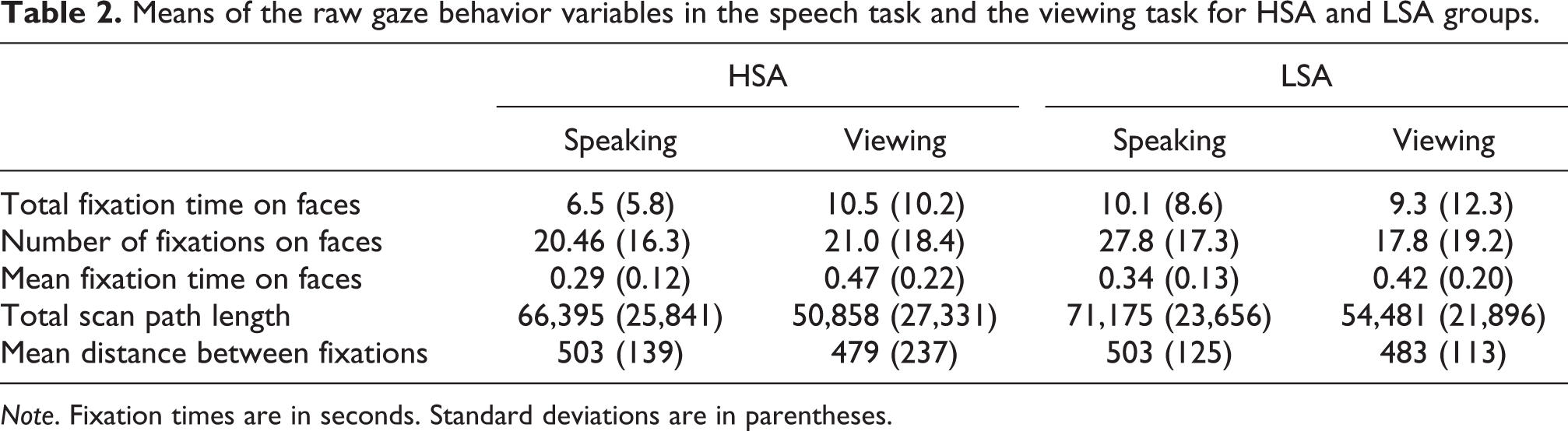
Note. Fixation times are in seconds. Standard deviations are in parentheses.
Regarding the avoidance hypothesis, the results of the MANOVA indicated a main effect of task, Wilks’s λ = .595, F(3,72) = 16.35, p < .001, partial η2 = .405, as well as a significant interaction between anxiety group and task, Wilks’s λ = .898, F(3,72) = 2.74, p = .050, partial η2 = .102. Three follow-up mixed-model ANOVAs were conducted on the dependent variables.
For the total fixation time on faces, the analysis showed a significant interaction between task and social anxiety group, Wilks’s λ = .925, F(1,78) = 6.35, p = .014, partial η2 = .075. Independent samples t tests showed that LSA participants spent more time fixating on the faces than HSA participants during the speech task, t(80) = 2.28, p = .025, whereas there was no difference in the viewing task. No other main effects or interactions were significant.
For the number of fixations on faces, the analysis showed a main effect of task, Wilks’s λ = .939, F(1,78) = 5.07, p = .027, partial η2 = .061. Participants fixated more often on the faces of the audience members during the viewing task than during the speech task. Moreover, there was also a significant interaction between task and social anxiety group, Wilks’s λ = .9439, F(1,78) = 4.75, p = .032, partial η2 = .057. Independent samples t tests indicated that LSA participants fixated more often on the faces than HSA participants during the speech task, t(80) = 2.15, p = .035, but there was no difference during the viewing task. No other main effects or interactions were significant.
For the mean duration of fixations on faces, the analysis showed a significant main effect of task, Wilks’s λ = .698, F(1,74) = 32.06, p < .001, partial η2 = .302, but no other significant main effects or interactions. The mean duration of fixations on faces was longer in the viewing task than in the speech task. In summary, the results are in line with the hypothesis that socially anxious people avoid looking at faces in the audience during a speech task. The HSA group spent less time looking at the faces than the LSA group. The fixations were of similar duration, but less frequent in the HSA group.
Regarding the hypervigilance hypothesis, the MANOVA on scan path length parameters revealed a main effect of task, Wilks’s λ = .709, F(2,77) = 15.82, p < .001, partial η2 = .291, but no interaction effects. A follow-up mixed-model ANOVA on scan path length also showed a main effect of task, Wilks’s λ = .747, F(1,78) = 26.48, p < .001, partial η2 = .253. Participants exhibited longer scan path length while speaking than while viewing the audience (see Table 2). There were no main or interaction effects of social anxiety, indicating that social anxiety did not affect the total scan path length. The mixed-model ANOVA on the mean distance between fixations did not show any significant main or interaction effects. In summary, the results were in line with the hypothesis that the HSA group would not show more indications of hypervigilance than the LSA group.
Discussion
The present study investigated the influence of the type of social situation on the relation between gaze behavior and social anxiety in a community sample. While their eye movements were tracked using eye tracking glasses, participants were asked to give a 1-min introduction of themselves in front of a neutral audience in one situation and to simply view the audience for the same period of time in the other situation. The results provided empirical evidence for the moderating effect of social situations. That is, in the public speaking task, HSA individuals looked less frequently and for a shorter amount of time at the faces of the audience than LSA individuals, whereas no difference was observed in the face-viewing task. Moreover, there was no indication of hypervigilance for HSA participants because all participants exhibited increased scan path length when giving a speech in front of the audience compared to when they were simply watching them. Despite the modest internal consistency of the APL, the present study also replicated a finding by Blöte et al. (2014) that participants with higher levels of social anxiety had more negative impressions of the audience.
In line with our main prediction, HSA participants displayed visual avoidance of faces, indexed as significantly reduced fixation time and counts on faces of the audience. Avoidance took the form of fewer fixations on faces, but the mean duration of those fixations did not differ between LSA and HSA participants. Importantly, this avoidance was only found during the actual performance of the speech. Not only are such findings consistent with previous public speaking studies conducted with community samples (Farabee et al., 1993; Lowe et al., 2012), but they are also in line with studies reporting no effects of social anxiety in community samples during face viewing (e.g., Berdica et al., 2018; Gregory et al., 2019; Mühlberger et al., 2008; Waechter et al., 2014). The findings extend previous research by providing direct evidence, within the same sample, that visual avoidance of faces in HSA persons depends on the type of social situation.
The avoidance patterns in HSA participants were only found during the speech; this supports that visual avoidance of faces may be a result of social-evaluative threat. Furthermore, the current findings are in line with prior studies using face-viewing tasks, which did not find indications of avoidance (or other distinct gaze patterns) in people with elevated social anxiety symptoms (e.g., Berduca et al., 2018; Georgy et al., 2019; Mühlberger et al., 2008; Waechter et al., 2014), even though some of them induced anticipatory state anxiety (e.g., by informing participants that they have to do a public speaking task after the completion of the face-viewing task). For example, Georgy et al. (2019) did not identify differences in eye-movement patterns when high and low socially anxious participants watched a 2-min video displaying natural social scenarios. Similarly, socially anxious individuals displayed a normal gaze pattern in a virtual environment, expecting that they would have to give a speech afterward (Mühlberger et al., 2008). In viewing conditions, either with or without an anticipatory threat, participants do not have to expose themselves (as opposed to speech tasks), and hence, HSA individuals are not tempted to use safety behaviors because they hardly expect to be negatively evaluated. Therefore, our results seem to fit better with a safety behavior interpretation than the state anxiety interpretation. Nevertheless, it is possible that the avoidance tendency could be linked to substantial state anxiety triggered by a combination of a negative impression of the audience and an interaction of both high trait and high state anxiety in our public speaking task, indicating that the state anxiety explanation could not be clearly ruled out. Future research including measures of state anxiety is needed.
With respect to scan path length, the current study found a task effect, but no difference between HSA and LSA participants. There were also no differences in the mean distance between fixations. Participants exhibited longer overall scan path length in speech than in face-viewing situations. One possible reason concerns cognitive demands during speaking; people are likely to make gaze aversions when they think hard because looking at someone’s eye region is too distracting when cognitive load is experienced (Doherty-Sneddon et al., 2002). Meanwhile, people have to monitor the audience’s reactions while performing a speech that may lead to a sequence of looking away and looking back at the faces in the audience. Hence, people may display longer scan path length during a speech. Our results are not in line with the findings from clinical samples that SAD patients are hypervigilant in social situations (N. T. M. Chen et al., 2015; Horley et al., 2003, 2004; Wermes et al., 2018), but they are consistent with other studies with a community sample that reported no differences during public speaking (Lowe et al., 2012), as well as during a face-viewing task in which a natural social scenario was dynamically presented (Gregory et al., 2019). Collectively, it seems that the effect of severity of social anxiety symptoms is an important explanation: in naturalistic social-evaluative situations, HSA people appear to display different scan patterns than patients with SAD.
The finding that the avoidance tendency varies across social situations in socially anxious individuals from a community sample may have implications for early detection of social anxiety. Naturalistic situations with heightened social-evaluative threat may be more likely to offer the opportunity to identify individuals with high levels of social anxiety before they experience the profound impairment associated with SAD than situations lacking such threat. In addition, assessing eye gaze behavior in natural social-evaluative situations may be useful to monitor progress during therapeutic interventions with socially anxious individuals. Further research is needed to investigate whether assessment of eye gaze behavior could be a useful tool for early detection and intervention for individuals with moderate to high levels of social anxiety.
The present study extended previous research by comparing two distinct types of social situations while presenting identical stimuli and provided direct evidence for moderating effects of this situational factor on the relation between social anxiety and visual avoidance of faces. However, some limitations should be noted. First, the two situations—public speaking and face viewing—did not only differ in their levels of social-evaluative threat but also differ in their cognitive demands. Social-evaluative threat might still be the more likely explanation of social anxiety-related differences in gaze behavior. Nonetheless, this interpretation could be tested by manipulating social-evaluative threat in a more direct way (e.g., by manipulating the presence of observers). Moreover, state anxiety could be measured to clarify the contributions of state anxiety and safety behaviors in visual avoidance of faces. Second, our situation was not completely naturalistic because we used a prerecorded audience and participants knew that the audience members could not actually evaluate them. This could have lowered social-evaluative threat levels. However, research with the Leiden PST showed that speaking in front of this audience evoked considerable social-evaluative stress (Westenberg et al., 2009). In addition, an earlier study found minimal differences between virtual and real public speaking environments (Kothgassner et al., 2016). Third, existing studies indicate that decreased attention to (images of) faces in HSA adults may not be simply because these people attempt to entirely withdraw from faces. Instead, they tend to relocate attention to other parts of the body to obtain important social information (Kim & Lee, 2016; Kret et al., 2017). However, our stimulus material of people sitting in rows and behind tables was ill-suited to investigate gaze patterns on the body. Hence, future research could explore possible body biases in a set-up where more of the body is visible. Fourth, this study only included female emerging adults (average age of 21), which prevents generalization toward other populations. Previous research has indicated that gaze behavior may be influenced by development (J. Chen et al., 2020) and gender (e.g., Jun et al., 2013). Specifically, in contrast to the avoidance tendency observed in adults, socially anxious children tend to maintain their attention on the eye region (Morgan & Banergee, 2006). In addition, a study found that socially anxious males are more likely to overestimate being looked at, but socially anxious female participants did not show this bias (Jun et al., 2013). In future research, these factors could be considered to obtain a full picture of gaze behavior in social anxiety.
Conclusions
Our study provides supporting evidence that visual avoidance of faces in HSA individuals depends on the nature of the social situation. Avoidance does not occur by default but seems to occur only when risks of (negative) social consequences are perceived. Importantly, there was no sign of hypervigilance in HSA persons. Future studies may examine the role of social-evaluative threat more directly and explore whether socially anxious individuals look at other body parts of social partners (e.g., hands) while paying less attention to their faces.
Supplemental Material
Supplemental Material, sj-pdf-1-epp-10.1177_2043808721989628 - Visual avoidance of faces in socially anxious individuals: The moderating effect of type of social situation
Supplemental Material, sj-pdf-1-epp-10.1177_2043808721989628 for Visual avoidance of faces in socially anxious individuals: The moderating effect of type of social situation by Jiemiao Chen, Esther van den Bos, Sara L.M. Velthuizen and P. Michiel Westenberg in Journal of Experimental Psychopathology
Footnotes
Data Availability Statement

Declaration of Conflicting Interests
The author(s) declared no potential conflicts of interest with respect to the research, authorship, and/or publication of this article.
Funding
The author(s) disclosed receipt of the following financial support for the research, authorship, and/or publication of this article: The first author is supported by the China Scholarship Council (CSC).
Supplemental Material
Supplemental material for this article is available online.
Note
References
Supplementary Material
Please find the following supplemental material available below.
For Open Access articles published under a Creative Commons License, all supplemental material carries the same license as the article it is associated with.
For non-Open Access articles published, all supplemental material carries a non-exclusive license, and permission requests for re-use of supplemental material or any part of supplemental material shall be sent directly to the copyright owner as specified in the copyright notice associated with the article.
