




Abstract
In the quest to uncover lower order processes that underlie anxiety disorders, researchers have proposed a number of fundamental fears, which are thought to represent fears of inherently aversive stimuli that can explain a number of higher order constructs such as more specific fears. In a recent theoretical article, Carleton narrowed the list of potential fundamental fears down to three candidates: fear of death, fear of pain, and fear of the unknown. Carleton proposes that fear of the unknown represents the primary fundamental fear, suggesting that unlike the other two, fear of the unknown is inherently aversive and logically irreducible. The present study represents an initial empirical investigation of this hypothesis. In a cross-sectional study (N = 373), fear of death, fear of pain, and fear of the unknown were assessed as simultaneous predictors of anxiety. Results showed that fear of the unknown was indeed the strongest unique predictor, while fear of pain also uniquely predicted anxiety, although to a lesser extent. While the results suggest that fear of the unknown may indeed be the most fundamental fear, the need for conceptual clarification and empirical work using diverse measures is discussed.
Keywords
Anxiety disorders are the most common class of mental disorders (Kessler et al., 2005) and are associated with significant functional impairment (Lochner et al., 2003). Psychologists since at least Freud (1894/1966) have developed theories to explain the etiology and treatment of pathological anxiety. One approach to this question has been to create hierarchical models that identify lower order, fundamental fears that contribute to a variety of specific anxiety disorders (Reiss, 1991). A potential benefit of this approach is that hierarchical models can help to identify important treatment targets that, when treated, should reduce a range of related higher order symptoms (Carleton, 2016a). For example, Reiss argued that fears can be conceptualized in terms of fundamental fears of (i) anxiety, (ii) injury, or (iii) negative evaluation. In terms of Reiss’ classification, what makes fears fundamental is that they are inherently aversive and that other, more specific fears can be explained by these fundamental fears (Taylor, 1993).
More recently, the construct fear of the unknown has emerged as a potential fundamental fear. Response to the unknown—and the attendant experience of uncertainty—is central to a number of models of anxiety that propose pathological anxiety to be an extreme response to uncertain future threat (Barlow, 2002; Carleton, 2016b; Grupe & Nitschke, 2013). The construct most frequently used in research related to aversive response to uncertainty is intolerance of uncertainty, which has been most recently defined as “an individual’s dispositional incapacity to endure the aversive response triggered by the perceived absence of salient, key, or sufficient information, and sustained by the associated perception of uncertainty” (Carleton, 2016b, p. 31). Intolerance of uncertainty is assessed with items that assess negative emotional, cognitive, and behavioral responses to uncertainty (e.g., “Unforeseen events upset me greatly,” “When it’s time to act, uncertainty paralyses me”) in the Intolerance of Uncertainty Scale (IUS; Carleton et al., 2007; Freeston et al., 1994). Although not a direct measure of fear of the unknown, intolerance of uncertainty is proposed to have at its core, and therefore act as a proxy for, fear of the unknown (Carleton, 2016). Most uncertainty-related research has used the IUS, with findings that the scale predicts the occurrence of anxiety disorders (Chen & Hong, 2010), and is related to anxiety symptoms in both clinical and nonclinical samples (McEvoy & Mahoney, 2011; Norr et al., 2013). Further evidence for the importance of intolerance of uncertainty in clinical disorders is represented by findings that fear of uncertainty (assessed with the IUS) decreases over the course of a transdiagnostic intervention and that this decrease is associated with a decrease in anxiety symptoms (Boswell et al., 2013). Moreover, compared to other potential fundamental fears such as anxiety sensitivity, intolerance of uncertainty has exhibited stronger unique relations with anxiety symptoms across disorder categories (Norr et al., 2013).
Recently, Carleton (2016a) revisited the fundamental fears originally proposed by Reiss and extended the criteria for establishing whether a fear is fundamental. Specifically, Carleton put forth eight criteria for defining a fundamental fear, including that it should (1) be an emotion, (2) occur in response to inherently aversive stimuli, (3) be evolutionarily defensible, (4) be normally distributed in the population, (5) be a logical reduction of relevant higher order constructs, (6) be logically irreducible, (7) explain variance in relevant higher order constructs, and (8) be factorially distinct (Carleton, 2016a). Although the originally suggested fundamental fears (anxiety sensitivity, fear of injury, and fear of negative evaluation) meet some of these criteria, Carleton proposes that they are not inherently aversive in that all three require some a priori learning about potential associated negative consequences of the feared events. Further, although anxiety sensitivity, fear of injury, and fear of negative evaluation represent lower order constructs, they could be reduced to even lower order constructs such as fear of the unknown and two other potential fundamental fears: fear of death and fear of pain (Carleton, 2016a; Carleton et al., 2009; Iverach et al., 2014).
Carleton (2016a) notes that given their primordial nature, fear of death and fear of pain would appear to be good candidates for representing fundamental fears. As the ultimate and inevitable threat, death and fear of death have been suggested to underlie a range of psychopathologies, with anxiety disorders suggested to develop as dysfunctional attempts to cope with this fear (Iverach et al., 2014). Initial research supports the idea that fear of death is positively correlated with anxiety disorders such as panic disorder (e.g., Menzies et al., 2019), health anxiety (e.g., Noyes et al., 2002), and social anxiety (e.g., Routledge et al., 2010; see Iverach et al., 2014, for review). Fear of pain has also been suggested to be fundamental, owing to the inherent noxiousness of pain (Carleton et al., 2009). Fear of pain has been shown to be elevated in anxiety disorders such as panic disorder, social anxiety, generalized anxiety, and specific phobias, when compared to healthy controls (Carleton et al., 2009). Despite the reasoning and evidence for the relation between these two fears and anxiety disorders, Carleton (2016a) argues that death and pain are not inherently aversive (e.g., death must be learned about to elicit fear and is thus not inherently fear-inducing; pain is an experience that involves both nociception, the basic neural processing of noxious stimulation that is inherently aversive, and learned attributions of meaning to the sensation; Merskey, 1986) and can be reduced to or are moderated by fear of the unknown (e.g., uncertainty regarding any aspect of pain increases its anxiogenic effects). Carleton’s review concludes that fear of the unknown is the only defensible fundamental fear, as evidence from neuropsychology and developmental psychology suggests that the unknown is inherently aversive and fear of the unknown seems to be logically irreducible, as what is feared about the unknown is the unknown itself (Carleton, 2016a).
The review of Carleton (2016a) proposes that fear of the unknown is a better candidate as the primary fundamental fear compared to fear of death or fear of pain. This proposition is mostly based on logical analysis (Carleton’s Criteria 2 and 6)—that is, that fears of death and pain require learning whereas fear of the unknown does not, and that fears of death and pain can be further reduced to fear of the unknown when probing for the reasons for these fears. In a recent review of the evidence for intolerance of uncertainty’s role in anxiety, Shihata and colleagues emphasized the need to disentangle vulnerability factors suggested in hierarchical models and to investigate these simultaneously to be able to evaluate the relative importance of suggested underlying factors (Shihata et al., 2016). In this regard, an important empirically testable criterion from Carleton’s list is that compared to non-fundamental fears, fundamental fears should be more strongly related with higher order constructs such as anxiety (Criterion 7). While all three candidate fundamental fears have been shown to be related with anxiety, to the best of our knowledge there has been no direct empirical comparison of the three. This study therefore represents an initial investigation of the hypothesis that fear of the unknown, rather than fear of death or fear of pain, represents the fundamental fear underlying anxiety. We predicted that (H1) fear of the unknown, fear of death, and fear of pain would all be significantly positively associated with anxiety. More specifically regarding which fear may be more fundamental, we predicted that (H2) in contrast to fears of death and pain, fear of the unknown would uniquely predict anxiety.
Method
Participants and procedure
Ethical approval for this study was obtained from the ethical committee of the Department of Psychology at the University of Groningen. Participants were 373 undergraduate Psychology students (76.2% female, M age = 19.74, SD age = 1.92) who completed a screening survey for a larger study in order to fulfill course requirements. The screening was conducted online. After providing informed consent, participants completed demographics and all questionnaires.
Measures
Anxiety
Anxiety was assessed using the Generalized Anxiety Disorder-7 (GAD-7; Spitzer et al., 2006), a 7-item scale originally constructed to screen for generalized anxiety disorder that has been found to be sensitive for identifying the presence of other anxiety disorders (Plummer et al., 2016). Items consist of experiences associated with anxiety (e.g., “Feeling nervous, anxious, or on edge”) and worry (e.g., “Worrying too much about different things”) that were rated on a 4-point Likert-type scale according to how often they were experienced over the past 2 weeks, ranging from 0 (“Not at all”) to 3 (“Nearly every day”). Internal consistency was good (α = .869).
Fear of the unknown
Fear of the unknown was assessed using the prospective subscale of the short version of the Intolerance of Uncertainty Scale (IUS-12; Carleton et al., 2007). This subscale consists of seven self-statements describing emotional (e.g., “Unforeseen events upset me greatly”) as well as cognitive (e.g., “One should always look ahead so as to avoid surprises”) responses in anticipation of uncertainty that were rated on a 5-point Likert-type scale ranging from 1 (“not at all characteristic of me”) to 5 (“entirely characteristic of me”). Internal consistency for the subscale was good (α = .857). We used the prospective subscale and not the inhibitory subscale of the IUS-12 for several reasons, including that in comparison to the inhibitory subscale, which assesses behavioral responses to uncertainty (e.g., “When it’s time to act, uncertainty paralyses me”), the prospective subscale is more similar to the fear of death and fear of pain scales in assessing emotional and cognitive responses to the fear target.
Fear of death
Fear of death was measured using a subset of 5 items from the Death Anxiety Questionnaire (DAQ; Conte et al., 1982) assessing a factor reflecting fear of death. The items are questions assessing to what extent participants fear their death (e.g., “Do you worry about dying?”; “Does the thought worry you that with death you may be gone forever?”). Questions were answered on a 5-point Likert-type scale ranging from 1 (“Not at all”) to 5 (“Very much”). Internal consistency of the factor was acceptable (α = .796).
Fear of pain
Fear of pain was assessed with the fear subscale of the Pain Anxiety Symptoms Scale–Short Form (PASS-20; McCracken & Dhingra, 2002). Items of the subscale describe fears associated with the occurrence of pain (e.g., “When I feel pain I think I might be seriously ill”; “Pain sensations are terrifying”) and were rated on a 6-point Likert-type scale ranging from 0 (“Never”) to 5 (“Always”) according to frequency of occurrence. Internal consistency of the subscale was good (α = .845).
Data analyses
The preliminary analysis consisted of examining zero-order correlations to investigate associations among the variables. Next, based on the preliminary analysis, to assess whether each of the independent variables contributed uniquely to explaining the variance in anxiety, a multiple linear regression analysis was conducted with the measures for fear of pain, fear of death, and fear of the unknown entered as independent variables and anxiety as the dependent variable. Assumptions of multiple linear regression were checked. As a follow-up analysis, a Fisher’s z-test was conducted to compare strength of regression coefficients. The data included in this manuscript are available at https://doi.org/10.17605/OSF.IO/MNWZQ (Papenfuss & Ostafin, 2020).
Results
The distributions of the variables are displayed in Figure 1—these histograms indicate that the variables approximated normal distributions, with the fear of the unknown variable demonstrating the closest approximation to normality and the fear of pain variable demonstrating the most positive skew. Means and standard deviations as well as correlations between all variables are summarized in Table 1. In line with predictions, regarding Hypothesis 1, all three predictor variables were positively associated with anxiety, with correlations ranging from .237 to .438 (ps < .001). Based on observations of the scatterplots, the linearity assumption was not violated for the subsequent regression analysis. Moreover, the predictor variables were all significantly positively associated with each other, with medium-sized correlations ranging from .348 to .414 (ps < .001), and thus the assumption requiring no multicollinearity in the data was not violated for the subsequent regression analysis.

Histograms of the distributions of all variables. The distribution of cases (a) for the measure of anxiety, (b) for fear of the unknown, (c) for fear of death, and (d) for fear of pain.
Bivariate correlations, means, and standard deviations for all variables.
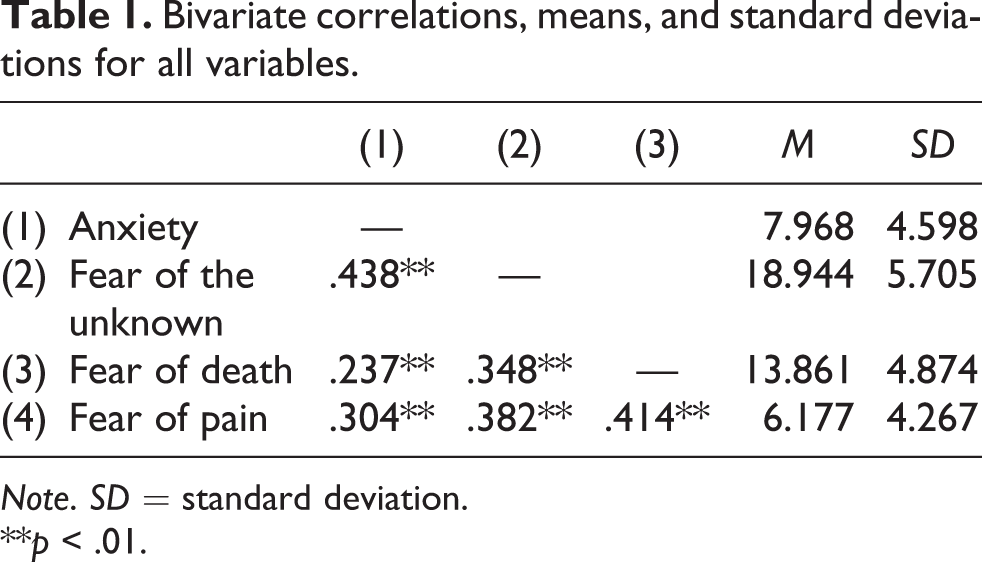
Note. SD = standard deviation.
**p < .01.
Based on these preliminary findings, the multiple linear regression analysis was conducted. Together, fear of the unknown, fear of death, and fear of pain explained a statistically significant amount of variance in anxiety, F(3,369) = 33.853, p < .001, R 2 = .216, R 2 Adjusted = .209. The results further showed that, while fear of the unknown, β = .366, t(369) = 7.138, p < .001, and fear of pain, β = .143, t(369) = 2.72, p = .007, both uniquely predicted anxiety, fear of death did not significantly predict anxiety, β = .051, t(369) = .975, p = .330, when the other predictors were included in the model. 1 Finally, a Q-Q plot of the residuals as well as a scatterplot of the residuals versus predicted values were observed, and based on these the normality and homoscedasticity assumptions were not violated.
To follow up on the finding that both fear of pain and fear of the unknown uniquely predicted anxiety, Fisher’s z-tests were conducted and the results showed that the regression coefficient for fear of the unknown was significantly larger compared to that for fear of pain (z = 3.034, p = .001) as well as that for fear of death (z = 4.286, p < .001).
Discussion
The present study represents a preliminary test of Carleton’s (2016a) proposal that fear of the unknown, and not fear of death or fear of pain, represents the fundamental fear underlying anxiety. One empirically testable criterion that Carleton put forth for a fear to be fundamental is that the fear should explain variance in higher order constructs. While there is some evidence for each of the potential fundamental fears explaining variance in anxiety, the three candidates have to our knowledge not been examined concurrently in terms of their predictive strength. We predicted that (H1) fears of the unknown, death, and pain would correlate positively with an anxiety measure and that (H2) fear of the unknown would be uniquely related to anxiety when fear of death and fear of pain are included in the model, while fear of death and fear of pain would not uniquely relate to anxiety if they can be further reduced to fear of the unknown.
Our hypotheses were partially supported by the data. Regarding H1, in line with expectations, fears of the unknown, death, and pain were all positively correlated with anxiety. Notably, the correlation between fear of the unknown and anxiety was highest, followed by fear of pain and fear of death, respectively. Regarding H2, the results were mixed. As expected, fear of death no longer predicted anxiety when the other predictors were included in the model. However, both fear of pain and fear of the unknown uniquely predicted anxiety when all three predictors were in the model. While the unique variance explained by fear of the unknown was expected, the unique prediction by fear of pain was not. A follow-up test did show that fear of the unknown was a significantly stronger predictor than fear of pain when all three fears were entered simultaneously in a regression analysis, which is in line with expectations.
One possible explanation for this pattern of results is that the incremental validity found for the pain scale may be due to the measurement of the constructs. That is, the construct of fear of pain might be reducible to fear of the unknown, but the way the constructs were operationalized with the current measures may obscure this relation. Specifically, the fear of pain measure used in this study (i.e., the fear subscale of the PASS-20) may assess aspects of fear of pain related to uncertainty that are not captured by the current measure assessing fear of the unknown (the prospective subscale of the IUS-12). Closer inspection of the fear of pain items suggests that this measure assesses worries and fears associated with uncertainty about the reason and possible implications of pain that is already occurring (e.g., “When I feel pain I think I might be seriously ill”), while items on the measure assessing fear of the unknown are more focused on future-oriented anticipatory fear (e.g., “One should always look ahead so as to avoid surprises”), which may make this subscale of the IUS-12 insufficient for assessing the full spectrum of uncertainty-related elements of pain. However, an alternative explanation for this pattern of results is that fear of pain may indeed capture something fundamental to anxiety that is not attributable to a fundamental fear of the unknown. Along these lines, Carleton has argued that the distinction between nociception and pain makes assessment of fear of pain as representing a fundamental fear more difficult and that, while affected by fear of the unknown, fear of pain may still be argued to be a fundamental fear (Carleton, 2016a). These findings and considerations may mean that fear of pain also reflects a fundamental fear in itself and thus warrants future empirical investigation.
Several limitations of this study should be considered. First, this study was cross-sectional in nature and conducted with a student sample. Research with clinical samples and experimental research that yields evidence on causal effects is needed to shed more light on the relationships between the candidate fundamental fears and anxiety. Moreover, it would be important to investigate these relationships in samples of different ages, as it is possible that the importance of the candidate fundamental fears for anxiety may vary with age. Furthermore, we did not assess full demographic data, limiting the generalizability of the findings. Moreover, related to the measurement issue discussed above, all measures used in the study consisted of brief scales, which limits the extent to which the constructs can be fully assessed. For instance, the subscale used to assess fear of death explicitly captured mostly uncertainty-related aspects of death (e.g., “Does the thought worry you that with death you may be gone forever?”), making it impossible to assess whether there is any non-uncertainty-related element in fear of death that may be uniquely related to anxiety. Notably, when inspecting the full DAQ, the scale does not include any items assessing fear of death itself, instead focusing on worry, and most of the items attributed to other factors also to some extent tap into uncertainty surrounding different aspects of death (e.g., “Do you worry that you may be alone when you are dying?”), so it would be interesting to see a replication using the full DAQ as well as other scales (e.g., the Collett–Lester Fear of Death Scale; Lester & Abdel-Khalek, 2003) assessing fear of death. Of course, death is imbued with the unknown, which makes it hard to measure “pure” fear of death. This substantiates Carleton’s rationale for what constitutes a fundamental fear, yet makes it hard to test empirically. Revisiting fear of pain, the subscale used to assess it also captures only the part of the fear of pain construct related to uncertainty (e.g., “When I feel pain I think I might be seriously ill”), with only one item assessing fear directly (i.e., “Pain sensation are terrifying”). The other subscales assess associated cognitive, behavioral, and physiological reactions to pain that may also reflect aspects of fearfulness with regard to pain (e.g., “Pain seems to cause my heart to pound or race”). Future research should assess these relationships using the full scales. Anxiety was also measured with a short scale and, although this scale is used to identify the presence of generalized anxiety as well as other anxiety disorders, additional measures of relevant higher order constructs such as symptoms of several anxiety disorders should be used to further examine relationships with these candidate fundamental fears and substantiate the findings. In sum, future research would benefit from a broad, multi-measure assessment of each of the candidate fundamental fears as well as anxiety (Sechrest, 2005).
Related, there is a question of what fundamental fear theorists think is necessary and sufficient for operationalizing, and thus measuring, a fundamental fear. Fundamental fears have been defined as those that “provide reasons for fearing a wide range of stimuli, whereas ordinary fears do not have this characteristic” (Reiss, 1991, p. 147). It is thereby somewhat unclear whether fundamental fear theorists use the term “fear” as representing an emotion that would be assessed with typical measures of the emotion response categories (i.e., cognitive, physiological, behavioral; Bradley & Lang, 2007). In the present study, we tried to assess the same (i.e., experiential, cognitive) categories of responses for each of the candidate constructs. However, future work would benefit from explicitly defining whether some elements are more important for the operationalization and measurement of fundamental fears and should assess the same categories of elements across the candidate fundamental fears to be able to compare them.
Nevertheless, the study also has some notable strengths. In line with the suggestion by Shihata and colleagues (2016) that there is a need to simultaneously investigate multiple vulnerability factors proposed in hierarchical models, the present study compared the predictive strength of three constructs that have been suggested as fundamental fears underlying anxiety: fear of death, fear of pain, and fear of the unknown. Carleton (2016a) set the stage by making a compelling logical argument based on previous research that fear of the unknown may be the one fundamental fear underlying all of anxiety. This cross-sectional study represents a first step in examining this and suggests that indeed fear of the unknown seems to be the strongest predictor of anxiety when also considering other candidate fears. The study is also complimentary to the influx in studies using psychophysiological measures of response to the unknown that tend to conflate fears of pain and the unknown using unpredictable threat in the form of electroshock or loud noise (see Tanovic et al., 2018, for a review of psychophysiological studies) and draws attention to the need for conceptual clarification regarding the measurement of fundamental fears. Finally, continued empirical work is needed to ascertain the role of fear of the unknown as the fundamental element underlying anxiety psychopathology, as a fundamental fear should, more so than other fears, strongly predict relevant higher order constructs such as anxiety.
Footnotes
Declaration of conflicting interests
The author(s) declared no potential conflicts of interest with respect to the research, authorship, and/or publication of this article.
Funding
The author(s) received no financial support for the research, authorship, and/or publication of this article.
