




Abstract
To address the unmet need for treatment of social anxiety disorder in China, it is timely and relevant to identify more effective, accessible, economic, and easily disseminated interventions. The present study examined the effect of an eight-session program for cognitive bias modification for interpretation (CBM-I). Smartphones were used in the training of reducing interpretation bias and social anxiety of Chinese undergraduates with high social anxiety. In total, 38 participants were randomly assigned to either a CBM-I training group (n = 19) or a control group (n = 19). As a result, the CBM-I training group provided more positive interpretations in ambiguous situations and less social anxiety than the control group. Results indicate that CBM-I training via smartphones can effectively promote positive interpretations of ambiguous situations and relieve social anxiety. CBM-I via smartphones may have clinical utility when applied as a multisession intervention of social anxiety for Chinese undergraduates.
Keywords
Introduction
As one of the most common anxiety disorders (Kessler et al., 2005), social anxiety disorder (SAD) is associated with negative outcomes in social functioning, family life, close relationships, and occupational and educational life (Fehm, Pelissolo, Furmark, & Wittchen, 2005; Stein & Kean, 2000). Among U.S. adults, 12-month prevalence rates are approximately 6.8%, with one third of these cases classified as severe (Kessler et al., 2005). Though the 12-month prevalence of SAD in China is much lower (0.2%) than in Western countries (Kishimoto et al., 2016), this may be due to methodological problems, such as stigma-related underreporting, or diagnostic incongruity with differing symptom presentations. Regardless, even a low prevalence rate of social anxiety translates into a very large number of Chinese people with severe social anxiety (Shen et al., 2006). To address the unmet need for treatment of SAD in China, it is timely and relevant to identify more effective, accessible, economic, and easily disseminated interventions.
Socially anxious individuals preferentially interpret ambiguous social situations in a negative way (Mobini, Reynolds, & Mackintosh, 2013). Research has found a significant correlation between change in interpretation bias and change in symptoms of social anxiety (Lisk, Pile, Haller, Kumari, & Lau, 2018). Cognitive theories suggest that negatively biased threat-related information processing plays a prominent role in the onset and maintenance of SAD (Clark & Wells, 1995; Mathews & MacLeod, 2005; Rapee & Heimberg, 1997). Studies have found that interpretation bias can be modified using an experimental paradigm, called the cognitive bias modification for interpretation (CBM-I), and that this change is accompanied by a reduction in anxiety (Hallion & Ruscio, 2011; Jones & Sharpe, 2017). To date, several studies have found that multisession CBM-I training would yield more robust effects on reduction of social anxiety than single-session training (Lau, 2013; MacLeod & Mathews, 2012; Murphy, Hirsch, Mathews, Smith, & Clark, 2007). Some studies revealed that eight-session of CBM-I could reduce negative interpretation bias and social anxiety symptoms for a longer time (Beard & Amir, 2008). It is worth noting that the effectiveness of the training was increased by simply repeating training sessions (Menne-Lothmann et al., 2014).
One common computerized CBM-I task is the Word-Sentence Association Paradigm (WSAP; Beard & Amir, 2008). During the training of WSAP, either a threat or benign word first occurs before an ambiguous sentence to activate threat or benign beliefs proposed to influence interpretation during social interactions. Then, participants are asked to judge whether the word implying a threat or benign interpretation is related to the ambiguous sentence. The task guides them to learn to endorse benign interpretations and reject threat interpretations by providing positive feedbacks to them. The WSAP assesses interpretation bias using both self-report endorsement and reaction time measure. There is equal opportunity for participants to choose either interpretation, and the participants do not need to tell how they would interpret a situation explicitly. The self-report endorsement measure provides an index of the likelihood of rating positive words and ambiguous sentences as related versus the likelihood of rating negative words and ambiguous sentences as related. The reaction time measure provides an index of how quickly (or easily) an individual endorses or rejects different interpretations. The paradigm that yields both self-report and reaction time data provides a more comprehensive assessment of interpretation (Beard & Amir, 2009; Rozenman, Amir, & Weersing, 2014).
In the last two decades, a lot of research has focused on the use of Internet-delivered treatments, and most of them were on desktop or personal computers. More recently, research has begun to explore the potential use of mobile phone technology for the treatment of both medical and mental health disorders. Dennis and O’Toole (2014) used the gamified attention bias (AB) modification app to show that a single session could help reduce the subjective anxiety and stress reactivity in trait anxious individuals. Evidence suggests that there are numerous factors that make mobile technologies effective in the treatment of mental health disorders. For example, the use of smartphones enables researchers to examine interventions’ effects in natural settings, rather than only in laboratory settings (Bang, Timpka, Eriksson, Holm, & Nordin, 2007). It extends the reach of CBM-I into users’ everyday life, makes it highly accessible for individuals seeking help, and reduces the cost of treatment (Kazdin & Rabbitt, 2013). In addition to their ubiquity, mobile devices are typically always with the individual, prompting the individual with reminders and alerts (George, 2018). In this way, CBM-I via smartphones might lead to more-frequent-sessions training, which may enable the adoption of cognitive habits developed through the intervention.
In general, CBM training research is moving toward delivering longer interventions in naturalistic settings (MacLeod, Koster, & Fox, 2009). Given that people generally have their phones with them at all times, smartphones may be ideal for the implementation of a multisession intervention in naturalistic settings and thus for improving the effectiveness of CBM-I. To date, there are few CBM-I intervention studies exploring the use of smartphones. Given that the rate of social anxiety-related problems and SADs in China is increasing rapidly (Guo et al., 2016), and the use of smartphones is widespread, the present study aimed to evaluate the effect of eight-session WSAP delivered via smartphones on social anxiety of Chinese undergraduates. Furthermore, to examine the longevity of the effects, a 1-month follow-up assessment was included for both the WSAP training group and the control condition. Finally, we would examine the mediators of change in social anxiety through longitudinal data. We predicted that the changes in interpretation bias would mediate the reduction of social anxiety after training.
Method
Participants
A total of 157 undergraduates from three different schools in Beijing participated in this study. Participants selected for the study were with high level of social anxiety, who scored above 38 on the Liebowitz Social Anxiety Scale (LSAS; Liebowitz, 1987). The subscale score of 72 meant that the testees chose the most serious level for each item. These testees might not answer the items seriously or suffer from other anxiety disorders or depression, thus we excluded the testees with subscale score of 72. All participants satisfied the criteria of not having received psychotherapy or medication for psychological problems. Finally, 41 participants were included. However, three participants in CBM-I intervention group dropped out prior to study completion. At the end, 38 Chinese undergraduates (31 women and 7 men) with average age of 21.26 years (SD = 2.18) completed the study. Eligible participants were randomly assigned into the CBM-I group or the control group. All participants read and signed the informed consent form and received 60 RMB as compensation for their participation. This study was approved by the Institutional Review Board of Capital Normal University. A power analysis with the power 0.80, p < .05, and a medium effect size showed that the total sample size was 38 for an F-test among the factors of a 2 × 3 repeated measures analysis of variance (ANOVA); thus, our sample of 38 participants was adequate.
Measures
LSAS
The Liebowitz Social Anxiety Scale (LSAS) consists of 24 items and participants rate their fear and avoidance for each item on a four-point Likert-type scale, ranging from 0 to 3. The Chinese version of the LSAS, used in the current study, has been found to have good internal consistency (Cronbach’s α > .90 for each subscale) among Chinese (He & Zhang, 2004). The Cronbach’s α for each subscale in the current study was greater than .85. Research shows that a total score of 38 is a good cutoff score in diagnosing SAD, with the best balance of sensitivity and specificity (He & Zhang, 2004). Thereby, we chose the participants who scored above 38.
The State-Trait Anxiety Inventory
The State-Trait Anxiety Inventory (STAI; Spielberger, Gorsuch, Lushene, Vagg, & Jacobs, 1983) consists of two parts with 20 items each. The first part, STAI-S, assesses temporary unpleasant emotional experiences, such as fear, tension, and worry, and we called it state anxiety. The other part is STAI-T, assessing the relatively stable personality toward anxiety, namely trait anxiety. The internal consistency (Cronbach’s α) of the STAI-T Chinese version is .88 (Li & Qian, 1995). The Cronbach’s α of STAI-T in the current study is 0.82.
Materials
WSAP
Participants completed a smartphone-based interpretation bias assessment before and after the intervention to assess the effect of the training on their interpretation of ambiguous social information. The procedure of this assessment was identical to the WSAP discussed previously (Beard & Amir, 2009). Each trial included four phases: First, there was a fixation cross in the center of the smartphone screen. It appeared for 500 ms, alerting the participants to focus on the coming trial. Next, either a threat word (e.g., “Criticize”) or a benign word (e.g., “Praise”) replaced the fixation and appeared for 500 ms. Following the word, an ambiguous sentence (e.g., “Your teacher asks you to meet him after class”) appeared and remained on the screen until the participant pressed the continue icon, to indicate that they had finished reading. Finally, participants need to press “1” on the phone screen if the word and sentence were related, or to press “3” if the word and sentence were not related. The next trial began immediately after the participant responded. We measured reaction time on the performance-based interpretation task. The reaction time measurement started when the participants pressed the continue icon and ended when they pressed “1” or “3.”
WSAP assessment and training materials
The stimuli of WSAP used in pre-, post-, and follow-up assessments. The CBM-I training was adapted for Chinese undergraduates by comprehensively reviewing the literature on social anxiety of Chinese college students (e.g., self-reports, clinician-rated assessments, and clinical experiences from Chinese undergraduates) for culturally and developmentally appropriate items. Twenty types of situations that are appropriate for the context of China were utilized. We created six sentences for each situation and got 120 ambiguous sentences that described social situations altogether. Then, we chose two words for each sentence: one that corresponded to a threat interpretation (e.g., “ugly”) and one that corresponded to a benign interpretation (e.g., “attractive”) and ended up with 240 word/sentence pairings: 80 trials for assessment (40 for pre-assessment, 40 for post-assessment) and 160 trials for the eight-session training (160 trials were divided into two sets, 80 for each set, and the two sets were repeated alternately). The training and the stimuli used have been validated for use with Chinese college students (Yang, Cui, Li, Xiao, Zhang & Oei, 2017).
Procedure
The sequence of each stage of the study is shown in Figure 1. The participants were provided consent forms at the beginning of the pre-assessment. The consent form stated the basic purpose of the study: to evaluate the usefulness of smartphone-based treatments for anxiety. The consent form also stated that participants would be randomly assigned to one of the two groups, the training or control groups. However, no information was provided regarding the specific purpose for either condition. After signing the consent form, participants completed the pre-assessment consisting of the LSAS and STAT-T self-report measures and the interpretation bias assessment. During the pre-assessment of interpretation bias, participants practiced for 10 trials first to learn how to operate on their mobile devices. After being familiar with the test, participants pressed the right arrow on the screen to enter the formal section, which contains 40 trials and takes about 5 min.

Diagram of participants’ progress through each stage of the study.
Subsequently, participants were randomly assigned to one of the two conditions. Eligible individuals would receive a website link that leads to the training protocol and instructions for accessing the training web page on their devices. Both the control and training groups’ sessions occurred on Tuesday and Friday of each week to ensure that they were carried out every 3 days. In total, there were eight sessions occurring over 4 weeks. Each session contained 80 trials, and so the participants completed 640 trials throughout the training. Each session lasted approximately 10 min.
CBM-I group
The procedure of the CBM-I training was similar to the interpretation bias assessment except that participants would receive feedbacks after they made a judgment on whether the word and sentence were related (Figure 2). If participants pressed “1” (related) to the benign-word trials, or pressed “3” (not related) to the threat-word trials, they would receive positive feedback (you are correct). In other words, participants received positive feedback when they either endorsed positive interpretations or rejected negative interpretations of the ambiguous sentences. On the contrary, if participants pressed “1” (related) to the threat-word trials, or pressed “3” (not related) to the benign-word trials, they would receive negative feedback (you are incorrect). That is to say, participants received negative feedbacks when they either endorsed negative interpretations or rejected positive interpretations. Through the feedbacks above, the CBM-I training aimed to achieve the effects of reinforcing the positive interpretation bias and eliminating the threat interpretation bias.

Example of a single trial in the WSAP interpretation bias assessment. WSAP: Word-Sentence Association Paradigm.
Control group
The control group was not aimed to adjust interpretations in either direction, thus the feedback contingency was 50%. That means the participants in the control group were reinforced equally for making a threat or positive interpretation. Besides, the procedures for the control group were identical to that of the CBM-I training.
After completing eight training or control sessions, all the participants completed a post-assessment. The process was identical to the pre-assessment, but the materials were quite different from that in pre-assessment, which contains 40 new ambiguous scenarios that participants have not seen. In addition, 1 month later, to explore the long-term effects of the treatment, participants completed a follow-up assessment of the LSAS and STAT-T. The entire study period from the pre-assessment to the follow-up assessment lasted approximately 2 months.
Results
Preliminary analyses
Descriptive statistics are presented in Table 1. Participants in the two groups did not differ significantly at baseline on any of the outcome variables.
Social anxiety and WASP measures.a

Note. LSAS = Liebowitz Social Anxiety Scale; STAI-T = The State-Trait Anxiety Inventory-Trait; CBM-I = cognitive bias modification for interpretation group; CG = control group; WSAP = Word-Sentence Association Paradigm.
aMeans and standard deviations.
Social anxiety
To examine whether the CBM-I training influenced participants’ social anxiety, we conducted a 2 × 3 mixed ANOVA based on the LSAS scores, with group (CBM-I vs. control) as the between-subjects factor and time (pre, post, follow-up) as the repeated measure.
The results showed that the main effect of time was significant, F[2, 72] = 26.31, p = .006, η 2 = 0.21, and the Group × Time interaction effect was also significant, F[2, 72] = 7.56, p = .03, η 2 = 0.15. Next, we examined the simple effects of time and group. The results showed that there was no significant difference between the CBM-I group and the control group at pre-assessment, t(36) = 0.56, p = .42. However, the CBM-I group scored significantly lower than the control group in both the post-assessment, t(36) = 4.13, p = .02), and follow-up assessment, (t(36) = 3.98, p = .04. Post hoc comparisons were also conducted on the two groups respectively. For the CBM-I group, the pre-assessment scores were significantly higher than the post-assessment scores, t(18) = 5.20, p = .03, and the follow-up scores, t(18) = 5.76, p = .02. The post- and follow-up assessment scores did not differ significantly, t(18) = 0.95, p = .33. Likewise, in the control group, the pre-assessment scores were not significantly higher than the post-assessment scores, t(18) = 1.13, p = .25, and the follow-up scores, t (18) = 0.79, p = .41. There were also no significant differences between post-assessment and follow-up scores, t(18) = 0.12, p = .91. The analyses above indicated that the CBM-I group, as compared to the control group, demonstrated lower levels of social anxiety after the intervention.
Trait anxiety
The 2 × 3 mixed ANOVA with group and time as factors based STAI-T scores showed that the main effect of time was significant, F[2, 72] = 11.21, p = .02, η 2 = 0.21, and the Group × Time interaction effect was also significant, F[2, 72] = 9.06, p = .04, η 2 = 0.11. Next, we examined the simple effects of time and group. The results showed that there was no significant difference between the CBM-I group and the control group at pre-assessment, t(36) = 0.61, p = .25. However, the CBM-I group scored significantly lower than the control group in both the post-assessment, t(36) = 4.13, p = .03, and follow-up assessment, t(36) = 3.03, p = .04. Post hoc comparisons were also conducted on the two groups respectively. For the CBM-I group, the pre-assessment scores were significantly higher than the post-assessment scores, t(18) = 7.34, p = .007, and the follow-up scores, t(18) = 8.33, p = .005. The post- and follow-up assessment scores did not differ significantly, t(18) = 0.99, p = .66. Likewise, in the control group, the pre-assessment scores were not significantly higher than the post-assessment scores, t(18) = 2.13, p = .51, and the follow-up scores, t(18) = 2.65, p = .25. There were also no significant differences between post-assessment and follow-up scores, t(18) = 0.33, p = .72.
Reaction time indices
Before analyzing the bias indices on the performance-based interpretation task, we detected the reaction times outliers using the absolute deviation around the median (Leys, Ley, Klein, Bernard, & Licata, 2013). This resulted in the elimination of 3% of the trials. Four types of reaction time were recorded: (a) acceptance of threat interpretations, (b) rejection of threat interpretations, (c) acceptance of benign interpretations, and (d) rejection of benign interpretations. Threat and benign bias indices were calculated as follows. Participants have varying numbers of reaction time for each trial type (Table 2). Threat bias index was the amount of time to reject threat interpretations minus the amount of time to accept threat interpretations (i.e., reject threat − accept threat = threat bias). Benign bias index was the amount of time to accept benign interpretations minus the amount of time to reject benign interpretations (i.e., accept benign − reject benign = benign bias). Positive and negative signs make a good distinction between benign and threat bias. Larger bias scores indicate more bias toward threat and away from benign interpretations.
Numbers of reaction time for each trial type.

Note. CBM-I = cognitive bias modification for interpretation group; CG = control group.
The mean negative and positive bias scores for the two groups over time are presented in Table 1. We conducted a 2 × 2 mixed ANOVA with group (CBM-I vs. control) as the between-subjects factor and time (pre- vs. post-assessment) as the repeated measure. For benign interpretation bias, the main effect of time was not significant, F[1, 36] = 0.63, p = .34. However, there was a significant Group × Time interaction effect, F[1, 36] = 6.55, p = .03, η 2 = 0.23.
Furthermore, post hoc comparisons of the pre- and post-assessments of positive bias were conducted separately. The results showed no significant difference in benign interpretation bias between the CBM-I group and the control group at pre-assessment, t(36) = 0.67, p = .51. At post-assessment, the CBM-I group had significantly lower benign bias scores than the control group, t(36) = 4.55, p = .008, indicating that the participants in the CBM-I group showed a more benign interpretation bias. Within-group post hoc comparisons were also conducted. The results showed significant difference between pre- and post-intervention positive interpretation bias scores for the CBM-I group, t(18) = 2.89, p = .04, but no significant difference in the control group, t(18) = 1.54, p = .19. These results indicated that, as compared to the control group, the interpretation bias of the participants in the CBM-I group was more positive after the intervention.
However, in terms of the threat interpretation bias, the main effect, F[1, 36] = 0.08, p = .80, and the interaction effect, F[1, 36] = 0.79, p = .62, were both nonsignificant. These results suggested that while the CBM-I training may promote more positive interpretation of ambiguous situations, there is no change in threat interpretation bias.
Endorsement indices
The mean threat and benign endorsement for the two groups over time are shown in Table 1. We conducted a 2 × 2 mixed ANOVA with group (CBM-I vs. control) as the between-subjects factor and time (pre- vs. post-assessment) as the repeated measure.
For benign endorsement, the main effect of time was not significant, F[1, 36] = 0.59, p = .31. However, there was a significant Group × Time interaction effect, F[1, 36] = 9.22, p = .005, η 2 = 0.29. Furthermore, post hoc comparisons of the pre- and post-assessments of positive bias were conducted separately. The results showed no significant difference in benign endorsement between the CBM-I group and the control group at pre-assessment, t(36) = 0.67, p = .60. At post-assessment, the CBM-I group had significantly more benign endorsement than the control group, t(36) = 5.13, p = .01, indicating that the participants in the CBM-I group showed more benign interpretation bias. Within-group post hoc comparisons showed significant difference between pre- and post-assessments benign endorsement for the CBM-I group, t(18) = 9.34, p = .003, but no significant difference in the control group, t(18) = 1.45, p = .18. These results indicated that, as compared to the control group, the interpretation bias of the participants in the CBM-I group was more positive after the intervention.
However, in terms of the threat endorsement, the main effect, F[1, 36] = 0.92, p = .32, and the interaction effect, F[1, 36] = 0.44, p = .51, were both nonsignificant.
Mediation analyses
To see if the changes in social anxiety were mediated by changes in interpretation bias, we first examined the correlations between these variables (presented in Table 3). Mediation requires temporal precedence from the independent variable to the mediator and from the mediator to the dependent variable, we examined the changes in interpretation scores from pre-assessment to post-assessment as mediators of the changes in social anxiety pre-assessment to 1-month follow-up assessment. There was no evidence that changes in threat endorsement or threat reaction time indices correlated with changes in the total score of LSAS; so, no formal mediation analyses were conducted. There was a significant association between changes in social anxiety and changes in benign endorsement, r(38) = .28, p = .033, or benign reaction time indices, r(38) = −.26, p = .045, so mediation analysis procedure described by Fritz and MacKinnon (2007) was used to investigate whether changes in benign interpretation mediated the correlation between group (CBM-I training vs. control) and changes in social anxiety.
Correlations between change scores (D) in LSAS, changes in bias endorsement, and changes in bias score.
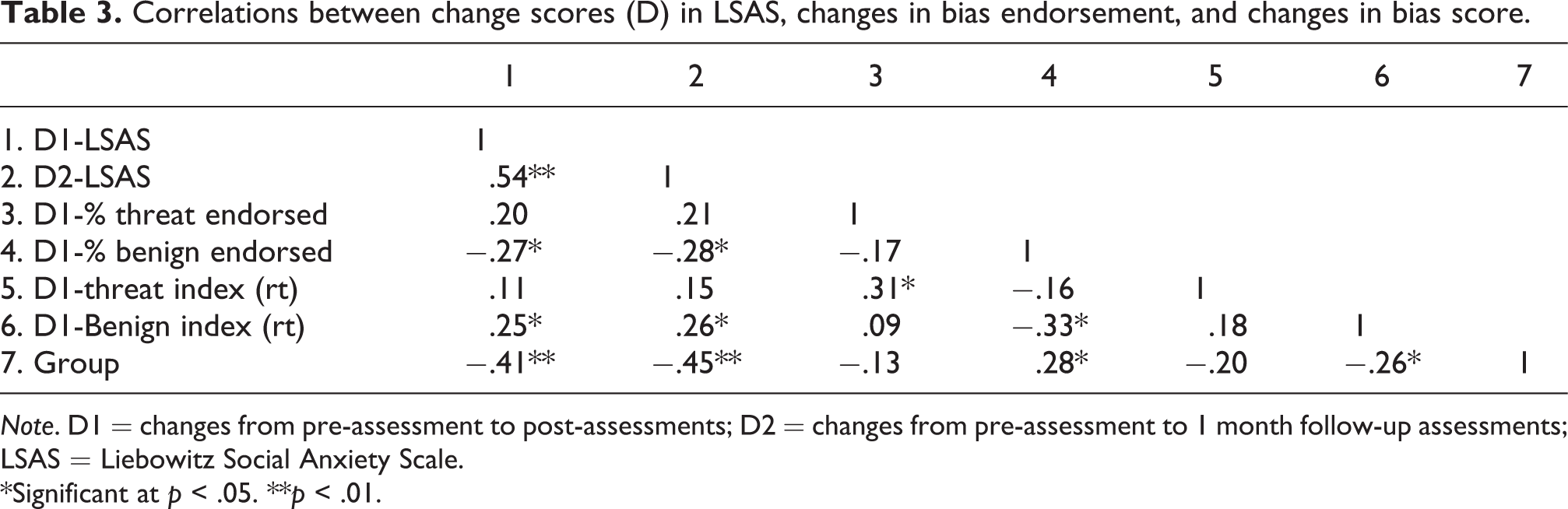
Note. D1 = changes from pre-assessment to post-assessments; D2 = changes from pre-assessment to 1 month follow-up assessments; LSAS = Liebowitz Social Anxiety Scale.
*Significant at p < .05. **p < .01.
Results for both the changes in benign interpretation endorsement and the changes in benign reaction time revealed that the 95% confidence intervals of indirect effects overlapped with zero (endorsement: lower limit = −0.1591, upper limit = 0.0231; reaction time: lower limit = −0.1125, upper limit = 0.0137), which indicated that neither changes in benign interpretation endorsement nor changes in benign reaction time mediated change in social anxiety.
Discussion
In the current study, we examined the efficacy of a multisession CBM-I training, delivered via smartphones, among Chinese undergraduates with high social anxiety. As expected, both the results of benign endorsement and reaction time indices showed that participants who received the training showed more positive interpretations of ambiguous situations after training and this change was accompanied by a reduction in social anxiety. These effects were maintained at least during a 1-month follow-up period. There was a significant correlation between changes in social anxiety and changes in benign endorsement and benign reaction time indices. The correlations of the current study suggest that CBM-I interventions change the cognitive processes that underlie social anxiety, and that these effects can be sustained.
Results from the current study are consistent with findings from previous research. For instance, individuals who received CBM-I had been found to endorse more adaptive interpretations of novel social stimuli (Mathews & Mackintosh, 2000; Salemink, van den Hout, & Kindt, 2010a, 2010b) and a significant reduction in social anxiety symptoms (Amir & Taylor, 2012; Beard & Amir, 2008). A meta-analysis conducted by Menne-Lothmann et al. (2014) found that positive multisession CBM-I training appeared to have long-lasting effects in interpretation bias and social anxiety, and that more training sessions were associated with larger cognitive and mood gains. In the current study, which used a multisession model, effects were maintained at 1-month follow-up.
It was noteworthy that the CBM-I group showed more and quicker benign interpretations, but there were no significant changes in threat bias. Previous studies showed that CBM-I training can increase benign interpretation bias and reduce threat interpretation bias (Stevens, Behar, & Jendrusina, 2018). However, the effect of CBM-I training might also be mediated by the preexisting benign interpretation and threat interpretation. The socially anxious individuals are usually characterized by making fewer benign interpretations and more threat interpretations (Beard & Amir, 2008). Participants in our study were normal undergraduates with high social anxiety. Compared with individuals with normal social anxiety, our participants tend to make fewer benign interpretations, but the same amount of threat interpretations. Thus, it might be easier for the training to demonstrate increased benign interpretations for this group, but not easy to demonstrate reduced threat interpretations. Mogoaşe, David, and Koster (2014) found that a stronger baseline AB was associated with more AB change following training. The effect of baseline interpretation bias on the efficacy of CBM-I should be explored in future studies.
The method of using smartphones to administer CBM-I for social anxiety in a Chinese sample is a novel and important extension of existing interventions. There are several advantages in the current study. Firstly, the training entailed eight sessions, twice a week, over 4 weeks. This is consistent with the movement toward providing longer courses of CBM-I training to enhance consolidation. Previous research indicates that CBM-I is a promising treatment modality for SAD (Amir & Taylor, 2012; Beard & Amir, 2008). However, recently meta-analyses suggest that CBM-I may have modest effects on negative affect, particularly anxiety, in adult samples (Krebs et al., 2017). Krebs et al. (2017) proposed that there may be a temporal lag between a change in interpretation bias and its impact on anxiety. The twice a week smartphone app training in our study may have helped participants form a positive thinking pattern and integrate the positive thinking pattern into their daily routines, which may gradually transform participants’ negative mental states and reduce anxiety.
Secondly, the study investigated this CBM-I intervention in a naturalistic setting rather than in a lab. The portability and accessibility of smartphones mean that multisession training, implemented anytime and anywhere, can be a reality. Utilizing smartphones requires no face-to-face interaction with others (such as a therapist), which can help an individual to avoid the stigma of seeking in person treatment and can be completed at times and locations that better suit the needs of the recipient. The current study supports the efficacy of a multisession treatment, delivered via smartphones with no therapist involved, for the treatment of social anxiety. Although the participants can be more easily distracted. Results from a review (Jones, & Sharpe, 2017) indicate that CBM is more effective when delivered in the laboratory, because the controlled laboratory testing encourages sustained attention to the training and effort to respond accurately. Future technological progress may develop certain functions to make CBM-I tasks more attractive and enable recipients to self-monitor and complete training attentively. Technology will make the online intervention more and more desirable. Through the online platform, treatment recipients can obtain various kinds of audio and video treatment resources for self-treatment. It is also very convenient to communicate with fellow treatment recipients (Boettcher et al., 2018). The potential for this type of intervention delivery should be further explored.
Thirdly, this is the first study of CBM-I training for social anxiety for Chinese undergraduates, and all the WSAP materials were matched with the type of social context depicted.
Limitations and future directions
Although the results are promising, there are several limitations of the current study. Firstly, the sample size of the study is small. Future studies with larger samples are needed to cross-validate the conclusions of the current study and to explore mediation effects. Secondly, there are significantly more female than male participants. Thus, the generalizability of findings is further limited by the gender disparity in our sample. Meta-regression results have shown CBM-I to be particularly effective for women (Jones & Sharpe, 2017; Liu, Li, Han, & Liu, 2017). Women are also disproportionately more likely to experience SAD (Eaton et al., 2012; Xu et al., 2012). Future studies should examine the effectiveness of CBM-I with men more closely or using gender-balanced samples. Thirdly, it is worth noting that Chinese individuals living in collectivistic cultures may have more interdependent self-constructs than Westerners in individualistic cultures (Hofmann, Asnaani, & Hinton, 2010; Woody, Miao, & Kellman-McFarlane, 2014). Although the current study attempted to select culturally appropriate items for the WSAP, cultural influences on participants’ responses were not explored. Future studies on CBM-I with Chinese students may further explore cultural influences.
The major method limitation of the current study was that there were no behavioral stressor tasks, which are considered to be somewhat less susceptible to demand characteristics that can influence response to bias assessment and symptom measures. Participants may have been aware that they were being trained to answer questions about social situations in a certain way and responded accordingly, but it would be important to see if there were differences on tasks, such as a speech task.
Furthermore, a limitation of the paradigm WSAP was the time when the reaction time measurement started. The reaction time measurement started when the participants pressed “continue” and they would have had plenty of time to prepare their response, which makes the task not a real reaction time task.
Although evidence is not entirely consistent, more and more studies support the content specificity of interpretation bias of social anxiety (Giannini & Loscalzo, 2016; Wilson & Rapee, 2005). Recently, some studies indicate that social anxiety is an effective predictor of negative interpretation bias in social situations (Giannini & Loscalzo, 2016; Miers, Blote, Bogels, & Westenberg, 2008). The results of Beard and Amir’s study (2009) suggest that the differences in reaction time between socially anxious and non-anxious participants are specific to social sentences as the response patterns did not generalize to nonsocial sentences. Thus, the CBM-I may be more effective when it targets a specific set of cognitions (cognitive biases, beliefs, or interpretations) rather than a more general disorder-level symptomatology. Future studies are needed to examine the degree to which CBM-I impacts global versus specific interpretations (Stevens et al., 2018) before any conclusions can be drawn.
Finally, the mediation analysis showed that neither changes in benign interpretation endorsement nor changes in benign reaction time mediated changes in social anxiety. One possibility for this nonsignificant mediation is that the sample size is small in the present study. However, to further our understanding of the mechanism of the CBM-I training on social anxiety, a more comprehensive and nuanced study of the mediational mechanisms should be completed.
Conclusion
In conclusion, the current study is the first to test the effects of CBM-I training via smartphones for Chinese undergraduates with social anxiety. The results indicate that this intervention effectively promoted positive interpretations of ambiguous situations and relieved social anxiety. The results suggest that CBM-I training via smartphones might be an effective, accessible, economic, and easily disseminated intervention method for undergraduates with social anxiety. While our findings are promising, we cannot draw conclusions about the clinical applications until further research replicates these findings with a larger and more diverse sample.
Footnotes
Authors’ Note
Xiran Sun is also affiliated with Beijing Key Laboratory of Learning and Cognition and School of Psychology, China. Ranming Yang is also affiliated with University of International Business and Economics, China.
Author contributions
Xiran Sun and Ranming Yang contributed equally to this work. Xiran Sun and Ranming Yang carried out most aspects of data collection and data analysis. Jing Xiao and Qin Zhang edited the paper in English. Lixia Cui directed the entire research project and wrote the paper. Chieh Li thoroughly reviewed and revised the paper.
Declaration of conflicting interests
The author(s) declared no potential conflicts of interest with respect to the research, authorship, and/or publication of this article.
Funding
The author(s) disclosed receipt of the following financial support for the research, authorship, and/or publication of this article: This research was funded by the National Natural Science Foundation of China (31571143 and 31200790).
