




Abstract
Previous research on relationships between self-reported impulsivity and behavioral impulsivity has been limited because behavioral impulsivity was assessed using individual tasks. To alleviate the task-impurity problem and the low reliability of laboratory tasks assessing impulsivity, the present study examined the correlations between a latent variable constructed from the performances of three laboratory tasks assessing impulsive action and each dimension of self-reported impulsivity. University students in Japan (N = 176) responded to the UPPS-P Impulsive Behavior Scale assessing five dimensions of self-reported impulsivity that included the following: negative urgency, lack of premeditation, lack of perseverance, sensation seeking, and positive urgency. They also conducted laboratory tasks for assessing impulsive action: the go/no-go task, stop signal task, and Conners continuous performance test 3rd edition (CCPT). Results indicated weak correlations between each dimension of self-reported impulsivity and the latent variable named impulsive action constructed from the performances of three laboratory tasks (mean r = .10) and with the performances of individual laboratory tasks (mean r = .03). The latent variable of impulsive action and the commission error rate in the CCPT were significantly correlated with sensation seeking. However, this association disappeared after controlling for the influence of gender. These findings suggested that measures of self-reported and behavioral impulsivity might assess different constructs.
Introduction
Impulsivity is an important construct in the field of psychopathology, and various psychiatric disorders are related to impulsivity. Whiteside and Lynam (2001) described that “after subjective distress, impulsivity may be the most common diagnostic criteria in the fourth version of the Diagnostic and Statistical Manual for Mental Disorders (DSM-IV; American Psychiatric Association, 1994)” (p. 670). They noted that impulsivity appears in the diagnostic criteria for impulse-control disorders, borderline personality disorder, antisocial personality disorder, attention-deficit/hyperactivity disorder, mania, dementia, bulimia nervosa, substance use disorders, and paraphilia.
The construct of impulsivity can be broadly summarized as “the tendency to act spontaneously and without deliberation” (Carver, 2005, p. 313). However, it is far from being a unitary construct, and it is assumed to consist of heterogeneous clusters (Cyders & Coskunpinar, 2011; Dick et al., 2010; Whiteside & Lynam, 2001). A particularly important classification of impulsivity is the distinction between self-reported impulsivity, which is assessed by self-report measures, and behavioral impulsivity, which is assessed by laboratory tasks. The widely used dimensions of self-reported impulsivity are those proposed by Lynam and his colleagues (Cyders et al., 2007; Whiteside & Lynam, 2001). They include the following five traits: negative urgency (i.e., the tendency to act rashly when experiencing negative affect), lack of premeditation (i.e., not thinking about the consequences of one’s actions), lack of perseverance (i.e., not following through with a task), sensation seeking (i.e., the tendency to seek excitement), and positive urgency (i.e., the tendency to act rashly when experiencing positive affect). On the other hand, many researchers have suggested that behavioral impulsivity could be classified as impulsive action, which represents the inability to inhibit a prepotent response, and impulsive choice, which represents the preference for smaller immediate rewards over larger delayed rewards (Grant & Chamberlain, 2014; Wang et al., 2016; Weafer & de Wit, 2014).
Although self-reported and behavioral impulsivity had been assumed to represent the same construct, previous studies have shown that the associations between the two are very weak. Cyders and Coskunpinar (2011) conducted a meta-analysis of 27 published studies and reported that the overall correlations between each dimension of self-reported and behavioral impulsivity were .10. Correlations with measures assessing impulsive action were .11 for negative urgency, .11 for lack of premeditation, .10 for lack of perseverance, and .00 for sensation seeking (no study has calculated correlations between impulsive action and positive urgency). Correlations with measures assessing impulsive choice were .01 for negative urgency, .13 for lack of premeditation, .03 for lack of perseverance, .06 for sensation seeking, and .13 for positive urgency. Subsequent meta-analysis also showed little overlap between self-reported and behavioral impulsivity (Sharma, Markon, & Clark, 2014). These weak correlations between self-reported and behavioral impulsivity have cast doubt on the assumption that they assess the same construct.
Research on relationships between self-reported impulsivity and behavioral impulsivity has the limitation that behavioral impulsivity had been assessed using individual tasks. In studies on executive function, adopting a latent-variable approach has been recommended because commonly used executive tasks are complex and typically place heavy demands not only on executive processes but also on nonexecutive processes such as language and visuospatial processing within which the executive processing requirement is embedded (Friedman & Miyake, 2017; Miyake & Friedman, 2012; Miyake et al., 2000). This problem, which is known as the task-impurity problem, as well as the low reliability of executive function tasks, could be alleviated if researchers construct a latent variable from multiple tasks that are assumed to tap the same executive function and statistically extract commonalities across these tasks. As a result, it was considered desirable to adopt a latent variable approach and examine associations between purer executive functions and other variables of interest.
The task-impurity problem might occur in impulsivity studies because laboratory tasks that assess behavioral impulsivity such as the go/no-go task (GNG) and stop signal task (SST) are also categorized as executive function tasks (Snyder, Miyake, & Hankin, 2015). In addition, certain laboratory tasks for assessing behavioral impulsivity such as the SST have low test–retest reliability (Enkavi et al., 2019; Hedge, Powell, & Sumner, 2018; Weafer, Baggott, & de Wit, 2013; Wöstmann et al., 2013). These methodological limitations could weaken the correlations between self-reported and behavioral impulsivity.
Recently, MacKillop et al. (2016) conducted a confirmatory factor analysis (CFA) and constructed a latent variable named impulsive action based on the performances in the GNG, SST, and Conners continuous performance test (CCPT), as well as another latent variable named impulsive choice from the performances on the Delay-Discounting Task and Monetary Choice Questionnaire. 1 Adopting latent variables constructed by MacKillop et al. (2016) could enable us to make a purer assessment of behavioral impulsivity, which might result in stronger correlations between self-reported impulsivity and behavioral impulsivity than that reported in the previous meta-analysis. MacKillop et al. (2016) examined correlations between latent variables of impulsive action and impulsive choice and the latent variable named impulsive personality traits, which was constructed from the subscales of the Barratt Impulsiveness Scale, Version 11 (Patton, Stanford, & Barratt, 1995) and the UPPS-P Impulsive Behavior Scale (Lynam, Smith, Whiteside, & Cyders, 2006) after excluding sensation seeking, which showed weak correlations (r = .16 and .10, respectively). However, because the five dimensions in the UPPS-P are assumed to be distinctive from each other, it would be ideal to examine associations between a latent variable representing either aspect of behavioral impulsivity and each dimension of the UPPS-P.
Negative urgency and positive urgency are more pathological aspects of self-reported impulsivity compared to the other three dimensions (Berg, Latzman, Bliwise, & Lilienfeld, 2015). They seem to be conceptually similar to impulsive action in terms of representing disinhibition of inappropriate behaviors. Although the previous meta-analysis showed small correlations between negative urgency and individual tasks of impulsive action (Cyders & Coskunpinar, 2011), these correlations might increase if the latent variable extracted by MacKillop et al. (2016) were used. Therefore, the present study constructed a latent variable of impulsive action from the performance in the GNG, SST, and CCPT and examined correlations between this latent variable and the five dimensions of self-reported impulsivity. 2
The present study also examined gender difference in the latent variable of impulsive action. The evolutionary perspective predicts that women would have evolved a greater ability to inhibit prepotent responses or low-frequency impulsive action (Bjorklund & Kipp, 1996). However, Weafer and de Wit (2014) reviewed previous studies to examine gender differences in individual impulsive action tasks and obtained mixed results. These inconsistent findings could be caused by the task impurity problem and the low reliability of laboratory tasks assessing impulsivity. Therefore, this study also examined gender difference in impulsive action assessed using the latent variable. Finally, this study investigated whether self-reported impulsivity and behavioral impulsivity were correlated with each other even after controlling for the influence of gender. The analysis controlling for gender was expected to show whether correlations between impulsivity assessed by different methods indicate that both measurements tap a common construct, or if gender differences in each measure have confounded these correlations.
Method
Participants
The sample of this study was identical to the one investigated by Hasegawa, Somatori, Nishimura, Hattori, and Kunisato (2019) that examined the relationship among impulsive action, rumination, stressors, and depression. The method of the study has been reported in detail elsewhere (Hasegawa et al., 2019), and they are described here only briefly. Undergraduate and graduate students recruited from four universities in Japan (N = 176, 89 men and 87 women; mean age 20.38 years, age range 18–28 years, SD = 1.88) participated in this study. All except five participants were Japanese. The other five participants were an American, an Australian, a Chinese, a Korean, and a mixed Japanese and Taiwanese national.
Self-report measures
UPPS-P Impulsive Behavior Scale
This is a 59-item self-report measure developed by Lynam et al. (2006) for assessing five impulsivity-related traits: negative urgency, lack of premeditation, lack of perseverance, sensation seeking, and positive urgency. Good psychometric properties of the UPPS-P, including good internal consistency, construct validity, and test–retest reliability, have been reported (Cyders & Smith, 2007; Cyders et al., 2007; Hedge et al., 2018; Smith et al., 2007; Weafer et al., 2013). The Japanese translation of UPPS-P by Hasegawa, Kunisato, Morimoto, Nishimura, and Matsuda (2018) was used in this study. The Japanese UPPS-P has good concurrent validity, internal consistency, and test–retest reliability (Hasegawa et al., 2018). Each item of the Japanese UPPS-P is rated on a 4-point rating scale anchored by 1 (disagree strongly) and 4 (agree strongly). Higher scores on each UPPS-P subscale indicate higher impulsivity. The internal consistencies in the total sample of the present study were .79 for negative urgency, .85 for lack of premeditation, .73 for lack of perseverance, .85 for sensation seeking, and .89 for positive urgency, respectively.
Behavioral measures
The go/no-go task
The GNG, which is based on the procedure adopted by Gutiérrez-Cobo, Cabello, and Fernández-Berrocal (2017), was used in this study. This task is composed of go trials in which a green circle with a diameter of approximately 5 cm appears on the center of a black screen and no-go trials in which a red circle of the same size appears. The participants were instructed to press the key in the go trials and refrain from pressing any key in the no-go trials. During each trial, the stimuli appeared for 500 ms, with 1,000 ms between trials. The go and the no-go trials were presented in random order. After a brief practice phase, one block of 120 trials was conducted such that 70% were go and 30% were no-go trials. We used the erroneous response rate in no-go trials (i.e., the commission error rate) as an indicator of impulsive action. In addition, we used the mean reaction time in the correct go trials as a supplementary analysis.
Stop signal task
The SST based on the procedure described by Verbruggen, Logan, and Stevens (2008) was used with a small modification, such that all the instructions were written in Japanese. The task included one practice block with 32 trials and three test blocks with 64 trials per block. A trial started with the presentation of a fixation circle for 250 ms, followed by an arrow pointing to the right or the left within the circle, which were presented in white on the center of a black screen. Participants were instructed to respond as quickly as possible where an arrow was pointing (go trial). However, an auditory beep was sounded in 25% of the trials to indicate that the response should be withheld on that particular trial (stop trial). The difficulty of stop trials was continuously adjusted by a tracking procedure that varied the stop signal delay (SSD; the latency between the go stimulus onset and the stop stimulus onset). If participants inhibited a response in a stop trial, the SSD increased by 50 ms in the next stop trial, whereas if they failed to inhibit, the SSD decreased by 50 ms. The SSD in the practice block was initially set to 250 ms and was carried over to the next block.
We used the stop signal reaction time (SSRT) as the main indicator of impulsive action. The SSRT was calculated according to the block-based integration method described by Verbruggen, Chambers, and Logan (2013), in which the SSRT is estimated by subtracting the mean SSD from the percentile of the go reaction time distribution that corresponds to the participant’s proportion of failed stops. The integration SSRT was calculated for each of the three test blocks, and the mean SSRTs were used as each participant’s SSRT. We also used the commission error rate in stop signal trials as a supplementary analysis. This variable is considered to be insensitive for assessing impulsive action because the difficulty of the SST (i.e., the SSD) is adjusted so as that the commission error rate of each participant could approximate 50%.
Conners continuous performance test 3rd edition
This task was developed by Conners (2014). In this task, 15 uppercase letters of the alphabet are displayed in black, one after the other on the center of a white screen for 250 ms. The interstimulus interval is programmed to change to 1, 2, or 4 s for every 20 trials. Participants were instructed to press the space bar as fast as possible when a letter other than an “X” was displayed (go trials), but to inhibit the response when an “X” was shown (no-go trials). The test phase composed of 361 trials was administered after a brief practice phase, such that 80% of the test trials were go trials and the others were no-go trials. The first trial was not scored. We used the commission error rate in trials after the first trial as an indicator of impulsive action. Furthermore, the mean reaction time in the correct go trials was used as a supplementary analysis.
Procedure
Students who were interested in participating in this study were individually invited to the authors’ laboratory. Then, they gave their written informed consent for participating in the study. After that, the participants completed the GNG, SST, and CCPT in a fixed order. The GNG and SST were administered via Inquisit 5 (Millisecond Software, LLC.), and the CCPT was administered using special software for conducting this task (Multi-Health Systems Inc., Toronto, Ontario). Participants could take a short break between tasks and between the SST blocks. After completing the three tasks, the participants responded to a packet of questionnaires including the UPPS-P. After the completion of the study, participants were debriefed and were given a gift certificate worth 1500 yen (approximately US$13). The Ethics Committee of Tokai Gakuin University approved this study.
Statistical analysis
Observations of the participants when they were conducting the SST, as well as SST data indicated that a small proportion of participants deliberately delayed pressing keys in every trial so as not to make errors in stop trials. It is inappropriate to assess response inhibition in the SST when participants delayed pressing any keys. Therefore, data of 19 participants in the SST were excluded because their go trial reaction times exceeded 700 ms. In addition, the CCPT data of four participants were excluded: one participant because the experimenter failed to save the data, one participant because of a computer problem during the CCPT, one participant because of outliers in the error rate of go trials, and one participant because of falling asleep during the CCPT. Furthermore, reaction times for correct go trial having over ±3 SDs from the mean of each participant in the GNG were removed from the analysis based on findings by Gutiérrez-Cobo et al. (2017). However, no reaction time for correct go trials in the CCPT was omitted because this test was standardized without using any data reduction method.
Raw data were analyzed except for the commission error rates in the GNG and SST to which square root transformation was applied because these variables were highly skewed (see Table 1). We allowed missing data in the analyses. Descriptive statistics and t-test were conducted using SPSS version 23 (IBM Corporation), and all other analyses were conducted using Mplus 8.1 (Muthén & Muthén, 1998–2017).
Descriptive statistics of each measure.

Note. SD = standard deviation; GNG = go/no-go task; SST = stop signal task; SSRT = stop signal reaction time; CCPT = Conners continuous performance test 3rd edition.
Hasegawa et al. (2019) conducted CFA with the same sample and confirmed that a single latent variable could be constructed from the performances of three laboratory tasks assessing impulsive action (i.e., the GNG, SST, and CCPT). Because this model was just identified (zero degrees of freedom), there has been no test of the overall model fit. Factor loadings of the GNG, SST, and CCPT were .41, .34, and .83, respectively (all p < .005). We used this latent variable, which was named “impulsive action” to examine whether impulsive action was related to self-reported impulsivity and whether there were gender differences in impulsive action.
Structural equation modeling was conducted to examine correlations between the latent variable of impulsive action and the other variables and gender differences in the mean scores for impulsive action. Missing data when conducting structural equation modeling were handled with full information maximum likelihood method.
Results
Table 1 displays descriptive statistics of each subscale of the UPPS-P and performances of individual tasks assessing behavioral impulsivity. Although descriptive statistics of the commission error rates in the GNG and SST given in Table 1 are based on raw data, transformed data of these variables were used in all the analyses described below. Table 2 gives the correlations among each subscale of the UPPS-P, individual task performances, and the latent variable assessing impulsive action. The results indicated that the CCPT commission error rate and the latent variable of impulsive action were significantly and positively correlated with sensation seeking, whereas reaction times in the correct CCPT go trials were negatively correlated with the lack of perseverance, although all these correlations were weak.
Correlation between behavioral impulsivity and self-reported impulsivity.
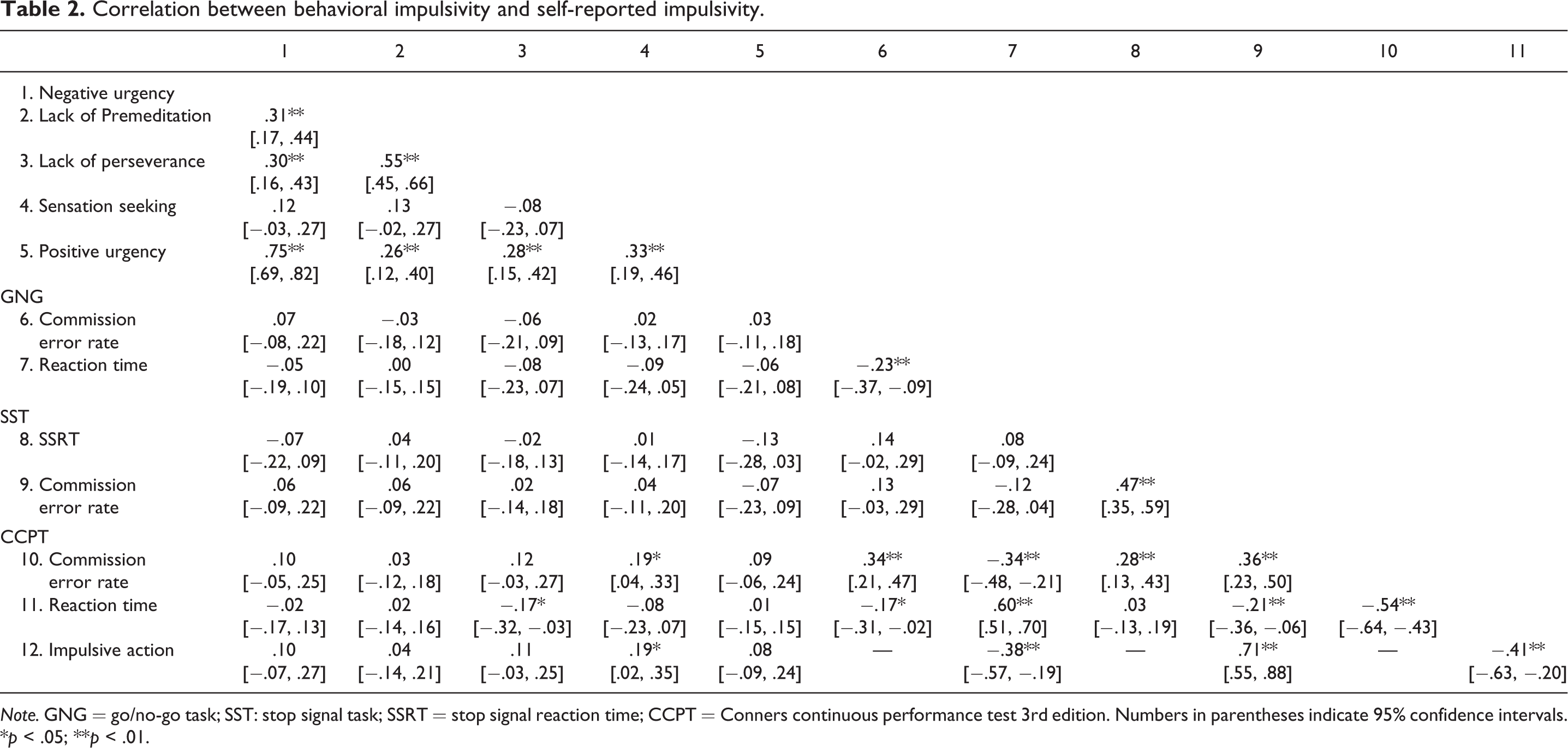
Note. GNG = go/no-go task; SST: stop signal task; SSRT = stop signal reaction time; CCPT = Conners continuous performance test 3rd edition. Numbers in parentheses indicate 95% confidence intervals.
*p < .05; **p < .01.
Table 3 lists the means and standard deviations of each measure for men and women. A t-test showed that men scored higher on sensation seeking, made more CCPT commission errors, and responded more rapidly to go trials in the GNG and the CCPT than women. Results also showed that the difference in age between men and women was not significant, suggesting that age differences did not cause significant gender differences in the measures described earlier. Multiple group CFA was conducted with men as the reference group and women as the non-reference group to examine gender differences in the latent variable of impulsive action. The unstandardized item loading across groups was constrained to be equal across groups, and the factor mean was fixed at zero for men and freely estimated in women. This model had an excellent fit with the data: χ2(4) = 4.20, p = .39; comparative fit index = .99; root mean square error of approximation = .02. The χ2 test of difference indicated that freeing the means and the variances of the latent variable across sex did not deteriorate the model fit compared to the saturated model that did not free the means and the variances. Result showed that group difference between men (M = .00, SD = .37) and women (M = −.23, SD = .40) was not significant, although effect size was medium (p = .092; d = .59).
Gender differences in measures of self-reported and behavioral impulsivity.

Note. SD = standard deviation; GNG = go/no-go task; SST = stop signal task; SSRT = stop signal reaction time; CCPT = Conners continuous performance test 3rd edition. Although Ms, SDs, and ds of the commission error rates of both the GNG and SST were calculated using raw data, group differences of these variables were tested using the transformed data of these variables.
*p < .05; **p < .01.
Partial correlations of sensation seeking with the CCPT commission error rate and impulsive action were calculated to examine whether these correlations stem from gender differences in the impulsivity variables. After controlling for gender, neither the correlation between sensation seeking and the CCPT commission error rate nor the latent variable of impulsive action were significant (pr = .11, 10, respectively, p > .16). Partial correlations were also calculated between the lack of perseverance and CCPT reaction time, which showed that this association remained significant even after controlling for gender (pr = −.16, p =.03).
Discussion
Consistent with previous meta-analysis (Cyders & Coskunpinar, 2011; Sharma et al., 2014), correlations in this study between self-reported impulsivity and behavioral impulsivity were weak. Correlations between main indices of behavioral impulsivity that was assessed by the performances in individual tasks (i.e., the commission error rates in the GNG and CCPT, and the SSRT), and each dimension of self-reported impulsivity ranged from −.13 to .19 with a mean of .03. Moreover, although positive and negative urgency seems to be conceptually similar to impulsive action in terms of representing disinhibition of inappropriate behaviors, none of the correlations between positive and negative urgency and main indices of individual task performances assessing impulsive action were significant (mean r = .02).
Correlations between the latent variable named impulsive action constructed from three laboratory tasks and five dimensions of the UPPS-P were also weak and these coefficients were similar to those of individual impulsivity tasks (rs ranged from .04 to .19 with a mean of .10). In particular, correlations between the latent variable of impulsive action and positive and negative urgency were approximately .10, although these measures were assumed to assess a similar construct. These findings suggested that the weak correlation between laboratory tasks and self-report measures assessing impulsivity might not be due to the task impurity problem and low test–retest reliability of impulsivity tasks, although this possibility cannot be entirely precluded.
Only the positive correlations of the commission error rate in the CCPT and the latent variable of impulsive action with sensation seeking were significant among the 20 correlations between dimensions of self-reported impulsivity and the main indices of behavioral impulsivity. These findings were not consistent with the results of the meta-analysis conducted by Cyders and Coskunpinar (2011), which indicated nonsignificant correlations between sensation seeking and impulsive action. Therefore, it is possible that the significant correlations found in the present study were false-positive results. Interestingly, as described below in detail, sensation seeking and performances in the CCPT were the measures that were found to have gender differences, and gender difference in the latent variable of impulsive action had a similar effect size, although it was not significant. After controlling for the influence of gender, significant associations of sensation seeking with the CCPT and the latent variable of impulsive action disappeared, suggesting that these significant correlations were due to the confounding effect of gender and that these measures did not assess the same construct. We also found a significant negative correlation between the lack of perseverance and the mean reaction time of correct go trials in the CCPT after controlling for gender. Because this correlation was weak and exploratory, it is suggested that future studies should be conducted to reconfirm our findings.
In the present study, men scored higher on sensation seeking than women. This finding is consistent with the previous meta-analysis of gender differences in sensation seeking (Cross, Copping, & Campbell, 2011). In addition, men made more commission errors in the CCPT. Because the mean response time of the correct go trials in the CCPT and GNG was faster in men than women, it is plausible that men try to respond rapidly to every type of trial, and as a result, had difficulty in refraining from responding to no-go trials. The effect size of sensation seeking and the commission error rate of the CCPT was in the medium range. Moreover, the identical effect size was detected for the latent variable of impulsive action, although this difference was nonsignificant.
Weafer and de Wit (2014) reviewed previous studies that examined gender differences in individual task performances of impulsive action and suggested that the findings of previous studies were mixed. It is possible that mixed findings resulted from the task impurity problem and low test–retest reliability of impulsive tasks. To solve these methodological problems, we adopted the latent-variable approach. Medium effect size in the latent variable of impulsive action favoring men is consistent with the evolutionary perspective suggesting that greater evolutionary preference to select high-quality mates and inhibit maladaptive social and sexual responses might have resulted in enhanced inhibitory abilities in prehistoric women than men, which are observable in modern people (Bjorklund & Kipp, 1996). However, this possibility should be considered cautiously because the gender difference in the latent variable of impulsive action was nonsignificant. Therefore, it is suggested that a future study should be conducted with a larger sample.
There are certain limitations to this study in addition to the issue described above. Because the sample of this study was composed only of undergraduate and graduate students, it is necessary to replicate it in a different population. In addition, the average rate of commission errors in the GNG was low, and about half of the participants in this study (n = 90) did not make any errors. As a result, the distribution of the commission error rate in the GNG was highly skewed, although this variable was normally distributed after applying the square root transformations. Young, Sutherland, and McCoy (2018) showed that shorter intertrial intervals, intermediate go/no-go stimuli ratios (2:1 to 4:1), and the use of multiple types of go stimuli produced more commission errors. It is suggested that future studies increase the difficulty of the GNG and examine associations between GNG performances and self-reported impulsivity. Furthermore, the factor loading of the SSRT on the latent variable of impulsive action was relatively low according to general standards (<.40). MacKillop et al. (2016) showed that the factor loadings of the GNG, SST, and CCPT performances on impulsive action were .69, .42, and .67, respectively. As suggested by Verbruggen et al. (2013), this study used the integration SSRT in the SST as an index of impulsive action, which is in contrast to the study by MacKillop et al. (2016) that used the commission error rate on stop trials as the index. It is possible that the difference in the scoring method lowered the factor loadings of the SST. Future studies should examine the procedures and the method of scoring each task that would be ideal for constructing the latent variable of impulsive action. Moreover, perhaps it would be fruitful to use the performance in the Simon task, which is considered to be a measure of impulsive action (Tiego, Testa, Bellgrove, Pantelis, & Whittle, 2018), as an observable variable in constructing the latent variable of impulsive action. Finally, Verbruggen and Logan (2008) proposed that task performance in the go/no-go paradigm including the GNG and CCPT might not reflect controlled top-down inhibition because no-go stimuli and stopping are consistently associated in these tasks, and the stop goal might be activated automatically through memory retrieval. Because this shortcoming raises questions about the adequacy of tasks used for measuring individual differences in impulsive action, it is recommended that future studies use other tasks requiring more reliance on top-down executive control processes, although the SSRT, which might reflect controlled inhibition (Verbruggen & Logan, 2008), was not significantly correlated with any of the dimensions of self-reported impulsivity in this study.
The present study demonstrated that correlation between the GNG, SST, and CCPT performances and each dimension of self-reported impulsivity were weak similar to correlations between the latent variable of impulsive action constructed from these three behavioral measures. Correlations between the self-report and laboratory measures that were assumed to assess a conceptually similar construct were also weak. These findings indicated that weak correlations between self-reported and behavioral impulsivity shown in the previous meta-analysis (Cyders & Coskunpinar, 2011; Sharma et al., 2014) were not due to the task impurity problem and low test–retest reliability of the laboratory tasks of impulsivity. Although correlations of sensation seeking with the commission error rate in the CCPT as well as the latent variable of impulsive action were significant, the finding that these associations disappear after controlling for gender suggests that these measures do not tap the same construct. This study also showed that men score higher on sensation seeking and make more commission errors in CCPT than women, and a similar trend was also found for the latent variable of impulsive action. Gender differences found in the present study were consistent with the evolutionary perspective of impulsivity (Bjorklund & Kipp, 1996). The present study is significant because it adapted the latent variable approach to behavioral impulsivity for examining the association between self-reported and behavioral impulsivity, and gender differences in these variables. It is suggested that future studies are designed to overcome the limitations of the present study and to investigate the content of self-reported and behavioral impulsivity constructs, as well as possible gender differences in impulsive action.
Footnotes
Acknowledgment
The authors thank Ryosuke Asano for his advice on statistical analysis.
Declaration of Conflicting Interests
The author(s) declared no potential conflicts of interest with respect to the research, authorship, and/or publication of this article.
Funding
The author(s) disclosed receipt of the following financial support for the research, authorship, and/or publication of this article: This study was partially supported by grants from the Japan Society for the Promotion of Science (18K13333).
