




Abstract
Models of social anxiety emphasize anticipatory processing (AP) and post-event processing (PEP) as repetitive negative thinking (RNT) processes that occur before and after social-evaluative events, respectively. Both AP and PEP have been implicated as maladaptive processes which maintain social anxiety. Accordingly, a common vulnerability, such as poor attentional control, may serve to maintain both. The present research included two separate samples to investigate the relationship between attentional control and AP (Sample 1) and PEP (Sample 2). Participants (n = 49 for Sample 1; n = 35 for Sample 2) completed self-report measures of social anxiety, AP or PEP, attentional control, and trait anxiety. Poorer total attentional control was associated with social anxiety in both samples. In addition, attentional control total and attentional shifting were negatively associated with PEP (Sample 2) but not with AP (Sample 1). Mediation modeling suggested that trait anxiety mediated the relationship between total attentional control and PEP. The findings suggest that attentional control plays a role in the regulation of emotion, such as anxiety, and RNT processes, such as PEP, but not AP.
Keywords
Introduction
Social anxiety disorder (SAD) is one of the most commonly occurring (Slade, Johnston, Oakley Browne, Andrews, & Whiteford, 2009) and researched (Boschen, 2008) anxiety disorders. It is characterized by excessive fear about one or more social situations, potentially exposing an individual to real or anticipated negative evaluations by others (American Psychiatric Association [APA], 2013). According to cognitive-behavioral models of social anxiety, two of the core cognitive maintenance factors of SAD include anticipatory processing (AP), which occurs prior to a social/performance event and is a form of repetitive negative thinking (RNT) that is dominated by predictions of poor performance, previous failures, negative images of oneself, and rejection; and post-event processing (PEP), which occurs after a social/performance event and is a form of RNT focused on perceived social failure (Clark & Wells, 1995; Rapee & Heimberg, 1997).
Research to date predominantly supports the contention that both AP and PEP are maladaptive processes that maintain social anxiety. For example, previous research on AP suggests that high socially anxious individuals who engage in AP experience increased levels of anxiety (Brown & Stopa, 2007; Hinrichsen & Clark, 2003; Wong & Moulds, 2011), predict a more negative overall appearance of themselves (Vassilopoulos, 2005), and show increased attentional bias for internal threat information (Mills, Grant, Judah, & White, 2014). Similarly, empirical studies on PEP suggest that high socially anxious individuals who engage in PEP experience a maintenance in anxiety (Wong & Moulds, 2009), report less positive thoughts and perceive their performance in a less positive manner (Brozovich & Heimberg, 2011; Kocovski, MacKenzie, & Rector, 2011), and experience greater PEP and negative thoughts over the course of 1 week (Rowa, Antony, Swinson, & McCabe, 2014).
AP and PEP are both considered forms of RNT with some degree of overlap (McEvoy, Mahoney, & Moulds, 2010; McEvoy, Watson, Watkins, & Nathan, 2013). In terms of similarities, both AP and PEP are processes that are considered repetitive, negatively valenced, centered on social performance, and difficult to disengage from (Laposa & Rector, 2016). Conversely, there also appears to be functional differences between them that support their diagnostic specificity (for a review of AP, see Sluis, Boschen, Neumann, & Murphy, 2017a; for a review of PEP, see Brozovich & Heimberg, 2008; Sluis, Boschen, Neumann, & Murphy, 2017b; Wong, 2016). The most distinct differences between AP and PEP include temporal orientation (i.e., prior to an event and post-event) and discrepancy (i.e., a completed vs. an uncompleted task; Martin & Tesser, 1996). However, the association between these cognitive constructs suggests that they may result from a common cognitive cause, such as attentional control deficits (Derryberry & Reed, 2002).
Attentional control is deemed necessary for the flexible regulation of cognitive resources and involves top-down control over various dimensions of attention (Armstrong, Zald, & Olatunji, 2011). Accordingly, it is thought that cognitive performance may be adversely affected by high levels of anxiety due to poor top-down attentional control (Derakshan & Eysenck, 2009; Eysenck & Derakshan, 2011; Eysenck, Derakshan, Santos, & Calvo, 2007). While attentional control can be voluntary or involuntary, the voluntary control system of attentional focus and shifting has been identified as an important source of individual differences (Derryberry & Reed, 2002). The attentional focusing dimension refers to the ability to maintain attentional engagement when faced with task-irrelevant distractions, while attentional shifting refers to the ability to allocate attention away from irrelevant distractions toward new or relevant tasks (Derryberry & Reed, 2002). A weakened attentional control system may facilitate RNT processes, such as AP and PEP, by allowing maladaptive thoughts to take precedence over adaptive cognitions, thereby fostering an inability to disengage attention away from the RNT. A similar line of research by Koster, De Lissnyder, Derakshan, and De Raedt’s (2011) suggests an impaired disengagement hypothesis to account for persisting negative thoughts in depression. Although this model describes the maintenance of rumination in the context of depression, the assumptions of the model appear comparable to account for anxiety also (i.e., depression and anxiety are highly comorbid clinical conditions; Belzer & Schneier, 2004). This model proposes that impaired attentional disengagement drives persistent rumination. Specifically, low attentional control may lead to prolonged rumination, subsequently resulting in negative affect or depression (however, potential reciprocal relations between rumination, attentional control, and depression are also posited).
While there is no prior research to date directly examining the association between attentional control, AP, and PEP, previous clinical research has demonstrated that deficits in attentional control are related to similar RNT processes in other anxiety disorders (Armstrong et al., 2011). For example, Armstrong, Zald, and Olatunji (2011) examined deficits in attentional control that may contribute to obsessional thoughts in patients with obsessive–compulsive disorder (OCD) or perseverative worry in patients with generalized anxiety disorder (GAD). They found that diminished attentional control was associated with both OCD and GAD relative to nonclinical controls. Furthermore, they demonstrated that deficits in attentional control were related to increased worry in GAD (but not with increased obsessional thoughts in OCD) and findings from their mediation modeling suggested that trait anxiety meditated the relationship between attentional control and worry in GAD. Given that worry is also considered an RNT process similar to that of AP and PEP, an examination of diminished attentional control relative to cognitive maintenance factors in social anxiety is worthy of investigation.
Aims, overview, and hypotheses
The current study examined the relationship between RNT processes characteristic of social anxiety (AP and PEP) and dimensions of self-reported attentional control (i.e., total scores of attentional control, attentional focusing, and attentional shifting). Given the preliminary nature of the research, self-report measures were used exclusively to assess all constructs of interest (i.e., social anxiety, AP, PEP, trait anxiety, and attentional control) as self-report measures provide useful insight from participants. However, the authors acknowledge that future studies will need to incorporate multimethod paradigms to assess attentional control in a more holistic manner.
On the basis of theory and previous research, it was predicted that deficits in attentional control (including attentional focusing and shifting) would be negatively correlated with core cognitive maintenance factors of SAD, including both AP and PEP. Furthermore, it was expected that self-reported social anxiety would also be associated with deficits in attentional control. Lastly, given that trait anxiety has been found to be associated with measures of attentional control (Derryberry & Reed, 2002) and is highly correlated with measures of SAD (Mattick & Clarke, 1998), a similar mediation model as that in Armstrong et al. (2011) was conducted with trait anxiety to gain further insight into the relationship between attentional control and cognitive maintenance factors of SAD.
Method
Participants
A total of 160 (Sample 1) and 122 (Sample 2) undergraduate participants completed an online screening measure of the Social Interaction Anxiety Scale (SIAS; Mattick & Clarke, 1998) to select individuals scoring higher than nonanxious samples on social anxiety. The SIAS has strong psychometric properties and good screening utility for both clinical and research purposes (Rodebaugh, Woods, Heimberg, Liebowitz, & Schneier, 2006). Participants received partial course credit as the basis for participation. Participants for the current study were selected by choosing those who scored equal to or above the mean on the SIAS (≥ 34) reported for a clinical sample with social phobia by Mattick and Clarke (1998; Heimberg, Mueller, Holt, Hope, & Liebowitz, 1992; Judah, Grant, Lechner, & Mills, 2013; Mills, Grant, Judah, & Lechner, 2013). The use of analogue samples in social anxiety has been justified by previous research whereby results obtained are largely similar to that of clinical samples (Stopa & Clark, 2001). Sample 1 consisted of 49 undergraduate participants (11 males and 38 females) with an age range of 17–48 years (M = 21.84, SD = 6.68). Sample 2 consisted of 35 undergraduate participants (9 males and 26 females) with an age range of 17–29 years (M = 20.41, SD = 3.55). 1 All procedures included in the study have been approved by the Griffith University Human Research Ethics Committee.
Measures
The SIAS
The SIAS (Mattick & Clarke, 1998) measures fear of social interaction in dyads or groups. The SIAS comprises 20 items with participants indicating the extent to which the statement is characteristic of them (e.g., I have difficulty talking with other people) using a response scale ranging from 0 (not at all characteristic or true of me) to 4 (extremely characteristic or true of me). The SIAS demonstrated excellent internal consistency in Sample 1 (α = .95) and Sample 2 (α = .95).
State-Trait Anxiety Inventory-Trait Version (STAI-T)
The STAI-T (Spielberger, 1983) is a 20-item scale that measures pervasive or chronic symptoms of anxiety (e.g., I lack self-confidence). Each item is measured on a 4-point Likert-type scale ranging from 0 (almost never) to 3 (almost always). The STAI-T had excellent internal consistency in Sample 1 (α = .92) and Sample 2 (α = .93).
Attentional Control Scale (ACS)
The ACS (Derryberry & Reed, 2002) is a 20-item measure of general capacity to control attention across two domains including the ability to focus (e.g., When I need to concentrate and solve a problem, I have trouble focusing my attention) and shift attention when necessary (e.g., I can quickly switch from one task to another). The ACS is rated on a 4-point scale from 1 (almost never) to 4 (always) with participants indicating the extent to which the statement is characteristic of them. Subscale scores are obtained for both the focusing and shifting components, along with a total score for overall attentional control. Higher scores on the ACS indicate greater attentional control. The ACS had adequate internal consistency in Sample 1 (α = .70) and Sample 2 (α = .87).
Anticipatory Social Behaviors Questionnaire (ASBQ)
The ASBQ (Hinrichsen & Clark, 2003) is a 12-item questionnaire which measures trait levels of AP behaviors prior to social-evaluative situations in general, such as giving a speech or interacting with unfamiliar people (e.g., I imagine the worst that could happen, I try to plan what I am going to say). Items are measured using a 4-point Likert-type scale from 1 (never) to 4 (always). The ASBQ had good internal consistency in Sample 1 (α = .83).
PEP Questionnaire-Revised (PEPQ-R)
The PEPQ-R (McEvoy & Kingsep, 2006) is a 9-item scale assessing how much and how often individuals engaged in PEP after a social situation in the past 2 weeks using 0–100 visual analogue scales (e.g., Do you find it difficult to forget about the event? If you think about the event, over and over, do your feelings about the event get worse and worse?). One item on the PEPQ-R assesses state anxiety (e.g., How much anxiety are you experiencing?) rather than PEP; as a result, this item was removed from the final analyses to ensure that the findings were not confounded by the inclusion of a state anxiety item. The PEPQ-R had excellent internal consistency in Sample 2 (α = .90).
Procedure
Participants provided informed written consent and demographic information and were then administered all self-report questionnaires in a laboratory setting in-person. Participants completed the same questionnaire measures, although participants in Sample 1 also completed the ASBQ (which was not administered in Sample 2) and participants in Sample 2 completed the PEPQ-R (which was not administered in Sample 1). Participants were debriefed about the nature of the study upon completion of the study.
Results
Sample 1
The means, standard deviations, and ranges of all self-report measures are presented in Table 1. Correlations between SAD, AP, trait anxiety, and attentional control are presented in Table 2.
Means, standard deviations, and range of scores for the primary measures (N = 49).
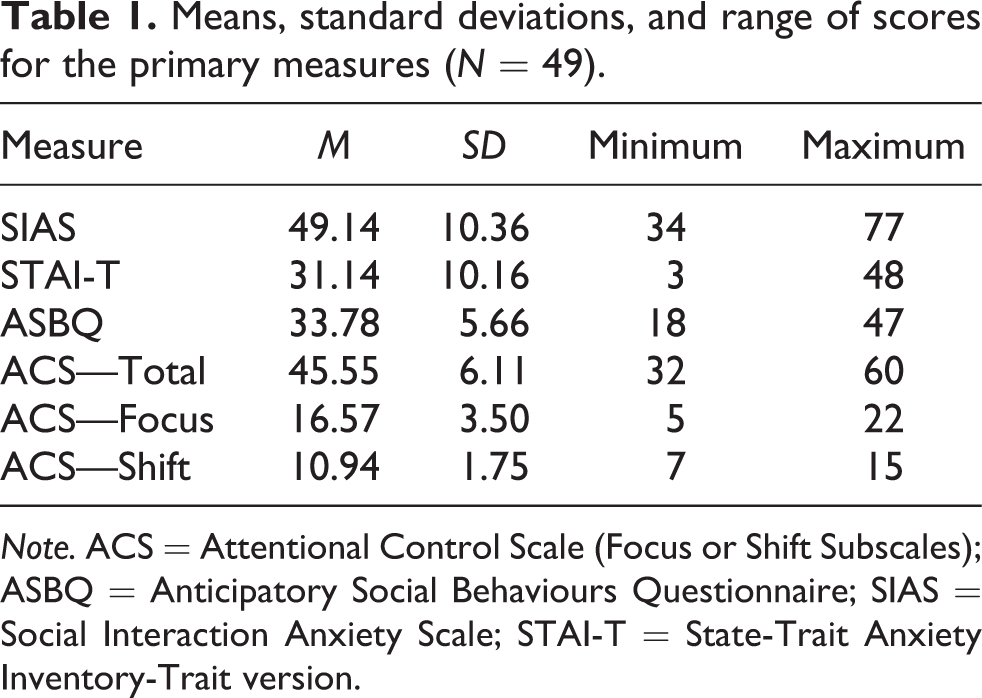
Note. ACS = Attentional Control Scale (Focus or Shift Subscales); ASBQ = Anticipatory Social Behaviours Questionnaire; SIAS = Social Interaction Anxiety Scale; STAI-T = State-Trait Anxiety Inventory-Trait version.
Correlations between SAD, AP, trait anxiety, and attentional control (N = 49).

Note. ACS = Attentional Control Scale (Focus or Shift Subscales); AP =anticipatory processing; ASBQ = Anticipatory Social Behaviours Questionnaire; SAD = social anxiety disorder; SIAS = Social Interaction Anxiety Scale; STAI-T = State-Trait Anxiety Inventory-Trait version.
*p < .05; **p < .01.
As predicted, total scores for attentional control were negatively correlated with social anxiety as measured by total SIAS scores. However, the predicted correlations between attentional control total, shifting or focus, and AP were not found. Given the absence of associations between AP and attentional control, mediation models were not explored for AP.
Sample 2
The means, standard deviations, and ranges of all self-report measures are presented in Table 3. Correlations between SAD, PEP, trait anxiety, and attentional control are presented in Table 4.
Means, standard deviations, and range of scores for the primary measures (N = 35).

Note. ACS = Attentional Control Scale (Focus or Shift Subscales); PEPQ-R = Post-Event Processing Questionnaire Revised; SIAS = Social Interaction Anxiety Scale; STAI-T = State-Trait Anxiety Inventory-Trait version.
Correlations between SAD, PEP, trait anxiety, and attentional control (N = 35).

Note. ACS = Attentional Control Scale (Focus or Shift Subscales); PEP = post-event processing; PEPQ-R = Post-Event Processing Questionnaire – Revised; SAD = social anxiety disorder; SIAS = Social Interaction Anxiety Scale; STAI-T = State-Trait Anxiety Inventory-Trait version.
*p < .05; **p < .01.
As predicted, attentional control total and attentional focus were negatively correlated with social anxiety as measured by the SIAS. Furthermore, attentional control total and attentional shifting were negatively correlated with PEP as predicted. Given that attentional control total was significantly negatively correlated with trait anxiety and PEP, further examination of a mediation model between attentional control total, trait anxiety, and PEP was conducted.
Mediation analyses of attentional control and PEP with trait anxiety
On the basis of mediation modeling conducted by Armstrong et al. (2011), trait anxiety was examined as a mediator of the association between attentional control total and PEP. Baron and Kenny’s (1986) conditions required to statistically test mediation were employed. Bootstrapping methods were used because this is a nonparametric test that provides a sensitive way to determine whether the indirect effect of the independent variable (attentional control total) on the dependent variable (PEP) through the mediator (trait anxiety) is statistically significant in smaller samples. Mediation modeling using bootstrapping methods with smaller samples has been used in previous research (Fritz & MacKinnon, 2007; Sluis & Boschen, 2014). Figure 1 presents results of the mediating model for the 95% confidence interval of the indirect path (ab) obtained using 5,000 resamples.

Mediation model for trait anxiety as a mediator between attentional control total and post-event processing with standardized regression coefficients (*p < .05; **p < .001). The indirect effect (ab) was significant at the 95% confidence interval (lower limit = −.8108, upper limit = −.0269).
Attentional control total and trait anxiety accounted for significant variance in PEP, R 2 = .45, F(2, 32) = 13.24, p < .001. Lower levels of attentional control were associated with higher levels of PEP when attentional control was entered alone in the regression model, β = −0.59, t(33) = −2.17, p = .04 (path c), and attentional control was negatively associated with trait anxiety, β = −0.44, t(33) = −2.30, p = .03 (path a). Higher levels of trait anxiety predicted higher levels of PEP while controlling for attentional control, β = 0.88, t(32) = 4.38, p < .001 (path b). The indirect effect (ab) of attentional control through trait anxiety on PEP was significant such that the 95% confidence interval did not overlap with zero (lower limit = −.8108, upper limit = −.0269). The direct effect of attentional control on PEP was no longer significant when controlling for trait anxiety, supporting full mediation, β = −0.21, t(32) = −0.88, p = .38 (path c′). 2
Discussion
The current research aimed to elucidate the associations between RNT processes of social anxiety, including both AP and PEP, and attentional control in an attempt to determine whether a poorer attentional control system is associated with increased levels of RNT in social anxiety. Given the paucity of research examining these associations within the context of social anxiety, the current study also aimed to explore potential mediating effects using an additional construct highly correlated with both attentional control and cognitive maintenance factors of social anxiety, namely trait anxiety (Derryberry & Reed, 2002; Mattick & Clarke, 1998). Therefore, it was expected that reduced attentional control would be associated with higher levels of AP and PEP in social anxiety.
As predicted, higher levels of social anxiety were associated with poorer attentional control scores (Samples 1 and 2) and decreased attentional focus (Sample 2). These findings are consistent with previous research demonstrating that top-down attentional control is adversely affected by high levels of anxiety (Derakshan & Eysenck, 2009; Derryberry & Reed, 2002; Eysenck & Derakshan, 2011; Eysenck et al., 2007). In terms of the association between attentional control and RNT processes of social anxiety (e.g., AP and PEP), the present findings were partially consistent with predictions. In Sample 2, higher levels of PEP were associated with poorer total attentional control and attentional shifting. This finding is consistent with previous research highlighting the role of attentional control in anxiety disorders (Berggren & Derakshan, 2013; Derryberry & Reed, 2002; Moriya & Tanno, 2008), and in particular, similar RNT processes such as worry (Armstrong et al., 2011). Furthermore, research within the field of attention training in anxiety disorders suggests that increased attentional control reduces maintaining features of anxiety (Wells, 1990; Wells, White, & Carter, 1997). For example, McEvoy and Perini (2009) conducted attention training for a clinical sample of participants with social phobia and found that increased attentional control during treatment was associated with reductions in both AP and PEP.
Conversely, AP was not associated with any aspect of attentional control (i.e., total, focus, or shifting) suggesting that increased AP is not related to poorer attentional control. While this finding is in direct contrast with previous research on attention training demonstrating a relationship between attentional control and AP (McEvoy & Perini, 2009), it is consistent with other research that did not find an association between attentional control and similar RNT processes such as rumination or obsessional thoughts (Armstrong et al., 2011). It is possible that increased levels of AP may be underpinned by other factors not examined in Sample 1, such as motivation, or may even have an adaptive component that is not affected by attentional control (Sluis, Boschen, Neumann, & Murphy, 2017c). The different associations between AP and PEP with attentional control found in Samples 1 and 2 are an important finding that highlights a potential distinguishing factor between both AP and PEP in social anxiety. However, it is also important to note that the content and time frames to which social situation responses are anchored to (on the measures employed for AP and PEP) are somewhat diverse. For example, the ASBQ (i.e., measure for AP used) assesses trait AP related to social situations in general with no specified time frame, whereas the PEPQ-R (i.e., measure for PEP used) assesses PEP related to a social situation occurring in the past 2 weeks. Accordingly, the discrepancy of the findings relative to attentional control with AP and PEP may in fact be due to differences in the variety of social situations recalled (i.e., social performance vs. a social interaction) or biases related to the time frames of recalled social situations. In addition, the PEPQ-R incorporates more items focused on RNT than the ASBQ. As such, it is probably not surprising that the PEPQ-R is more highly correlated with attentional control than the ASBQ. In order to make any firm conclusions regarding attentional control being more involved in PEP than AP, future research would need to replicate the findings with more comparable measures of AP and PEP. Therefore, caution should be ensured when interpreting and comparing the findings for Samples 1 and 2 relative to AP and PEP findings.
While an association between attentional control and PEP was evident in Sample 2, it appears that the pathway of this relationship is mediated by trait anxiety, rather than social anxiety. However, it is important to note that the sample included only those scoring higher than nonanxious samples on mean levels of social anxiety (e.g., SIAS). Thus, to conclude that social anxiety does not mediate this relationship may be somewhat premature and should be investigated in future studies. The current mediated outcome is consistent with Armstrong et al. (2011), who found that reduced attentional control was associated with increased levels of worry that was also mediated by higher levels of trait anxiety. These mediated relationships suggest that attentional control abilities are a key factor in regulating a negative emotion, such as anxiety, which subsequently affect RNT processes. The mediated model found in the current study suggests that diminished attentional control is associated with increased PEP through trait anxiety. Accordingly, the effect of attentional control on trait anxiety can be justified by theory and prior research proposing that attentional control has an important influence on the regulation of emotions, such as anxiety (Derryberry & Reed, 2002; Derryberry & Rothbart, 1988; Lonigan & Phillips, 2001). The reciprocal interplay between attentional control and the regulation of emotion has also been documented by a review demonstrating that the ability to control attention away from or to emotional stimuli can affect emotional responses (Ochsner & Gross, 2005). Further to this, the influence of attentional control on RNT processes has been described by Koster et al.’s (2011) impaired disengagement hypothesis. This model proposes that deficits in the capacity to disengage attention result in persistent rumination (also positing potential reciprocal relations between rumination, attentional control, and depression). In terms of the current findings, reduced attentional control may weaken the ability to disengage from external/internal stressors, leading to increased anxiety. In turn, increased trait anxiety may increase engagement in PEP as a result of the perceived threat.
Implications
The findings of the current study have several implications for understanding the association between attentional control and the cognitive maintenance factors of social anxiety. From a theoretical perspective, the current findings may contribute to informing models of social anxiety (Clark & Wells, 1995; Rapee & Heimberg, 1997). The differential relationships between AP versus PEP with attentional control in the current study raise the question of whether these RNT processes could potentially be driven by separate underlying mechanisms. Given the correlational nature of the current research, no firm conclusions can be made from this conjecture. However, this is an interesting line of research that warrants further investigation.
In terms of clinical intervention, research within the field of attention training has demonstrated that improved attentional control attenuates not only anxiety but also the cognitive maintaining features associated with anxiety (i.e., AP and PEP; McEvoy & Perini, 2009). Findings from the current study corroborate the notion that attention training may be a useful intervention, particularly with regard to PEP, that targets the underlying mechanism of attentional control responsible for maladaptive processes. This study also provides preliminary support for the importance of assessing for attentional control when treating individuals with social anxiety, or other anxiety disorders, in order to design appropriate, individualized interventions. Accordingly, cognitive-behavioral interventions incorporating strategies designed to increase attentional control, such as mindfulness exercises or tasks designed to improve executive functioning or working memory capacity, may reduce preoccupations with anxiety-related fears, ultimately alleviating maladaptive RNT processes. On the basis of this, and other related research (Koster, De Lissnyder, Derakshan, & De Raedt, 2011; McEvoy & Perini, 2009; Ochsner & Gross, 2005), it appears useful to consider RNT processes as being driven in part by attentional control deficiencies. It could also be beneficial to target attentional control for at-risk individuals likely to develop first anxiety episodes. In a time of modern technology, applications in multimedia technologies can be more easily accessed to improve attentional control abilities which may have protective effects for at-risk people, and potentially prevent the need for further intensive treatment.
Limitations and future directions
Despite the novel findings from the current research, several limitations and ideas for future research should be mentioned. First, the findings from the research were collected from two different samples to assess AP and PEP rather than examining both processes in a single cohort of participants. Furthermore, the inclusion of only one measure of RNT in each sample (e.g., AP and PEP) negates the ability to examine the relationship between both AP and PEP within a single sample. Accordingly, the differences in the findings across samples may have been due to differences in the samples as opposed to differences in AP and PEP. Therefore, future research examining both of these RNT processes within the same sample is necessary to distinguish whether differences in the findings did indeed occur due to AP and PEP differences.
Second, although the findings from the mediation modeling provide important insight into the relationship between attentional control and RNT processes, causal relationships are unable to be inferred due to the correlational nature of the research. Thus, longitudinal designs and experimental studies are necessary in future research before more definitive inferences can be made. Third, samples of undergraduate students were employed limiting the generalizability of the findings to clinical or community samples. However, it should be mentioned that participants in both samples were individuals scoring equal to or higher than the clinical cutoff used for the SIAS and were not random samples of undergraduate students with all levels of anxiety.
Lastly, both samples exclusively used self-report measures to examine associations between attentional control, AP, and PEP in social anxiety. While self-report measures provide useful insight into these constructs, it would be beneficial to incorporate behavioral measures of attentional control in order to corroborate the current findings. Future research addressing these limitations would further elucidate the role of attentional control as an underlying mechanism of RNT processes in the context of social anxiety.
Footnotes
Declaration of Conflicting Interests
The author(s) declared no potential conflicts of interest with respect to the research, authorship, and/or publication of this article.
Funding
The author(s) disclosed receipt of the following financial support for the research, authorship, and/or publication of this article: This work was supported by an Australian Postgraduate Award to Rachel Sluis and carried out under the supervision of Dr. Mark Boschen, Professor David Neumann, and Dr. Karen Murphy.