




Abstract
A current model of contamination aversion suggests that it has distinct affective and cognitive components that interact to respond to threats. The affective component involves disgust and responds preferentially to direct contaminants (e.g., feces). The cognitive component involves obsessive beliefs and responds preferentially to indirect contaminants (e.g., money). This study examined characteristics of the two components by comparing emotional and cognitive responses to different contaminants. In total, 47 participants completed behavioral avoidance tasks with direct, indirect, and harmful contaminants. Participants rated their disgust, fear of contamination, and threat estimation while in contact with each contaminant. The contaminants produced different emotional and cognitive responses, suggesting the differential involvement of affective and cognitive factors depending on the type of threat. Additionally, it was found that disgust did not habituate over time in contact with contaminants, whereas fear of contamination and threat estimation appeared to decline. Clinical and theoretical implications are discussed.
Introduction
Contamination aversion is the negative feeling experienced in response to possible or actual contact or association with an item considered to be contaminated. Contaminants are constantly encountered in daily life, and there are circumstances where contact is common and inevitable (e.g., holding a handrail on a train or eating food prepared by a stranger in a restaurant). Most people are able to neutralize the feeling of contamination aversion by quickly responding to remove or avoid the threat or by mentally rationalizing the actual risk posed (e.g., handwashing after alighting the train or rationalizing that the restaurant would comply with standard hygiene regulations). However, people who struggle with this may continue to worry about the threat or go to extreme lengths to remove or avoid it. This maladaptive response to contamination aversion is present in a number of psychological disorders, most notably obsessive–compulsive disorder (OCD) contamination subtype, but also in health anxiety (Olatunji, 2009), animal phobias (Matchett & Davey, 1991), blood injection injury phobia (Sawchuk, Lohr, Tolin, Lee, & Kleinknecht, 2000), and post-traumatic stress disorder (Herba & Rachman, 2007). Therefore, examining how contamination aversion functions may help to understand this complex response and how it can become maladaptive.
A recent model of contamination aversion proposes there are distinct affective and cognitive components involved (Adams, Cisler, Brady, & Lohr, 2012; Adams, Cisler, Brady, Lohr, & Olatunji, 2013; Cisler et al., 2011). The affective component is driven by the emotion of disgust. Disgust is thought to play a key role in disease avoidance (Oaten, Stevenson, & Case, 2009) and has been found to be stronger in response to contaminants associated with disease, such as an infected pus-filled wound, than to corresponding disease-irrelevant threats, such as a clean wound (Curtis, Aunger, & Rabie, 2004). In addition, disgust sensitivity predicts avoidance of contaminants in behavioral tasks (Deacon & Olatunji, 2007; Tsao & McKay, 2004). Thus, disgust is thought to be a key emotion in contamination aversion. In contrast, the cognitive component involves an appraisal of the threat which produces a fear of contamination (Dorfan & Woody, 2006). The appraisal is influenced by many cognitive factors, including knowledge and estimation about the threat posed (Adams et al., 2013). Estimations about the level of threat include the perceived likelihood and perceived severity of contamination if contact occurs (Riskind, 1997). Overestimation of threat is important in determining one’s response to contamination (Rachman, 2002) and has been shown to predict time spent in contact with a contaminant (Jones & Menzies, 1997) and behavioral avoidance (Dorfan & Woody, 2011). Furthermore, increasing one’s perceived probability and severity of harm by providing information about the potential threat also predicted behavioral avoidance (Jones & Menzies, 1998). Therefore, estimations of threat are an important factor in the appraisal of fear of contamination through the cognitive component.
Recent studies have tried to examine the differences between the affective and cognitive components of contamination aversion. One study employed a chain of contagion to compare the two components of contamination aversion as a function of the degree of removal from an initial contaminant (Cisler et al., 2011). The chain of contagion involves a neutral item, typically a pencil, contacting a contaminant and then being rated for its level of contamination. Then, a second neutral item comes into contact with the first neutral item and is rated for its level of contamination. This process continues for 12 neutral items. It was found that disgust propensity, as a product of the affective component, predicted contamination ratings of the primary contaminant and the first few pencils in the chain. In contrast, an attentional bias involving a difficulty disengaging attention from a threat (i.e., delayed disengagement) is thought to function through the cognitive component and shown to predict contamination ratings of pencils throughout the entire chain of contagion (Cisler et al., 2011). Similarly, priming with information about threat predicted contamination ratings of pencils later in the chain (Adams et al., 2013). These findings were thought to suggest that the affective component responds predominantly to items directly associated to a threat (i.e., the initial contaminant and the first few pencils), whereas the cognitive component responds predominantly to items indirectly or less proximal to a threat (i.e., the latter pencils). Evidence consistent with this interpretation comes from psychometric research investigating self-report responses of contamination aversion to items from established OCD measures and newly developed items (Adams et al., 2013). Exploratory and confirmatory factor analyses found that two different groups of contaminants consistently emerged. These were direct contaminants, which were directly associated with disease, such as feces and garbage, and indirect contaminants, which were indirectly associated with disease, such as money or door handles. This distinction is important as it has been suggested that while most individuals find direct contaminants threatening, only individuals with maladaptive level of contamination aversion, such as those seen in OCD, find indirect contaminants threatening (Adams et al., 2013). Factors associated with the two groups of contaminants also differed, with disgust propensity correlating with the direct contaminant factor and obsessive beliefs and emotional dysregulation correlating with the indirect contaminant factor (Adams et al., 2013). This finding suggests that the affective component is triggered predominantly by direct contaminants, and the cognitive component is triggered predominantly by contaminants indirectly associated with disease, although there is likely to be contribution from both components.
The current study aims to build on this evidence by examining responses in a behavioral task to contaminants thought to be processed predominantly by the affective or cognitive component. Direct and indirect contaminants were included to replicate the finding that they reflect the affective and cognitive components, respectively. Another group of physical contaminants that have been understudied in the literature are harmful substances, such as radiation, pesticides, and chemicals (Rachman, 2004). Harmful substances are common threats and have been shown to elicit similar levels of avoidance as direct contaminants (Fallon, Rozin, & Pliner, 1984; Rozin, Millman, & Nemeroff, 1986). Given the lack of overt disease indication, it is thought that responses to harmful substances may operate predominantly through the cognitive component as they require information and knowledge to appraise the level of threat posed. For example, bleach may present as a benign liquid unless one is aware of its dangerous properties. Therefore, harmful substances (referred to hereinafter as harmful contaminants) were also included to explore whether the cognitive component extends to processing other cues unrelated to disease.
Given the differences already found between the affective and cognitive components, it is possible that the two components will respond differently to prolonged exposure to a threat. Numerous studies have compared habituation of responses through the employment of exposure and response prevention (ERP) therapy (Adams, Willems, & Bridges, 2011; Cougle, Wolitzky-Taylor, Lee, & Telch, 2007; McKay, 2006; Olatunji, Wolitzky-Taylor, Willems, Lohr, & Armstrong, 2009). ERP is the current recommended evidence-based treatment for OCD (Ludvik, Boschen, & Neumann, 2015). Therefore, understanding differences between the two components over time in contact with a contaminant has important implications for treatment. In ERP therapy, participants are exposed to a threatening stimulus for a certain amount of time, or a number of trials, and prevented from cleaning or removing the threat. In nonclinical populations, it has been shown that disgust, fear, and cognitions about danger all decline when exposed to a contaminant for a period of time (Rachman, Shafran, Radomsky, & Zysk, 2011; Van Den Hout, Engelhard, Toffolo, & Van Uijen, 2011). However, evidence regarding the rate of decline of disgust in clinical and subclinical populations is mixed. One study found that, similar to nonclinical populations, both disgust and fear significantly decline in a subclinical OCD population (Cougle et al., 2007). However, several studies have found that during exposure to a contaminant, disgust declines at a slower rate than fear in participants with high contamination fear but not in those with low contamination fear (Adams et al., 2011; Olatunji et al., 2009). Similarly, there was a slower decline of disgust in people with OCD contamination subtype compared to people with other subtypes of OCD (McKay, 2006). This suggests that an increased level of contamination fear may be associated with slower habituation of disgust and should be considered as a potential moderating factor in ERP.
The aforementioned studies employing ERP tasks are limited to examining responses to direct contaminants. To our knowledge, there is no research examining responses to other types of contaminants, such as indirect or harmful contaminants. There is a possibility that habituation of responses may differ depending on the type of contaminant and what component is most strongly utilized. Therefore, it is important to compare changes in affective and cognitive responses over time in contact with direct, indirect, and harmful contaminants.
To summarize, the primary aim of this study was to test the model of contamination aversion, which suggests that the distinct affective and cognitive components respond preferentially to different threat types (i.e., contaminants). A behavioral avoidance task (BAT) was employed to explore the emotions and cognitions experienced in response to contact with direct, indirect, and harmful contaminants. Firstly, this study compared levels of disgust, fear of contamination, and threat estimation experienced in response to the different contaminants (Aim 1a). Disgust was used to measure the affective response, fear of contamination was used as a measure of the product of the cognitive appraisal, and estimations of the perceived likelihood and severity of contamination threat were used to measure a key factor in the cognitive appraisal. Secondly, we investigated whether the affective and cognitive responses evoked by each contaminant predicted the subsequent behavioral response (Aim 1b). Behavioral response was measured by time in contact with the contaminant. Self-reported likelihood of handwashing while in contact with the contaminant was also used to provide information about the perceived likelihood of engaging in a behavioral response. Based on the theory that there are two components in contamination aversion which respond to different contaminants, it was hypothesized that disgust will be the strongest response to direct contaminants and will predict the subsequent behavioral response, whereas fear of contamination and threat estimation will be the strongest responses to indirect and harmful contaminants and will predict the behavioral response to these contaminants. The second aim of this study was to examine how these emotions and cognitions change over time while exposed to the contaminant (Aim 2). This was achieved by comparing disgust, fear of contamination, and threat estimation at four time points while touching the three different contaminants (direct, indirect, and harmful). It was hypothesized that disgust, fear of contamination, and threat estimation will decline for all contaminants, but the rate of decline may differ depending on the type of contaminant and the individual’s level of contamination fear as measured by the Padua Inventory (PI) Contamination Fear subscale.
Method
Participants
There were 47 participants in this study. Participants were enrolled in an introductory psychology course at Macquarie University and participated for course credit. There were 7 males and 40 females. Ages ranged from 17 to 46 years, with a mean of 20.91 (SD = 5.15) years.
Measures
PI contamination fear subscale
As a measure of contamination fear, participants completed the contamination obsessions and washing subscale of the PI (Burns, Keortge, Formea, & Sternberger, 1996). This subscale consists of 10 items, which are rated on a 5-point Likert-type scale ranging from 0 (not at all) to 4 (very much). Ratings across all items were summed to produce an overall score, with higher scores indicating greater contamination obsessive–compulsive tendencies. This subscale has been found to have adequate internal consistency and test–retest reliability (Burns et al., 1996; Deacon & Maack, 2008). There was evidence of good internal consistency in the current sample (α = .88).
Disgust Scale
The Disgust Scale (Haidt, McCauley, & Rozin, 1994) was used as a measure of disgust. It consists of 32 items, with half the items requiring participants to make a true or false judgment and the remaining items requiring participants to indicate their level of disgust experienced from not at all disgusting to very disgusting. This measure has been validated with a behavioral task (Rozin, Haidt, McCauley, Dunlop, & Ashmore, 1999). The scoring system developed by Olatunji, Williams, et al. (2007) was used to produce an overall disgust score based on 25 items. Higher scores indicate greater disgust propensity. The revised scoring system has been shown to have good internal consistency (α = .87) and correlates with the original scale (r = .89; Olatunji, Williams, et al., 2007). The current sample showed acceptable internal consistency (α = .78).
Contamination Cognitions Scale
The Contamination Cognitions Scale was developed by Deacon and Olatunji (2007). It provides a measure of threat estimation of contamination from 13 items associated with germs, such as door handles, toilet seats, and animals. Participants are asked to imagine contacting the item without being able to wash their hands afterward and then rate the likelihood and severity of contamination on a scale from 0 (not at all) to 100 (extremely). Likelihood and severity responses across the 13 items are averaged to produce a total score, with high scores indicating greater perceived vulnerability. This scale has been found to have good internal consistency (α = .95–.99) and test–retest reliability (α = .94; Deacon & Maack, 2008; Deacon & Olatunji, 2007). There was evidence of good internal consistency in the current sample (α = .92).
Tasks
Behavioral avoidance task
For each BAT, participants were presented with an item in a container. They were asked to answer the following questions: (1) How disgusted do you feel? (2) How frightened do you feel of becoming contaminated? (3) What is the likelihood of the item contaminating you? (4) If you did become contaminated how severe would the consequences be? and (5) How likely are you to wash your hands? Question 1 assessed the affective response of disgust, Question 2 assessed the emotive response believed to be the product of the cognitive appraisal, Questions 3 and 4 assessed the cognitive factor of threat estimation, and Question 5 assessed the self-reported behavioral response to contamination. All questions were answered on a 7-point Likert-type scale where 1 was not at all and 7 was extremely.
They were then asked whether they would feel comfortable touching the item. If so, they were instructed to place their palm on the surface of the item and keep it there for as long as they felt comfortable, up to a maximum of 3 min. Upon initial contact and at 1-min intervals, participants were asked to answer the same five questions assessing their current feelings of disgust, fear of contamination, perceived likelihood, perceived severity, and likelihood of handwashing. This resulted in four time points of ratings.
Participants completed three BATs in total: one with a direct contaminant, one with an indirect contaminant, and one with a harmful contaminant. There were two possible stimuli in each of the categories of contaminants. Assignment of stimulus from each contaminant type was random. Direct contaminants were those chosen to indicate threats directly associated with disease as described by Adams, Cisler, Brady, Lohr, and Olatunji (2013) and Curtis, Aunger, and Rabie (2004). Direct contaminants were the following: (1) a bin with used tissues, paper towels, and food wrappings or (2) a compost soil mixture. A dirty dish cloth was used as an alternative item for two participants who refused to touch either of the direct contaminants presented first. Indirect contaminants were items that are associated with disease and germs through contact or association with direct contaminants (Adams et al., 2013; Rachman, 2004). Indirect contaminants were: (1) Australian coins or (2) American dollar notes. Harmful contaminants were chosen if they reflected harmful substances (Rachman, 2004). Harmful contaminants were: (1) leaves which participants were told were poisonous if ingested or (2) a chemical container filled with tap water. There were no differences in responses to the contaminants from each type.
Procedure
Participants provided demographic information and completed the three questionnaires. Participants were told they would be completing tasks where they would be asked to come into contact with an item. It was explained that this was not a test of courage, and they should only complete a task if they felt comfortable doing so. Participants completed the three BATs according to the task description. The order of BATs was counterbalanced. On completion of each BAT, participants were instructed to use a tissue to wipe their hands for 10 s to minimize carryover effects (Cougle et al., 2007).
Statistical analysis
Firstly, ratings of perceived likelihood of contamination and perceived severity of contamination for each contaminant were averaged to provide a measure of threat estimation. This is consistent with the Contamination Cognitions Scale, which averages the ratings of perceived likelihood and severity of becoming contaminated from a range of items (Deacon & Olatunji, 2007). This decision was also supported by significant correlation between these ratings (r = .62, p < .001). One-sample t-tests and paired t-tests were conducted to examine descriptive statistics.
To compare initial ratings of disgust, fear of contamination, and threat estimation to different types of contaminants (Aim 1a), a two-way repeated measures analysis of variance (ANOVA) was conducted with independent variables of contaminant type (direct, indirect, and harmful contaminants) and response (disgust, fear of contamination, and threat estimation). Greenhouse–Geisser corrections were used, as the assumption of sphericity was not met. Only the interaction effect was of interest with simple effects as planned contrasts. A false discovery rate control decision rule was applied to control for type 1 error.
Next, it was of interest to investigate whether the affective and cognitive responses evoked by a contaminant predicted the subsequent behavioral response (Aim 1b). Separate regression analyses were conducted for each type of contaminant to examine whether disgust, fear of contamination, and threat estimation predicted behavioral avoidance and self-reported likelihood of handwashing. Disgust, fear of contamination, and threat estimation experienced to each contaminant were used as predictors of the subsequent behavioral response to that contaminant. Given 89% of participants remained in contact with the contaminants for the entire 3 min, there was not enough variability to analyze this as a dependent variable. Thus, average rating of likelihood of handwashing while in contact with the contaminant was the sole measure available to provide some insights into the behavioral response, albeit only a judgment of the likelihood to engage in a particular behavior. Average likelihood of handwashing was obtained by calculating the mean likelihood reported across the four time points. These variables were significantly skewed, and square root transformations were required.
Lastly, changes in disgust, fear of contamination, and threat estimation over time in contact with a contaminant were examined to understand habituation of these responses (Aim 2). A measure of the rate of change over time was obtained by fitting a linear slope across the four time points for each response to each contaminant. This resulted in nine linear coefficients per participant. These data were not normally distributed, and transformations were not effective; therefore, nonparametric analyses were conducted to compare the change over time of disgust, fear of contamination, and threat estimation across the different types of contaminants. Firstly, to establish whether responses changed over time, the median slope score was compared to 0 using a one-sample Wilcoxon signed rank test (nonparametric analogue of a one-sample t-test). The slopes of disgust, fear of contamination, and threat estimation were compared across contaminant types using Friedman’s two-way ANOVA by ranks. Complex interaction contrasts were also conducted to compare differences in the responses across contaminant types. Given constraints of nonparametric analyses, this was achieved by calculating difference scores between disgust and fear of contamination, disgust and threat estimation, and fear of contamination and threat estimation. These difference scores were then compared across contaminant types using Friedman’s two-way ANOVA by ranks (nonparametric analogue of an ANOVA). Spearman’s correlations were conducted between all variables in this analysis, and PI contamination fear subscale was used to examine whether this was associated with the rate of decline of responses. A false discovery rate control decision rule was applied to each group of comparisons.
Given there were only seven males in the sample, all analyses were also conducted with males excluded. All conclusions were the same whether investigated in the entire sample or only females. Therefore, only results from the entire sample were reported.
Results
Sample characteristics
The mean PI contamination fear subscale score in the sample was 11.55 (SD = 7.69), and the mean Disgust Scale score was 14.62 (SD = 4.04). These scores are higher than what is seen in normative samples (Burns et al., 1996; Olatunji, Williams, et al., 2007) and may be a result of the current sample having more females (Mancini, Gragnani, & D’Olimpio, 2001; Olatunji, Sawchuk, Arrindell, & Lohr, 2005). However, the mean Contamination Cognitions Scale of 40.24 (SD = 17.07) was consistent with a previous sample (Deacon & Olatunji, 2007).
Differences in responses to direct, indirect, and harmful contaminants (Aim 1a)
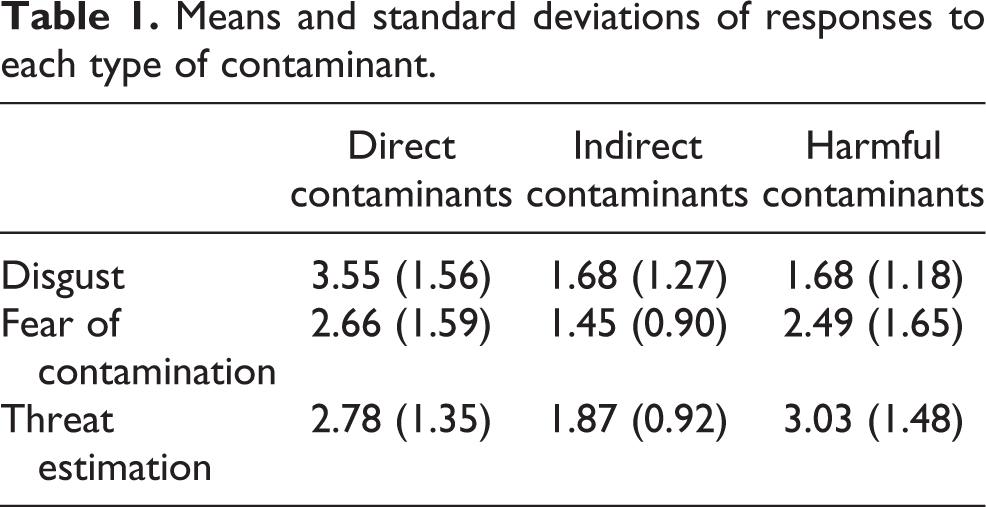
Means for disgust, fear of contamination, and threat estimation in response to the three different types of contaminants are presented in Table 1. There was a significant interaction between contaminant type and response, F(3.5, 159.8) = 30.91, p < .001, partial η 2 = .402. The interaction is presented in Figure 1. When examining direct contaminants, it was found that disgust was significantly higher than fear of contamination (p < .001) and threat estimation (p < .001), but there was no significant difference between fear of contamination and threat estimation. For indirect contaminants, threat estimation was significantly higher than fear of contamination (p < .001); however, there was no significant difference between disgust and fear of contamination, nor between disgust and threat estimation. Lastly, for harmful contaminants, threat estimation was greater than both fear of contamination (p = .004) and disgust (p < .001), and fear of contamination was greater than disgust (p < .001).
Means and standard deviations of responses to each type of contaminant.
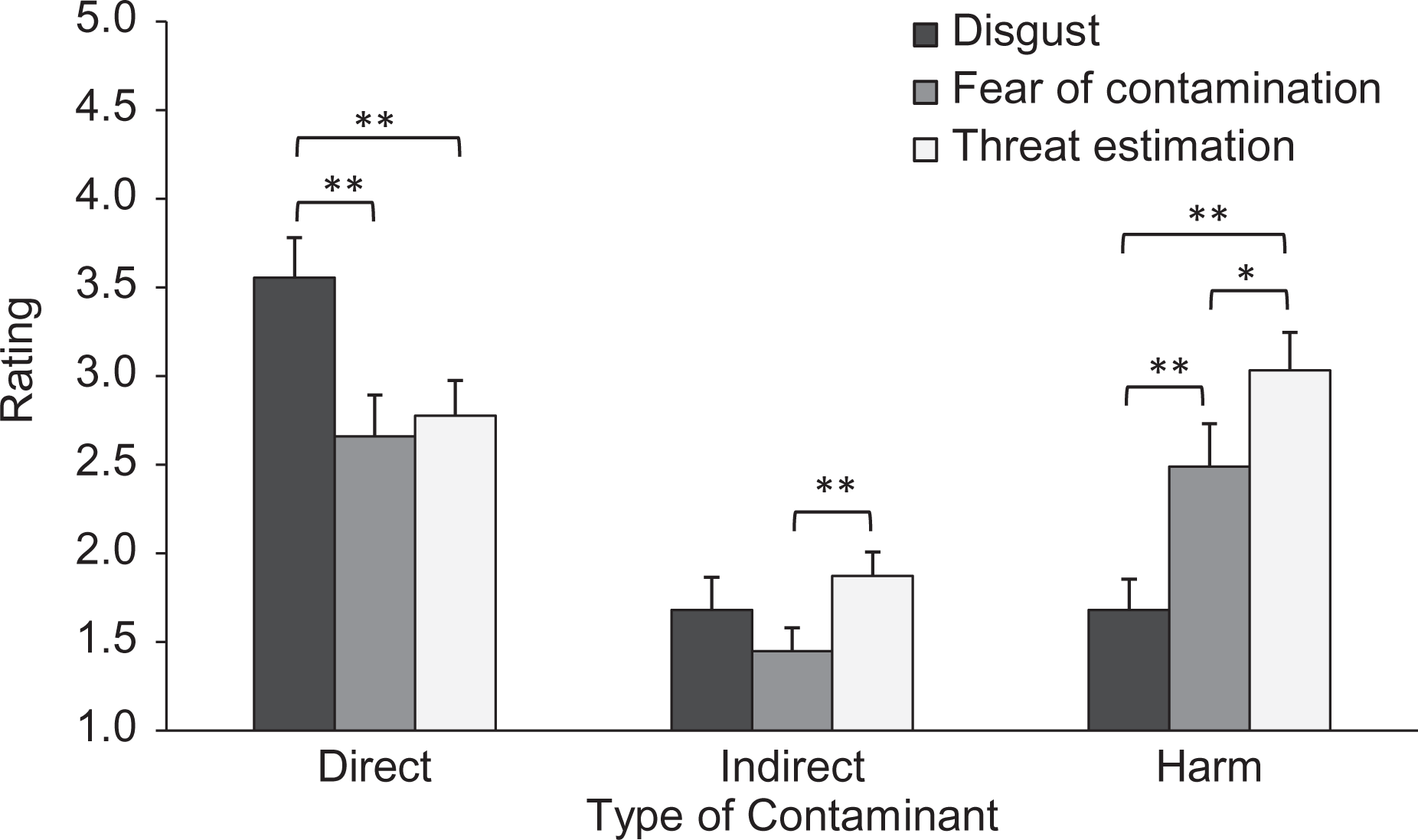
Disgust, fear of contamination, and threat estimation to different types of contaminants. *p < .05; **p < .001.
Comparing responses across stimulus types, it was found that the disgust response was stronger for direct contaminants than for indirect (p < .001) and harmful contaminants (p < .001). The fear of contamination response was stronger for direct (p < .001) and harmful contaminants (p < .001) compared to indirect contaminants. Similarly, threat estimation was stronger for direct (p < .001) and harmful contaminants (p < .001) than for indirect contaminants.
Predicting the self-reported likelihood of handwashing for each type of contaminant (Aim 1b)
Results of the three regression analyses are presented in Table 2. The tolerance statistic for each predictor was always > 0.31; therefore, multicollinearity was not a concern. For direct contaminants, disgust, fear of contamination, and threat estimation together significantly predicted likelihood of handwashing, F(3, 39) = 5.75, p = .002, Cohen’s f 2 = .339. These predictors explained 25.3% of the variation in likelihood of handwashing in response to contact with direct contaminants. However, no response emerged as a significant individual predictor. Similarly, for indirect contaminants, disgust, fear of contamination, and threat estimation significantly predicted likelihood of handwashing, F(3, 43) = 5.70, p = .002, Cohen’s f 2 = .307, with 23.5% of the variance explained, but no response emerged as a significant individual predictor. For harmful contaminants, disgust, fear of contamination, and threat estimation again significantly predicted likelihood of handwashing, F(3, 41) = 5.47, p = .003, Cohen’s f 2 = .304, and together explained 23.3% of the variance. Fear of contamination was found to significantly predict likelihood of handwashing when controlling for disgust and threat estimation, β = .55, p = .025. That is, as fear of contamination increased, the likelihood of handwashing increased significantly, controlling for disgust and threat estimation.
Regression analyses predicting likelihood of handwashing for each contaminant type.

Changes in emotions and cognitions over time in contact with contaminants (Aim 2)
Figure 2 depicts the changes in disgust, fear, and threat estimation over time in contact with each type of contaminant. For each participant, linear slopes were fitted to the four ratings of each response for each contaminant. Means of these linear coefficients are presented in Table 3. Results of one-sample Wilcoxon signed rank tests comparing the linear coefficients to 0 are also presented in Table 3.
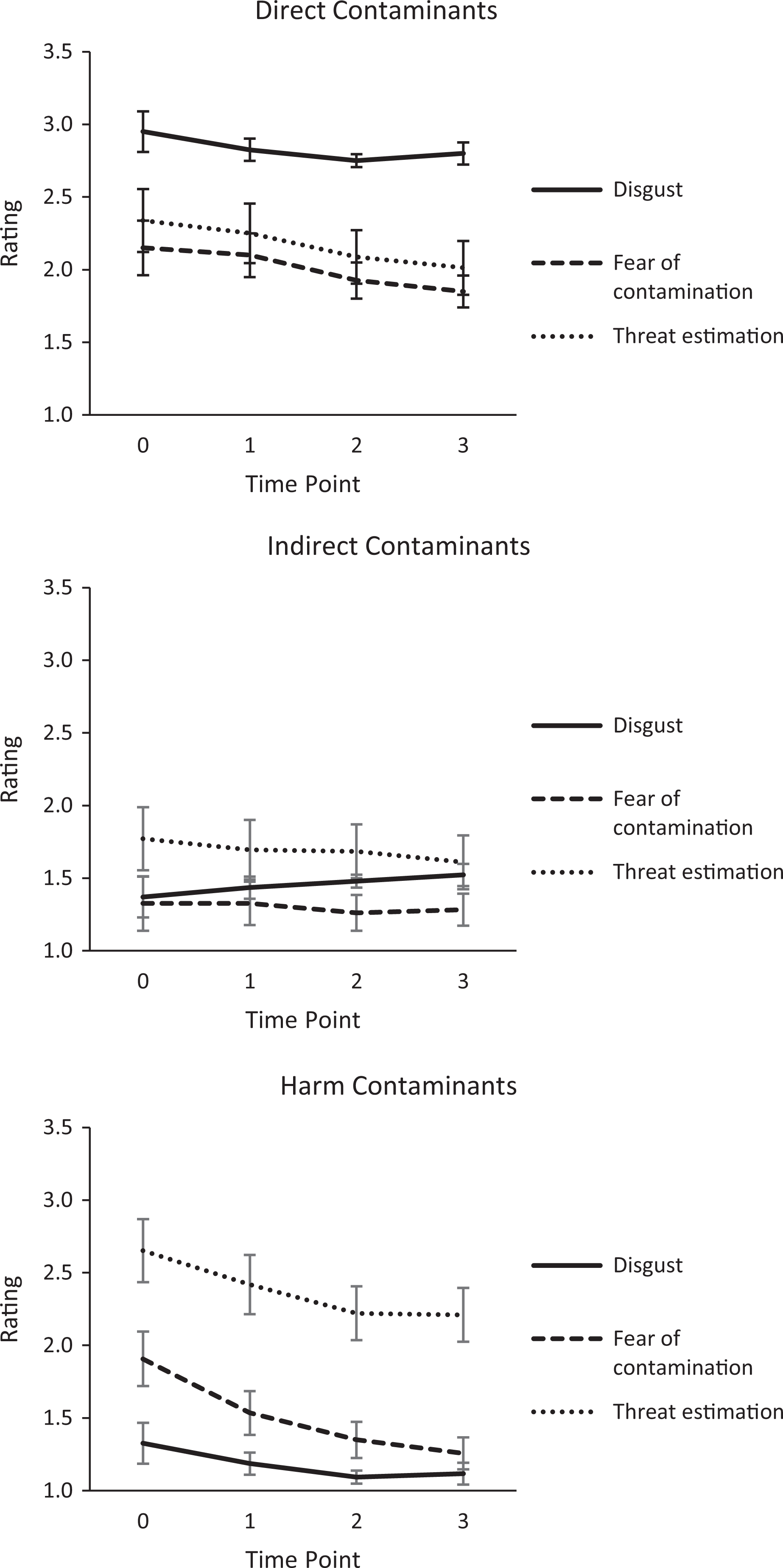
Change in responses over time in contact with each type of contaminant.
Means and standard deviations of the linear coefficients representing the change over the four time points for each response and the Wilcoxon signed rank tests comparing slopes to 0.

aSignificant when applying the false discovery rate control.
Friedman’s two-way ANOVA by ranks revealed that the slope of disgust did not differ across the three contaminant types, χ2(2) = 1.88, p = .391. Similarly, the slope of threat estimation did not differ across the three contaminant types, χ2(2) = 4.05, p = .132. The slope of fear of contamination differed significantly across the three contaminants, χ2(2) = 11.19, p = .004. Pairwise differences revealed that the decline of fear was greater for harmful contaminants than for indirect contaminants (p = .016); however, there was no difference in the fear slope between direct and indirect contaminants, nor between harmful and direct contaminants. Complex interaction contrasts found that there were no significant differences across contaminants for the difference in decline between disgust and fear, χ2(2) = 4.28, p = .118; between disgust and threat estimation, χ2(2) = 1.41, p = .494; or between fear of contamination and threat estimation, χ2(2) = 0.47, p = .791. There were no significant correlations between PI contamination fear subscale and any slope or with any difference between slopes (p > .05).
Discussion
The purpose of this study was to investigate the characteristics of the affective and cognitive components of contamination. This was achieved by comparing the responses of disgust, fear of contamination, and threat estimation experienced when presented with direct, indirect, and harmful contaminants. It was also of interest to examine changes in these responses over time in contact with the different types of contaminants in a BAT.
Firstly, it was found that different types of contaminants are associated with different responses. Direct contaminants evoke more disgust than fear of contamination and threat estimation, whereas harmful contaminants evoke more threat estimation and fear of contamination than disgust. This highlights the differential involvement of affective and cognitive factors when processing contaminants, consistent with the proposal of a two-component model of contamination aversion (Adams et al., 2013). The finding that harmful contaminants produce responses thought to be mediated by the cognitive component broadens our current understanding of this component. The importance of threat estimation when processing harmful contaminants suggests that there is a reliance on knowledge and awareness of the threat posed, such as the harmful properties or previous associations. This is consistent with the hypothesis that the cognitive component utilizes knowledge in its appraisal of contamination (Adams et al., 2012). Indirect contaminants evoke more threat estimation than fear of contamination; however, all responses are generally lower relative to other contaminants. This is consistent with the finding that indirect contaminants are less commonly seen as threatening in nonclinical populations (Adams et al., 2013). Interestingly, disgust and threat estimation did not differ for indirect contaminants. While this was not consistent with the finding that indirect contaminants are processed by the cognitive component and are related to obsessive beliefs (Adams et al., 2013), it may suggest that both components are involved and contribute to the processing of these types of threats. This highlights the possible interaction between the two components and may reflect the link that indirect contaminants have with disease, albeit indirectly, which triggers the emotion of disgust. These findings build on previous evidence by using a behavioral task to show that the affective component produces disgust in response to disease threats, whereas the cognitive component produces threat estimations in response to other threats which require knowledge, and these components may interact in response to threats.
The unexpected finding that fear of contamination and threat estimation differ highlights the multifaceted nature of the cognitive appraisal. Fear of contamination is thought to be the emotive product of the cognitive appraisal and would be influenced by threat estimations. However, other subprocesses have been suggested to be involved in the cognitive appraisal, such as the ability to regulate emotional reactions (Adams et al., 2013), biases in attention toward, and memory of, contaminants (Cisler et al., 2011), and magical thinking (e.g., beliefs that the transfer of properties from a contaminant is permanent even after very brief contact; Adams et al., 2012; Rozin & Fallon, 1987). This wide range of factors may all interact and influence the appraisal to various extents, possibly accounting for the differences observed between fear of contamination and threat estimation. While the scope of this study did not allow all possible cognitive contributors to be assessed, providing a more detailed profile of these factors would be a useful future endeavor.
We also examined whether disgust, fear of contamination, and threat estimation experienced in response to a contaminant predict the self-reported likelihood of handwashing. Although all responses together predict likelihood of handwashing for each contaminant, the only significant unique predictor was fear of contamination for harmful contaminants. For harmful contaminants, fear of contamination significantly predicts the self-reported behavioral response, over and above disgust and threat estimation. This provides mixed evidence for the hypothesis that the strongest response(s) evoked by a contaminant would predict behavioral intention. It is possible that this mixed finding is a result of the variable used. Self-reported likelihood of handwashing was the only outcome related to behavior that could be analyzed as there was a lack of variability in the amount of time people touched the contaminant. Self-report measures of behavior are not necessarily an accurate reflection of actual behavior, and participants may have a tendency to provide more socially desirable responses (Paulhus, 2002). Therefore, this finding should be interpreted with caution, as self-reported behavioral intention may not generalize to actual behavioral responses.
Given the differences in responses based on the type of contaminant, it was important to examine habituation of these responses in a BAT. There was no evidence of a significant decline in disgust for direct, indirect, or harmful contaminants. This is consistent with previous studies that have shown that disgust is resistant to habituation (Adams et al., 2011; McKay, 2006; Olatunji et al., 2009) and extinction (Mason & Richardson, 2010; Olatunji, Forsyth, & Cherian, 2007). Contamination fear, as measured by the PI subscale, did not correlate with these slopes, contrary to expectations that the rate of decline may be related to the level of contamination fear (Adams et al., 2011). There was evidence of a significant decline in fear of contamination responses to direct and harmful contaminants but not to indirect contaminants. This may reflect floor effects seen in fear responses to indirect contaminants across the duration of contact, rather than a resistance to extinction. This suggests that fear of contamination may habituate with exposure, if initially provoked by a contaminant. Threat estimation was found to decrease significantly and at a similar rate for all contaminants. There were no interactions between response types across contaminants. This is not consistent with our hypothesis that emotions and cognitions will decline at different rates for different contaminants. However, it suggests that while responses habituate at different rates, this appears to be consistent across the different types of contaminants.
These findings have implications for ERP. The emotion of disgust seems somewhat resistant to decreasing with exposure. This was seen across all contaminants, although there was a possibility that disgust levels were at floor for indirect and harmful contaminants. Regardless, even when disgust is the strongest response provoked, it shows resistance to habituation. In contrast, fear of contamination and threat estimation appear to decline, if initially provoked. This supports the suggestion that treatment for the different emotions and cognitions present in OCD may benefit from different approaches (Woody & Teachman, 2000). This also suggests that although ERP is a behavioral treatment, it may be effective at modifying cognitions in contamination. The involvement of cognitions in ERP has been examined in other research by explicitly modifying cognitive appraisals in an exposure task (Dorfan & Woody, 2006). Appraisals of harm, illness, and vulnerability were lower when participants were told to imagine a static threat or no threat compared with those who were told to imagine the threat as constantly approaching. Although research is still developing, it is clear that cognitions play an important role in ERP, and maladaptive cognitions may dissipate with exposure even in the presence of a strong emotional response.
Differences in habituation of responses also contribute to the current understanding of the two components of contamination as it highlights the possibility that the affective component is less reliant on appraisals and knowledge. That is, disgust does not alter even with evidence that there are no negative consequences resulting from being in contact with a contaminant. In comparison, fear of contamination and threat estimation reduce over time, possibly reflecting an altered evaluation of the threat of the situation. This again highlights the role of knowledge and previous experience in the cognitive component but not in the affective component. However, it is important to note that it is likely that these components interact, and although the affective component may not directly be influenced by knowledge, it can be influenced by the outcome of the appraisal. This proposed interaction should be explored in future research.
This study has the advantage that it compared responses to direct, indirect, and harmful contaminants, whereas most studies are limited to examining responses to direct contaminants. Although these categories of contaminants are not always mutually exclusive and a contaminant may have properties of more than one category (Adams et al., 2013), it is still important to differentiate and examine responses to prototypical contaminants in these categories. People with the contamination subtype of OCD have a wide and varied range of items which they consider contaminating (Prabhu et al., 2013), and examining response characteristics to certain categories of contaminants may enhance our understanding of the heterogeneity of triggers and behaviors in OCD. The current finding suggests that the involvement of disgust, fear of contamination, and threat estimation is dependent on the content of the threat and related obsessions. For example, if the obsessions are predominantly related to disease, although all emotions and cognitions may be heightened, it is likely that disgust will be the prominent emotion that provokes compulsions. This study was also the first to investigate habituation of responses to direct, indirect, and harmful contaminants, showing that all contaminants have similar patterns of decline. This is an important and novel finding suggesting that habituation of aversive responses occurs for a range of contaminants. Future research should use items chosen by the individual to better profile the range of possible emotions and cognitions provoked and investigate habituation of these responses over time. This will provide a better understanding of the efficacy of ERP therapy for varied disorder-relevant contaminants.
These findings should be interpreted in the context of several limitations. This study served as a pilot behavioral experiment conducted with a small, nonclinical sample. Firstly, the small sample size may have limited the statistical power of this research. A larger sample size would be necessary to exclude the possibility that additional significant effects would emerge with more power. Secondly, although findings from nonclinical samples have been shown to be generalize to clinical samples (Gibbs, 1996) and some of our findings are consistent with results from clinical populations (McKay, 2006), it is nonetheless important to confirm these conclusions in a larger sample with clinical participants. Additionally, there was a possibility of floor effects in responses, and there was limited variation in the behavioral measure of avoidance, which may be a result of utilizing a nonclinical sample. Replicating this experiment with a large clinical sample may result in more variation in emotions, cognitions, and behavioral avoidance and may provide information about the clinical significance of changes seen in the BAT. Another concern about the sample was that it was predominantly female, and given there are gender differences in disgust sensitivity, this may have implications for the findings. While this was controlled for in the statistical analysis, future research should aim to include an equal proportion of males and females to provide an unbiased sample. Another limitation is the use of self-reported questions as the outcome measure for disgust, fear of contamination, threat estimation, and likelihood of handwashing. Other outcome measures should also be employed, such as physiological responses. Also obtaining measures of distress during the BAT may be useful to control for levels of anxiety provoked by the task.
Conclusion
This study provides useful information about the components involved in contamination aversion and how responses change over time. Different types of contaminants produce different responses, such that direct contaminants produce strong levels of disgust, indirect contaminants produce strong levels of both threat estimation and disgust, and harmful contaminants produce strong levels of threat estimation. These different responses may reflect the differential involvement of the affective and cognitive components in contamination aversion. The findings also show that regardless of the contaminant, disgust appears more resistant to extinction, whereas fear of contamination and threat estimation decline over time. This may have important implications for therapy approaches in people with contamination OCD. However, future research should replicate this study with a larger, clinical sample.
Footnotes
Declaration of Conflicting Interests
The author(s) declared no potential conflicts of interest with respect to the research, authorship, and/or publication of this article.
Funding
The author(s) disclosed receipt of the following financial support for the research, authorship, and/or publication of this article: This work was supported by a Macquarie University Research Excellence Scholarship.