




Abstract
An initial test of the initiation–termination model of worry was conducted in a sample of 51 individuals (half of whom had at least one anxiety disorder). On multiple occasions each day, participants were prompted to answer a variety of questions regarding their worrying. Worrying about new topics was presumed to reflect ease of worry initiation, whereas continuing to worry about the same topics and the duration of worrying were presumed to reflect difficulty with worry termination. Results aggregated across the sampling period revealed that worry initiation and termination incrementally predicted global worry and anxiety severity and were differentially associated with depression severity and emotion-induced blindness. Multilevel modeling indicated that, within participants, worry initiation and termination were differentially associated with the perceived costs of undesirable outcomes and with worry beliefs.
Introduction
Worry is a form of unpleasant repetitive thinking focusing on potential future undesirable outcomes (Borkovec, Robinson, Pruzinsky, & DePree, 1983). Although worry is a very common experience (e.g., Silverman, La Greca, & Wasserstein, 1995; Tallis, Eysenck, & Mathews, 1992), excessive levels of worry are an important aspect of numerous forms of psychopathology. Worry is present in virtually all cases of anxiety disorders and is a defining feature of generalized anxiety disorder (GAD). Excessive levels of worry are not limited to the anxiety disorders. For example, individuals with eating disorders have repetitive unpleasant thoughts about the potential impact of eating on the appearance of their body, and individuals with paranoid personality disorder have repetitive unpleasant thoughts about the prospect of being harmed by others.
Researchers have been making steady progress elucidating the factors that contribute to worry, such as attentional biases, interpersonal patterns, and maladaptive worry beliefs (e.g., Freeston, Rheaume, Letarte, Dugas, & Ladouceur, 1994; Goodwin, Yiend, & Hirsch, 2017; Hirsch & Mathews, 2012; Przeworski et al., 2011). Berenbaum (2010) proposed a two-phase, initiation–termination (IT) model of worry in which worrying is thought of as a dynamic process that unfolds over time. The IT model did not propose any etiological factors that had not already been studied (though all of the factors included in the model had not been previously been combined into a single integrative framework). What sets the IT model apart from other models of worry is that whereas the principal contribution of other models tends to be what contributes to worry (e.g., attentional bias, attentional control, maladaptive interpersonal functioning), the principal contribution of the IT model is its focus on when in the worrying process a factor may play a role (i.e., before worrying begins vs. after worrying has already begun). Specifically, the focus of the IT model is distinguishing between the initiation of worry and the termination of worry.
The goal of the present research was to test five hypotheses derived from the IT model. Berenbaum (2010) proposed that there are two distinguishable reasons why people may worry excessively: (a) worrying being initiated very easily (even in the absence of having difficulty terminating worries once they begin) and (b) difficulty terminating worrying (even if worrying is not easily initiated). Thus, the first hypothesis derived from the IT model tested in the present research was that worry initiation and worry termination would incrementally predict problematic worrying (i.e., predict problematic worrying even when taking the other into consideration). The rationale for this prediction is that to the extent that ease of worry initiation and difficulty terminating worrying are alternative (though not necessarily mutually exclusive) paths to problematic worrying, and they should both incrementally predict problematic worrying.
The second hypothesis derived from the IT model was that cognitive factors would be differentially associated with worry initiation and worry termination. A great deal of theorizing and research has linked worrying with a variety of cognitive factors. For example, attentional biases to threat have repeatedly been found to be associated with GAD and worry (especially the former; see Goodwin et al., 2017, for a recent review). Anxiety and worry have also been found to be associated with cognitive factors, such as attentional control and working memory, even when nonaffective stimuli are employed (e.g., Bredemeier & Berebaum, 2013; Eysenck, Derakshan, Santos, & Calvo, 2007). However, not all studies employing neutral stimuli have found evidence of links between cognitive factors and worry. For example, Bredemeier, Berenbaum, Most, and Simons (2011) found that attentional blinks on a rapid serial visual presentation (RSVP) task with neutral stimuli were not associated with worry. In the present research, we examined emotion-induced blindness, an index of the extent to which unpleasant emotional stimuli interfere with the visual processing of subsequent stimuli (Most, Chun, Widders, & Zald, 2005). Past research on emotion-induced blindness has found that greater difficulty disengaging from an emotional stimulus in order to process a subsequent stimulus is positively associated with harm avoidance (Most et al., 2005), one component of which is worry. To the degree that someone has difficulty disengaging from an emotional stimulus, we would expect them to have difficulty terminating worrying. We, therefore, hypothesized that a measure of emotional blindness would be associated with worry termination and not with worry initiation.
Worry and GAD are associated with numerous other forms of psychopathology, such as depression (e.g., Brown, Campbell, Lehman, Grisham, & Mancill, 2001; Olatunji et al., 2010). If the IT model is correct that the etiological factors associated with worry initiation differ from the etiological factors associated with worry termination, worry initiation and termination should be differentially associated with other psychopathological outcomes. 1 Thus, the third hypothesis derived from the IT model tested in the present research was that worry initiation and worry termination would be differentially associated with depression. We examined symptoms of major depressive disorder (MDD) because it is a common mental disorder that is highly comorbid with GAD (e.g., Brown et al., 2001). We hypothesized that depression would be more strongly associated with worry termination than with worry initiation. This hypothesis is consistent with the results of past research showing that people who are depressed tend to continue engaging in the processing of negative emotional information for longer durations than do controls (Siegle, Condray, Thase, Keshavan, & Steinhauer, 2010; Siegle, Steinhauer, Carter, Ramel, & Thase, 2003) and that they have difficulty removing irrelevant negative material from working memory (Joormann & Gotlib, 2008), both of which would be expected to contribute to difficulty terminating worry. In contrast, the increased attentional capture of threat cues that Berenbaum (2010) hypothesized contribute to worry initiation is not as clearly associated with depression (Mogg, Millar, & Bradley, 2000).
The fourth hypothesis derived from the IT model tested in the present research was that worry initiation and worry termination would be differentially associated with the two core features of perceptions of threat: (a) the perceived probability of the undesirable outcome occurring and (b) the perceived cost of the undesirable outcome occurring. Both of these factors have been found to be associated with worrying in past research (e.g., Berenbaum, Thompson, & Bredemeier, 2007; Bredemeier, Berenbaum, & Spielberg, 2012). Because worrying requires the perception of some future threat about which one can worry, Berenbaum (2010) emphasized the role of perceptions of threat in the initiation of worry. Thus, we hypothesized that the perceived costs and probabilities of potential undesirable outcomes would be more strongly associated with worry initiation than with worry termination. Because previous research has sometimes found that the relation between probability estimates and worry is moderated by perceived cost (e.g., Berenbaum, Thompson, & Pomerantz, 2007), and a relatively recent study found that the relation between perceived threat and worry was moderated by how far into the future the occurrence of the undesirable outcome was anticipated to be (Bredemeier et al., 2012), we explored whether links between worry initiation/termination and probability and cost estimates would be moderated by time frame (i.e., how far in the future is the anticipated threat) and/or the alternative aspect of threat (i.e., Probability × Cost interactions).
A great deal of theorizing and research suggests that the belief that worrying could help prevent undesirable outcomes from occurring plays a role in excessive worrying (e.g., Borkovec & Roemer, 1995; Freeston et al., 1994; Wells, 1999). Thus, the fifth hypothesis derived from the IT model was that beliefs regarding worry would be differentially associated with worry initiation and worry termination. Specifically, we tested the IT model’s prediction that the belief that worry is adaptive would be associated with the disinclination to terminate worrying. It should be noted that in contrast to the prediction of the IT model, previous theorizing had linked worry beliefs with the initiation of worrying (e.g., Wells, 1999).
Method
Participants
Fifty-one individuals were recruited using advertisements seeking people who worry frequently. 2 This strategy was employed because we wished to recruit a sample with a broad range of worrying that would be sure to include many individuals at the high end of the continuum. That our recruitment strategy focused on worrying, as opposed to a particular diagnosis, is consistent with recent trends in the field (Insel et al., 2010). Participants were between the ages of 20 and 61 (M = 36.9; SD = 12.8), and 66.7% of the sample was female. Consistent with the population characteristics of the local community, the majority of the participants (72.5%) were White/Non-Hispanic, followed by 9.8% African American, 7.8% Asian American, 5.9% multiracial, and 3.9% describing themselves as “other.” All participants completed a voluntary informed consent at the start of the session and received monetary compensation for their participation. The research protocol was approved by the university institutional review board.
Overview
Participants first came to our laboratory where we administered questionnaires, an interview about anxiety and mood disorders and an emotional blindness task. Over the course of the next week, we collected information regarding individuals’ worrying using ecological momentary assessment (EMA; Reis & Gable, 2000). On multiple occasions each day, we randomly prompted participants to answer a variety of questions regarding their worrying. Doing so enabled us not only to determine whether an individual had been worrying but also to obtain indicators of ease of worry initiation and difficulty with worry termination. Ease of worry initiation was indicated by participants reporting that they were worrying about something new. Difficulty with worry termination was indicated by worry duration and by the frequency of worrying about something they reported having been worried about at the time of the preceding prompt. At each prompt, we also inquired about perceptions of threat and belief in the value of worry so that we could examine, within-participants, associations between worry initiation/termination and perceptions of threat and worry beliefs.
Measures
Global worry
The Penn State Worry Questionnaire (PSWQ; Meyer, Miller, Metzger, & Borkovec, 1990), a well-validated global measure of worrying, was used to assess the tendency to worry. On the PSWQ, participants rated 16 statements (e.g., “My worries overwhelm me”) with regard to how typical each is of them on a 1 to 5 scale. Previous studies indicate that the PSWQ has good convergent validity and test–retest reliability (e.g., Meyer et al., 1990). In the present study, Cronbach’s α was .94.
GAD and MDD
Participants were interviewed using the Structured Clinical Interview for DSM-IV-TR Axis I Disorders (SCID-I; First, Spitzer, Gibbon, & Williams, 2002) to assess symptoms of Axis I anxiety and mood disorders, with GAD and MDD being of particular interest. All interviews were conducted by advanced graduate students with training in the use of the SCID-I for clinical and research purposes. Each criterion 3 was rated on a scale from 0 to 2 (0 = absent; 1 = subthreshold; 2 = criterion met). In addition to determining whether each participant met criteria for GAD or MDD, we computed anxiety and depression severity scores (by summing across the ratings for each of the diagnostic criteria, for GAD and current MDD, respectively). This approach (i.e., the use of symptoms counts) has been used frequently in psychopathology research (e.g., Wright et al., 2013) and is in keeping with the evidence that dimensional measures of psychopathology are more reliable and valid than are categorical measures (e.g., Markon, Chmielewski, & Miller, 2011). All interviews were audiotaped, and 15 were randomly selected to be listened to by a secondary rater. Interrater reliability was measured using the intraclass correlation following Shrout and Fleiss (1979), treating raters as random effects and the individual rater as the unit of reliability. The intraclass correlation was .98 for GAD and .99 for MDD.
Emotion-induced blindness
We administered an RSVP task developed by Most et al. (2005) in which stimuli are presented sequentially and quickly (100 ms/item). On each trial, participants were instructed to look through a rapid stream of upright landscape and architectural photos. They were asked to look for the one landscape/architectural photo that had been rotated 90° clockwise or counterclockwise and to report the orientation of that target. On some trials, a negatively valenced image of a person or an animal preceded the rotated target stimulus by two (lag 2) or eight (lag 8) images in the sequence; on other trials, the target was preceded by the same lags by an emotionally neutral picture of a person or an animal. Emotion-induced blindness is operationalized as the difference in detecting the rotated image when it is preceded by the negative image, relative to the neutral image. Note that the effect typically dissipates by lag 8, which serves as a comparison that helps to verify that the effect reflects attentional–perceptual processes (e.g., Most et al., 2005; Kennedy & Most, 2012). As this has been well verified, lag 2 was the focus of analysis. The mechanisms driving emotion-induced blindness are thought to involve difficulty disengaging from emotional distractor information (Kennedy, Rawding, Most, & Hoffman, 2014).
Worry sampling
Each participant was given a handheld electronic device (Palm Zire, model m150) that would deliver prompts by emitting an audible beep. The Experience Sampling Program (ESP 4.0) software (Barrett & Feldman Barrett, 2004) was used. Participants were prompted six times/day, between the hours of 10 AM and 10 PM, over the course of 1 week. Prompts were randomly dispersed within 2-hr time periods throughout the day, such that one prompt would occur within every 2-hr time period (i.e., one prompt between 10 AM and 12 PM, one prompt between 12 PM and 2 PM, etc.). Prompts occurred as little as 26 min and as much as 232 min apart (M =123, SD = 42). Participants were given up to 20 min to respond to each prompt and subsequent series of questions. If participants did not respond, the device hibernated until the next prompt, recording missing data for that prompt. Participants responded to between 7 and 40 of the 42 prompts (M = 31.3; SD = 5.8; mean response rate of 75%). Participants who responded to fewer than half the prompts were excluded from between-participant analyses. 4 Response rate to prompts was not significantly correlated with either PSWQ scores (r = −.06, p = .70) or anxiety severity (r = −.06, p = .67).
At each prompt, they were first asked whether they had worried at any time since the last prompt; specifically, participants were asked whether they had been “thinking about something bad that might happen in the future.” When they had worried, participants were asked whether they had been worrying about something new since the last prompt (1 = which we considered new worries) or about the same thing they were worried about in the last prompt (0 = which we considered continuing worries). They were also asked: (a) how long they had been worrying (1 = less than 10 min; 2 = less than 30 min; 3 = less than an hour; 4 = less than 2 hr; 5 = more than 2 hr); (b) how likely the outcome they were worried about was to occur, used to measure perceived probability (1 = extremely unlikely; 2 = very unlikely; 3 = somewhat unlikely; 4 = somewhat likely; 5 = very likely; 6 = extremely likely); (c) how large the consequence would be if the outcome were to occur, used to measure perceived cost (1 = extremely small; 2 = very small; 3 = somewhat small; 4 = somewhat large; 5 = very large; 6 = extremely large); (d) how much they believed thinking about the outcome would prevent it from occurring, used to measure worry beliefs (1 = not at all = 1; 2 = slightly; 3 = somewhat; 4 = very; 5 = extremely); (e) when they anticipated the unwanted outcome was most likely to occur (1 = within minutes; 2 = sometime today; 3 = this week; 4 = this month; 5 = this year; 6 = more than a year away); and (f) what they were worried about (data concerning the content of their worries are not presented in this article). If participants reported not having worried since the last prompt, they were asked the same questions, but regarding the last time they had worried (these responses were not included in the analyses)—this discouraged participants from reporting they had not worried as a strategy to have to answer fewer questions.
Results
Data analytic approach and preliminary analyses
We divide our presentation of results into three sections. First, to gain a better sense of our sample, we examined diagnostic status and levels of worrying. Second, we examined the first three hypotheses by conducting between-participant analyses. To do so, we aggregated participants’ momentary reports across the study. Specifically, we computed the following: (a) the proportion of prompts on which they had new worries; (b) the proportion of prompts on which they had continuing worries; and (c) the total duration of their worries, adjusted based on the number of prompts to which they responded.
Although positive, the correlation between the frequency of new worries and the frequency of continuing worries was small (r = .13) and not statistically significant. Also, as expected, the frequency of continuing worries was strongly correlated with the total duration of worries (r = .88, p < .01). The frequency of new worries was also positively correlated with the total duration of worries (r = .36, p < .05), albeit not as strongly as was the frequency of continuing worries. Because the total duration of worries was so highly correlated with the frequency of continuing worries, we report the results of analyses examining only the latter, which we consider an index of difficulty with worry termination; in contrast, we consider the frequency of new worries to be an index of ease of worry initiation. To test hypotheses 1–3, we examined the relations between our indices of difficulty with worry termination and ease of worry initiation with the baseline measures (i.e., global worry, anxiety severity, emotion-induced blindness, and depression severity). For hypothesis 1, in addition to computing correlations, we conducted regression analyses to test whether our indices of difficulty with worry termination and ease of worry initiation would incrementally predict global worry and anxiety severity.
In the third section of the results, we tested hypotheses 4 and 5. To do so, using multilevel modeling we examined, within occasions when the participant reported worrying, whether factors posited to be associated with worry predicted the nature of the worry (i.e., continuing or new) as well as the duration of the worry. For hypothesis 4, guided by the results of past research on perceptions of threat (e.g., Berenbaum et al., 2007; Bredemeier et al., 2012), we also explored whether our two within-participant indices of worry initiation/termination and probability and cost estimates would be moderated by time frame (i.e., how far in the future is the anticipated threat) and/or the alternative aspect of threat (i.e., Probability × Cost interactions).
Within-participant analyses were conducted using multilevel modeling since the prompts were nested within individuals. Importantly, multilevel modeling does not assume independence of data points and is able to handle missing data (Snijders & Bosker, 1999). We used the MIXED procedure of the SAS 9.3 software. We report parameter estimates with standard errors. All models included random intercepts and random slopes for within-participant variables, unless otherwise noted. Each predictor variable was participant centered (i.e., each score was subtracted by the participant’s weekly mean for that variable). All continuous predictor variables were standardized. Additional details regarding the multilevel models can be found in Online Supplementary Materials.
Unlike the aggregated scores examined in the between-participant analyses, in the within-participant analyses, new worries could not be examined separately from continuing worries since at each individual prompt, a worry could be either new or continuing. The nature of the worry was dummy coded (0 = continuing; 1 = new); thus, a negative association signifies a greater likelihood of being a continuing worry, and a positive association signifies a greater likelihood of being a new worry.
Although the two between-participant variables (total frequency of continuing worries and total duration of all worries) that represent worry termination were highly correlated (r = .88), the two within-participant variables (whether a worry was old or new, and the duration of this one worry) that represent worry termination did not appear to be as strongly associated despite being significantly associated. The intraclass correlation (ICC) of the null model (i.e., an empty model with no predictor variables) predicting worry duration decreased from .228 to .212 with the addition of the within-participant variable of whether a worry was old or new. This decrease of .016 suggests that whether a worry is old or new accounts for 1.6% of the total variance of worry duration. Consequently, for the within-participant analyses, we report findings for both of the following outcomes: (a) whether a worry is old versus new (which we consider an index of difficulty with worry termination vs. ease of worry initiation) and (b) worry duration (which we consider an index of difficulty with worry termination).
Diagnostic status and worrying
Consistent with our recruitment strategy, 49% of the sample met DSM-IV criteria for at least one anxiety disorder. Thirty participants (59%) met at least one diagnostic criterion of GAD, with 19 participants (37.3%) displaying sufficient symptoms to meet criteria for a DSM-IV diagnosis of that disorder. PSWQ scores ranged from 25 to 75 (M = 54.7; SD = 14.5). Anxiety severity scores ranged from 0 to 16 (M = 7.0; SD = 5.8). Thus, the present community sample contained a relatively wide range of anxiety severity, with a significant portion of the sample reporting clinically important worry-related symptoms. Eleven participants (21.6%) met criteria for social phobia; however, all but two of these individuals additionally met criteria for GAD. Twelve participants (29.4%) met criteria for one or more other anxiety disorders (i.e., panic disorder with/without agoraphobia, specific phobia, obsessive-compulsive disorder, and/or posttraumatic stress disorder), all but four of whom also met criteria for GAD. Additionally, although only two participants were currently experiencing a major depressive episode, almost half (47.1%) had experienced at least one episode during their lifetime.
Next, using the worry sampling data, we examined how common it was for participants in our sample to worry. As expected, since we intentionally recruited people who worry frequently, the proportion of times participants reported new and continuing worries were both relatively high (M = .18, SD = .17 and M = .18, SD = .21, respectively). Thus, participants’ reports of frequent worrying during the laboratory portion of our study was confirmed using the EMA data.
Between-participant analyses (hypotheses 1–3)
Table 1 presents the results of both zero-order correlations and multiple regression analyses, in which frequencies of new and continuing worries were entered simultaneously. Importantly, these regression analyses allow for examination of the incremental predictive utility of new and continuing worry frequencies. In the regression analyses, both predictors (i.e., new worries and continuing worries) were entered simultaneously.
5
As can be seen in Table 1, both new and continuing worries were significantly associated with both global worry scores and anxiety severity. Further, new and continuing worries provided incremental predictive utility to both global worry and anxiety severity, with both contributing significantly even when the other was taken into account. In the regression predicting global worry, the multiple correlation was r = .63 (R2 = .39), F(2, 39) = 12.58, p < .01. In the regression predicting anxiety severity, the multiple correlation was r = .59 (R2 = .34), F(2, 39) = 10.22, p < .01.
As can be seen in Table 2, continuing worries were significantly positively associated with emotion-induced blindness, as predicted. In contrast, also as predicted, new worries were not associated with emotion-induced blindness. There was a trend for the magnitudes of these two correlations to differ, z = 1.37, p = .09.
Summary of zero-order correlations and multiple regression analyses predicting global worry scores and anxiety severity (precise p-values in parentheses).

Note. For regression analyses, new and continuing worries were entered into the model simultaneously. Global worry is measured using PSWQ; Anxiety severity is based on SCID ratings.
Summary of zero-order correlations between new and continuing worries and depression severity and emotion-induced blindness (precise p-values in parentheses).

As can be seen in Table 2, continuing worries were significantly positively associated with depression severity, as predicted. In contrast, also as predicted, new worries were not associated with depression severity. There was a trend for the magnitudes of these two correlations to differ, z = 1.27, p = .10.
Within-participant analyses (hypotheses 4 and 5)
As can be seen in Table 3, within occasions, the greater the perceived cost, the longer the duration of the worry. There was also a trend that the greater the perceived cost, the greater the likelihood the worry was continuing rather than new. In contrast, perceived probability was not significantly associated with worry duration or the nature of the worry.
We found that worry duration was significantly associated with a Cost × Time frame interaction (γ60 = −0.09, SE = 0.04), t(533) = −2.00, p = .0457, as well as with a significant Probability × Cost × Time frame interaction (γ70 = 0.04, SE = 0.02), t(524) = 1.98, p = .0483. As can be seen in Figure 1 (which is based on the parameter estimates of the model), the impact of cost estimates was greater for near-term outcomes than for longer term outcomes. Further, for outcomes anticipated in the near term, the impact of probability estimates was greater for low-cost outcomes, whereas for outcomes anticipated in the longer term, the impact of probability estimates was slightly larger for high-cost outcomes. The patterns of results were similar, though not as strong and not statistically significant, regarding associations with continuing versus new worries. Specifically, though in the same direction, neither the Cost × Time frame (γ60 = 0.03, SE = 0.02), t(446) = 1.80, p = .0720, nor the Probability × Cost × Time frame interactions (γ60 = −0.01, SE = 0.01), t(444) = −1.38, p = .1684, reached conventional levels of statistical significance.
As can be seen in Table 3, within worry occasions, worry beliefs were significantly associated with the nature (i.e., continuing versus new) but not duration of worry. Contrary to Berenbaum (2010) prediction, but as might have been predicted by Wells (1999), the belief that worrying will prevent bad outcomes was significantly associated with the worry being new as opposed to continuing, though not quite significantly associated with briefer worry duration.

Graphs are based on the model with “low” and “near-term” defined as 1 SD below the mean and “high” and “longer term” defined as 1 SD above the mean.
Summary of associations, within occasions, between factors associated with worrying and whether the worry was new versus continuing and its duration fixed effect continuing versus new duration.
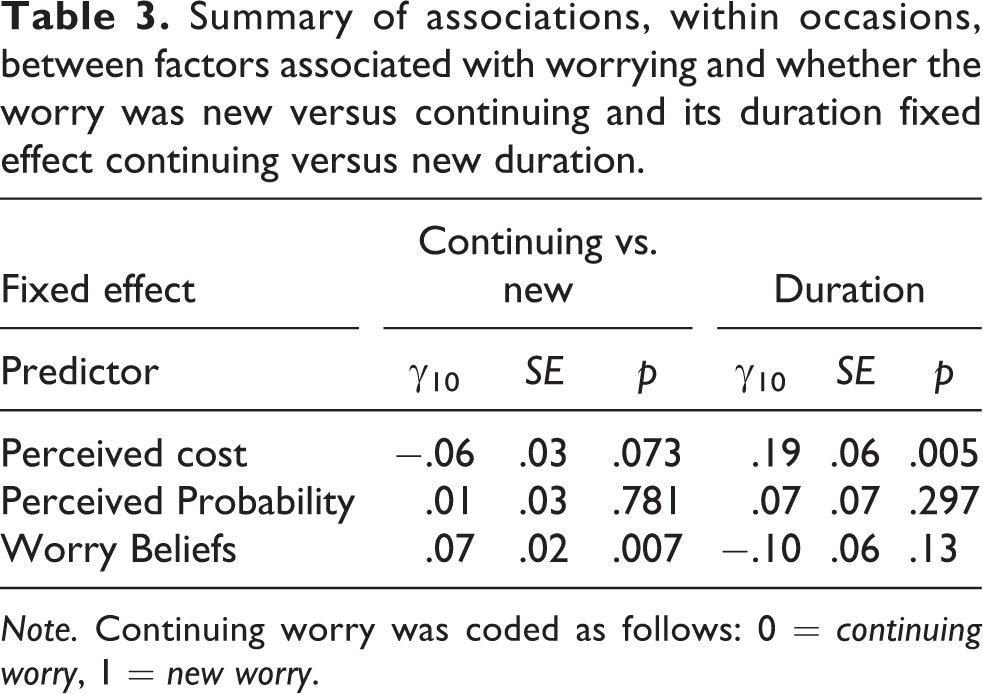
Note. Continuing worry was coded as follows: 0 = continuing worry, 1 = new worry.
Discussion
The results of the present research highlight the potential value of distinguishing between the initiation and termination of worrying, and they provide initial support for the IT model of worrying (Berenbaum, 2010). Indicators of worry initiation and termination were weakly associated and were incrementally associated with a global measure of worry and with anxiety severity. Moreover, the indicators of worry initiation and termination were differentially associated with depression severity and emotion-induced blindness. Finally, on those occasions when participants were worrying, perceived costs and worry beliefs were differentially associated with indicators of worry initiation and termination. Thus, the present results provide support for the most fundamental aspect of the IT model—that the initiation and termination of worrying are distinguishable, contribute incrementally to clinically relevant levels of worry, and are differentially associated with potentially important antecedents and correlates of worry.
We found that the frequency of continuing, but not new, worries was associated with both depression severity and emotion-induced blindness. Although it is possible that there are different reasons for depression severity and emotion-induced blindness to be associated with worry termination, we believe a more parsimonious and likely explanation is that a common factor contributes to both. We think the most likely candidate is an executive functioning deficit, such as working memory (found to be associated with worry; Bredemeier & Berenbaum, 2013) or a process related to working memory (e.g., see Stout, Shackman, & Larson, 2013). Another plausible executive functioning deficit that may contribute to both emotion-induced blindness and difficulty terminating worry is a shifting deficit (found to be associated with anxiety; Eysenck & Derakshan, 2011). Of course, cognitive deficits are not the only possible explanation for the link between worry termination and depression. There are other factors that may contribute to difficulties with worry termination, such as behavioral avoidance and reassurance seeking (found in previous research to be associated with depression; Ottenbreit & Dobson, 2004; Starr & Davilla, 2008). However, there is no reason that we are aware of to expect factors such as behavioral avoidance and reassurance seeking to be associated with emotion-induced blindness.
It is worth noting that MDD is associated with rumination (e.g., Nolen-Hoeksema, 2000), another form of unpleasant repetitive thinking that shares much in common with worry (e.g., Hur, Heller, Kern, & Berenbaum, 2017; Watkins, 2008). This leads us to propose that an executive functioning deficit contributes to difficulty terminating unpleasant repetitive thinking, which in turn predisposes people to develop depression and disorders related to worry (e.g., GAD). These hypotheses are consistent with previous research that has documented links between executive functions and (a) depression (e.g., Bredemeier, Warren, Berenbaum, Miller, & Heller, 2016; Snyder, 2013), (b) worry (e.g., Bredemeier & Berenbaum, 2013; Stefanopoulou, Hirsch, Hayes, Adlam, & Coker, 2014), and (c) rumination (e.g., Davis & Nolen-Hoeksema, 2000; Joormann & Gotlib, 2008).
The results of the present research provide further clarification of the relation between worry and perceptions of threat. Past research examining the relation between worry and perceived threat has found that, across individuals, elevated cost estimates are associated with greater worry, as measured by the PSWQ or the presence of GAD diagnosis (Berenbaum et al., 2007; Bredemeier et al., 2012; Butler & Mathews, 1983). Herein, we found that, within individuals, higher cost estimates were associated with continuing and longer worries. This provides additional evidence of elevated cost estimates playing a role in worrying. More importantly, it suggests that the link between cost estimates and worry severity may be mediated by the impact of cost estimates on difficulties with worry termination.
Several studies have found that, across individuals, worry severity is associated with probability estimates (Berenbaum et al., 2007; Bredemeier et al., 2012; Butler & Mathews, 1983; MacLeod, Williams, & Bekerian, 1991). Herein, we found that, within participants, the relation between probability estimates and the duration of participants’ worries was not strong and depended on both cost estimates and the anticipated timing of the unpleasant outcome. It is possible that elevated probability estimates are associated with worrying, as has been found repeatedly in past research, but that probability estimates are associated equally strongly with worry initiation and worry termination. It will be important for future research to explore precisely how elevated probability estimates contribute to worrying, and whether and why other factors (such as cost estimates and time frame) moderate the impact of probability estimates.
We found that the belief that worry can be helpful was associated with worry initiation rather than with worry termination. This finding is consistent with the importance placed by Wells (1999) on worry beliefs in the initiation of worry but is inconsistent with Berenbaum (2010) hypothesis that worry beliefs would be associated with worry termination. It will be important for future research to examine the possibility that different specific beliefs about worry differ in the degree to which they are associated with the initiation and termination of worrying (and for whom they may foster potentially adaptive or maladaptive forms of worrying).
Although the original IT model of worrying (Berenbaum, 2010) emphasized the impact of threat perception (perceptions of probability and cost) on the initiation of worrying, the results of the present research, particularly those involving cost estimates, suggest that threat perception plays a role in worry termination. Although not originally proposed, it is not entirely surprising, especially since what would generally be referred to as threat perception (i.e., the perceived likelihood and cost of the undesirable outcome) is undoubtedly related to, and may be indistinguishable from, the salience of the person’s worry/concern—it should be expected that people will have an easier time terminating a worry about a small threat that is not especially salient than terminating a worry about a large threat that is salient. The findings concerning threat perception, and our interpretations thereof, lead us to propose a significant change to the IT model. We now propose that perceiving a threat is not sufficient for the initiation of worrying, and that it is probably best to distinguish among three phases or processes: (a) the development of perceptions of threat; (b) the initiation of worrying once a threat has been detected, which may be influenced by factors other than the magnitude of the perceived threat (e.g., worry beliefs); and (c) the termination of worrying after it has begun. Although perceptions of threat are a necessary first phase, they can be expected to influence both the initiation and termination of worrying.
The present research was limited by its modest sample size. It was also limited by the manner in which we operationally distinguished between new and continuing worries (i.e., based on whether participants reported that they were worrying about something new versus worrying about the same thing they had been worrying about at the time of the previous prompt). We recognize that, in reality, there is not a neat dichotomy between new and continuing worries. For example, using our approach, two people worried about their job at the time of two consecutive prompts, would both be judged as having continuing worries, even if one person had been worried about their job for two consecutive hours, whereas the other person had started and stopped worrying about their job several times over the course of the 2 hr. Using our approach, someone who had been worrying about their job and then, prior to the next prompt, shifted to worrying about their finances (out of fear of losing their job) without ever having stopped worrying, would have been judged as having a new worry. While this may raise questions in the minds of at least some readers about the validity of our system of categorizing worries as new or continuing, we are assured that the new versus continuing worry distinction is a valid indicator of initiation versus termination of worrying (which is what we ultimately care about) by the findings that (a) in the between-participant analyses, the number of continuing worries was extremely strongly correlated with another indicator of difficulty terminating worrying, namely the duration of worrying and (b) in the within-participant analyses, whether a worry was coded as new or continuing was significantly associated with duration, and the patterns of findings for new versus continuing worries was quite similar to the pattern of findings for duration of worries (though the relatively small differences often determined whether a p-value fell above or below .05). Finally, it is worth noting that to the degree that our measures of worry initiation and termination were impure, it would have diminished rather than increased the likelihood of our finding worry initiation and termination: (a) having incremental predictive utility and (b) being differentially associated with other variables.
Although the strategy we used to measure worry in people’s lives has many advantages, particularly the ability to measure worrying in people’s daily lives, the ability to minimize (though not eliminate) recall biases relative to retrospective reports, and the ability to examine within-participant associations in addition to the more typical between-participant associations, it still has significant limitations. The only way to be certain when worrying is initiated and terminated is to monitor worrying in real time, which for practical reasons cannot be done under naturalistic circumstances. We prompted participants, on average, every 2 hr, and did not do so between 10:00 PM and 10:00 AM. The small number of questions we asked at each prompt (so at to increase response rates and not overburden participants) was incapable of capturing the richness of people’s worries over a duration of that length. Therefore, it will be important for researchers to use a variety of alternative methods in future research examining the IT model. In particular, laboratory research in which factors posited to influence the initiation and termination of worrying are experimentally manipulated will be critical for testing causality.
Despite its limitations, the results of this study provide initial support for the broader premise of the IT model, namely that worrying is a process that unfolds over time and that it is important to determine the precise manner in which different factors contribute to the different phases of worrying. In addition to the need to replicate the current results in different (ideally larger) samples, with alternative methodologies, there are two especially important issues that we believe need to be addressed in future research. First, researchers need to explore how and why perceptions of threat lead to (or fail to lead to) the initiation of worrying. Although we expect the magnitude of the perceived threat to play a role, the results of this study convince us that the magnitude of the perceived threat is not sufficient to account for the initiation of worrying. Second, researchers need to explore further how and why people terminate worrying. Although this study provides some clues (e.g., the ability to deprioritize and consequently disengage from unpleasant emotional representations), we believe we have a long way to go until we fully understand how and why people terminate worrying.
Supplemental Material
Supplemental Material, Worry_EMA_Supplemental_Materials_11_08_17 - A test of the initiation–termination model of worry
Supplemental Material, Worry_EMA_Supplemental_Materials_11_08_17 for A test of the initiation–termination model of worry by Howard Berenbaum, Philip I. Chow, Luis E. Flores, Michelle Schoenleber, Renee J. Thompson, and Steven B. Most in Journal of Experimental Psychopathology
Supplemental Material
Supplemental Material, Worry_EMA_Supplemental_Materials_11_08_17 - A test of the initiation–termination model of worry
Supplemental Material, Worry_EMA_Supplemental_Materials_11_08_17 for A test of the initiation–termination model of worry by Howard Berenbaum, Philip I. Chow, Luis E. Flores, Michelle Schoenleber, Renee J. Thompson, and Steven B. Most in Journal of Experimental Psychopathology
Footnotes
Author Notes
Howard Berenbaum, Department of Psychology, University of Illinois at Urbana-Champaign. Philip I. Chow, Department of Psychology, University of Illinois at Urbana-Champaign; currently at the University of Virginia. Luis E. Flores, Jr., Department of Psychology, University of Illinois at Urbana-Champaign; currently at VA Pittsburgh Healthcare System and University of Pittsburgh School of Medicine. Michelle Schoenleber, Department of Psychology, University of Illinois at Urbana-Champaign; currently at St. Norbert College. Renee J. Thompson, Department of Psychology, Washington University in St. Louis. Steven B. Most, School of Psychology, University of New South Wales.
Declaration of conflicting interests
The author(s) declared no potential conflicts of interest with respect to the research, authorship, and/or publication of this article.
Funding
The author(s) disclosed receipt of the following financial support for the research, authorship, and/or publication of this article: This research was funded by a grant from the University of Illinois Research Board.
Notes
Supplemental Material
Supplementary material for this article is available online.
References
Supplementary Material
Please find the following supplemental material available below.
For Open Access articles published under a Creative Commons License, all supplemental material carries the same license as the article it is associated with.
For non-Open Access articles published, all supplemental material carries a non-exclusive license, and permission requests for re-use of supplemental material or any part of supplemental material shall be sent directly to the copyright owner as specified in the copyright notice associated with the article.
