



Abstract
This article explores how the Indigenous philosophy of Obuntubulamu (a Buganda version of Ubuntu) may offer a more holistic and inclusive framework for fostering inclusion among youth in Norway. It is grounded in a qualitative case study of youth workshops with four participants aged 14 to 16 from diverse backgrounds, focusing especially on one girl’s evolving self-representations and the corresponding peer discussions. Drawing on decolonial thinking, the analysis uses Obuntubulamu to illustrate how relationships with family, friends, nature, and ancestors provide a lens for foster inclusion and diversity. By integrating my lived experiences of Obuntubulamu, I position this Indigenous framework as a more holistic alternative to dominant Western perspectives of inclusion and discuss how this alternative perspective contrasts and expands Norwegian approaches.
Keywords
Introduction
This article explores how can the Indigenous philosophy of Obuntubulamu offer a more holistic and inclusive framework for fostering inclusion and appreciation of diversity among youth in Norway. In recent years, growing attention has been paid to racism and exclusion in the Nordic countries, particularly among children and youth. Nordic views on inclusion stress equality, universal rights, and access through legal safeguards and policies (The Norwegian Directorate of Integration and Diversity (IMDi), 2024; The Norwegian Ministry of Labour and Inclusion, 2024). These views often rely on liberal individual-centred approaches that prioritise procedural fairness, neutrality, and cultural similarity (Chinga-Ramirez, 2017; Gullestad, 2002). Despite Norwegian efforts such as the Action Plan on Racism and Discrimination (2024–2027) by The Norwegian Ministry of Labour and Inclusion (2024), racism persists. Children and youth from diverse backgrounds frequently face everyday racism and systemic exclusion, particularly in schools, public spaces, and digital environments (Bufdir, 2024; UNICEF, 2022). A report by UNICEF Norway (2022), Sammen mot rasisme (Together Against Racism), based on responses from 1815 youth aged 13–19, found that 37% of youth reported experiencing racism due to appearance and 25% due to religion. Racism occurred most frequently in schools (57%), followed by social media (13%) and leisure activities (4%). 68% reported not receiving help when experiencing racism, and 67% believed authorities were not doing enough. As one 19-year-old stated, “Learn more at school about what racism is. Many teachers, for example, don’t know that the N-word is racist and don’t take it seriously” (UNICEF Norway, 2022, p.12). Another study shows that nearly 50% of youth reported experiencing racism, with rates especially high among those of African (71%), Middle Eastern (64%), and Asian (63%) descent (Bufdir, 2024). The Norwegian Centre Against Racism (Antirasistisk Senter, 2017) also highlighted how exclusion occurs in schools, playgrounds, and public spaces, with youth reporting name-calling, exclusion from play, and a lack of adult support.
These reports align with broader scholarly critiques. Over two decades ago, Gullestad (2002) argued that Norwegian national identity constructs “the Other” as foreign, even when individuals are legally Norwegian. Later scholars show how media, public discourse, and school culture reinforce these exclusions, causing youths to question their sense of belonging and Norwegianness (see also Chinga-Ramirez, 2017; Erdal and Strømsø, 2016; Faye, 2021; Ramirez, 2022). Further research from a Norwegian primary school shows that racist discourses and bodily hierarchies are already enacted in children’s play as early as first grade, even when inclusionary measures such as introducing diverse dolls are implemented (Ramirez and Ursin, 2024).
Similarly, a Danish study demonstrates that 11- to 12-year-olds are not only aware of racism but actively negotiate it, through their play (Yang, 2024).
In Sweden, Lundström (2021) shows how racism persists in schools despite formal anti-racist policies. His study revealed that racial microaggressions, though often subtle and invisible to adults, are recognised by children. Many youth want to speak out but lack institutional support and protection. Furthermore, Lundström and Wendt Höjer (2021), through a literature review, demonstrate how racism occurs not only in schools but also in healthcare, the police, social services, education, and housing. These studies reveal a structural gap between Sweden’s formal anti-racist commitments and the everyday lived realities of racialised individuals. Together, these Nordic studies illustrate that racism is present and reproduced in the everyday lives of children and youth across the Nordic context.
Inclusion and appreciation of diversity have frequently been approached from a Eurocentric theoretical framework despite their relevance to children and youth from non-European backgrounds. As Quintero (2017) notes, researchers in the Global North “seldom highlight aspects of theories, philosophies, and practices that have been deeply rooted in childrearing, daily life, and scholarship from the Global South” (p. 186). Bearing in mind the multicultural character of Nordic societies today, Southern philosophies may be valuable for understanding childhood experiences in both the Global North and South (Ursin et al., 2022). This article is inspired by decolonial thinking and the call for challenging colonial power structures and the dominance of Western knowledge systems (Fanon, 1963; Ndlovu-Gatsheni, 2013; Smith, 2022; Tamale, 2020). Fanon (1963) emphasised that decolonisation involves not only political liberation but also psychological emancipation from colonial subjectivities. Tamale (2020) critiques the privileging of written archives over oral knowledge in academia, noting how such biases sustain coloniality and marginalise Indigenous ways of knowing, which often are oral, and, hence, less visible in academic literature.
As research indicates that children of African descent experience particularly high rates of racism, with a staggering 71% impacted (Bufdir, 2024), it is both reasonable and required to draw from African ways of thinking and being in efforts to foster inclusion. In this study, I draw on youth self-representation workshops as a case study to explore how the Indigenous Buganda philosophy of Obuntubulamu offers a relational and holistic approach to inclusion. Obuntubulamu is a local version of the more well-known African philosophy of Ubuntu (Mugumbate et al., 2024). As part of this, I engage with scholars and epistemologies from the Global South by using Obuntubulamu to bridge conceptual gaps and contribute to discussions surrounding decolonisation within research with children and youth (Abebe et al., 2022; Rabello De Castro, 2021). This contribution adds to the growing, yet limited, body of literature on Afro-centric, non-Western and Indigenous frameworks for social inclusion, diversity and Obuntubulamu/Ubuntu childhoods in a Nordic context. Obuntubulamu not only complements but also challenges and expands Western epistemologies, offering a richer understanding of how inclusion can be realised, experiences, and practised.
The article is organised as follows: First, I introduce the Buganda philosophy of Obuntubulamu. Then I describe the self-representation workshops and research methodology before continuing to present the case study. Finally, I discuss the empirical data through the lens of Obuntubulamu and discuss how this African philosophy offers a more holistic approach to social inclusion in Norway.
Philosophical framework: The lived experience of Obuntubulamu
As mentioned, Obuntubulamu is the Buganda version of Ubuntu, as Ubuntu has various names and expressions across Africa (Mugumbate et al., 2024). Ubuntu is expressed as “I am because we are” or “a person is a person through others” (Metz and Gaie, 2010,p. 2; Tutu, 2000; Ukpokodu, 2016). According to Tutu (2009), Ubuntu is “an African concept of personhood in which the identity of the self is understood to be formed interdependently through community” (p. 1). It represents a specific ethic of care inherently linked to the African tradition of communal and shared living (Tutu, 2009). An individual is not self-sufficient but depends on others just as much as others rely on her (Waghid, 2014). Ubuntu is the essence of African humanness and communalism, encompassing values such as sharing, hospitality, empathy, honesty, humility, compassion, and humanity toward others (Battle, 2009; Metz and Gaie, 2010; Ngubane and Makua, 2021).
The doing and being of Obuntubulamu
Although I now live in Norway, I learned, lived, and experienced Obuntubulamu from my parents, grandparents, community, and environment in the rural Buganda region in Uganda, making it my own indigenous “intellectual inheritance” (Smith, 2022). Obuntubulamu has been my everyday social, environmental, and cultural reality throughout childhood and youth, conveyed through proverbs and oral stories. Buganda is a kingdom in the central region of Uganda that dates to the 14th century and boasts a rich tapestry of culture and traditions. It is one of the largest and most historically significant traditional kingdoms in East Africa, playing a central role before, during, and after colonial rule. The Baganda people primarily speak Luganda. In Luganda, a person(individual) is omuntu, people abantu, and things/environment ebintu where the shared ending of -ntu highlights the interconnectedness and interdependency of these three. It is very hard to briefly say what Obuntubulamu is, however my lived experience and understanding of it, is that the we in I am because we are, includes omuntu, abantu and ebintu. There are many core principles and values of the philosophy of Obuntubulamu, which include, among others, obwetowaze (humility), empisa (morality), bulungibwansi (civic engagement), obumu(solidarity) and obuvunanyizibwa (responsibility).
In the Buganda Kingdom, it is believed that once a person is born, she embarks on what I call Obuntubulamu childhood, which is constructed through a living and learning journey of practicing the doing and being of Obuntubulamu. From an early age, children are socialised and taught the principles of Obuntubulamu by adults, peers, and their surroundings, emphasising the importance of understanding oneself as a person (omuntu) through relationships and interconnectedness with others (abantu-people and ebintu-things). By doing good and acting justly toward others, we ultimately benefit everyone. The positive impacts of Obuntubulamu can be felt by the individual, society and future generations, as the good deeds we cultivate today create Obuntubulamu legacy. Notably, the aim of such good deeds is not to seek reciprocity, although the practice of Obuntubulamu can produce it.
In the Buganda kingdom, Obuntubulamu is to be fully exercised, where the doing (actions) and being of it go hand in hand. Although a person may engage in the practice of Obuntubulamu, it does not necessarily mean they embody its principles (the being). In short, this means that you can do a good deed without being good and vice versa. Being Obuntubulamu is to exemplify true humanness and genuinely care for the well-being of others and her-/himself. Furthermore, to prioritise the community and the welfare of others over only personal interests indicates a mastery of Obuntubulamu. Obuntubulamu emphasises the responsibilities we have toward ourselves and one another. As children and youth, responsibilities vary depending on age and gender and often include performing household chores and taking care of siblings, plants, and animals within the household and community. Through these responsibilities, individuals gain practical insights into how Obuntubulamu is expressed and realised: Those who authentically care for oneself and others.
The holistic character of Obuntubulamu
The philosophy of Obuntubulamu extends our interconnectedness and interdependence with all aspects of life, including other species, non-living things, and the deceased. For instance,when I collected mangoes in childhood, my mother often said: “Be careful not to fall, not to break the branches of the tree”. This shows the importance of caring for the tree, which has generously provided the community with mangoes over the years. It also serves as a habitat for birds that build their nests there, while various reptiles find food and shade among its branches. This illustrates the care and interconnectedness between people, the tree, and wildlife, reflecting the principles of Obuntubulamu through both the doing and being of it.
The Baganda people traditionally describe who they are by recounting their lineage, which includes grandparents (and the siblings of their grandparents), parents (whether living or deceased, along with their burial sites), and then themselves. This practice shows the relationality of Obuntubulamu and reflects the belief in intergenerational relationships, interconnectedness, and interdependence, which persist beyond an individual’s lifetime. Individuality and collectiveness are not binary forces but interconnected aspects of human existence. The principles of Obuntubulamu extend beyond those we know or have relationships with; they encompass strangers and those who may be marginalised or different. This philosophy values human dignity and rejects discrimination, viewing discrimination as a means of dehumanising oneself and others, as we are defined through our connections with one another (the “ntu” that exists in us all).
When I collected mangoes, my mother also said: Remember to bring mangoes for those who can’t climb or visitors who may come. You know, munyumba yaffe temuli nkubo (there is no road through our house; a common Luganda proverb).
This conveys that individuals should warmly welcome visitors or strangers as an embodiment of Obuntubulamu. Hosts go the extra mile by caring for strangers and offering food or drinks. In return, the stranger demonstrates Obuntubulamu by graciously accepting what is offered, initiating a reciprocal relationship. When visitors stay for an extended period, they are invited to engage in the family or community’s everyday activities. Through Obuntubulamu, visitors transition from being strangers or immigrants to fully integrating into their new home, enriching it with their diverse cultures. Uganda’s identity as a refugee paradise is, thus, anchored on this principle of Obuntubulamu (see Viga, 2024).
Obuntubulamu is used in different ways. For instance, it is integrated into the judicial system through plea bargaining, mediation, and reconciliation to address disputes before they reach the courts (Lubogo, 2020) and social work initiatives with children, youth, and women (Nnabagereka Foundation, 2024). However, this does not imply that the people in Buganda consistently embody Obuntubulamu. For instance, corruption and nepotism are on the rise, and it is crucial to differentiate these political and structural challenges from the core values of Obuntubulamu. When individuals engage in corrupt behaviour, it departs from the principles of Obuntubulamu. Expressions such as si muntumulamu or takoze buntubulamu, which translate to a lack of humanity or empathy, underscore this disconnection between one’s actions and the tenets of Obuntubulamu.
In summary, Obuntubulamu, primarily transmitted orally among the Baganda, emphasises interconnectedness, shared humanity, and mutual responsibility and respect. It posits that one’s humanity is inherently linked to the humanity of others, thus reframing inclusion as a collective and relational process. Rather than viewing inclusion as an individual’s integration into a dominant system, Obuntubulamu advocates for the co-creation of inclusive spaces that affirm diverse relationships, identities, and worldviews—both human and non-human.
The self-representation workshops
This case study draws on two self-representation workshops with four youths aged 14 to 16, and with diverse backgrounds, in a youth centre in a major Norwegian city. The workshops were part of a project inspired by transformative learning (Mezirow, 2000), seeking to initiate transformation through critical reflection, dialogue and interaction, making participants more inclusive, open, and capable of change (for more details on the overall project, please see Hoem et al., 2025; Hoem and Ursin, 2025).
The workshops were also inspired by my personal experiences with racism as a Black woman, mother, and professional of Ugandan heritage living in Norway (see Lyså and Hoem, 2024). My experiences of living across different cultures, countries, and continents have provided me with cultural resources, privileges, challenges, and cultural humility, which drive my commitment to advocating for inclusion, diversity, multicultural education, and anti-racist pedagogies. Reflexivity is crucial in my research, allowing for critical self-examination of my identities, experiences, and positionalities. Incorporating these insights into my work enhances my understanding of the subjects explored. As Berger (2015) notes, reflexivity strengthens research credibility, while Ide and Beddoe (2024) highlight its importance in qualitative research for recognising the researcher’s influence on interpretation. This approach fosters a deeper connection between philosophy and lived experiences, promoting inclusivity and addressing issues like racism and social exclusion.
The two self-representation workshops were inspired by inclusive education and the activity titled “Who Am I” (Skeiv ungdom, 2021). In the first workshop, the youths met for the first time. After some introductory activities, they were asked to describe who they were by writing in a notebook and then presenting to one of the others. In the second workshop, the youth expanded their self-representation by using additional materials (drawings, photographs, and collage) as suggested by the youth themselves. In the time elapsed between the two self-representation workshops, the youths engaged in other activities that may have influenced their evolving self-representations (see Hoem et al., 2025). In the second workshop, I also shared my own self-representation based on my experiences as a Black woman of Ugandan heritage living in Norway. This was done to build trust and openness by setting a stage through using my own stories and experiences (see also Cranton, 2002; Whalen and Tisdell, 2023).
Research methodology
These two workshops were studied using a qualitative methodology, where participant observation was the primary research method. This allowed access to explicit and implicit meanings in youths’ expressions and interactions. I maintained openness to their modes of meaning-making while moving through the room as youths worked individually and in groups. I made detailed observation notes, wrote verbal and non-verbal cues, emotions, and engagement shifts.
I analysed three types of empirical data: the self-representations created by the youth, reflections of and dialogues among the youths, and my observation notes. To explore in-depth,in this article, I focused on one youth participant, Maya, and the interactions, reactions, and reflections of Maya and her peers as they observed her second self-representation.
The other three youths also made rich self-representations. However, I chose Maya’s self-representations because they were more vibrant and expressive, particularly the second . I value Maya’s unique way of representing herself because it shows what can be achieved in a specific social setting (Chase, 2005). The choice to only focus on one participant is inspired by intrinsic case studies (Stake, 2005), focusing on understanding her personal experiences in depth rather than using her story to draw general conclusions or build theories.
The analysis process combined inductive and deductive approaches, resulting in an abductive approach. I first looked inductively at possible changes in youths’ self-representations across the two workshops. Then, deductively, I recognised and applied Obuntubulamu principles such as interconnectedness between omuntu (the individual), abantu (people) and ebintu (things); obwetowaze (humility); bulungibwansi (civic engagement); and obuvunanyizibwa (responsibility) to analyse and discuss Maya’s self-representations and the following interactions, reactions and reflections among the youths. This back-and-forth movement between data and theory follows Graneheim and Lundman’s (2004) approach and reflects abductive reasoning (Timmermans and Tavory, 2012), allowing me to capture both personal shifts and the relational dynamics that emerged across the workshops.
Ethical approval was obtained from the Norwegian Agency for Shared Services in Education and Research (No. 470424), and informed consent was secured from participants and their parents. Given the sensitive topics—racism, discrimination, and personal loss—workshops were designed to provide emotional support through dialogue, personal sharing, and breaks (Kim and Merriam, 2011). A key ethical challenge was sharing Mayas’ self-representations, many of which included personal photographs of herself and others. To protect privacy and dignity, I gave them pseudonyms and blurred faces where necessary.
Case study: Maya’s self-representations
Maya is a 14-year-old ethnic Norwegian girl. In the following, I will present the case of Maya’s two self-representations and the discussions that evolved.
Maya’s first self-representation
Below is Maya’s journal. This was her first round of self-representation, which she wrote down in her notebook. Maya wrote: I am 14 years old, and I am a girl. My birthday is on 23rd June. I am 169 cm high. My hair is naturally brown, but I have coloured it to make it lighter. My eyes are blue. My parents are divorced. I am in Year 9. My favourite subject is Maths. I am really friends with everyone, but the friends I hang out most with are . . . [mentions three friends]. I can talk a lot with people I am friends with, but when I am going to speak in front of many people, I become very nervous (social anxiety) [my translation].
Maya discussed her self-representation with another youth, where each youth gave feedback. In the first self-representation activity, we glimpse Maya’s life, who she is, how she perceives herself, and what may be necessary for her. In this workshop, Maya emphasised her individuality, focusing on the self and physical appearance (her height, hair and eye colour), telling more about who she is and what may be vital to her as an individual. Maya frequently uses personal pronouns such as “I” and “my”. Her self-representation centres around Maya as an individual.
However, she also offered insight into her everyday life, feelings, and family dynamics. Maya’s mentioning her parents’ divorce can mean that this is important to her regarding who she is and who she is becoming. Drawing from my lived experiences of Obuntubulamu, this may reflect the values of obuvunanyizibwa (responsibility) in mentioning such a sensitive issue, and obwetowaze (humility) in sharing this information with the group. Maya also highlighted her diverse friendships, followed by the names of three friends from various backgrounds and religious beliefs. Her social life and friendships are an essential part of who she is, despite her experience of social anxiety. This resonates with Obuntubulamu in that people are defined through their connections with others, emphasising that individuals rely on one another as much as they are relied upon (Metz and Gaie, 2010; Waghid, 2014).
Maya’s second self-representation
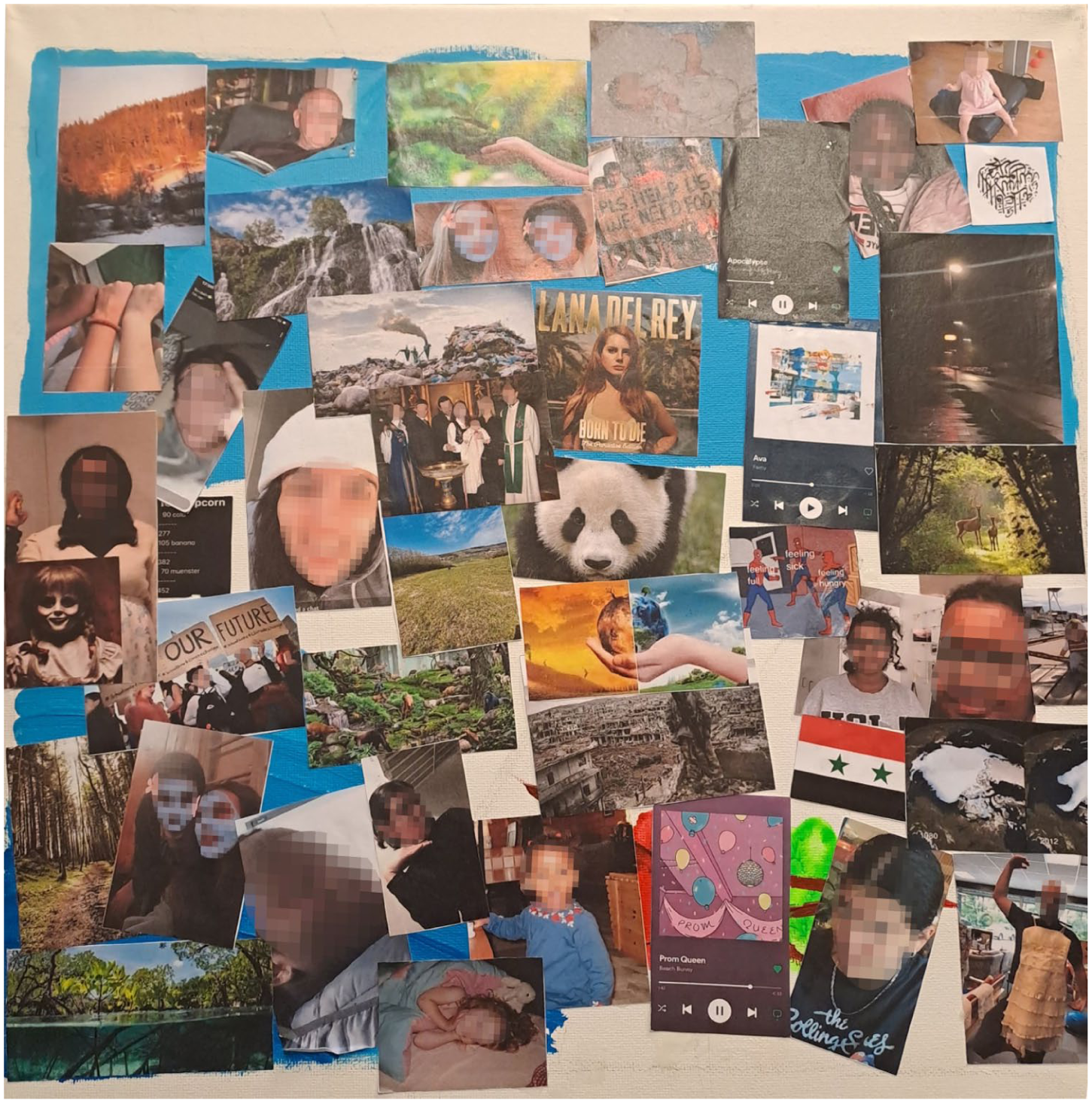
Maya’s second self-representation was crafted on a board, on which she glued photographs and newspaper clippings (see Photo 1). This second self-representation shows her creativity, where her artistic skills are vital as they provoke reflection, awareness, and critical thinking (see Blackburn Miller, 2020).
Maya’s second self-representation.
The second self-representation seems to have enriched Maya’s expression of herself, a change that extends her first self-representation and broadens a sense of relational interconnectedness. Maya told us that the board features photographs of her friends in movie-inspired makeup, a family photo from her baptism, and a photo of her grandfather. Through the lenses of my lived experiences of Obuntubulamu, Maya’s relationships (as illustrated on the board) show how her identity and belonging is shaped by significant others. As Tutu (2009) reminds us, within Ubuntu, “the self is understood to be formed interdependently through community” (p. 1; see also Ngubane and Makua, 2021).
Many principles of Obuntubulamu are showcased in her self-representation. Her commitment to acknowledge and include her friends, even in their absence, without seeking recognition or reward, demonstrates authentic care and empathy. In this way, Maya embodies the essence of being Obuntubulamu, which can be understood as being a good human(humanity). In contrast, a person who practices Obuntubulamu without embodying the being, may only recognise friends when they are present or when it serves their hidden motives. Furthermore, Maya expresses her appreciation for diversity by displaying photos of her friends with different skin colours and religions and clips of religious symbols, a Syrian flag, Arabic words, and music from different countries. From an Ubuntulogical perspective, this reflects obwetowaze (humility), incorporating Muslim and Syrian symbols despite not being a Muslim or coming from Syria herself. Maya demonstrates care for her friends by acknowledging a sense of interconnectedness that transcends religious differences. This act of Obuntubulamu symbolises her commitment to meaningful social inclusion and cultural humility, as she recognises and respects their differences.
Maya’s self-representation also features photos of animals, forests, and the Earth held in a human’s hands, revealing her interconnectedness with non-humans. Within Obuntubulamu, the notion of community encompasses both living and non-living things. She also included a photo from a climate protest and the slogan “Our future”. This all suggests a love for the planet, wildlife, social justice, bulungibwansi (civic engagement), and climate action. This also reflects a sense of obuvunanyizibwa (responsibility) that my mother taught me: To care for the non-human, which in turn will care for me (as illustrated by the mango tree anecdote). These principles embody not only immediate reciprocity but also highlight interconnectedness, co-existence, and responsibilities we share as human beings and with non-human entities, forming an enduring cycle of Obuntubulamu. Maya’s identity and well-being are, therefore, interconnected with the well-being of both humans and non-humans.
Lastly, it is important to note that it is impossible to determine why the changes that occurred between Maya’s first and second self-representations happened, resulting in a greater inclusion of symbols of intergenerational connection, global care, and cultural diversity. It might be the result of activities conducted between the two workshops (Hoem et al., 2025) or of inspiration drawn from the self-representations of other youths or from my own, creating room for critical reflection and a deeper understanding. However, more importantly for the argument in this article, is to showcase what the philosophy of Obuntubulamu teases out as key to understanding and advancing social inclusion in the lives of youths, as they too showcase their Obuntubulamu childhoods.
Maya’s presentation of her second self-representation to the group
Lastly, I draw on my journal notes, describing my observations of the youths’ dialogue, interactions, reactions, and reflections upon viewing Maya’s self-representation on the board.
[Maya] made her board with several photo clips, including her grandfather; I observed youth participants being impressed by her board and responded with smiles, saying, “Wow, you love your grandfather; he is the first person on your board.” She smiled briefly and replied, “Yes, he was my everything. He died recently.”
To feature a photo of her late grandfather aligns with the traditional Baganda values of interconnectedness, emphasising the importance of lineage. Grandparents and parents (regardless of whether they are alive or not) are paramount in explaining who we are, as the deceased also plays a role in shaping who one is, directly and indirectly. Understanding oneself transcends personal identity; while everyone is an individual, they exist collectively. Acknowledging and embracing these relationships is empowering, fostering a sense of belonging and reminding us that we are never alone. The legacy of Obuntubulamu, therefore, transcends individual life; it endures through generations.
In realising that her grandfather was dead, the following happened in the group: The youths conveyed shock as they looked at the photo of the grandfather (whom they assumed was still living) and replied in a calmer voice, “Oh, sorry for your loss; you must miss him very much.” She looked at her board, nodded, and responded, “Thanks.” [Sebuza-Kolstad] instantly shared how he also lost his grandmother in [an African country] and how it distresses particularly his mother very much.
I noticed how Maya grieves the loss of her grandfather together with the youth from diverse backgrounds whom she had met only recently for the first time. Maya invited her peers to connect with her pain, vulnerability, and humanity. She is of Norwegian descent, while Sebuza-Kolstad has Norwegian and African heritage. Despite having different backgrounds, they shared their lived experiences of losing grandparents, acknowledging one another’s pain and loss. Through the lens of Obuntubulamu, I observed Maya and Sebuza-Kolstad’s Obuntubulamu childhoods of doing empathy (okufa ku munno), solidarity(obumu), and obwetowaze (humility) within this space. The act of grieving for the deceased is fundamentally an ethical matter rooted in care and interconnectedness. This may exemplify the inclusivity and relationality inherent in Obuntubulamu (see also Ngubane and Makua, 2021). According to Obuntubulamu philosophy, we understand that our identities are shaped by others, not only in times of joy but also in moments of sorrow. The true essence of Obuntubulamu comes to light, especially in times of crisis, revealing how we interact and connect with individuals from varied backgrounds and worldviews.
In my journal, I also noted Nabiryo’s reaction to Maya’s self-representation: Nabiryo explored Maya’s board with admiration and said, “You must know and care for many people.” Nabiryo pointed at a photo of a black girl whose skin colour resembled hers.
For Nabiryo, a girl of African descent, the representation of someone who looked like her on Maya’s board seems to have made her feel included and connected. This suggests the importance of Maya’s enclosure of friends with different skin colours and religions (discussed in the second part). As described earlier, the principles of Obuntubulamu extend beyond those we know, encompassing strangers and those who may be marginalised or different. Through their interaction, Nabiryo and Maya also demonstrated that promoting inclusion and celebrating diversity is a collective responsibility, highlighting the necessity of empowering individuals like Maya who strive to make a positive impact and the reward on the other end when Nabiryo felt recognised.
Discussion
The analysis of Maya’s two self-representations and reflections from youth participants, along with the following discussion, illustrates how some of the core values of Obuntubulamu can emerge as a lived framework among youth when they are given the time and activities that promote critical reflection. Maya’s shift—from an initially individualistic self-representation aligned with dominant Norwegian norms to a richly relational one incorporating diverse cultural symbols and personal loss—demonstrates how youth can internalise and express Obuntubulamu values such as empathy, solidarity, humility (obwetowaze), and responsibility (obuvunanyizibwa). Importantly, Maya’s shift was not driven by explicit instruction but arose through shared reflection and mutual recognition, as shown, for instance, in the interaction between Maya and Sebuza-Kolstad who shared his own story of the dead.
Similarly, Obuntubulamu’s ethical orientation calls for compassionate interdependence, humility, and responsibility, making inclusion a holistic practice embedded in everyday interactions. The workshops exemplify this: Youth like Nabiryo experienced inclusion in Maya’s self-representation not as mere policy fulfilment but as genuine relational encounters where she felt seen, heard, and valued. Nabiryo’s emotional response to Maya’s inclusion of a Black girl in her self-representation underscores how such relational self- recognition by others can foster a sense of belonging. These moments highlight that inclusion and appreciation of diversity are not abstract concepts but lived ethical experiences that can encourange youth’s sense of belonging and inclusion in a given community. Through the lens of Obuntubulamu, one’s humanity is closely tied to that of others, thereby reframing inclusion as a holistic process of both collective and individual responsibility . Instead of seeing inclusion as an individual’s integration into a dominant system, Obuntubulamu champions the co-creation of inclusive spaces where everyone is an individual yet interdependent,with a shared responsibility towards themselves and each other.
The prevailing Nordic perspectives of inclusion emphasise equality, universal rights, and access through legal protections and policies (see The Norwegian Directorate of Integration and Diversity (IMDi), 2024; The Norwegian Ministry of Labour and Inclusion, 2024). However, these perspectives often rest on liberal individual-centred paradigms that prioritise procedural fairness, neutrality, and cultural sameness (Chinga-Ramirez, 2017; Gullestad, 2002). This approach risks overlooking the relational and structural dimensions that contribute to exclusion and may inadvertently reproduce inequalities by focusing on surface-level compliance and assimilation rather than deeper belonging and appreciation of diversity. Maya’s second self-representation shows her belonging within her social, cultural and environmental networks, and suggests that her wellbeing is interdependent on the wellbeing of others (see also Ursin et al., 2022). This has implications for educational and policy practice, suggesting that a more holistic approach is needed with social inclusion of youths with diverse backgrounds and childhoods.
The use of Obuntubulamu to understand and promote social inclusion among youth advances a decolonial practice (see Smith, 2022; Tamale, 2020) by actively reclaiming and re-centering traditional proverbs,oral narratives, and cultural archives within academia.It, thereby,contests claims of neutrality and cultural uniformity. The philosophy of Obuntubulamu emphasises the importance of relationality, plurality, and the dignity found in differences rather than erasure or assimilation. This philosophy, hence challenges and expands the prevailing paradigm by prioritising relational accountability, mutual care, and interconnectedness amidst diversity. Its core principle—”I am because we are”—positions the individual not as isolated but as part of a web of relationships that includes family, community, ancestors, and the environment as seen in Maya’s case. This relational ontology challenges the fragmentation and procedural focus of Norwegian inclusion policies by emphasising inclusion as an ongoing moral and communal responsibility enacted daily at multiple levels. In contrast to Norwegian perspectives as discussed earlier (see Chinga-Ramirez, 2017; Gullestad, 2002). Obuntubulamu begins from the premise that inclusion must be holistic, relational, and practised in all spheres of life. A youth cannot be meaningfully included in school while they or their parents and friends are being excluded from housing, work, healthcare, or community spaces. Such fragmented inclusion may explain the persistence of racism despite policy efforts, as discussed earlier(see Lundström and Wendt Höjer, 2021), contradicts the spirit of Obuntubulamu, which teaches that the individual (omuntu), the people (abantu), and the environment or material world (ebintu) are interconnected.
While Obuntubulamu offers a powerful philosophical lens for reimagining inclusion, diversity, and relational being beyond Eurocentric paradigms, its application in Nordic contexts will not be without caution and limitations. First, there is a potential risk of cultural translation that diminishes its depth. I have worked tirelessly to translate this philosophy from Luganda to English (a language rooted in Western thinking), which does not fully capture its richness; however, inspired by decolonial thinking, I have kept some core values written in Luganda . Obuntubulamu is rooted in the unique African epistemology of the Baganda people, and principles such as reciprocity might be misinterpreted as equivalent to their Nordic counterparts. As a result, they could lose their Afrocentric contextual richness, while other values like sharing may be idealised when applied in Western contexts. Focusing on one aspect may limit its holistic view; therefore,the focus must remain on the interconnectedness of Omuntu, Abantu, and Ebintu.
According to my understanding, this is the first time Obuntubulamu philosophy and Obuntubulamu (Ubuntu) childhoods are utilised to understand and promote the social inclusion of youth in a Nordic context, and it is new to Norwegian institutional and policy frameworks. This may limit its structural impact and may confine its use to symbolic or educational spaces rather than transformative systems change. The strong emphasis on communal identity and interdependence, while central to Obuntubulamu, may occasionally conflict with dominant liberal values of individual autonomy and rights, raising questions about how to balance collective and personal freedoms (see Tutu, 2009). In highly diverse and secular societies like Norway, philosophical frameworks rooted in culturally specific ontologies may not resonate universally, and there is also a risk of resistance or superficial appropriation, applying the doing of Obuntubulamu and not the being of it.
Lastly, promoting Obuntubulamu as representative of “African philosophy” risks essentialising diverse African worldviews and overlooking the continent’s plural oral intellectual traditions. However these limitations do not negate the values of Obuntubulamu; instead, they highlight the need for a critically reflexive and dialogical approach that navigates cultural specificity, power relations, and epistemic plurality when introducing alternative knowledge systems into Western educational and policy domains to understand, support and advance inclusive societies.
Conclusion
In this article, I have presented a case study based on a 14-year-old girl’s self-representations and the subsequent reflections of other youths in two workshops in Norway. I have used the lens of African indigenous philosophy of Obuntubulamu to explore the inclusive character of the girl’s self-representations and then discussed how this philosophy can serve as a more holistic and inclusive framework for promoting inclusion and appreciating diversity among youth.In so doing, I have responded to decolonial critiques (Abebe et al., 2022; Rabello De Castro, 2021; Tamale 2020) by centring Obuntubulamu, which is mainly an Afrocentric and oral non-Western knowledge, in education, social work and policy-making, not as a replacement for Western approaches but as an expansive and ethically generative contribution that foregrounds lived experience, relationality, humility, and interconnectedness.
Drawing on Maya’s evolving self-representations and the subsequent interactions, reactions and reflections among other youths, this case study has illustrated how Obuntubulamu’s core values, interconnectedness, relational being, ethical responsibility, and mutual care emerged as a lived framework among youth when allowed time and activities for critical reflection. Maya’s shift from an initially individualistic self-representation to a more relational one demonstrates how youth can internalise and express their obuntubulamu childhoods and core Obuntubulamu values such as empathy, humility (obwetowaze), and responsibility (obuvunanyizibwa). Obuntubulamu invites us to rethink inclusion as a moral, social, and relational imperative rooted in our shared humanity. Obuntubulamu not only broadens our conceptual understanding of inclusion but also transforms how it can be practised with the above mentioned “ntu”interconnectedness and principles. Such an approach can cultivate deeper respect for diversity, dismantle exclusion and racism, and foster more just and connected individuals and societies.
By weaving together data and my own childhood and youth lived experiences of Obuntubulamu, this article contributes to the decolonisation of childhood and youth studies by making visible African childhoods in the North, philosophical contributions in efforts to foster inclusion and appreciation of diversity among youth. In doing so, it supports calls for epistemic plurality and affirms the value of Indigenous knowledge systems (Smith, 2022; Tamale, 2020) in shaping more just and inclusive societies.
In summary, Obuntubulamu provides a holistic framework that expands Nordic inclusion beyond legalistic and individualistic paradigms. Through the youth self-representations and subsequent interactions, the case study demonstrates that meaningful inclusion arises from relational recognition, shared humanity, and interconnectedness. The philosophy invites educators, social workers, policymakers, and others working with youth and social inclusion in Nordic contexts to rethink how inclusion is conceptualised and operationalised. It challenges dominant Western notions of the autonomous individual and the assumption that individual access to rights and services alone suffices for belonging.
By promoting a holistic worldview that recognises the dignity and interdependence of all people and things. Obuntubulamu calls for reframing social inclusion efforts to encompass everyday interactions, relationships, and encounters with youth-embracing the ‘doing’ and ‘being’ of Obuntubulamu in building an inclusive society.
Therefore, Obuntubulamu is not merely a complementary lens but demands a shift from procedural compliance to compassionate belonging, from isolated individuals to interconnected ones and communities, and from fragmented policies to systemic and holistic coherence. As such, it offers both a critique and a hopeful vision for reimagining inclusion in increasingly diverse Nordic societies.
Footnotes
Acknowledgements
Thank you all. I want to express my gratitude to my supervisors Prof. Marit Ursin and Prof. Carla Ramirez, research communities at Norwegian University of Science and Technology, Prof. Chryell Bellamy and all PRCH members at Yale University, and colleagues at Makerere University. To the youth participants in this study, all of which your insights shaped this study. Special thanks to my parents Mr. and Mrs.Grace and James Bisasso of Nakaseke, all my siblings, community members and the environment for teaching me about Obuntubulamu in my childhood. Even though my name is on this article. It is our collective effort—Omuntu (myself), Abantu (all contributors, youth participants, funders, editors, reviewers, including you the reader), and Ebintu (the tools, journals and spaces that continue to support this work). I am because we are-The Obuntubulamu (Ubuntu) Knowledge of Buganda an African indigenous philosophy and pedagogy for inclusivity.
Author note
All claims expressed in this article are solely those of the author and do not necessarily represent those of their affiliated organisations, or those of the publisher, the editors, and the reviewers. Any product that may be evaluated in this article, or claim that may be made by its manufacturer, is not guaranteed or endorsed by the publisher.

Funding
The author disclosed receipt of the following financial support for the research, authorship, and/or publication of this article: The author declare financial support was received for the research, authorship, and/or publication of this article. This study was funded by the Norwegian University of Science and Technology.
Declaration of conflicting interests
The author declared the following potential conflicts of interest with respect to the research, authorship, and/or publication of this article: The author declare that the research was conducted in the absence of any commercial or financial relationships that could be construed as a potential conflict of interest.