




Abstract
Young people involved in climate justice activism engage in a range of tactics across entangled ‘online’ and ‘offline’ spaces. This article explores the affordances and ambivalences of humour in digital modes of contention for young people (aged 12–30) involved in climate justice activism. Four of the authors are 19–22 years old and involved in climate justice activist organising, and one author is a university-based researcher in her early 40s. Through a collaborative, intergenerational analysis of stories of hybrid digital climate activisms, we ask: what is the role of humour in young people’s varied activist repertoires? Thinking with the conceptual resources of adrienne maree brown’s Pleasure Activism, we pose three analytic provocations: (i) humour can amplify generational tensions; (ii) humour is entwined with individual and collective identity-work; and (iii) sometimes humour is ‘just a thing’ (that can also help with burnout). We collaboratively analyse how young people use humour to dissent, through lampooning hierarchical power structures and profit-driven systems, drawing attention to intersectional injustices, and joyfully expressing affinity and solidarity. At the same time, humour may exclude, offend, and reinforce existing divisions and injustices. Humour is an underappreciated feature of organising towards a more just world, even as the pleasurable and just outcomes of humour are not guaranteed. We argue for further attention to young people’s multimodal repertoires across hybrid spaces, and the multiplicity of feelings that accompany climate justice activisms.
Keywords
Introduction
The mass mobilisations of school-aged young people under the banner of Fridays for Future and School Strike 4 Climate (SS4C) captured mainstream media attention in 2018 and 2019 (Alexander et al., 2022). Across the continent known as Australia, numbers of strikers swelled from an estimated 8000 people at the November 2018 strikes (Albeck-Ripka, 2018) to 300,000 at the September 2019 strikes (ABC News, 2019). These mass mobilisations have inspired a body of literature analysing school strikes as climate activism (Neas et al., 2022). While the face-to-face mass strike has been the type of action most frequently associated with student-led climate activism, Neas et al. (2022) point out that these events were only ‘one activity in a wider web of youth climate activism’ (p. 2), with a far longer history. 1 This ‘wider web’ of activism includes digitally-facilitated modes of activism that challenge the ‘fallacy of spatial dualism’: that is, where ‘the online realm—that is, the digital, the cyber, or the virtual—is treated differently than the offline realm—the physical, or the real’ (Lim, 2015: 118). A range of feelings associated with climate change and its injustices move across imbricated ‘online’ and ‘offline’ spaces: including eco-anxiety, grief and rage, to joy, love and hope (Bowman et al., 2023; Curnow et al., 2021; Nairn, 2019; Pickard et al., 2020).
This article, written by an intergenerational research project team in Australia, reflects on young people’s 2 use of humour in hybrid digital modes of climate justice activism. Four of the authors are 19–22 years old and involved in climate justice activist organising as well working as paid research associates at Deakin, and one author (Eve) is a university-based researcher in her early 40s. We draw on our own experiences of creating and responding to ‘funny’ social media posts, and other examples of humour in climate organising spaces. Analysing stories surrounding a curated selection of online posts and face-to-face actions, we consider humour’s affordances and ambivalences, asking: what is the role of humour in digital ‘repertoire[s] of contention’ for young people (Tilly, 1986: 4)? Our analysis challenges the construction of boundaries between ‘online’ and ‘offline’ spaces and between emotional states, arguing for further attention to multimodal repertoires across hybrid spaces and the multiplicity of feelings accompanying climate justice activisms. Our collaborative analytical processes contribute towards methodological discussions about the value of co-researching and co-publishing with young activists.
In what follows, we synthesise work from social movement studies relating to humour and digital modes of contention, before outlining our collaborative writing and analysis process and the conceptual influence of adrienne maree brown’s (2017) Pleasure Activism. We then collaboratively theorise how humour is used in digital organising and pose three analytic provocations: (i) humour can amplify generational tensions; (ii) humour is entwined with individual and collective identity-work; and (iii) sometimes humour is ‘just a thing’ (that can also help with burnout).
Humour and the digital in social movements
Humour and activism go hand in glove. Humour is a ‘serious matter of concern’ (Dodds and Kirby, 2013: 45) for social movement and climate change communication scholars (e.g. Boykoff and Osnes, 2019; 't Hart, 2007). Humour has been argued to have the potential to disrupt dominant messages and disarm systems of power (Sørensen, 2017), and to foster interpersonal connections that sustain social movement relationships (Hinzo and Clark, 2019). However, while humour in social movements and climate change communication can cleverly draw attention to the hypocrisies, inconsistencies and pretensions of power (Boykoff and Osnes, 2019: 154), using humour also risks trivialising or undermining its intended political message (Penney, 2019).
Digital social media, like humour, has become a ubiquitous feature of contentious political movements, from mass movements including Occupy Wall Street (DeLuca et al., 2012) and the Arab Spring (Ben Moussa, 2013), to the solidarities forged between Indigenous peoples across ‘distance, time and nation-states’ around the globe through social media technologies (Carlson and Berglund, 2021: 3). Digital social media have offered novel, inexpensive channels for people to connect, organise and mobilise (Earl and Kimport, 2011). 3 Treré (2018) argues that social media are more than just neutral ‘tools in the hands of social movement actors’ (p. 1): social movements and media technologies mutually shape each other. Digital activisms, like humour, have ambivalent and multivalent affective and political impacts on those young people engaging with them, as we elaborate below. Further analysis is needed of the affordances and ambivalences of emotions, humour and digital modes of contention for young people involved in climate justice activism. We argue that these research analyses need to happen in conversation with the young people who are creating these texts and involved in these modes of activism.
Humour, young people and digital climate justice activisms
In recent years, scholars have analysed the importance of humour in the public-facing messaging of school strikers in their protest signs (e.g. Bowman, 2020) and visual communication (e.g. Catanzaro and Collin, 2023). Humorous placards created by young climate strikers have been argued to disrupt ‘routinized expression’ of political demands (Bowman, 2019: 9), be ‘vehicles of grassroots creativity’ and ‘bottom-up science communication’ (Hee et al., 2022: 2), hold public pedagogical potential (Mayes and Center, 2023), and breed ‘enthusiasm’ that sustains those involved (Catanzaro and Collin, 2023: 27). Hee et al. (2022) identify and analyse specific forms of humour in in-person SS4C placards in Australia – from ‘[p]uns, rhymes and other forms of wordplay’, ‘[f]unny juxtapositions’, ‘[w]itty cultural references’, ‘[v]isual humor’, ‘[s]elf-deprecating humour’, to an ‘[u]nderlying theme of satire’ (7, 8, 9, 10, 13, 14). In an ethnographic analysis of young climate justice activists’ actions at the United Nations Conference of Parties (COP) 19 climate summit, Foran et al. (2017) describe young activists’ creation of a mock Lemonade Stand to raise money for the Adaptation Fund, ‘showcasing the paltry contributions made so far by developed countries’ and ‘the hypocrisies of the COP process’ through the use of ‘irony and satire’ (364). Curnow and co-researching university activist colleagues (2021) analyse the use of ‘snark’ (sarcastic and ironic jokes) within a university-student fossil fuel divestment campaign, and its ‘ability to create joy-filled expressions of rage’ and within-movement solidarity in the face of internal sexist and racist movement dynamics (962). Such uses of humour in relation to climate change are argued to re-empower individuals and reduce their eco-anxiety (Elgaaied-Gambier and Mandler, 2021).
Before analysing the role of humour in young people’s multimodal hybrid climate activisms, we contextualise the role of digital platforms and applications in young people’s climate organising. Sorce and Dumitrica (2023) note that much of the organisation of ‘flagship’ mass climate strikes in 2018 and 2019 happened via a ‘digitally-supported action repertoire’, including advertising in-person events on Facebook event pages, Instagram and TikTok posts, and planning and communicating via Google Docs, Slack, Discord and Facebook messenger and Zoom meetings (571). Tattersall et al. (2022) call these various platforms digital ‘Town Squares’ for young people’s climate organising (p. 48). Though digital strategies were not new, when COVID-19 was declared a global pandemic, student-led climate networks across the world were compelled by public health measures to move all in-person actions to online space: a move described, in the European context, as the ‘forced digitalization’ of the ‘flagship’ strike mobilisation strategy (Sorce and Dumitrica, 2022: 570). In Australia, online actions organised by SS4C included #ClimateStrikeSchool – a series of interactive national online zoom workshops from April 2020, in preparation for the national May 15th 2020 #ClimateStrikeOnline. In Australia, Pacific Climate Warriors, an intergenerational ‘youth-led grassroots network working with communities to fight climate change from the Pacific Islands and diaspora’ (Pacific Climate Warriors n.d.: para. 1), continued to meet online, and engaged in digital storm actions (see below). After the COP26 climate summit in Glasgow (December 2021), Seed Mob (the First Nations youth-led climate justice network) organised a First Nations climate justice webinar open to the public for young First Nations leaders to share their experiences and insights from being there. Over the period of COVID-19-related lockdowns, young people and youth climate networks continued to create Instagram posts and TikTok videos in more ‘ephemeral’ everyday modes of climate change communication (Hautea et al., 2021: 1).
In recent years, a wave of scholarship has emerged examining the use of social media surrounding young people’s climate activism. There have been analyses of ‘anti-feminist, anti-environmentalist, and ableist’ memes about Greta Thunberg (White, 2021) and social media trolling of Greta (Vowles and Hultman, 2021), large-scale analyses of trace data from Twitter (Boulianne et al., 2020) and Facebook (Sorce and Dumitrica, 2023), and analyses of the framing of Fridays for Future on social media (Huttunen and Albrecht, 2021; Kenis, 2021). Huttunen and Albrecht (2021) analyse what they call the ‘dominant adult voice’ in Twitter posts about FFF; in their analysis, while over 92% of the posts were positive and ‘well-meaning’ in tone, they are ‘depoliticising’, in their predominant focus on what young strikers can ‘learn about politics’ from their participation rather than FFF’s ‘political acts’ and ‘demands’ (56; their emphasis). Such textual analyses of young people’s climate activism on social media have been largely undertaken by those positioned outside these movement spaces, and through analysis of single platforms that may not be young people’s preferred platform. For example, Feldman (2022) points to the disparity between older social media users’ habits and those of young people, citing that only 6% of regular Facebook users are aged 13–17 (Social Media News, 2020, as cited by Feldman, 2022: 114).
Alongside larger-scale analyses of trace data and responses to young climate activists online, others have analysed how young climate activists are using social media to circumvent ‘traditional media and gatekeepers’ and ‘speak on their own terms’ (Mayes and Hartup, 2022: 1012). In a digital ethnography of Twitter feeds of seven young climate activists, Wielk and Standlee (2021) analyse how these climate activists use social media to ‘build community and mobilize followers’ with ‘digital and physical resistance’ working in dynamic ‘fusion’ (22). Brünker et al. (2019) analyse user comments on two of Greta Thunberg’s public posts on Instagram, finding that social media is used to create ‘group cohesion and emotional attachment’ (304). Such analyses of young activists’ online participation argue that such engagement is not ‘slacktivism’ or ‘clicktivism’ (Dennis, 2019) – where online movements are dismissed as enabling low stake and symbolic involvement only – but, rather, is part of a continuum of tactics for individual and collective action across enmeshed and hybridised ‘online’ and ‘offline’ spaces (Showden et al., 2023). Boulianne and Theocharis’ (2018) meta-analysis demonstrates that such (so-called) ‘online’ activities correlate with ‘offline’ activities. Despite the methodological promise of engaging with young activists’ social media ‘on their own terms’, Neas et al. (2022) point out that such discursive analyses risk the researcher imposing their own interpretive frames on what young people are doing (2). They call for young people to be involved in ‘knowledge co-production’ about young people’s climate activism (Neas et al., 2022: 3).
The ambivalences of humour in young people’s digital activisms amplify the need to foreground young peoples’ analyses of the role of humour. Hautea et al. (2021) point out that humour in social media climate content can be ‘highly ambivalent’: blending ‘irony, satire, and sincerity in ways that produce rabbit holes of potential meaning’ (2). Analysing a student-created Facebook page, Uruguayan Memes for Young Citizens, Winocur and Dussell (2021) find that the content creators’ use of ironic humour works to affirm the ‘superiority of some’ and to exclude and stigmatise others (p. 43). When young people mobilise humour – as in the school strikes – their humour risks being interpreted and dismissed as demonstrating their adolescent immaturity, contempt for authority, or juvenile vulgarity (Mayes and Hartup, 2022), potentially exacerbating generational tensions in relation to climate change. To parse out these ambivalences and nuances of humour in young people’s social media communication of climate change, scholars have called for further qualitative studies, including analyses of platforms beyond Twitter (Hautea et al., 2021: 2; Pearce et al., 2019: 1). Hee et al. (2022) call for further co-research methodologies with young people since, when young people’s humour is analysed ‘purely by adults’, adults may not capture and analyse the ‘key messages’ in humour that ‘young people themselves’ would identify (p. 17). These calls for further qualitative participatory studies inform our methodological approach.
Methodology
Our analysis of digital modes of climate justice organising and humour in this article begins with our own experiences, responding to calls for studies of young people’s climate organising to be conducted with, not on, young people (Cutter-Mackenzie and Rousell, 2019; Neas et al., 2022). We write as a team of four young (18–21 years old) climate organisers who are also paid research associates (Sophie, Netta, Dani and Natasha), and one university-based researcher (Eve). Sophie Chiew is a former organiser with SS4C and former fundraiser with the Australian Youth Climate Coalition (AYCC); Eve Mayes is a university researcher and former secondary school English teacher; Netta Maiava is an organiser with Pacific Climate Warriors (PCW); Dani Villafaña was an organiser with SS4C, was previously a campaigner with Sweltering Cities, and is currently a campaigner with Fair Agenda; Natasha Abhayawickrama is a former organiser with SS4C, is involved with Sapna South Asian Climate Solidarity, and is an organiser with AYCC. This research team is working together on an Australian Research Council project exploring young people’s climate justice activism(s). The research team has met fortnightly since June 2022, developing protocols for working together, preparing the project’s design, engaging in consultation processes with members of the project’s First Nations Critical Reference Group and Stakeholder Reference Group, preparing an institutional ethics application, engaging in research conversations with each other and with participants in the project, collaborative analysis and co-authorship.
The project team’s methodological approach is informed by an understanding that those involved in activism are already creating knowledge and theories through their own activist praxis before the arrival of university-based researchers (see Choudry, 2015: 61). We understand young people to be knowers and theorists of their own lives and activist practices, in alignment with Youth Participatory Action Research (Cammarota and Fine, 2008) and feminist critical participatory activist traditions (Fine, 2018). In developing the research team’s protocols and research methods, we have wondered how we could speak with other young climate justice organisers in ways that are respectful (of time and knowledge), just (of use and benefit to those pursuing climate justice), non-extractive (generative and reciprocal, rather than extracting and stealing stories and knowledge), and attuned to our complicity, as researchers, in unjust systems and structures (see Fine and Barreras, 2001; Leboiron, 2021). The team co-developed and practised ‘research conversations’ (the central project method) during project team meetings over Zoom: conversations where both the typical ‘participant’ and the ‘interviewers’ share experiences and insights, with at least one younger member of the project team involved. Naming these interactions as ‘conversations’ rather than ‘interviews’ is intended to trouble the one-way dynamic of the qualitative ‘interview’ where the researcher ‘extracts’ a story from a minoritised ‘other’ (Tuck and Yang, 2014). 4 To date (December 2023), we have had formalised 5 research conversations with over 56 people 6 involved in youth-led climate activism; and have received over 60 responses to an anonymous online survey about young climate advocates’ experiences. Since these research methods are still in process, this article does not include insights from these conversations or survey responses.
Before beginning to have formalised research conversations with others, we started by having these research conversations amongst ourselves during research team meetings. We each brought a screenshot or photo to the research conversation from our own activist experiences and shared a story about the photo or screenshot. We learn from Louise Phillips and Tracey Bunda that stories can operate ‘as theory, as data, as process, as text’ (Phillips and Bunda, 2018: 7), particularly for social movements (Bunda and Phillips, 2022). It was in these early conversations when Natasha first shared an Instagram account and Netta shared a Pinterest board (see below) that they each had been part of creating, walking us through these online spaces and telling us about them (cf. Møller and Robards, 2019). After the project team was invited to speak at a conference symposium in November 2022, and to contribute to this special issue, we noted the prominence of digital modes of activism and humour across our research conversational stories. Sophie and Eve took the lead in writing notes and meeting together to start analysing these texts, drafting this article in a shared Google Doc, touching base periodically with the research team. Laughter has been part of our conversation and analysis processes: laughing with the storyteller and laughing at the idea of analysing these posts (including when Natasha’s housemate overheard and laughed at a conversation over Zoom where we were analysing Nicki Minaj parody memes, see below).
After peer review, earlier analysis categories were further refined to the three ‘analytic provocations’ discussed below. We name these ‘analytic provocations’ rather than ‘themes’ or ‘findings’, in recognition that our analyses of our stories are situated, partial and provocative, and not universalisable across contexts; these are the stories and analyses of five people in ongoing conversation. We are inspired by Michelle Fine’s notion of ‘provocative generalisability’: research that provokes ‘readers to act’ through the ‘creative provocation of an aesthetic experience’, and analysis that ‘launch[es] from [. . .] findings to what might be’ (Fine, 2006: 100; see also Leboiron, 2021b). We hope that you will be provoked and/ or perplexed by the stories and examples of humour that follow, and that you might be inspired to engage in ‘pleasure activism’. Writer, activist and facilitator adrienne maree brown (2019) defines ‘pleasure activism’ as ‘the work we do to reclaim our whole, happy, and satisfiable selves from the impacts, delusions, and limitations of oppression and/or supremacy’ (brown, 2019: 13). 7 Drawing inspiration from black female writers including speculative fiction author Octavia Butler, brown writes that pleasure activism is ‘us [collectively] learning to make justice and liberation the most pleasurable experiences we can have on this planet’ (brown, 2019: 13). We make the provocative generalisation that humour is an underappreciated feature of organising towards a more just world, even as the pleasurable and just outcomes of humour are not guaranteed.
The following section elaborates on three analytic provocations that draw on five selected examples of humour in organising that we have been part of, in entangled online and offline spaces, across different platforms, from 2019 onwards. These five examples differ in the mode and relative ‘success’ of the intended humour. Following the conventions of social media research, for screenshots and photos that we share in this article, we engage in ‘ethical fabrication’ (Markham, 2012): altering the form of data by removing usernames and cropping and modifying images where the web source can be traced via a reverse Google image search. We acknowledge, as a disclaimer, that nothing kills a joke like explaining it; you might not share our sense of humour, and that’s okay. ;)
Three analytic provocations
Humour can amplify generational differences
Across imbricated ‘online’ and ‘offline’ environments, the use and interpretation of humour in climate activism can be contentious, risking exacerbating perceptions of an ‘intergenerational dividing line’ (Kenis, 2021: 139) in relation to climate change. We share two stories to illustrate this analytic provocation. Netta described the creation of memes in an online action during a 2020 COVID-19 lockdown period, when Pacific Climate Warriors were not able to physically gather:
[We had] a Flash Flood Friday [. . .] when we all got on Zoom together, and then would do little actions that involved spamming the [CEOs of major] banks and getting their attention through different sorts of media. [. . .] I think if it wasn’t for COVID, this wouldn’t have been a thing. [. . .] We created a Pinterest board [for a major bank] full of memes that would attack [particular banks] and their investment in coal, gas and oil. [. . .] So if anyone searched up any of these banks on Pinterest, this is what would come up. I was quite new to the scene, so it was like me, three other organisers and then the people who attended were literally just all my friends and my siblings [. . .]. I would make a tutorial on how to make a meme, and then I’d present it and send out the links for people and then they can just pick whatever images they want, and whatever message they want on there as well. [. . .] They would go off and create the memes and then we’d put them on this Pinterest board [see Figure 1]. I remember we tried to pitch [meme-creation as an action] to a different, older group recently and one of the people, they were like, “Oh, what’s a meme?” And then it was kind of like, “Oh, we have to explain like the whole concept of a meme” [. . .]
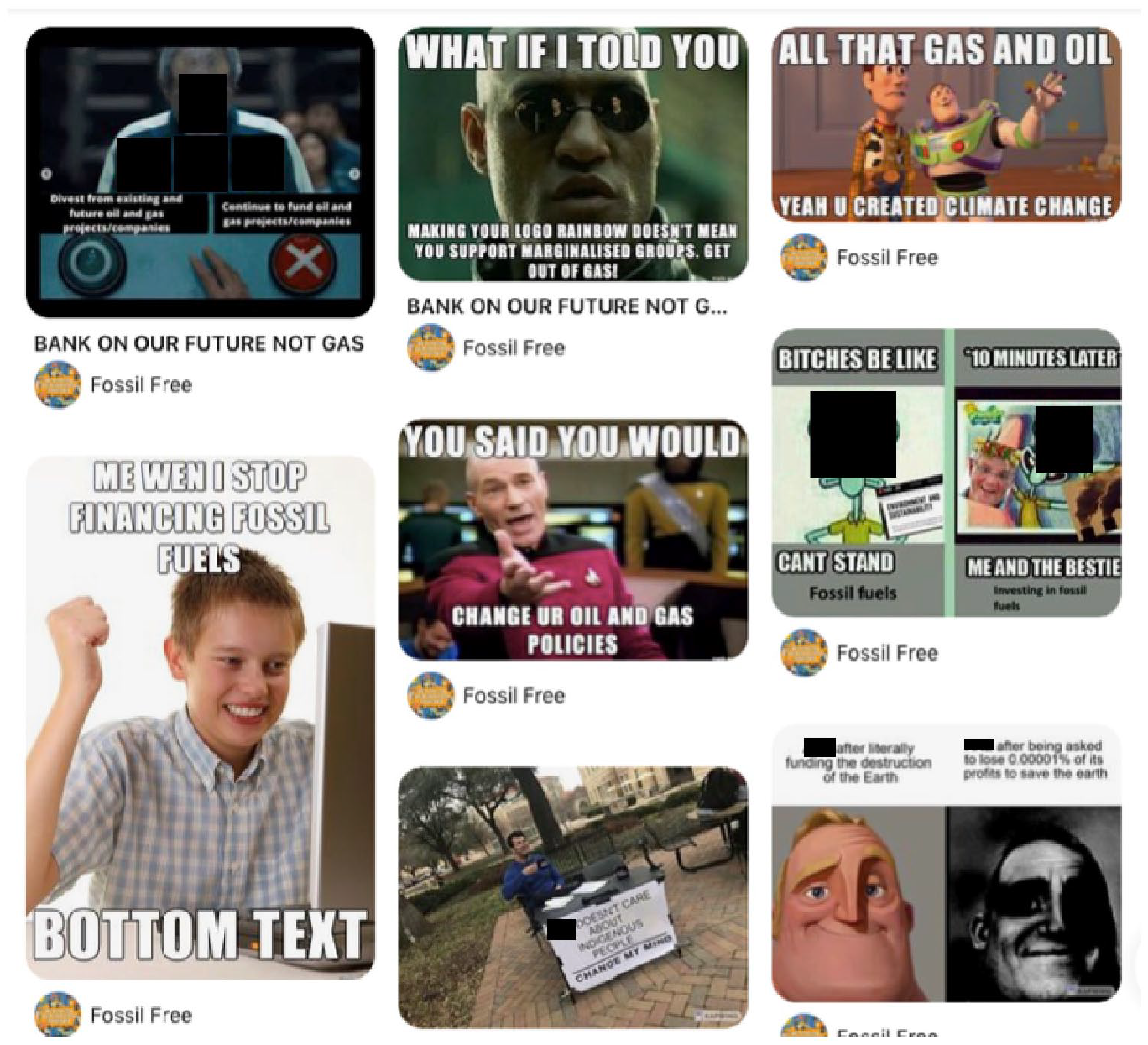
Screenshot (edited) of a Pinterest board created during a Pacific Climate Warriors online action in 2020.
This online action, creating and posting memes, during the height of the COVID-19 pandemic, was part of a broader repertoire of ‘digital storm’ tactics that erupted under lockdown conditions (Gulliver, 2022). Digital storm actions – also used by School Strike 4 Climate and other grassroots climate networks – also included calendar jamming (where multiple people simultaneously request meetings with a corporate executive and/ or politician about the bank’s fossil fuel investments) and ‘jamming’ a bank’s online customer service response form (by multiple people simultaneously completing forms). In digital storm actions, time is set aside, online, and participants individually create/ type, with the accompaniment of upbeat music. In the meme-creation action, Netta, her siblings and friends, created memes that generated humour for them: at the thought that someone could search the bank’s name on Pinterest and find a page of satirical memes.
But this humour is not guaranteed to be shared by others and may misfire when shared across generational groups. The same action, attempted again with an older group of people, sparked the question, ‘what’s a meme?’ The meme action, and its interpretive success, relies on an alignment of popular cultural codes, which are generationally and culturally contingent, between those undertaking the action and their audience. Not all activists are necessarily familiar with meme conventions, nor have access to digital platforms where memes are shared. When those unfamiliar with the conventions create a meme in these circumstances, and try to fit existing messaging into meme templates, there is the risk of feeling awkward or out of touch. Viewers may experience second-hand embarrassment or less of an affinity with the organisation when it is shared.
The potential for humour to refract in meaning with a different audience is also evident in a face-to-face School Strike 4 Climate action with plastic kazoos. 8 Dani told the story of a ‘wacky action’ in Sydney in 2019, and how journalists’ representations of the strikers shaped how their words and actions were interpreted by online readers of a different generation:
[A] lot of our actions were focused around movement-building and getting students engaged and having conversations, rather than campaigning to a decision-maker for a specific outcome. It was just about getting that energy for climate action out there. So that meant that a lot of our actions were really wacky. My favourite one was when we did a rally outside Anthony Albanese’s 9 office and we ordered like two hundred kazoos to the office, and then we all just played kazoos outside his office for a day, which was really fun. It was in the pouring rain as well.
I remember reading about that [action] in The Daily Telegraph. The way that [the reporters] wrote about it emphasised that the students said: ‘we have kazoos and we’re not afraid to use them’. They made it sound really sort of scary, and [they reported that the students] then were leaving rubbish. [. . .] I thought, this just sounds like a hilarious action. But the newspaper painted it in this particular light. Did you see that article?
Yeah. . .we [had] made like a point of using a tagline that was like, ‘we have kazoos and we’re not afraid to use them’, because to us it was just a really, really funny thing for us as like fifteen-year-olds, to say to the man who would eventually become a Prime Minister. At the time, Albo 10 wasn’t even Leader of the Opposition. So, to us he was just our local MP in the inner west, and we were like, ‘we’re going to attack you with kazoos’, because obviously, what’s he going to do? We’re not going to traumatise him with really bad kazoo playing. [Laughs] So, we thought that was a really fun action that got a lot of students really engaged in the issue and got a good turnout. Even though The Daily Telegraph seemed to think we were terrorising him.
This action, in Dani’s account, was laced with tongue-in-cheek, self-deprecatory humour. The humour is derived from the (to the school strikers, obvious) power asymmetries of students declaring that they are ‘not afraid to use’ kazoos against a Member of Parliament in the presence of security guards and the media. The incongruity and impossibility of young people hurting the MP with kazoos generates the humour for the young people involved. The action is fun, gleeful and exuberant, with the ‘wacky’ strategy of kazoos attracting media coverage; this strategy was accompanied by the more ‘serious’ demands for stronger climate action from the Labor party.
Yet, in an article published in The Daily Telegraph (a Murdoch-owned newspaper 11 ), this kazoo action was reported in terms that decontextualised the intended humour. Students were described as ‘aggressive’ and ‘insult[ing]’, ‘barg[ing]’ into the office, ‘trash[ing]’ Albanese’s reception area, ‘yell[ing] inappropriate and violent comments’ including ‘“we have Kazoos and not afraid to use them”’ (Beaini et al., 2019). This report was also published online on news.com.au (No author named, 2019) and the kazoo quotation repeated in an article on the Australian Daily Mail website (Bevege and Australian Associated Press, 2019). This reporting of the kazoos deliberately misreads and obscures the humour by taking the slogan out of context, diverting attention away from the strikers’ political demands, and recontextualising young people’s gathering with kazoos and political demands as indicative of teenage rebellion and violence (Mayes and Hartup, 2022: 1008–1009). In algorithmically-curated news consumption networks, politically conservative readers of these online articles will not have ‘got’ the intended humour, potentially amplifying generational tensions relating to young people’s climate activisms.
Humour is entwined with individual and collective identity-work
Youth-led climate organising networks have a strong social media presence, frequently posting about how to get involved in upcoming actions and movement-building meetings and camps. Such uses of social media are ‘connective’ and generative of ‘collective’ activist identities and solidarities (Showden et al., 2023). While there are many examples of info-graphics and ‘serious’ messages in youth climate networks’ social media accounts, here we focus on a light-hearted post shared by a youth-led organisation in its externally-facing social media communication:
Recently, I saw a TikTok posted by a large youth-led climate organisation. In the video, the camera pans around to show a large group of young people, almost all of them wearing Doc Martens boots, with the squeaky voice of a young child saying ‘nice Docs’ over and over again playing in the background. The caption reads, ‘POV: you are at an [organisation’s name] camp.’
Algorithmically-curated Instagram feeds mobilise and create ‘affinity online’ (Ito et al., 2019) through tapping into shared tastes, sociabilities and familiar modes of cultural production. This TikTok video satirises the embodied expressive performance of an ‘activist’ identity by wearing vegan ‘Docs’ – associated with ‘greenie’ politics – signifying a particular ‘type’ of person and politics. The TikTok short video format, the repetition of the child’s voice, and the absence of political demands project a youthful and fun feel of those gathered for the organisation’s camp, challenging perceptions of the movement as serious, scientific, and potentially boring. The organisers create a sense of shared cultural codes (dress and shoe style) and concerns (the environment) and make fun of themselves by playing with stereotypes of young climate activists (as wearing Doc Martens). Young climate organisers potentially laugh at this story because it is recognisable – they see themselves and their friends reflected in the post. Yet there is also the potential for young people who care about the climate, but who do not share this dress sense, or who do not have the resources to buy expensive boots, to feel alienated by this post (Figure 2).
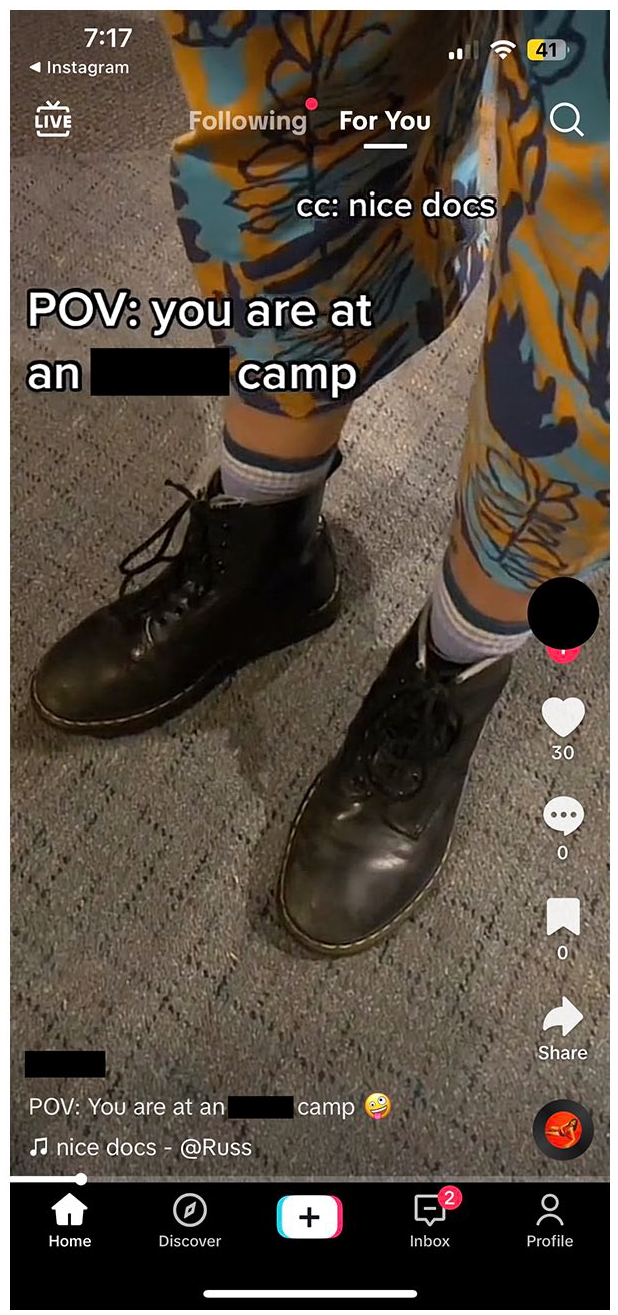
Screenshot from youth-led climate organisation’s ‘nice Docs’ Tik Tok video from 2022.
Using humour within organising circles does not necessarily create a sense of affinity, and can be used for different purposes, as Dani’s story suggests:
We [previously] basically all organised [actions] out of a Facebook Messenger chat, which was hell. But at the time it was what we had and obviously we didn’t have any money to get something like Slack or to even set up a Google Drive, so we were all organizing out of Facebook Messenger [. . .] – we were relying on these free services. Once we pranked them [other organisers] and a few of us told the entire national network that we were going to move all of our organizing conversations to [a particular freeware instant messaging mobile app], and that we had undemocratically chosen to do this. . . [This app] was kind of like WhatsApp, except only teenagers used it, and then [older] people stopped using it because it’s not a very secure platform, and often, randos [random people] will text you and be like, “Hi! Do you need a sugar daddy”, so no one uses it anymore. 12 But what was funny about it was that it’s a platform that you probably associate with being like a child and it’s also a dead platform. Anyway, half of them believed us and then got really, really angry at us afterwards and we had to apologise.
Dani’s story is of a ‘in-group’ joke within an online organising context, in the spaces that have been described as the ‘backstage spaces of digital activism’ (Treré, 2018: 6). In these spaces of ‘everyday’ organising that are in ‘continuous interaction’ with the ‘frontstage’ (Treré, 2018: 210) of public-facing activity, there are ‘submerged negotiations’ and the ‘construction and maintenance’ of ‘collective identity processes’, including group norms (Treré, 2018: 11). The prank – where a few strikers told the others that they had unilaterally decided to change the online communication channel – troubled the group’s norms of democratic decision-making and child safeguarding. They were perceived by some to have crossed the unspoken collective boundary of when it’s okay to joke around and when it’s not okay to joke around. Organisers who took this decision at face value responded earnestly to the breach of democratic decision-making norms, and the issues with child protection on this particular app. When the prank was exposed, other organisers may have felt that their trust or expectations of strikers’ democratic processes, professionalism and maturity were violated; they may have felt embarrassed or excluded from a joking ‘in-crowd’. Within-movement humour, whether externally-facing (in the Doc Martens TikTok example) or internal (in the communication of a prank), may be responded to in a wide variety of ways by differentially-positioned people. Humour may variously draw in and/ or exclude and may highlight the differences between members of a previously perceived collective.
Sometimes humour is ‘just a thing’ (that can also help with burnout)
Sometimes there is no apparent strategy behind the uses of humour. Natasha’s story is of an Instagram account classified as an ‘Environmental Conservation Organisation’ and named after fans of Nicki Minaj (Trinidadian-born rapper, singer and songwriter). This account was created by a group of young school strikers during the height of the COVID-19 pandemic (2020). In posts on this account, Nicki Minaj is pictured saying climate-related slogans. 13 While not deliberately strategic in intent, this account seemed build movement engagement through laughter and ‘fun’, according to Natasha (Figure 3):
During one of the many COVID-19 lockdowns, some of my friends and I created an Instagram account using the name of fans of Nicki Minaj [Barbz]. It was one thing in lockdown where we could actually have fun and laugh about it, and actually make funny content. We didn’t feel embarrassed or cringe because everyone just kind of found it funny, because it was just like a thing. . . . So, it wasn’t like a traditional form of activism in any way, but it was just a fun thing that a group of friends were doing whilst also putting out messages about. . . like Nicki Minaj doesn’t support plastic or something. Just things that definitely aren’t true. Nicki Minaj has. . . never made comments about [the climate crisis], but it was a funny thing and people hopped on board.
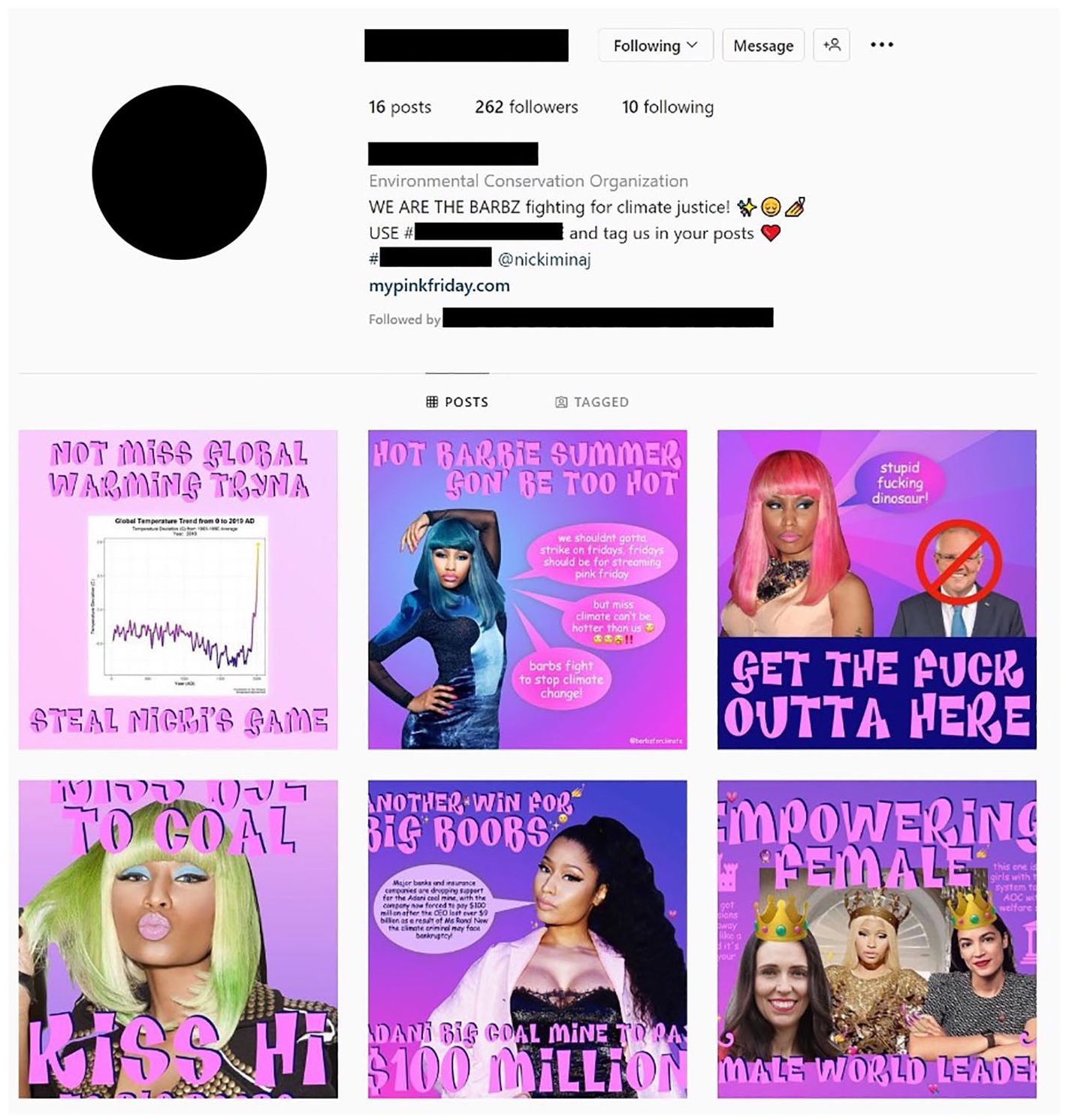
Posts from parody Environmental Conservation Organisation Instagram account created by young climate organisers during the height of the COVID-19 pandemic in 2020 and 2021.
Nicki Minaj’s fashion and grooming is diametrically opposed to the ‘climate activist’ stereotype associated with Doc Martens (above). In this climate-related account, Nicki Minaj is reclaimed as ‘queen’, in a way that also mimics and parodies individualistic #girlboss feminism. The ‘empowering female world leaders’ post (see Figure 4) juxtaposes images of Nicki Minaj, New Zealand’s (then) Prime Minister Jacinda Ardern, and Alexandria Ocasio-Cortez, progressive member of the US Congress. On either side of them, Nicki Minaj lyrics are reworded to comment on fossil fuel emissions and welfare systems (e.g. ‘this one is for the girls with the ruling system top down, AOC [Alexandria Ocasio-Cortez] with the welfare system’). The juxtaposition of Nicki Minaj with these female politicians, the pink aesthetic, and the words ‘empowering female leaders’ operate simultaneously as a tribute to these female leaders championing climate action, and as a snarky parody of ‘#girlboss’ culture associated with social media influencers. Girlboss feminism has been described as a form of ‘neoliberal feminism that equate[s] feminist empowerment with financial success, market competition, individualised work-life balance, and curated digital and physical presences driven by self-monetization’ (Mastrangelo, 2021: 4). Parodying the #girlboss trope shows up the whiteness of both ‘girlboss’ feminism and the environmental movement and the empty promises of a meritocratic individualistic feminism in a white supremacist society. Further, it critiques capitalist feminist discourses for their promotion of capitalism as a vehicle for progress, ignoring its contributions to the climate crisis (e.g. through the fast fashion industry and infinite economic growth models). The humour, in this post, comes from this exaggerated use of the #girlboss aesthetic (pink and successful and ‘empowering’) and its white progressive logics of gradual social change. This meme satirises a public fixation on ‘extraordinary’ individual women (Taft, 2020: 11) where gossip surrounding their appearance overshadows discussions of their political demands, and where the importance of the collective networks that support and sustain these individuals is downplayed.
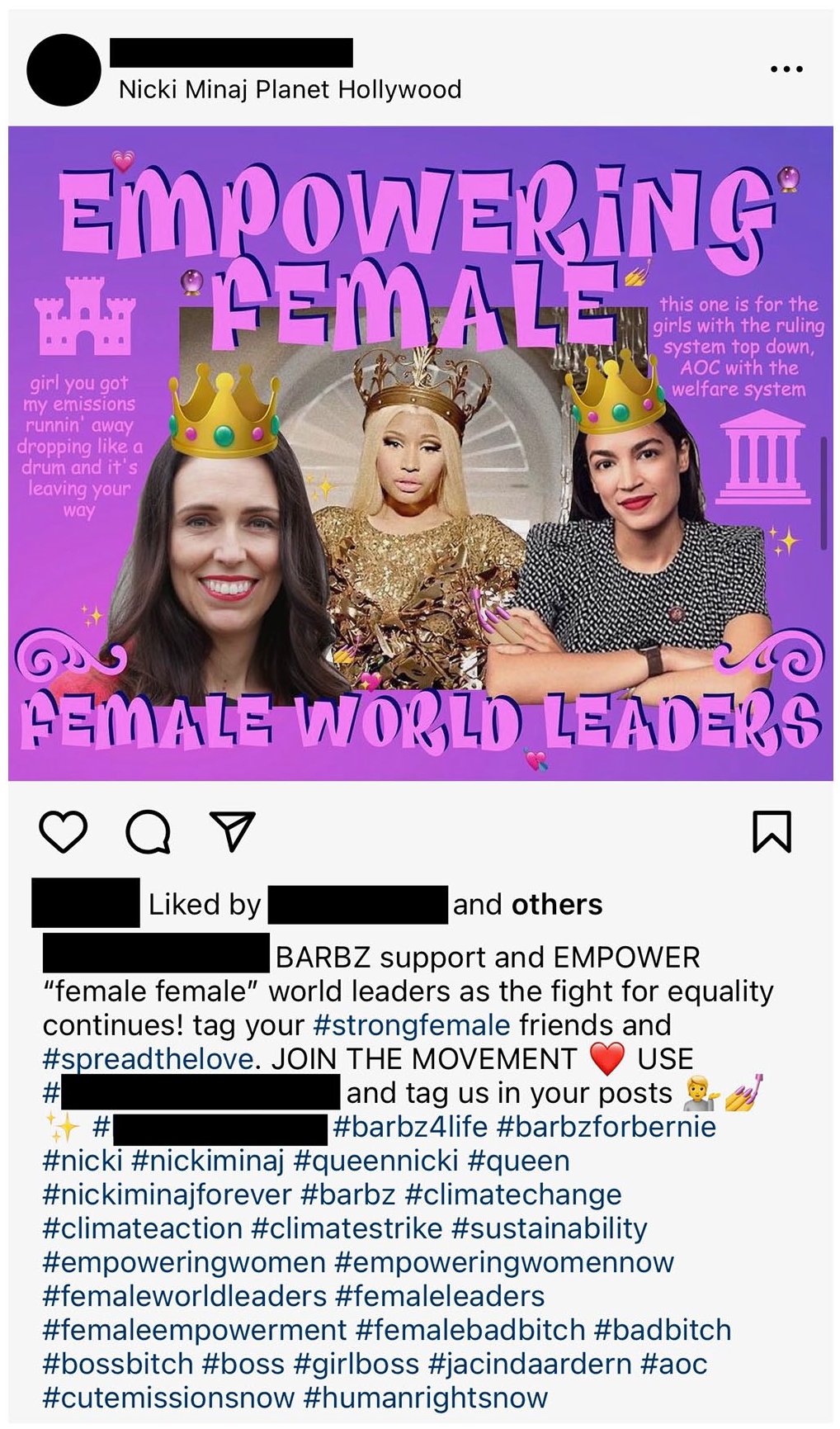
‘Empowering female’ Instagram post from parody Environmental Conservation Organisation Instagram account in April 2020.
As we talked through this collective analysis, we also laughed at the idea of over-interpreting this Instagram account and its posts. It was, as Natasha said, ‘just like a thing.’ Natasha reminded us, during our analysis, how this account formed in the particular context of COVID-19 lockdowns. Natasha explained how, in movement circles during the height of COVID-19, when the ‘movement was losing steam’, and people ‘didn’t care about infographics’, memes were shared widely. According to Natasha (acknowledging that her view ‘is subjective’), ‘memes aren’t shared as much now’ and there’s been a ‘fall in that culture of humour.’ According to Natasha, the hyperbolic humour associated with this Nicki Minaj account, in the height of pandemic lockdowns, was a way to relieve the anxiety and stress associated with the intersecting pressures of facing climate change, a global pandemic, remote learning and remote organising. We wonder whether this Instagram account unintentionally functioned to ameliorate burnout at the height of the COVID-19 pandemic.
Discussing funny activism?
The impacts of climate change are devastatingly serious. The United Nations Framework Convention on Climate Change (UNFCC)’s Yearbook of Global Climate Action 2023 summarises how anthropogenic ‘[c]limate change is causing planetary tipping points, with Earth hitting temperature records and extreme events affecting communities in every continent, with weather and climate disasters costing billions of dollars as a result’ (United Nations Framework Convention on Climate Change [UNFCC], 2023: 11). The impacts of climate change are unevenly distributed and experienced, and climate change is ‘merely a symptom of an unequal and unsustainable system of global production and consumption’ (Mikulewicz et al., 2023: 6). Climate change intensifies the effects of long-standing intersecting social oppressions including colonialism, capitalism, white supremacy and heteropatriarchy (Sultana, 2022).
Many young people are overwhelmed and outraged by the ongoing influence of fossil fuel interests in national and international climate policy-making, and the disconnect between government rhetoric and reality of ‘climate action.’ At the same time, children and young people experience overlapping and dynamically shifting emotions in relation to climate change (Jones and Davison, 2021; Verlie, 2022) – particularly young people who identify as involved in climate activism and advocacy. While there has been growing scholarly and medical attention to the correlations between young people’s eco-anxiety, despair and anger and perceived inadequate governmental action on climate change (Hickman et al., 2021), feelings of anxiety, despair and rage move in dynamic affective relation with feelings of love, joy, love and hope. Young people are anxious AND laughing at the short-sightedness of politician’s inaction in the face of such a serious issue. They are enraged at the power of fossil fuel interests AND rolling their eyes. And these feelings move across hybrid spaces.
In this article, we have collectively storied and reflected on examples, from our experiences, of every-day uses of humour in young people’s climate activism across hybrid spaces of contention. Figure 5 provides a visual summary of these three analytic provocations and their entwined relation. Sophie created this figure to synthesise our collective analysis for a broader audience beyond the academy; we will share this figure (and quotations from this article) on the project’s Instagram account (@striking_voices). While previous work has analysed young activists’ online participation on single platforms (Twitter, Facebook or Instagram), social media around major climate actions (Boulianne et al., 2020), and ‘highly viewed and shared posts’ (Hautea et al., 2021: 2), we have closely engaged with five stories of humour in hybrid ‘online’ and ‘offline’ spaces that we have been enmeshed within. We consider a central contribution of this article to be our methodological process: creating analytical provocations with young climate justice organisers (four of the authors), about digital texts and events that we have been part of creating. The examples shared in our stories also contribute to scholarly conversations about the ‘porous boundaries’ (Showden et al., 2023: 5) between ‘online’ and ‘offline’ spaces, overlapping feelings, and the concept of ‘activism’ itself. Could the creation of an Instagram account with memes of Nicki Minaj as a climate activist be considered ‘activism’? What about the creation of a TikTok video of young climate organisers’ shoes at an organising camp? The examples of humour shared in these stories trouble assumptions about the boundaries of ‘the political’ and the relationship between the ‘personal’ and ‘political’ online in living with climate change (cf. Bowman et al., 2023: 27).
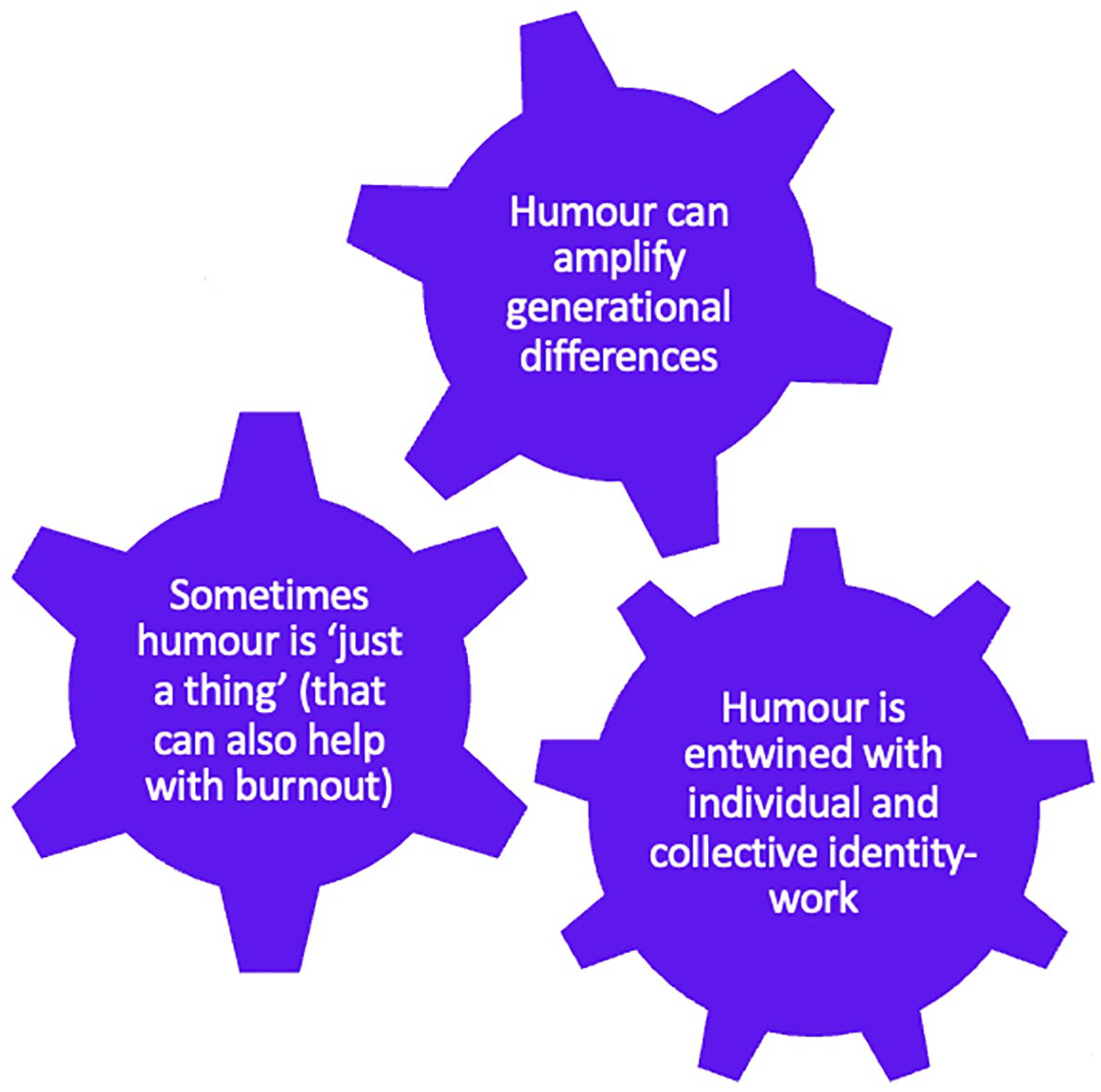
Humour and young people’s climate justice activism: Three analytic provocations.
So what is the role of humour in hybrid spaces of contention where young people seek climate justice? In the examples that we collectively analysed, humour is used to dissent, through lampooning hierarchical power structures and profit-driven systems (through kazoos and snarky jokes directed at major banks, see Figure 1); humour is used to draw attention to intersectional injustices (‘WHAT IF I TOLD YOU. . .. MAKING YOUR LOGO RAINBOW DOESN’T MEAN YOU SUPPORT MARGINALISED GROUPS. GET OUT OF GAS!’, Figure 2), and to joyfully express affinity (Doc Martens, Figure 2) and solidarity (with a fictionalised Nicki Minaj-turned-climate-activist, see Figure 4). In the face of intersecting injustices, humour has the potential to enliven and sustain collective solidarity. Collective work towards climate justice feels good when ‘wacky’ actions are done together, stereotypes and affinities are laughed at (Doc Martens), and false forms of liberation (like being a #girlboss) are satirised. Dani stressed that the humour discussed in these examples is more related to ‘how we do activism, rather than what we want to achieve’; it is more about the process than (necessarily) the outcome.
The uses of humour that we have discussed could be considered part of an emergent, affirmative youthful participatory democratic ethic. Bowman et al. (2023), writing together as academic researchers and young climate organisers, unpack the concept of ‘radical kindness’: as a youthful participatory democratic ethic that foregrounds dissent, intersectionality and love (16; see also Pickard et al., 2020). Humour is perhaps less a civic ‘act’ and more part of the process of ‘building community in relationships of kindness’ (Bowman et al., 2023: 27).
However, humour does not always serve to strengthen collective bonds and build solidarity. As Dani’s ‘prank’ example, Netta’s account of meme-creation with another group, and media responses to the kazoo action demonstrate, people do not experience a ‘joke’ in the same way. One person’s joke may offend or alienate or confuse someone else. Humour often relies on sarcastic contradictions, or ambiguities which rely on ‘in-group’ membership that can create and/ or exacerbate social exclusion (Hautea et al., 2021; Winocur and Dussel, 2021).
But why is it important to wrestle with these ambivalences of humour in climate activism? In recent years, there have been numerous studies of burnout in intersectional justice movements (e.g. Danquah et al., 2021), and questions raised about how to sustain a lifetime of activist organising (Wood, 2023): a particular concern for those who start activist organising whilst still at school. We wonder if humour that misfires can contribute, unevenly and ambivalently, to burning young people out from their ongoing engagement in climate justice activism? This risk of burnout through not ‘getting’ the joke, or refusing to laugh at the ‘joke’, may be particularly pronounced in overwhelmingly white movement spaces for young activists of colour and those who may not ‘fit’ the image associated with environmental activism (cf. Gorski and Erakat, 2019). Climate campaigner Charlie Wood cites adrienne maree brown to argue for the need for cultures of care and practices of joy in climate spaces (Wood, 2023). Wood asks: ‘Why do this work if not to generate joy? How we feel when we work matters’ (Wood, 2023). We agree with brown’s call to seek to ‘understand and to learn from the politics and power dynamics inside of everything that makes us feel good’ (brown, 2019: 13), including uses of humour.
To understand and learn from the politics of humour might involve attuning to the ambivalent duality of humour: which, on the one hand, forges bonds, strengthens affinities and joyfully amplifies dissent, and on the other hand, holds the capacity to exclude and offend. In our own uses of humour, we are seeking to ‘increase the pleasure we feel when we are doing things that are good for the species and the planet’ (brown, 2019: 12), and to ‘prioritise the pleasure of those most impacted by oppression’ (brown, 2019: 13). How climate justice activism feels, and who is experiencing pleasure in the process, matters.
Footnotes
Acknowledgements
The project team acknowledges the First Nations Critical Reference Group, Stakeholder Reference Group, Ruchira Talukdar (project mentor) and Rachel Finneran (data manager). We thank the editors and anonymous peer reviewers for their feedback and support.
Declaration of conflicting interests
The author(s) declared no potential conflicts of interest with respect to the research, authorship, and/or publication of this article.
Funding
The author(s) disclosed receipt of the following financial support for the research, authorship, and/or publication of this article: This project is funded through an Australian Research Council Discovery Early Career Researcher Award (project number DE220100103).
