



Abstract
In 2018 a new, more inclusive concept, of preschool education was adopted in Serbia with plans to implement the change from September 2019 to 2022. This paper examines how the national reform in Early Childhood Education (ECE) was perceived by Hungarian kindergarten pedagogues, who are the largest ethnic minority group in Vojvodina, Serbia. To consider the possible impact this change has on both kindergarten pedagogues and children the research aims were to explore, and to increase scholarly awareness of, potential issues Hungarian ethnic kindergarten pedagogues are facing in their understanding of the new approach. Narratives from Hungarian kindergarten pedagogues who were working with preschool age children were collected. To illuminate different understandings, we propose to apply dialogical self, I positions and intersectionality as a fruitful approach for analysing personal and cultural positioning. Findings show uncertainty, resistance, and sentient ways educators interpret the new programme. Findings also demonstrated many kindergarten pedagogues applied a reflexive method of professional practice that remained unchanged for decades. It was demonstrated that in the professional context, the interactions between different selves, and intersection between different cultures contribute to different positions, and storylines, cumulatively resulting in new we and they positioning. Our recommendation is that further opportunities need to be developed to advance the kindergarten pedagogues’ competencies how to deal with change.
Introduction
In 2018, a new, more inclusive concept of preschool education was adopted in Serbia, with plans to implement the change from September 2019 to 2022. The purpose of the new Curriculum Framework ‘Fundamentals of the Preschool Education Program’ (informally called, ‘Years of Ascent’) is to improve the pre-school practices by emphasising holistic development and well-being of children through an integrated approach to learning, play and other activities. It also focuses on the child building meaningful relationships with peers and adults in a nursery that provides inspirational learning spaces. In this paper, we report our qualitative data findings of how the national reform in Early Childhood Education (ECE) was perceived, by the Hungarian kindergarten pedagogues who are the largest ethnic minority group in Serbia, and how they responded to this significant change. The project had two focal points; one, to investigate how the participants understood and responded to the new Curriculum Framework, and two, to examine how the intersection of culture, language, and ethnicity are mobilised to construct the future practice.
For the Hungarian minority population living in Serbia, providing ECE in the Hungarian language is of great importance to support children’s cultural and language awareness. Therefore, it is of high importance to investigate how the new program, which was created to address the cultural diversity, affects the Hungarian minority groups from the linguistic and cultural perspective. In order to capture the change in ECE services, and to identify the importance of culture and language, Bakhtin’s (1986) and Hermans’ (2001) concepts of dialogical self, I positions, and Phoenix (2006) theory of intersectionality were applied as a fruitful approach for analysing personal and cultural positioning of Hungarian kindergarten pedagogues.
In Serbia, the ECE is divided between bölcsőde (nursery) services, from 6 months to 3 years old, and óvoda/napközi (kindergarten/pre-school), from 3 to 6 or 7-year-old children (Kamenov, 1987). Besides the division between bölcsőde and óvoda, children are further divided by their age and language they speak. (‘small’ groups 3–5 years; ‘middle’ groups 5–6 years; ‘big’ group 6–7 years) (author and date). Children attending the middle and big groups follow the ‘school readiness’ programme (Kopas-Vukašinović, 2006). Since 2004, it has been a statutory requirement for children in Serbia to attend nursery from the age of five for a minimum of 4 hours a day for a minimum of 6 months.
The importance of addressing the Hungarian minority group
With the view to understand the function of ECE in the current autonomous province of Vojvodina, Serbia, it is necessary to give a brief history and ECE background of the region. Within this province Hungarians are the largest ethnic majority, comprising d 3.5% of the whole population of Serbia (Census of Population, Households and Dwellings in the Republic of Serbia, 2011), generally in eight local authorities (Raduški, 2013). The evolution of the Hungarian ethnic community was the result of a series of historical events (Mikuska and Raffai, 2018; Mikuska et al., 2022; Bárdi et al., 2011). Hungarians in Serbia were created by post-war territorial changes and became minorities in their native Hungarian communities living outside of the state of Hungary. They are called ‘involuntary minorities’ as they were separated from their motherland by border changes based on externally imposed political decisions (Bárdi et al., 2011). It was further argued by Bárdi et al. (2011) and by Mikuska (2021) that the majority of these Hungarians have developed a ‘double’ identity: one is based on cultural and traditional positioning, and one is based on the state vision. Their main signifier is the use of the Hungarian language, as it is one of the most significant markers of national identification, especially in a minority environment where the sense of identity and language retention are closely connected (Fenyvesi, 2005).
The use of Hungarian language in (early) education in Serbia
After the collapse of the Yugoslavian state and the communist regime in 1991, the education authorities re-visited all educational policies. Due to the lack of clear guidance and principles about the rights of minorities (Beretka and Széke, 2016), the Hungarian national minority enjoy cultural autonomy by being able to educate their children in their native language. Fenyvesi (2005) argued Hungarians in Serbia are not just ethnic minorities but also linguistic minorities whose language has almost no linguistic similarity to their host nation’s language. One aspect of life in which linguistic minority issues most frequently arise is that of (early) education. This raises questions as to whether minority linguistic groups should be required to learn the national language in order to attend school or participate in official functions, or whether the government should provide or allow for education in their native language. Different countries around the world have approached this dilemma differently. In the United States, for example, despite vast numbers of non-English-speaking citizens, English is the only official language and is the predominant language of instruction at all levels of schooling. In Finland, the national language is Finish and Swedish and the education (from early years to higher education) is available in both Finnish and Swedish languages (Skutnabb-Kangas, 1981: 72). We note, that there are similarities between Finish, and how the (early and higher) education is organised in Vojvodina. For example, similarly to Finland, in Vojvodina, the majority of families have the opportunity to choose early education for their children in their mother tongue. The main reasons are the continuity of the family and/or maintaining Hungarian identity through the language. Göncz (2004) stated that a minimum threshold in language proficiency must be passed before a second language can harvest any benefits from first language calling it ‘additive bilingualism’. On ethical grounds Landry and Allard (1993) highlight the inequity between children who can access bilingual programmes that allow for acquisition and protection of home and second languages, whereas others are submersed in the second language where the home language is unprotected. Lendák-Kabók (2020) argued that the significance of the historical periods for ECE in Vojvodina resulted in the opportunity to attend education using the mother tongue. In their view this opportunity is fundamental for future educational success. Such a view was adopted by several newly formed establishments through which the Hungarian education and the ethnic minority groups were supported (Mikuska and Raffai, 2018). For example, Magyar Nemzeti Tanács (The National Council of the Hungarian National Minority) (2015) and the Association of the Hungarian Kindergarten Pedagogues in Vojvodina organised several continuous professional development (CPD) training sessions for kindergarten pedagogues and teachers for free, and gave them access to free resources (Szigethy, 2021). These professional courses and resources were the base of how the Hungarian kindergarten pedagogues in Serbia embraced and integrated the folk and heritage into their kindergarten work (Szigethy, 2021). All these organisations and financial help from the Hungarian state, significantly influenced the ways in which the Hungarian Kindergarten pedagogues professional work has been shaped (Mikuska et al., 2022).
Development of the new preschool education programme
At the end of 2000, a new democratically elected government came into office in Serbia, initiating large-scale reforms of education. The main goals of these reforms were based on the modernisation and reorganisation of the school system after the devolution of socialist Yugoslavia, to support the Serbia’s wider international integration (Spasenović et al., 2007). Serbia’s preschool education programme, introduced in 1996 by the Ministry of Education (Ministarstvo Prosvete, 1996) has been replaced with the new ‘Fundamentals of the Preschool Education Program’. This programme is also symbolically named ‘Years of Ascent’, where ascent represents the quality and direction that is dependent on everyone involved working in preschool education and care (Breneselović and Krnjaja, 2021). The new Curriculum Framework was a result of cooperation with many stakeholders and organisations inspired by the Reggio Emilia approach (Breneselović et al., 2022). The implementation of the New Curriculum was planned in three phases from September 2019 to September 2022. Due to significant change and shift between the previous and the new Curriculum Framework, training courses were rolled out to encourage everyone who works with children to attend. These training courses were delivered by mentors, first in the Serbian language and, at a later stage, also in Hungarian (Author, date).
Responses to change
There is a growing body of academic work exploring how educators respond to organisational change in (post)socialist or (post)communist societies with the focus on how politics intersect with education (Millei et al., 2021). Aydarova et al. (2016) highlight that, due to specific national histories, the shift from being an object of the state within a communist culture, to the more democratic approach to ECE, is a long process. Habinyák (2022) and Rădulescu (2006) argued that the education system (including early education) during the communist regime stipulated discipline, obedience and patriotism in Romania. It was manifested by making it mandatory to do voluntary community services, wear a uniform, and to respect the teachers. After the fall of the communist regime Habinyák (2022) further argued that teachers found it challenging to respond to the curriculum change, and reported that early learning still follows strict educational rules. In Hungary, Canning et al. (2022) observed a similar pattern. They stipulated that incorporating child-led ECE practices could be challenging, as their voices intertwines with the routine of daily practice and they act as an influential force that present potential barriers to adopting change. They claim, that these include the ‘power relationships that exist as an underlying current between children and pedagogues’ as well as the ‘cultural and historical weight of expectation that shapes values and beliefs’ (p. 229). In Serbia, Horák et al.’s (2021) research showed that Hungarian kindergarten pedagogues are ‘missing the structure in the programme’ (p. 56), and the interpretation of the new Curriculum Framework is still a challenge.
Worldwide, academics have reported that accepting change in educational institutions can cause resistance and trepidation (Clasquin-Johnson, 2016; Littledyke, 1997; Wedell and Grassick, 2018). Of the resistors to change outlined by Mullins (2005), threats to power and influence and loss of freedom may be factors, however, a more appropriate explanation is ‘selective perception’ (Kurowski, 2020). This selective perception is based on educational values; these fit more with liberal education and democracy and cultural capital which cherish the habitus of their educational values (Bourdieu, 1977). Kurowski (2020) argues that when talking about educational change, there is much resistance and individuality which subverts the enactment of policy. Educational leaders create their own cultures to meet the needs of their children, staff and communities as they see fit (Kurowski, 2020). However, through a combination of institutional training, additional resources and attending personal development courses the challenges of curriculum change can be met (Bongco and De Guzman, 2022).
Research design
In this study the aims were to investigate how the participants understood the new Curriculum Framework, and to examine how the intersection of culture, language and ethnicity are mobilised to construct future practice. After ethical permission was granted by the university’s ethics committee careful reference was made to the ethical guidelines of the British Education Research Association (2018); for example no real names and no traceable information was used. To address our aims, we collected narratives, using semi-structured interviews, with Hungarian kindergarten pedagogues who were at the time of the interview working with preschool age children.
Participation
Participants were recruited through e-mail invitation aimed at Hungarian kindergarten pedagogues. In total, 35 e-mails were sent out and nineteen responses were received. Semi-structured interviews were conducted in the Hungarian language, recorded, transcribed and translated into English by the authors of this article. Each interview lasted between 1 and 2 hours. All participants had a higher education degree level qualification, they were all working in the region of Vojvodina, and came from 10 different local authorities. They were all females and had substantial experience of working with children and they came from three groups (see Table 1). The first group comprised of kindergarten pedagogues who implemented the programme in September 2020; the second group were those individuals who adopted the programme in September 2021, and the third interviews were conducted with those individuals who are to implement the programme in September 2022. The interviews were conducted in the Hungarian language (with occasional switch to Serbian), recorded, transcribed and translated into English by the authors of this article. Each interview lasted between 1 and 2 hours.
Participants background.
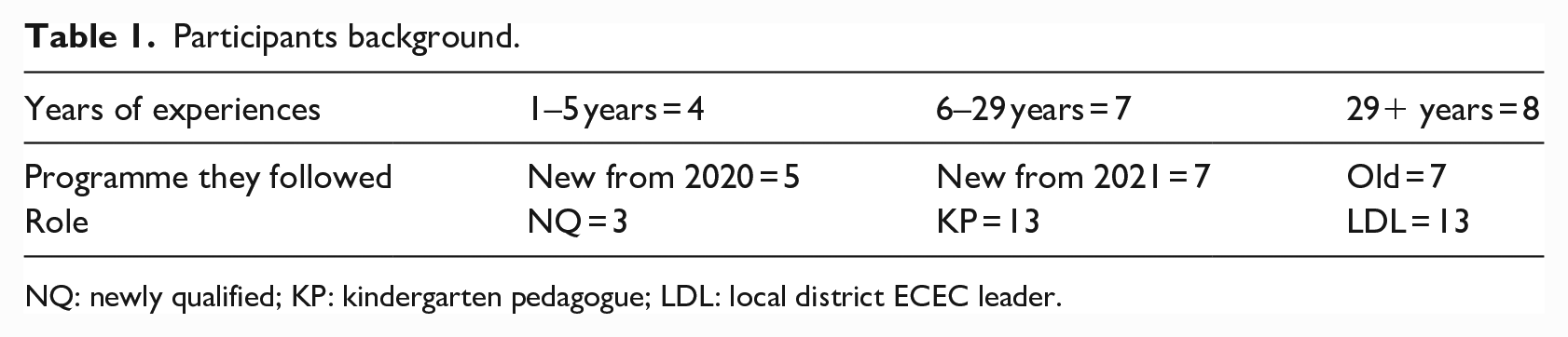
NQ: newly qualified; KP: kindergarten pedagogue; LDL: local district ECEC leader.
The use of thematic analysis was used searching for emergent themes (Riessman, 2008). These sections were colour coded and notes were made on the transcripts. Due to narrative inquiry, we chose longer quotes so it offer the reader to form their own understanding alongside our analysis.
Data analysis: Thinking through the dialogical self, I position and intersectionality
The concept of dialogical self, I position and intersectionality was central in the exploration of data in particular to find the answer to how Hungarian kindergarten pedagogues understood the new Curriculum Framework and how they made sense of ‘self’, ‘other’ and ‘I’ (but not excluding one another). Theory of dialogical self was developed to understand the self through multiple I positions (Akkerman and Meijer, 2011; Hermans, 1999). The conceptualisation of I positions was informed by the theory Bakhtin (1981, 1986), who reasoned that people speak with multiple voices, where the concepts of self and dialogue are associated with the internal space of the individual mind, and the external relations with others. Bakhtin (1986) suggested that people shift between their different I positions when telling stories about their past, and presenting them as a way of making sense of their lives. His theory directly addresses the notion of identity, with ‘self’ referring to the self-as-knower and ‘identity’ referring to the self-as-known. I position assumes that there is multiplicity in a self (Davis and Harré, 1990), in which the I moves from one to the other position and, as such, results in an identity that is continuously (re)constructed and (re)negotiated (Hermans and Hermans-Jansen, 1995). Of particular interest in this theory is the recognition that the various positions can conflict or, as said: The I in the one position, moreover, can agree, disagree, understand, misunderstand, oppose, contradict, question, challenge and even ridicule the I in another position. (Hermans and Hermans-Jansen, 1995: 249)
In order to understand and to make sense of self across time, Bamberg (2011) states, that we make (un)conscious decision who to include and exclude from our world. Buitelaar (2006) also noted that the different I positions, through which the identity is narrated, tend to reflect different basic needs, certain categories and story lines. The emphasis is, therefore, on the narrative identities that tend to be constructed through several narrative voices rather than through one unified and coherent storyline. In other words, the self is ‘multi-voiced creating alternative perspectives on the world and self’ (Hermans, 2001: 250). This approach enables narratives to be put in dialogue with each other and to understand how dialogues operate between the personal and the surrounding social world.
Understandings of the dialogical self and positionality are strongly linked to the Crenshaw’s (1989) concept of intersectionality which explored the multi-dimensional discrimination experienced by black women in the workplace in the U.S.A. Phoenix (2006), building on the work of Crenshaw (1989), conceptualised intersectionality as: The complex, irreducible, varied, and variable effects which ensure the multiple axis of differentiation – economic, political, cultural, psychic, subjective and experiential – intersect in historically specific contexts. (Phoenix, 2006: 76)
Phoenix’s definition suggests that intersectionality can be used to explore how any group of people operate dynamically with each other within a specific site, making ‘visible the multiple positioning that constitutes everyday life and the power relations that are central to it’ (Phoenix, 2006: 187). In this case, it focuses on how the Hungarian minority group of kindergarten pedagogues operates dynamically within the kindergarten in Serbia, and how they seek to work in harmony, addressing cultural differences. The rationale for utilising dialogical self, I position and intersectionality for data analysis purposes is that it affords a way of exploring the intersection between Hungarian kindergarten pedagogues’ lived experiences, and how these might both exemplify and counter the master or metanarratives.
Data analysis
Data was analysed addressing how the kindergarten pedagogues spoke from multiple positions – that of a professional worker, being part of the Hungarian ethnic minority group, and the role they needed to fulfil at work. To address the research aims, we grouped the narratives thematically i) Conceptualising the new Curriculum Framework and ii) How the intersection of culture, language, and ethnicity (self) are mobilised to construct future practice.
Conceptualising the new Curriculum Framework
In this section, examples are given of how a dialogical self, different I positions and intersectionality was used to analyse interviews with Hungarian kindergarten pedagogues. Examples were chosen as there were commonalities in terms of how participants responded to, and understood the new Curriculum Framework. The scrutiny of their narratives illustrates the ways in which participants expressed their concerns of the ‘unknown’; the narratives were generally predictions of the event that might occur rather than those that had actually occurred in the past. We discerned two main I positions; one that is the traditional ways of working with children that questions (adult) autonomy, and self-reliance. The other main I position, is anxiety and instead of what happens in the present moment, the past is ruminated upon and worries about the future were narrated.
I position that questions autonomy and self-reliance
The main thread in the identity narrative is best captured by the following self-descriptions in which dialogical self is captured as active collection of relatively autonomous I positions. In the following extract this participant described the four-day-long training sessions she had attended with her colleagues. She felt that the sessions, although helpful, were directive and left her with the feeling that they undervalued her professional judgment and independence. The difference between the two I positions she was using (I as someone who needs attending a training session, and I as an established kindergarten pedagogue), stands out most clearly when this participant changes the narrative style and when she realised that her authority, independence and perhaps even her expertise were in question.
The [training] session was really interesting as the sessions kind of shake you up from burnout and boredom . . . it was held in Serbian language . . . we were told to encourage creativity by redesigning the homecorner which should be done without . . . or not to enforce the adult led ideas . . . it [idea] has to come from a child, and not to force upon them our ideas and not to follow the daily structured routine. . . there was, however, no guidance about how to cherish our tradition . . . how I see it, the new program carries other values . . . Our professional authority, professional rigour and level is in question if we let the children decide what to do. (Ibolya)
Hermans (2001) said that dialogical self and the I positions are often contradictory and yet work together. Incorporating children led practices proven to be challenging to Ibolya, the presence of multiple and conflicting I positions can be linked to Canning et al. (2022) research where they highlight the issue of power between children and pedagogues. This particular quote resonates with Hermans (2001) view of the ‘self’ which is relatively autonomous. The self in this case moves between different longitudinal and three dimensional positions in time, space and situation. Application of both affords to see how Ibolya’s voice transforms to a collective voice – the I position transforms to a we position (in this particular case we = our), the position of the professionals whose authority is challenged.
Evidently, most of the participants talked about the transition period. While some participants reflected on their own practice, mainly by asking rhetorical questions about what to include or exclude from current practices, not every kindergarten pedagogue reacted the same way. In the next example, it was explained how the new Curriculum Framework gives voice to the child by shaping the professional role of the kindergarten pedagogues and their identity.
The change means that we cannot carry on answering, finding solutions for the child. The kindergarten pedagogue role is now to encourage a child to find the answer themselves. If the child wants an immediate answer then we were told, have to say . . . ‘I cannot answer you now, but by tomorrow perhaps we can all [other children] find the answer’ and by doing this we can create a learning community. Just to clarify, all the children as well as the kindergarten pedagogue creates this learning community. We have to hold ourselves back a bit by cancelling our leading role as a pedagogues, and by doing so we are and by promoting the child’s independence . . . . (Csilla)
In this example the narrative takes us to a different level of understanding as to how narratives can operate. The narratives, in general, were filled with the collective voice where the I position transformed to we position such as ‘we attended the training sessions’ or ‘we cannot carry on . . .’ or ‘our professional authority’ or ‘we need to put aside past practices’ or ‘we need to think differently’. The domination of social relations between Hungarian kindergarten pedagogues and embodied forms of (self) dialogue can be traced here. I, we and ourselves are seen as co-existing and ‘in dialogue’. Csilla further stated: . . . this process requires lot of intellectual work and a lot of preparation. There are many kindergarten pedagogues where there is no issue with their confidence, authority and self-love, now this has to be pushed to the background but not in a way that ‘I’m not going to do anything now’ but differently. It means that it is necessary to change inside.
The I position, for Csilla, take turns and engage in a dialogue between the inter and intra personal dialogue that are simultaneously present (Hermans, 2001) in which she has the ability to reflect and consider the need for the reflexive self (Breneselović & Krnjaja, 2021).
Another conceptualisation of the new Curriculum Framework is to determine the trajectory from the adult to the child. What is interesting in the following quote is that the participant is searching for some kind of compromising solution between her I positions, her belief and what is required from her. Here, the I position instantly transforms to a we position; particular attention was paid to the domination of past practices through the embodied forms of dialogue in which the routine of daily practice acts as an influential force that present potential barriers to adopting change.
We need to think about what does child centeredness really mean as well as what is the the role of the child and what is the role of the kindergarten pedagogue. Somehow, we need to put aside past practices, focusing on how we are going to build ourselves into the new approach. This is not going to be easy because the daily routine is deeply embedded into our everyday practices. So I think we will often have to restrain ourself and I am sure we will experience something and will say ‘Oops, I should’nt have done this’ but I also think in confusing situations we will get the help because there are mentors who will be able to help to get this transition more smooth. (Anna)
I position of the past and the future
The other main I position is anxiety and, instead of what happens in the present moment, the past is ruminated upon and worries about the future were narrated.
We had an opportunity to attend a continuing education training in Budapest lasting four days because I still use this event as a feeder to enhance my practice . . . I feel, every person interprets it [the New Curriculum] in their own way and they apply the principles differently. The mentors promote way too much freedom, that everything originates from the child and everything has to be from natural material in every group . . . for me this approach is a bit ‘full on’ and you can get lost in this ‘crowd’ easily. However, in Budapest, I really liked the training session because there we were told a child initiates the project accordingly to their interest, but each project has some kind of rules and borders. Like during the activity, which kind of behaviours we accept and expect from a child for the success of the activity . . . and this is when I feel safe. (Melinda)
In this quote, the participant draws a parallel between the past continuous personal development (CPD) she attended and the current training session she recently attended. The focus turns inward from the present moment (current practice) to the past and the future practice. This participant explains that the CPD was organised in Budapest by the Hungarian state. In that session, although slightly differently, the specialist pedagogues also talked about the project pedagogy. Therefore, beside I and we positions, the here (domestic and future practice) and there (Hungary and past) are equally important. In the domestic version, there is ‘too much freedom’ and ‘easy to get lost in’ while, what they learnt in Hungary, there are certain rules that need to be obeyed in which the success is conditioned by these rules. For this participant, this kind of rule, the rule in which she participates, gives her security. She continues her story: We discussed this with other kindergarten pedagogues, that we have to be alert at all times to be able to get the equilibrium not to lose the balance to maintain our own values and the child enjoys the learning. So we have to pay close attention to this as you can get lost in this freedom.
Freedom is the opposite of rules. As the participant clearly explains, ‘we have to pay close attention’ to achieve some kind of balance between the freedom and rules in order to teach and to establish a good learning environment. Rules help to structure and navigate through the freedom which enables positive validation of the work that kindergarten pedagogues do which was expressed well by saying that ‘While I am happy to talk about the solar system, but the path that explains our world needs to be found’.
Another example exemplifies the ways in which the reflection from the past seeks solution for the future practice. Less resistance and more openness to change was narrated in this example, and this could be due to implementing the new programme 6 months ago. Emma reflects on the past and present practices and said: Our [nursery] practice has evolved . . . in the past, every child had to learn a poem or had to learn how to retell the story. We will have to ’loosen’ our practice now. Not every child likes to perform on stage and not every child likes to learn a poem by heart. Why do we force a child to perform, to learn the poem, and then in five years’ time they will be ashamed of their performance? I like this, we have to change this practice, but it is not easy because the parent wants to see what their children learnt in the nursery. (Emma)
In this quote, the different perspectives of three I positions provide to the same set of events exemplify well the key dynamics of a dialogical self. According to Hermans (2001), I positions ‘function like interacting characters in a story, involved in a process of question and answer, agreement and disagreement. Each of them has a story to tell about his or her own experiences from his or her own stance’. One I position is a professional worker, another one is a child and the third one is a parent. The reflexive nature of tacit yet explicit rhetoric questioning throughout the interview and in this quote is evident and acted as a positive outcome for the child. The dialogical self proposes a far-reaching decentralisation of both the concept of self (Hungarian kindergarten pedagogue) and the concept of power (have to ‘loosen’ up) but also a child. In this case, the child was put in the centre and the child future wellbeing was considered.
There was considerable shift from a rather negative to positive attitude towards the new Curriculum Framework, especially when the pedagogues discovered new opportunities and ways of working with children. This change was captured by the participants who we talked to, 5 months after the new programme was implemented in the nursery, in 2022.
There are big changes. We are the stage when we can see what is not good. Resources are checked and we look for new possible resources, solutions were searched, and I can see that teamwork is established. We work much more, it is some kind of inner drive to see the result. At the beginning we didn’t see the meaning of the new approach but since we done a project, we can see the purpose of it. (Helga)
How the intersection of culture, language and ethnicity (self) are mobilised to construct future practice
Cultural complexity follows not only from the multiplicity of meanings and professional practices shared by Hungarian kindergarten pedagogue’s community, but also how these practices are understood across this community in Serbia. One of the implications of cultural complexity is the ways in which the understanding of the new Curriculum Framework is manifested. One participant, for example explained, that in her view, the new Curriculum Framework is not suited to the local culture. Through the following account it is possible to discern the intersection between the Western society, Hungarian community and Serbian culture. In this quote the participant tried to reconcile the tensions between the three culture: This programme was developed in a Western society where there is a prosperity where people don’t pay much attention to their national self-awareness where prosperity perhaps cancels this national self-awareness. This programme arrives to our society where Hungarians treasures their language, culture . . . for Serbians this treasure is not at importance and it has never been, but for us [Hungarians], we stick to our things; therefore we have to find the balance between the two [culture][Bea]
When talking about culture and tradition, the we position has another dimension that leans to find the balance between what they understand been told by the mentors, and their practice within which the local culture and tradition is captured. This shows the irreducible and varied effects that confirmed the axis of cultural and political differentiation. Similarly, the following quote shows the complex intersections between I position of Hungarian kindergarten pedagogue and the choice she has made as a professional person: Well, the balance must be maintained because our language and traditions must be fostered, and I believe that everyone among us, among Hungarian colleagues, we will maintain this balance, nurturing traditions.
In these quotes finding a right balance in the practices in multicultural environment were demonstrated; ‘the multiple axis of differentiations’ (Phoenix, 2006: 74) such as the intersection between different cultures, languages and traditions. This intersection challenges both: the idea of a core, essential self and the idea of a core, essential culture. In apparent contradiction with such a view, the present viewpoint proposes to conceive self and culture as a multiplicity of positions among which dialogical relationships can be established. For example, the intersectionality between the minority Hungarian kindergarten pedagogues (we) and the majority Serbian kindergarten pedagogues (them) professional view. One of the narratives summarises the differences between the importance of teaching folk and traditions comparing and contrasting the two cultures (Hungarian and Serbian). This particular participant felt that for Serbian kindergarten pedagogues the global aspect of their life is at more importance which is ‘far’ from their heritage. She said: For them [Serbians] this kind things are not highly important therefore they are more open to choose to do a project addressing Egyptian theme, or talk about dinosaurs. We [Hungarians] are also open to do these themes because we would also like our children to be open to the world, but there are other things [cultural heritage] that we cannot exclude from their education. (Anna)
The quote suggests an intersection between the Hungarian and Serbian culture; the Serbian kindergarten pedagogues (they) was put in opposition with Hungarian kindergarten pedagogues (we). In many cases the we illuminates the Hungarian ethnic minority identity and the differences in which they operate. The we position encompasses the ethnic and local traditions that can be found very significantly in the professional self-image. This positioning not only shows the ethic and professional identity and self-image, but also gives us an understanding through which the new Curriculum Framework was conceptualised.
A new Curriculum Framework states that cultural awareness and expression competence should be ‘supported by cultivating children’s play; through development of cultural and national identity as well as the identity of the “inhabitant of the planet”; by acquitting children with cultural habitat of the community’ (Breneselović and Krnjaja, 2021: 17); the program itself does not mention the methods through which the cultural heritage and traditions can be preserved, nor explains the use of the ethnographic materials, and genres such as folk tales, traditional children’s games, folk songs, preferred by Hungarian kindergarten teachers (and other ethnic minority groups living in Vojvodina). Our analysis suggest that the training sessions Hungarian kindergarten pedagogues attended in Serbia, did not stress the importance of preserving culture. This is perhaps due to the mentors who promoted a more contemporary way to work with children illustrated with examples taken from the wider, global aspects.
All participants had a strong view that the importance of learning poetry and folk songs, and festive storytelling plays a key role in children’s (Hungarian) language development. Yet the uncertainty of how to interpret the new Curriculum Framework and to move forward with the new approached caused unhappiness, confusion and in cases resistance. The emergent of dialogical self through rhetoric but important and constant questioning throughout the interview was captured especially in the following extract.
We were told to ‘provoke’ the child, to do provocation to facilitate the child creativity and through their idea to do a project through which they will learn. I don’t seem to see the end result of this project. Who invents the project? When the project will be finished? And how will I be able to assess the child cognitive development? Is this really a good direction for us? (Marika)
In his particular quote not only the uncertainty, confusion come across but also questioning the direction in which the child and the kindergarten pedagogues are heading.
Conclusion
One of the project aims was to investigate how the participants understood and responded to the new Curriculum Framework. Our findings demonstrated that participants had doubts in regards of the new Curriculum Framework. We found that participants told similar stories in which they referred to concerns about how to continue to teach children traditions. We also found similarities between Habinyák (2022), Rădulescu (2006) and Canning et al. (2022) research, and our research outcomes. Resistance to change was evident and it was assigned to cultural and historical weight of expectation that shapes values and beliefs the kindergarten pedagogues.
Another aims of the project was to examine how the intersection of culture, language, and ethnicity are mobilised to construct the future early years practice in the kindergartens. Findings highlighted that by applying intersectionality, we challenged both: the idea of a core, essential self and the idea of a core, essential culture between the minority Hungarian kindergarten pedagogues (we) and the majority Serbian kindergarten pedagogues (them) professional view. Findings of the research also shows that beside the uncertainty of how to interpret the new Curriculum Framework, they have concern how they can continue to work with children to incorporate Hungarian heritage, dance, customs and storytelling.
It is important to address that at this stage of the research, there are considerable differences in the practices between nurseries. For example, some of the nurseries that started to follow the new programme in 2019, follow a mixture of the previous, and new programme. They reported that only the documentation is ‘new’. In other nurseries we seen less resistance and more openness to change. For example pedagogues talked about their change in practice straight after attending the training session. These pedagogues said that 6 months after implementing the new programme they had some successful completed projects that gave them confidence. It is noted that there was considerable shift from a rather negative to positive attitude towards the new Curriculum Framework, especially when they discovered new opportunities and ways of working with children.
The programme encourages the kindergarten pedagogues to seek for new learning opportunities including parents and the community. Therefore, we argue that the transition should be a longer process with greater opportunities to access professional training that addresses localised culture, identity, language and other ethnic characteristics. There is also a danger that the combination of implementing a new program and previous educational practices will create a less successful hybrid practice, which will determine the quality of kindergarten education and care in the years to come. We argue that further opportunities need to be developed to advance the kindergarten pedagogues’ competencies how to deal with change. It was demonstrated that in the professional context, the interactions between different selves contribute to different positions, and storylines, cumulatively resulting in new we and they positioning. The repertoire of these narratives implies the (mis)match between the various I positions in multiple contexts, which exhibited the process of preserving minority identity. Participants report that this involves constant (re)positioning in the professional work context.
Footnotes
Funding
The author(s) received no financial support for the research, authorship, and/or publication of this article.
