



Abstract
With the Donald Trump Baby Balloon as a provocation, this work utilizes philosophy as a method and cinema-as/in-philosophy to multi-modally interrogate the particular images of giant babies. Deleuze and Guattari’s conceptions of molarity and molecularity and Bakhtin’s conception of grotesque bodily images are put to work alongside several cinematic portrayals of giant babies and their social material contexts, including the animated fantasy Spirited away, the family comedy Honey, I blew up the kid, the independent short Las Palmas, and the Disney-Pixar superhero franchise Incredibles. Within this constellation of images and texts, the giant baby emerges as a specific entanglement of developmentalism, humanism, and neoliberalism. Furthermore, the ways in which images of giant babies materialize particular notions of monstrosity, consumption, and destruction might disrupt some commonsense notions of time and bodies. This kind of destabilization of concepts furthers the argument for employing a philosophical, cinematic axiology within the realm of childhood studies.
Throughout the Trump presidency, frequent comparisons were made within both long- and short-form media of various kinds between the abilities and temperament of Donald Trump and those of an infant or toddler (e.g. Blotky et al., 2020; Hyde, 2020). Of course, these were not comparisons to any specific young child, but rather to an essentialized notion of infancy and/or toddlerhood characterized by whatever “childish” (i.e. negative) traits were being ascribed to Trump in the moment, such as egotism, impulsivity, irrationality, volatility, recklessness, impatience, and so on. A particularly striking image of Trump-as-infant/ toddler emerged in the Donald Trump Baby Balloon (Bonner, 2018), a 6 m tall, inflatable work of protest art that depicted a scowling, diaper-clad Trump holding a cell phone. After its debut at a London protest, this caricature of the then-president gained international notoriety. It recently appeared on the cover of a book entitled Toddler-In-Chief (Dresner, 2020), further tying this giant, infant/toddler image to criticisms of the negative aspects of Donald Trump’s character.
With the giant Donald Trump Baby Balloon as a provocation, this work combines philosophy as a method (Koro-Ljungberg et al., 2015; Tesar, 2021) and cinema-as/in-philosophy (Livingston, 2006; Wartenburg, 2006) to interrogate particular images of giant babies in popular media and theorize what emerges with/in these images. In terms of philosophy as a method, first Deleuze and Guattari’s (1988) politics of being and becoming, and later, Bakhtin’s (1984) conceptions of image, are put to work alongside several cinematic portrayals of giant babies and their social-material contexts to create “relationality with the text which is axiological in its nature” (Tesar, 2021: 545). In terms of cinema-as/in-philosophy, my point of departure here is that cinematic images have the capacity to both illustrate and actualize philosophy. Even films assumed to be frivolous or unserious have the potential to be the “locus of some deep thinking” (Wartenburg, 2006: 30 ) and can be put to work in manifesting deep engagement with philosophical concepts. I am not approaching these processes—engaging with philosophy as a method, engaging with cinema-as/in-philosophy—as distinct forms, but rather as overlapping and reciprocal ways of working with and (re)producing concepts, texts, and images.
Within this constellation of images and texts, the figuration of the giant baby emerges as a specific and complex entanglement of developmentalism, humanism, and neoliberalism, the genealogy of which can be traced through historically received discourses about young children. However, further philosophical engagement with these images can upend received discourses by offering paradoxical notions of scale, time, and corporeality. I argue that this “non-linear approach to reading and rereading” (Tesar, 2021: 550), wherein philosophical texts, cinematic images, and perennial narratives regarding infants and toddlers are placed in relation to each other, opens space for different images of infants and toddlers to emerge and for new questions to be posed around our ethical engagement with childhood images.
Giant babies, cinema, philosophy, images
In the sections that follow, four literal and figurative images of giant babies are introduced—Boh from the animated fantasy Spirited Away (Myazaki, 2001), Adam Szalinski from the family comedy Honey, I Blew Up the Kid (Kleiser, 1992), Middle-Aged Baby from the independent short Las Palmas (Nyholm, 2011), and Jack-Jack Parr from the Disney-Pixar superhero franchise Incredibles (Bird, 2004, 2018). Each character will be placed within the context of the film through a brief written and visual introduction, and then a specific scene will be read through a philosophical orientation. The images I’ve constructed of these giant babies via (re)drawing (see Figures 1–5) are placed alongside my written analyses for the purposes of re-presenting my processes of engagement with cinema, philosophy, and image. It’s important to note that I do not try to provide detailed critiques of a film’s narrative as it relates to children or childhood nor to make judgments of accuracy or authenticity regarding the film’s representation of children. I recognize the paradox herein, as narrative devices are necessary to orient the reader to a (perhaps unknown) film segment in the context of a written article. But beyond that purpose, the full narrative arc of any of one these films is not the focus for this work.
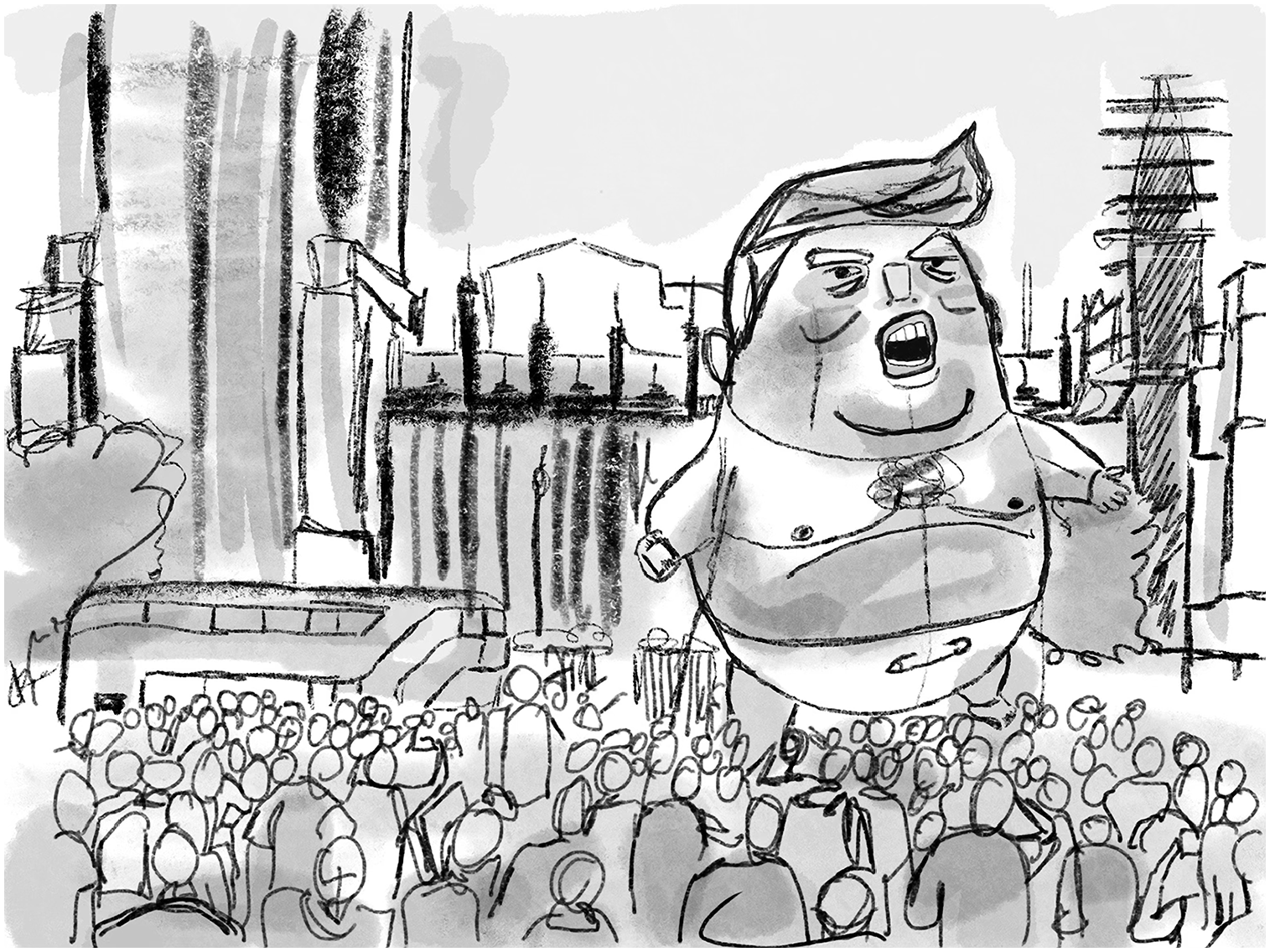
Donald Trump Baby Balloon in a London crowd.
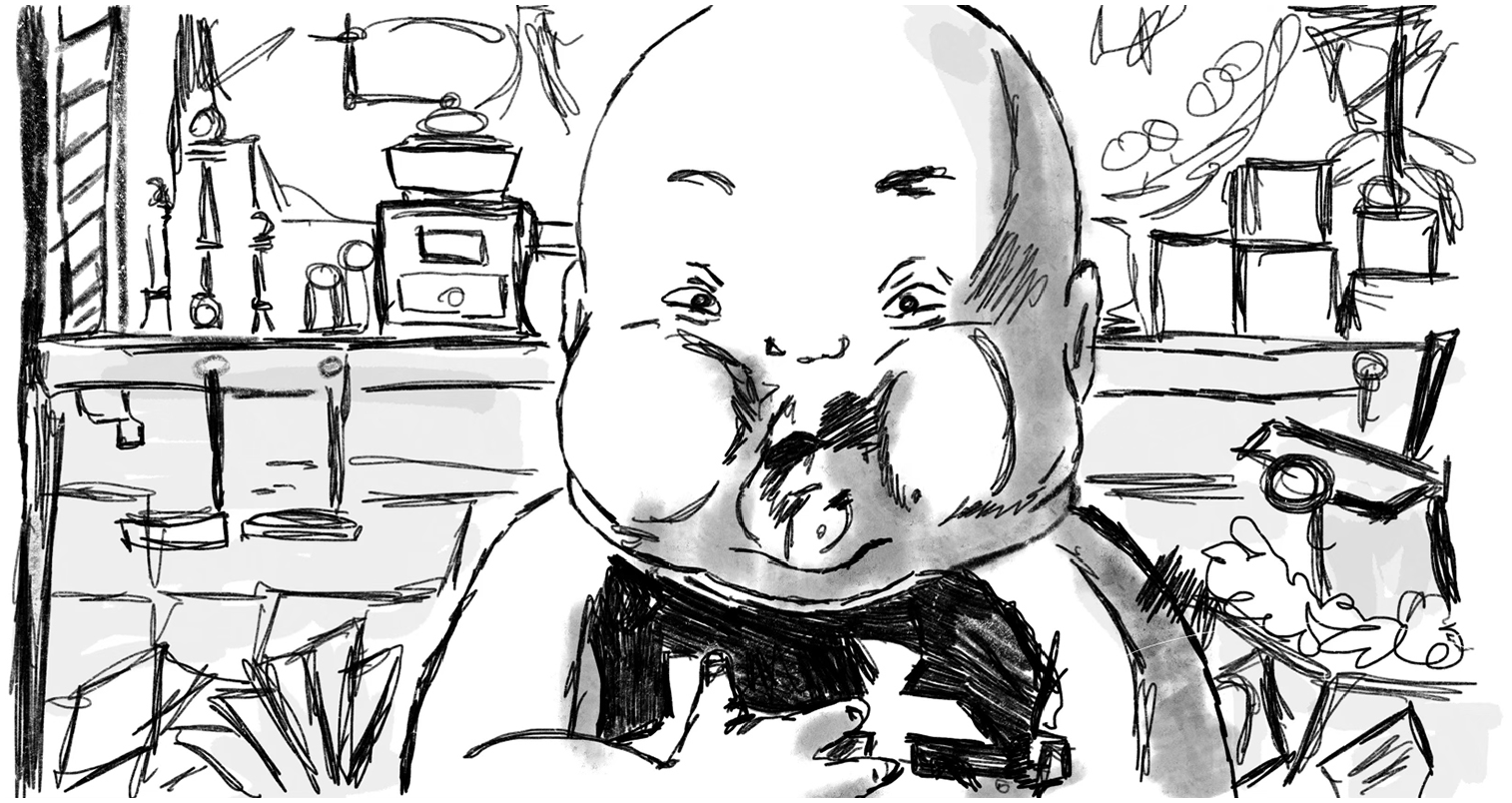
Boh eating.
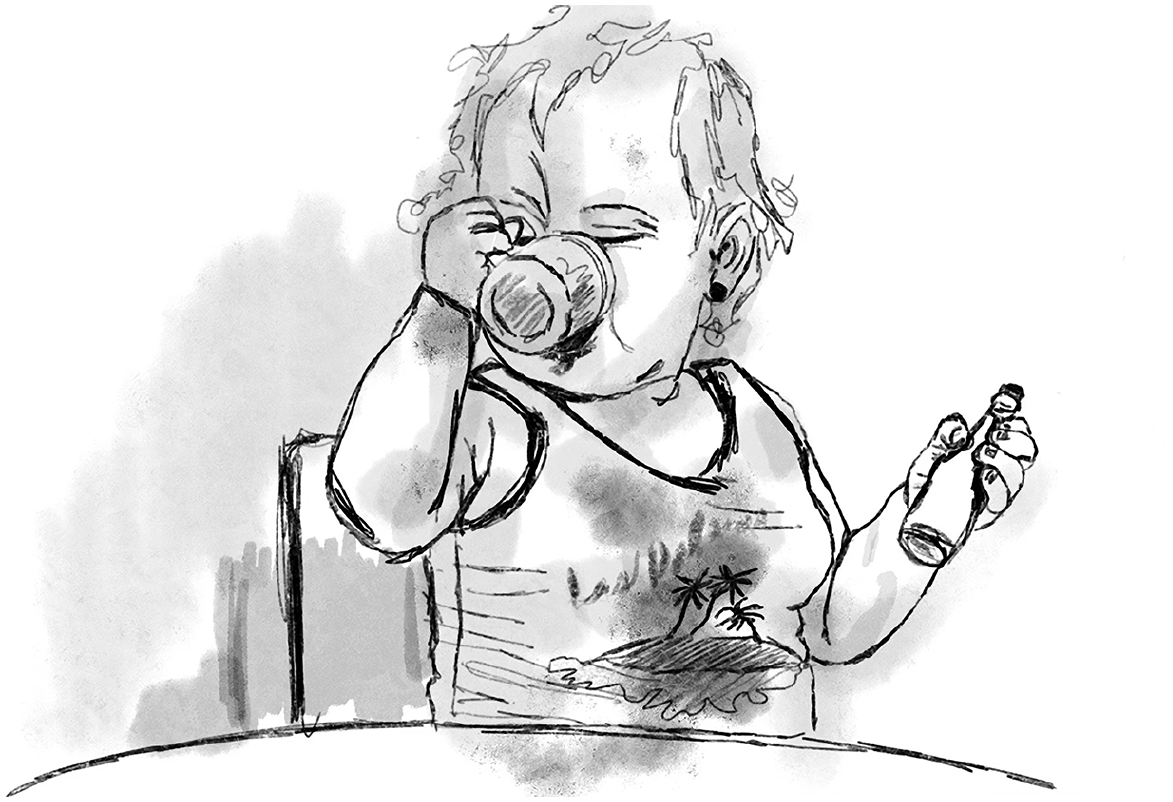
Middle-aged baby in the bar.
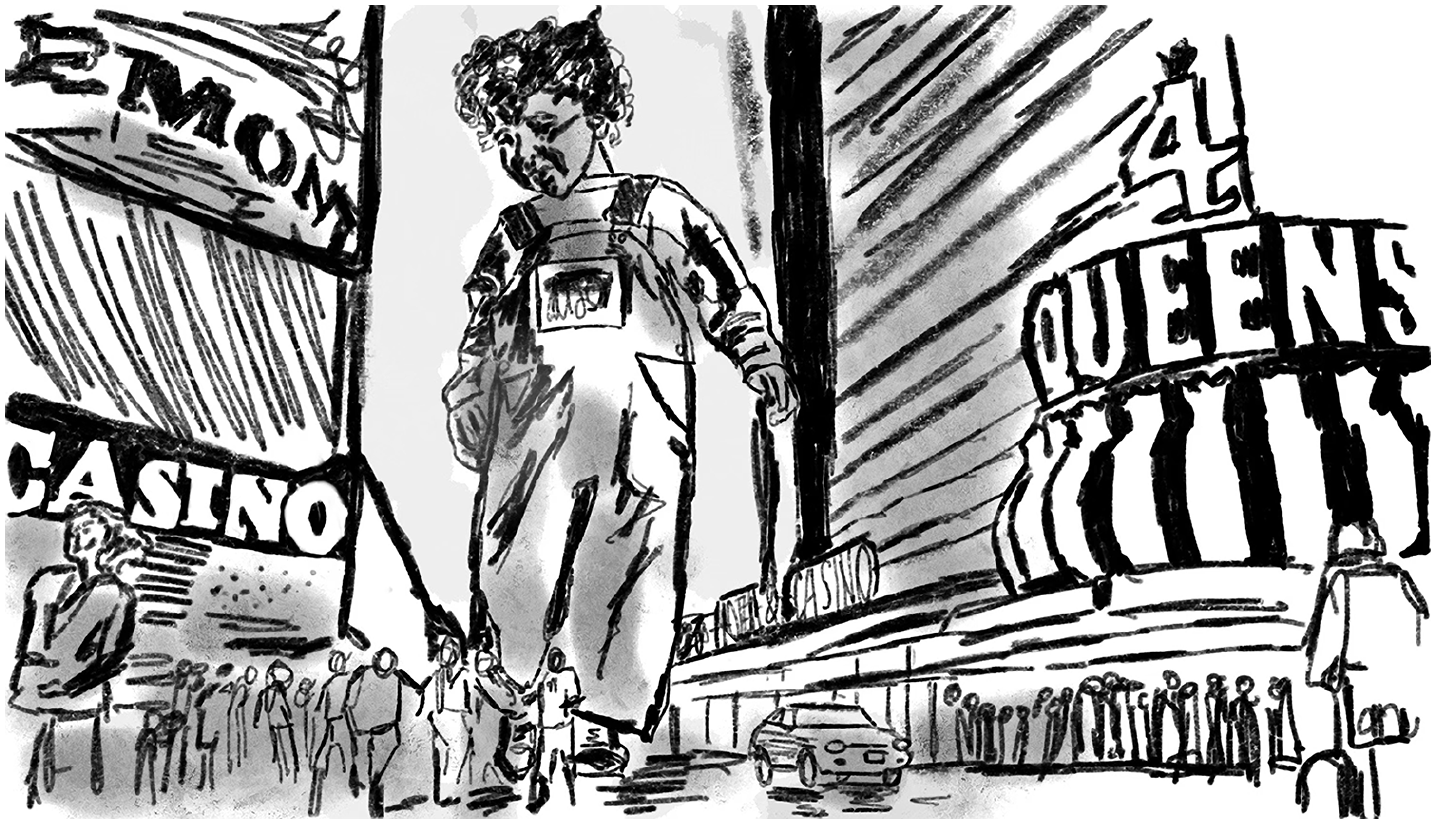
Adam Szalinski on the Las Vegas strip.
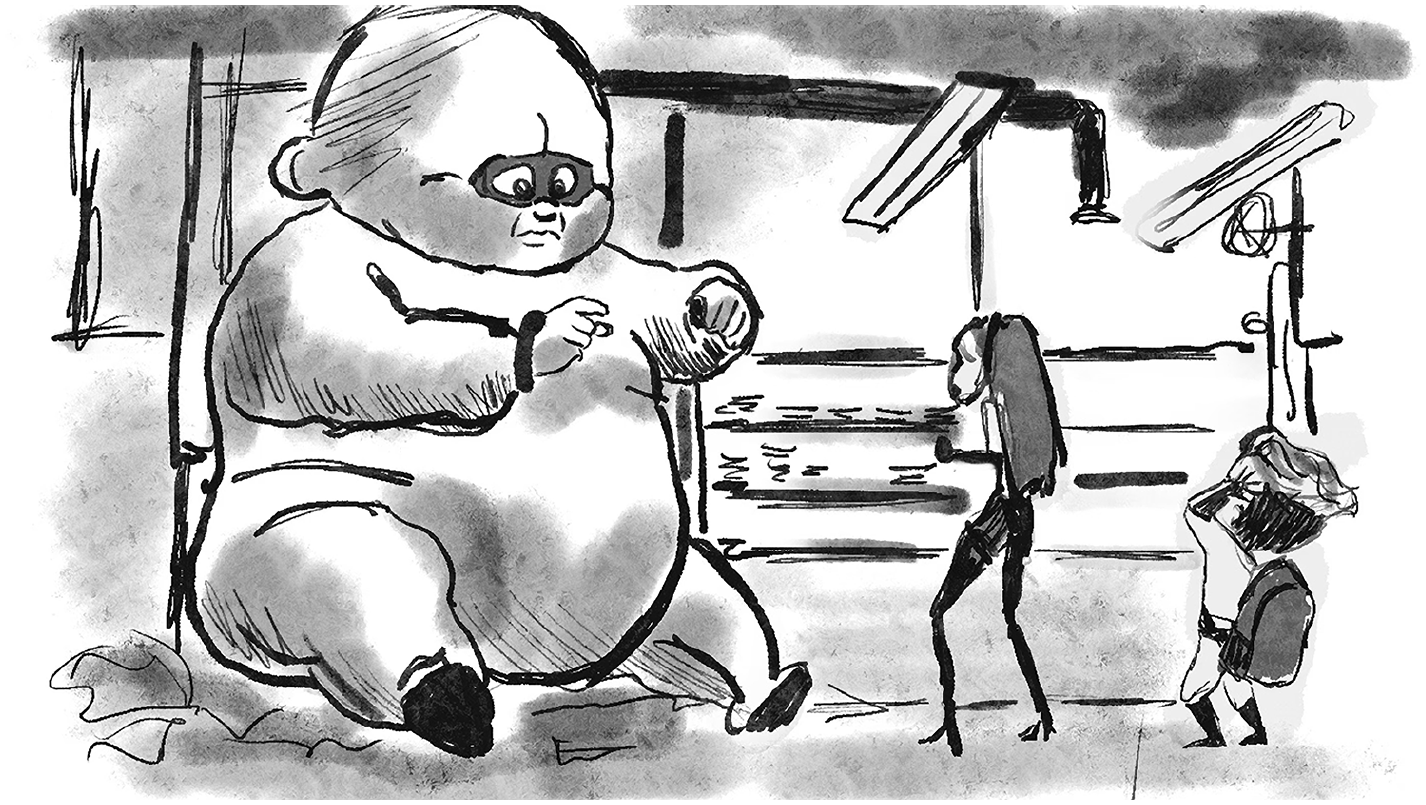
Jack-Jack Parr after bursting from the heating duct.
On multiple levels, the concept of images and the (re)production of images are put to work “making contingent connections with the conditions surrounding their creation” (Knight, 2013: 255). These cinematic images of giant babies are treated as philosophical machines, immanent planes of cultural production wherein mircopolitics emerge from moment to moment (Colebrook, 2002a). The brief cinematic vignettes of giant babies that follow are interrogated in terms of Deleuze and Guattari’s (1988) conception of the molar and molecular—the elemental constitution of perceptions (the molar), which are formed through investments in particular affects, movements, or desires (the molecular). The molar and molecular exist in fluctuating relation to one another, wherein being and becoming are politically entangled processes (Deleuze and Guattari, 1988). Colebrook explains the molar and molecular specifically in the context of cinematic images as such: Molar formations are formed from varying investments in intensities, which have less to do with belief or meaning so much as the elevation of specific qualities. We could therefore look at the distinct ways in which political machines produce the general concept of ‘man’. This micropolitics or schizoanalysis would be different from analysing sexist beliefs or ideology; it would look at the images that allow those beliefs to be formed (2002, p. 88).
The following is meant to turn attention toward not what these films mean, but rather what particular moving images (might) do, and how affects and movements produce particular childhood bodies “below and above the threshold of perception” (Deleuze and Guattari, 1988: 281). As I engaged with these philosophical concepts, films, and images, I asked myself: Giant babies are produced through political investments in what kinds of forces? What follows is meant to offer moments of synthesis wherein (re)reading Deleuze and Guattari and, later, Bakhtin, (re)watching the films, writing, and (re)producing particular images together emerged as a philosophical, methodological production.
Boh
Spirited Away (Myazaki, 2001) is the story of 10 year-old protagonist Chihiro, who must engage in a quest through an in-between spirit world in order to save her parents, who have been turned into pigs as punishment for eating food left as a temple offering. Chihiro works at a bathhouse for spirits that is run by a witch in exchange for her parent’s freedom. The witch’s infant son, Boh, is first introduced when Chihiro accidentally wakes him upon arrival at the bathhouse and his mother must calm him before he destroys her office. Boh is roughly three times the size of his mother. He wears only a one-piece red bib emblazoned with his name, demands food and playtime, and speaks fearfully of germs and the outdoors. Later, Boh is transformed into a small, plump mouse that accompanies Chihiro on a quest beyond the bathhouse before returning with Chihiro for her final challenge.
1:20:46 - 1:21:51
Chihiro encounters a sleeping Boh in his nursery — a space with quilted walls, heavy draperies, toys, cushions, unwrapped presents strewn about the floor, and an artificial skylight that can be turned from day to night. When he awakes, he pulls Chirhiro deep into a pile of ornate cushions. He accuses her of being a “germ from outside” that will make him sick. When Chihiro begs to be let go, Boh tells her that the outside will make her sick and admits that he has never left his playroom for fear of germs. He calmly tells her, “If you go, I’ll cry and Mama will hear me and Mama will come in here and kill you. Play with me or I’ll break your arm.” He begins to twist her arm and she cries out in pain. He orders her to play with him immediately. Chihiro threatens Boh with her germs, thrusting her dirty hand in his face. Boh recoils and releases her arm. Chirhiro runs from the nursery, while Boh screams and kicks under his pile of cushions.
Middle-aged baby
The short film Las Palmas (Nyholm, 2011) centers around the seaside escapades of a middle-aged lady. The lead character is the director’s 1 year-old daughter dressed as a middle-aged tourist in a set scaled to make her appear to be a large adult. Choking down food, breaking dishes, and tripping over furniture, Middle-Aged Baby revels in the beachside bar. She treats its patrons and service staff—played by blankly staring marionettes—with hedonistic disregard. Middle-Aged Baby rings up an unfathomably high bar tab before escaping town on a three-wheeled motorbike, cigarette in mouth.
05:36-08:41 A waiter brings Middle-aged baby a large ice cream sundae, complete with sparkling candles, that she partially consumes and then pushes to the floor. She guzzles drink after drink, her face and shirt stained with various wines, beer, and ice cream. She passes gas. Middle-aged baby stumbles to another patron’s table, takes the food from their plate and shoves it into her mouth. She eats a sausage and coughs a bite of it back onto their table after choking on it. She takes their wine, drinking some and then pouring the rest on the floor as the patrons and employees stare blankly. She knocks over another table and climbs onto the bar, stealing a cask of wine and smashing it on the floor.
Adam Szalinski
Honey, I Blew Up the Kid (Kleiser, 1992) centers its plot on a hapless inventor who accidentally enlarges his toddler son with a particle beam. As his size increases, his family makes attempt after attempt to both pacify and contain him. After he escapes the safety of their home, Adam continues to grow to over 100 feet and his family (and the authorities) pursue him in hopes of minimizing property damage and causalities. At the climax of the film, the giant toddler makes his way to Las Vegas, where the large crowds of people and the bright and shiny architectural elements combine to create an environment that is both confusing and intriguing to the giant toddler (and harrowing to everyone else).
1:07:28-1:10:57 While in the middle of the Las Vegas Strip, Adam notices the yellow convertible carrying his older brother and his brother’s girlfriend. “Toy car,” he says as he picks it up. He brings the car to his mouth and begins chewing on it, oblivious to the presence of his screaming family members inside. Crowds of people gather to watch with varying levels of panic and/or morbid fascination, while others scramble to escape. A live news crew is reporting from the scene as Adam’s parents arrive, along with military and police reinforcements. Adam doesn’t appear to notice any of the hundreds of people gathered around his feet. He removes a peppermint candy from the pocket of his overalls; it crushes the windshield of a car after he tosses it to the ground. Adam spins, weaving the car through the air, over buildings and through the tops of trees. “Vroooom,” he says as he pretends to drive the car through the air. His family inside the car screams, “put us down!” When Adam spots a tall neon sign shaped like a cowgirl, he balances the car on her dangling leg. As the car wobbles precariously high above the street, the family members inside scream, “pick us up!” Adam tilts his head to look at the balancing car and laughs.
Jack-Jack Parr
The Incredibles franchise (2004, 2018) is a series of shorts and feature films by American animation house, Pixar. It stars a family of superheroes as they juggle various family dynamics, such as sibling relationships and working parents, while fighting villains. In Incredibles 2, the infant son, Jack-Jack, has several superpowers, including shape shifting, teleportation, combustion, and increased size/strength/speed. Because he is a baby, his powers are influenced by his rapidly shifting emotional states and preferences, which serve as both a source of comedy and to introduce, escalate, and/or resolve various plot points. His emotions and resulting superpowers can be mediated with music, cookies, or contact with his family, typically his mother. He wears a specially designed suit that is paired with a handheld tracking device that alerts his family to his moods and allows them take measures to counter unwanted manifestations of his superpowers (e.g. if he combusts, a family member can use the device to trigger a flame retardant feature in his suit).
1:32:45-1:33:08 Jack-Jack and his two older siblings are hiding from villains in the heating duct of a large building. Jack-Jack is unaware of the danger these villains pose; his siblings encourage him to be quiet but fail. Hearing them in the ductwork, a villain begins to crush the duct from all sides to expose them. Jack-Jack, upset by the sound of the crumpling metal, begins to cry and balloons to a giant size. A gigantic Jack-Jack bursts from the vent and lands on the villains. Now, on the floor, his siblings try to calm him and make a get away. Jack-Jack crushes the handheld control device and angrily swats away the cookie his sister offers to pacify him. He storms off, crashing through several walls and leaving giant baby-shaped holes behind.
Molarity and molecularity of giant babies
These giants do not share narrative functions—they are all giant for different purposes within the context of the larger plot of their respective films and in service to particular genres.
Boh is not a major character; he is generally recognized in Spirited Away lore as a literary nod to Kintarō, a traditional Japanese folk character who is typically a child of immense strength (e.g. Sakade, 2008). Jack-Jack Parr presents as a foil for both the good guys and the bad guys in Incredibles 2, as he manifests his super-size without regard for the intentions of those around him. Middle-Aged Baby, as a visual gag, drives the entirety of the action in Las Palmas, the premise being that a toddler simply being themselves reads identically to a drunken party animal (and vice versa), especially given the right scenery and costumes. Adam Szalinski, as an antagonist, exists in relation to humans and technology similarly to others within the giant monster genre (e.g. Honda, 1954), but without any of the prophetic warnings or metaphors inherent in true science fiction.
However, if we take-up molar and molecular propositions, commonalities emerge in the ways in which these giants are coded as “babies” through particular intensities. The molar “baby” is formed through intensities of whim, desire, fear, chaos, destruction, and gluttony. In all of these films, disparate in plot and genre as they are, the giant baby can be thought of as being produced from similar kinds of affective oppositions (Colebrook, 2002b). The large and sturdy, yet clumsy, body of the baby emerges in opposition to the compact and coordinated, yet fragile, physiques of adults and/or older children. An unregulated, desiring baby body emerges in opposition to a mature body controlled by rationality. Physical danger (either purposefully or accidentally) emerges in opposition to safety and restraint. These giant babies are coded as something other than fully human but not just because of their giant size. Their size makes them dangerous, inconvenient, and/or comical but it is their size combined with the molecular characteristics coded as “baby” that render them a monstrous whole.
From a sociohistorical perspective, the pervasive discourse of young children as inherently wild or evil and the adult as inherently civilized and reformed has been well documented in the field of childhood studies (Cannella and Viruru, 2004; Kromidas, 2019; Rollo, 2018). In the West, persistent remnants of early European Christian theology and American Puritanical teachings share an uneasy alliance with dominant discourses grounded in developmental psychology—the young child is not fully formed and, as it grows, certain steps must be taken to ensure the proper development of desired characteristics (e.g. Kehily, 2013).
Additionally, the embodiment of physical growth without cognitive development can be understood as a direct antagonist to the logic inherent to both neoliberalism (e.g. the direct relationship between proper child development and economic inputs and outputs) and humanism (e.g. the orderly hierarchy between the rational human subject and the unruly body).
The molar formation of “baby” in these films, as well as the image of giant “Baby Trump,” could be understood as reproducing the historical, developmental, neoliberal, and/or humanist discourses outlined above. Without dismissing the reproductive (and reductive) power of these dominant discourses, and with an understanding of the helpfulness of a sociohistorical perspective, it is worth considering how the affective intensities of these “giant baby images” might alter or produce otherwise perceptions.
Giant babies as grotesque bodily images
In describing the potential of deep philosophical engagement with a thought, Tesar (2021) states that “the content and method are both present in “philosophy as a method,” and as such it covers a vast territory of thinking and methods which do not subscribe to one particular paradigm, philosopher or thinker” (p. 545). To this end, I now turn toward (re)readings of Bakhtin, specifically Bakhtin’s (1984) writings on grotesque bodily images, in order to actualize different patterns of perception around these cinematic images and produce an altered micropolitics of giant babies.
In common terms, “grotesque” refers to a distortion, caricature, or a negative exaggeration that is explicitly ugly or offensive, typically for the purposes of comedy (Merriam-Webster, n.d.). This conception of the grotesque could, of course, apply to the images of giant babies that have been examined in this article. However, in (re)reading Bakhtin’s analysis of renaissance-era art (1984) from an axiological standpoint, the grotesque image of the body has forms and functions that complicate the notion that “grotesque” is simply a negative caricature. According to Bakhtin’s (1984) analysis of Rabelais’s Gargantua, grotesque bodily images do not simply contain exaggerated features, but are specifically formulated so that “the limits between the body and the world are weakened” (p. 313). That is, the physical exaggerations that typify the grotesque are not meant to be negative, but deeply ambivalent—encompassing birth and death, degradation and renewal, child and adult—thereby effectively merging the body with the life of society, returning the body to a cosmic whole. Bakhtin (1984) argues that a “body is not separated from the rest of the world. It is not a closed, completed unit; it is unfinished, outgrows itself, transgresses its own limits” (p. 24). These exaggerated bodies are constantly in metamorphosis, always becoming through “copulation, pregnancy, childbirth, the throes of death, eating, drinking, or defecation” (Bakhtin, 1984, p. 27). As such, the grotesque utilizes bodily exaggeration to produce accounts of scale, of time, and of society that run counter to modernist conceptions of the orderly, objective, completed, and rational world (see Figure 6).
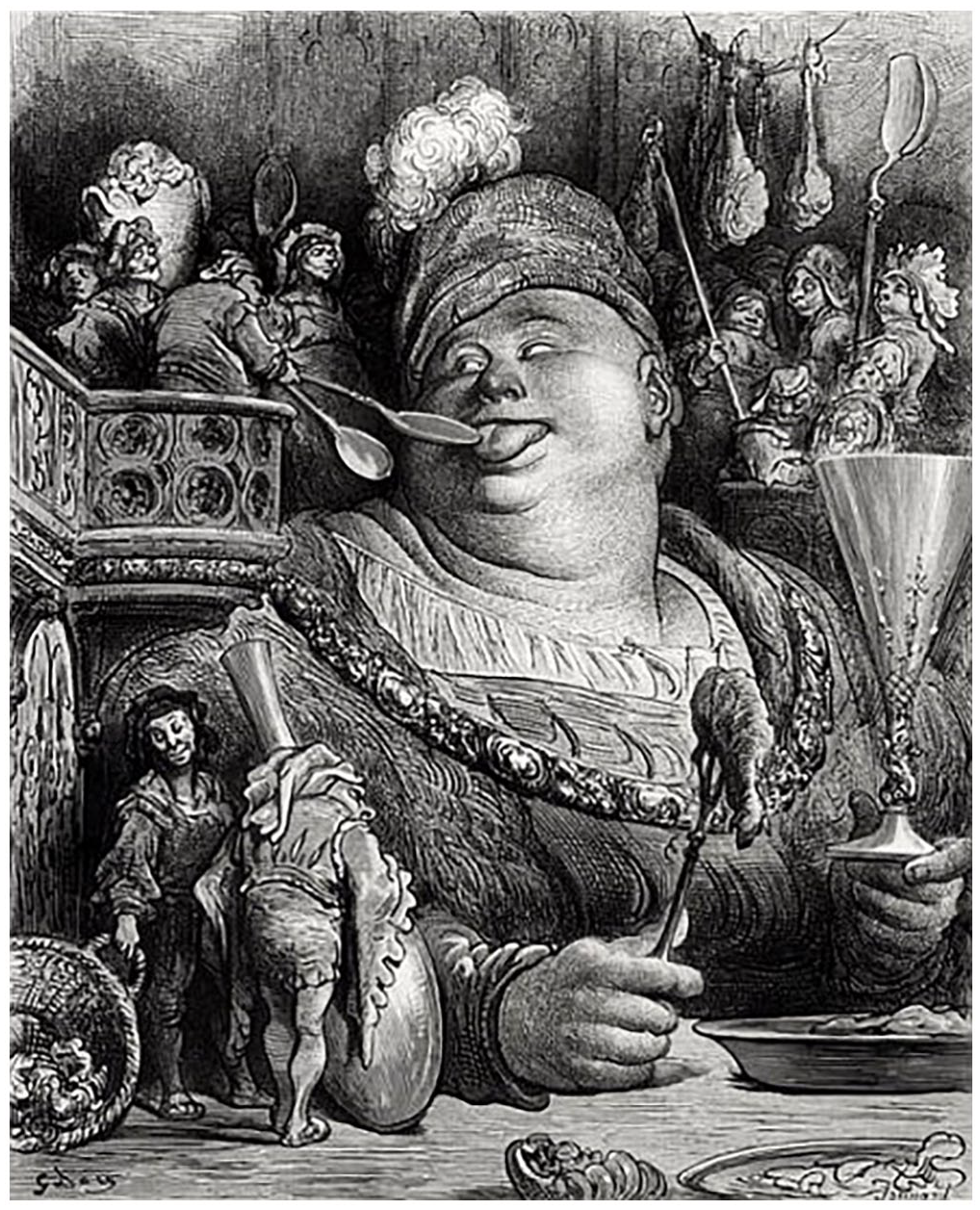
Gargantua’s Parisian meals, four men shovel mustard into his mouth (I 21). Wood Engraving (1873) Gustave Dor For Gargantua And Pantagruel by Francois Rabelais.
Reading cinematic images (and their intensities) through Bakhtin’s clarification of the grotesque, produces a different kind of giant baby—a more ambivalent and less scary, less monstrous figuration. In the Bakhtinian (1984) sense, the desiring, eating, farting, drinking, crashing, salivating, breaking, screaming intensities of Boh, Jack-Jack Parr, Adam Szalinski, and Middle-Aged Baby are “acts of the bodily drama” (p. 317) that are, yes, coded as “baby” but also coded as “adult” through the grotesque exaggeration of size, strength, and power. The giant baby, as a grotesque bodily image, is formed through paradoxical intensities: evil, destruction, and danger (i.e. giant) but also renewal and birth (i.e. baby). These paradoxical intensities highlight the artificiality of an investment in an orderly and time-bound understanding of growth and development. Returning to Deleuze and Guattari’s (1988) figuration of the molar and the molecular, we can see how the molecular holds molar bodies in a particular kind of tension. With regard to the interplay between being and becoming, Merriman (2019), states that “highly organized, punctual molar masses and bodies may distract our attention, occupying our perceptual field for more-or-less extended periods, but vital and incessant molecular forces, affects, desires and political relations simultaneously underpin and undermine these molar perceptions” (p. 78). These giant babies, just as they are, may be more complete commentaries on the fullness of infant/ toddler relations, as well as the absurdity of dominant figurations of rational, controlled, and fully-developed “adult.”
Giant babies as productive provocations
"This is the ever unfinished, ever creating body. . .”
Bakhtin (1984: 26)
Where do these intersecting readings of cinema as/in philosophy leave our provocation, the Donald Trump Baby Balloon? To be clear, I don’t believe the artist’s intention with regard to the Donald Trump Baby Balloon was to present a complex, ambivalent image of infants/toddlers specifically, or life and growth in general, through exaggerated intensities related to desire, scale, time, etc. It was, of course, meant to protest, to insult, to lampoon. Personally, my first impulse was (and continues to be) to be repelled by and vocally reject the casual comparisons of Trump to infants/toddlers for these very reasons, whether they are presented in the media or spoken by friends or colleagues. However, it is worth considering how images of giant babies, when read philosophically, might materialize, (re)produce, and/or mutilate particular notions about young children in ways that overrun the intentions of their creators. It is worth considering the ways in which images of giant babies are productive sites of multiplicity that can both reaffirm and disrupt commonsense notions of young children and childhoods, as well as the conceptual tensions between “child” and “adult.”
Philosophical engagement—and in particular the (re)reading of philosophical texts and child/hood images side-by-side—can provide an intervention into otherwise solidified ways of thinking around images of infants and toddlers in popular culture, art, literature, etc. This kind of destabilization of concepts, in turn, furthers the argument for employing both philosophy as a method and cinema-as/in-philosophy within the realm of childhood studies, affording opportunities for us to “confront the ways in which forms of perception in art and cinema allow us to re-think the emergence of the human” (Colebrook, 2002b: 160) or “to expose the generative in childhood otherness” (Tesar and Koro Ljungberg, 2016: 4). This might have broad implications for how those of us in childhood studies and/or in early childhood education, care, and policy might respond to these images, as we engage with them in the media and respond to them within our everyday conversations and relationships.
Footnotes
Funding
The author received no financial support for the research, authorship, and/or publication of this article.
