



Abstract

This Themed Edition emerged from a deep concern that we share regarding the recent growth in forms of intensified and virulent childism. We have been particularly struck by a specific form of childism that has circulated in popular culture, through myriad media outlets, that seeks to parody powerful male leaders as ‘tantruming toddlers’ in late Capitalism (e.g. Crump, 2021; Hyde, 2020). This was especially prevalent in media portrayals of Donald Trump during his presidency (Cavna, 2017). It seems that likening Trump’s abhorrent behaviour (selfish, unreasonable, angry, intolerant, insolent and intolerable) to that of a small child is the worst insult that can be waged against an adult man in a position of power. This is a phenomenon that stretches beyond the geopolitical context of the USA and has far reaching consequences. There are traces and examples of this pernicious form of childism in numerous other geopolitical contexts, across time and space (e.g. Alvares, 2020; Pesek, 2013). As such, it raises important considerations for childhood scholars concerned about the state of the world and the place of child/hood(s), both materially and discursively, at this particular moment. Such reductionist and grotesque portrayals of ‘child’ work to denigrate and limit ideas about child/hood within the public imagination and so actively silences other accounts of contemporary child/hood. This collection of critical childhood studies scholarship seeks to intervene by offering a range of alternative narratives that grapple with the ways in which the image of the child might be rethought as a means to directly challenge the notion that the misbehaving toddler somehow embodies and epitomizes hyper-capitalism.
Reclaiming Toddler
Sweet baby smell, fading Small hands, pointing Reaching Falling down Getting up Active and aware Playful Curious Undaunted Imaginative mischief-maker Stomping feet Defiant Disruptive Tantruming, Purposeful protestor Angry, Loving Imitators Initiators Communicators Vulnerable, Relational Capable Participatory citizens. Wholly human; More-than-Adult-huMan. Toddlers, becoming
As our poem above gestures, in various ways the contributions to this Themed Edition trouble the spectacle of the tantruming toddler as it has come to occupy space as a ‘rapacious version of capitalism and its systematic undermining of democracy’ (Davies, 2019, p. 171). The tantruming toddler narrative of the phallocentric statesman is often presented through visual imagery, as materialised spectacle that sets in motion powerful affective forces. Such cartoonish, dark playful depictions work to legitimise analogies of unacceptable adult behaviour to spectacles of the tantruming toddler with worrying implications for broader conceptualisations of the child. We propose that thinking with the spectacle of the tantruming toddler in alternative ways holds the potential to disrupt this logic. For example, mobilising Bakhtin’s (1984) carnival creates space and opportunity for mass expression of political identities and ontologies that call for change. Through a Bakhtinian lens the spectacle of the tantruming toddler might evoke the carnivalesque since attention is drawn to everyday identities that would otherwise remain obscured; to the inversion of hierarchical social structures, and to social encounters in public and private spaces that become saturated with ritual parody, anger, and shame projected towards public figures. In many senses political activism and mass protest marches take on a carnivalesque quality. The civil disobedience, swelling noise, haptic movement captured in the collective energy of an activist rally does important work to disrupt and draw attention to that which has become commonplace and unremarkable. It is a lively space through which spectacles are made, unmade and remade. (see Figure 1 below).

Making of a spectacle, source: https://time.com/5338370/trump-london-protests/.
As we began crafting the call for submissions to this Themed Edition of Global Studies of Childhood, I (Jayne) recounted experiences of marching the streets in protest at Trump with my two young children in 2015 and again in 2018, which sparked an ongoing and wide-ranging conversation amongst us (the editors) that provoked a series of endlessly unanswerable questions about child/hood(s) in the Capitalocene.
1
In the photo below (Figure 2) my children (and their friends just out of shot) hold aloft placards with direct quotes from Donald Trump:
“I just start kissing them. It’s like a magnet. Just kiss. I don’t even wait. And when you’re a star, they let you do it. You can do anything”
“Grab ’em by the pussy. You can do anything”
"Part of the beauty of me is that I am very rich."
“The concept of global warming was created by and for the Chinese”
“When Mexico sends its people. . .they’re sending people that have lots of problems. . .they’re bringing drugs. They’re bringing crime. They’re rapists”
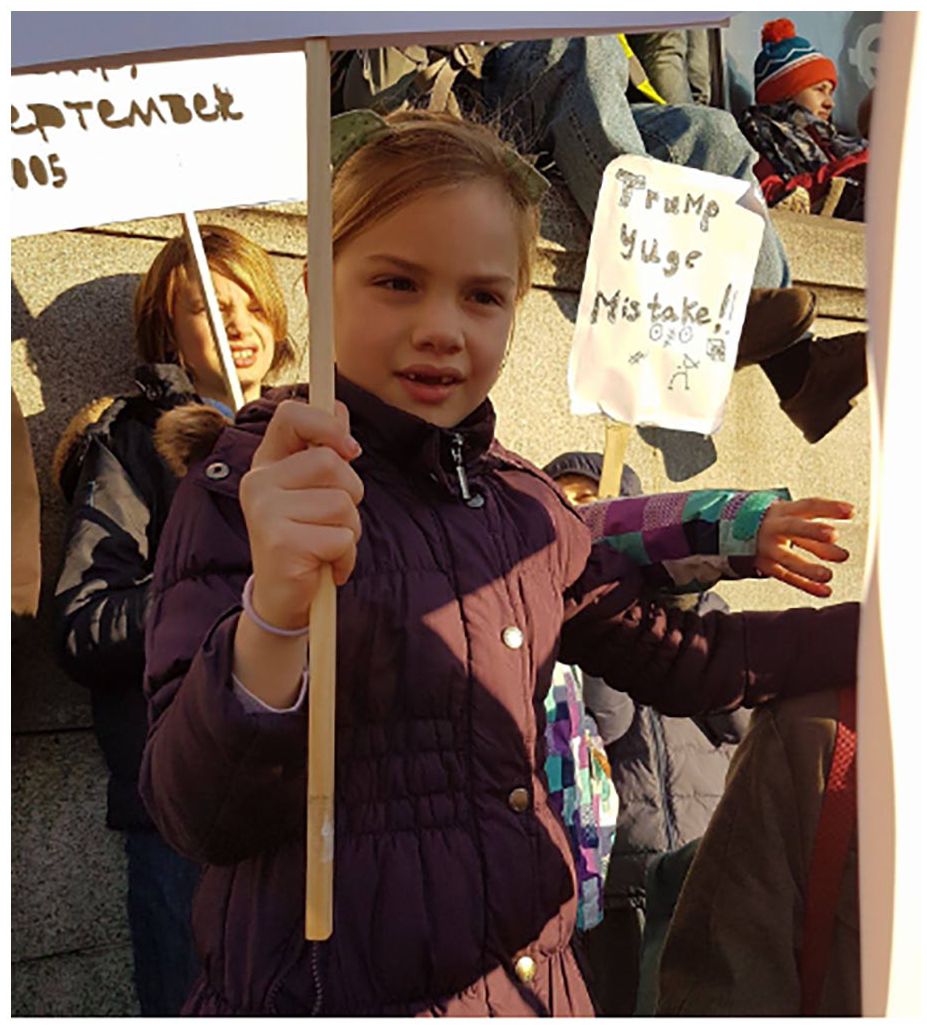
‘Childish’ Pussy Rioting: author’s own photo.
In this image my daughter, having heard about the Pussy Hat Riots, wears pussy cat ears on a headband as a mark of protest; throughout the day my children (then aged 6- and 9-years-old) witnessed impassioned and enraged declarations through megaphones and PA systems. My children asked many questions; some of which felt (and continue to feel) impossible to answer.
Three years later, in 2018, we were marching again. The whole day we found ourselves persistently hailed by the presence of the Trump Baby balloon. 2 (see Fig 3 below) Soon it became impossible to avoid the intense mixture of unsettling affective forces when confronted with this impossibly huge materialisation of public protest against Capitalist greed, misogyny and racism.

Materialised Phallocentric Capitalism.
A bright sunshine-filled day in summer of 2018, along with hundreds of thousands of other protestors, we marched our way through the streets of central London, finally arriving in Trafalgar Square to hear impassioned speeches by political leaders, child activists and feminist protestors alike. The whole time the six-meter balloon bounced high in the air, its presence a public declaration of deep-seated contempt for Trump and all that he has come to represent in late Capitalism. The inflated figure of an ageing, bloated, wealthy, capitalist baby-statesman is less a representation of ‘child’ than it is a representation of the Capitalocene, wherein the ‘market-and-profit besotted, modernizing, and human-exceptionalist business-as-usual commitments of so much Anthropocene discourse’ is at play (Haraway, 2016a, p. 50). Likewise, its material form parodies the monstrosity of Capitalist greed, embodied by politically powerful figures (such as Kim Jong-Un, Bolosarno, Johnson, Morrison among many others) who are ultimately called to account through civil protest.
The spectacle of the tantruming toddler in late Capitalism sets off all manner of uncomfortable affects which manifest in various ways but notable is the political activism within and across various social groups, from Greta Thunberg and her youth activist peers to the emergence of The Pussy Hat Riots across the globe, see Figure 4:
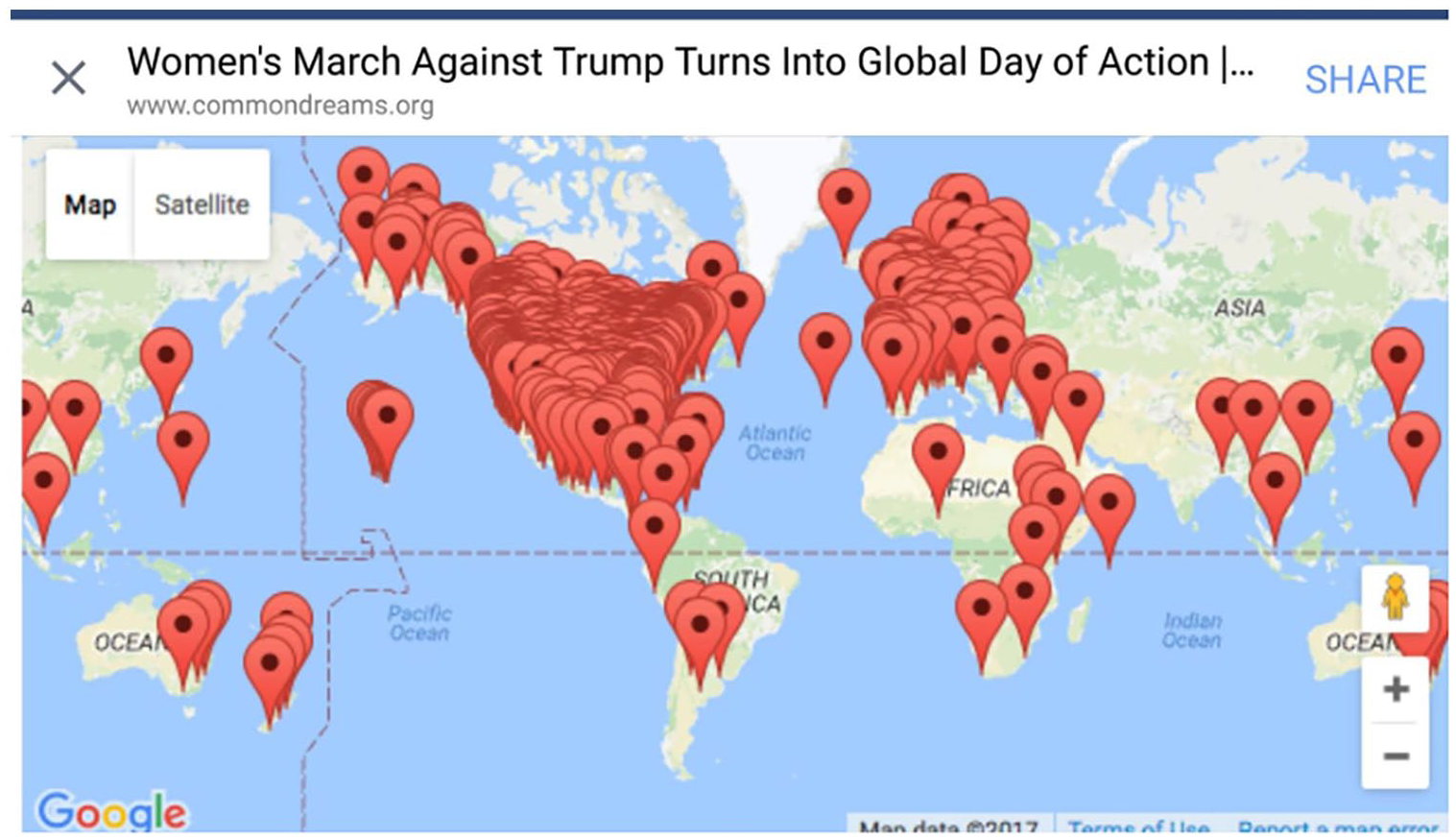
Mapping Global Pussy Hat Protest, source: www.commondreams.org.
The grotesquely inflated-to-bursting balloon both figuratively and affectively speaks back to power; by taking up space and making its presence felt. After the 2016 election, it was impossible to avoid encounters with the spectacle of the ‘Trump baby’ on the street, screen or page. In the field of early childhood though the figure agitated all sorts of paradoxical emotions - about babies, about tantrums and about toddlers. However, staying with the trouble (Haraway, 2016a) that the figure of the tantruming toddler agitated ultimately proved to be a generative force. It provided fertile ground upon which we began to wrestle with the troubling questions that were agitated (about monstrosity, misogyny, racism, white supremacy, homophobia, corruption and hatred) and that have been afforded more freedom to find expression as particular sorts of political leaders have taken public office. This Themed Edition invites an engagement with the complexities, the possibilities, as well as the challenges and limitations that hyper-capitalism, and reactions and resistances to it present to childhood scholars.
We take the figure of the infantile statesman as an opportunity to contemplate what might be generated from a range of disciplinary orientations. This collection of papers considers the affective relationalities of the spectacle of the tantruming toddler to child/hood(s) in the Anthropocene and the possibilities made available to tell other stories. Authors in this collection explore, problematise and reclaim the ‘monstrous toddler’ and ‘awkward baby’ spectacle by offering theorisations of child/hood(s) grounded in empirical research that unsettle unhelpful and pernicious accounts of child/hood(s). Placed in the context of the Capitalocene (Haraway, 2016b) the papers consider the implications of globalisation and capitalist logic for contemporary child/hood(s). By approaching childhood studies in this way this issue generates alternative accounts of child/hood(s) that variously recognise the agentic capacities of the child, and child/hood as presenting vital opportunities from which adults and communities can learn about political renewal and hope when confronted with the challenge of finding ways of living (and dying) on a damaged planet (Tsing et al., 2017).
This Themed Edition brings together a collection of papers from across the field of childhood studies that engage with ‘toddlerdom’ from a range of theoretical and epistemological starting places. These alternative narratives pose a direct challenge to the capitalist trope that privileges the white, phallocentric, male (see Braidotti, 2022) and instead acknowledge ‘the toddler’ as full with competence, curiosity, insight, and connection. As such, a space has been created for arguments to unfold and co-mingle, to enrich and challenge established thinking about contemporary child/hood(s). Furthermore, it invites the reader to engage in on-going debate about child/hood(s) that substantiates and makes visible counter narratives. Collectively a range of alternative ‘truths’ about the young child are presented that are made possible by drawing specific attention to children’s immersed, complex and often surprising engagements with the world. These alternative truths agitate a form of questioning of the established foundations on which much received wisdom about child/hood(s) rests. An openness to conceptualising the child in other, more generative ways, brings about a healthy critique of developmentalist logic (that sets up normative ideas about what children should be able to do physically, emotionally, behaviourally and socially); and instead invites us to view children as citizens, implicated and active in world-making practices (Hodgins, 2018) which can, and often does, include angry resistance. Collectively the papers in this issue dismantle the prevailing narrative of tantrums and infantile behaviour and in its place offer nuanced and complex engagements with toddlers, young children, and with images of children in early childhood contexts and more broadly in popular culture, movies and children’s literature.
The Special Issue begins with a paper entitled Clowns, fools, and the more-than-Adult toddler in which Charlotte Arculus and Christina Macrae explore affinities between the figures of clown and toddler. They challenge the derision with which infant and clown behaviour is typically met and instead propose that the productive potential of such ways of being in the world should be celebrated. Posthuman and feminist theories are mobilised to allow for a playful investigation into the affordances and synergies that align the figures of clown and toddler. Through arts-based methodologies that engage the public, childism is called to account, specifically the idea that ‘child’ is routinely positioned as less-than-adult, unformed, and beholden to a linear trajectory. The common antics of both toddlers and clown are explored to reveal how they might productively inform the co-production of improvisational pedagogic practices with young children. The pursuit of the figure of the more-than-Adult toddler enables the authors to identify how clownish antics intersect with toddler ways of be(com)ing as a decolonising strategy intended to disrupt bounded and linear constructions of ‘toddler’.
Next, Casey Myers takes the Trump Baby Balloon as a provocation in her paper entitled: “Play with me or I’ll break your arm”: Giant babies, philosophy, and images to interrogate particular images of giant babies by attuning to multi-modalities through a ‘philosophy as method’ approach. Attending to grotesque bodily images, alongside a selection of cinematic portrayals of giant babies and their social material contexts, provides conditions on which to challenge, explore and rework ideas about toddlers. The particular constellation of images and texts that are subjected to Deleuzian and Bakhtinian analysis, allows the giant baby to emerge as a specific entanglement of developmentalism, humanism, and neoliberalism. Commonsense notions of time and bodies are disrupted by the ways in which images of giant babies materialize particular notions of monstrosity, consumption, and destruction. The ultimate goal of the paper is to destabilize core concepts that circulate within the realm of childhood studies and so make visible the potential of bringing together philosophical enquiry with everyday cinematic representations of giant babies that shift thinking about contemporary child/hood(s).
Bringing together a concern with affect, materialities and bodies as they coalesce within ‘the tantrum’, Jayne Osgood & Victoria de Rijke pursue a critically affirmative account of child/hood(s) in all its messy complexity. In “That’s enough!” (But it wasn’t): the generative possibilities of attuning to what else a tantrum can do the authors enact a feminist project of reclamation and reconfiguration of ‘the toddler tantrum’. They draw on a range of theoretical traditions to investigate the complex yet generative possibilities inherent within the tantrum to encounter it as a more-than-human worldly-becoming, a form of resistance to Anthropocentric childism; and ultimately as a form of (child) activism. Arts-based approaches to research allow for speculative accounts of what tantrum-ing is, what it makes possible, and how it might shift practices with very young children. A playful engagement with children’s literature creates space for the uncomfortable affective ecologies that are agitated by child rage to be taken seriously.
Sustained shared thinking dialogues, which focus on teacher talk with young children, are widely recognised as a way to gauge developmental learning. But such approaches could be extended to enable attunement to toddler dialogue which typically exceeds only talk. As a consequence of the currently narrow approach to learning dialogues the child is typically marginal because the all-knowing, fully verbally literate adult is granted primacy in the Capitalocene. The toddler child is not fully human in this context because their validity relies upon the acquisition of adult forms of communication. In Utterance chains: A dialogic route to speculative thinking-with toddlers in the Chthulucene, Jayne White explores the important clues offered by toddlers through subtle, fleeting, embodied and interconnected language acts. Seemingly random utterances, when stitched together across time and space, can elevate the toddler through chains of thought that implicate teachers as well as toddlers. Utterance chains were animated through curated video and dialogue with a group of teachers in Aotearoa New Zealand who were willing to ‘think with’ toddlers in ECE settings. The paper underlines the importance of attuning, slowing down, thinking-with toddlers in order to expand communicative repertoires that fundamentally shift ideas about how ‘child’ gets produced, and what teachers might un/re/learn, from living/teaching within the context of the Chthulucene.
From a very different theoretical orientation Abigail Hackett also works to trouble notions of time-as-progress and (adult) human exceptionality in her consideration of conceptualisations of children’s literacies and futures in the context of faltering logics of capitalist progress. In Unruly Edges: toddlers literacies in the Capitalocene the paper dwells upon an ethnographic study undertaken with families and young children in northern England that is curious about young children’s literacies that start with the seemingly unremarkable that unfolds through everyday happenings within communities. Hackett pursues the ways in which ‘young children’s changing communicative practices do not accumulate within an empty void, but rather jostle up against, sit in relation to and sometimes squeeze out, other ways of relating in and with the world’. Arguing for the interconnection between notions of human exceptionalism, human/planetary relations and literacies and language, the paper offers some fresh imaginaries about literacies and young children’s relationalities to the communities, things and atmospheres that constitute their worlds.
Time is also threaded through Anna Moxnes & Teresa Aslanian’s contribution to this Themed Edition. Their manuscript Thinking Time: Producing time and toddler’s time to think in ECEC attends to the curious and significant ways in which Toddlers contribute to early childhood education and care (ECEC) environments. Early childhood teachers’ stories about toddlers, thinking and time are analysed through a feminist new materialist lens to explore the unlikely and generative places these stories can take conceptualisations of the ‘child’. Specifically, the research follows a moment of storytelling told with toddler fingers. Using Baradian concepts (spacetimematter and temporal diffraction); and Haraway’s concept of Capitalocene and practice of storying, the paper pursues what else toddler-thinking and toddler-time in early childhood produces. The authors conclude that the Capitalocene induced obsession with linear, developmental, progressive time actively produces thoughtlessness in the nursery and seriously curtails children’s opportunities to participate.
Also concerned with what unfolds within nursery contexts, Jenny Robson draws upon knowledge generated from empirical research conducted in nurseries in Australia, England and Nordic countries to map the responsibilities adults have to facilitate the co-construction of values with children that underscore their status as active, invested and knowing citizens. In Unsettling the Trump Baby: learning from values and pedagogy in the early childhood nursery a spotlight is shone on the 2018 street protest, a giant balloon, and the conflation of President Donald Trump with child/hood(s). On the surface the balloon is intended to ridicule and belittle Trump, but a more critical reading unearths a sinister appropriation and manipulation of childhood. Trump masquerading as a baby becomes the ‘vagabond’ who is denied citizenship; a focus for negativity and fears, symbolising the values of hate and intolerance. As the Trump-baby is mocked and humiliated, hostile acts against children become effectively legitimised prompting urgent questions about the interdependency between children and adults in the construction of values and the pursuit of citizenship.
Emmanuele Fincham similarly pursues a critical deconstruction of the ways in which toddlers are discursively constructed and outlines the implications of this for teachers working directly with young children. In From Barbaric to Knowing: teaching to resignify toddler a persuasive case is made for adults to persistently question their attitudes, assumptions and engagements with toddlers and to interrogate the forces that sustain narratives of young children as barbaric and unformed. The readiness with which political leaders are infantilised in cartoons and protest propaganda speaks volumes about the societal views held about young children, particularly infants and toddlers, which can be detected in public and professional discourses that actively demean and undervalue the young child. The paper explores how such discourses are maintained through ingrained expectations around classroom management and the need to shape children according to school-readiness and ultimately future lives as enterprising neo-liberal subjects. The paper offers a call-to-arms to adults privileged enough to spend time and learn-with/from very young children.
The Themed Edition arrives at some sort of open-ended conclusion with a Coda. Written by, us, the editors, this brief paper does not seek to neatly summarise, or to tease out emergent themes, or arrive at some definitive recommendations. Rather, the purpose is to dwell upon what this collection of papers has agitated. To create an opening for wide-ranging debates about the spectacle of the tantruming toddler to continue. To wonder what new questions have been provoked. The authors have offered myriad provocations and theoretical possibilities for ways in which ‘toddler’ might be rethought, reencountered, respected and reconceptualised. It raises important matters of concern about how research might be undertaken in ways that celebrate and recognise the validity of toddlerdom as a space for adult re/un-learning. Attuning to what else ‘toddler’ makes possible demands that pedagogical practices and everyday encounters with very young children are in urgent need of reappraisal. Child/hood(s) must be acknowledged as being implicated, affected, actively shaping and shaped by endless relationalities to the world. We might take up Haraway’s (2014, 2016a) invitation to move from the terrors of the Anthropocene, the devastating consequences of the Capitalocene, to the more generative possibilities available within the Chthulucene, as a space, place, time where perhaps ‘toddler’ offers the key to explore how revolution might be thought and carried into action, whilst, as she articulates: ‘we collect up the trash of the Anthropocene, the exterminism of the Capitalocene, to something that might possibly have the chance of ongoing’.
Footnotes
Correction (December 2024):
This article was updated to correct the affiliations of the third author.
Funding
The author(s) received no financial support for the research, authorship, and/or publication of this article.