



Abstract
This article explores the role resilience processes play in education and well-being outcomes for street-connected children. It draws on research and practice undertaken as part of the Building with Bamboo Programme (BwB) on resilience. BwB investigated the forms a resilience-based approach might usefully take in practice, the effect this has on promoting resilience in children, and how this resilience leads to improved outcomes in their lives. Our article draws specifically on the experiences of street-connected children who were involved in such approaches as part of programmes at S.A.L.V.E. International, Uganda between 2016 and 2018. Drawing on individual street-connected children’s resilience pathways through BwB and beyond, the article unpacks the connections between resilience processes and improved educational and well-being outcomes. It outlines how programme activities were developed and nurtured through cycles of learning and innovation to continually evolve existing strength-based programme practice with street-connected children whilst extending this work into the wider systems around children including peer networks, organisations, families and communities.
Introduction
Resilience-based programmes, concerned with fostering resilience processes, which are protective for individuals and systems and help them make adjustments in the context of adversity, are increasingly popular in international development (Kimber, 2019). This trend includes the growing use of resilience-based approaches in work with separated children who are experiencing adversity, such as street-connected children. Part of the attraction of such programmes is how they are believed to improve children’s outcomes. However, there is limited understanding both about what supports the resilience of children in sub-Saharan African contexts (Meinck et al., 2014; Theron and van Breda, 2021) and the specific role resilience processes play in improving their educational and well-being outcomes (Ungar, 2004). This gap in understanding is pertinent given that resilience processes and how they affect children’s outcomes are sensitive to situational and cultural contexts (Theron and van Breda, 2021). This article contributes to understanding the role of culturally situated resilience processes in improving educational and well-being outcomes for street-connected children in Uganda. The link between increased resilience and improved well-being is clearly established (Ungar, 2021). Whilst we recognise that the concept of ‘well-being’ has multiple definitions and understandings and is operationalised in different ways across a range of domains (e.g. shelter, care, positive relationships, independence, confidence, protection), we do not seek to expand on this work here. Rather, our focus is on resilience processes and their impact on improving children’s outcomes drawing on understandings of both which are rooted in children’s own perspectives and stories.
This article draws on research undertaken with S.A.L.V.E. International, Uganda (hereafter, S.A.L.V.E.), one of three learning partners involved in the Consortium for Street Children (CSC) and Oak Foundation’s Building with Bamboo Programme (BwB), conducted between 2016 and 18. BwB was an international learning and innovation programme exploring resilience-based approaches to working with street-connected children who are exposed to sexual abuse and sexual exploitation (CSC, 2018a). It generated understanding about what it means to work in resilience-based ways and how such approaches can help street-connected children become more resilient and experience improved educational and well-being outcomes. Although BwB is now complete, the learning and practice change that emerged continues to inform the work of all three learning partners, as well as other organisations.
S.A.L.V.E. has been supporting street-connected children in Jinja, Uganda, since 2008. They follow a child-centred methodology which recognises children’s capacities and encourages them to work alongside staff to co-design their path away from the streets. This focuses on Street Work, counselling, care and skills development to help children re-settle into their families and re-enter education. Street Work is a child-centred, rights-based approach to supporting street-connected children, in which trained adult professionals aim to establish relationships of trust based around children’s values, issues, experiences and ambitions (Street Invest, 2020). S.A.L.V.E. Street Outreach Workers walk the streets daily to get to know the children and understand them better. They identify new children connected with the streets and check on children they already support and remind them of the services that S.A.L.V.E. can offer them. S.A.L.V.E. joined BwB as an organisation that was using an approach implicitly underpinned by resilience principles, reflected in their strengths-based activities and informed by the organisation’s aims and values. This approach was positioned mainly in the context of their work with individual children. Through BwB, S.A.L.V.E. laid the foundations for resilience processes informed by the wider systems around street-connected children such as those located in peer networks, families and communities.
Charting the changes in S.A.L.V.E.’s evolving resilience practice and development, this article shows how street-connected children’s resilience pathways are, ultimately, contingent on building more than children’s internal strengths, instead requiring a systemic approach (Ungar, 2021). There are four further sections in this article. The first section describes how the concept of resilience has been operationalised as a tool for improving people’s lives, outlining how emphasis on understanding resilience processes has shifted, in recent times, from ‘individual’ to ‘systems’ in terms of viewing it as a process of interaction with the environment, not only an inherent quality in the child (Ungar, 2021). The second section explores the use of strong research and practice links to evolve resilience-based practice change and development at S.A.L.V.E. The third section draws on case studies of three street-connected children’s ‘resilience pathways’ to show how resilience processes are built and contribute to improved education and well-being outcomes. The final section reflects on the potential for resilience processes to contribute to transformational outcomes for street-connected children.
Resilience and street-connected children
Understanding resilience
The concept of resilience has gained huge currency in international development over recent years, portraying a vision for making the world a “better, stronger and safer place’ (Kimber, 2019). It originally became a popular concept in the context of the risk discourse – hazards, crises and disasters – in the late 1990s, superseding discussions about ‘vulnerability’ widely associated with the susceptibility to be harmed (Janssen and Ostrom, 2006) and becoming a positive replacement implying the possibility of adjustment, adaptation and recovery (Kimber, 2019). Conceptualised and adopted in different, sometimes conflicting, ways resilience continues to be debated theoretically and in relation to its practical application (Tanner et al., 2017). There is no absolute and agreed definition of resilience. However, many studies describe resilience as the capacity of an individual or system, for example a child or a community, to function normatively despite exposure to stress and adversity (Kimber, 2019). In the context of a child’s life, ‘resilience’ is recognised to be in evidence when they cope better with adversity than they might be expected to or, put another way, do well in life regardless of the adversities they experience which can threaten good outcomes.
The resilience of a child can be fostered and supported through ‘resilience processes’ (Theron, 2015). These may be informed by the individual child’s strengths (e.g. problem solving, self-regulation, sense of humour, tenacity and good social skills) which contribute to their individual resilience. However, it is generally recognised that the wider systems around children are also important (for example, home routines, quality education, good support and social services) (Masten and Cicchetti, 2016; Ungar, 2011). This is described as ‘systemic resilience’ in which positive adjustments in the face of adversity are necessarily congruent on socially and culturally rooted interactions between children and their environment (Ungar, 2011). Proponents of systemic resilience argue that children should not be held accountable for adjusting well (Theron and van Breda, 2021). Rather, societies need to be ‘resilience-supporting’ by promoting positive relationships between children and their sociocultural ecologies. Indeed, the more supportive resources available to children, the better their chances of adjusting positively to risk or adversity (Hobfoll, 2001).
More recently, the concept of ‘multisystemic resilience’ has been put forward (Ungar, 2021), which recognises that multiple, co-occurring systems - biological, psychological, social and ecological – make a person’s resilience possible by contributing factors and processes that are ‘resilience enabling’ (Theron and van Breda, 2021). As such, attention is placed on key systems considered as fundamental to children’s resilience, including both the stakeholders (such as parents, other caregivers, educators) and the systems themselves (such as families and schools) (Matsopoulos and Luthar, 2020). Importantly, a multisystemic understanding of resilience suggests that the systems contributing to a child’s resilience must themselves be resilient (Masten and Motti-Stefanidi, 2020; Ungar, 2018), requiring supportive social policies at local, national and global levels to provide the necessary scaffolding across the whole ecosystem (Pinkerton and Van Breda, 2019). Consequently, a multisystemic understanding of children’s resilience brings attention to the multiplicity of systems that form relevant protective factors and processes (Theron and van Breda, 2021).
Understanding ‘resilience’ in Uganda
Resilience processes differ across contexts and definitions of resilience are socially and culturally constructed (Panter-Brick, 2015; Theron, 2015; Ungar, 2004, 2011). Conceptualisations of resilience, as well as the mechanics of how adjustments to adversity are made, are relative to and shaped by intersecting socio-cultural ecologies (Russell et al., 2015; Theron, 2015; Theron and Liebenberg, 2015) or the ‘cultural script’ which exists for shaping processes that facilitate resilience (Panter-Brick, 2015; Theron and Liebenberg, 2015). Consequently, local concepts in resilience research should be informed by a ‘fine-grained approach to culture’ to effectively situate and operationalise the concept of resilience for understanding children’s empirical resilience-related realities (Panter-Brick, 2015: 233).
During BwB, we used Carbaugh’s (2007) Cultural Discourse Analysis (CuDA) to establish how the term ‘resilience’ is named and described in locally relevant ways. This local approach to understanding ‘resilience’ was considered important because the theoretical and international concept of ‘resilience’ in use reflects the hegemonic cultural values of Western societies where the majority of studies on resilience have been conducted (Ungar, 2004). We used key informant interviews to listen for the range of local terms connected with ‘resilience’ and to understand how these terms were manifest through people’s practices and what forms and meanings they attached to them (Edmonds, 2021). From this we developed a ‘local narrative’ of resilience in Uganda which provided an understanding of how key local concepts relevant to resilience are recognised in cultural life and pinpointed socio-cultural components of ‘resilience’ that are locally recognisable. In particular, we learned that the terms obuvumu (in Luganda) and obuvuumu (in Lusoga) can be used to talk about ‘resilience’: “Obuvumu / obuvuumu is developed through the experience of facing challenges and overcoming them and is used to describe a person who always: feels the need to be brave, bold, courageous and strong; maintains a sense of control and exercises emotional self-restraint in times of adversity; can have a confrontational manner when dealing with challenges; is not daunted when faced with difficult situations nor put off by the steps they must take and can keep the end goal in mind; is able to look at problems from a variety of perspectives; is proactive in seeking help and advising others; is not easily overwhelmed and is hopeful about the future. The Lusoga term ‘obuvuumu’ additionally reflects an individual who believes that a difficult situation is not permanent and retains the hope that time will change their situation for the better”. (CSC, 2018b)
Understanding street-connected children
Children who have strong connections to the streets are known as ‘street children’, ‘children in street situations’ (Lucchini and Stoecklin, 2020) or ‘street-connected children’ (Thomas de Benitez and Hiddleston, 2011) and by other names. For such children, the street is a central reference point, playing an important role in their everyday lives and fundamentally shaping their development and identities. It is widely recognised that a child’s connections on the street are both a source of strength, family and resources, as well as risk and adversity – exposing them to potential challenges, including entrenched poverty, stigma, discrimination and hunger, abuse, exploitation and violence (Kaneva and Corcoran, 2021; Ennew, 2003; Ferguson, 2017; Malindi and Theron, 2010).
During BwB, we considered various street connections and the different implications they have for children’s exposure to risk and adversity. For example, children lived and worked on the streets: as part of peer groups or with family; in supportive environments such as markets, or with trusted adults in their lives who helped to protect them; during the day only, returning to a family home at night where they might be exposed to further abuse. A child who lives in circumstances of almost constant adversity, such as those who rely on the street for their survival, is likely to have different priorities for their well-being and different ways of coping with traumatic events which occur within the context of this adversity (CSC, 2018a). In turn, some of the resilience factors and processes in a street-connected child’s life may appear, at first glance, to be risky and morally ambiguous, in opposition to normative ideas about childhood and challenging to widely held notions of protection for children (Kaneva and Corcoran, 2021). To work effectively with street-connected children to build their resilience, organisations need to embrace these empirical realities and work with them, not against them, nor simply try to ‘correct’ them (Bordonaro and Payne, 2012; Edmonds, 2019).
Putting theory into practice: Evolving resilience-based approaches
Resilience-based approaches recognise children’s agency to negotiate adversity by developing and deploying strategies that draw on their own strengths and resourcefulness in the context of appropriate support and wider systems. They can be operationalised at individual, group, and community levels, working with community members who support their ability to be resilient and developing the wider scaffolding needed to promote resilience within and across multisystemic levels (Theron and van Breda, 2021). In essence, resilience-based approaches attend to the ‘building blocks’ that are needed in a child’s life to strengthen resilience. At S.A.L.V.E. a strong and intentional relationship between research and practice facilitates a dynamic, iterative and flexible approach towards evolving resilience-based practice change and development.
Evolving resilience-based practice change and development
BwB drew on developmental evaluation, ethnographic principles, participatory action research, peer research approaches and service design. It used cycles of learning and innovation to continually evolve S.A.L.V.E.’s resilience-based approach over the programme period. Such processes are recognised as highly generative for practice change and development because they maximise opportunities to learn from challenges and failures as well as successes (Gamble, 2008). It was also particularly suitable to the unstable, uncertain and chaotic settings in which S.A.L.V.E. works on a daily basis because street-connected children’s needs are complex and dynamic, requiring a flexible, adaptable and responsive approach.
The learning and innovation cycles typically lasted between 3 and 5 months and were implemented in three sequential phases. Data gathered in the ‘learn’ phase comprised experiences and reflections about how resilience-based practice evolved and how it promoted resilience and subsequently well-being, in locally recognisable ways. We collaboratively developed a deck of cards with staff and children that depicted locally recognisable components of both ‘resilience’ (or obuvumu) and better outcomes related to education and well-being (e.g. hopefulness, happiness, new skills, positive relationships). Staff used these cards to collect children’s stories of resilience, encouraging their reflection on their experiences of the previous 2 months, how these experiences prompted positive changes in their lives, and how programme activities contributed to them. We applied grounded theory in the ‘analyse’ phase (Strauss and Corbin, 1998) to make sense of the data. We open-coded for themes relating to the different forms of resilience practice, how these connected with street-connected children’s feelings of growing resilience and their descriptions of how this led to positive change. Using design thinking in the ‘innovate’ phase, we reflected on the findings to develop specific adaptations and innovations in resilience-based practice to trial in the subsequent learning and innovation cycle. Findings were used to develop ‘How Might We’ questions used to initiate rapid prototyping of programme practice adaptations and innovations which could be tested during the next cycle (see CSC, 2018a; Edmonds, 2021 for more detail).
BwB addressed several limitations of more traditional evaluation and programme design approaches. It was concerned with learning and innovation processes instead of impact processes primarily focussed on the modes of implementation and the measurement of impact (Edmonds and Cook, 2014). It, therefore, provided practitioners with space and scope to explore experiences and try out new ideas. BwB also followed a ‘best process’ approach (Miller and Rudnick, 2010) in which practice is developed in response to local contexts rather than by choosing or rejecting programme approaches and delivery from a ‘best practice’ menu of options (Edmonds and Cook, 2014; Miller and Rudnick, 2012). It, therefore, enabled more dynamic programme implementation so that modes of operation could shift in response to children’s, communities’ and practitioners’ ideas about what was needed to promote resilience. Traditional approaches are typically less flexible, with programme management, measurement and funding systems often not reflecting the ethos and principles of adaptation and innovation in practice, despite the recent shift towards ‘adaptive programming’ (Yanguas, 2018). In addition, whilst, traditional approaches to programme evaluation typically favour accountability towards programme funders and implementers in terms of measuring programme effectiveness (Edmonds, 2016), BwB emphasised local accountability in terms prioritising of children, practitioners and community members’ understandings of effectiveness.
Laying foundations for systemic resilience
When S.A.L.V.E. joined BwB they already had a strengths-based approach to working with street-connected children but did not use a resilience-based approach in their work in family or community contexts. During BwB, they continued to focus on resilience processes located in the individual child whilst beginning to lay foundations for a systemic resilience approach in response to learning about the role of positive relationships in promoting resilience. They explicitly worked to nurture supportive resources underpinning the wider systems around street-connectedness (Hobfoll, 2001), paying particular attention to building constructive relationships and ‘youth context interactions’ in peer, family and community contexts (Theron and van Breda, 2021). In practice, this meant fostering supportive and resilient families and communities around street-connected children, by extending counselling activities in family contexts and building positive relationships with key community stakeholders in positions to provide supportive networks (e.g. market vendors, school teachers, religious and political leaders). To support the development of systemic resilience, S.A.L.V.E. concentrated on developing staff skills and abilities to (re-)build children’s positive relationships with parents/caregivers and community stakeholders alongside new systems, structures and tools to support this. Table 1 provides an overview of how this resilience-based practice evolved over the programme period in response to each learning and innovation cycle (see CSC, 2018b for more detail).
How S.A.L.V.E. Uganda’s resilience-based practice evolved through programme cycles.
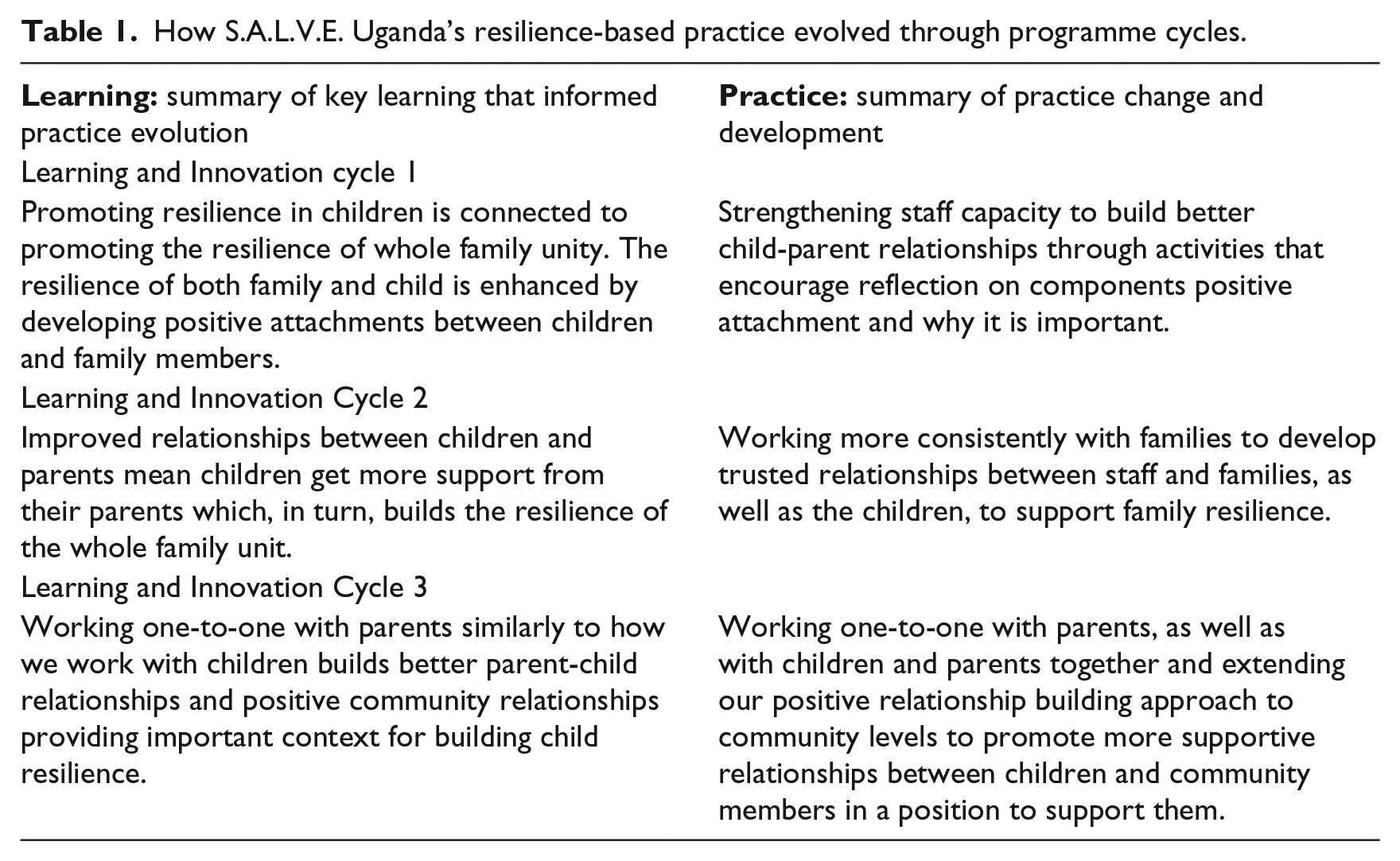
In practice, this process involved a number of different initiatives at S.A.L.V.E. over the programme period, such as staff training and workshops about the specific role positive relationships play in promoting resilience. For example, staff wrote imaginary letters to significant people in their lives, encouraging their reflection on the roles these relationships play and they collaborated with other practitioners to share ideas, explore challenges and develop new practice directions for supporting relationship building work. S.A.L.V.E. also expanded their use of the ‘genograms’ tool which deepened understanding about children’s relationships and connections and helped staff better plan resettlement processes. They introduced one-to-one work with parents/caregivers specifically, encouraging them to visit the drop in, residential and street sites to deepen understanding between children and parents/caregivers prior to resettlement, and adapted the rota system to provide more regular and consistently staffed follow-ups to resettlement over longer time periods. In the context of the wider community, staff mapped the supportive community networks available to street-connected children, through churches and schools for example, identifying individuals within these networks from whom children could seek support.
Resilience pathways: From resilience processes to improved outcomes
Street-connected children’s resilience pathways are complex, reflecting challenging contexts of adversity and non-linear and multi-directional journeys towards repairing family relationships, returning to education, and addressing negative behaviour patterns. We contextualise these through the stories of three street-connected children involved in BwB - Joseph, Ishmail and Derek – to explore S.A.L.V.E.’s resilience-based work to build children’s internal strengths while laying the foundations for resilient systems around them.
Resilience pathways: The stories of Joseph, Ishmail and Derek
Seventeen year old Joseph did not have a good relationship with his stepfather. During BwB he re-established contact with family with support from a social worker who spent some time building a strong relationship with Joseph and his mother. His mother visited the street where Joseph had stayed and the S.A.L.V.E. drop in centre. She encouraged Joseph to return home but his relationship with his stepfather remained difficult and he chose to continue living separately from his family and look for work to be financially independent. Joseph now lives in Kenya, sending home a portion of his salary to his mother every month, and volunteers as a mentor for other street-connected children going through challenging times.
Ishmail (now 14 years) was 10 when his parents, both living with HIV, separated. He remained with his mother but was mistreated by his stepfather. After a year on the streets, Ishmail became involved in BwB, eventually deciding to go to S.A.L.V.E’s rehabilitation centre. With sponsorship, he attended boarding school because of the problems with his stepfather at home. At school, Ishmail was closely supported by a teacher who worked with S.A.L.V.E. staff to help him adjust to school. When Ishmail’s biological father died, his support network at S.A.L.V.E. and school was vital in helping him deal with the news but when his mother also died he dropped out of school. With further financial and emotional support, Ishmail eventually went back to school and is currently training to be a welder.
Fourteen year old Derek used to mix with older boys on the street who would encourage him to steal. The new relationships he formed with S.A.L.V.E. staff provided positive role models and people who would listen and help him reflect on his behaviour and actions. With support, he began to reconnect with family and return to school. S.A.L.V.E. provided support for Derek and his family during these transitions and skills training to help his family establish a business, increase their income and better support Derek.
Resilience processes: Developing a sense of ‘I can’
Resilience-based practice at S.A.L.V.E. promoted a sense of ‘I can’ amongst street-connected children. Programme activities variously contributed to building children’s internal strengths to deal with adversity and improve education and well-being outcomes, even though this involved addressing new challenges along the way. The children used arts to express their experiences and feelings, verbalise their ideas about resilience and their thoughts about adversity. They composed and reflected on messages about becoming resilient, sharing their feelings and ideas and having them validated by others. Creating and performing songs and plays for staff, peers, and some radio stations and community events helped children feel and articulate a growing sense of belief in themselves and their abilities. S.A.L.V.E.’s ‘I can, I am, I have’ peer activity was designed to encourage children to vocalise their challenges and support each other to find ways to overcome them and they described how this helped them reflect on what makes them strong and gave them a sense of internal power over negative experiences and feelings. Standing in a circle, they shared challenging situations in their lives and listened to ideas from the group for overcoming them, starting with the words ‘I can. . .’, ‘I am. . .’ or ‘I have. . .’. Children found that this process ultimately gave them more impetus to make positive changes in their lives. For example: Derek was exposed to other ways to respond to street-based challenges and was able to re-think his friendships; Joseph reflected on his strengths, which helped him repair his relationship with family in a way which was both respectful of their needs as well as his own; and Ishmail shared his feelings with staff during sports activities, gradually reflecting on his behaviour and the consequences of his fights with other children on the streets.
Children described how sports, arts and music helped them release stress, develop a sense of fun and relaxation, alleviating some of the anger they feel because of the extreme stress and violence they are exposed to daily. Children were observed by staff to be calmer and more able to focus on addressing problems and challenges because they were less consumed by anger, better able to manage feelings and regulate destructive negative emotions. They were better able to relate and respond to those around them, demonstrating respect both for themselves and others, thinking before they acted, considering others’ situations and feelings and the potential consequences of their actions. Children described how this helped them better manage transitions such as returning to family homes or re-entering education.
Resilience processes: Laying foundations for resilient systems
Central to S.A.L.V.E. laying the foundations for more resilient systems was attention to (re-) building meaningful relationships and interactions between them and the peer networks, practitioners, parents/caregivers and community members around them. Essentially, this began building systemic resilience processes around street-connected children to support improved education and well-being outcomes.
Street-connected children were encouraged to develop stronger connections with peers, which they could draw on in times of adversity. Regular team sports practice and competitions with local schools gave them opportunities to come together, developing wider peer networks, forging new and deeper friendships, and prompting learning about the importance of working as a team to overcome challenges. Giving children ways of talking openly about their experiences in safe spaces, such as through the ‘I can, I am, I have’ circle, made conversations about challenges an explicit part of peer support networks and contributed to the abilities of children to be more emotionally available for each other, actively listening and supporting each other. Discussion about the role of friendship in providing protection in times of danger, companionship in times of loneliness and material resources (e.g. food, money) in times of need helped children recognise the importance of positive relationships and address conflicts with peers and family with Joseph saying ‘I have friends, neighbours. I have relatives. I have pastors. I run to them in case I need help. They never ignore me. They listen and support me’.
Street-connected children also developed more consistent relationships with S.A.L.V.E. Street Outreach Workers who acted as ‘transitional attachments’ in their lives, increasingly working to emotionally, as well as physically, reconnect them with a permanent parent/caregiver. Street Outreach Workers modelled positive relationships, providing foundations from which children could move forward to improve their relationships with family members. Programme activities provided a basis for understanding that acknowledged the realities of street life and children’s experiences there. Such approaches enabled street-connected children and parents/caregivers to share feelings, resolve misunderstandings, improve communication, and develop mutual empathy. For example, in one counselling sessions Joseph mentioned that ‘its normal to feel not okay but these feelings should be temporal and [it’s up to] an individual to control [them]self’. He explained how negative feelings and losing control previously led him to react badly to situations or make poor decisions because his emotions were out of control but that as he progressed through BwB, he began to advise his peers to calm down when they reacted badly to parents’ visits and to resolve misunderstandings with support from S.A.L.V.E. or other community structures.
Deeper connections between street-connected children and community members were initiated and developed through performances at community functions where children shared key messages about their lives to build resilience and resilience pathways beyond the individual. Children began to consider themselves important members of and contributors to their communities. Derek, Joseph and Ishmail made public testimonies in local communities where outreach activities were conducted, describing their experiences on the streets and how they had been able to turn their situations around. Such activities built community awareness, broke down stigma, encouraged understanding and the development of supportive relationships between street-connected children and community stakeholders. For children who experience abuse and stigma on the street such community-based connections proved protective, providing a point of reference for community support and fostering a sense of belonging they had not experienced before. They were able to draw on community support to resolve family conflict following resettlement which helped some children remain at home rather than returning to the streets. Belonging and the ability to draw on community support mechanisms extended into formal community spaces such as schools where S.A.L.V.E. worked alongside teachers to reintegrate children into schools, helping them to either stay in education or to return after further dropping out again, like Ishmail.
Working explicitly to build resilient systems around street-connected children, S.A.L.V.E. fostered a strong network of supportive and protective connections. Children described a greater impetus to address challenges with family members, contributed more positively to processes of family reintegration, showed greater interest in changing negative situations and shared their own ideas and solutions to problems with peers, family members or in the context of wider community settings. They also demonstrated greater proactivity in seeking support from those around them and giving this back to others, reflecting the culturally relational dynamics of resilience or obuvuuma in Uganda.
From the individual to the system: Towards transformative outcomes?
Resilience-based approaches are preventative, mitigating adversity by helping children to not become overwhelmed by their problems and emotions. They also help children respond, adjust to and protect themselves against future adversity. However, resilience processes are messy, complicated and multi-directional and have been criticised for focussing overly on the individual (Ungar, 2011). During BwB, resilience-based approaches at S.A.L.V.E. moved intentionally towards building the resilience of the wider systems and structures around street-connected children, not just the children’s internal strengths. As such, S.A.L.V.E. began to shift their focus to resilience processes located in the ecosystem around children, including attention to building resilient organisations, peer networks, families, communities and schools. This shift encouraged them to think carefully about their own role viz-a-viz facilitating other positive relationships and more permanent attachments located in other systems present in street-connected children’s lives, and to recognise that their programme activities need to be embedded within a systemic resilience approach, rather than as ends in themselves.
Taking such steps towards systemic resilience is fundamental for improving education and well-being outcomes. BwB was a contributory factor in street-connected children’s experiences of positive change. However, it is important to recognise that sustaining these improved outcomes over time is challenging. As Masten (2021: 22) says, ‘resilience in a child or family is always changing because the situation and the systems are always changing’. The case studies of Joseph, Ishmail and Derek hint at inconsistencies in children’s non-one-dimensional resilience pathways, which are characterised by the ebb and flow of resilience as new challenges emerge and impact on them.
At systemic levels, it is clear that resilience-based approaches have the potential to produce transformative outcomes for children by emotionally (re)connecting them within protective family, peer and community networks and systems that support and sustain them in the long-term. However, building systemic resilience requires wide and sustained engagement of stakeholders and systems around children in ways which are suited to, and can operate effectively within, the dynamic contexts of children’s resilience pathways. For resilience-based approaches to be truly transformative, helping children go beyond ‘coping’ to turn negative situations around, greater attention is needed towards resilience-based practice at programme and policy levels. This should include important connections between resilience-based practice and policy-oriented discussions, such as adaptive programming, to drive forward more responsive and supportive programmes which build the resilience of the ecosystem around the child.
Footnotes
Acknowledgements
We are grateful to the Consortium for Street Children, its network members, Juconi Ecuador, S.A.L.V.E. International, Uganda and CWish Nepal and the street-connected children involved in BwB.
Author’s Note
Ruth Edmonds is now affiliated to Centre for Research on Families and Relationships, University of Edinburgh, UK.
Funding
The author(s) disclosed receipt of the following financial support for the research, authorship, and/or publication of this article: We extend our thanks to the Oak Foundation for their collaboration and funding.
