




Abstract
In the aftermath of catastrophes, art based participatory research has proven to be a useful tool for evoking emotions and knowledge in affected children, as well as for informing risk education and recovery psychology practices. Framed by disaster risk reduction and environmental philosophy, this article analyses a sample of drawings produced by schoolchildren aged 6–10 years old affected by the wildfires of October 2017 in the central inland region of Portugal, obtained using a ‘draw and write’ technique. The children’s narratives expressed concerns for their own safety and that of others, as well as concern for ecological damage. Emotional distress was also reported. The verbal statements accompanying the drawings helped the children to express their narratives carefully, allowing them to become active participants in their own process of thinking about the phenomena. We argue that children’s drawings constitute a valuable methodology to access children’s experiences after a disaster, as their visual richness reaches more than humans worlds. We recommend training for professionals, age-appropriate levels of informational support and a children’s disaster intervention model.
Introduction
Disasters have become part of the new normal in contemporary times, whether they involve wildfires, heat waves, floods, a pandemic, a technological accident or violent acts. Planning for and adapting to risk is now a much-needed skill for facing the future. Namely, climate-related disasters are rising and recent literature portrait children and youth as most vulnerable to its impacts across various life domains (Currie and Deschênes, 2016; Dyregrov et al., 2018; Kousky, 2016; Peek, 2008; Sanson et al., 2019; Seddighi et al., 2020; Stanberry et al., 2018; Tanner and Seballos, 2012).
According to the Centre for Research on the Epidemiology of Disasters (2020) (CRED – Natural Disasters 2019) a disaster is defined as ‘situation or event that overwhelms local capacity, necessitating a request at the national or international level for external assistance; an unforeseen and often sudden event that causes great damage, destruction and human suffering’.
The wildfires experienced in the central inland of Portugal in 2017 significantly impacted the functioning of the community and generated several reforms regarding land management and the civil protection system. Research on the impacts of wildfires on children’s mental health and well-being was undertaken so far mostly in Australia and North America (Towers et al., 2019). In Portugal, studies on wildfire disasters focusing children just recently started to emerge, due to the increasing magnitude of these phenomena.
As key figures in foreseeable future scenarios, children have an ambivalent status with regard to acquiring capabilities for disaster preparedness, given the contradiction between the principles of protection and participation patent on the Convention on the Rights of Child (UN General Assembly, 1989), specifically stated in Article 3, which grants children the right to be protected specifically in matters regarding safety and health, and in Article 12, that grants children the right to be heard in matters of their own interest, according to age and maturity. Accordingly, if on the one hand, they should be protected in disaster situations as their social, cognitive and physical status renders them vulnerable, it is also in their best interests to learn about and be involved in disaster risk reduction and emergencies, as such events may place them in a situation in which they have to make rapid and informed decisions (Amri et al., 2018). Moreover, regardless of these debates, children who have lived through a disaster have experiential knowledge of an extreme situation that is worth sharing and may inspire policymakers and practitioners to devise more inclusive and responsive disaster risk reduction plans, which include strategies for response and recovery in emergencies (Haynes and Tanner, 2015; Mort et al., 2018).
Assuming the principle of the child’s right to participate enshrined in Article 12 of the Declaration of Children’s Rights, our research focused on children’s narratives of the catastrophic megafire of 15–16 October 2017 in Portugal. Theoretically, it is framed by environmental philosophy, a branch of philosophy that examines the relation of humans beings to nature from metaphysical, epistemological aesthetical and ethical perspectives (Brennan and Lo, 2010; Mathews, 2014). Using drawing as a visual research method, we argue that although in certain cases they may be traumatic, the emotional impacts of catastrophe should be taken into account in disaster risk reduction.
Disaster risk reduction plays a major role in increasing awareness on disasters and is commonly referred as the conceptual framework of elements considered with the possibilities to minimize vulnerabilities and disaster risks throughout a society, to avoid (prevention) or to limit (mitigation and preparedness) the adverse impacts of hazards, within the broad context of sustainable development (United Nations Inter-Agency Secretariat of the International Strategy for Disaster Reduction, 2004). As noted by Gibbs et al. (2013) education programmes tend to base their interventions to foster conceptions of children as responsible, participatory or socially critical citizens. When structuring disasters preparedness educational interventions, emotional responses can provide insights into how children relate to their changing social and ecological landscapes and play a critical role on children’s mobilization for action (King and Tarrant, 2013). Hence emotions can be crucial in moving from a passive, at risk conception of children and allow for their expression as active citizens.
Our exposition starts with a brief review of emotions, their definition and relevance for disaster studies involving children, then situates drawing as an art-based research method. This is followed by a short methodological section and the presentation of selected narratives. We conclude with a discussion of the significance of emotions for disaster risk reduction strategies and for children’s relationality with social and natural environments.
Emotions, children and disasters
Emotions have traditionally been considered separate from thought following a Cartesian dichotomy that recent theories in science and humanities now question. Damásio (1994), for example, postulated that emotions are essential in making decisions, as a result from experiences with patients who had ventromedial frontal lobe removal, a brain part implicated in detecting fear and regulating amygdala activity (Motzkin et al., 2015). Likewise, philosopher Nussbaum (2013) defended that emotions cannot be taken apart from the process of ethical reasoning, as all emotions ‘involve intentional thought or perception directed at an object and some type of evaluative appraisal of that object made from the agent’s own personal viewpoint’ (p. 399).
Biologically, an emotion is a neurological reaction to an external stimulus which generates a bodily modification that translates into an observable emotional state, whereas a feeling is the subjective and individual consciousness of this bodily state, the awareness of its existence (Damasio, 2000). Hence context and the surrounding environment become critically important in the shaping of our emotions. Perspectives that range beyond the human argue that humans always exist in relation to nature, things and the non-human beings that exist the world, and that a situated ethics of care is necessary in order to transition to a world now permanently disrupted by human action and threatened by climate change (Haraway, 2016; Puig de la Bellacasa, 2017). Hence, in the post-humanist approach, emotions are seen as entangled and embodied, rather than as individual experiences (Latimer and López Gómez, 2019), highlighting the etymological root of emotion (in Latin, muove means to move, to change, to become). The philosopher Albrecht (2019) created the concept of solastalgia, defined as ‘the pain or distress caused by the ongoing loss of solace and the sense of desolation connected to the present state of one’s home and territory. It is the existential and lived experience of negative environmental change, manifest as an attack on one’s sense of place’ (p. 38). In the same vein, Albrecht identifies several negative emotions that are generated when humans witness violent changes to the landscape and nature, signalling their negative impacts on physical and mental wellbeing, but also stressing their potential to galvanize humans into action. Emotions are therefore embedded in human experience and are intrinsic to learning processes, particularly for children, who use the body and senses as their primary tools to relate to the world (Pacini-Ketchabaw and Taylor, 2015).
Considering learning as ‘the process whereby knowledge is created through the transformation of experience’ (Kolb, 1984: 38) necessarily involves contemplating how the embodied experience of disaster impacts on a child’s life. Reviewing the literature for wildfire disasters (Towers et al., 2019) refer to impacts such as fatalities, injuries and damage to health (caused by delayed evacuation and inhalation of wildfire smoke), impacts related to mental health and wellbeing (expressed in nightmares, anxiety or depression), impaired educational achievement (due to absenteeism or loss of infrastructures), and family functioning and social connectedness (caused by school closures or displacement). Such consequences are often experienced with great pain, instilling strong emotions such as fear, guilt or grief.
Examining children’s experiences of the Hazelwood coal mine fire and smoke, Berger et al. (2020) interviewed children aged between 8 and 16, noting that while some stated that they did not have any concerns during or after the event, others reported feeling scared, worried and sad, emotions caused by the potential danger of the fire and smoke, and were also concerned about the safety of their families, as well as losing possessions or having their school burnt down. In addition, some children reported feeling anger and frustration at not being allowed outside and the fact that their families received little assistance during the event. These emotions often linger after the event and shape perceptions and attitudes in similar situations (Erikson, 1994; Oliver-Smith and Hoffman, 1999). Several studies found that disasters such as wildfires, earthquakes and hurricanes negatively affect children’s emotional and behavioural adjustments (Kessel et al., 2018; Papadatou et al., 2012; Sprung and Harris, 2010; Sun et al., 2014), although research by Vijayakumar et al. (2006) found that following a major disaster such as a tsunami, the majority of children are likely to be resilient and only children with pre-existing vulnerability require specific specialist interventions. Moreover, the literature also shows that the psychological reactions observed in children following climatological hazards are closely tied to the reactions of their caregivers and surrounding adults (Overstreet et al., 2011).
As McDonald-Harker et al. (2020) point out, children’s experiences of disasters not only provide researchers with a grasp of what children know in terms of content, but also how they experience this knowledge emotionally. In addition, beyond this capacity for acquiring knowledge and knowing, children affected by disasters are also capable of reflecting on this knowledge, confronting themselves and their attitudes in the light of their perceptions of change in their surrounding environment and recent experience of disasters. Interviewing children aged between 5 and 17 and their parents, McDonald-Harker et al. (2020) found that experiencing the floods in Alberta sparked their curiosity about what causes disasters, led them to investigate and think more about wider environmental issues, and encouraged them to take action on a micro level, engaging with their peers though fundraising campaigns in schools and sharing information with friends and family. Hence, although they are not always considered by practitioners or authorities (Walker et al., 2010), feelings and emotions play an important part in developing resilience, not just through positive emotions that promote adaptive behaviour in challenging situations, but also through emotions such as anger and fear that help children navigate and map a changing environment. Emotions are therefore an ‘underpinning of personal geographies – a compass that helps children make sense of place (. . .), being relational, externally produced, and transformative’ (Joassart-Marcelli and Bosco, 2015: 92). To sum up, emotions and feelings are an important dimension of learning, as they influence this process by facilitating, blocking or structuring knowledge, even if words are often inadequate to describe them (Moon, 2013). In these situations, a work of art or a drawing may provide a better means of conveying such personal and situated knowledge.
Creative art-based methods and drawings
Creative methods gained attention in recent years, as a form of methodological innovation in the social sciences (Leavy, 2018; Lenette, 2019; Lupton, 2020; Mannay, 2016), although they were widely used in practice based research frameworks in the artistic field (Candy and Edmonds, 2018; Skains, 2018). According to Kara (2015), creative methods include art-based methods, online and virtually-based methods, mixed-method research and transforming methods. These ‘new’ forms of inquiry are devoted to evoking preverbal ways of knowledge, summoning the body and the imagination, thus questioning the dominant positivist research frameworks while being culturally responsive. Within creative methods, art-based methods are perhaps the ones that take these premises furthest, since they move away from language-based data to admit images, artefacts, performances, maps or games as the basis for scientific reflection. For Eisner (2008), the main distinctive features of such methods are their capacity to reveal the nuances in reality and provide insights that would not otherwise be visible, their capacity to inspire empathy with lived experiences that are often extreme, their ability to provide fresh tools to interpret the world and the possibility of incorporating subjective emotions that allow for greater self-discovery. Curiously, it is the eliciting of emotion and subjectivity that grants art-based methods greatest criticism, since this casts doubt on the rigour of the research, particularly with regard to interpretation (Lenette, 2019). Other critics point time consumption and the requirement of a specific skill set, as some of the methods require the researcher herself to display artistic ability but also flexibility and intuition. Despite such caveats, (Leavy, 2018) identifies several advantages in the use of art-based methods, namely the facility with which they forge connections between micro and macro contexts, their transdisciplinary, holistic approach to research and their ability to produce research outcomes than can be transmitted to audiences outside academic circles.
Drawings and children’s drawings have been used in research for quite some time, starting with psychology and art therapy and then expanding to education, anthropology and sociology. Drawing was used effectively by Literat (2013) to grasp children’s conceptions of community justice and empowerment. She noticed that drawing overcomes language and cultural barriers when working with children from diverse cultural contexts, and that it carries also the advantage of not inducing a linear temporal expression, as a written or oral narrative generally does. Several events may be depicted in the same canvas, portraying a subjective memory in what is represented is sometimes as relevant as what is omitted. Regarding the expression of traumatic emotions, Haen and Weber (2009) and Gibbs et al. (2013) have noticed that approaching painful experiences and desires through drama and drawing allows for the children to fantasise and distance herself from the events, hence preserving her own vulnerability.
Given that it is an everyday activity for children in kindergartens and schools, drawing is generally considered an accessible, inclusive and participatory method of data collection (Green and Denov, 2019; Mannay, 2016). As researchers have increasingly turned to art-based methodologies due to their restorative, therapeutic and empowering qualities (Leavy, 2020; Orr, 2007), several studies of disasters involving children have used drawings as a data-gathering method to highlight the social consequences of an event. Fothergill and Peek (2015) used drawings, together with poems, games and songs, in a longitudinal ethnographic study that followed the lives of children in the aftermath of Hurricane Katrina. They found that ‘many of the children suffered immensely, had enormous losses and struggled to find a balance as they and their families faced years of temporary homes and uncertainty, and that this blend of resilience and vulnerability could be seen in the stories they told and the art they created’ (Fothergill and Peek, 2017: 67). Walker et al. (2012) have used storyboards with school children to enable them to narrate their own experiences of the Hull floods. Using the drawings and representations as prompts for discussions with the children, Walker and her colleagues were able to grasp that the impacts of the floods were not only special but also temporal and evolved over time, stressing the need to study children’s reactions to disasters in a processual, gradual form. Finally, Towers (2015) used the ‘draw and write’ technique to support focus group discussions with children to assess their knowledge of bushfire emergency responses. Based on their experiences with the Black Saturday bushfire disaster, Towers concluded that the children demonstrated a capacity to understand the fundamental principles of emergency response, despite revealing some misconceptions and gaps in their perceptions.
All of the above-mentioned studies did not use drawings as a single research method, but to supplement written or verbal discussions with children. This is because any interpretation of drawings that lacks input from the artists themselves generally results in great misunderstandings, since it is not always clear what the drawings represent and they are therefore interpreted according to individual expectations and cultural background (Nomakhwezi Mayaba and Wood, 2015; Smørholm and Simonsen, 2017), and also because the method in itself looks for children’s expertise in their own experiences and perspectives (Hall, 2015). On the other hand, a verbal or written account often allows for a form of triangulation with the data illustrated in the drawing, confronting what is real with what is not, and what was intended with what appears to be there. Nevertheless, children can be influenced when drawing, finding out what they think the researcher likes or hopes for, copying motifs from their peers or drawing only what they feel they can instead of what they want to present (Ganesh, 2011). For this reason, drawings present several challenges in terms of interpretation and should be contextualized with care.
Methods and ethics
As initially stated, our exploratory study focuses on the narratives and experiences of 25 children aged between 6 and 11 years old affected by the megafires of 15–16 October 2017 in the central inland region of Portugal. This catastrophic forest fire was caused by specific climacteric conditions and there were more than 500 ignitions in 1 day, resulting in simultaneous fires spread over a vast area, affecting several municipalities (San-Miguel-Ayanz et al., 2018). Overall, the forest fires in this event caused 51 deaths (mostly individuals aged over 65) and many losses in industry, businesses and ecosystems (Comissão Técnica Independente et al., 2018; Viegas et al., 2019). The municipality of Gouveia is located next to the highest mountain range in mainland Portugal. It has a predominantly rural landscape and the population totalled 12,711 inhabitants in 2017. The wildfire that started on 15 October remained out of control for over 24 hours: one man died, 24 houses were burnt to the ground and 19 others were partially destroyed. Several small shops and family business were also affected, as well as livestock and wild animals.
The drawings used in this research followed the ‘draw and write’ technique as explained by Nomakhwezi Mayaba and Wood (2015). The children inhabited two different parishes of the municipality, and were selected through a convenience sample, due to proximity with one of the researchers. We obtained written consent from parents and assent from children, and as one of the researchers is both a psychologist and a community leader, substantial local knowledge was assured. The data was collected approximately 3 months after the event in two sessions, each lasting 2 hours. We asked the children to make a drawing of the wildfire event and then write a small text explaining it, based on the following guiding questions: ‘What was the fire like? What did you feel? Who or what helped you during the fire? Can you recall something bad or good that happened during the fire? What can we do to prepare better for disasters? Do you have any ideas?’. We avoided interfering with the children’s creative process, letting them lead the process as far as possible. Because some of the written accounts were absent or confusing, we asked some children to clarify what was in the drawing. We were aware that using this projective technique entails risks of enacting traumatic memories for some children (Masten et al., 2015) and therefore we refrained from insisting on further clarification if the child would not readily reply.
Our 25 cases consisted of three categories of motifs: landscape perspectives, action scenes from the fire (often with the author participating) and houses portraits. We focused on six that best illustrate the diversity of children’s art, their actions and emotions when facing the disaster. The choice of these six drawings was also determined by the existence of a written caption, since not all children provided an explanation or a narrative for what they drew. The analysis we provide here is grounded in the children’s accounts, since ‘images are visual aides to facilitate talking points. The picture does not tell a story . . . it comes with a story’ (Theron et al., 2011: 33). However, as drawings are a multimodal device and relay on more than language to fully communicate all their meanings, we also paid attention to compositional aspects (Rose, 2001) such as size, shape and colour that could give further indications of the emotions triggered by the events. Hence, some of our insights may also be speculative, since arts based research extends far beyond a univocal representation of social life, moving towards multiple subjective but authentic accounts of it (Chamberlain et al., 2018). This can raise issues of validity and reliability concerning this epistemological framework, which we addressed by carefully triangulating our interpretations with the children’s written accounts and with our knowledge of the specific territory in which the wildfire disaster took place.
‘We must end this!’: Disaster emotions in children and nature
Marta (7 years old) confronted the fire (Figure 1). She was with her family in the forest when the flames took them by surprise. She kept inside the car while her grandfather was trying to put out the fire. Her mother and sister were in another car ahead of them and were able to help the firefighters: ‘I was with my grandfather, in the woods near the farm. I was in the car. I saw the fires and it was bad. The trees were all black. The fire was red and yellow. I felt very sad. My grandfather helped to put out the fire with water and leaves. We can protect the trees if more firefighters come. My grandmother was giving milk to the firefighters. They began to spray more water on the trees. The clouds were crying to put out everything. The fires were caused by the sun, it was shining a lot and became too strong and bad people came to start the fire’.
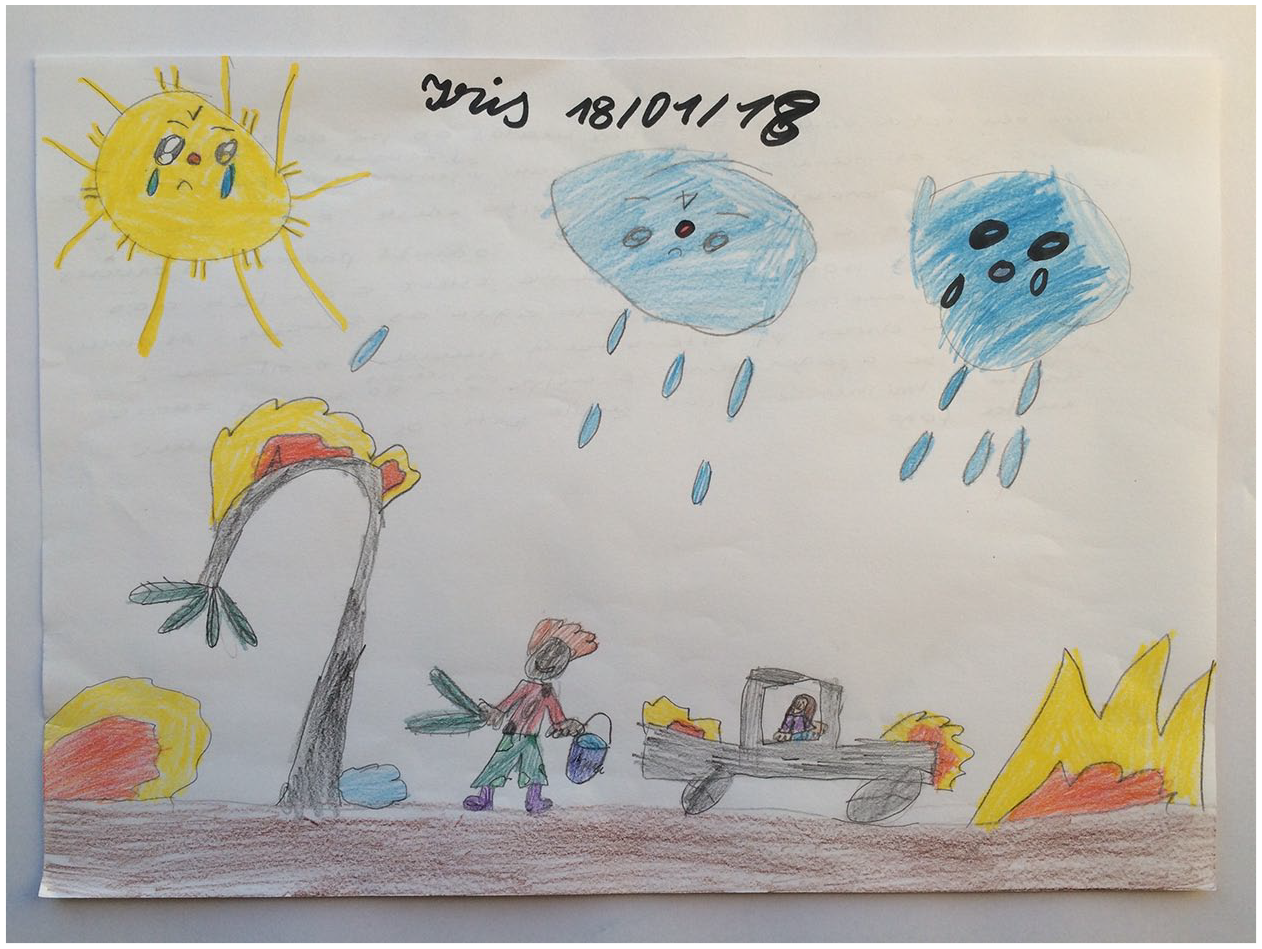
Marta, 7 years old, first year, in the car while her grandfather fights the fire.
Marta’s visual narrative is infused with the emotions she experienced during the event, and the fact that she portrayed herself hiding in the car expresses the fear she felt. The crying clouds and sun mirror the tragedy of the fire. In the drawing it is possible to see sadness in nature in the crying sky, expressing a battle between natural elements such as the sun, clouds, or bending trees; and fire, seen as an unnatural and hostile element.
André, a 9-year-old boy, was with his family, putting out the fire (Figure 2). In the drawing he portrays himself as a full-sized member of the family saying, ‘We must end this!’, together with his mother, father and neighbour, all carrying hoses and agricultural tools. Their faces are black from the smoke. André’s statement reinforces his will to stop wildfires: ‘The fire was very intense and very huge in front of me. I saw many very high flames, and the local people screaming and many flames around me. I felt very sad and went to call the villagers to come and help and I also went to help. The most difficult thing was to put out the fire. What was good was that everyone got out safe. We have to have fire extinguishers at home and hoses and most of all, we should clear the woods’.
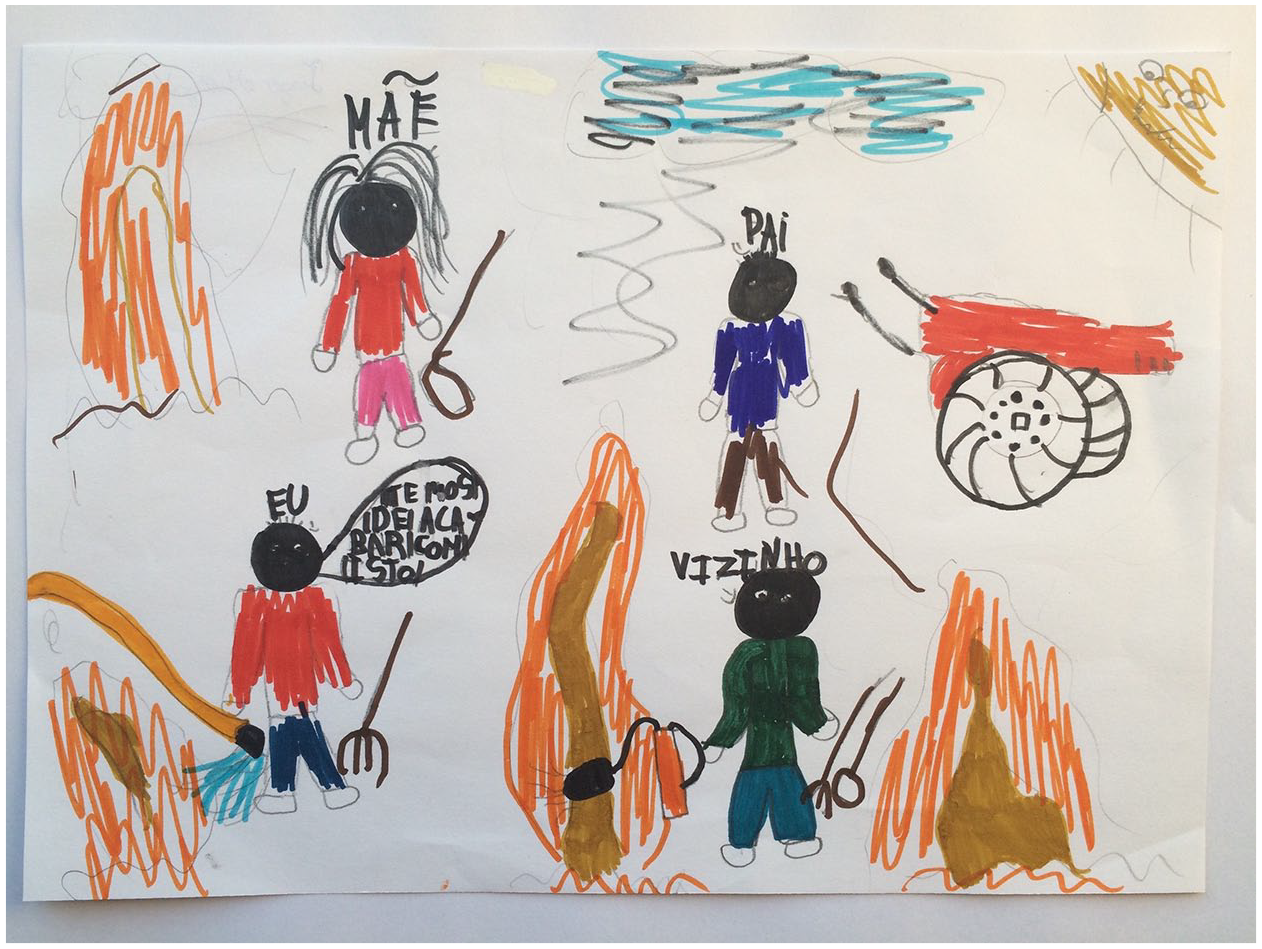
André, 9 years old, fourth year, fighting the fire with his family and neighbours.
The fire was an occasion where André felt at the same level as their adult peers, equally equipped with a hose at hand to fight a common enemy. The centrality of the collective in the drawing, with André and the neighbour in the bottom surrounded by orange flames sees him taking action.
David (aged 8) saw the fire from his window in the centre of the village: ‘On October 15 there was a very large fire. I was at home with my family and we saw a lot of smoke far away, the fire had suddenly reached my village and the flames were very high. I was very scared and frightened, it seemed like hell. From the window of my room, I saw many trees, vegetation, barns with straw for the animals, agricultural machines, and some houses burning fiercely. It looked like a horror movie. The wind was blowing so hard that it spread the flames in all directions. I had never seen a fire like it, and for several days there was a great cloud of smoke that we could not even breathe. What we can do when these things happen is not pollute the environment and not waste things that poor people want and do not have’.
His words reveal great ecological and social awareness, as well as illustrating the embodied consequences of wildfires. In the picture below (Figure 3), a helicopter and a Canadair plane are throwing water onto the flames, the background is filled with smoke clouds and several types of trees are burning, as well as a public illumination tower.
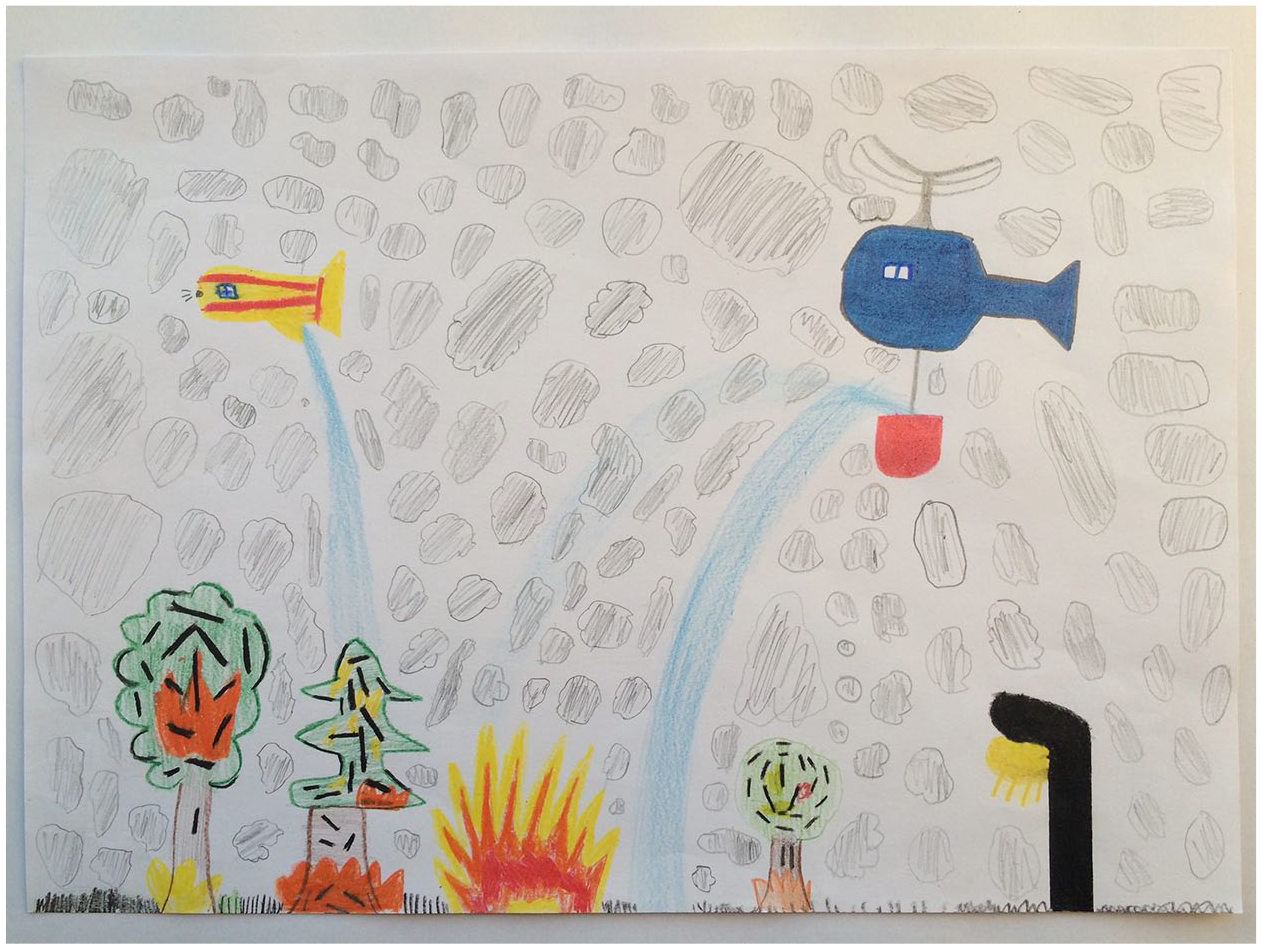
David, 8 years old, third year, views the fire from his window.
João’s take on the event features a firefighting scene (Figure 4). He drew several aeroplanes throwing water onto mountains and flames, while firemen and policeman fight the fire on the ground. He stresses how scared he was: ‘I saw the fire in the mountains, I was afraid, and I went there to see with my father. The fire was huge, and I was afraid. Then I went home, and the fire was in the farm. I saw the haystack burning, I was afraid, and I went home. The fire kept going’.
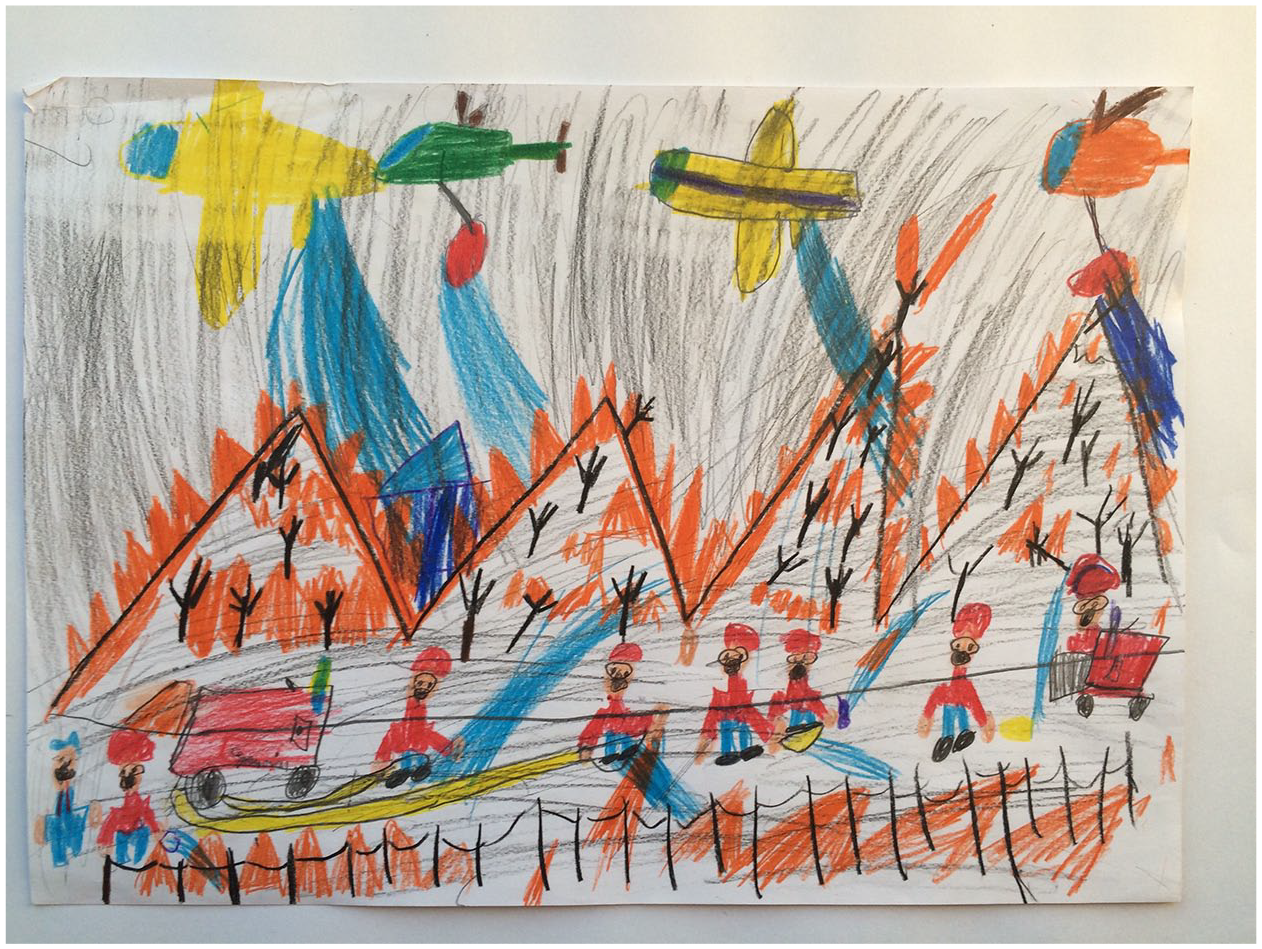
João, 9 years old, second year, portrait of a firefighting scene.
João’s portrait of the fire is dense, leaving no room to breathe in the canvas. The human and technological elements appear small and surrounded by mountains in flames. All firefighters carry mask, and the smoke is also depicted through a greyish black atmosphere. The confusion of the scene represents the complexity of the hazard for a 9-year-old child, who was overwhelmed by it all and went home.
Despite their overall fear and sadness, some children also reported anger and perplexity at the behaviour of adults in this situation. A 10-year-old boy who fought the fire with his father told us: ‘I was surprised that he asked me to help, even the firemen were warning him that it was dangerous!’. Thus, children not only had to deal with strong emotions but suddenly felt as if they had become part of the adult world, playing an active role in saving lives.
Discussion and conclusion
In this study, the sample of drawings provides a substantive way of understanding how the school children made sense of their wildfire experiences and feelings, adjusting to a new environment. The children’s verbal statements during the analysis were helpful in clarifying the context and giving meaning to it from the child’s point of view, mainly showing concern for the safety of self and others. Some reported specific issues such as being present in the area when the fire broke out, joining family members in the firefighting, seeing flames from a distance or close to their own or a relative’s house, seeing agricultural land and machinery burning, or witnessing the damage to the landscape and homes. Most of the children were involved in the situation and expressed their emotions verbally in terms of ‘sadness’ and ‘fear/being scared’, reporting states of anxiety, panic or somatic complaints. One of the children did not express any feelings as she had not been in close contact with the wildfire and had seen the flames via media reports. Facilitated by the drawings, the verbal statements offered insight into the children’s emotional reactions and more support and credibility for our research.
Through the stories narrated in these drawings it can be observed that the children were well aware of their personal process of experiencing the wildfire, capturing a wide range of emotion indicators and witnessing its impact on nature surroundings. Using the ‘draw and write’ strategy children express a relationality that reflects entangled emotions, translated into sad clouds or bent trees, or through the classification of the fire as evil, endowing it with agency. Although it can resemble magical thinking (Subbotsky, 2004) (a belief with no logical foundation that attributes causality and power to inanimate objects), this emotional take on events may encompass a form of caring that is directed towards both humans and non-humans, since the emotions expressed in the drawings are felt by children and natural elements alike. Thus, our study also suggests that, particularly in the case of wildfires, these children see nature as both a threatening and threatened place (Adams and Savahl, 2017); wildfires, which are part of nature and represent a process for renewing ecosystems, can pose a real threat to life for children. However, as Albrecht (2019) postulates, psychoterratic emotions (emotions aroused by negative and positive states affecting the Earth) can be a powerful motivation for ecological action. As these narratives show, for some children the disaster represented a moment of violent growth, in that they were asked to fight for their lives alongside adults. In such situations, managing emotions in disaster response and recovery acquires greater importance not just as a means of preventing trauma but also in order to foster resilience. The acknowledgement of emotions such as hope, fear, anxiety or despair regarding climate change and its consequences can galvanise youth activism, as showed by Martiskainen et al. (2020). Encouraging children to share their stories and works of art is a way of empowering them through proper recognition of their capacity to contribute to disaster risk reduction, and as important elements who can transmit the knowledge they have acquired to their communities and peers.
In line with this approach, our observations emphasize the importance of training children coping skills so that they can manage their emotions during disasters and express them in the aftermath. Specifically, this involves techniques to enable community adults and parents to regulate both their own emotional distress and that of any children involved in the disaster, strategies for informational and emotional support messages targeting children’s appraisals of threats, fostering supportive relationships and helping children to understand their reactions. Providing age-appropriate levels of informational support is essential to delivering a health service response to young people after a natural disaster.
Hence, we consider there is a need to rethink the role of crisis intervention professionals in Portugal, particularly in terms of psychological first aid, by improving skills through crisis intervention training, specifically in the form of intervention models for children that are locally appropriate, culturally sensitive and cost effective (Beja et al., 2018). Professionals need to feel confident and be able to maximize the efficacy of their response in order to overcome the disruption in the functioning of a community caused by disasters, further undermining the child’s sense of security and normalcy. Training in art-based methodologies and interpretation is also important, in order to understand how professionals can help children cope through the use of drawings and other nonverbal artistic expressions. On the other hand, civil protection policies need to recognise and integrate children’s agency into local disaster risk reduction plans, as they have proven to be capable of contributing to disaster mitigation, to the very least by protecting themselves. That their contribution occurred unintendedly should let us wonder what role they could play if listened to and adequately prepared.
Footnotes
Funding
The author(s) disclosed receipt of the following financial support for the research, authorship and/or publication of this article: This work is financed by the Portuguese Foundation for Science and Technology, I.P., within the scope of the UIDP / 50013/2020 project.
