




Abstract
Artbooks, which are a combined form of picture and story book created using mixed media, can be a simple yet powerful way of supporting children affected by war and displacement to tell their stories. They allow children to work through the creative arts, which protects them from being overwhelmed by difficult memories. They also allow, even very young children, to show us how they cope with past violence and present injustice by recalling and representing the small everyday overcomings of their lives – a garden they planted in DRC, a mother who walks them across a busy Johannesburg street, a curtain blowing in the door of their new home – just as it did in their old home. The books allow them to witness to the injustice of xenophobic violence by neighbours and the immoveable bureaucracy attached to accessing documents, through representing the small details of their lives in crayons and paint. Making artbooks also allows for some measure of meaning-making in the chaos of the everyday in a hostile city where their parents struggle to maintain a normal life for them. Books are also a powerful way for children to safely share their stories and advocate for changed attitudes, laws and policies in the increasingly migrant-hostile South African society.
The article will tell the story of a book-making project run over a number of years at a community counselling centre that works with families on the move in Johannesburg South Africa. It will also describe how some of the children’s books have become a powerful advocacy tool through their inclusion in the digital library of the African Storybook project. The article will explore some of the practical details of the project and the theory around the power of the representation of the everyday which we are beginning to derive from the work.
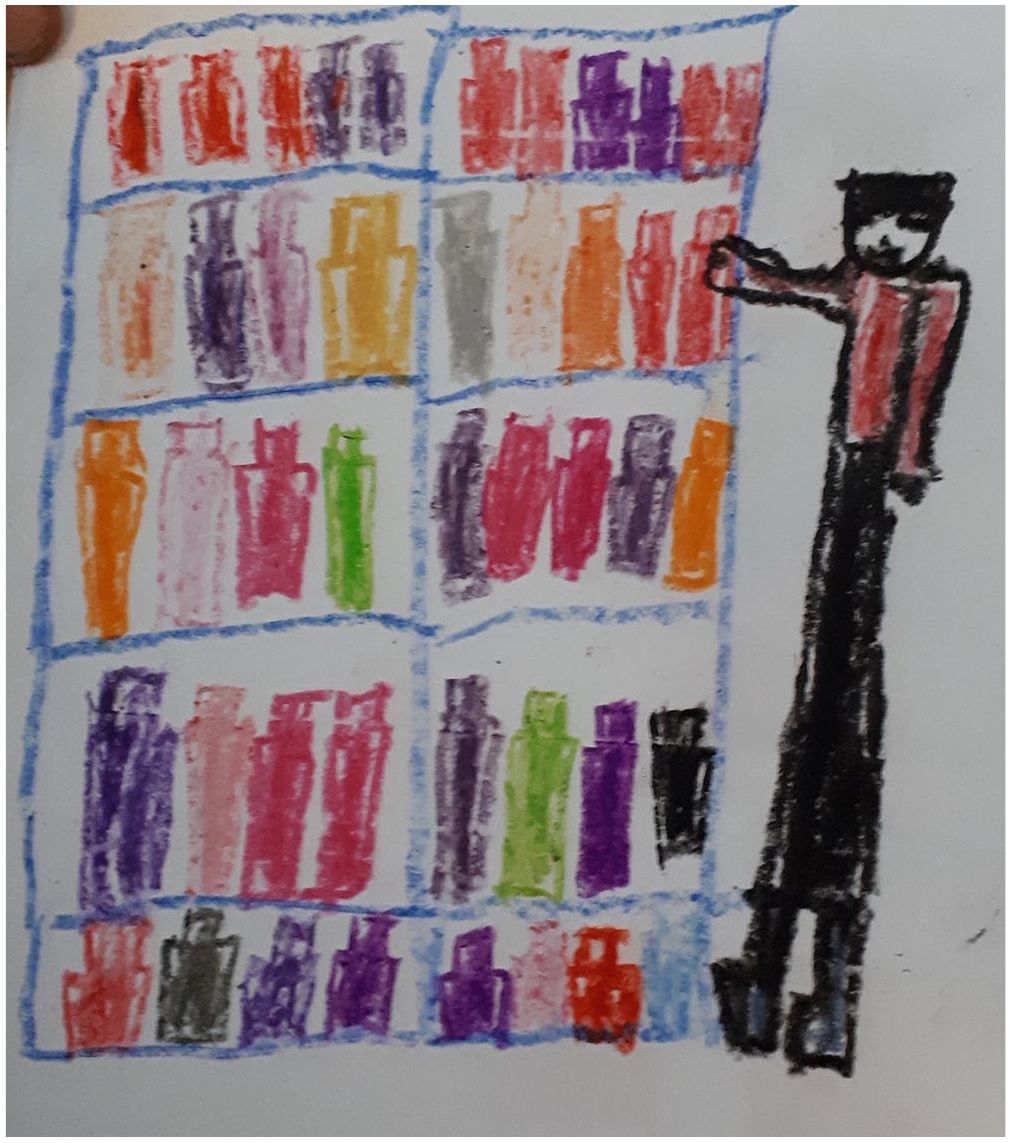
[Artwork 1]
There is a small shop near my house.
The shop owner is a fat man with a thin voice.
It is hot outside.
I go to the fridge.
I get a strawberry Kingsley.
1
I give the fat man my money.
Then I open my Kingsley strawberry and drink.
That cold Kingsley tastes so sweet!
2
Introduction
These are the words of the artbook that Josias made. It is a simple story of a simple, everyday event, but it is also a story of claiming normality and an act of resistance in the face of past and present difficulties. Josias, who is 10 years old, came to Johannesburg with his family in order to escape war in eastern Democratic Republic of Congo in 2019. His mother is a client at the Sophiatown Community Counselling Service in inner city Johannesburg, which is where Josias participated in a 5-day holiday artbook-making project.
This article describes the project and the emerging theory we are building around the use of art for ethical psychosocial support led by lay counsellors for children like Josias. It outlines how the children began to make some meaning of the fear and loss of their past (Kholi and Mather, 2003) through telling simple stories of things, places and people lost or left behind. The article also describes how the making of the books allowed the children to claim the small acts of everyday normality (like the walk to the shop in Josias’s story) in a context of significant everyday stress (Fernando et al., 2010; Miller and Rasmussen, 2010; Newnham et al., 2015). We explore how claiming the normal in both past and present becomes an act of resistance (Lenette 2019; Walker 2015) against the injustices of their lives as foreigners in a deeply xenophobic society where bureacracy actively works to keep them displaced (Amit, 2015; Gandar, 2019; Walker and Vearey, 2019). We also describe how some of the artbooks have become part of the ‘African Storybook’ project, an Africa-wide digital initiative that promotes story writing and reading for over a million children all over Africa.
Picture-story books have been used by a number of support programmes globally as a psychosocial support tool with displaced children. Power (2016) and Minou (2006), Sibley (2010), Johnson (2020), Rousseau et al., (2003) and Mandrona et al., (2019) are some examples of the use of book making with migrant children. The creation of digital libraries, some focussed specifically on migrant children, are also being developed globally. The International Children’s Digital Library is perhaps the best known example http://en.childrenslibrary.org/ but there are others. Druin (2005) describes the development of a children’s digital library ‘for children with children’, Daly and Limbrick, (2020) describe translating books for refugee children into their own languages, Sibley (2010) describes translating and digitising books for Somali refugee children for an education programme in Minnesota. The description of the artbook-making project in Johannesburg, included in this article, will we hope, contribute to this global discussion while also providing an example of an approach to psychosocial support of refugee children that builds on the children’s own agency.
Living in Johannesburg as a refugee
The artbook-making project is run during every winter school holidays for a different group of 20 children of adult clients of the counselling service. Over the years since the project began in 2008 about 120 children and young people ranging in age from 7 to 16 years have participated. Most were refugees from the war in eastern DRC and the economic collapse in Zimbabwe, while a few came from South Africa. Many of the children from DRC had been through traumatic experiences and all of them, wherever they came from, had lost homes, family members and familiar places.
All of the children lived on the edge of the inner city of Johannesburg in an area that was characterised by abandoned, run-down houses and blocks of apartments that often had no electricity or running water. Most of the children lived with their mothers or both parents in single rooms rented from landlords who charged exorbitant rents for a small room (sometimes a shared room with a curtain dividing the room) with a shared kitchen and bathroom (Walker, 2018). The families struggled to pay rent and eviction at the end of the month was a constant threat; often a reality. Parents struggled to find jobs and the meagre amount they made from informal work such as selling vegetables on the street or acting as security guards was often not enough for food and rent. Violent crime and abuse, both verbal and even physical, against foreigners was a daily threat on the streets (Monama and Landau, 2016). This meant that all of the children lived with high levels of everyday stress (Miller and Rasmussen, 2010), which was often made worse by their own and their parent’s anxiety and fear caused by previous war experiences (Miller and Rasmussen, 2010).
None of the families had legal documents, which made them vulnerable to police harassment and endless bureaucratic abuse as they sought to access refugee papers or renew asylum seeker status (Amit, 2015; Gandar, 2019). Their lack of legal status meant they could not access health services and education easily (Walker and Vearey, 2019). For this reason some were not in school. Kistner (2007), a clinical psychologist working with the children and their families at the Sophiatown Community Psychological Service (SCPS), describes their context as a ‘landscape’ of past and present trauma.
Sophiatown Community Psychological Service
The SCPS ‘Families on the Move Programme’ operates from a house on the edge of the Johannesburg inner city where many migrant families live. The programme is directed by a clinical psychologist with the support of social workers, a lawyer and trained lay counsellors. An advocacy component facilitates clients speaking into government and civil society organisations around migrant injustice. While the focus of the programme is on psychological counselling, the lack of services available to families on the move means the staff also provide social services such as helping families access schooling, documentation and health services.
The psychological aspect of the service works through individual, family and group counselling. After screening, the women (and a few men) who come to the centre begin with individual counselling and after some time they join a support group. Children also receive individual counselling if needed but most often they participate through regular holiday projects, family counselling and focussed support groups for particular needs. The artbook-making process described here has been run as a holiday project since 2008.
Impact of war and displacement
The development of the artbook-making process was informed by three points of theory. Firstly, the knowledge that the impact of war and the displacement it brings make children vulnerable emotionally (Masten and Narayan, 2012; O’Kane, 2015; Reed et al., 2012). Second, an awareness that intersecting characteristics such as previous life experience, family, gender, context and levels of violence experienced (Pells and Morrow, 2018) affect the impact of war and displacement on children. We acknowledge that children are not all impacted equally, some children need more support than others, some children are able to process what has happened to them easily, others need more gentle care over a long time. The final point of theory is the acknowledgement that children are not traumatised and passive victims, but also agents of their own wellbeing. This focus on agency is part of what James and Prout (1990) call an ‘emergent paradigm for the study of childhood’ (p. 2). One of the characteristics of this way of thinking is that ‘. . . children must be seen as actively involved in the construction of their own social lives, the lives of those around them and the societies in which they live’ (p. 2). In the context of children affected by war (Boyden, 2003; Boyden and De Berry, 2004; Denov and Akesson, 2017; Kohli and Mather, 2003; Vindevogel and Verelst, 2020) researchers emphasise the need for psychosocial support programmes that take into account child agency by working ‘towards the affirmation of [children’s] strengths, personal agency, motivation and sense of mastery to identify and utilize what can help them towards a positive transition in the post-migration context’ (Vindevogel and Verelst, 2020 p. 59).
Given these three theoretical perspectives we chose to use an approach that focussed on helping the children to ‘make meaning’ of what had happened to them (Finnström, 2008; Lester, 2013) rather than the more traditional ‘healing’ approach which often defines children as victims (Bracken et al., 1994). Making meaning suggests agency. From this perspective children’s coping strategies (both socially acceptable and ‘unacceptable’) can be viewed as evidence of power and not pathology. This article highlights just one of the ways in which the ‘meaning-making’ approach we employed can help children to claim their agency through the description of everyday acts of resistance and coping.
It is important to make the point that the children were not part of an ongoing support group when they joined the artbook-making holiday project. It was vital, therefore, that the process we followed should not break down the carefully constructed coping strategies they had set up to survive their hard everyday reality (Mann, 2010). With this in mind, we looked to the creative arts because of the evidence that suggests that creative arts approaches provide emotional protection. Alongside this, the resources of the counselling service were available if facilitators of the art-book workshops needed to refer particular children who needed further help psychologically.
Art-making as protective
Though the project was not art therapy directly but rather a psychosocial support programme we built on the work of art therapy theorists such as Buk (2009) and Johnson (1987) in our choice of a creative arts approach. Buk and Johnson suggest that the creative arts give children a sense of control over negative emotions linked to past and present experiences. If children are working with drawing and painting, for example, ‘Instead of the discussion of a feeling, one has a discussion of a picture of a feeling, a less threatening situation . . . because the picture is concrete and external to the self’ (Johnson, 1987: 11). This protective approach was what we were looking for. Previous work with refugee children (Clacherty, 2019) led us to use a particular mixed-media visual art approach with a range of art materials. The use of a variety of art materials was inspired by the work of community artist Diane Welvering (Clacherty and Welvering, 2006).
I offer the children a wide range of art-making options so they can “lose themselves” in the process. At an important point – where I feel creativity works at its optimum – the children no longer feel self-conscious, and dialogue in close relation to the materials at hand, absorbed in the free-flowing dynamic of their own ideas. (pers. comm.)
Using many different tactile art materials also facilitates ‘the synthesis of the sensorimotor and perceptual realms’ (Buk, 2009: 62), allowing children to work at both a physiological and psychological level. In this way Buk suggests that ‘the bodily and life-affirming activities of the artist making art can remediate the feelings of helplessness, passivity, and annihilation experienced during trauma’.
Having decided we would use a mixed-media visual art process we developed an art-making approach built around the creation of picture-story books. This art form was chosen deliberately. The predictable step-by-step, page-by-page construction of a picture-story book was a form that would provide protective structure but also space for the children to express themselves as they reflected on their lives.
Artbook-making project
We chose to use the term ‘artbook’ to describe the books the children made as they were not simple ‘picture’ books or ‘story’ books but a mixture of the two. The artwork was not a simple illustration of the story as in a ‘picture’ book, sometimes the words ‘came’ from the picture and sometimes the picture came from the story. We also felt that using the word ‘art’ described the important role of the mixed media approach that was used to evoke experience.
We ran the artbook-making project once a year during the winter school holidays for groups of about 15–20 children in the SCPS retreat house, which has big rooms and a garden to play in. Some of the children, especially those who attended school spoke English, the others spoke a number of different languages including French, Swahili and Lingala. At least one facilitator spoke each of these languages so we made sure children were in a group with a facilitator who spoke their language. These facilitators also translated the English which we used in the large group discussions.
The core of the work with the children was built around reading carefully chosen published picture-story books, followed by step-by-step writing and illustrating of their own books. ‘Getting to know you’ games and energisers were all built around the idea of story and the lay counsellors used storytelling practices from their own multiple language cultures to create an environment where ‘storytelling is fun and something we all do all the time’. At no time were children pressured to produce a product but supported through the week to each make an art-book that they could choose to read aloud (with much celebration) to their caregivers who attended the last day of the workshop. We introduced the storybooks by suggesting that ‘We are going to be writers and illustrators this week’. We have found that this approach allows adolescents to happily engage with the process of reading, writing and illustrating picture books.
Beginning by reading storybooks
Over the first 2 days of the workshop we read a number of different published books which included stories about a walk down a city street, a journey in a bus, a grandmother and objects that bring back memories. The published stories were chosen to resonate with the children’s own experiences. If they chose to they could explore the journey that they had made, loved ones they had left behind or objects that evoked happy or difficult memories. Equally, if they chose not to they could explore each of these topics in a simple non-threatening way. For example, in response to the story of a boy walking down a city street a girl of 6 told the story of how her mother met her after school every day.
Every day my mother comes to fetch me after school.
I feel happy when mummy comes.
We cross the street with many cars.
My mother says, “Look right, look left, look right again.”
In response to the same published story of the boy walking down a city street, a 16 year old boy told the story of a house. It was his family home in DRC where armed men entered, killed his father in front of him and burned the house. In amongst the drawings of the burning house he drew a small, heart-breaking detail, his father’s spectacles which fell to the floor as he was murdered.
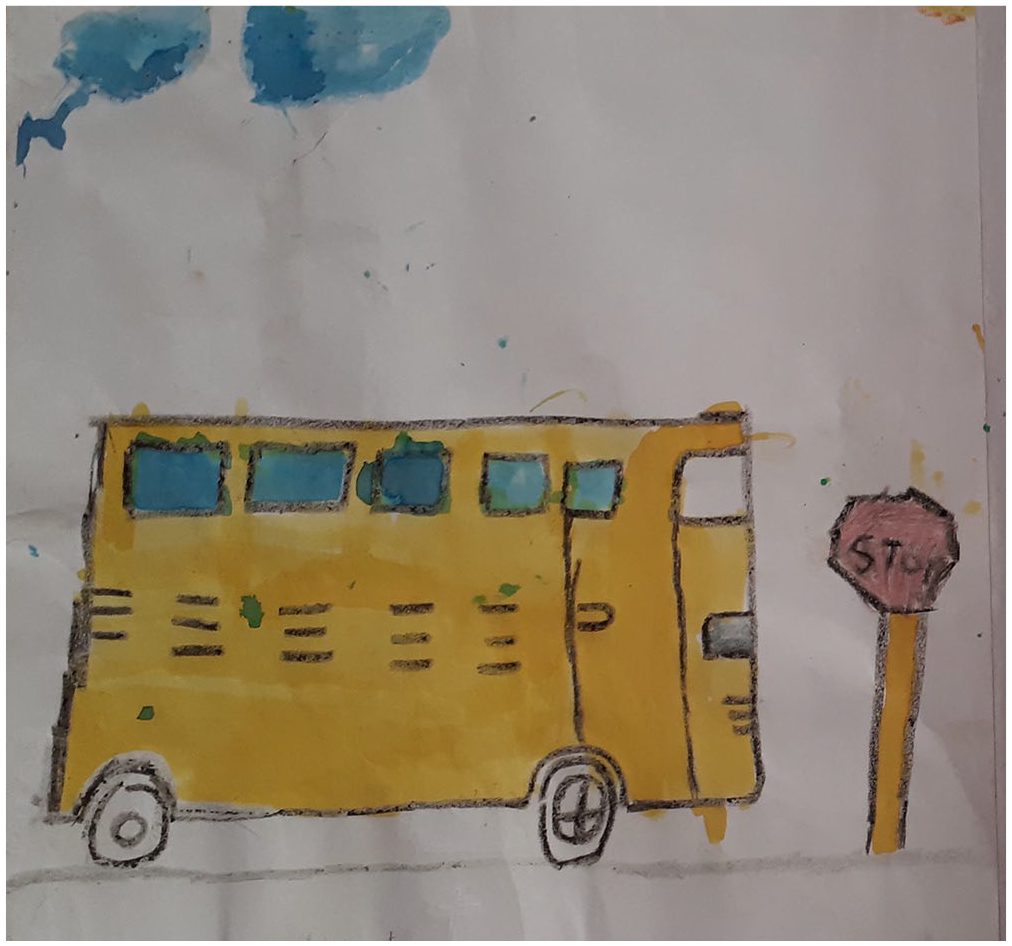
In another example, the reading of the published story of the bus evoked for 11-year-old Praise, the deep longing to go home.
[Artwork 2]
This is a yellow bus.
I am inside this bus.
I am going back to my country Congo, DRC.
I wish we can go back to my country.
My mother says she doesn’t.
She says, “We’ll go next time.”
This makes me sad.
By contrast, for 12-year old Peniel, the reading of the same published story about the bus evoked the story of a simple trip to the zoo.
This is my family in the bus going to the zoo.
There was my aunty, my mother, my brother, my two sisters (who always dress the same) and Me!
These stories illustrate the ability of the process to allow children to tell, often untold, stories of simple everyday events and also to make meaning of difficult experiences and emotions.
Making a personal picture storybook or artbook
After the reading of each published story (with play and meals in between) the children worked in small groups of five, each with a trained lay counsellor, to make an artwork about their own lives that had been evoked by the story they had just heard. By the beginning of Day Three the children had produced a number of artworks about their lives. They then chose one that they wanted to turn into a picture book. Giving them the choice allowed them to decide how deep or difficult the story would be for them to tell. We were relying on their own sense of self-protection in this process (Kohli, 2006).
The counsellor invited each child on their own to tell the story that was represented in the picture they had chosen. As they spoke the counsellor wrote it down exactly as the children said it. We have learned over the years to use this spoken story telling approach rather than asking those who can write to write their story as the spoken word allows for an ease of telling that captures deeper layers of meaning. Many of the children told their story easily; others needed prompting questions. These prompts were designed to add detail and texture to the story and not to probe a child’s life experiences or inner narrative. We worked in the language the child was most familiar with (which was either English, Lingala or French). Overnight, the counsellors typed and printed out each story as a page-by-page book, keeping the language as close as possible to what the child had said. This process allowed the children to see their work promoted to a picture-book style on the fourth day, which elevated the story for them and built their engagement with the rest of the process. They then illustrated each page of their picture-story book using an art medium of their choice.
Making meaning
There are many ways in which we have seen children and young people ‘make meaning’ out of aspects of their lives through their work on a picture-story or artbook. A common theme in many of the stories over the years has been memories of landscape.
We used to live in a house in Zambia.
It had big trees. I was 8 years old.
We played hide and seek in the trees.
There was a very tall tree. My brother climbed up and so did I.
This is a happy memory.
Often the children, as in Christelle’s story below, contrasted the landscape of the present with the past.
3
This house is in Congo. I like this house. We had our own toilet and we had our own bathroom.
We had a garden. I was planting my own garden.
My mother told me her mother is teaching her to plant and then she was teaching me.
I plant tomatoes and spinach, I did it alone.
I would take tomatoes to my mother and she would say “Thank you”.
We left that house and now we have no garden here in South Africa.
Over time we have come to understand these ‘recallings’ in a similar way to those described by Ring (2006) in her work with displaced women in Karachi. Ring describes how the women in their talk together described the ‘sanity [and] . . . peace’ (p. 182) of the past. Our sense is that recalling the everyday of the past gave the children an opportunity to remind themselves that their lives were normal once, that they existed beyond the chaos of war and migration and the precarity of the refugee.
Often, though, the stories the children told do not recall ‘the sanity and peace’ of the past but, rather, what is lost. There are hints of this in Christelle’s story and the story of the yellow bus but it is perfectly expressed by 12-year-old Norbert in his story ‘Dreaming of New York’.
My father was good at telling jokes and playing cards.
He used to take me to the park near my house and I still remember how we used to laugh at his funny jokes and we played ‘Five Cards’.
When I lie in bed at night I think that maybe he is still sitting under the tree in that park. I feel sad. I feel angry.
Then I close my eyes and dream I am going to New York to see the Statue of Liberty. I dream that I am very rich and powerful. I am a big business man and I can stop bad things happening. I can stop my father suffering. I can stop my father dying.
But I know I can’t.
Though deeply sad, Norbert’s story is also an example of meaning-making, he is acknowledging reality and his inability to control it. It is, however, not a victim story. Norbert has a strategy for dealing with his sadness, dreaming of New York!
Artbooks as an act of resistance
The above stories show not only the making of meaning through acknowledging loss and reality but they also bring to the surface the ways that children cope, the normalcy they can create even in a displaced environment. All of the stories describe the children’s agency. We understand this claiming of agency, similar to the way Lenette (2019) in her work on art-based methods, in research with refugees describes taking photographs as ‘acts of resistance’.
There are at least two levels at which the stories express themselves as acts of resistance. The first is in the narrating of the normal. We have come to see the small stories of the everyday such as the story from Josias that we quoted at the beginning of this article, or Mary’s story of her mother meeting her after school, as ‘acts of resistance’. This understanding is based on Walker (2015) who worked with women caught up in the ongoing war in Sri Lanka. She explores how grief, pain and trauma are resisted through the normalcy of small daily tasks and actions. Through the planting of trees, fishing, cooking and sewing, men and women resist and create small, safe spaces as they continue with their lives. Walker is not suggesting that violence has become so ‘everyday’ that people do not need supporting. Rather, her work shows that the women and men she worked with were deeply affected but, as an alternative to the PTSD model, their trauma and frailty were woven together with resilience, even a quiet resistance to those who created the trauma. Walker explores how involvement in simple activity, ritual and group interaction supports this everyday creation of resilience. In the artbook project we have begun to understand the small stories of everyday life in the same way – as celebrations of normalcy, as acts of resistance in ‘a landscape of trauma’. The stories claim that ‘I am a child who walks to the shop to buy sweet juice on a hot day, who crosses the road while her mother holds her hand, who plays hide and seek and catches a bus to go to the zoo, I am not merely a refugee’.
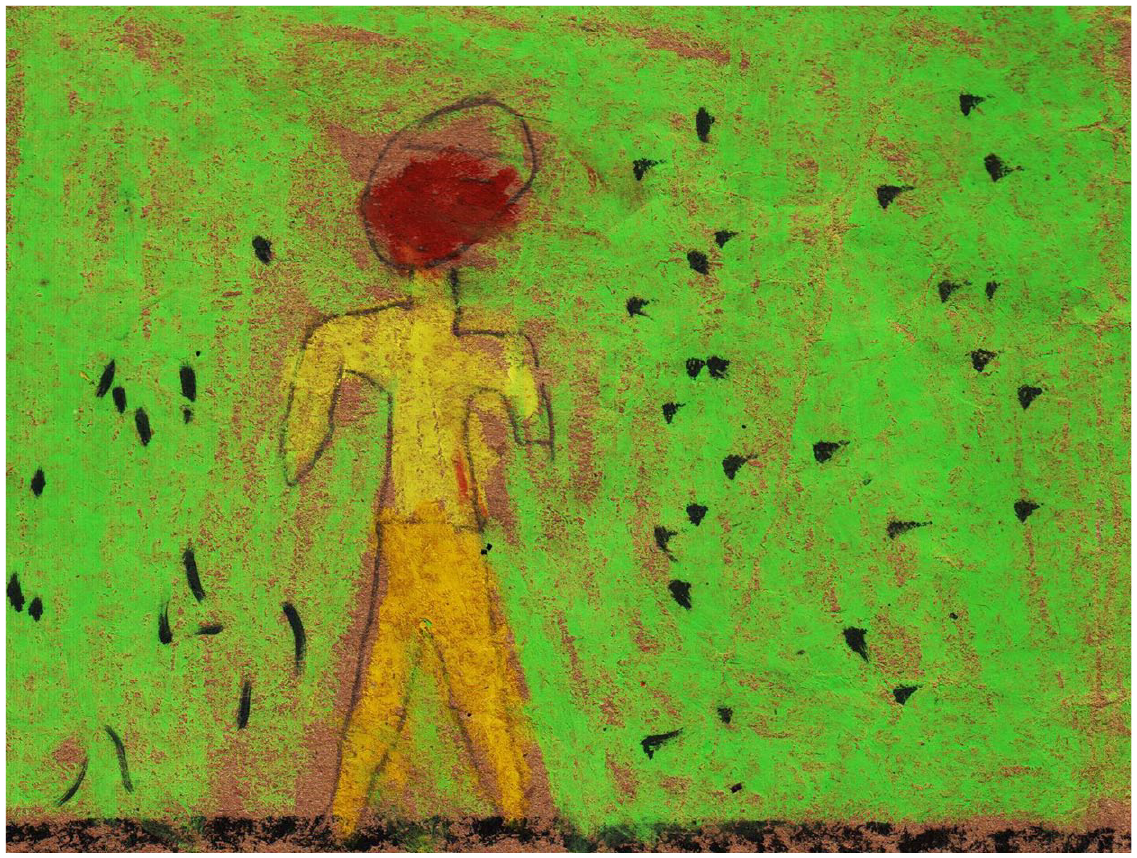
The second level of resistance we see is an explicit one. Children and young people describe what they do, the action they take to resist being overwhelmed by loss or fear. We have read how Norbert, dreams of New York when he is sad but one of the best examples of children describing how they cope is Ally’s book.
[Artwork 3]
I’m Ally. I am 11 years old. I was born in DRC but now I live in Jo’burg. I left my home when I was 5 years old.
I left my grandmother and grandfather behind.
Some days I am sad when I think about my grandfather who passed away. You can be sad about people you don’t even know.
Some days I feel so sad because I think about my grandfather. I never knew him and I feel so sad because I never knew him. I have a picture of my grandmother and grandfather and me when I was small.
When I am always sad I lie down on the grass and I look at the stars in the night. The grass is in the garden at my step-grandmother’s house. I feel better when I go and do that. I just lie there and feel better.
When Pedro is sad he asks his dad for money and goes to the cinema and watches funny movies. Ephraim dances, Lillian goes on her own far from other people, Grace reads and goes to another world. Helena sings church songs, Michel sings gospel . . .
. . . but I lie on the grass and look at the stars.
The artbooks are meaning-making because the children use them to describe and reinforce for themselves how they live with their loss and displacement. What we see in these stories resonates with Jackson (1995) who in his exploration of home suggests that part of what helps people to feel ‘at home in the world’ no matter where they are is the ability to control the everyday objects we use and activities we do. The artbooks make concrete that control.
Invoking the Moral Third
The artbooks go beyond merely making control concrete for the children and young people. They also speak to those of us outside of their experience, asking us to listen in the way that Bragin (2019) suggests that all children who are affected by violence caused by structural injustice ask us to listen. In helping us understand why this listening is necessary Bragin uses the work of Benjamin (2016, 2017) who describes a concept he calls ‘The Moral Third’. This is the space between the child and the healer or facilitator or counsellor where we acknowledge our ‘common humanity’. The artbooks the children and young people made were created in a space where the children invoke the Moral Third; they remind us how they are just like us, living out the same everyday actions as we do. They remind us of the simple normality they wish for and the way this has been shattered by war and political conflict and they ask us to witness and act to repair.
It is the job of child and adolescent therapists and of society itself to acknowledge the historic and present wrongs and to set things right. Through their memories of individual loved and lawful childhoods, however difficult, these youngsters call for a world in which that which was broken can be repaired. (Bragin, 2019: 208)
One of the best examples of invoking the Moral Third, which is a reminder of the structural injustice behind the young people’s sadness and how they used the books as an act of resistance, is the book created by 16-year-old Ephraim.
Some days I wake up and I feel as if there is darkness all around me.
The darkness comes when I think about how my brother walked out of the door and got attacked during the xenophobic violence.
The darkness comes when I think about our financial problems at home.
The darkness comes when I think about my brother who is in Cape Town and far away – I worry what is happening to him now.
The darkness comes when I think that there is maybe no future for me. . .
I greet my family at breakfast . . .
It is hard to greet them with the darkness on my back.
I walk out the door and along the road to school . . .
It is hard to walk with this darkness on my back.
I sit in my desk and try to concentrate . . .
It is hard to concentrate with this darkness on my back. . .
Then I begin to think about my dancing . . .
I hum a song and my fingers begin to dance and the darkness clears . . . a little bit.
I stand in the playground and my friends call me to play . . .
But it is hard to play with the darkness on your back!
I walk home with my sister who sings a song . . .
It’s hard to join in with the darkness on my back.
Then I throw my school bag down, fetch my radio from the top of the cupboard and turn it on . . .
I jive, I dip, I jump, I glide, I bump, I dance and dance and dance!
And the darkness flies away!!!
Conclusion
What Ephraim’s and the other stories do is allow us to ‘apprehend’ the children and young people as real people, ‘people just like us’ which Butler (2009) suggests counters the anonymity created by the statistics and faceless images of the displaced that frequent the media. For Butler, this apprehension of the lived-experience of children and families on the move is the foundation for what Bragin would call acting against injustice through ‘witnessing’ and ‘repair’ from within our sense of our ‘common humanity’ (p. 208)
In 2019 the artbook holiday project was presented with a powerful mechanism for bearing witness, by apprehending real children through their stories. The ‘African Storybook’ project, 4 an Africa-wide open access digital reading project that has 1410 storybooks in 209 languages worked with us to place 10 of the books on to their digital platform. The books have been translated into Kiswahili, Lingala, French, isiZulu and Sesotho. The children and young people were able to share their common humanity with the 48,303 educators and 1,145,226 5 children who accessed storybooks via African Storybook. The artbook-making project of the Sophiatown Community Psychological Services illustrates how the creative arts can be used to help displaced children make meaning of past and present difficult experiences in a nuanced way that takes into account different levels of vulnerability. Using the creative arts allows children and young people to demonstrate their agency in powerful ways that capture the depth of their lived experience. By claiming the normality in their everyday lives through the creative arts they remind us of our common humanity and in this way demand a response from us against the structural violence that they live within.
Footnotes
Acknowledgements
This article is dedicated to the memory of Tessa Welch the founder of African Storybook; she delighted in children’s stories and was a true activist against all injustice.
The 2019 artbook-making holiday project was funded by The African Storybook Project through the Google Foundation
Sophiatown Community Psychological Services supported the work of the artbook project from 2008 to 2019 as part of their therapeutic work
Funding
The author(s) received no financial support for the research, authorship and/or publication of this article.
