



Abstract
My article considers German wartime propaganda and pedagogy from 1914 to 1916, which influenced young schoolchildren (aged 5–14) to create drawings and paintings of Germany’s military in World War I. In this art, the children drew bodies of German soldiers as tough, heroic, on the move, armed with powerful weapons, and part of a superior military movement; their enemies (French, Russian, British soldiers) embodied disorder, backwardness, ineptitude, and deadly weakness. The artwork by these schoolchildren thus reveals the intense propaganda of the war years, and the children’s tendency to see the German military as the most accomplished combatant in the war. During the first two years of the war, in the primary schools of the nation, many children did such art under the supervision of teachers who passionately embraced the nation and the war cause. Within the classroom, teachers directed students to imagine the war by drawing scenes of battles, including the sinking of the Lusitania. Some of these teachers had been influenced by the Kunsterziehungsbewegung (the arts’ education movement) and thus encouraged children’s creativity in art of the war years. In this pedagogical wartime environment the young student became actively engaged in creative learning and study about the war, expressing romantic ideas of the indomitable German soldier and sailor. My research has involved analysis of over 250 school drawings done by children aged 10–14 in a school in Wilhelmsburg, near Hamburg, in 1915. I analyze the depiction of the German forces in six of these sources and also consider the history of art instruction in German schools. Furthermore, I address the ways in which historians can analyze children’s art as a historical document for understanding the child’s experience.
Keywords
In Imperial Germany the family became a central part of nation-building and of nationalism. It was the chrysalis of future generations, able to nurture productive sons and marriageable daughters, and it fostered early notions of citizenship and thus national consciousness (Nipperdey, 1990: 43; Weber-Kellermann, 1974: 102–118). By the time of the 1914 Great War, as it was then called, the family on the home front was carried along on a tide of nationalistic propaganda and its children were directed by experts to become a part of the war effort to save Germany (Matthias, 1915). German children’s art during the war reflects this widespread nationalism and pitched war fever. These children—aristocratic, bourgeois and working class—were serenaded daily by government wartime propaganda that encouraged faith in Germany’s ability to win the war and emerge supreme in Europe. School teachers, among the most ecstatic supporters of the national cause, inserted the war into daily lessons of literature, geography, history, and math (Geißler, 2013: 233–234); some teachers also introduced art lessons with wartime themes. In these classes boys and girls created drawings of Germany’s soldiers, sailors, nurses, and the new wartime technology, celebrating the war as exciting and winnable. The children drew bodies of German soldiers as tough, heroic, on the move, armed with powerful weapons, and part of a superior military movement; their enemies (French, Russian and British soldiers and sailors) embodied disorder, backwardness, ineptitude, and deadly weakness. The artwork by these schoolchildren reveals the intense propaganda of the war years and the children’s tendency to see the German military as the most accomplished combatant in the war. It also shows the children’s desire to be part of the fighting forces. Implicit here too were ideas of Germany’s cultural and moral supremacy.
During the first two years of the war, in the primary schools of the nation, many children between the ages of 5 and 14 produced such art under the supervision of reform-minded teachers who embraced the nation and the war cause. Within the classroom, art teachers directed students to imagine the war by drawing scenes of battles and hospitals, or by making postcards and models. Some of these teachers had been influenced by the arts’ education movement or Kunsterziehungsbewegung, which encouraged children’s natural creativity in art. Their young students became passionate supporters of the German cause, expressing romantic ideas of the indomitable German soldier, although this was an image at complete odds with the reality of the actual pain, suffering and trauma of the front-line fighter. The crisis children faced in 1914 was not that of despair over wartime brutality or of possible defeat, collapse and death—in comparison, for example, to children’s art of the Spanish Civil War or of the Holocaust (Geist and Carroll, 2002; Stargardt, 1998); rather, they believed the crisis was Germany’s encirclement by hostile enemies, which meant that the nation’s army had to respond forcefully to defend German civilization. The children’s art I will examine, then, shows the impact of the government’s drumming up of support for the German troops during the war years. The years 1914 to 1916 are my primary focus because the children’s artwork that forms the basis for my research originated during this time period; furthermore, the effects of war pedagogy diminished after 1916 with the loss of teachers sent to the front lines, the closure of schools, student absenteeism for reasons of work or illness, and growing classroom fatigue about the war (Scholz and Berdelmann, 2016). My research has involved analysis of over 250 school drawings done by children aged 10–14 in a school in Wilhelmsburg, near Hamburg, in 1914 and 1915 (Kay, 2019). I will analyze the heroic depiction of the German soldier and of German technology in these sources and also consider the history of art instruction in German schools.
War and the German child
Children’s lives in Germany were fundamentally transformed by the war that began on August 1st, 1914. As historians Stambolis (2014: 12) and Donson (2010: 223–225) have argued, the war was a decisive turning point for German youth. Millions of fathers, brothers, cousins, and uncles left for the war within the first year, cheered on by their family members but also fearfully missed. Meanwhile, mothers took charge of family life and as the war went on some became workers in factories and on farms. After the first year of the war, when the expected victory did not happen and when the men did not return home, children witnessed their mothers struggling with illness, exhaustion, worry, and depression (Whalen, 1984: 77–78). Some of these children were placed with other relatives while their mothers worked outside the home, often a difficult experience for girls and boys. The number of orphans increased dramatically (Stambolis, 2014: 71). School life was affected too, as beloved teachers signed up for the army and were then replaced by older and less engaging instructors. By 1916–1918 deaths of loved ones and the scarcity of food and fuel because of the British blockade created great hardship, and the glamour of war surely faded (Cox, 2019; Davis, 2000: 2, 41–42, 90). Upwards of 600,000 children lost their fathers and grappled with the absence of male authority figures through the breathless years of the Weimar Republic (Stambolis, 2014: 43; 106–108).
Despite these tough conditions there is plenty of evidence to show that German boys and girls were thrilled by what they saw as the adventure of the war and that many continued to support the war cause until the very end of hostilities in 1918 (Donson, 2010: 198). This is not surprising considering the onslaught of propaganda these children encountered on a daily basis, at home, at church, in school, and on the streets. As Demm (2001) notes, the wartime propaganda had a specific goal: “to teach children to have unshakable trust in the heroism of the army and the principled wisdom of the High Command,” while stressing to children “that we are not in this world in order to be happy, but to do our duty” (p. 63). The schoolroom was transformed by the war, with teachers decorating classrooms with images of military leaders, models of tanks and aircraft, and maps showing the combat zones. They taught lessons based upon war themes and added school activities that included collecting metal and foodstuffs for the war cause (Demm, 2001; Donson, 2010: 67–90 and 109–113; Kay, 2014). Assemblies were held for wartime celebrations, where songs, speeches, and poems proclaimed Germany’s invincibility. Children’s books and wartime toys—nurse dolls, toy soldiers—allowed for strong emotional connections with a romantic notion of war, far removed from the reality of the war’s carnage and slaughter (Hoffmann, 1997; Zunino, 2019). Within the first year of the conflict, youth celebrated the eastern victories of the German forces under Paul von Hindenburg, who became one of the most popular leaders of the war. Klaus Mann, son of the novelist Thomas Mann, was nine when the war broke out. He recalled the fervor of the war in his 1932 autobiography: What did we notice in the meantime of the war? In the afternoon you went to the nearest corner to read the daily report. Two thousand prisoners captured on the Eastern front, a triumphal advance in the West: there were always only victories. The great victories were something akin to high holidays. When Hindenburg performed that colossal feat in the Masurian swamps, the children were as excited as on Christmas Eve. . . (quoted in Wildt, 2009: 25).
Sebastian Haffner stresses in his memoirs that as a boy of seven in 1914 he saw the war as a marvelous and exciting game between nations (Wildt, 2009: 26–27). Historian Wildt (2009) thus notes that children did not appreciate the sheer destructiveness of the war on a human scale: “The pain and death of war and the lacerated, mutilated bodies entered the world of children and adolescents only as the unreal stories of adults” (p. 25). As Klaus Mann argued: “We were certainly aware that many brave men “fell” every day and that this was the reason that our parents almost always looked so serious. But were we capable of somehow realizing the monstrous process of this “falling”? We could comprehend the fact of daily mass death only as a completely distant and celebratory awareness. If we were honest, the physical pains of our dog Bauschan were of more concern to us” (quoted in Wildt, 2009: 25).
The arts education movement
When the war broke out in 1914, German education was in a state of flux. Child educators in early 20th-century Germany were split into two main camps of traditional disciplinarians and progressive child advocates (Kay, 2010; Stambolis, 2014). This was the era of generational conflict—of the Youth Movement or Wandervogel—which extolled nature and embraced ideas of independence, the spiritual regeneration of German society, and the superiority of youth. New authors on child-rearing urged parents to dispense with physical punishment and to allow their children to develop freely, respecting and nurturing the child’s inherent or natural qualities. When Key (1909) wrote The Century of the Child (released in Sweden in 1900 and then Germany in 1902), she attacked child experts who viewed children as bad creatures, needing reform and excessive discipline; as she put it, such experts “continue to educate as if they still believed in the natural depravity of man, in original sin, which may be bridled, tamed, and suppressed” and who worked “to suppress the real personality of the child, and to supplant it with another personality (pp. 107–108).” “Even men of modern times,” she pointed out, “still follow in education the old rule of medicine, that evil must be driven out by evil. . . (Key, 1909: 107).” This evil was corporal punishment—which Key equated to torture. Her attack on prevailing notions by so-called experts of the day, including pedagogues and doctors, found support in Germany, where her book had many readers. For Key the solution to the dilemma of raising children was to allow each child to develop naturally, without force or deception, and to give the child respect and consideration just as one would another adult. The child’s inherent characteristics were to be allowed free expression, as long as they did not injure another person or the child herself.
We can see these emerging ideas in the arts education reform movement, called the Kunsterziehungsbewegung. This pedagogical approach to art was part of the new wave of German education at the fin-de-siècle and it was centered in the cities of Hamburg, Leipzig, Dresden, Berlin, Darmstadt, and Jena (Kerbs, 2001: 378–397). German art education had changed dramatically over the course of a century. In the early 1800s educators considered drawing a luxury for children and not an essential part of instruction. A much different approach emerged with the pioneering work of Pestalozzi and Fröbel, who encouraged children’s drawings of geometric shapes and daily play with balls and blocks, as a means of developing skill, intellect and personality. Children’s art as a serious subject was further taken up in a posthumous publication of 1848 by the Swiss romantic artist and educator Rudolphe Töpffer, who defined children’s artistic creativity as expressing “an elemental beauty” of imagination and expression (Fineberg, 2006: 203; Töpffer, 1848). In 1887 the Italian writer Corrado Ricci became one of the first authors to systematically study children’s art, in his work The Art of the Child (Fineberg, 2006: 205; Kerbs, 2001: 381; Ricci, 1887). Finally, toward the end of the century efforts by a variety of German educational reformers, including Alfred Lichtwark, the director of the Hamburg Kunsthalle, helped guide educators’ attention to the arts. Allied with the teachers’ reform movement in Hamburg and a passionate advocate of arts education named Carl Götze, Lichtwark wrote “Art in the School” in 1887, urging art instruction for the young. The next year he helped organize an exhibition in the Kunsthalle of children’s art, entitled “The Child as Artist” (Götze, 1898; Lichtwark, 1917 [1887]). Lichtwark and Götze invited researchers from around the world to send in children’s artworks and this resulted in art submissions not only from Germany but also from Britain, Japan, Belgium, Russia, Peru, Brazil, Greenland, and America (Götze, 1898: 31–34.) A California teacher, Mrs. Maitland, gave 1570 drawings of human figures, flowers and animals, created by children aged 5–7 (Götze, 1898: 6). Several years later, in 1901, Carl Götze organized a conference on arts education for teachers, held in Dresden; others followed in Weimar and Hamburg. In these conferences new ideas about free drawing for children became a rallying cry for reform of the traditional art class, where children’s creativity was stifled by rote lessons of copying objects and images (Kerbs, 2001: 382).
The art reform movement in Hamburg inspired and promoted a modern approach to teaching art and also made appeals to understanding children’s psychology or state of being. Indeed, throughout Germany, educational reformers described children’s art as the result of their instinctive, deeply perceptive and essential creativity—what Rothe (1915), art teacher in Vienna, described as the “Urinstinkte” or “primal instincts” of children (p. 9). To many progressive thinkers the child was a blank slate; the powers of imagination, or what was called “uncorrupted imagination”—considered the wellspring of artistic creativity—was believed to be at the core of the unvarnished child (Kerbs, 2001: 394). Modernist artists like Kandinsky, Műnter, Kirchner, Klee, Picasso, Matisse, Chagal, and Miró believed in such ideas, showing an often intense interest in children’s “primitive art” and seeing the child as the “pre-history” of adulthood, and thus as “a kind of domestic noble savage” (Fineberg, 1999: 6, 11). Furthermore, drawing was deemed by art teachers like Kik (1915) and Rothe (1915) as the first and most effective language for many children, allowing them to express a wide range of emotions and thoughts. In such an approach, the child’s feelings and imagination were to be given free expression, and psychologists of the era interested in child development defended the idea of allowing the child to express herself without adult influence. As historian Clive Ashwin has argued: the theorists of the reform movement centered their attention, especially in relation to the very young child, on the child’s developing personality and intellect, accepting from the start that its perception of the world was not the same as that of the adult and that its drawing should not be measured according to the adult criterion of objectively verifiable truth, but in relation to its own private and often highly idiosyncratic view of reality (Ashwin, 1981: 175).
The arts education reform movement was thus inextricably linked to emerging ideas on child development and psychology.
In Prussia, the new drawing classes were introduced to primary and upper schools in 1901 and 1902 and soon spread to other German states. In Munich, teacher and superintendent Georg Kerschensteiner released his 1905 ground-breaking study of hundreds of thousands of children’s drawings, entitled The Development of Drawing Ability (Kerschensteiner, 1905). He urged teachers to encourage children’s study of objects and their development of a confident drawing technique. By the summer of 1914, art teachers in classes throughout the German Reich were adapting the new methods and encouraging children’s practice of free drawing.
Children’s art during the war
The historian who studies children’s lives in Germany during World War I faces difficulties with sources: discovering the “voice” of the child is a challenge. This is true of other eras of history; as Frijhoff (2012) has argued: “children are virtually mute in the sources of history” (p. 11). Boys and girls rarely write about their experiences, and autobiographies of childhood are commonly authored by adults whose memories have been altered by time (Frijhoff, 2012: 17). For the war years there are letters and collections of school essays, and there are school drawings, but few have survived since the war years (many were destroyed in the bombings of World War II or were discarded by teachers) and even then it can be quite hard to determine what a child thought or felt. Admittedly, the emotional life of a child is a complex interplay of influences from such environments as the home, school and the street; as Stephanie Olsen has argued “A child’s emotional development is influenced by any number of agents and experiences, in a constant process of negotiation. This, of course, includes the child’s own capacity to shape her development in concert with or in opposition to these forces” (Olsen, 2019: 2; see also Olsen, 2015). Whether one can talk of a monolithic group of children in the war years is another question, since children’s experiences differed according to age, gender, geography, and class (Stambolis, 2014: 29). Despite these limitations, children’s art during the war offers the historian an opportunity to gain a sense of what some children may have been experiencing and feeling on the home front. In their art children “reinvent” ideas, personal experiences, cultural values, and social conditions (Ivashkevich, 2006: 57). According to art historian Ivashkevich (2006) their artwork becomes “an artefact of lived experience” (pp. 56–57). Other specialists on children’s art have argued that children’s drawings express several intense desires, including their demand to be in control and to be seen as grown up (Thomas and Silk, 1990: 64–65). The war drawings encapsulate such desires and also show an attempt to make order out of the dramatic world of 1914–1916. My work on children’s art has been made possible by books from the war years, with illustrations and photographs of school drawings of the time, and by a remarkable collection of hundreds of school drawings from 1915 that survived the war; these drawings were done by students of a Wilhelmsburg Volksschule and were discovered in an attic of the original school building in the 1980s (Kik, 1915; Museum Elbinsel-Wilhelmsburg, 1915; Rothe, 1915; Zentralinstitut für Erziehung und Unterricht, 1915).
This collection of wartime children’s drawings from the Hamburg area originated in Wilhelmsburg Schule 3 (today a Waldorf school); the students were boys and girls in classes “II” and “IV” between the ages of 10 and 14, born between the years 1902 and 1906 (Drygas, 2015: 10–12). They were students in a Volksschule, a primary school that was free and obligatory for all children over the ages of 5. The area of the school lay in a section of expansion for the Hamburg docks and industry; thus, the children were likely of working-class background. In this school Prussian values of order, obedience, hard work, godliness, and loyalty to the Kaiser and the state prevailed. A school flag contains the words “Religion, Virtue, Hard Work—with God for the Emperor and the Empire” (Drygas, 2015: 10–12). In the Schule III classroom drawings of 1915, numbering more than 250 works, the children explored four main subjects: the battles on land, on water, and in the air, and the care provided by nurses in war hospitals. Weapons such as cannons, bombs, machine guns, airplane bombers, submarines, and Zeppelins are featured, but one also sees bayonets and horses. There are no scenes of gassings, although some of the drawings show trenches and barbed wire. Also missing are graves or cemeteries. The drawings do not appear to lament the deaths of the war, but to revel in the victories and accomplishments. It is worth mentioning that Wilhelmsburg was the place of 4500 conscripted soldiers in World War I; of this number, 900 died (Drygas, 2015: 12).
The drawings
I have chosen six drawings to show the influence of wartime propaganda on the Wilhelmsburg children and to explore their imagination and skill in drawing on the theme of war. The art teachers of the era who wrote about German and Austrian children’s wartime art have emphasized that in their classes children were not told specifically what to draw or how to draw (Kik, 1915: 3; Rothe, 1915: 23, 38), but the Wilhelmsburg collection does reveal that the children occasionally drew the same images: German soldiers attacking French soldiers; German submarines attacking British and Russian vessels; German aircraft and Zeppelins bombing French villages; and German hospitals and German nurses caring for soldiers. Whether the children copied from each other or followed a story or report told by the teacher is unclear. The drawings were done on beige or brown paper with colored pencils; occasionally pastels and watercolors were added.
Karl Ahrendt, 12
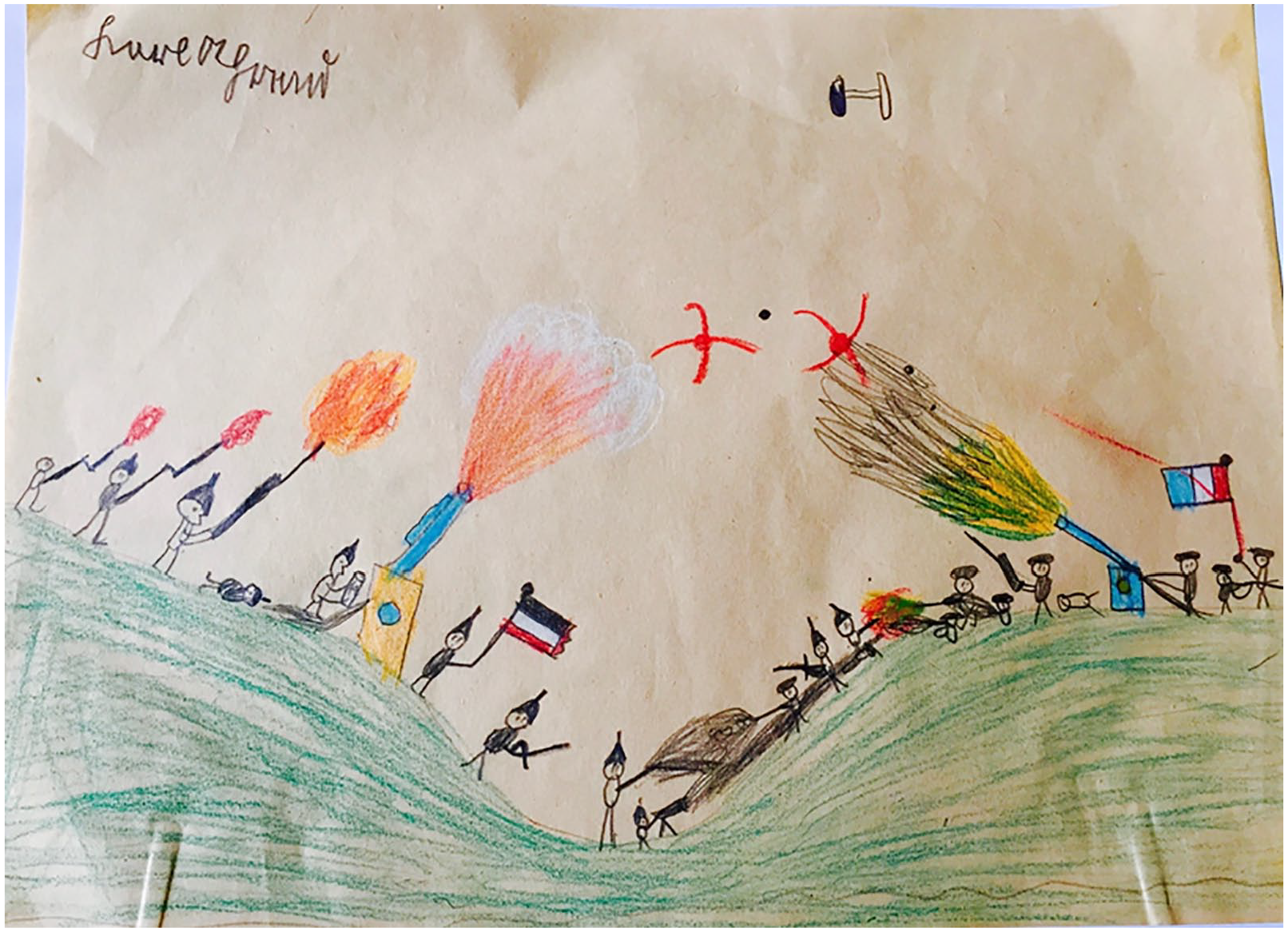
The first example we will consider is a drawing of a German-French encounter of soldiers on a hill. The artist was a 12-year-old boy named Karl Ahrendt and his drawing is unique in terms of the composition of troops on a hill and in a valley. Very few of the other drawings in the Wilhelmsburg collection had a similar setting and with so many figures, although a large number did feature the general subject of German troops fighting French troops.
The drawing shows a group of French troops on the right about to be overwhelmed by the technology (the firepower) and superiority of German troops on the left. Bombs also fall from a German flier above. The two combatant forces hoist flags of their nation, with the flags an extension of the soldiers’ bodies. The boy draws the German soldiers as larger than the French, suggesting their strength and importance. There are 10 German soldiers, one of whom has collapsed on the ground, and nine French soldiers, three of whom are wounded or dead. One French soldier fires his gun the wrong way, standing next to the soldier with the flag. The German soldiers are identified by their Pickelhelm, or spiked helmet. The firepower of the Germans is bright red, sometimes added to with yellow and white; in contrast, the French firepower is green and yellow, evolving into black plumes (perhaps meant to express extinguished fire?). The technological force of the Germans is shown by the child as far more lethal. The guns are bigger, extending like a thunderbolt from the arm skyward, while the cannon is massive and much larger than the French cannon. At the center of the work, two German soldiers fire at close range against a French soldier, with the German fire exploding in a huge black burst of lethal force. The smaller figure may be firing a machine gun. There is one German soldier, close to the French forces, whose gun fires the wrong way—perhaps to shoot the French soldier just beneath him—and whose face looks out at us, with the mouth turned down.
What this drawing suggests, at first glance, is the war as a sort of game—to capture the hill. The figures are in movement, surging forward up the hill, firing weapons and cannons, holding flags, dropping bombs. The soldiers themselves are facing death but they continue to press on. Here we see the theme of the war as a battle of movement, harkening back to the 19th-century conception of war fought by troops on horseback and surging lines of attacking infantrymen, and led by heroic figures (Frederick the Great, Blücher, Moltke) who inspired their forces to ecstatic victory (Zunino, 2019: 116–120). Karl Ahrendt does not show one hero in command, however; here the soldiers together act heroically, pushing their side to victory. There is so much energy and action in this one drawing: the child has used his full sense of imagination. We can also see his emotional connection to the subject of war, in the sense of the drawing’s drama and movement. The real war of 1914–1918 was monotonous and horrifying, but the child has not learned of these realities. Instead, war is depicted as a thrilling act of gaining the upper hand, conquering the hill, overcoming the foe. He does not show the French troops in red and blue uniforms (as appeared in other drawings of his class), but he distinguishes them by their flat hats, the kepi (Pignot, 2019: 177). Almost everything about them is smaller—their bodies, their weapons, their cannon. The Germans soldiers are the winners, the superior combatants.
The style of drawing here is rudimentary, with soldiers drawn in circles and lines. The teacher allowed Karl the opportunity to draw freely, without demanding the kind of skill that would delineate specific details of the human figure or the correct anatomical proportions. Creativity flourishes in this work and thus the boy’s glee over the violence and the fighting and the guns and the bombs is evident to the viewer. This drawing celebrates the idea of German dominance of the war. Like Karl Ahrendt, other German children expressed giddy enthusiasm and excitement in drawing war scenes that celebrated the German troops; many art teachers of the era commented specifically on this emotional connection between the child and the war (Dix, 1915: 172–174; Franck, 1915: 125; Göth, 1916: 237; Kolb, 1915: 49; Rothe, 1915: 10, 38).
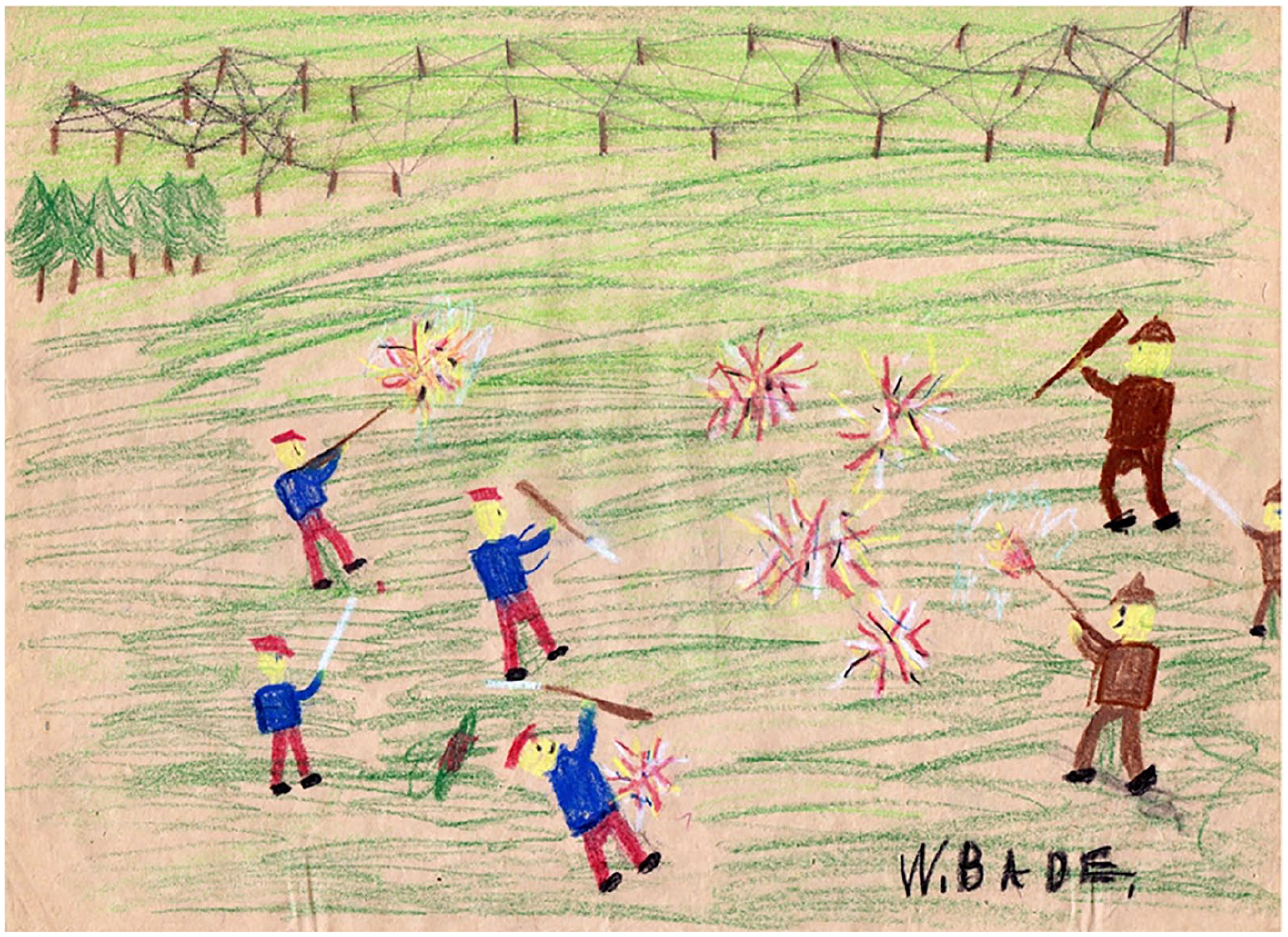
The subject of German superiority over the French is echoed in several other drawings from the Wilhelmsburg collection. Consider the drawing by Wilhelm Bade (age 12) showing hostilities on the western front, next to a section of barbed wire. Here we see French and German troops facing each other, with the French soldiers in blue coats, red pants and hats, collapsing backward, out of formation, and looking comically inexperienced. In contrast, the German soldiers’ bodies press forward, moving with precision and determination, shooting red explosions of firepower. The Germans are outnumbered, but in control. Significantly, the French troops are shooting the wrong way and in one case the gun is turned upside down. Wilhelm Regutzki, also 12, has drawn another scene of German precision versus French disorder; he shows trenches and barbed wire, behind which the Germans are well protected, lying in a close formation of men and guns. They fire at the French forces who are easy targets in their red and blue uniforms.
The sources of such notions of German superiority, heroism and military skill may have been the teachers’ promotion of the war cause, or the widespread euphoria at the start of the war, along with newspapers and broadsheets that celebrated each victory and the military leadership. Comments by parents or other authority figures (such as grandparents, local officials and clergy) would have left a deep impression too. But children’s illustrated books were likely a primary source for the romantic image of soldiers, nurses, military leaders, and wartime battles. In her masterful study of children’s literature before and during the war, Zunino (2019) shows that hundreds of books for young readers extolled soldiers, soldiers’ uniforms, romantic images of battle, stories of caring nurses and brave young girls during wartime, and also showcased amazing examples of technology, such as Zeppelins. During the war years, such books sustained an idealized image of war, swelling in number as print editions went into the tens of thousands (Zunino, 2019: 106–107). What is fascinating, as she reveals, is that the idea of war as a battleground of movement and heroics—referring back to the Prussian war of liberation from Napoleon in 1813, or the glorious victory of the Franco-Prussian war in 1870–71—was
Wilhelm Bade, 12
W. Regutzki, 12
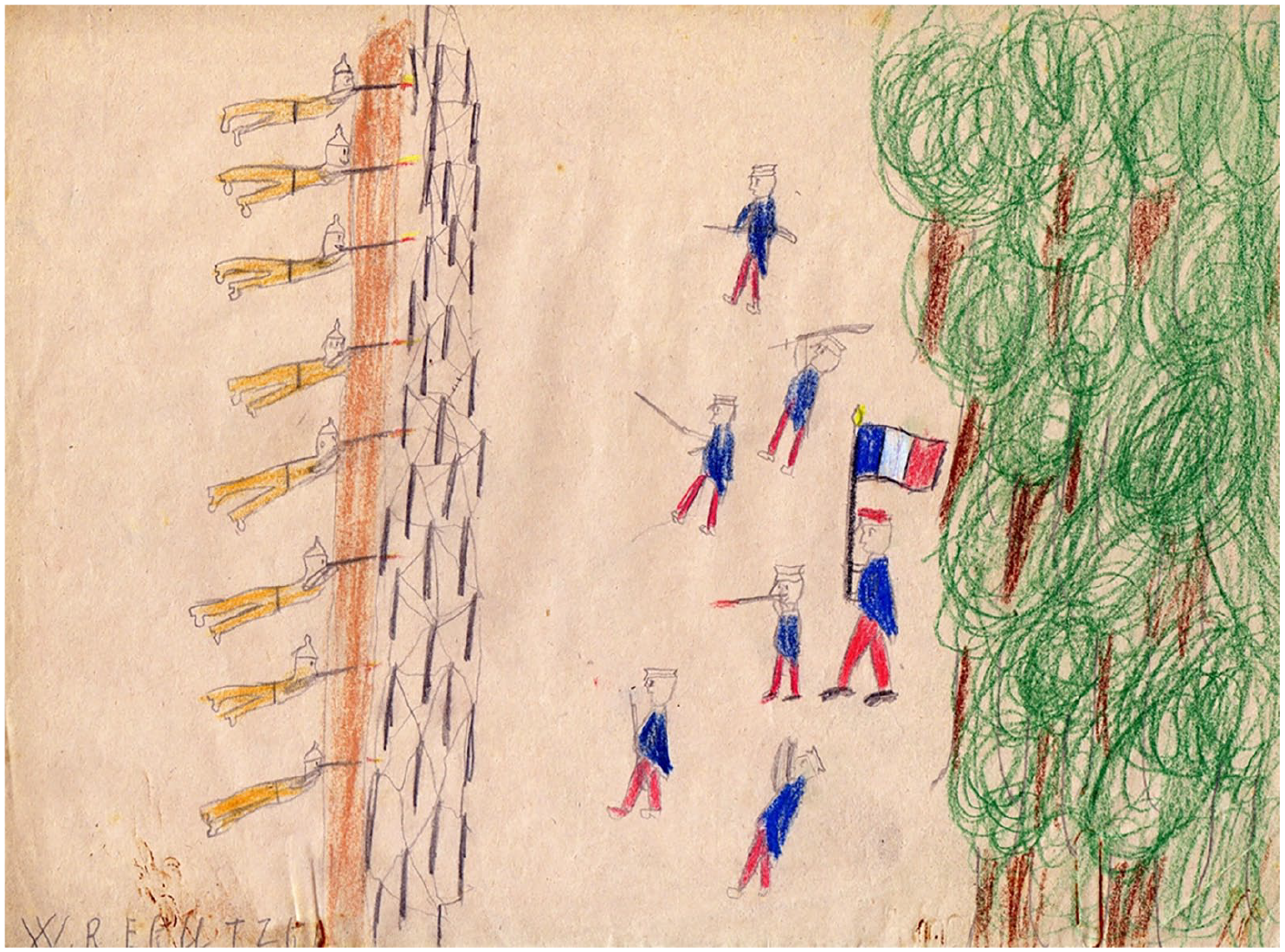
Illustration from Watch on the Rhine, Angelo Jank, 1910 and 1915
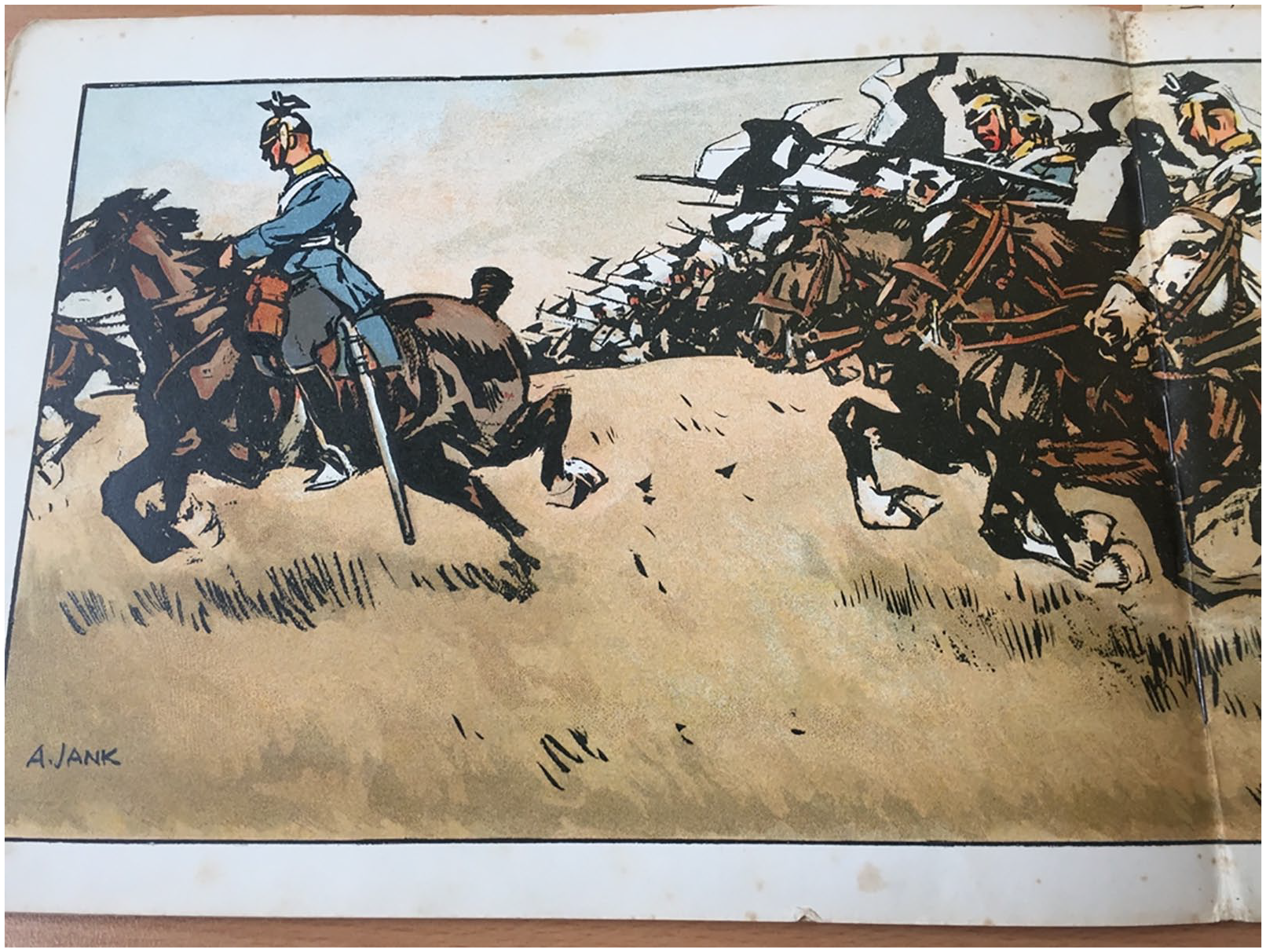
Consider, for example, a popular children’s book of 1910 entitled The Watch on the Rhein, re-released in 1915, and celebrating Prussia’s victory in the Franco-Prussian war of 1870–1871. Illustrated by the artist Angelo Jank (1910/1915; Zunino, 2019: 71) and featuring the verses of the romantic author Wilhelm Hauff (who also wrote the notorious Jud Süss), the book celebrated military struggle and martyrdom. In this work we see chiseled young soldiers running, marching and riding horses into battle. The images celebrate majestic action, freedom and invincibility even as some of the words depict sacrifice and death. War is shown as an adventure, a test of courage, a patriotic struggle. In Imperial Germany, such illustrated children’s literature offered an idealistic image of war, of dynamism, glorification, and sacrifice, dressed up in historical costume. These images attracted and indeed captured children’s attention. As they looked at epic pictures, their emotions would be stirred and the horrible reality of war would remain unknown (Zunino, 2019: 74).
Although the idea of war in most German children’s literature of 1914–1916 harkened back to the glorious wars of the 19th century, many of these books also celebrated the new technology of the 20th century without showing the consequences of their lethal force. Popular children’s books on air and sea wars featured the Zeppelin, for example, and children often drew Zeppelins in their classroom art. Like the Zeppelin, the German submarine galvanized children’s attention, and the boys and girls who drew the U-Boat attacking British and Russian ships made reference to famous exploits by German subs before 1916. Two drawings from the Wilhelmsburg collection address the sinking of the Lusitania by the U-20 in 1915 and the exploits of the U9 in 1914.
I. Möller, 12
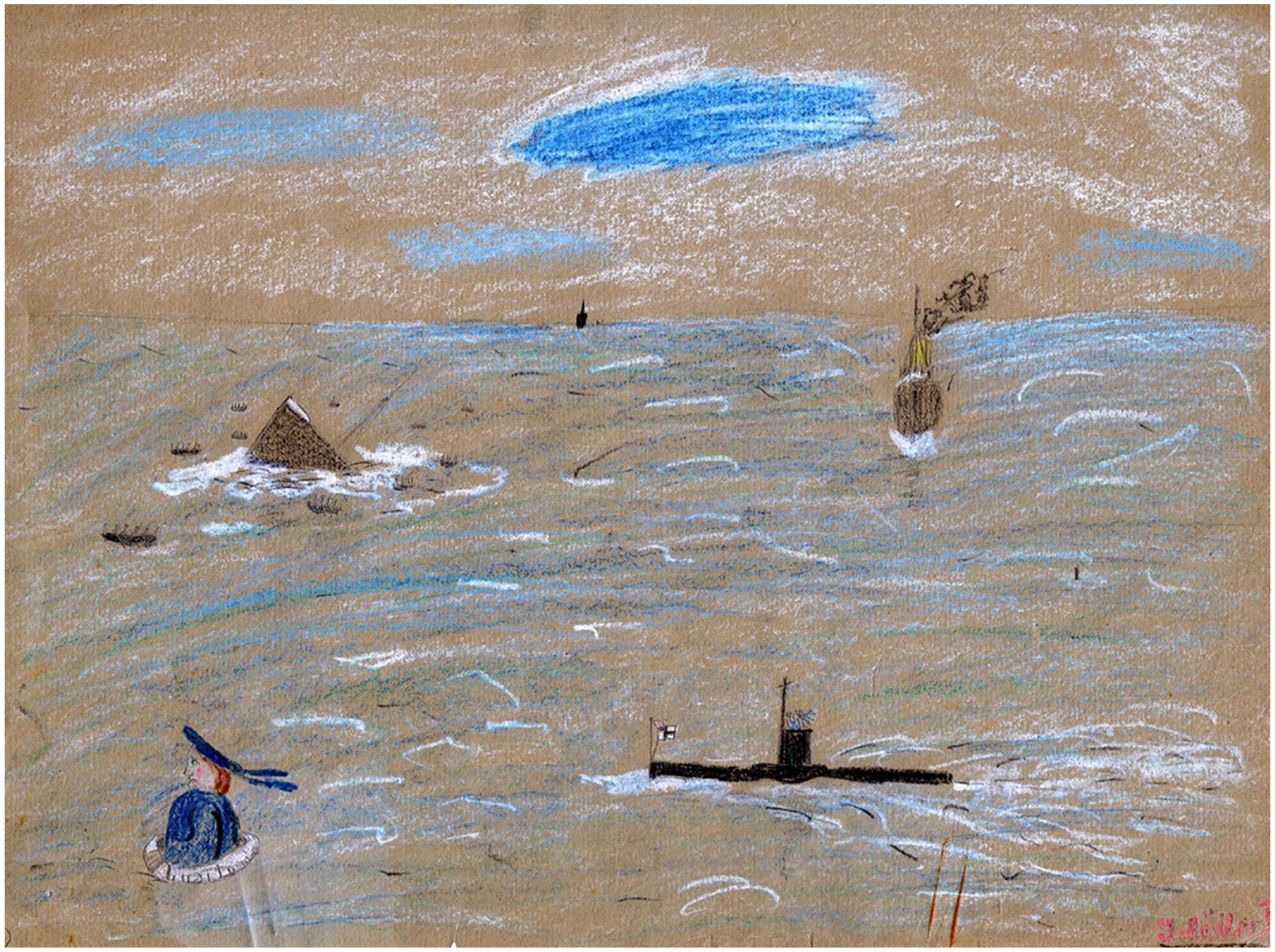
This drawing, done on brown paper with colored pencils, is of the torpedoing of the Lusitania on May 7, 1915 by the German submarine U-20. The artist who drew it was named I. Möller and was 12 years old. We do not know whether Möller was a girl or boy. The image shows the German submarine in the lower right of the drawing; we see the German flag and what could be the head of a German sailor emerging from the tower. The sub is sleek, dark (black) and only partially visible in the water. A short distance away, the remains of the Lusitania—the ship’s bow—reveal the sinking vessel. White caps of water form a circle around the doomed ship, as 10 lifeboats of sailors has ten away. At the lower left of the drawing we see a British sailor dressed in blue and bobbing in the water in a life preserver, with the words “Lusitania” in black letters. Two other large warships are shown in the water, one a long distance away, the other approaching. Their identities are not clear.
Several ideas emerge from this work. Firstly, the child is clearly referencing one of the most significant events of the war. The British sailor in the life preserver is proportionally larger than all other images in the work, and one can assume the child wanted the viewer to see the words Lusitania. In the German press, the sinking of the Lusitania was welcomed as a great victory, the argument being that illegal weapons were on board the passenger liner, destined for Britain (Jasper, 2016: 6, 92–93). From the British, French, Canadian, and American perspectives, the German attack was barbaric, destroying innocent civilians and providing further evidence of Germany’s use of aggression and terror in the war. In this artwork, the child’s embrace of wartime propaganda is evident: what we see is the German submarine’s decisive and effective power. It is no longer the British who rule the seas, it is the Germans. There is no sense of the real tragedy that occurred from the sinking of the Lusitania, when 1,197 innocent civilians died, including children (Jasper, 2016: 6). Instead the theme of the superiority of German technology commands the drawing, and the images show the lethal force that could be wielded by the U20 against the mighty British. The scene is one of dramatic excitement—a powerful submarine, a torpedoed ship, sailors in lifeboats escaping from the sinking ship—but without any sense of the immense and horrifying destruction that actually occurred in a matter of minutes.
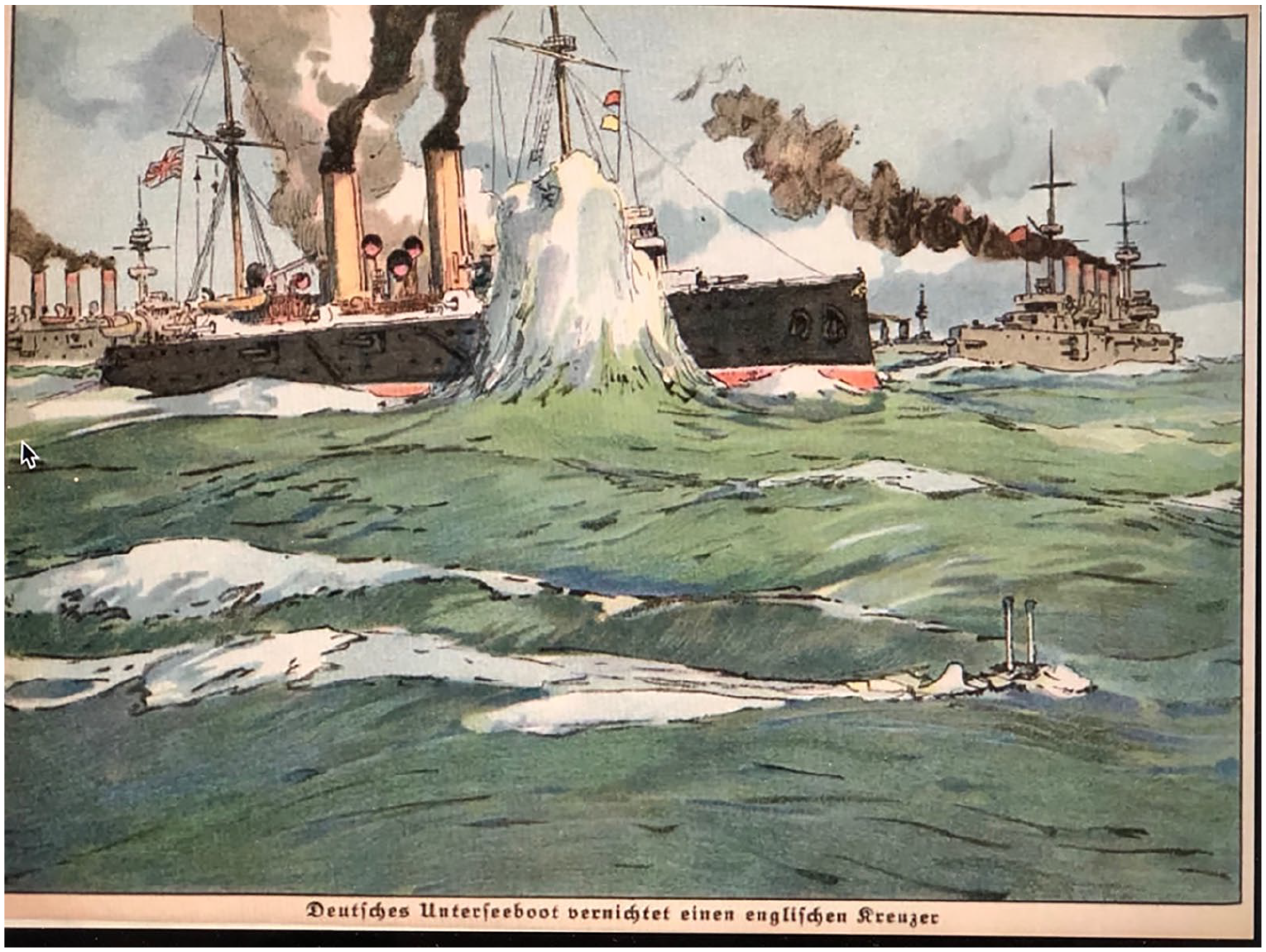
Notably, Germany’s popular children’s war literature of 1914–1916 often featured sea battles, including the book The Great War (Anker and Möller, 1915). Even before the war began, books by Willy Stöwer were dedicated to the fledgling German navy, stoking children’s nationalistic fervor and curiosity about the big ships. During the war, in stories of sea battles, submarines were introduced and their commanders celebrated as great heroes, such as in Stöwer’s German Submarine Attacks (Stöwer, 1916; Zunino, 2019: 138). There was even a coloring book on this theme: The War at Sea: A Coloring Book for German Youth (Gleich, 1915; Zunino, 2019: 138). The U9 and its “martyred” commandant, Otto Weddigen, were enormously popular. On September 22, 1914 the U9, under the command of Weddigen, sunk three English cruisers: HMS Aboukir, Hogue and Cressy (Sondhaus, 2014: 118). Weddigen later died in March 1915 under attack from a British Dreadnought off the coast of Scotland. His story was celebrated in German culture as one of supreme victory for the German forces and of personal sacrifice for the Fatherland.
Several drawings in the Wilhelmsburg collection feature German submarines destroying British and Russian boats. Another artwork by Möller specifically mentions the U9—with the title “U9 bei der Arbeit” (the U9 at work) in the lower left corner. The submarine can be seen in the lower right corner, with the designation U9 written in red. We watch another dramatic scene in action: a torpedo has been launched against one of the British cruisers, and there are explosions of yellow and black nearby the doomed vessel. A lifeboat of four sailors begins to move away from the ship. The scene we are witnessing is the “before” image of the imminent destruction, as though the child is excited by the prospect that the torpedo will hits its mark and do its worst. Did Möller see an illustration from the marine coloring book of 1915 on the same subject? Did he/she color this page and then build an imaginative image from this? Or did the teacher suggest the subject? We do not know, but the artwork certainly extols the U9 and its triumphs.
The last drawing we will consider was the creation of a 13-year-old girl named Irma Danker. In the writings of wartime drawing teachers like Kik it was argued, quite emphatically, that boys drew war scenes and girls focused on images of nurses caring for soldiers (: 3–4). He made the case for boys being better artists than girls, as boys were supposedly more talented at drawing forms and utilizing detail, while girls—who had a good color sense—tended to cram too many objects into the picture or get lost in the decorative details (Kik, 1915: 3–4). He argued as well that boys were inherently excited by violent battles (Kik, 1915: 8). In these accounts we see the adult projection of what is suitable material for boys and girls to draw during wartime, based upon prescribed gender roles in Imperial Germany. One does not see such gender distinctions in the Wilhelmsburg III collection of drawings, however. Girls drew war scenes just as frequently as the boys did, with skill and detail, and the drawing by Irma D. is a perfect example.
The artist here has filled her page with colorful depictions of soldiers, flags, Zeppelins, cannons, and even a horse. A vibrant green covers the ground, while strokes of luminous blue delineate the top of the sky; the Zeppelin is gray and yellow, decorated by two German flags, and the soldiers’ uniforms appear in red and blue, brown and black. The horse is a dappled brown and white. Notably, Irma does not shy away from showing crimson red blood dripping from the head of a French soldier, whose body begins to collapse after being hit by a black bomb from the Zeppelin. The scene in general shows us three German soldiers, wearing Pickelhelm, who have defeated two French soldiers in their garish uniforms. One of these soldiers holds up a green and yellow flag of surrender. The Zeppelin dominates the sky, sending bombs onto the soldiers below. Meanwhile, cannons spew red and yellow firepower into the sky.
The Great War, Hanns Anker and Marx Möller, 1915
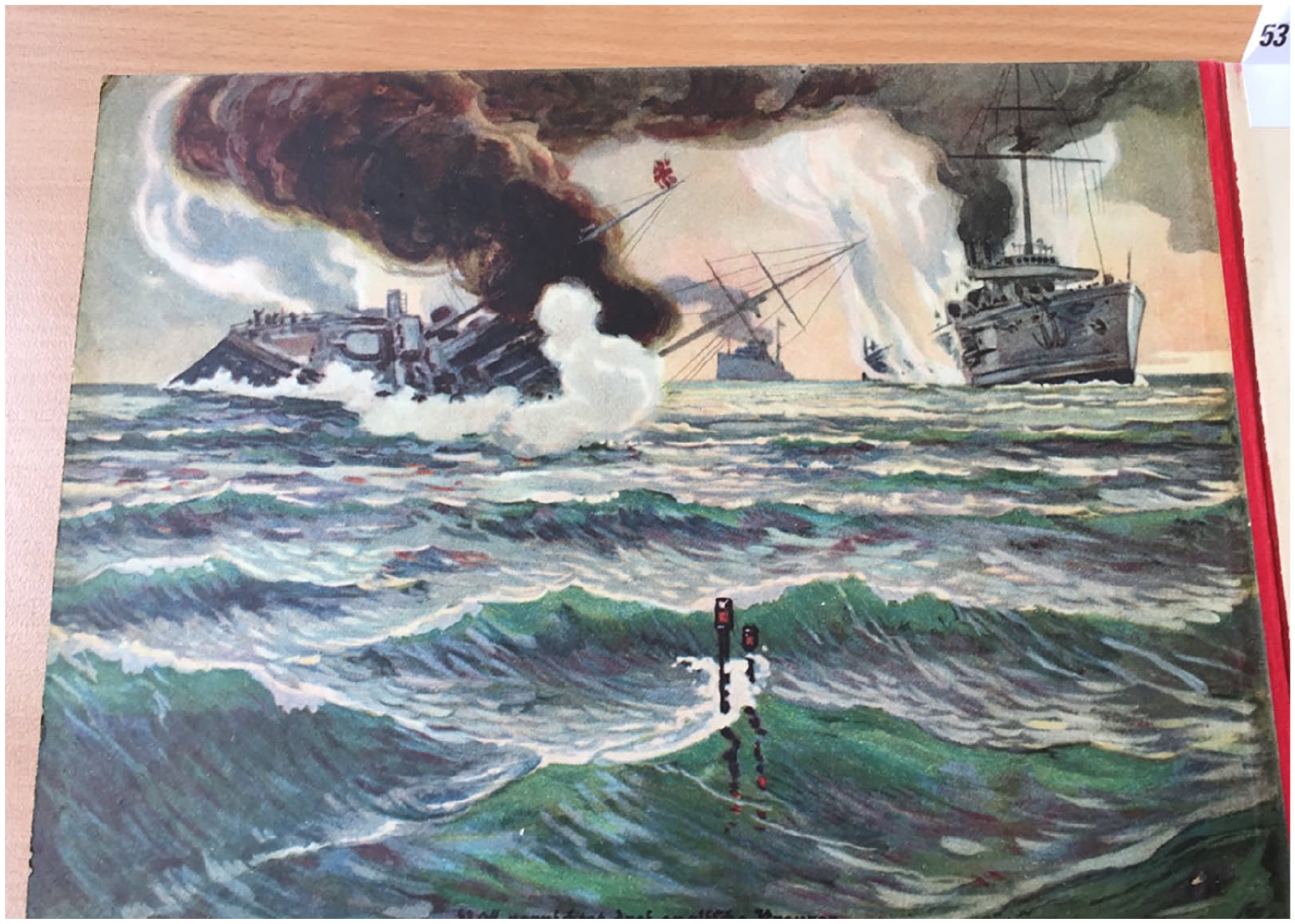
I.Möller, 12
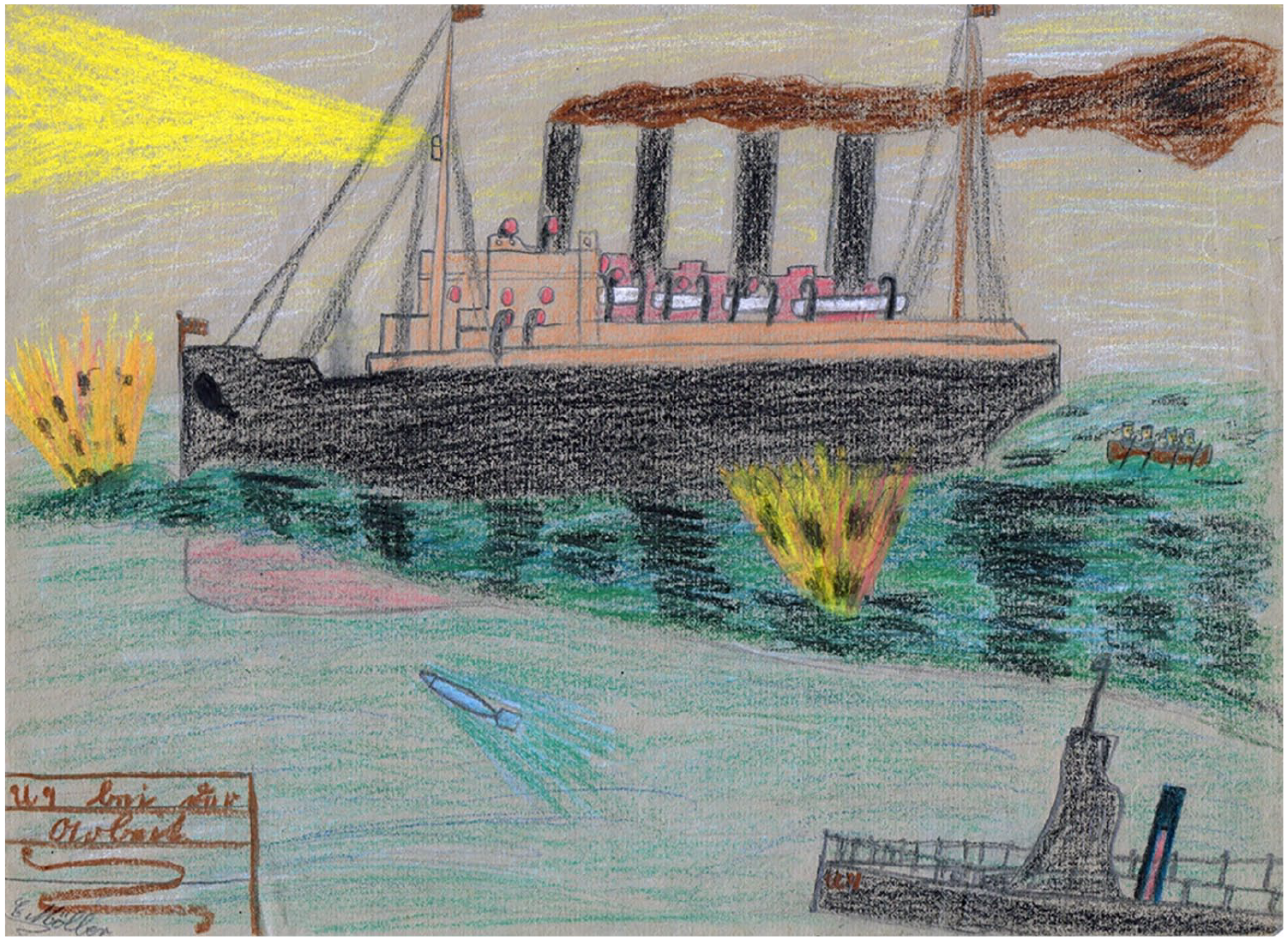
John Gleich, The War at Sea: A Colouring Book for German Youth, 1915
Irma Danker, 13
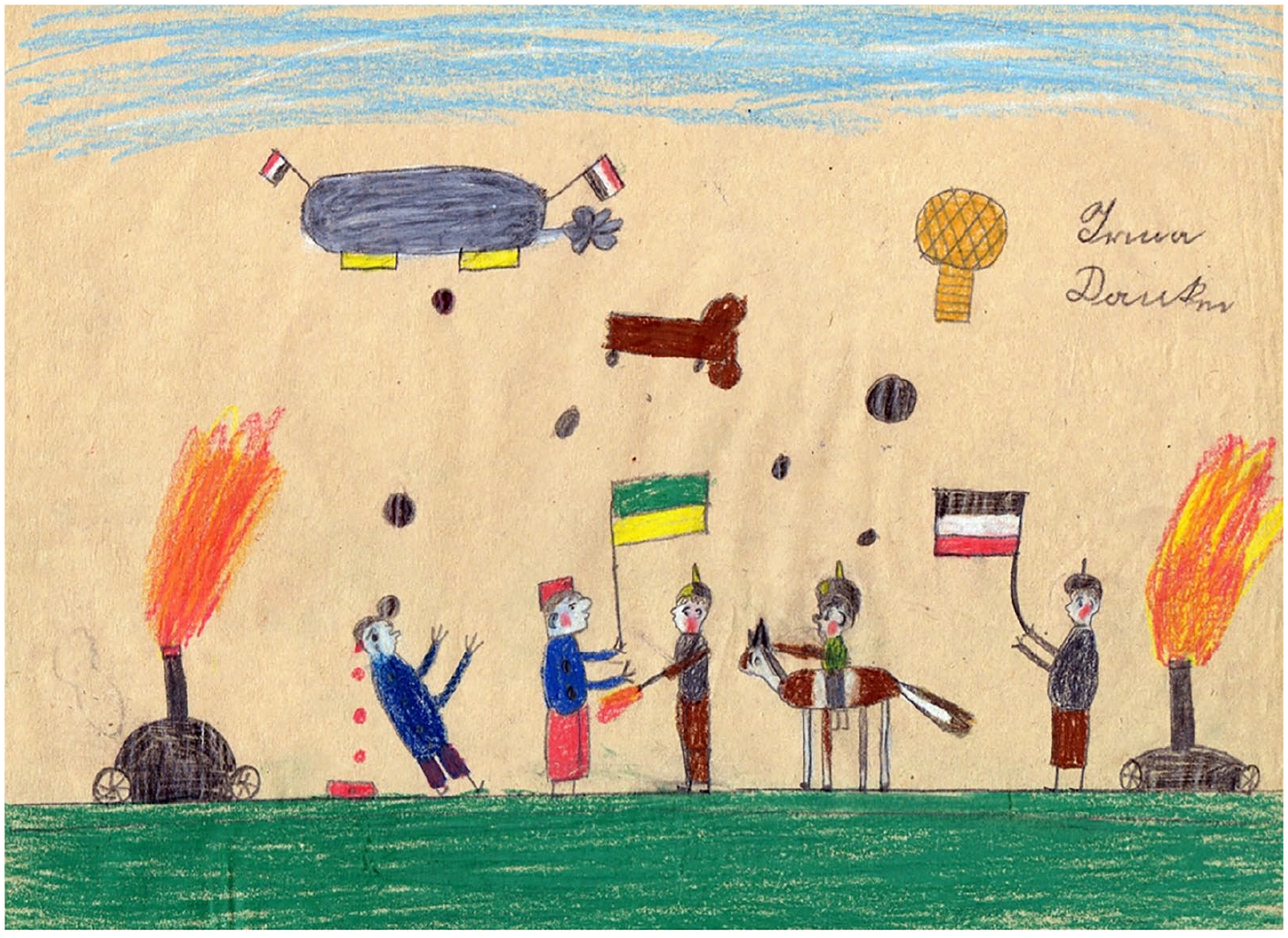
What is unique about this drawing is the placement of one German soldier on a horse, since few other students in the collection drew horses (presumably because they are hard to draw), and the image of blood spilling in crimson circles from the French soldier’s head: a graphic depiction of violence and a wound, ending in a pool of blood. One sees the powerful imagination of the child here, including her idea of what killing a soldier would look like (losing blood and falling backward). What is similar to other drawings is the theme of German superiority in the war: the French soldiers are outnumbered and outgunned by the Germans and their technology. Children’s books of the war years often showed soldiers on horseback, even though the use of horses and of cavalry charges (see image above, from The Watch on the Rhine) was infrequent on the western front (Zunino, 2019: 58). The iconographic image of a soldier on a galloping horse would reinforce the idea of a war of movement and of a war that could be won by heroes.
The different figures in the work appear in profile, akin to an Egyptian frieze; Irma has given the faces rosy cheeks, noses, ears, and eyes (all except the soldier who is wounded). Some of the figures have two arms, others only one. The cannons appear to be firing away from the fighting, without much purpose. She shows the Zeppelin as having the most lethal force, along with the rifle of the first German soldier that is spewing red flame. At the center of the work is the surrender of the French soldier to the German, next to the fatally wounded French soldier. The French are no match for the Germans in Irma’s imagining of the war.
All of the children’s art shown above share certain characteristics: they depict the Germans as victorious, they showcase superior German technology, and they reverberate with a sense of excitement and movement. It is hard to discern any sense of sadness, regret or rejection of the war.
Conclusion
The examination of German children’s art from 1915 gives us a deeper sense of the war’s effect upon German society and thus upon the future adults of the post-war era. Schools became communicators of wartime values, where nationalism and hatred for the enemy shared equal space. This propaganda had the function of legitimizing the war in the minds of the children and urging their involvement in the national struggle. Thus, the children’s artwork shows the war as just, important and winnable, fought by heroic soldiers of the Reich defending the nation with their bravery and sacrifice, upholding a superior German people and German civilization. In France in World War I school children drew pictures of war too. Historian Pignot (2004) has documented this art in her acclaimed study La Guerre des Crayons and in a comparative study of Russian, German and French drawings (Pignot, 2019). Her argument is that French children were encouraged by teachers to draw scenes of violence and war, attacking the Germans as barbaric and internalizing the idea of killing the enemy as a joyful event. In French wartime culture, the Germans were defined as the antithesis of civilization: dangerous brutes (Huns) who would destroy the French way of life. In both the German and French cases of children’s wartime art we see children accepting the war as a legitimately violent and indeed heroic national struggle. Ironically, in Germany the arts education movement was a progressive force in moving German education away from the traditional rote learning of the 19th century toward new methods of nurturing the child’s independent character and creative expression: but by the war years, art teachers, however well meaning, stood behind the war effort and so encouraged the children’s creativity in supporting a disastrous and fiercely destructive war. The German children from World War I embraced and interpreted the popular narrative of the war as an exciting and honorable game between winners and losers, little knowing that they themselves would lose so much when the war came to its end.
Footnotes
Funding
The author(s) disclosed receipt of the following financial support for the research, authorship, and/or publication of this article: The author gratefully acknowledges the financial support of the DAAD in researching this article.
