




Abstract
This paper explores what place means for early childhood education at a time of global environmental precarity. We draw on fieldwork in Arctic Norway, where kindergarten children spend time with snow for more than half of the year. Children’s movement attunes to the nuances and diversity of the snow, as seasons, temperature, light, wind and weather change the consistency of snow and the possibilities for what can occur. The paper presents data of children walking in deep snow during an ice-fishing trip, a practice known as ‘grynne’, asking what we can learn both about the moment-by-moment attunement between child, snow and place necessary to grynne, and the paths of movement left behind in the snow afterwards. We draw on Manning’s work in order to trace the major and minor gestures running through grynne, as an analytic starting point for educators considering the role early years pedagogy might play in planetary sustainability.Thinking beyond the notion of humans as masterfully in control of environment, Ingold’s notion of correspondence offers a counter, advocating for a ‘lifetime of intimate gestural and sensory engagement’ as a way of learning to attune more deeply to place and take seriously the way in which place and humans mutually shape each other. In a place where seasonal temporality matters, in extreme ways that change how children’s bodies can move, we consider what children’s entanglement with snow can teach us, educators as well as researchers, about education for sustainability.
Vignette
Through deep, loose snow, a three-year-old boy walks away from the others. The fresh snow reaches high up to his thighs and there are no treads or tracks. Gazing towards the horizon, he lifts his entire leg and leans his upper body forward, moving slowly step by step. He does not have a steady course. In some places, his foot falls further into the snow, and he almost overbalances, striking with his arms, but staying on his legs. He moves forward about 20 meters, before turning back, snow and wind blowing on his face.
Introduction
Children, like all of us, are embedded in local places, wherever they may be and however interpenetrated by global flows of knowledge, materials and virtual connections (Alaimo, 2016; Hackett, Procter, and Seymour, 2015; Somerville, 2015; Taylor and Giugni, 2012). Today, our planet is warming more quickly than ever, leading to extreme weather events, damage to bio-diversity, ice melting and higher sea levels (IPCC, 2018). Understanding how humans are entangled in place, in the context of increasing climate change, requires all of us to rethink our actions, relations and priorities, with a less human-centric worldview (Rooney, 2018). Aiming to contribute to a conceptualization of humans as part of the world, rather than somehow separate from it (Myrstad 2018; Ingold, 2011; Instone and Taylor, 2015), this paper considers educational opportunities in an entangled world, intended to assist educators to respond to the question of early childhood pedagogy for planetary wellbeing.
This paper pays attention to child-place-relationships in Arctic Norway, an area that is also a part of Sápmi. In this environment, children in kindergarten spend time outdoors regardless of weather and season. The snow lies for several months, usually from late October to mid-May. During heavy snowfalls, the landscape becomes a snowscape, where earlier nuances, details, and references on the ground disappear. The character of the snow changes significantly both during the season and on a daily basis, and these changes define mobility, visibility and availability of different landscapes (Eira et al., 2018). 1 The Arctic region is warmer than it used to be and it continues to warm, causing changes to the sea ice and the snow covered areas (National Snow and Ice Data Center, 2020). The tundra is melting and snow lies on the ground for average 2 weeks less each springtime and arrives 2 weeks later in the autumn, compared to past years. As Arctic winters become slightly warmer, they become wetter, meaning that snow is a little less common. A greater attending to what happens between children and snow, and the ways in which the two shape and change each other (Sanderud et al., 2019), is important for informing early childhood pedagogy in a context in which these ways of being may be weakened or lost, in the face of climate change.
Whilst children, like all of us, are already emplaced (Pink, 2011), yet we encourage educators to consider the implications of the diversity of spatial, temporal, geo-political ways in which children interconnect with Earth. Places, humans and other bodies are unbounded, mutually dependent and leak into one another (Alaimo, 2016; Comber and Nixon, 2009). Those ‘bodies are material themselves’ (Änggård, 2016: 77) and through movement, all living organisms interweave with other aspects in social, physical, (im)material environments. Ingold (2013) describes this process as correspondence, or a dance of animacy between human and nonhuman players. Seeking alternative ways to articulate mutual processes of change between living beings and places, and thus to ‘become more responsive beings’ (Ingold, 2018: 23), leads us to feminist (Osgood and Robinson, 2019; Singh, 2018), Indigenous (Sundberg, 2014) and place based scholarship (Green and Somerville, 2015). This work advocates the impossibility of abstracting knowledge from place, and cautions against notions of mastery of the nonhuman world by humans. Manning (2016) describes ecologies of practice through which more-than-human events unfold and catch children up, with a particular attention to the energies and movements that might unsettle existing structures of value and hierarchies of knowledge, as minor gestures. In this paper, we consider how conceptualising children’s movement through deep snow as a mutual process of correspondence (Ingold, 2013), replete with minor gestures (Manning, 2016) that offer the possibility to unthink human mastery (Singh, 2018), might provide literal and metaphorical lessons for how educators might respond in a context outside of human control.
Sustainability and early childhood education
As Somerville and Powell (2019) write, 21st century children are growing up with a different sense of urgency in relation to the environment, they are growing up in a world ‘already out of control’. A growing body of scholarship explores the implications of this for the lives of young children as well as exploring how curriculum and pedagogy might respond (Comber, 2013; Malone, 2018; Rousell et al., 2017). In particular, we are inspired by scholarship that critiques the nature/culture binary which still appears to be perpetuated in dominant ‘solution focused’ responses to environmental destruction. Ironically, Elliott and Davis (2009) point out, the unspoken assumption that we can separate out the fate of the human race from the future of the rest of the planet, is, in fact, the basis of environmental destruction. Somerville (2016) critiques environmental education frameworks for their Western-centrism, pointing out that when we teach children that the environment is important for human survival and it is their responsibility to act to save it, we are conveying to children that they are heroes who can save the planet with their actions. Whilst this aims to move individuals to act in particular ways, it also sends a message about the human race as powerful masters of both their own fate and that of the rest of the world. Bowers (in Somerville, 2016) shows how metaphors of anthropocentrism, individualism and progress, dominate Western environmental education;
“these metaphors work to naturalise an attitude towards cultural practices that disqualifies the significance of non-human nature, take for granted the individual as the basic social unit, and assume that historical change is on a linear path of constant progress.” Somerville, 2016: 511
In a recent report considering the future of education, the Common Worlds Collective (2020) have argued that understandings of interdependency between human and planetary survival should be at the heart of pedagogy intent on planetary sustainability. As a result, a more radical rethinking of the purpose of early childhood in a global, shifting and more-than-human context is required; what does it mean to grow up on an already damaged planet, and what kinds of skills, practices and understandings do children need for a future that we, as adults, cannot fully imagine?
Somerville and Green (2015) propose place as a conceptual framework for these quesetions. Scholars from numerous global locations have described place based approaches to early childhood education in which care for environment, others and self are inter-twined, often with a focus on noticing micro relationships between children and the more-than-human world (Duhn, 2012; Nxumalo and Rubin, 2019; Somerville, 2015; Taylor et al., 2013; Thiel, 2020). Taylor (2019), for example, describes small, everyday encounters between children and wild rabbits as children became ‘incrementally aware of how their lives, as well as those of the rabbits, are co-implicated in the imbroglio of invasion and extinction in Australia’ (p.7). Rooney (2018) argues that being in or with weather can open up less human-centric ways of responding to environmental challenges (see e.g. Myrstad and Sverdrup, 2018; Ødegaard and Marandon, 2019; Sanderud et al., 2019; Weldemariam, 2020). Common across this work is a commitment to giving up the human as separate category from nonhuman, and rethinking the relationship between, for example, children’s bodies, thoughts, movement, place, brains, words, breath, growth, development and time.
Movement, gesture, intention
Ingold’s (2013) concept of correspondence is a way to think beyond the notion of humans as masterful and in control of environment and open up the possibility for other actants in the context of education. Accordingly, through direct contact and engagement with the environment, knowledge grows into and becomes a part of you. Driving this ‘dance’ is not accumulation of information about the world, but an urge to better correspond with the world (Ingold, 2013). The form of materials, for instance clay or, in our case snow, are generated in fields of circulating forces between practitioners, materials and the wider environment (Ingold, 2013: 26–28). The weather, temperature, lights, moisture, wind and particles in the air affect the material at any given time. This means that whenever we encounter matter ‘it is matter in movement, in flux, in variation’, with the consequence that ‘this matter-flow can only be followed’ (Deleuze and Guattari, 2004: 450–451). Applying the notion of correspondence to the field of early childhood has implications for how we imagine human intentionality (Hackett and Rautio, 2019) and the way in which thinking may be distributed through bodies and materials (MacRae, 2019).
Ingold’s notion of wayfaring as an ongoing process of movement that catches up living beings, has been taken up to describe children’s paths of movement through place (Hackett, 2016; Myrstad and Sverdrup, 2019). In our study, as ‘wayfarers’ in the snow, children ’follow in a gestural dance with the material` (Ingold, 2013: 26). In a snowscape, children’s movement must attune to nuances such as seasons, temperature, light, wind and weather, forces that change the consistency of snow and the possibilities for what can occur. Walking calls for the walkers’ continual responsiveness to the terrain, the path, the wind, the light, the consistency of the snow and other elements; along the path, events occur and things come into presence (Ingold, 2018). Thus, walking is an important practice in the performative coproduction of knowledge and space (Springgay and Truman, 2018; Sundberg, 2014). Sundberg builds on decolonial scholarship to argue that walking, as ‘the embodied and emplaced movements involved in producing worlds - may foster recognition of multiplicity of knowledge system’ (p.39). At every step, walkers follow fields of forces; there is an element of uncertainty (Ingold, 2018: 23) and in this sense, attending to the world through wayfaring involves opening up with a lack of fixed intention (Rautio and Stenvall, 2019).
Thinking of movement with lack of prior fixed intention offers resonances with Manning’s (2016) notion of the ‘minor gesture’. According to Manning, the minor is continual variation of experience, where the staging of disturbances open up new ways of expression. Unlike the major, the minor is not controlled by a preexisting structure, but open to flux. It has a mobility, not given to the major. The decision to respond emerges, as Manning puts it (p.18–19) in the event - in the way movement moves, where one step leads to another. Despite mobility and variation, the minor gesture is often overlooked in favour to the major. Yet, Manning argues, change lies in the minor. By emphasising children’s attunement to their surroundings, we want to create a field of resonance for the minor gesture and offer alternatives to the dominant political and economic discourses of sustainability-as-mastery (Elliott and Davies, 2009; Ingold, 2019; Somerville, 2016).
Methodology approach
Drawing on fieldwork in a kindergarten in the northern part of Norway, our data consists of examples of children’s entanglement with snow. The data derives from research on children’s experiences with and relations to outdoor places during their time in a kindergarten. In Nordic countries, included the Sami areas, children’s self-initiated outdoor play and activities are widely recognised as important educational praxis and aspect of daily life (Halldèn, 2011). The kindergarten in our study is located to a semi-urban area in the northern part of Norway. In this kindergarten, both the Norwegian and the Sami approach to being outside and being in or with the nature are valued. Similarly to Aotearoa/New Zealand, Norway has implemented indigenous themes and cultural values in the education system. This reflects the Norwegian curriculum, which requires teachers to explicitly draw on both Norwegian and Sami cultures (Norwegian Ministry of Education and Research, 2017). Thus, all children within the Norwegian education system should have an Indigenous perspective integrated in their understanding of democracy, and this is a step towards recognizing that Sami culture is part of Norway’s National Heritage (Olsen, 2019).
The participants in our group were 22 children (age of 3–6 years), staff and researchers. Together with children and teachers, two of the authors, Anne and Pernille, experienced the outside environment in an area near to the kindergarten, half a day once a week, from October 2018 to May 2019, through the different seasons. In addition to daily time spent in this immediate outside space, the kindergarten took the children on trips to other outside locations, including ice fishing, farms and rock art locations.
As participant observers, we tried to see, listen and sense what was going on. Participation included taking part in children’s activities, and learning through these processes (Ingold, 2018). We were inspired by Powell and Somerville’s (2018) description of ‘deep hanging out’ as a curious practice, waiting to be invited by the children to play and walk along with them. According Haraway (2015), curiosity might lead participants off the intended path. As researchers, we were particularly interested in casting our attention beyond the activities and outcomes planned by the teachers, to try to notice what else takes place. For instance, in the example of the ice fishing trip below, we were interested in what children did beyond fishing. We see the practice of being together with the children and place, with curiosity and a wide field of attention, as a practice of correspondence itself (Ingold, 2018), where an animate dance between researcher and the world shapes what we notice during fieldwork.
The data we are working with consists of field notes, video clips, digital photos and our own bodily experiences from 130 hours of fieldwork, carried out by Anne and Pernille. The data also includes reflections from meetings with the kindergarten staff, where we shared some of the photos and video clips. Although informed consent was given by the children's parents, we also had an ethical responsibility to meet the children with sensitivity and respect. One example of this was our approach to video documentation; a handheld camcorder with an open display was used, held at the children’s height. This prevented our faces from being hidden behind the camera, allowing us as researchers to communicate with the children (Myrstad, 2009). We also avoided using zoom during videoing, because we wanted the children to constantly be able to see what the lens was pointed towards, and give their verbal or non-verbal assent to being filmed.
This paper draws, in particular, on data from an ice-fishing trip, in April. The ice fishing area is 40 minutes by bus from the kindergarten. At this time of year, the lakes were frozen and covered with snow, and could be walked across. We find data from this trip interesting, because the frozen lake was like a clean sheet with no visible traces of other living organisms. The traces where children, adults and researchers moved with the snow became clear and remarkable. Thus, the wide and expansive location of the frozen lake provides a particularly striking example of practices of walking with snow and ice that we observed throughout our fieldwork with the children in different outdoor locations. Ice-fishing is both a Norwegian and Sami tradition and practice. In a Norwegian context ice-fishing is related to outdoor life and recreation. In this case, ice-fishing where linked to the Sami culture, where ice-fishing traditionally has been part of the harvesting of natural resources during the year, often arranged as a family event.
A clean sheet
When we arrived at the ice-fishing area, the frozen, snow covered lake was as a clean sheet (see Figure 1). Approximately 30 cm of loose snow had erased previous tracks and ice-fishing holes. The landscape appeared untouched to the eye, yet walking across the snow, it was possible to feel the spaces made by previous footprints, hidden under the fresh blanket of snowfall. When the kindergarten arrived, new paths in snow had to be made by walking, creating new traces and paths to places where the group could practice ice-fishing and make a base camp with a fire place.
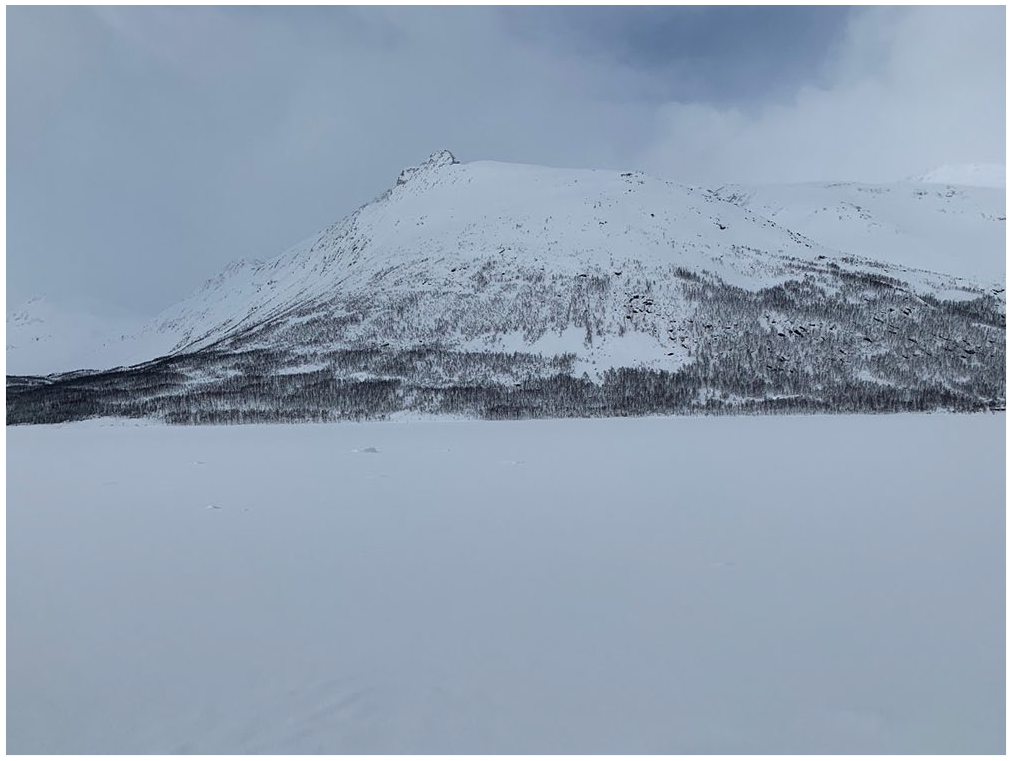
A frozen, snow covered lake.
Walking in deep snow – ‘to grynne’
In northern part of Norway, there is a distinct expression for wading in deep snow, ‘to grynne’. When grynning, you lift the legs to get ahead, then push down the snow with the foot until the foot meets firm ground. For children depending on their size, there are even more challenges, as deep snow often goes far up their thighs. To get ahead through snow they have to lift their whole leg, combined with leaning the upper body forward. The more moisture in the snow the heavier it is to grynne. However, there is a tipping point, when the snow becomes so compacted as the temperature drops, that it can bear the weight of a small child, but not an adult. In this scenario, the children find the going easier, walking across the crust surface of the snow, whilst the adults’ heavier feet continue to sink down deep. Thus, as the snow compacts and the temperature drops, possibilities for the area that can be covered and how much speed and effort this might require, constantly change.
Lines of movement in the snow
At the start of the fishing trip, walking through the deep snow (grynning), the staff made two straight lines to guide the children to a place to make a base-camp with a fireplace and ice-fishing-holes (see Figure 2). To ‘grynne’ in deep snow is heavy and challenging work; therefore, the most effective way to get to the destination is to walk in a straight line and in the footsteps of the person in front of you. The easiest thing for the children is to follow in the footsteps of the adults leading the way. It is easier to move in the snow when someone has stepped down the snow and you do not have to lift your whole leg to walk. The more people who have walked the path, the easier it is to move. In this case, the body’s movement is shaped by how others have used the environment (Ingold, 2000).
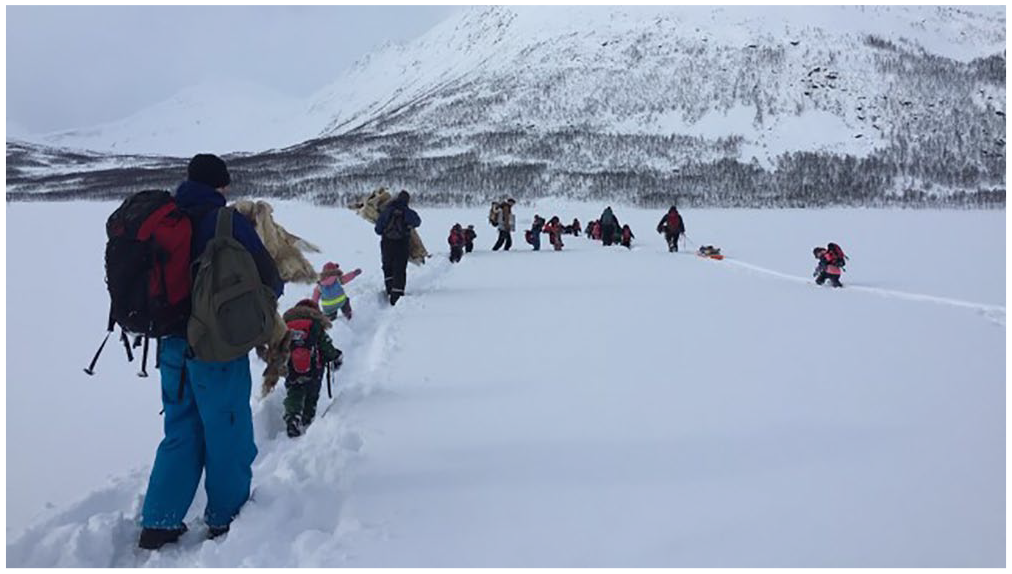
From ice fishing during the month of April.
Whilst the purpose of the kindergarten trip was to make a base camp and do ice fishing, following our methodology, we were interested in casting our attention beyond the pre-planned activities, to pay attention to what kinds of correspondence might unfold between place, children and snow.
Hanging out with the children, Anne took a video clip from which the opening vignette was drawn; a boy walks away from the main group, out towards the horizon some way before turning back. As she followed him, filming (see Figure 3), it had begun snowing and the wind was blowing in his face, and can be heard on the video sound track.
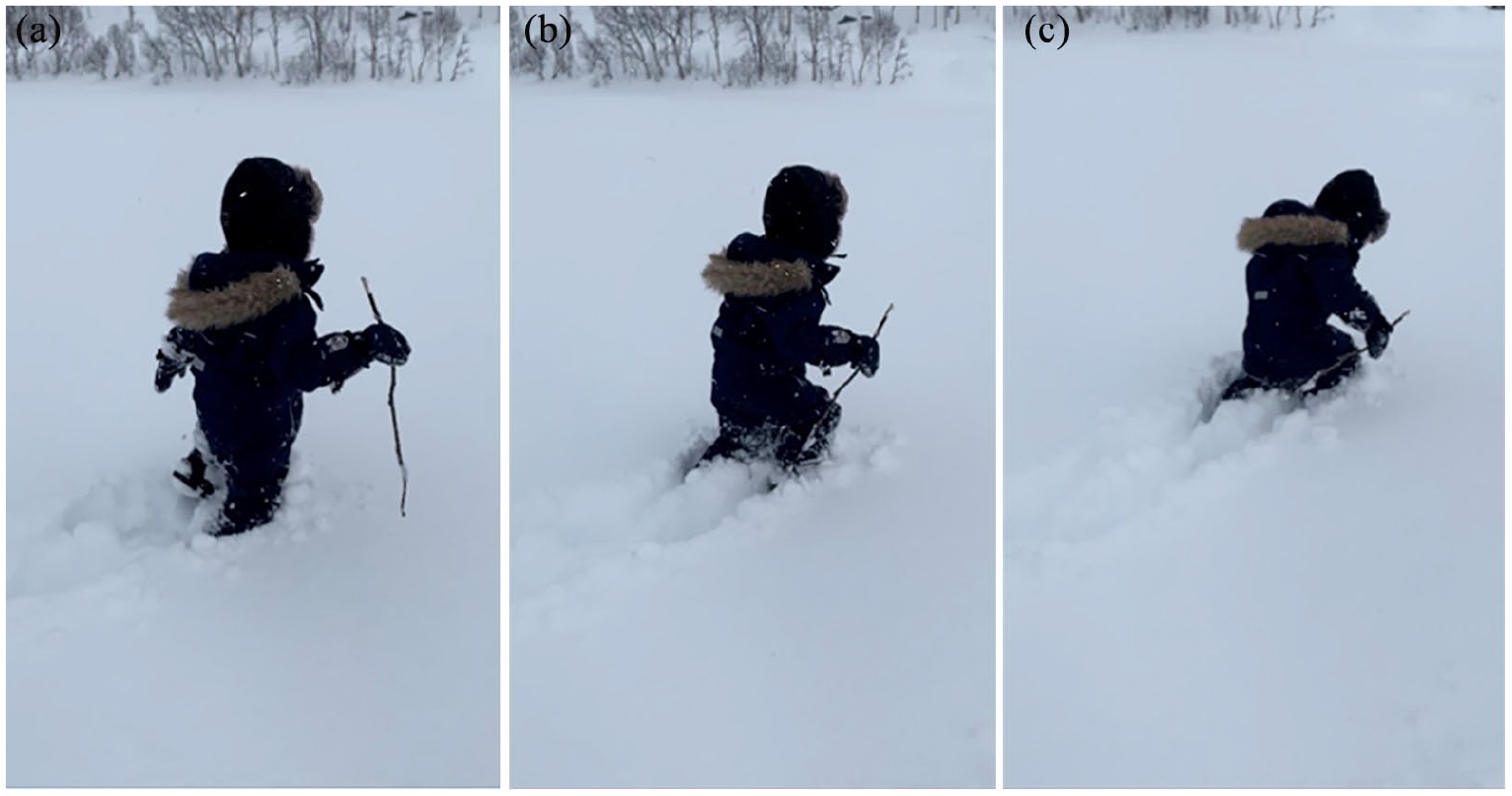
Grynning in the snow.
During our fieldwork, we became aware that the paths the children tended to make during their wayfaring (Hackett, 2016) remained visible afterwards as tracks in the snow. We began photographing snowy spaces before and after the children had visited. Figure 1 shows a before shot of the frozen snow covered lake as a blank slate, and Figure 4 shows the same space after the children had got back on the bus.
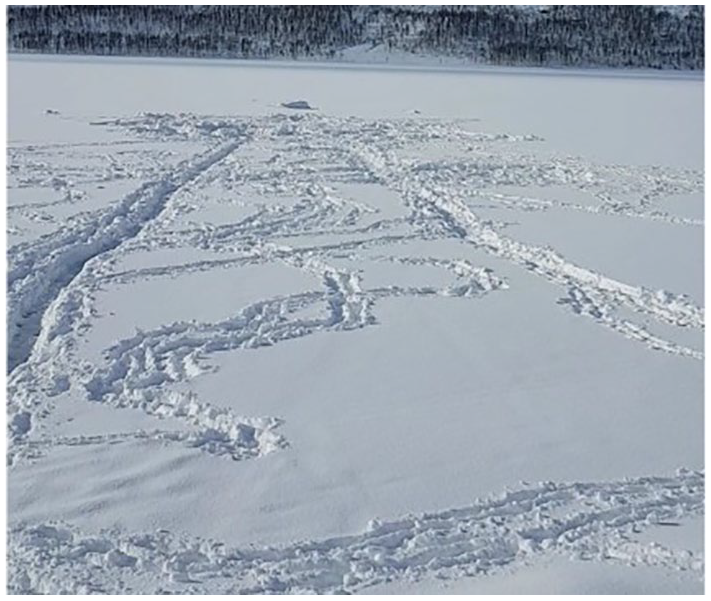
Lines in the snow after ice-fishing.
As Figure 4 shows, the lines of walking left in the snow after the ice fishing trip demonstrate that children don’t just go straight ahead following the adult in the lead. In spite of the difficultly and challenges of going in deep snow, the children carved out fresh lines, which meandered around the space in contrast to the two more destination-oriented paths (created initially by the adults).
Being aware (both from our observations and in our own bodies) of the physical challenges of grynne, we argue for taking seriously these meandering paths. However, we resist an interpretation of these ‘break away’ paths as an intentional demonstration by the children of independence, mastery, agency and so on, or seek to draw a contrast between the behaviours of adults versus children. As Manning (2016) points out, when we think of movement (of adult or child, human or any other being), the notion of volition can only be applied retrospectively. What unfolds actually depends on ‘a continuous interplay of conscious and non-conscious movement’ (p.19) shaped by the ecologies of place. Instead of mastery or agency, we read these grynne events as correspondence (Ingold, 2013), recognizing the grynne is not individual movement, rather it is shaped by place, conditions and mutual responsiveness. In addition, we argue that grynne is not an abstractable skill that can be taught, but is specific to place on a moment-by-moment basis and can only be learned through direct participation. In considering grynne as correspondence, we hope to open up both literal and metaphorical understandings of what these hard-won meandering paths through snow (Figure 4), created through mutually responsive human and more-than-human bodies (children, boots, lying and falling snow, wind) might have to teach us about early childhood education, place and environmental precarity.
Rhythm, variability and responsiveness
In our close observation and personal bodily experience of doing grynne, we find that to move in this way through deep snow relies on finding a rhythm, attuning the body to the conditions, and muscles to the kinds of movement necessary. However, grynne is also an experience of constant variability, requiring an ability to adapt and change with each footstep. Each step into the snow holds different possibilities for what the foot will find, depending on how tightly the snow is packed, and whether there are hidden spaces underneath the surface. Children’s movements attune to changes in temperature, light, wind and weather that create micro-variations in the consistency of snow (Eira et al., 2018). For Manning (2016) movement can never belong fully to the human subject and their own volition precisely because of these micro-variabilities in the conditions of movement.
“But movement-moved is never twice the same: it is always altered by the ecologies that create this singular field of relation, and that influence how it will unfold this time. Volitional movement understood as movement belonging to the subject and fully directed by the subject is, therefore, impossible” Manning, 2016: 19
Ingold’s notion of correspondence articulates this process as a dance of animacy between human and more-then-human players. For Manning (2016), the minor gesture is a destabilising force, working independently of human intentionality to shape what unfolds. During the ice-fishing trip, there were pre-planned activities (make a base camp, do ice fishing) together with rational and functional walking lines to these destinations. At the same time, many other actions, activities and lines of movement also occurred. Whilst it is important not to conflate the major with curriculum or adult planning, and the minor with what the children do, Manning writes,
“The major is the structural tendency that organizes itself according to predetermined definitions of value. The minor is the force that courses through it, unmooring its structural integrity, problematizing its normative standards.” Manning, 2016: 1
In this sense, the minor is always there, closely related to and indivisible from the major. It is not a question of which walking lines represent the minor, but a question of how we pay attention to the energies and movements of both the major and the minor during unfolding events. Noticing the minor, when we grynne with children and their adults in the snow, involves noticing what is taking place beyond human volition and beyond predetermined definitions of value.
Pedagogy in a context beyond human control
We write in a context in which, internationally, we notice moves towards the formalisation of early childhood education, coupled with desires for ‘globally competitive’ students. At the same time, paradoxically, global environmental crisis and the related stuttering of capitalism as a way of making sense of the world (Thiel, 2020; Tsing, 2015) suggest that something quite different might be required. Scholarship we outlined above on sustainability and education highlights how notions of mastery perpetuate a human / nature divide, implying both that the survival of the human race is separate from or more important than the survival of the planet as a whole (Eliott and Davies, 2009), and that humans hold both the power and responsibility to ‘fix’ the crisis (Somerville, 2016). Recently UNESCO have launched an inquiry into the future of education, and in response, the Common Worlds Research Collective (2020) have argued that ‘education needs to play a pivotal role in radically reconfiguring our place and agency within this interdependent world’ (p.2). Thiel (2020), drawing on Tsing, urges us to notice unruly edges, as a route to creating new kinds of educational narratives beyond the tropes of progress, mastery and solutions. A little boy’s circles of red pen across a blank sheet of paper, Thiel argues, can offer a counter to neoliberal forces mostly concerned with his production as a future economic citizen. Imagining the lines of red pen across a blank sheet of paper, we wondered whether we could similarly view the lines made by the children’s grynne, lines that do not go directly from A to B, as another example of unruly place making in the context of the faltering and failing of capitalism and the ‘progress’ narrative.
Although variations in movement ecologies are always present (Manning, 2016), grynne gives us a particularly striking example to think with (and to move with). We can literally feel the differentials in the ecologies of movement as our feet slip slightly further than we anticipated into a foothold, or meet snow that looks soft but feels ice hard. As more-than-human movements are activated by registers of difference, they create ‘new forms of life-living’ (Manning, 2016: 8). These minor gestures could be an alternative way of viewing forces working through and in spite of formalisation, competition and universalisation in education. To find alternative ways for living in a world in which the environment is changing in irreversible ways, does not require straight line points of connection, from A to B (Figure 4), it does not require problems to which there are already solutions (Manning, 2016). These events cannot be tamed or controlled by a conventional educational setting, while it requires openness to the unknown and what might spontaneously unfold. Acknowledging learning with and through place has possibilities for practicing a pedagogy that re-centeres the agency of the teacher and makes space for a myriad of more-than-human ‘co-teachers’ (Bleikinsop, 2018). For early childhood educators then, paying attention to the minor gestures and considering bodily experiences of place, may be helpful for reframing the role of the teacher and exploring possibilities for a collaborative pedagogue with the world (Common Worlds Research Collective, 2020).
Time, space and valuing the minor gesture
For those who work with young children, taking place seriously involves thinking beyond the use of environments or materials to facilitate the acquisition of skills or knowledge. Instead, giving up the notion of mastery and human exceptionality, a starting point might be embracing the excessiveness of place and the way in which it shapes possibilities for bodies to experience and learn together, often in unpredictable ways. One of the teachers in the kindergarten, where the research was done, said that after becoming more aware of how children are mutually involved in flows and forces in ice and snow, she spends more time moving with the children from one place to another. A trip that previously lasted a few minutes can now last up to half an hour. More often she stops in moments when something unexpectedly engages children meaningfully, for example when puddles are frozen to ice and the children want to feel the ice with their bodies. Similarly the teachers in kindergarten, have learnt from their own situated experiences of grynne, that making time and space for things to unfold, can be valuable gifts that adults can offer to children. An increasing familiarity with the materials of the world (Ingold, 2013), that is, an increasing experience of correspondence, is not a skill that can be taught, hurried or abstracted. It is not a process fully under the control of a human teacher. Time and space during the kindergarten day allows dances of animacy to unfold. This involves attending, as researchers and educators, to the major and minor gestures that run through any event. Manning’s (2016) work remind us of the inter-dependency of the minor and the major; it is not a case of doing away with structure of planning in favor of in-the-moment spontaneity, but of noticing and valuing the major and minor within these dynamics.
Conclusion
An important shift in the scholarship around environmental precarity and education has been to move beyond tropes of ‘solutions’ or ‘human mastery’. Alaimo (2016) writes that sustainability imagines the natural world as a store cupboard for human convenience and survival – something there ‘for us’ that we must be sure to replenish. She argues that a radical shift, rather than a maintenance of the status quo, is required to respond to the environmental crisis the planet will face in the coming decades. This shift would involve unpicking assumptions about both the desirability of human mastery, and abstractability of knowledge from place.
We have encountered grynne during our fieldwork with young children in Northern Norway as both a literal example and a metaphor for articulating mutual processes of place, children and learning in a more-than-human world. In order to notice the rhythm and variability of grynne, it was necessary to pay close and specific attention to both children and place. Grynne involves learning to change. It involves learning through the body about what kinds of changes might be necessary, on a moment-by-moment basis, and in a context that is not under human control. Whilst we do not want to offer a prescriptive list of recommendations for pedagogy, dialogue with the kindergarten teachers has identified some starting points for early childhood pedagogy for planetary wellbeing; shared bodily experience of movement and place, making time and space for the minor gesture, and making space for more-than-human teachers. We suggest that the children’s careful attuning to the many nuances of snow and the possibilities that it offers, gives us a glimpse of just one example of what an alternative approach to learning with and being together with place might look like.
Footnotes
Funding
The author(s) disclosed receipt of the following financial support for the research, authorship, and/or publication of this article: The article is based on a project in KINDknow, funded by RCN, Project code: 275575.
