




Abstract
Care in the early years entails more than childcare. This paper has three major sections. In the first section, I begin with an introduction and a quick overview of the ECEC system in Australia. This snapshot of the Australian ECEC system presents a messy map of the care and education system for young children under a neoliberal political economy to elucidate what this may mean in the face of the COVID-19 pandemic. With this contextual background of the ECEC system in Australia, in the second section I discuss my theoretical, ethical, political, ontological, and epistemological positioning when re-imagining and reconceptualizing what a socially just ECEC landscape might look like through the lens of a feminism approach. This onto-epistemological discussion explains the shift toward a feminist approach and how this enables me to (re)think about care and education in the early years differently. Taking up this different set of analytical tools with a post-structural sensibility of the politics of caring, in the third section, I continue on to critical analyses and discussions, highlighting the paradoxes of care and education in the early years. A key aim of this paper is to un-settle the taken-for-granted ways of thinking and talking about ECEC in Australia. I build my discussions by unsettling the dominant ways of thinking about care and education in the early years to deconstruct the narrowed political rhetoric of care in the early years as childcare only. I assert such a critical analytical position requires a new language from a new onto-epistemological positioning to mobilize a different system of reasoning as a strategy for re-imagining a new landscape toward an ethical world with social justice and greater social inclusion for all children.
Introduction
The year 2020 is filled with unprecedented challenges. Under the affects and effects of the COVID-19 global pandemic, we are all facing difficult circumstances and encountering waves of lockdowns, which have produced levels of local and global socioeconomic uncertainty with anxieties and fears about health and wellbeing. Around the world, the spread of COVID-19 has led to the lockdowns of cities and countries and has had great impacts on human activities for those of all ages, at all levels. Take the case of New South Wales, Australia, for example. During the lockdown months of the COVID-19 pandemic, only “essential” services such as hospitals and grocery stores were allowed to remain open, including early childhood centers and schools for the children of “essential workers.” Being “classified” or given “official” recognition as a type of “essential service” for the society is certainly something new for the field of Early Childhood Education and Care (ECEC) in Australia.
A recent research brief by the United Nations (UN) titled “Childcare in a global crisis: The impact of COVID-19 on work and family life” highlights the ongoing g/local problems of childcare with at least 40 million children missing out on the opportunity for early childhood education and care during the most critical moments for development and learning in the early years (Gromada et al., 2020). Referencing this UN research brief, Henrietta Fore, the head of the United Nation Children’s Fund (UNICEF), expressed her concern about the effects of COVID-19 on children and young families, stating that “the pandemic is making a global childcare crisis even worse” (UN News, 2020). The disruption of COVID-19 and waves of lockdowns in communities with shutdowns of early childhood settings and schools are exacerbating the adverse circumstances for the already disadvantaged children and their families, locally and globally.
In many communities and countries, not having access to quality care and education, whether due to the effects of the COVID-19 pandemic or not, means social isolation, challenging family financial conditions, and deteriorating mental health and wellbeing for many vulnerable children. While these problems are not new, the COVID-19 pandemic has ruptured our world and interjected a new discursive space/time enabling us to critically reflect on what must be done in order to (re)build a new future with a vision of social justice.
This paper has three major sections. In the first section, I begin with an introduction and a quick overview of the ECEC system in Australia. This snapshot of the Australian ECEC system reveals a messy map of a care and education system for young children under a neoliberal political economy to elucidate what this may mean in the face of the COVID-19 pandemic. With this contextual background of the ECEC system in Australia, in the second section, I discuss my theoretical, ethical, political, ontological, and epistemological positioning when re-imagining and reconceptualizing what a socially just landscape of ECEC might look like through the lens of a feminist approach. This onto-epistemological discussion is to explain the shift toward a feminist approach and how this enables me to (re)think care and education in the early years. Taking up this different set of analytical tools with a post-structural sensibility of the politics of caring, in the third section I continue on to critical analyses and discussions, highlighting the paradoxes of care and education in the early years. I build my discussion by unsettling the following dominant ways of thinking about care and education in the early years:
The myth of a “free” market approach to ECEC in Australia.
The dominance of a neoliberal discourse for a narrowed socio-political construction of care (and education) in the early years.
These selected threads of reasoning about care and education are treated as grand narratives which have contributed to shape the dominant understanding of care and education in Australian ECEC. To go against the grain, a key aim of this paper is to un-settle the taken-for-granted ways of thinking and talking about ECEC in Australia. I assert such a critical analytical position requires a new language from a new onto-epistemological positioning to mobilize a different system of reasoning as a strategy for re-imagining a new landscape toward an ethical world with social justice and greater social inclusion for all children.
Introducing the unlevelled playing field: Early childhood education and care system in Australia
The sector of ECEC in Australia for children from birth to 5/6-year-olds is diverse and fragmented, with multiple types of early childhood programs/settings and levels of professional qualification. Table 1 provides a snapshot and overview of the structure of the ECEC, highlighting several main (or popular) types of early childhood programs and the levels of professional qualification. All early childhood care and education programs in Australia are legally obligated to follow the National Law, and National Regulations National Quality Framework and meet the requirements of the Australian Children’s Education & Care Quality Authority (ACECQA) as well as the requirements of state and territory regulatory authorities.
Types of early childhood programs and levels of professional qualification in Australia.
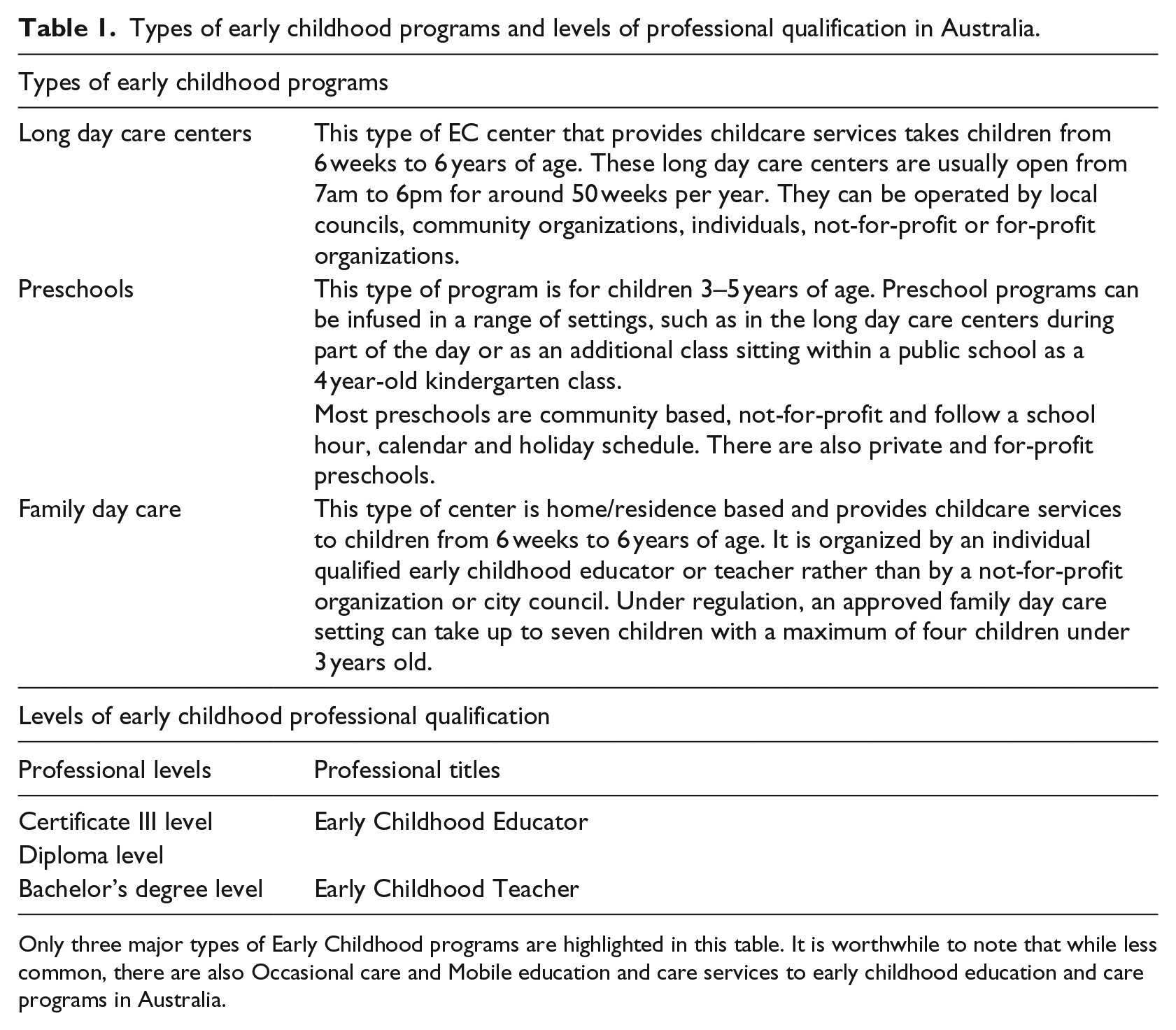
Only three major types of Early Childhood programs are highlighted in this table. It is worthwhile to note that while less common, there are also Occasional care and Mobile education and care services to early childhood education and care programs in Australia.
As described in Table 1, there are multiple types of early childhood settings providing care and education for young children prior to beginning their K-12 compulsory education experience. Different from the K-12 education system, the provision of ECEC in Australia has been left to be organized by private funding from various community based, not-for-profit, and for-profit organizations, with very little government/public funding. Parents and families with young children are expected to “bear the cost” of their own children’s care and education as they make their “private” choice and arrangement in the early years prior to the start of their formal education. Issues of affordability and accessibility to early childhood education and care programs have always been highly politicized in Australia.
In July 2018, the Australian government merged and replaced the previous schemes of Child Care Benefit (CCB) and Child Care Rebate (CCR) to provide a single unified Child Care Subsidy (CCS) scheme. This centralized government CCS scheme is a means-tested subsidy that can cover up to 50% of the childcare cost for eligible parents who enroll their children in approved and eligible early childhood care and education centers/programs. Despite the centralized government CCS funding scheme, the provision of childcare is never “free” or universal for any Australian children. The high cost of ECEC in Australia has become a “normal” contemporary phenomenon for young families with children. For example, in Sydney, it is common for a long day care center to charge a daily fee of $80-$200 AUD for one child. Even though the federal government’s CCS scheme could cover up to 50% of the total cost for care and education for eligible children, it is important to note that with the high cost of ECEC, not all Australian families can afford to have their children attend a quality long day care center, preschool program, or family day care program (as families are still expected to pay for the remaining 50% of the cost). Additionally, for many young children in Australia, attending ECEC is not a “daily” living experience. A majority of young children, depending on their families’ employment arrangement, may only be able to afford to enroll in early childhood settings for 1–3 days per week. Issues regarding affordability and accessibility are ongoing systemic problems for social justice for an inequitable provision of ECEC for children in Australia. Additionally, when the focus of discussions regarding affordability and accessibility for ECEC is trapped between debates on parents’/family’s choice versus government’s responsibility, it shifts the conceptualization of ECEC to that of a privilege rather than emphasizing ECEC as a children’s right.
Ironically, while the COVID-19 pandemic has exacerbated the systemic problems of ECEC, a new possibility for a more equitable ECEC emerged when the Early Childhood Education and Care Relief Package was introduced and implemented in Australia. In March 2020, during the beginning of the COVID-19 pandemic, the Australian government announced several relief programs for multiple sectors and industries as a national reaction to face the challenges of the COVID-19 crisis, including the Early Childhood Education and Care Relief Package (also known as the Relief Package, more commonly referred to as “free” child care). In the early months of the COVID-19 pandemic, many families were un-enrolling their children from ECEC programs for a range of different concerns and reasons, including concerns for health and the high cost of child care if the parents themselves were stood down from work or lost work (and therefore would lose their eligibility for the CCS scheme).
Considering all levels of challenges with COVID-19 while “seeing and conceptualizing” ECEC as an ambiguous business “industry” that provides “child care services” to families as well as to children of essential workers during the pandemic, the Parliament of Australia passed the Child Care Subsidy Amendment (Coronavirus Response Measures No. 2) Minister’s Rules 2020 to provide an additional 50% top up fee to be paid to the ECEC settings to cover the remaining cost of the existing CCS (for more details, see Klapdor, 2020). In a way, this COVID-19 Child Care Subsidy Amendment made childcare “free” from March to July 2020. This “free” COVID-19 pandemic childcare created new momentum and interjected a new discursive space to discuss the feasibility of universal childcare for all children in Australia. In late August 2020, as the COVID-19 free childcare funding scheme was drawing to an end, major discussions by families and those in the field of ECEC advocating for ECEC were highlighted. For example, while not perfect, COVID-19 free childcare has continued to be available for preschools only until the end of the 2020 school year (in NSW, Australia as different states would have variations of COVID-19 relief packages in addition to the federal government’s). 1
As illustrated in the initial development and rollout of the COVID-19 Early Childhood Education and Care Relief Package, care in the early years is politicized as family ability to choose the appropriate service for “childcare” to “free” up domestic responsibilities of care so that parents can be(come) more productive and engage in paid labor. The provision for childcare services in the early years has been commodified as “childcare” and has been conceptualized as a blended business “industry” providing human services (for children and their families). Rather than placing the child in the center of policy making, political discussions about care in the early years have consistently been reduced to threads of reasoning about cost/money/budget rather than for the family and the society in the name of “childcare”. Within the Australian ECEC system, care has been narrowly constructed and understood as “childcare” only. To expand our understanding of care in the early years beyond the discussion of childcare, we need a different set of analytical tools to “investigate” and unsettle the socio-political fixation of childcare as a business of service.
Reconceptualizing care: A feminist approach with a post-structural sensibility
In this paper, I destabilize the popular and typical conception of a “normal” landscape of ECEC in relation to how care has been conceptualized in false dichotomies to simplify what caring work may mean in the society. To do so, I depart from a conventional standpoint and take up a feminist approach with post-structural sensibility to (re)conceptualize care and care work as a paradoxical issue in ECEC by looking into the ways care has been thought of and practiced in early childhood educational policies and regulations. The problem with care in the early years is how caring work in contemporary times has been reduced to gendered notions of babysitting, childminding as a motherly duty in the form of a gendered moral obligation. When deconstructing “care” in the early years, a troubling universal gendered domicile conception of female care-giver vs. the child as care-receiver or care as “women’s work” has been challenged by many feminist scholars (for some examples see Held, 2006; Dahl, 2017; Larrabee, 2016; Murphy, 2015; Robinson, 2011; Tronto, 2014, 2015).
Feminism is not monolithic. Among the multiple trajectories of feminism since the 17th and 18th centuries, there have been multiple waves and epistemologies of feminist perspectives for unpacking and critiquing gender inequality. A wide variety of socio-political issues ranging from equal opportunity to recognition of equal rights for all levels of participation in the society have been significant for breaking the systematic injustice built along the divide of gender differences. While this paper would not be able to cover the scope of discussions on feminist philosophy, I build my analysis upon a feminist approach to the ethics of caring (i.e. the works of Gilligan, 1982; Noddings, 2013) and political theory of care (Tronto, 2018) to assert what Engster (2007) had noted:
. . .human beings universally depend upon one another for care, we all have moral obligations to care for others in need. While we can fulfill some of our obligations to others through personal caring relationships, we can fulfill many others only through collective caring institutions and policies. Our moral obligations to care for others thus generate collective responsibilities to organize our political, economic, international, and cultural institutions at least in part to support caring practices and care for individuals in need (p. 2).
Care work is intra- and inter-personal. Caring happens in a web of relation as our positionings are in relation to and with one another. I draw from a feminist approach that taps into the intersectionality of who we are in the process of be(com)ing as we are simultaneously a care giver and receiver at all times with fluidity in our being and becoming across a range of sociocultural contexts. In light of such a feminist standpoint, care is understood as a socio-political concept which cannot be separated from critical investigation of race, class, gender inequalities (Tronto, 2018).
Taking a feminist perspective to understand ECEC in Australia is very relevant for ECEC has been and still is a highly feminized workforce, nearly 97% female (Press, 2015). As a gendered profession with philanthropic origins, the historical and socio-cultural conceptions of care and education in the early years have been nested within a network of power relations to evoke multiple threads of critical discussions. Here, I highlight some threads to illustrate how a feminist standpoint can be mobilized as a different analytical tool to shape the critical analyses and discussions about the construction of care and care work in the early years.
(1) A thread of historical meanings about ECEC in Australia was (and still is) rooted within a Western colonial moral value woven into a salvation narrative of “saving the children”. The socio-cultural reasoning on caring in ECEC settings is tied with a logic and an assumption of a noble moral sentimentalism for female carers to give their caring service to children who couldn’t receive it at their homes. Care was coupled with a notion of responsibility – as either a moral or a social obligation. With time, the shift in language for care and care work in the early years (as well as in other fields such as nursing) has evolved from a moral sentiment to a political rhetoric of ethics of caring for contemporary discussions about social welfare, justice, and equity.
(2) Another thread of historical meanings about ECEC and caring work need to be positioned within the backdrop of early waves of feminism, known as Women’s Suffrage in Australia that advocated for childcare and early childhood education and mobilized ECEC as a means of empowering and supporting mothers’ economic independence by allowing them to enter into paid employment. With a women’s right-based rhetoric, discussions about childcare and care work have been paradoxically positioned within a complex grid of power relations. For instance, a critical analysis and discussion on the complexity of one female carer receiving low pay when caring for another female’s children in order for her to gain the right to independence (or to be liberated from unpaid domestic labor) is much needed.
(3) A thread of contemporary political and socio-cultural construction about care and care work in ECEC is linked to the notion of political economy of care. In Tronto’s (2014) own words to address a political economy of care, she has noted that:
. . . Let’s start from the economics of care itself. If we use the economic logic of advanced neoliberal capitalism, the goal is to try to turn care into a commodity and to squeeze more profit out of it. But the very goals of caring are not only to accomplish some task, but to nurture and support the human relationships that are part of the care. Can we economize relationships in the same way that we economize commodities, including labour? . . .In my own thinking, we need to go back, as feminists warned us early on, to rethink the nature of labour as a commodity, too, in order to appreciate and valourize human qualities such as creative work, and at the same time, try to preserve the centrality of human relationship (p. 44).
A neoliberal capitalist logic is infused into contemporary discussions on the economics of care and care work. This can be seen in the language and vocabulary of Australian political and social policy making. For example, within Australian politics, policies about childcare for families or child care and early childhood learning are topics of key discussions that sit with the Productivity Commission, which is one of the Australian Government’s principal government authorities with administrative power on microeconomic policy regulation for a variety of social and environmental issues. When discussions about childcare and early childhood learning are in line with discussions about economic and measurable “productivity,” the philosophies about care and care work in ECEC are reduced and narrowly confined within a logic of economics that aims to quantify human experiences of care.
These threads of historical and socio-cultural constructions about care and care work can be unpacked though mobilizing a feminist onto-epistemological perspective to unravel the politics of care in Australian ECEC. Care is nested within a network of power relations. Therefore, it is important to investigate care as a political concept to unpack age-old debates on social justice, gender inequality, and inequity. A feminist standpoint with a post-structural sensibility has provided the onto-epistemological foundation for me to go beyond the traditional dyad relations and binary system of reasoning to challenge the taken-for-granted narratives about care and care work in ECEC.
Paradoxes of care and education in the early years: Mapping the reasoning systems
Care and education in the early years are two inseparable core concepts. Without caring work, there is no early education in the early years (and learning in the early years does not stand alone without the socio-political concept of care). The landscape of ECEC in Australia is at a time of change. The COVID-19 pandemic has brought forth more challenges while exacerbating existing systematic problems, and the Australian government’s implementation of childcare relief package policy during the first months has offered a glimpse at what universal provision of ECEC may look like to interject a new political and social imaginary of what care could look like in the early years.
As I shift toward a feminist perspective and political theory of care, in this section I present and highlight selected dominant logics/systems of reasoning about care and education in the early years. When charting these lines of common thinking and discussion, I problematize how care and caring work in the field of ECEC have been dangerously reduced to a shallow meaning of childcare and babysitting without professional recognition while subscribing to a biased and gendered politics.
The myth of a “free” market approach to ECEC in Australia
Australian ECEC, as presented in the first section of this paper, has a long history of limited public funding. Left to be organized by the private sphere (but meeting centralized government regulations), a majority of ECEC centers, programs, and settings are owned and operated by private organizations (whether they are community based, for-profit, or not-for-profit). It is no longer news in Australia that some EC centers are owned by for-profit companies listed in public trading (stock market) with shares to be purchased/sold among investors while others may be run by large not-for-profit organizations. The default system of ECEC has appeared to be based on a “market” model in which all ECEC settings are competing against each other for children enrolment. In order to stay in the “business” of ECEC, children’s enrolment rate is a key factor for ECEC programs to “survive” as children’s daily fee is the primary “income” source for maintaining the “cost” of running the ECEC setting.
During the COVID-19 pandemic in Australia, as children’s enrolment numbers were dropping across the ECEC, a government relief package in the form of “free” childcare was implemented to “sustain” and “support” the economy of ECEC business (while keeping it running and open for children of essential workers). Laced through the pandemic, the Early Childhood Education and Care Relief Package is a narrowed socio-political conceptualization of ECEC as childcare only. The Australian political language has a habitual tendency of condescending vocabulary usage for constructing care and education in the early years as childcare and babysitting only while dismissing such caring work as “women’s work” with their motherly nature to care for the young(er) generation—children.
The dominance of a neoliberal discourse in early childhood care and education in Australia
Neoliberalism is a dominant thread of the political economic reasoning system that has prescribed individualism, capitalism, and privatization as central tenets to re(con)figure our new common sense about freedom, choice, equity and equality (e.g. see Lee, 2018). Within the neoliberal logic, care is calculated with a political economic logic. Subscribing to a neoliberal logic, a dominant language used in talking about Australian ECEC often centers around discussions of smart investment in ECEC, cost-benefit analysis on the value of childcare, or parents as responsible entrepreneurial individuals exercising their freedom to choose or selecting their children’s childcare service.
While a dominant neoliberal economic logic has been circulating and growing strong roots in the landscape of Australian ECEC, the COVID-19 pandemic has ruptured and challenged what care and education may mean for the society. Ironically, the appearance of COVID-19 has demanded new ways of understanding and imagining what care may entail in the early years during the pandemic and it may even change the ways we define care in the coming post-pandemic era. Within the context of Australia, the temporary pandemic Early Childhood Education and Care Relief Package has become one of the most effective policies to challenge a neoliberal market approach to ECEC. Recognizing its pros and cons from all perspectives, the relief package has offered a glimpse of what caring for our younger citizens during a pandemic may look like.
What does the COVID-19 Child Care Subsidy Amendment mean for children?
For a short/limited period of time, in the face of the pandemic, some children and families had an opportunity to experience “free” ECEC in Australia. This “free childcare” policy, while it was temporary and one-off, has demonstrated that universal provision of ECEC is achievable. Additionally, the concept of “free” early education and care (despite it being narrowly defined as childcare with a political rhetoric), also opened up a different social imaginary about care and care work within a political theory of care. Through this policy of free childcare, the binary conception of the care-giver versus the care-receiver in domestic homes or home-like but institutionalized early childhood settings can be unsettled and further investigated. Although the pandemic has created a troubled and challenging time for all aspects of our lives, within the context of Australia, it has opened up a discursive space for a new social imaginary about care and caring for our youngest citizens. In New South Wales, ECEC and schools were never really “closed” during the pandemic (although such a policy for ECEC and schools to remain “open” during the spread of COVID-19 has been controversial). A “free childcare” policy as a financial relief package for both the ECEC sector and the families has offered a different outlook on the landscape of ECEC.
Some concluding notes
Care in the early years entails more than childcare. In this paper, I have built my discussion with a feminist approach to problematize the narrowed political rhetoric and construction of care in the early years as childcare only. A feminist perspective offers a critical standpoint to unpack the inequality and inequity about care and caring work in early childhood learning. In this paper, I have highlighted that within the Australian context of ECEC, in facing the challenges of a global pandemic, the temporary relief policy of the COVID-19 Child Care Subsidy Amendment has created a discursive space for re-imagining and re(con)figuring a different landscape of ECEC in Australia. In the field of Australian ECEC, COVID-19 has exemplified and amplified multiple paradoxical moments. For example, while the political decision to keep the ECEC centers and schools open during the pandemic evoked critical discussions in Australia for its lack of thoughtfulness on the political obligations for the wellbeing of early childhood educators and teachers (mainly women), the implementation of “free childcare” nevertheless offered a new “futuristic” outlook for what it means to have universal provision of care and education in the early years.
In the face of the global pandemic, COVID-19 has exacerbated issues of inequality and inequity in every aspect of our lives throughout every corner of the globe. In the context of the Australian ECEC system, it is time for us to critically re-examine our taken-for-granted political theory of care in the early years as childcare only. To reject the “old” normal doesn’t mean we need to create/accept a “new” normal. What we need in a new socio-political reimagination of care in a post-pandemic era is a democratic process with greater social inclusion for all actors and members of the society to engage in the new mapping process of ECEC.
Critical discussions on the politics of care and care work in the field of ECEC are nested within grids of power relations. Ironically, policy discussions and decisions about care in the early years such as how care is funded and subsidized or how care is organized and practiced are never “open” to the greater public when the fundamental meaning of care is about building relationships. With a feminist perspective, in Tronto’s (2014) written response to the question about a democratic ethics of care, she noted:
While a feminist democratic ethics of care requires, in any society, that people agree to an allocation of responsibility, I do not believe that there is a real solution to the fact that there will always be more needs for care than care in the world. . . . in the context of pluralistic differences about the needs for care, people come to some agreement about the ways in which care is possible so that people can live together as well as possible. . . .Any adequate practice of caring democracy would, in the first place, allow people to articulate those competing demands, and in the second place, listen to possible ways to resolve whatever disputes arise. . . .The task before us is to figure out how to put such concerns at the forefront of social theorizing, rather than continuing to rely upon economistic versions of what they are and represented (p. 46).
This quote encapsulates the politics of care. Care and caring work are carried out in daily human-to-human and more-than-human interactions for building networks of relations and relationships. In this trouble time of the COVID-19 pandemic, our relations and relationships with each other are re(con)figured. It is time for critical reflection on what a just and sustainable world may look like if we “care” to think about our shared futures.
Footnotes
Declaration of conflicting interests
The author(s) declared no potential conflicts of interest with respect to the research, authorship, and/or publication of this article.
Funding
The author received no financial support for the research, authorship, and/or publication of this article.
