



Abstract
This article shares two research projects in the United States and Australia where children and teachers lead their local communities towards living well in precarious times. Rooted in the image of ‘children as citizens of the now’, the research projects offer innovative pedagogies as a way for children to generate meaningful relationships with community and local places. Specifically, children, families, teachers and researchers bring questions and curiosities from their everyday lives that activate teaching and learning with and from the world through the concepts of slowing down, noticing and engaging with multiple perspectives.
Keywords
We acknowledge the Wadawurrung and Wurundjeri-Woi Wurrung Country where the research in Australia takes place, and the Massachusetts, Narragansett and Nacotchtank lands where the research in the USA takes place. We pay respect to Ancestors, Elders and Families and the deep knowledges embedded within Indigenous communities and the ongoing connection of, and care for Country and the Land. We also acknowledge that connections with place provoke learning as we learn with, and care for, Sky Country, the Waterways and the Land.
Activating children as citizens of the now
Dominant discourses in early childhood often shape the frames of reference, thinking and acting in the field. As ‘regimes of truth’ (Moss, 2017), these discourses are often situated in colonial logic and Western perspectives that regard regulating, managing, measuring and normalising as desirable frames for teaching and learning (Dahlberg et al., 2007; Moss, 2019). Such framing values the universal child, with little attention to diversity and context. Further, it implies the image of the child as deficit and in need of intervention as the foundation of early childhood decision-making and teaching practices (Hamm & Iorio, 2020). For example, when children arrive in the formal school system, they can be deemed ‘not ready’ to engage in education, furthering the dominant discourse of readiness. In Australia, this is often addressed by policies and practices in the form of the correct amount of hours, or ‘dosage’ (reminiscent of a Western clinical model) of quality preschool so children can be ‘skilled-up’ for ‘real’ school. This image of the child as deficit promotes teaching and learning that is focused on intervening to fix the individual child, with little regard for the child as part of a community. In this sense, children responding to and participating in relationships with each other, materials, local places and communities is often pushed to the margins.
At the same time, as the ocean fills with plastic, droughts and bushfires are more commonplace, and democracy continues to breakdown, we recognise the lack of connection and relationship between people, environments and communities. It is in this space we find the call to engage with what Donna Haraway (2016) names as ‘response-ability’. ‘Response-ability’ is the capacity to respond ethically and politically to everyday moments that emerge spontaneously from being in and with the world. This is in contrast to responsibility, which is defined as actioning items on a list of pre-organised tasks where the outcomes and responses are already known. One way of engaging with ‘response-ability’ is through teaching and learning experiences that are intentionally situated as ethical, political and accountable to place, more-than-human others and colonial inheritances. For example, this includes identifying and foregrounding local Indigenous Worldviews and perspectives in everyday teaching and learning. Engaging in response-ability in early childhood is premised on an understanding of the image of the child as a capable and critical member of a community.
Rinaldi (2006) offers a way to view children as contributing members of local and global communities by considering the child as a ‘citizen of the now’,
The child is not a citizen of the future; he is a citizen from the very first moment of life and also the most important citizen because he represents and brings the ‘possible’, a statement for me that is without rhetoric. The child is a bearer, here and now of rights, of values, of culture; the culture of childhood. He is not only our knowledge about childhood, but the childhood’s knowledge of how to be and how to live. It is our historical responsibility not only to affirm this but to create cultural, social, political and educational contexts which are able to receive children and dialogue with their potential for constructing human rights.
(pp. 135–136)
This view of the child as citizen of the now resituates children as capable and contributing members of their local communities; it values context, multiplicity and subjectivity (Dahlberg et al., 2007). Further, Rinaldi (2006) notes it is our responsibility, as teachers and educators, to create contexts where children can debate, dialogue and contribute.
In this paper, we respond to the issues of our time and illustrate how innovative teaching and learning practices generate actions of ‘response-ability’ (Haraway, 2016). We share examples of these practices from two contexts – the United States and Australia – to illustrate pedagogies that support children contributing to important civic conversations and actions. In each project, we focus on the concepts of slowing down, noticing, posing questions with and from the world, and engaging with multiple perspectives.
Children Are Citizens
As the world becomes more interconnected, knowledge of oneself as an individual learner and members of a community becomes more important. When children begin their formal schooling with support for thinking, feeling and acting in groups, they are more likely to participate in and practice democracy as informed and caring citizens. Since 2011, the Children Are Citizens (CAC) project at Project Zero, a research centre at the Harvard Graduate School of Education has built on Rinaldi’s view that children are not just future citizens, but also are citizens in the here and now, with the right to express their opinions and participate in the civic and cultural life of their communities.
The Children Are Citizens project facilitates collaborations among schools and cultural and civic organisations in the U.S. in order to build informed and meaningful relationships between children and their communities. The collaborations have taken various forms. For example, in June, 2011, the mayor of Providence, Rhode Island, Angel Taveras welcomed 2000 teacher educators to the National Institute for Early Childhood Professional Development, by giving them a book written by children from across the city, called Places to Play in Providence: A Guide to the City by our Youngest Citizens (https://www.pz.harvard.edu/resources/places-to-play-in-providence-a-guide-to-the-city-by-our-youngest-citizens). The next day, some of the book’s 3- and 4-year-old authors visited the institute and received a standing ovation for their work. More than a year later, the mayor was still handing out copies of the guide to visitors to the city (Mardell and Carpenter, 2012).
In another set of collaborations, both in Providence and in Boston, Massachusetts, preschool children from a variety of early childhood settings created ‘How To’ books about their areas of expertise (e.g. How to Be a Big Brother, How to Sing in the Living Room and How to Fly like Superman). In Providence, 105 How-To books were displayed at the Providence Children’s Museum. Six hundred and fifty children, families, teachers and members of the community participated in the opening event, including the Rhode Island Commissioner of Education, who had written her own book, How to Be Commissioner of Education. The books were later displayed at City Hall during National Literacy Month (Krechevsky et al., 2014). In Boston, the set of How-To books left at the public library for 6 months after the opening celebration became a popular reading choice for young children.
In the longest-running collaboration, from 2014 to 2018, Project Zero, along with the Washington International School’s Professional Development Collaborative directed by Jim Reese, worked with 55 teachers from 10 schools and centres across Washington, DC, serving over 1000 3- to 7-year-old children, and five cultural institutions including the DC Public Library, the National Gallery of Art, the National Building Museum and Imagination Stage (a children’s theatre company) in an initiative called Children Are Citizens: Children and Teachers Collaborating across Washington, DC. The main goals of the initiative were: (1) to engage children in and across classrooms and schools, not as future or hypothetical, but as current and active, citizens capable of contributing to their communities in powerful ways; and (2) to expand children’s perceptions of their cities and their roles as citizens as well as the city’s understanding of children.
The teachers met in a monthly professional development seminar both to design learning experiences that helped children explore their city, and to collectively reflect on documentation they collected of children’s thinking during their explorations. Teachers gave children ‘provocations’ to engage their curiosity about the city, and then stepped back to observe, listen and document 1 their thinking (see Figure 1). A National Building Museum educator led children on a neighbourhood walk (see Figure 2). Children and teachers regularly visited the National Gallery of Art, and theatre artists from Imagination Stage visited classrooms to facilitate children’s reflections on what they noticed through theatre games. Children learned to slow down, to observe carefully, to pose questions and to exchange perspectives.
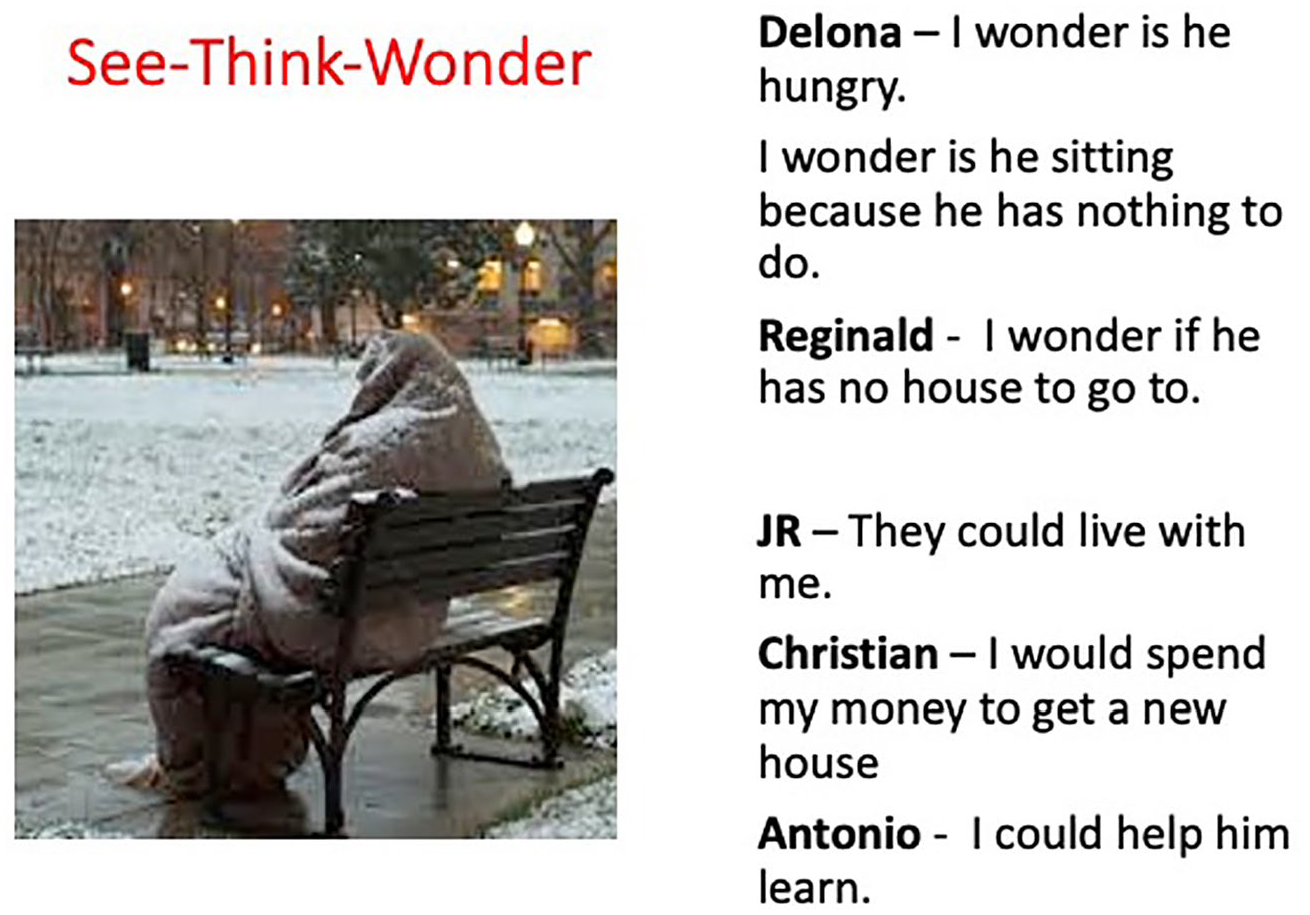
Five-year-olds’ ‘See-Think-Wonder’ comments on a photo of a person sitting on a park bench.
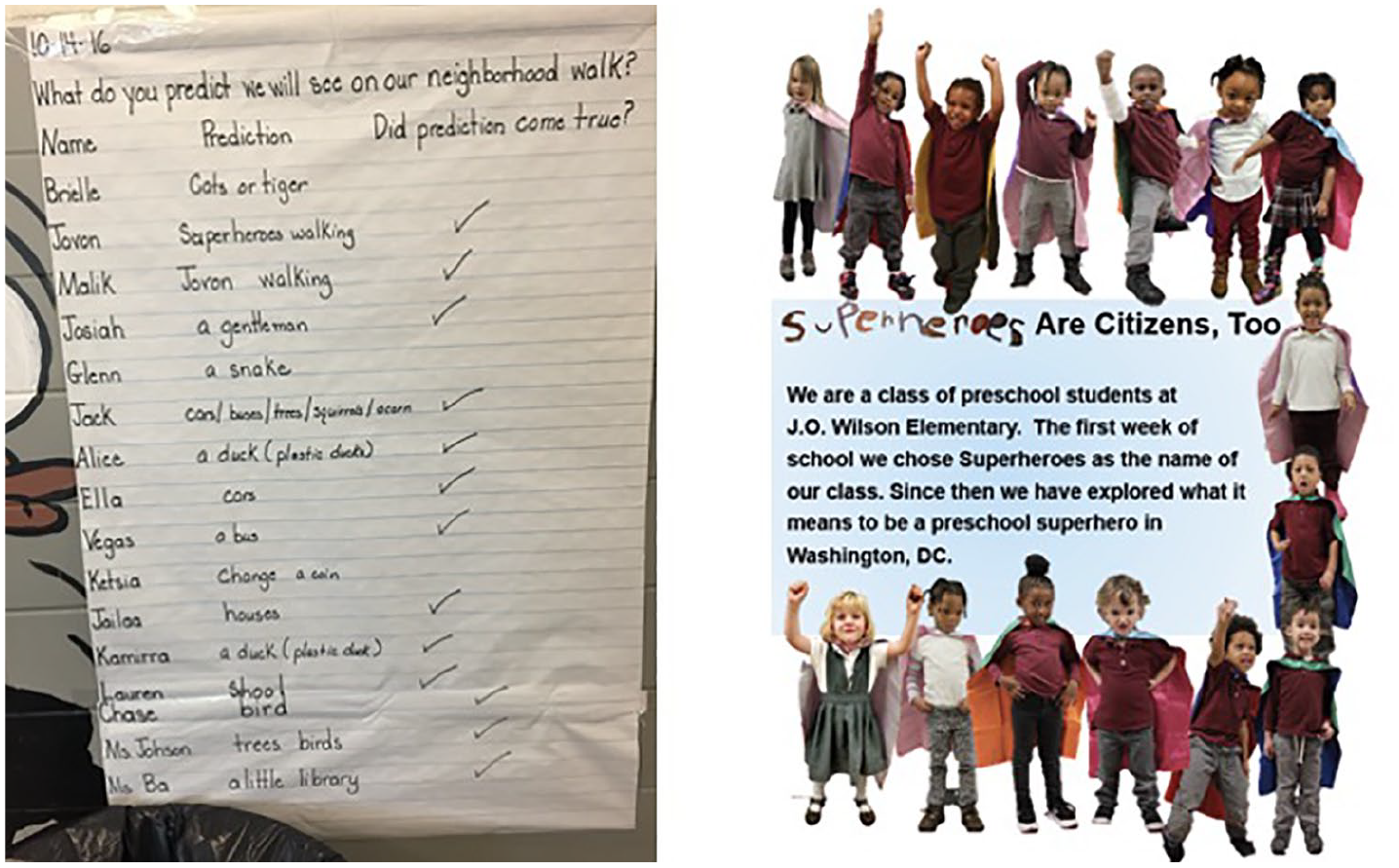
Three-year-olds’ predictions for a neighbourhood walk.
After a few months of exploration, the teachers arranged for a letter to arrive in the mail from a ‘very important person’ (e.g. a museum director) in the community inviting children to contribute a chapter to a book to share what they were learning with others. With their teachers’ guidance, children chose which topic to focus on for their chapter (each class was allotted eight pages), using the following selection criteria:
Important to the community
Brings together children from different socio-economic and cultural backgrounds
Builds on children’s competencies and interests
Entails children learning from and with each other
Invites children and teachers to reflect on themselves as citizens and their connections to the community
Addresses Washington, DC, Early Learning Standards
Draws on the resources of one or more cultural partners
For instance, Georgina Ardalan’s class of 3-year-olds chose to explore what it means to be a citizen (Ardalan, 2017). They invited Mr Allen, a local government official (also the father of one of the students), to the class to answer questions they had generated, such as ‘Are plants citizens?’ ‘Do good citizens do everything people ask them to do?’ ‘Are bad guys citizens?’ ‘Do citizens take care of table toys?’ And ‘How do you know so much about Washington, DC?’ After much discussion, the children settled on the following definition of citizen: ‘a person, big or small, an animal or a plant, that lives in Washington, DC’. Each child signed the agreed-upon definition. When Georgina reviewed the conversation with Mr Allen with the class, they were inspired by his comment about citizens writing letters about issues of concern to the community. The class decided to embark on their own writing project to write cards of happiness in their message centre. When one child asked, ‘Can we make other people happy who are not in our classroom?’, the class decided to find out by writing and illustrating cards that they delivered to people on class field trips. Ultimately, their chapter, entitled ‘Spreading Happiness’ appeared in the 2017 CAC book, entitled Washington, DC: What People Like Most Is in this Book (http://www.pz.harvard.edu/sites/default/files/2017_CAC_Book_vFinal_PRINT.pdf).
Other classrooms chose topics like national monuments, public art and playgrounds, the Metro and traffic patterns. Children shared drafts of their book chapters with children from other schools for feedback. After a lengthy drafting and editing process, the books were both published by and launched at the National Gallery of Art, in a celebration to which families and community members were invited (see Figures 3 and 4). Each class also donated a book to their local public library in a private ceremony. The DC Children’s Librarian submitted the 2017 book as Washington DC’s entry to the Library of Congress’s National Book Festival, in which each state chooses one book to represent it The children’s book, was selected as the official entry to represent DC, and a copy of the book now resides in the Library of Congress.
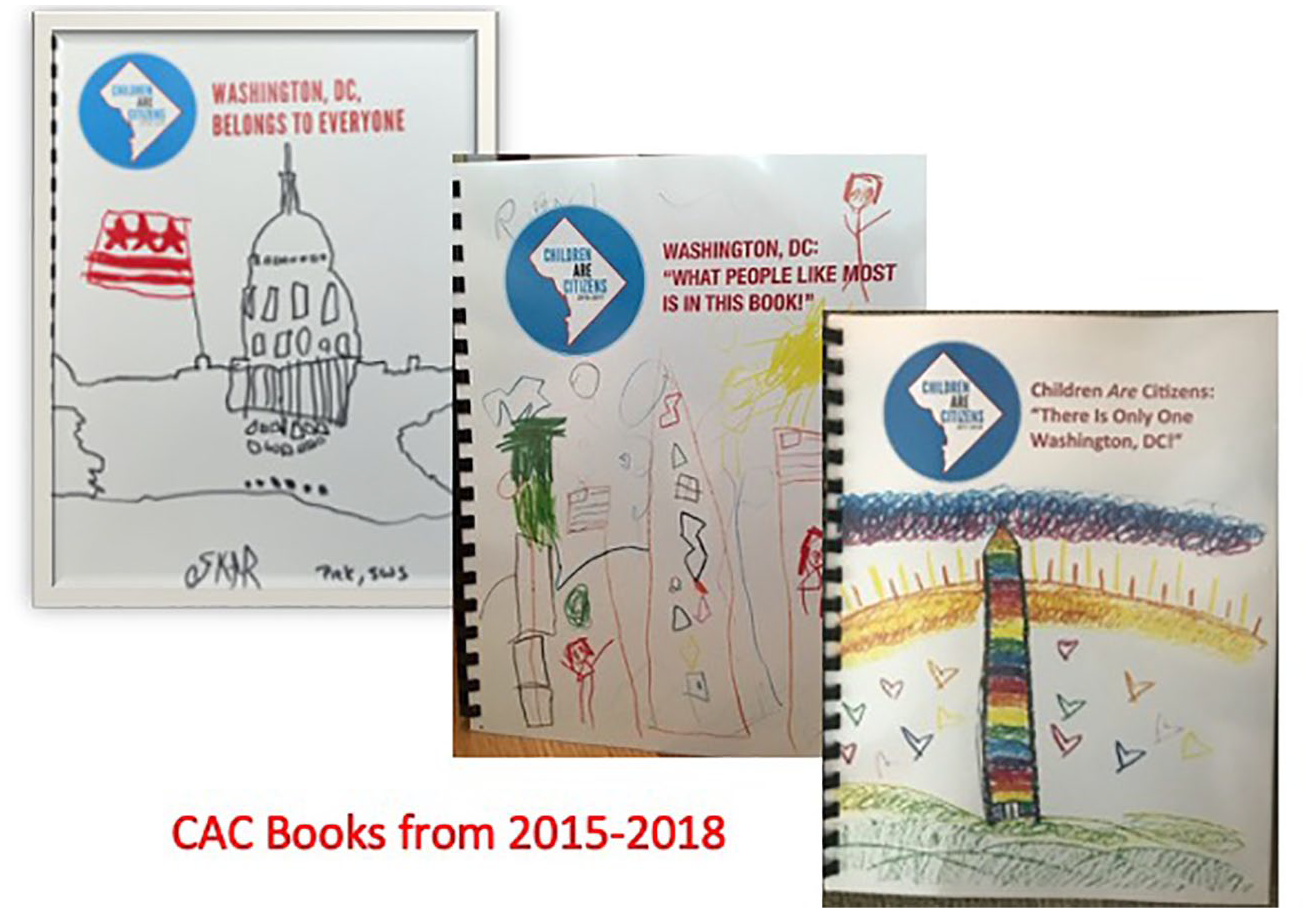
CAC books 2015–2018.
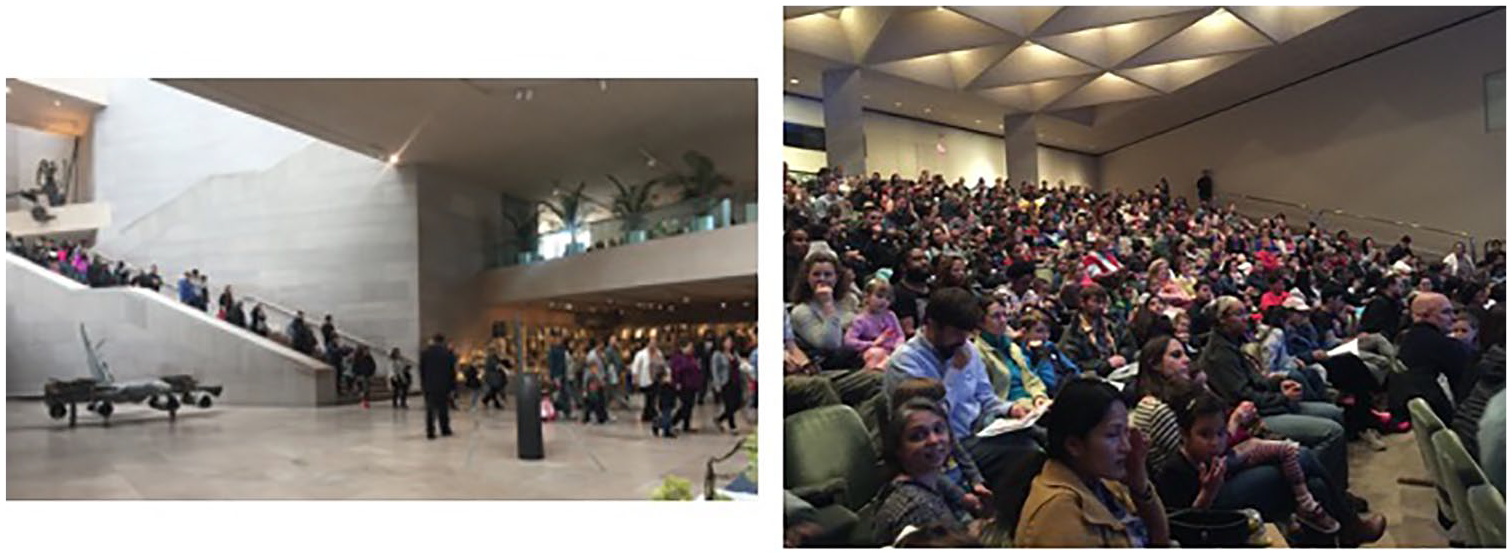
2017 CAC book celebration at the National Gallery of Art.
Gopnik (2009) reminds us that, ‘Very young children can use their causal maps of the world – their theories – to imagine different ways that the world might be. . . Eventually, they enable even adults to imagine alternative ways the world could be and make those alternatives real’ (p. 246). In each CAC project, children learned that the world was larger than their immediate neighbourhood. They developed individual and collective understanding through exchanging opinions and ideas about places to play, areas of expertise and points of interest in their communities. Children did not just share what they already knew – they asked questions and built knowledge together. They acquired the skills and dispositions to listen to each other, and to develop ideas and work together to solve problems – critical capacities for building meaningful connections between children and their communities. When children are encouraged to share their thoughts and feelings, and to participate in the civic and cultural life of their city, they become part of something bigger than themselves that can give them back meaning. At the same time, they learn new vocabulary, become familiar with print and its uses and learn how text and images convey meaning.
Going Out and About
The Out and About project (see www.goingoutandabout.net; Hamm & Iorio, 2020; Iorio & Tanabe, 2019; Iorio et al., 2017; Hamm & Boucher, 2017, Hamm, 2017), a qualitative research project located in regional and urban Victoria, Australia, entails teachers, children and researchers walking and spending extended periods of time with local places once a week or fortnight. There is a slowness present throughout this work as Beach, Cliff, Creek, Bees, Waa (Crow) and Ant become ‘kin’ through an understanding of the stories, histories and acknowledgement of the Traditional Custodians of the Land.
In this project, a central idea is that children are already entangled within more-than-human relations and their community is inclusive of histories and stories of place, trees, waterways, landforms, insects and animals. We recognise places are never neutral and in Australia, the land is unceded and holds many layers of the ongoing effects of colonisation (e.g. massacre, stolen children and stolen land) that are present in the land and society (human and more-than human). We identify as white settler women; this brings particular ethical and political requirements to our work. We take seriously our commitment to make public the tensions that are generated from and with ongoing colonial inheritances. This commitment includes respectfully foregrounding local, Indigenous perspectives in teaching and learning, not as an ‘event’ but as part of the everyday.
In order to do this work, we are inspired by the concept of ‘coming alongside’ (Martin, 2016). This concept opens space for non-Indigenous people to engage respectfully with Indigenous worldviews. Martin explains that ‘coming alongside’ requires time to sit and listen with local Elders, time to think with, listen with and walk with place and more-than-human. This idea is echoed by Dr (Aunty) Sue Atkinson, ‘Yes, to sit and listen to Elders and to Country, engaging with more-than-human others connects to caring for country, plants and the land. I believe that our ancestors still guide us and exist on a spiritual level’ (Hamm, 2019).
Engaging with the concept of coming alongside – a relational perspective – opens space to consider who we are in relation with, beyond exclusively human relationships. Van Dooren and Rose (2016) offer the idea of ‘lively multispecies ethography’ as a way to engage with human ethical accountabilities to places and earthly others: ‘an ethography tends to start with, to be provoked by, other-than-human ways of life, the openness of these accounts inevitably draws humans into the frame’ (p. 86). We understand ethography as a way for humans to activate ethical and moral relations with more-than-human others, aligning with our intentions within the Out and About project. For us, this includes using the practice of ‘lively’ stories – accounts of entanglements with earthly others (see Rose, 2017; Van Dooren, 2014; Van Dooren and Rose, 2016) – as part of our multispecies ethographies.
In the following section, we offer two ‘lively stories’ from the Out and About project provoked by the Out and About Manifesto, a document generated by the children, teachers and researchers co-participating in the project over the course of 5 years.
The Manifesto
Following the traditions of feminist environmental philosophers (Gibson et al., 2015; Haraway, 1991, 2008; Plumwood, 1993, 2002), children, teachers and researchers participate together to create the Out and About Manifesto (see Figure 5). Drawing from the propositions in the Manifesto, teachers and researchers generate pedagogical intentions (see Land et al., 2020) that enact the image of the child as citizen, situating and activating the political and ethical accountabilities embedded within participation. The image of the child as citizen is threaded throughout the Manifesto propositions and activated within the stories from Out and About. Each proposition generates pedagogical intentions that ‘are carefully designed, specific practices that work to foreground and activate ethical and political accountabilities (Land et al., 2020). These pedagogical intentions are ‘experimental, partial, messy, complex, and enact slow pedagogy’ (Iorio & Hamm, In Press, p. TBA). This work is not easy, teachers and researchers grapple with hidden traps; it is so easy for teaching practices to slide into human-centric ‘saviour’ narratives (Taylor, 2020) and superficial educational activities, where humans ‘rescue’ the earth. Deep thinking and attentiveness are required to avoid these slippages.
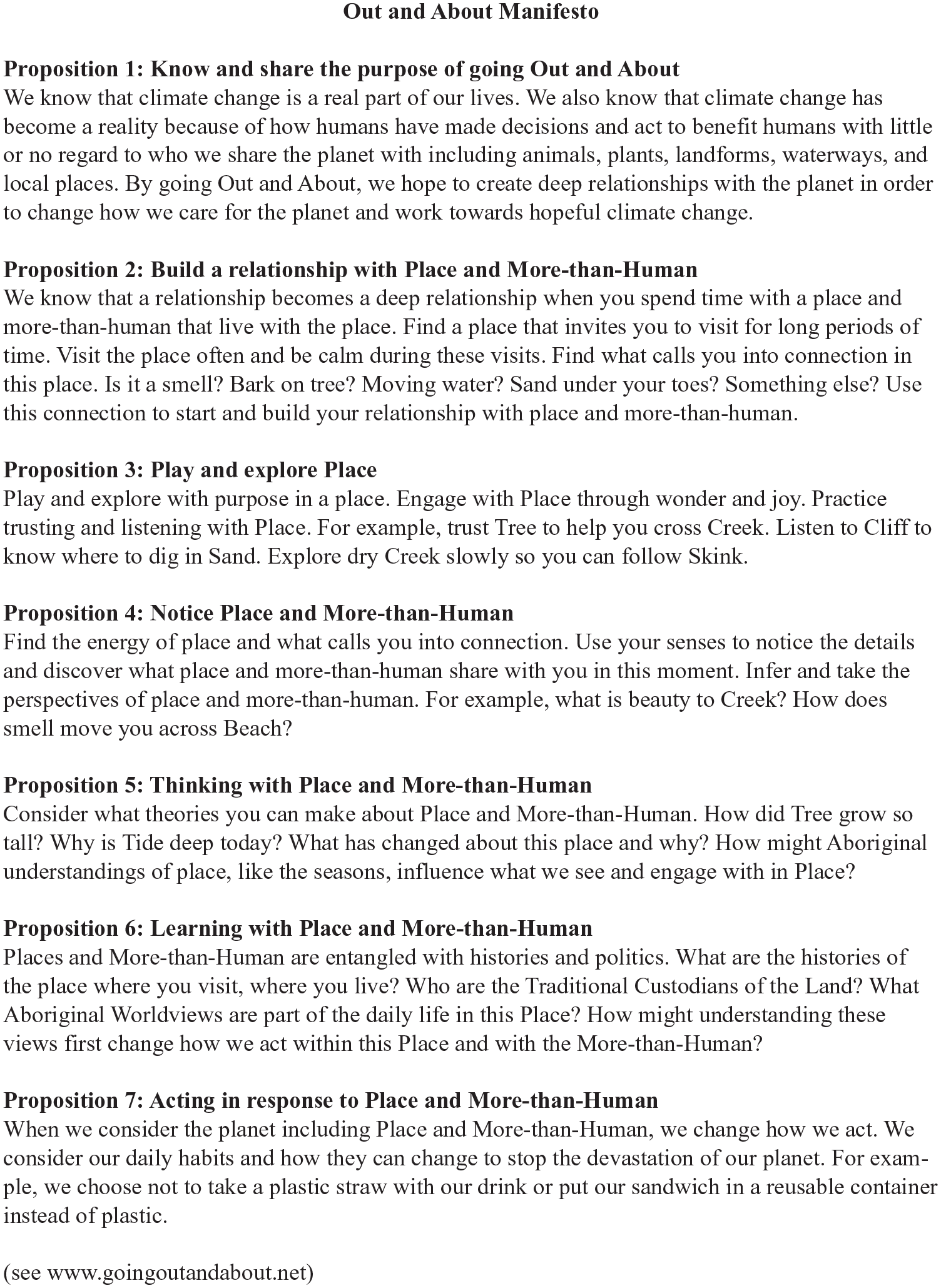
Out and About Manifesto.
Activating Proposition 1: Building a relationship with Place and More-than-Human
Feet walking, feet moving slow and fast, feet stop as hands re-tie shoes, groups of feet traveling down the hill to Fishermans Beach. Calmness, slow movement, movements marking our journey. An anticipation of going Out and About fills the air around each of us; we are returning to a place we know.
Ocean sits at the bottom of the hill, calling us into connection. Blues of all shades sparkle with the winter sun. Warmth covers our bodies on the unseasonal warm day in the Kulin season of Gwangal Moronn, the season of the honey bees. Country should be cooling down following summer, yet today, Sun reminds us of summer. Ocean seems to soak in Sun too, moving, changing blues, and calling us to visit.
Tree growing on the grass next to Fishermans Beach holds a memory for us. Cool, covered, underneath, we know this Place where we find another connection to the place. Branches stretch towards the sun and for a moment, we stop and join branch, sitting and touching with bark.
Continuing on, feet move to the usual spot on Fishermans Beach. Memories of this place from our visits when we were 6- and 7-years old join us as 11- and 12-year olds on this visit. Maybe because we have joined the current 6- and 7- year olds on this visit, or maybe because we remember when we thought with this place previously. Time has been given to us today; time to walk with the place, time to find what calls us into connection.
Something is different today. Reef has emerged from the ocean making visible rock pools – this is something we have never seen before on our previous visits! Feet move with reef into rock pools water moves across toes, hands, legs, shoes! (see Figure 6) Crab emerges from the sand under the water, moving away from us. Sand with hands is a safe place for crab as scooping becomes our hope of spending time with crab. Crab seems scared or maybe angry. Hands bring crab back with her home. Last time, crab hotels populated the beach, all made by humans. Have we begun to understand crabs actually already have homes? Are we listening with crab now?
(lively story, Out and About, 2019)
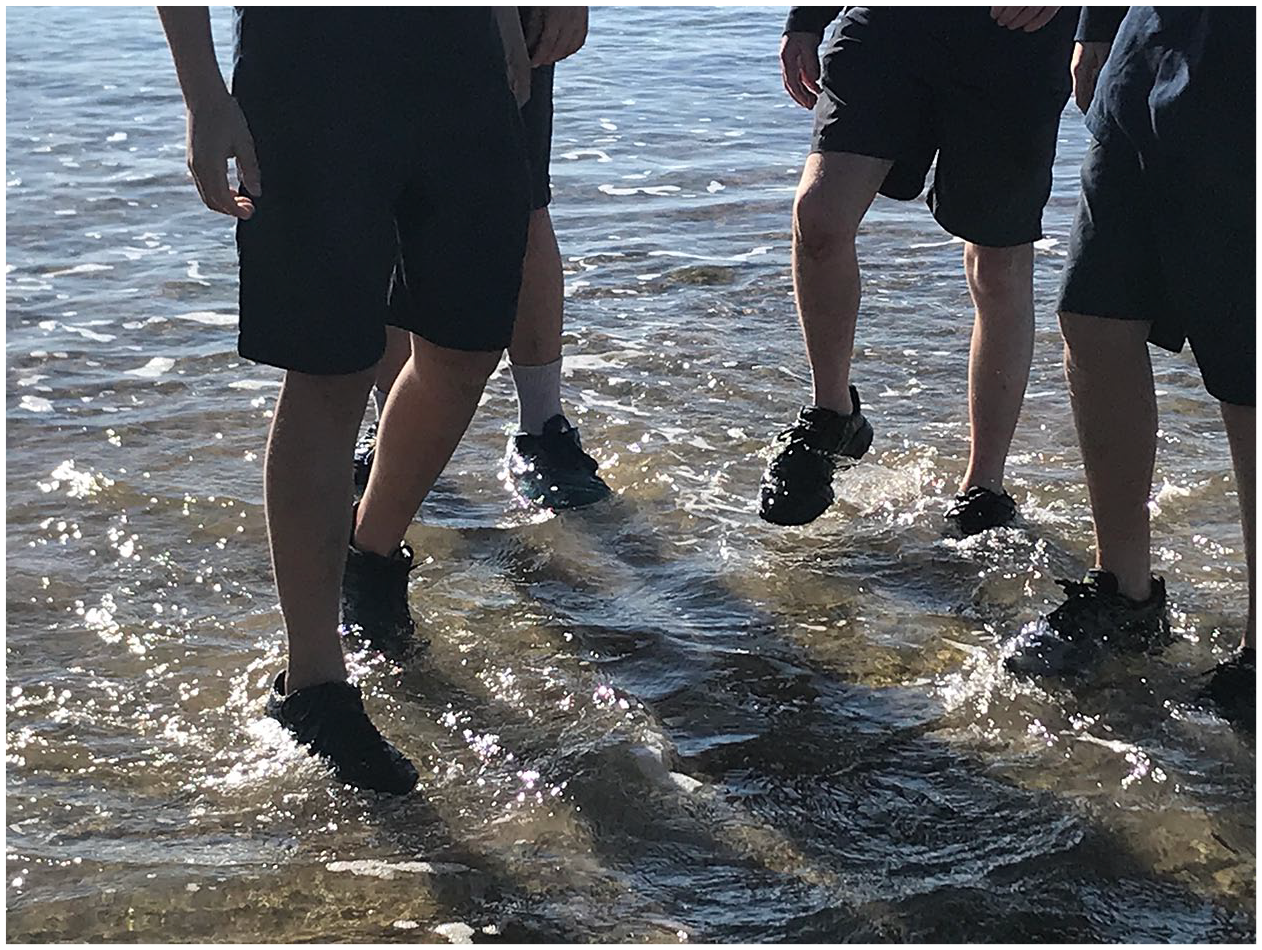
This lively story makes visible the relations between these children, place and more-than-human, but also the critical importance of slowness. For some children in this multi-age group, visiting Fishermans Beach is a new experience while others are returning to Fishermans Beach as in their previous primary experience, where they spent 2 years listening with Fishermans Beach and over 2 years with another local spot, Deep Creek Reserve. What has emerged in this commitment of time are relationships that illustrate how children have been called into connection and the stories that are now told. As children articulate a connection to Tree, or how they feel Water pulling them towards Beach, stories of place and more-than-human are shared. Deep relationships with Crab are evident in how the older children stop and wait for Crab to move in water rather than disrupting Crab’s journey to put Crab into the human-created hotel. In these moments and long pauses, slow pedagogies are at the heart as teachers have created ways in which time activates complex relationships and sees Tree, Beach and Crab as agentic in creating new relations with place.
Teachers and children are called into connection as part of building relationships with place and the more-than-human. Martin (2016) reminds of the requirement to sit and listen with as we ‘come alongside’ Indigenous Worldviews. As many of these children and teachers are white settlers, taking on this practice of ‘coming alongside’ is critical to respectfully engaging with Aboriginal perspectives, stories and worldviews. This is part of understanding the stories of a place and building a relationship with place. Participants in deep relationships know the histories and understand the entanglements brought to the relationship. Generating relationships in this manner offers a way not to become a ‘saviour’ to place and more-than-human. Rather, in these practices, ethical and political accountabilities (Land et al., 2020) are integral.
Activating Proposition 6: Learning with Place
This lively story is written from Catherine’s perspective in collaboration with Place, children and teachers.
It is Winmallee Yallambie-Gunnung (Hot north wind and fishtrap) season
2
day on Wurundjeri-Woi Wurrung Country. The air is hot and dry and the sound of bees humming in the flowering gum blossoms moves with the gentle breeze to me. I am with a group of preschoolers and their teachers, taking our weekly walk with our local place. As we walk, we attend to Sky Country, Waterways and the Land as intentional practices of respectfully foregrounding Indigenous perspectives. We sit by Creek and wonder about the fish trap and Eel trap practices of Wurundjeri-Woi Wurrung people. Are there Eel swimming with Creek today? (see figure 7)
(lively story, Out and About, 2018)
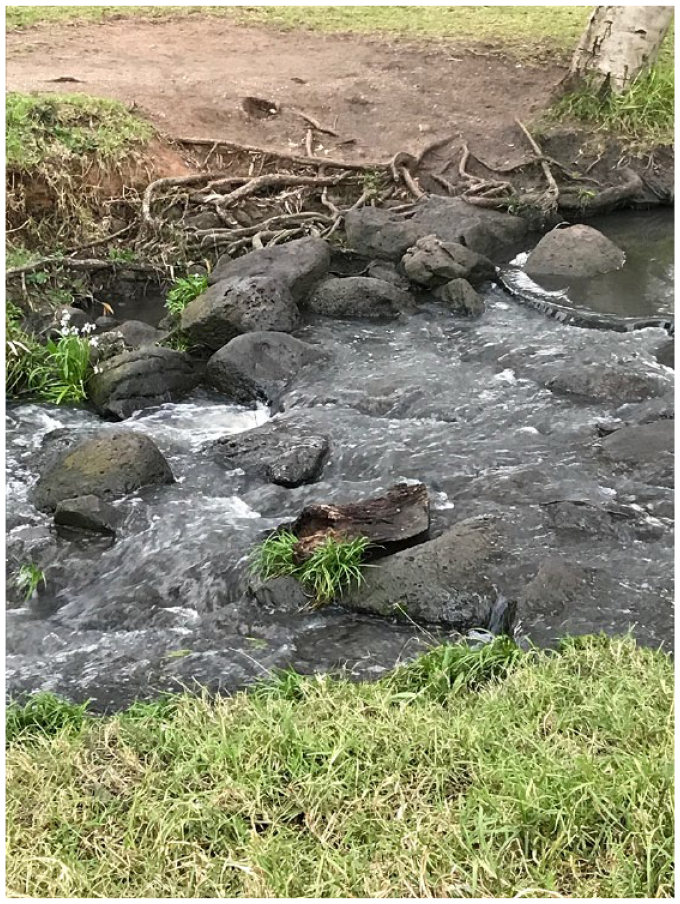
Through this lively story, children and teachers engage with Place by respectfully foregrounding local, Aboriginal perspectives through their engagement with the eight Kulin 3 seasons, rather than inverted Spring, Summer, Winter and Autumn – colonial inheritances that don’t ‘fit’ in this place. The children and their teachers have engaged with ‘place-noticing’ (Hamm et al., 2019) through several cycles of the Kulin seasons, attending to cues from plants, animals and the waterways that signal shifts from one season to the next. Learning with, rather than about place in this way disrupts colonial framing of the seasons as arbitrarily assigned to months of the year. Pedagogical intentions that respond to respectfully foregrounding local, Aboriginal knowledges provoke inquiry for children and their teachers. Learning with Kulin seasonal knowledge prompts investigations of the practices of trapping Eel and Fish, noticing the plants and other animals that are present and the colours of Sky Country. These investigations generate pedagogies that position Aboriginal Elders as holders of environmental knowledge and the importance of caring for Country (Atkinson, 2017).
Thinking with Indigenous perspectives counters tokenistic practices that often homogenise Indigenous worldviews in educational contexts. Thinking with local, place-based Indigenous worldviews disrupts dominant settler perspectives and respectfully foregrounds Indigenous knowledges. This work must include respectful and genuine relationships with local Indigenous groups as well as engaging with the tensions that come with the ethical, historical and political contexts of the local place.
Relational understanding of place foregrounds Indigenous perspectives and situates place as an active part of learning. This conceptual difference calls for moving beyond the colonial inscriptions of place, including recognition of violence committed to places, in order to recover Indigenous ways of knowing and being (see Tuck and McKenzie, 2015). This re-positioning of Indigenous perspectives at the centre of making meaning and acknowledges Indigenous people’s original and ongoing connections with the land.
Conclusion: Co-constructing participation with the local community
In this paper we have shared two projects where children and their teachers enact the image of the child as citizen of the now. The image of the child as capable and competent grounds learning and teaching, and positions children as active contributors to their communities. In Washington, DC, children share their own perspective on what is special about their community with others. In Australia, children engage with their local place, making an ongoing commitment to make visible their ethical and political accountabilities to more-than-human others. We share these local stories not to compare and contrast contexts, but to build collaboration and a collective of local ideas and innovative practices that activate the image of the child as citizen of the now. We hope to inspire others to respond to a world in crisis by engaging children in collaborative projects where they can contribute to their local communities in situated, contextual ways. This will require opportunities for children to actively participate in finding and responding to everyday questions from the world, rather than being burdened with the impossible task of saving the earth for future generations.
Activating the propositions in the Out and About Manifesto generates meaningful relationships with local places and more-than-human others. A multispecies ethographic approach expands the notion of community by de-centring the human in encounters with more-than-human others. In the CAC project, children encounter multiple perspectives and build and communicate their understandings about their local communities in a variety of ways. Both projects illustrate the political and ethical nature of teaching and learning. Building these relationships requires slowing down, listening, attending closely and acting ethical and political accountabilities that come with living well together (human and more-than-human) in precarious times.
Footnotes
Funding
The author(s) disclosed receipt of the following financial support for the research, authorship, and/or publication of this article: The Children Are Citizens Project was funded by generous grants from Fight for Children, the Annie E. Casey Foundation, and the PNC “Grow Up Great” Program.
Notes
Author biographies
 ). Her publications (with co-editor Will Parnell) include Rethinking Readiness in Early Childhood Education: Implications for Policy and Practice (2015), Disrupting Early Childhood Education Research: Imagining New Possibilities (2016) and Making Meaning in Early Childhood Research: Pedagogies and the Personal (2018). Her most recent text Higher Education and the Practice of Hope (2019) (co-authored with Clifton Tanabe) is part of the Rethinking Higher Education (Springer) series she co-edits with Clifton Tanabe.
) and her current projects involve investigating children’s relations with place. Her research brings together post-developmental perspectives of early childhood, environmental humanities and Indigenous worldviews.