




Abstract
Recent investigations in South American anthropology have focused on children in a range of contexts. In ethnographic research with children from indigenous communities in Argentina, we have considered social categories that result in different ways of being a child. In this way, this article presents a model that departs from a traditional, monolithic approach to childhood. The aim is to examine the first stage of life, guided by nominal references, childrearing and the formative experiences of children, with a focus on the network of social relations during this stage of live, particularly, linguistic development, religion and play.
Preliminary issues: Childhood in South American anthropology
Children have become a major focus of South American anthropological research in recent years. This can be observed in the many research groups debating the topic at local and regional conferences and the number of academic theses, journal articles and books on childhood. As Szulc and Cohn (2012) have shown for Latin America, the field of anthropological studies on children has carved out a niche within the discipline over the past two decades (García Palacios et al., 2012; Leavy et al., 2018; Paradise and Robles, 2016; Tassinari and Cohn, 2009). As this research is mostly published in Spanish or Portuguese, scholars from the Global North are largely unaware of it (Rabello de Castro, 2019).
This interest in childhood cannot be considered a new trend in anthropology, since approaches involving children – like those found in research on education and Indigenous communities – can be traced to different fields within the discipline. However, in countries like Argentina, many researchers interested in childhood have traditionally engaged with the topic vis-à-vis more institutionalised fields of study such as education, religion, migrations, Indigenous studies and legal anthropology. Though they worked individually at the start, these researchers eventually formed networks with other childhood investigators at academic conferences and educational institutions. In particular, the emergence of this research field owes much to a young generation of anthropologists, mostly women, who undertook numerous investigations on childhood as a contended social, cultural and historical construction, identifying and examining children’s social agency from an ethnographic perspective (García Palacios et al., 2012).
Thanks to the efforts of these scholars, recent investigations on children have established novel research objectives. In general terms, we could say that Argentine anthropologists interested in infancy and childhood work to reveal children’s myriad perspectives on a range of social phenomena and processes. More specifically, recent studies in this field reveal the new place children occupy in the public sphere and unveil specific aspects of children in formative settings both in and outside school (Batallán and Neufeld, 2011; Hecht et al., 2019; Novaro, 2011; among others). Other topics of interest have included the field of rights (Barna, 2015; Villalta, 2006; among others) and the political struggles for rights that often directly involve children (Batallán and Campanini, 2008; Shabel, 2019; among others). When considered together, these changes would point to new ways of being boys and girls in society and the awareness among new generations of these roles and of their ability to reshape them. In this regard, it is essential to note the new historical twists on children’s actions and expectations.
Far from treating children as a single, unified group, the new generation of anthropologists focused on childhood recognise that children are not a homogeneous collective but have diverse experiences and worldviews. Capturing the voices of children, however, often brings challenges at the methodological level. This line of research, which includes our own investigations, addresses this challenge with a multivocal approach that goes a step further than traditional sociocultural studies on childhood, education and Indigenous people by incorporating the perspectives of the children themselves. Topics like language, religion, education and childrearing have been widely researched in the field of anthropology to bring out the vantage points of adult men and women. Few, however, have attempted to elicit children’s views on themselves, their social practices and surroundings. In this sense, the unique aspect of this novel research in anthropology is a methodology that allows children to express their perspectives within the framework of an ethnography focused on aspects involving them but also the environment at large (Hecht et al., 2019).
In our own research at the graduate, doctoral and postdoctoral level, ethnographic analyses have served to explore diverse social constructions of childhood through a range of educational or learning contexts such as schools (Enriz, 2011; García Palacios, 2012; Hecht, 2005, 2010), language socialisation (Hecht, 2005, 2010, 2012), recreational practices (Enriz, 2006, 2011) and religious education (Enriz, 2011; García Palacios, 2006, 2012). In terms of indigenous childhood, we have conducted research with children from Indigenous communities in Argentina – Hecht and García Palacios in a Toba (Qom) neighbourhood of Buenos Aires, and Enriz with Mbyá Guaraní communities of Misiones – exploring relations between the specific designations of each life stage and the formative experiences of the children in these communities. This article draws on these experiences, presenting materials gathered during extended periods of fieldwork over the past decade in which we often lived with the two communities described.
The social categories that groups apply to different phenomena – in this case, about the stages of life – are not merely descriptive. Instead, they are a substantive part of the thought systems of actors who build the world around them through these categories of understanding. In order to reconstruct these important social categories, the ethnographic research that lays the groundwork for this article draws on the voices of all the actors in the groups we work with, including children.
On the other hand, the detailed description of the different stages of life of a given social group is the empirical basis for the claims about diversity of childhood so in vogue in academia today. Specifically, thinking about Indigenous children contributes to more sensitive views on the experiences of children and also more respect for these experiences on the part of the institutions and organisations who work with them. Moreover, it favours the break with the homogeneous and hegemonic view of a single ‘global childhood’ (Rabello de Castro, 2019). In the so-called ‘Global South,’ there is no one childhood, but multiple childhoods that coexist in conditions of great inequality. Therefore, it is fundamental to draw attention to the diversity within childhoods that the ‘Global North’ monolithically treats as ‘other childhood.’
This article is divided into four sections. The first offers a brief overview of the research methodology and mentions certain characteristics of the Qom and Mbyá communities of Argentina that have been the focus of our fieldwork. In the second section, nominal references to the stage of childhood in the Mbyá and Qom communities are analysed, while childrearing practices and children’s formative experiences, including topics such as language, play and religion, are addressed in the third section. Finally, the conclusions present reflections on Indigenous childhood today.
Methodology
The materials analysed in this text were gathered over the course of a decade of ethnographic research conducted with two indigenous groups in Argentina, the Mbyá Guaraní and the Toba/Qom.
The Guaraní people inhabit an area that encompasses parts of Argentina, Bolivia, Brazil and Paraguay. Considering the entire region and all of the existing subgroups (Aché, Avá or Ñandeva, Mbyá and Paĩ or Kaiowa), the total population exceeds 100,000. In Argentina, the Guaraní live in the provinces of Salta and Misiones. In Misiones, where the fieldwork reported here was conducted, 6500 individuals from the Mbyá subgroup live in clusters (tekoa) in the countryside (Grumberg and Bartomeu, 2008). The living conditions of the different Mbyá clusters in the province of Misiones vary significantly and these differences can mainly be attributed to the ties these groups have with state institutions. With regard to schooling, there are also differences, though a high percentage of the communities has only limited access to schools.
The Mbyá communities are rural or peri-urban. There are no explicit property divisions on their land, only stretches where vegetation grows. Grouped in twos or threes, the family houses are separate from those of other families. Each family group shares a patio and fire pit, the gathering point for conversation, caregiving and food preparation. Some of the family homes – like those of grandparents, especially acknowledged spiritual leaders – have a special status. Children pay grandparents daily visits and seek their advice. The home of the spiritual leader is the site where religious ceremonies are held, some by day and others by night. The community layout is based on a certain logic of movement between the various family settlements; entering a settlement is referred to as a visit and its frequency and duration vary. On the other hand, family members may also move as the result of major events like enmities, illness and a range of other crises.
In terms of methodology, the fieldwork involved ethnographic research conducted during several stays with the different community clusters in the province of Misiones from 2003 to 2015 (Enriz, 2011). Until 2010, the research mainly focused on three locations in the centre of the province, each with different relationships to state institutions that is, schools, public healthcare, etc. During our stays, children’s everyday activities, their reflections on these activities and the thoughts of the adults were an emphasis of the analysis. The ethnographic focus meant fully participating in all activities whenever the cluster agreed to having the researcher present. Generally, the fieldwork was not filmed or recorded and written observations were made only after the events. During interviews, no written observations were made; these were informal conversations guided by the research questions while allowing for spontaneous reflections. With regard to quantitative linguistic information on the Mbyá, our only data comes from Argentina’s 2010 Census and the supplementary survey for indigenous populations, since this is an area that has received little attention in the country.
The Toba people, whose ethnonym is Qom, are part of an ethnic and linguistic group called Guaycurú, which also includes the Mocoví, Pilagá, Kadiwéo (or Caduveo) and groups that have disappeared, the Abipón, Mabyá and Paraguá (Messineo, 2003). According to data from Argentina’s 2010 census conducted by the National Statistics and Census Institute (INDEC), 126,967 people who self-identify as Toba/Qom live in either Buenos Aires or the northeast. They represent 13.3% of the total indigenous population nationwide.
The neighbourhood in Greater Buenos Aires where we did most of our research was built in 1995 by 32 families, most of whom came from rural and semi-urban communities in the provinces of Formosa and Chaco, where we have also done supplementary ethnographic work to understand the situation of this population (García Palacios, 2012; Hecht, 2010). Their reasons for migrating to the city of Buenos Aires were mainly economic (expropriation of their lands, deforestation and the crisis in cotton production in Chaco, etc.). In addition to the 32 family homes, the neighbourhood where the fieldwork was done has a community centre that hosts crafts fairs, workshops, etc., a community dining hall (not currently in use), a soccer field and three Evangelio churches. The Evangelio (literally translated, ‘Gospel’) is a religious movement that dialectically links elements of Pentecostal evangelism – notions of healing and spiritual gifts, glossolalia or the ‘gift of tongues’ – with the ‘traditional Toba socio-religious baggage’ tied to shamanism (Ceriani and Citro, 2005; García Palacios, 2014; Wright, 2008).
Children are generally free to move about the neighbourhood on their own. A small percentage attends a private Catholic school located across the street, while the majority go to one of the nearby public schools. Although Argentina’s Constitution guarantees access to an education that takes into account the ethnic and linguistic identity of Indigenous people, the province of Buenos Aires does not have a single school where Indigenous languages are taught or the cultural contents of these communities are part of the curriculum. The socioeconomic situation of the families depends on the production and sale of handicrafts, outreach work to spread ‘Toba culture and language’ at different schools and state welfare benefits.
With regard to the methodology utilised in the fieldwork, ethnographic and sociolinguistic strategies were combined with research-intervention workshops (García Palacios, 2012; Hecht, 2010). From 2002 to 2012, an ethnography of the neighbourhood registered the day-to-day intergenerational speaking practices and aspects of children’s religious socialisation in different spaces. Therefore, one of the main methodological tools was participant observation (without a recording device and without taking notes in front of the subjects to strengthen affectional bonds) in the social spaces where children, youth and adults interact: homes, medical visits to the dispensary, community meetings, religious worship, celebrations, playtime, outreach work at schools, etc.
In addition to the observations, local residents participated in recorded interviews. Notes were taken during these interactions, as this was not spontaneous dialogue. More than 30 adults (ages 24–70) were interviewed, along with approximately 40 children and youth (ages 4 and up). This ethnographic approach was supplemented by intervention workshops with children in order to create a novel research tool that could address some of the demands and social needs the subjects voiced. The first was a Toba/Qom language revitalisation workshop, followed by one on reconstructing the story of the neighbourhood from the perspective of its children and youth; and finally, one on communication and the use of technologies. Many residents viewed these interventions as a way of giving back to the community while it also provided us as researchers with an opportunity to expand on aspects that had come up during the other activities.
Most of the core topics in this text arose from discussions on our respective research teams. The decision to include both research populations in this text highlights the value of the comparative viewpoint but does not overlook their unique realities. The importance of diverse ways of thinking about childhoods lies in revealing the myriad forms of that generic category of ‘other childhood.’ The similarities and differences between the two experiences – that of the Toba/Qom people versus that of the Mbya people – significantly enriched the analysis.
Linguistic denominations of the life cycle among the Qom and the Mbyá
In public policies and legislation – and among state officials and professionals – childhood tends to be conceptualised as a universal category for all humans ages 18 and under in accordance with the United Nations Convention on the Rights of the Child. This is precisely how it is defined in Argentina’s Constitution in 1994. In our research, native categories are used to define different ways of being boy and girl because we believe that incorporating these categories to the analysis denaturalises the hegemonic meanings assigned to this category and thus facilitates a break from monolithic, Eurocentric approaches to childhood.
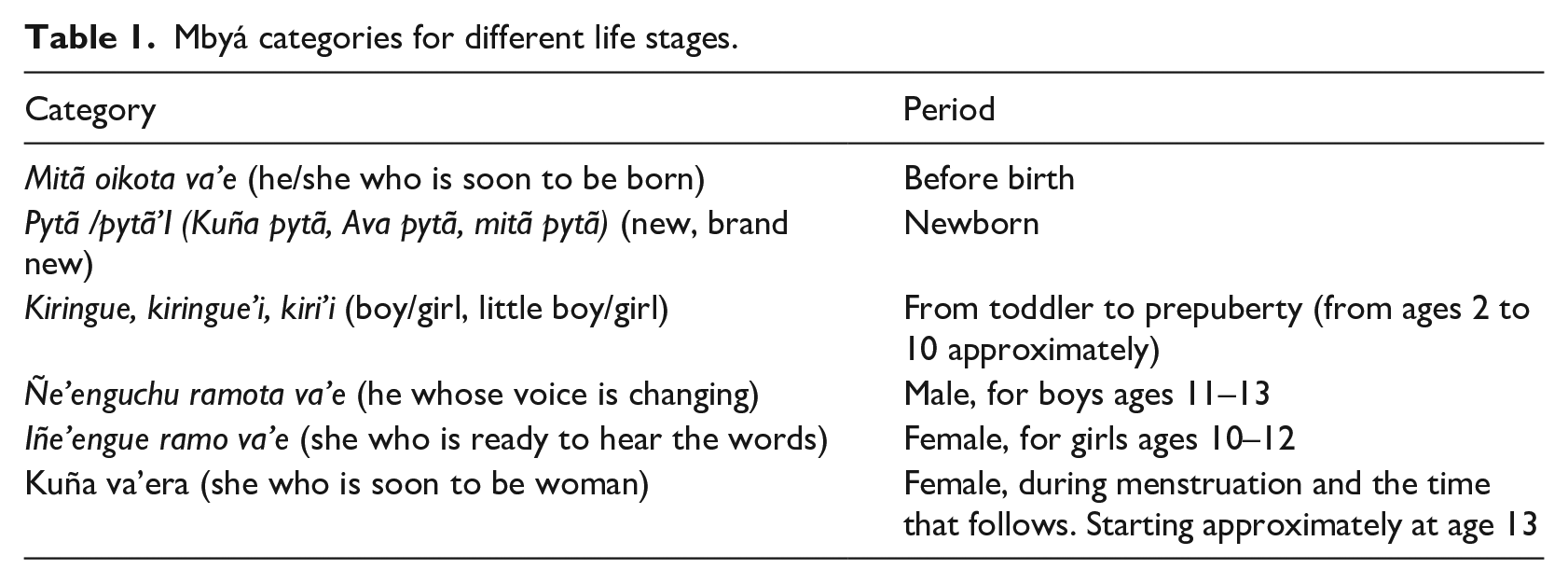
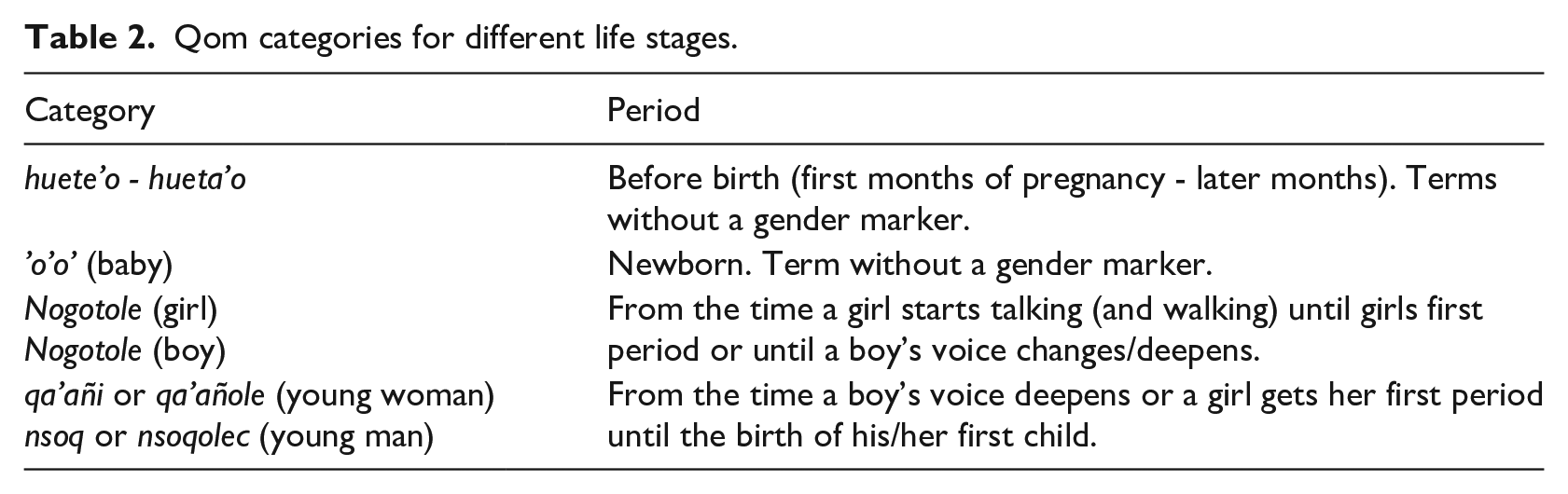
In this regard, this text proposes to contribute to the definition of childhood and to the nuances that the notion of childhood can acquire among different populations in terms of both the ages it encompasses and its sociocultural implications. Herein, the cases of the two communities will be presented separately because, although there are similarities in the ways they conceptualise childhood, our research showed that they are not the same (see Tables 1 and 2).
Mbyá categories for different life stages.
Qom categories for different life stages.
The Mbyá categories for the different stages of life allow us to consider the dimensions life acquires (see Table 1). The child to be born is referred to as Mitã oikota va’e (he/she who is about to be a child). Once born, the child is referred to as pytã or pytã’i (new or brand new; the -i suffix indicates the diminutive). This category applies to every newborn. Pyta may be accompanied by a term that indicates whether the child is a girl or boy (kuña pytã, ava pytã) or simply mitã pytã (child) (Cadogan, 1992).
Children display certain behaviours during this period and are very attached to their mother, father and family members, with whom they share social spheres (the fire pit, the home of the elders). There are ceremonies associated with childhood in the communities, like the ñemongarai, in which the little one’s status as a child is recognised. Once a child has a name, begins to speak and, fundamentally, develops certain motor skills (around age two), he or she is referred to as kiringue, kiringue’i or kiri’i.
The differentiation between boys and girls begins between ages 2 and 3. Later, between the ages of twelve and thirteen, many aspects of everyday life begin to evolve depending on the child’s gender and social categories change. In the case of boys, they go from ñe’enguchu ramota va’e (he whose voice is about to change – ages 11–12) to mitan ruchu (he whose voice has deepened, young man from approximately age 13 and up).
The transformations for girls begin gradually and peak with the first menstruation as a definitive step towards adulthood. In the time leading up to menstruation, when certain changes become evident in a girl’s body, she is referred to as Iñe’engue ramo va’e (she who is ready to hear the words). As we will see further on, this denomination is associated with the possibility of young women absorbing adult women’s advice during the ñemondyiá ceremony. Once she has menstruated, the girl is referred to as kuña va’era, (she who is ready to become a woman) and later, after having a child of her own, she becomes kuña tai (young woman).
With regard to the Toba/Qom, it is first important to note that there is a word in Qom that can be loosely translated as ‘childhood and youth.’ The word is nogotshaxac (nogot, ‘boy/youth’ and shaxac, ‘the way of being’; literally, then, ‘the way of being boy/girl/youth’) (Hecht, 2005, 2010). This period starts at birth and extends to the birth of one’s first child, covering different stages that involve various traits, expectations, attitudes and abilities. There are several categories used to refer to these stages (see Table 2).
The first stage within nogotshaxac covers the time inside the womb: the child to born is referred to as huete’o in the first months and hueta’o in the later months (Hecht, 2010). At birth, the person becomes ’o’o’. This period is characterised by close contact with one’s domestic circle and doting on the part of adults. Once the baby begins to speak, he or she has entered the next stage: nogotole and nogotolec (girl and boy). The ability to walk plays a significant part in the change of status of little ones, though the subjects did not explicitly mention it as a condition for change. During this period, which proves crucial for social learning, children participate much more actively in the family economy and work, looking after siblings and doing certain household chores. The transition to the next stage is marked by menstruation for girls and by the boy’s voice changing. The girls are then referred to as qañole (young woman) and the boys nsoqolec (young man), and both are now considered ready for living on their own. This stage and the entire nototshaxac period culminates with the birth of one’s first child (Hecht, 2010).
According to Stephens (1995), while all cultures apparently give particular meanings to different ‘ages of life,’ this content varies significantly. Now that the first stages of life for the Mbyá and Qom communities have been defined based on their linguistic denominations, the next section examines these stages from the perspective of caregiving, childrearing and children’s formative experiences. Thus, employing the nominal references referred to above, the emphasis will now turn to the network of social relations developed during childhood, considering questions related to language, religion and play during the first two stages.
Childrearing from birth: Caregivers and experiences
Among both the Mbyá and the Qom, the most prominent characteristic of the stage that begins with birth and lasts until one begins to speak (pytã or pytã’i for the Mbyá and ’o’o, for the Qom) is that the little one’s caregivers (adults, but also older children) work to satisfy their demands, adapting to their rhythms and their material and emotional needs (Colangelo, 1994; Enriz, 2006; García Palacios, 2012; Hecht, 2010).
In many social groups, speaking marks stages in the life cycle because it is tied to many other references and identifications that exceed the use of a given lexical, grammatical or phonological resource (Saville Troike, 2005). In the case of the Toba/Qom, the first stage of the life cycle concludes when the little ’o’o’ begins to speak. Among the Mbyá, speaking is combined with the ability to walk or move on one’s own, and mobility takes priority over speaking. As a result, mothers and fathers grow worried if they notice that the child has some difficulty that keeps him/her from walking and draw on certain special resources to encourage movement. For example, as analysed in prior works (Hecht et al., 2008), caregivers often use a fruit of a plant referred to as ’ele’ l’achaxat (‘parrot’s tongue’) and shaped like a swollen capsule to encourage speaking. The capsule is popped inside a baby’s mouth, producing a noise that is believed to be stimulating. Another way the Qom encourage speaking it to feed children grilled millic (crickets). Both traditional remedies reveal an analogy between the name or characteristics of the plant/animal and their effects. Therefore, all resources used to stimulate speech involve animals or plants that make sounds in the hope that the child will then begin making sounds on his/her own (Hecht et al., 2008). Similarly, sometimes the Mbyá use objects from nature that foster certain abilities among children, like the shells of certain snails to help toilet train and certain musical instruments that protect the little one’s soul from the dangers of the forest (Enriz, 2011). To foster mobility and movement, thick branches are used to form an arch (referred to as amba or kiringue amba) as tall as the child that allows them to stay balanced when standing.
Returning to the importance of speech, it is critical to note that in the Toba/Qom settlement where fieldwork was conducted, there was a visible language shift from Toba/Qom to Spanish in most communicative interactions involving children. In studies on the childrearing practices in other Toba/Qom neighbourhoods of Buenos Aires, Colangelo (1994) and Ibañez Caselli (2007) have noted that although the Toba/Qom language is still used at home in exchanges between parents and babies, la castilla (Spanish) is gradually imposed as a result of both school and contact with other non-indigenous children. In spite of this notable shift, the bond between the o’o’ and their mother tongue continues since they grow up in a clearly bilingual environment: while Spanish is the language most commonly used with other children, parents prefer Toba/Qom when speaking among themselves and with their babies (Ibañez Caselli, 2007). In this regard, children are brought up in complex linguistic environments. Additionally, as noted by De León (2005), it is important to discern the idea of ‘speaker’ from that of ‘participant,’ since this participation allows children to observe verbal and non-verbal interactions that contribute to the development of their linguistic competence. In other words, little ones develop their communicative competence as they participate in social activities (De León, 2005). For this reason, the linguistic settings in which babies develop prove critical to the analysis.
With regard to different formative religious experiences involving these younger children, as mentioned above, the Mbyá practice child-naming ceremonies known as the ñemongarai. As noted by the Brazilian anthropologist Pissolato (2007), these ceremonies are indicative of the community’s interest in childhood and receiving a name establishes the necessary conditions for being considered a person. Being named means that the opygua (an elder, a spiritual leader) has communicated with the gods to determine the region of origin of the child’s soul. It is also important that during the period in which children are included in the ñemongarai, they already have reached a certain level of development, as up to a year has passed since birth. Throughout this period, children acquire many abilities, like sitting up on their own, making certain sounds and walking. As with other important ceremonies, like those used to cure serious illnesses, the lives of all those in the cluster are arranged around these religious milestones. The value of words when acknowledging a person is undeniable, particularly considering that word and soul are a binomial pair (Cadogan, 1992). Yet in order to be able to have a name and be interpreted through the words of the gods, the child must have reached a certain level of development through other practices that contribute to establishing one’s self.
In the case of the observations in the Toba/Qom neighbourhood, the Evangelio was clearly the most predominant space for sociability and community interaction during church service and other activities it organises (García Palacios, 2012; Miller, 1979; Tamagno, 2001). Children and adults have attended church since they were babies (’o’o’); it is thus part of everyday life. If a child is discovered to be suffering from an illness or ailment, the Evangelio provides therapy options, though, as Colangelo (1994) noted, these are often combined with popular traditional remedies and allopathic treatments. This evidences the importance of the Evangelio throughout people’s lives and not only at the point in which ‘they give themselves over’ (García Palacios, 2012). (‘Give oneself over’ is a native expression that refers to the moment in which the person ceases to ‘be in the world’, drinking, going out dancing and ‘fooling around’ and moves into the Evangelio).
Childrearing guidelines and children’s formative experiences
In our ethnographic studies, we established that the next stage in childhood (kiringue, kiringue’i and kiri’i for the Mbyá and nogotole and nogotolec, for the Qom) begins when children acquire abilities such as walking and talking, each of which has its own value. As noted earlier, it is important to consider that in the case of the Toba/Qom, the transition to this new stage comes when the little one starts speaking. Speaking is associated with ‘understanding’ and ‘reasoning,’ that is, with an individual’s intellectual development; at the same time, it is crucial for learning and for a person’s formation as a social being. With regard to speaking, the ‘orders’ or instructions that adults give their children on how to behave in everyday situations become particularly important during this life stage (Hecht, 2010). While language is highly emphasised in childrearing, the learning processes involved in observation and imitation are also essential to the process.
In the case of the Mbyá communities, the transition to the new stage is strongly associated with walking. Once children can walk, they can travel within the community, going from one place to another, for example, from the fire pit to the house. Their range of movement cannot exceed the area cleared of vegetation, where everything is visible and certain dangers can be avoided. Within the safe area, however, children come into contact with fruit trees, water and different elements that grant them independence and permit a diverse range of activities. In the Toba/Qom neighbourhood, children also have greater independence once they can walk as this allows them to go outside their home and move about the community. Among both the Mbyá and the Toba/Qom, then, walking allows children to move with a good degree of freedom in the community space. At this stage, parents are not the only ones caring for and supervising the children; older siblings and cousins are now also entrusted with this task. Numerous studies (Colangelo, 1994; García Palacios, 2012; Hecht, 2010; Ibañez Caselli, 2007) have shown that the Qom ‘caregiving style’ is neither ‘careless’ nor ‘negligent’ as it might well be seen from the Western perspective; instead, it is rooted in strong family and group support for the children. For many Indigenous people, caregiving does not involve enclosures, limits or isolation, but providing children with freedom and the ability to move safely within a solid surrounding structure or frame of reference.
In this regard, as conceived by the adult population of the Mbyá and Toba/Qom, childhood appears to be a time for living as many experiences as possible in order to garner the knowledge expected of an adult. For this reason, it is possible to consider children’s autonomous circulation in the community and their broad margin for decision-making as part of a ‘native pedagogy’ (Tassinari, 2007) that recognises children’s agency in the learning process by enabling children to move freely about different spaces and ‘see it all’ (García Palacios, 2012).
The child who can safely wander gradually joins a group of peers and other children of different ages – play groups – and together, they explore and become familiar with their surroundings. In the case of the Mbyá, recreational practices are formative experiences have been prioritised in our analysis, particularly during the stage of kiringue. There are several reasons for this emphasis, fundamentally because this is a period of frequent experimentation with peers. Children move around the community and gain new experiences. They play no role in subsistence and their activities are divided into two categories: recreation (ñeovanga) and community contributions (jajagua).
With regards to the relationship between playing and life stages, it is important to note that childhood recreation requires that the child be part of a group of children, generally of different ages and genders. This play group or community does more than just play, incorporating dynamic experiences that also support learning, including those related to subsistence, school and religion.
Practically all the children from the Toba/Qom neighbourhood (fundamentally in the nogotole and nogotolec stage) go to church and Sunday school (a place reserved for children) and can be seen coming in and out during services. It is important to examine children’s other formative experiences, ones that often go unnoticed precisely because they are part of everyday life: church ceremonies like anniversaries, weddings, fifteenth birthday celebrations; occasional gatherings to make and sell bread in the neighbourhood; and gatherings to practice religious music. As noted earlier, children are free to come and go from different social spaces – as well as places of worship – from a very young age and this also contributes to learning. Children’s circulation and participation in religious spaces help build significant knowledge. To mention just one example, children learn to pray when they are afraid at a young age and demonstrate extensive knowledge of the act of praying and its potential (García Palacios, 2012, 2014).
In summary, having reviewed different formative experiences (religious, recreational and linguistic) from the first stages of childhood, it is important to note, as found in previous studies (Hecht, 2010), that the stage in which boys and girls are referred to as nogotole/c among the Qom and kiringue among the Mbyá is critical to growth. Children evolve into social beings within their sociocultural surroundings during this stage, but more importantly, based on native conceptions of this time in life, it is when children attain the largest portion of the knowledge required for collective living.
Final thoughts
Based on these studies comparing formative religious, recreational and linguistic experiences during different stages of childhood, it is possible to argue that the earliest stage of childhood entails the greatest amount of caregiving, the closest supervision and immediate responses to any need that could cause little ones to become fussy. As children grow older, these responses on the part of adults gradually lessen. Young children, however, are always protected by older children, who are in turn looked after by the adults. On the other hand, the moment in which children are referred to as nogotole/c among the Qom and kiringue among the Mbyá is a critically important stage, as this is when children evolve into social beings within their sociocultural surroundings and actively acquire the necessary knowledge for community living.
As seen throughout this article, the childrearing and teaching/learning processes among the Qom, the Mbyá – and, extrapolating, other Indigenous people of South America – often involve children circulating with groups of their peers around the community. In some cases, these peer groups do things on their own; in others, they accompany elders in their subsistence activities. These vitally important activities to becoming competent in this environment (Hecht, 2010; Szulc 2011) are learning processes closely tied to experience (Hecht, 2010; Hecht and García Palacios, 2010).
At the same time, several important studies have provided insight into how different societies have diverging approaches to complex but naturalised concepts like that of ‘child’ or ‘baby.’ Such research not only expands the anthropological understanding of this period of life but also helps propose strategies for intervention in fields such as intercultural education: how to design proposals based on native definitions of childhood in order to think about intercultural research frameworks. In this regard, it is important to emphasise that Indigenous children are the targets of public policies in area like education – particularly intercultural education – and the scope and design of such policies impact their daily lives. Educational practices in Argentina are generally based on an inflexible model that entirely overlooks native stages of childhood and other modes of attachment of these communities. Thus, the social categories and experiences that we examine here are undergoing transformations in the light of the increase in graded school systems.
In closing, we believe it is critical to develop an ethnographic approach to children’s perspectives in order to include them when studying social categories. This requires not only interviews but also participant observation in the myriad interactions among children and between children, adults and the social world (García Palacios and Hecht 2009). With this methodology, the social fabric that envelops the youngest children of a community can be reconstructed. More specifically, participant observation proves fundamental when studying babies, since interviews are not possible with this population. In terms of children, this methodology also proves fruitful by allowing investigators to document knowledge and practices that would not necessarily appear during conversation, like those related to linguistic uses and participation in recreational spaces. Without ethnographic observation, it would be impossible to learn about children’s experiences or understand the underlying complexities of denaturalised definitions of childhood.
Footnotes
Funding
The author(s) disclosed receipt of the following financial support for the research, authorship, and/or publication of this article: This research is supported by the National Council for Technical and Scientific Research (CONICET, Argentina) and University of Buenos Aires (UBA, Argentina).
