




Abstract
Since the advent of the United Nations Convention on the Rights of the Child (UNCRC), concerns have been raised regarding tokenistic engagement with children’s participation rights as well as ethical considerations that must be addressed in research with children. This article explores how one particular ethical dilemma regarding representation and who can speak for whom in children’s rights-based research was confronted through critically reflexive ethics in practice. While publication of Ethical Research Involving Children and the ‘International Charter for Ethical Research Involving Children’ provide guidance for researchers, further illustration of how ethical dilemmas have been confronted and addressed within a particular research context could provide further guidance and insight regarding how critically reflexive ethics in practice can be utilised as a further contextual-based tool towards ethical research. Thus it is the intention that this illustrative example can encourage others who are engaged in research with children to continually undertake critically reflexive ethics in practice with their own ongoing research, consultation and engagements with young children.
Since the advent of the United Nations Convention on the Rights of the Child (UNCRC; United Nations, 1989), concerns have been raised regarding tokenistic engagement with children’s participation rights (Hart, 1992; Mellon and Tisdall, 2020; Murray et al., 2019; Shier, 2001, 2010) as well as ethical considerations that must be addressed in research with children (Graham et al., 2013; Harcourt et al., 2011). However, even with the best intentions of entering into research with children following these ethical guidelines, there are moments in a research project where ethical issues and questions are confronted. What happens in those moments is seldom the focus of publication, thus providing little insight for other researchers who may confront their own ethical issues. This article illustrates how critically reflexive ethics in practice (Graham et al., 2015) was utilised to confront ethical issues of representation in a recent research project undertaken with two groups of children in Aotearoa New Zealand. It is hoped that this illustrative example can guide others who are engaged in research with children to continually undertake critically reflexive ethics in practice with their own ongoing research, consultation and engagements with young children.
Critically reflexive ethics in practice
In order to conduct research with humans, researchers generally must acquire ethical approval from their institutions’ Human Ethics Committee, or similar orgainsations, to ensure that they are following all the accepted rules, guidance and supports to protect the participants and themselves. These are procedural ethics (Bessell, 2017; Graham et al., 2015; Guillemin and Gillam, 2004). However, once ethical approval at this level has been achieved, ethical considerations are far from over.
Throughout the research process ethical issues and dilemmas are constantly arising and can take many forms, from larger ethical dilemmas to the more everyday ‘ethically important moments’ that arise as research is being conducted (Guillemin and Gillam, 2004, p. 265). Researchers’ responses to these ethical issues, dilemmas and moments are ethics in practice. In order to address these ethics in practice Graham et al. (2015) point to three pillars: reflexivity, rights and relationships. Reflexivity refers to the need for researchers to be ethically mindful and self-aware throughout the entirety of the research process. Children’s rights must be prioritised, particularly those UNCRC Articles that are related to: children’s voice and participation, scientific standards of the research, appropriate methods for children to express themselves and beneficence that children are not harmed or exploited (Bessell, 2017). Furthermore, socio-cultural situatedness, localised values and relationships are key aspects that factor into the reflexivity, flexibility and dialogue needed for ethics in practice (Abebe and Bessell, 2014; Bessell, 2017; Fine et al., 2003; Graham et al., 2015).
Thus, taking a children’s rights stance towards research ethics means making children the focus of our ethics in practice, recognising that children are situated within their own particular contexts. Furthermore, children themselves are diverse with their own sociocultural situatedness, relationships, experiences and stories (James, 2007) so that we must be mindful that the voice of the child is the voice of this child in this space and time. These localised contexts are then also situated within and impacted by greater society (see Figure 1). Adult researchers, themselves a subset of the greater society but likely not members of the localised context (although they could be), then cross the boundaries into these localised contexts and children’s lives after gaining access by fulfilling the requirements of procedural ethics to conduct the desired research. The crossing of these boundaries, within, between and amongst these contexts are sites of power relationships where issues of ethics in practice are then confronted (Bessell, 2017).
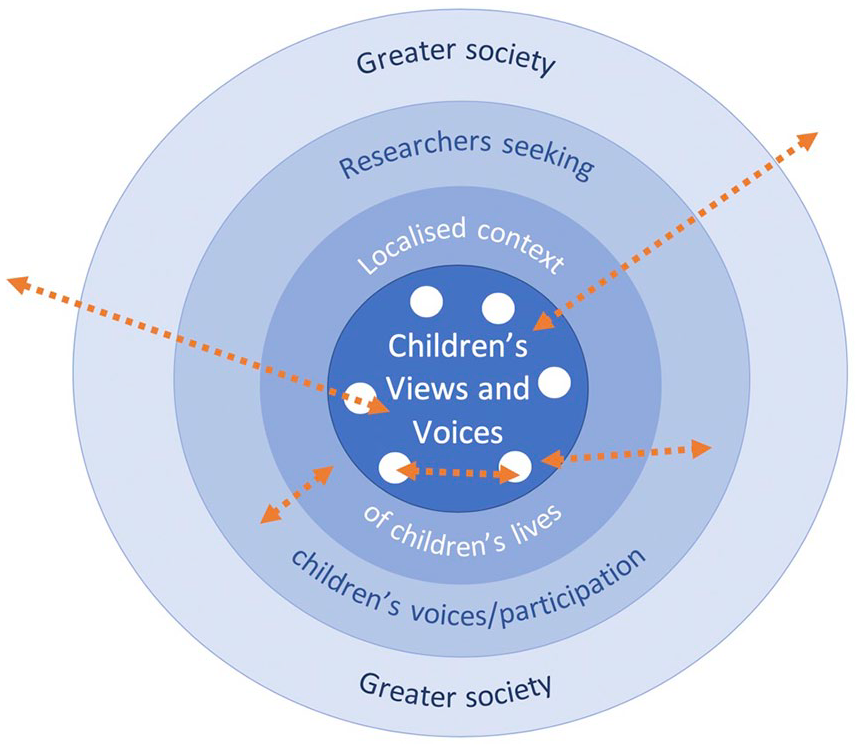
The multiple contexts and boundaries in research with children.
Pillow (2015) notes that ‘showing power claims, showing who benefits and how, has been key to definitions and expected transformational outcomes of methodological reflexivity’ (p. 424). In the context of feminist research, Pillow (2003) also states that ‘(r)eflexivity. . .is not only about investigating the power embedded on one’s research but is also about doing research differently’ (p. 178). Additionally, in the direct context of research with children, one of Connolly’s (2017) three premises of conducting research with children is the need for researchers to be critically reflexive. Connolly argues that adult researchers must recognise the power of their influences upon research with children and the resultant findings.
Bringing together these concepts of ethics in practice, reflexivity and critical reflectivity, I argue that critically reflexive ethics in practice can play an important role to expose and confront power imbalances within children’s rights-based research and to interrogate how this research can be done differently across, between and within these boundaries throughout the research process.
Throughout my recent research project with two groups of children in Aotearoa New Zealand, a critically reflexive ethics in practice perspective was undertaken, most particularly as related to the intersections within, between and amongst these boundaries and their ensuant power relationships. While various ethical issues, dilemmas and moments were explored, those related to representation, or who can speak for whom, were of primary focus.
There are two major points to consider before discussing the ethical issues, dilemmas and moments that these critically reflexive ethics in practice explored. First, there are no ‘right’ solutions to these issues but there may be some potentially better choices than others in particular places and times. What is described and discussed here are the ethical issues, dilemmas and moments that I confronted and how I responded in these particular contexts. Secondly, these descriptions are partial. These are complex issues with many varying perspectives on what is/was happening as well as a plethora of possible responses. There are constant multi-force tensions pulling at notions of truth, knowns, unknowns, potentials and so on. To become paralysed by these many ambiguities and conflicting powers could ultimately silence the voices and views of children, which runs counter to the very purpose of children’s rights-based research. To become paralysed by these many ambiguities and conflicting powers could also ultimately preclude researchers from confronting the ethical issues within their own research. I proceed then with ‘uncomfortable reflexivity – a reflexivity that seeks to know while at the same time situates this knowing as tenuous’ (Pillow, 2003: 188).
Context of this research project and its ethical dilemmas
In 2017 I set out on a
The United Nations Convention on the Rights of the Child (UNCRC) Monitoring Group (2017) had noted that
New Zealand children are often overlooked and seldom heard. Children are unable to vote and rarely have a voice in decision making. Despite representing a quarter of the population, what children in New Zealand think about things - like their schooling, where they like to play, or what makes them feel safe - is often not considered when making rules or developing policies (p.3).
In response to this report as well as other political, economic and social pressures, the Children’s Commissioner of Aotearoa New Zealand had been undertaking research projects seeking children’s and youth’s perspectives on important matters in their lives (Children’s Commisioner Manaakitia Ā Tātou Tamariki and Oranga Tamariki Ministry for Children, 2019). However, the entirety of this work was undertaken solely at the schooling level. The voices and perspectives of children under the age of 5 were not being sought nor included.
Knowing that much of research on and about children has been based upon adult-driven perspectives and priorities (Smith, 2011, 2013), I recognised that my proposed research journey was once again falling into this pattern as it was completely based upon my adult-derived rationale. I found myself confronting the first of many ethical conundrums: was my proposed research project of value in and for children’s lives? Therefore, I determined that a children’s rights-informed ethical positioning was needed (Gaches and Gallagher, 2019). I felt a consultation project with a panel of ‘expert children’ could provide guidance on potential benefits and limitations of pursuing my desired research with young children. Additionally, while a great deal is already known about potentially effective research methods with young children (Docket and Perry, 2005; Docket et al., 2011; Einarsdóttir, 2005; Gollop, 2000; Thomas and O’Kane, 1998, 1999), I believed this panel of expert children could guide me on which methods
Yet this consultation process itself raised a further,
Therefore, this article proceeds with a description of the critically reflexive ethics in action that was undertaken (Graham et al., 2015; Guillemin and Gillam 2004; Pillow, 2003, 2015) both within the rights-based consultation and then the implementation of the resultant research protocol in research with younger children. A full accounting of all ethical issues present in this research is not possible here, so I focus on the ethical questions of who can speak for whom and what are some boundaries of this representation (Bessell, 2017). The article will also demonstrate how a critically reflexive ethics in practice can inform ongoing research with children and will conclude with a discussion of implications for further work with children.
One important note is that the reflections shared here are my thoughts and my reflections as I have had the privilege of working with and alongside some amazing groups of younger people. In this article I will not to speak for children but rather have children’s voices, opinions and experiences guiding and provoking this analysis and discussion as well as my continuing research, teacher education and personal interactions with children. The children’s voices have been prioritised and are privileged in other presentations and publications and continue to have a strong presence in other work.
The research project
This overall research project emanated from my desires to know more about the lives of children in my new home-country as well as the realisation that currently in Aotearoa New Zealand young children’s views and voices about their lives was not being given the same weight as school-aged children in research conducted by the Children’s Commissioner (Children’s Commisioner Manaakitia Ā Tātou Tamariki and Oranga Tamariki Ministry for Children, 2019).
Consultation with older school-aged children
Being concerned about the adult-centric nature of this focus, the overall research was planned as a two-step process. First, I would consult with older children as to the potential benefits and limitations of pursuing my planned research with younger children. I made the commitment that if these school-aged children felt that my planned further research would not be of value and/or if the potential limitations would out-weigh any benefits, I would not continue with the further research. However, if the consultation with the school-aged children indicated that the further research would be of value, I would then seek their guidance on how that research with younger children could be conducted.
The consultation project was conducted during the 2018 academic year with twenty-two 7 to 9 year old children in a primary school on the South Island of Aotearoa New Zealand (further details on this consultation project can be found in Gaches and Gallagher, 2019). These school-aged children provided a great deal of input and ideas through a series of whole group, small group and partner activities. After each consultation session, I would review with the children a display of their data so they could provide feedback whether I was recording their ideas as they had intended and for them to add any new relevant points. This iterative process led to the creation of a focused conversation protocol to be used in the upcoming research with younger children.
Research with younger early childhood-age children
During 2019 I implemented this research protocol with younger children in two early childhood settings also on the South Island of Aotearoa New Zealand. Following the procedural ethics gatekeeping tasks, the first 3 months of this research involved weekly relationship-building visits to the early childhood settings (Smith, 2011). Once these relationships were established (as determined by the setting’s teachers), I began the consenting process with the families. Soon after I introduced the project to the young children via a specially created ‘big book’ which contained required ethics key points using child-friendly and personalised language and illustrations (e.g. a cartoon version of myself and of their early childhood setting). Thereafter when I attended the early childhood setting, I reminded children about the research project using the big book and/or smaller versions of the book that were also used to document the children’s consent to participate. Only after the children’s consent was obtained did these children participate in the focused conversation protocol. Thirteen children between the ages of two-and-a-half and 5 years old chose to participate across the two settings (five in one setting; eight in the other).
Each focused conversation was audio recorded and transcribed. In an effort to seek younger children’s perspectives on whether or not I was representing their ideas as they intended, I created small personalised books using excerpts from the transcripts. One of the challenges in creating these small data books was to present excerpts relevant to the research questions in a manner that would be familiar to children. A storybook format would be preferable to a traditional dialogic display. Thus my voice in the data book took the form of a narrator describing the context of the child’s statements and reforming my questions as statements of what I had asked. These excerpts would be the only data analysed in this research. Each subsequent research visit to the early childhood setting, I brought in draft versions of the small data storybooks to review with the children for accuracy and completeness of their ideas. In the excerpt, that follows from one 4-year-old child (AB), my narrator voice was represented in black text and the child’s voice was represented red text (here it is italicsed). The child’s voice in the excerpt appears exactly as stated on the audio recordings. The original conversation occurred in transcript #1 and then additions or corrections were made in follow-up visits with the child in transcripts #18 and #21, noted by underlined and bold text respectively.
Later you were colouring in children at a park and I asked if you ever go to a park. You told me: Sometimes. One time I went to a mericle go round. Then I asked you what you did on the merry-go-round and you told me: Um I went around and around and around and around and around on the mericle go round and (Transcripts 1,
As these focused conversations occurred during children’s regularly occurring playtime, there was much conversation present that was not related to my research focus thus these small data storybooks only contained excerpts related to the original research focus of where and how children learn, how they are engaged with(in) their communities, and what the future might hold. At the end of the academic year and the research project, children decorated their finalised books. A non-anonymised copy was given to the child and I retained an anonymised version. These booklets are the only data being analysed for this research with younger children. Discussion of this data and the children’s views will be presented in further publications.
While there were many ethical issues that were confronted throughout these consultation and research processes, those most pertinent for this article are those that were provoked by reviewers critiquing the appropriateness of having older, school-aged children consult on the research to be undertaken with the younger children. However, as described in the next section, utilisation of critically reflexive ethics in practice brought forward further issues of representation within the contexts of the research.
Critically reflexive ethics in action within this research project
While this research had been guided by critically reflexive ethics in practice from the outset, a critical moment arrived when I was questioned by reviewers whether it was appropriate for older children to make judgements regarding research with younger children. A key question for my critically reflexive ethics in practice became what are some of the boundaries regarding who can speak for whom? As I delved ever more deeply into this question, drawing from the literature on ethical research involving children (Abebe and Bessell, 2014; Bessell, 2017; Fine et al., 2003; Graham et al., 2015; Harcourt et al., 2011; Morrow and Richards, 1996; Smith, 2013), this critically reflexive ethics in practice became centred around two main areas: representation and consent/assent.
Issues of representation
As previously mentioned, I had based my consultation rationale on a prior study conducted with similarly aged children when I was a classroom teacher in Arizona (Swadener et al, 2013). In that study we felt that these children (6–9 year olds) could provide key insights as they still had many memories of when they were a few years younger and many also had younger siblings. Additionally, many of our regularly occurring classroom practices were those that would lend themselves well to the consultative process. However, it had always troubled me a great deal that this consultation in Arizona was not utilised as had been intended in that larger research project. I admit, I was likely jaded by this rejection of my young students’ valuable insights. I had to ask myself, did this sting create a representational ethical conflict, crossing a boundary between my adult researcher motivation forcing an unneeded consultative process and the misappropriation of children’s time for this current research project? However, based upon the feedback from the child research consultants and their teacher, this consultative process was a positive experience for the children indicating to me that the consultation was a valuable use of time for these children and the further intended research (see Gaches and Gallagher, 2019).
However, the question remains as to whether these older children in their place and time would be inappropriately crossing a boundary between their perspectives in relation to the experiences and desires of younger children? Beyond the age differences between these groups of children, there were also differences between their geographic and sociocultural locations. While both groups of children are close neighbours in a global sense – same part of the same country – there are other differences, such as one setting being more rural. Then again, there were differences between the two planned settings for the younger children as well: different types of services (e.g. parent cooperative childcare and education setting, kindergarten setting) and different parts of town. Did these differences override similarities?
This issue then also brings into question the relevance towards a greater society context. Children’s lives and experiences and notions of childhood are multiple and varied and no child nor one group of children can ever speak for all children and childhoods (James, 2007). Ultimately this is also a concern of qualitative research in general, where the goal of qualitative research is not generalisation to the greater population but rather, as Denzin and Lincoln in 2005 state, ‘to seek answers to questions that stress how social experience is created and given meaning.’ (p. 10). Christensen and Prout (2002) utilise the concept of ethical symmetry to argue that the same ethical principles that apply for research with adults apply to the research with children, unless there are conditions special or unique in ‘the concrete situation of children’ (p. 482). Ethical symmetry thus became my yardstick. My decision-making proceeded as follows (Gaches and Gallagher, 2019; Figure 2): Is the concrete situation of the younger children different from adults? Yes, in the sense that others have deemed children a vulnerable population. One approach taken by other vulnerable populations (e.g. indigenous communities, refugees, etc.) is engagement with a consultative process, where members of the vulnerable population help determine if proposed research is ethically appropriate (Dickert and Sugarman, 2005). Thus, I decided that a similar consultative process would be appropriate. As other vulnerable populations generally call upon members of their own community as experts, I thus needed to call upon other members of the child-community.
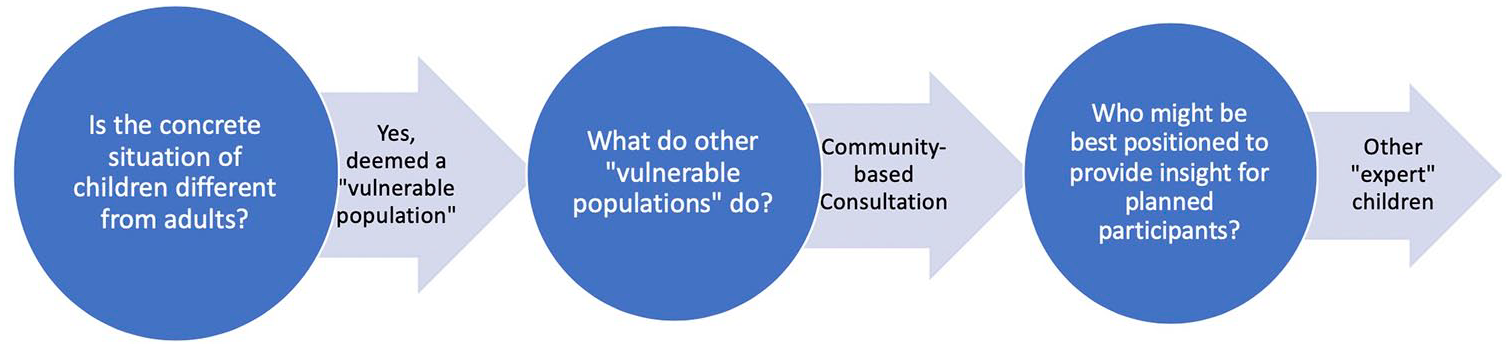
Addressing ‘the concrete situation of children’ (Christensen and Prout, 2002: 482).
I then asked myself, What is it about children’s concrete situation that makes them ‘vulnerable’ in research? Smith (2011, 2013) described that one of the ethical issues regarding young children’s participation in research is their understanding what research is and how their voices will be used. This was a recurring point in both the consultation and research phases of this project. First, I needed to be sure that my consultants would be in a position to understand not only the research consultation process but also the intended research with young children. While I was fairly certain that a group of young children would be able to understand their own participation in the intended further research, the added layer of consulting ABOUT another young child’s participation in intended further research was a more challenging layer of complexity potentially creating an unethical level of confusion and discomfort for young children.
However, much as a group of adults considering research to be conducted with other members of their community, older children could relate to a question of ‘would this be okay to do with your younger siblings or cousins or you when you were little’? One excellent example of how the older children understood this complexity was when one of the school-aged consultants was quite adamant that I should seek out her sister’s childcare centre for the further research. She wanted her sister to participate in the research protocol that she helped create.
Was this consultative group of primary-aged children the right group? Did they adequately represent the population younger early childhood-aged children for further study? In the further research with younger children, would the younger children’s voices and experiences be sufficient to answer questions about the experiences of children and childhood? Using the concept of ethical symmetry, I recognised that these are ongoing questions and issues of qualitative research at large for which there are no definitive or easy answers (Pillow, 2003).
However, there were further issues where ethical symmetry and children’s unique concrete situations played a larger role. The first of these was my researcher accountability towards participating children to ensure that their voices were being used appropriately and how the children had intended (Abebe and Bessell, 2014). From a procedural ethical positioning, it would important to return to your adult research participants for such member-checking processes as ensuring the accuracy of interview transcripts or to further discuss parts of an interview that were unclear to the researcher (Lincoln and Guba, 1985; Thomas, 2017).
From an ethical symmetry stance, the same would be true for young children. Therefore, for both the consultants and the younger children I returned to them to make sure that I was ‘getting it right’. The challenge was to do so in a manner that would be best understood by those particular child participants, much as Bessell (2017) points out that Article 13 of the UNCRC requires that ‘methods need to be found, and used, to help children express their perspectives and opinions freely in research’ (p. 235). The previous excerpt shared from 4-year-old AB’s data storybook is a representative example of the level of engagement children had with this process. She was quite happy to revisit our prior conversations, to correct herself and me, and to add to her previous thoughts. While I have a degree of comfort that I have data representing their ideas to share with the world as they intended, there continue to be levels of uncomfortable reflexivity (Pillow, 2003) as to whether this process was enough and if each and every child felt that this process was sufficient to represent their ideas adequately.
Additionally, some questions remain regarding how their stories and experiences are being and will be utilised. Already the primary-aged consultants’ voices have been utilised in the creation of the research protocol. In our publication about the consultation process (Gaches and Gallagher, 2019), we intentionally presented much of the data and children’s input in raw data format to maintain the children’s voices as they intended. For their written feedback, we had asked the children if they wanted us to correct mis-spellings and those who responded in the whole group discussion indicated to leave the writing as presented. However, we do not know if this response reflected those who created the mis-spellings.
How to present the views and voices of the younger children is still under consideration but as much as possible it will be maintained as intact as originally presented to me during the focused conversations. Further ethical considerations will include crossing boundaries with academic writing and presentation of research, such as what counts as analysis and findings as well as publication limitations of word counts (whose words get privileged given a limited number of words) and reproduction of colour illustrations children have integrated within their text.
Consent/Assent
Through my critically reflexive ethics in practice, I realised that ethical issues related to consent/assent were particularly relevant to whose voices are heard and thus represented in the research. This was also then related to whether the children understand to what they are consenting (Smith, 2011, 2013). Issues of consent and assent in research is an incredibly complex and multidimensional set of ethical tensions (Docket and Perry, 2011; Harcourt and Conroy, 2011; Smith, 2013). However, examples from this research provide insights as to how critically reflexive ethics in practice can inform researcher responses. Of course, even the decision of whose voices and stories get shared in these examples confronts an ethical boundary.
In the consultation project with older children, all parents initially returned the consent form, likely a result of the form’s similarity to parental permission slips in school environments. All children were given brochure-sized information and consent forms upon which they could record any questions or concerns they wanted to discuss either with their teacher or with me, individually, with the option to provide a question anonymously for us to discuss with the entire class. No one partook of these options and only one child had a question regarding what kind of ‘code name’ (pseudonym) they could create. Thus the boundaries between research and school became blurred, questioning whether the power of the school setting influenced decisions regarding participation. It could be argued that I was taking advantage of the power of this teacher and the school to further my own research aims. While the parental and child consent form contained the procedural ethics statement guarding against potential harm for those not consenting, the power of school could have swayed parents decisions. This was another point of uncomfortable reflexivity (Pillow, 2003) with the possibility that the time I spent building relationships with the children and community created a level of trust that could help or harm this consent process.
It is a well-agreed upon norm that child consent/assent is constantly ongoing throughout the research process (Docket and Perry, 2011; Harcourt and Conroy, 2011; Smith, 2013). One particular incident with the primary-aged consultants recorded in my field notes provided an important moment for critically reflexive ethics in practice. One child consultant, codenamed Sharpie, had been quite engaged throughout the research. However on the consultation day when I was working with partners outside under the big tree in their lunch area, Sharpie didn’t come outside with his classroom designated partner. Thinking he just didn’t hear it was his turn, I asked his partner to go get him. She came back out and reported that Sharpie didn’t want to join us. However, I could see him slowly and reluctantly coming across the courtyard. I told both of the children that Sharpie didn’t have to participate if he didn’t want. He sent his partner a scathing look and yelled, ‘See, I told you I didn’t have to come if I didn’t want to’. Sharpie waved happily to me and ran back inside. His partner shrugged her shoulders and continued to share her ideas with me. As I left for the day, Sharpie ran over and told me that he just didn’t want to talk about my research that day but that my research was really cool. The ongoing right to dissent created a momentary boundary conflict between children based upon the usual classroom-required participation expectations. It appeared, too, that Sharpie was concerned about a potential boundary he’d created through my research between himself and me. I am uncertain though whether it was our personal relationship boundary he felt he’d damaged or the research consultation to which he’s already contributed that he felt needed comment and relational soothing.
In the research with younger children, one of the first consent/assent-related boundaries was a procedural ethics boundary in the form of parental consent and whose views and voices are represented in the research. Child M was adamant that she wanted ‘to have one of those books to share my ideas with the world’. This child was referring to the mini-books that were used with children to explain the research and where children noted their consent. She was very interested in the conversations I was having with children, yet I had not received parental consent. The teachers determined that most likely because the parents had not responded to the consent form due to their schedules and communication patterns. They decided that one of the teachers would approach M’s father the next day regarding parental consent. Until then, M would be able to participate in our drawing and general conversations but I would not use any of the transcribed conversations in the research until parental consent and M’s consent were obtained. Yet if the parents did not provide their consent, the child’s desire for her views to be represented would ultimately be supressed. We chose to privilege the child’s desire to be heard and it was with uncomfortable reflexivity that the power of the teacher-family relationship was used to further reach out to the parents for consent (which was ultimately obtained). After parental consent was obtained for M, she was very happy to receive her own small book and provide her consenting ‘x’ and signature.
Another ethical dilemma arose when making sure that children then understood the boundary between our initial play-based relationship and this new research relationship (Smith, 2011, 2013). Immediately this raised the question as to whether the children wanted to engage with the research or continue our play-based relationship. Was I taking advantage of the relationship that we had developed? In response to this critically reflexive ethics in practice dilemma we created a verbal signal to the children as to the purpose of this particular playtime. As the child or small group of children and I played, I would ask the child/ren, ‘Can I share these ideas with the world?’ If they said yes, we continued with the recording. If they said no, I turned the recorder off. If in a group some children said yes and others said no, I asked if I could keep the recorder on but only share the ideas from the child/ren who had agreed. This was always agreed upon by the children. However, questions remain as to whether this was actual agreement or acquiescence to peer pressure and/or adult power. This would be yet another point of uncomfortable reflexivity (Pillow, 2003).
When M’s younger brother came over to our interactions one day, she explained to him that he could have one of these books if he wanted to ‘share his ideas with the world’. Her repetition of this key phrase was an indication to me that she understood the purpose of the research and boundaries between that and the way we had often played. Young children in both settings frequently reiterated this phrase amongst each other and with me. In one instance, a mother reported that her child had declared that her tattling older sibling shouldn’t be tattling because that child had not given her older sibling her permission to share her ideas with the world (the child has given permission for this story to be told). The frequent repetitious use of this phrase by children provided feedback that children were feeling empowered by this statement (Tobin, 2000) and appeared to understand how their views would be used.
Often M and I would be engaged in a focused conversation activity (drawing or such) and I would turn the conversation to my research questions, ‘So I was wondering, M, what do you think the world will be like when you are an adult?’ She would pointedly look at me, pause, then go back to her task. This type of look and response was a clear signal that she was consenting to the research project, but not necessarily to responding to my questions. This particular type of response to my focused questions occurred not just with M but with several other children as well. This non-verbal response was certainly one manner in which the children made it quite clear during our play-time focused conversations that they may consent to the research but there were boundaries as to what information they were willing to provide. In those moments, my question was dropped only to be picked up again if the children indicated they were interested in resuming.
Concluding remarks and implications for further work with children
Thus, this article has illustrated how a critically reflexive ethics in practice has responded to issues of power within a children’s rights-based research project in regards to who gets to speak for whom and how children’s views are represented. A critically reflexive ethics in practice began with the original reviewer critiques focused upon the appropriateness for older children to consult upon research to be conducted with young children, yet further issues of representation and the consent/assent process needed to be confronted and addressed. While Graham et al. (2015) ‘International Charter for Ethical Research Involving Children’ (p. 335) and Ethical Research Involving Children (ERIC) (Graham et al, 2013) provide clear guidance for research with children, each researcher will need to engage with critically reflexive ethics in practice throughout their research processes. These key points relating to how these issues were confronted throughout this children’s rights-based consultation and research could provide some further guidance.
Taking the time to build strong relationships with children is of paramount importance (Graham et al., 2015; Smith, 2011, 2013). It is through these relationships that we can better understand what children are telling us throughout the research process. My relationships with Sharpie and M helped me better understand and read their momentary dissent to engage in the research or particular questions and to recognise the importance of the seemingly simple phrase, ‘share your ideas with the world’. Of course, we must be vigilant that these relationships may build a false sense of trust, as could have occurred and influenced parental consent in this research process.
Ethical mirroring (Christensen and Prout, 2002) provides guidance as to whether an ethical issue is one of ‘concrete situation of children’ (p. 482) or one of greater research ethics. Critically reflexive ethics in practice in this research addressed the initial question regarding the appropriateness of older children consulting for research with younger children through the realisation that this dilemma ethically mirrors that of representation in qualitative research at large (Denzin and Lincoln, 2005). Furthermore, holding up an ethical mirror to the consent/assent and member-checking processes led to unique modifications for older and younger children.
Thus we must also embrace the calls in Article 13 of the UNCRC (United Nations, 1989) as well as General Comment 7 (Office of the United Nations High Commissioner for Human Rights, 2005) to conduct research with children in manners that are particularly appropriate to these children’s abilities in their time and space. In this research, information and consenting was presented to children in familiar formats, as brochures, book(let)s and discussion. When returning to children for guidance on the accuracy of their recorded views and voices, familiar styles of interactions were implemented, such as whole group charting and one-on-one storybook reading.
While the issues, dilemmas and moments confronted here and how they were addressed through critically reflexive ethics in practice are illustrations of possibilities, they would not necessarily be appropriate in other contexts, as children and their localised places and times would have their own unique considerations (James, 2007). Furthermore, it must also be recognised that there are a myriad of research issues, dilemmas and moments for which we have only ‘uncomfortable reflexivity’ (Pillow, 2003: 188) creating tenuous and conflicting possible responses. However, this must not paralyse children’s rights-based research out of fears of who can speak for whom or how children’s views and voices should/can be represented. Rather researchers should proceed with caution through a localised, relational, critically reflexive ethics in practice.
Footnotes
Funding
The author(s) received no financial support for the research, authorship, and/or publication of this article.
