



Abstract
The aim of this article is to investigate ways that young children interact with touchscreen devices during museum visits and during the process of making a digital story in their kindergarten classrooms related to these visits. Drawing on children’s communicative embodied museum experiences and the notion of wayfaring and lines of movement, I discuss that digital stories become children’s visual lines of movement in time and place, and that through the process of making a digital story, children become digital wayfarers. Data include pictures, videos, children’s drawings and their digital story. In particular, I argue that this way back to the museum can be seen as children’s visual and digital ways of connecting with, interacting with and inhabiting the museum. This article gives insights on children as creative meaning makers, by looking at children’s perspectives and by exploring children’s visual lines of movement through their digital story.
Introduction
Museums are considered dynamic meeting places for local and global processes, where cultural elements can influence place attachment and place identity; active interaction provides meaning through representations in a dwelling perspective (Hodge and Beranek, 2011; Ingold, 2005). The communicative role of the museum can be an important factor in the close relationships between individuals, local places and place-making practices (Hackett, 2012).
The aim of this article is to investigate how children become wayfarers inside the museum and how they visualize their wayfaring with their drawings and by making a digital story. This study focuses on how the theory from Ingold (2007) about wayfaring could be related to children’s perspectives regarding museum experiences, their drawings and their digital stories. Many researchers have revealed that digital storytelling enhances children’s active participation and engagement and promotes creative and meaningful use of touchscreen technology (Arnott et al., 2017; Garvis, 2018; Letnes, 2016). Touchscreen devices and digital stories will be explored as children’s visual lines of movement, children’s wayfaring in and back to the museum and as ways of exploring spaces and meaning making. This study investigates the following research question: How do touchscreen devices contribute to children’s communication in and with the museum and with each other?
Hjorth and Pink (2014) argued that traces made when using mobile phone cameras are a way of weaving between material and digital environments and users, as digital wayfarers emplace their environments ‘digitally, socially and materially’ (p. 25). Furthermore, there is a need for ‘emplacement and compresence, whereby people, images and technologies are always situated, in movement and part of and constitutive place’ (Hjorth and Pink, 2014: 26). A need, therefore, is to open up to new ways of movement, emplacement places and understanding children’s activities in digital/non-digital practices and activities.
Thus, as the objective of my project is to follow and observe young children in museum settings, I am investigating the essence of the shared experiences in the museum from children’s perspectives. Therefore, digital devices and digital storytelling are seen as means of communication between children and the museum, and their previous experiences and meaning making, in a form of a communication between present and past. Digital stories are considered a new social arena that will take children back to the museum and back to their experiences and knowledge about the museum.
Theoretical overview
Meaning in the lines of movement and wayfaring
Place plays an important role in how we make meaning in the world. Our lives are marked according to places. A place can be the place we come from, the place we live, the place we contact our past and present. Places are shared with others and we return to places that bring back memories and are connected with meaning (Dardanou, 2018).
Drawing on Ingold (2007), the knowledge about our environment is forged in the very particular way that we are moving through it, in paths or passages, from place to place, and the changing perspectives and horizons along these ways or paths. In addition, Ingold (2007) claimed that to walk, to wander or to be in movement is fundamental for learning; experiencing through our movements is the path where our knowledge develops and expands. To know is to learn, and to move is to know; to move is to learn (Ingold, 2007). Wayfaring is meaning making and through this process, is a way to learn. A wayfarer is described as ‘one who participates from within, in the very process of the world, is continually coming into being and who, in laying a trail in life, contributes to its weave and texture’ (Ingold, 2007: 81). Continuous movement makes traces, which are the marks that people leave. Significantly, Ingold (2007) focused not on place but on the movements in place. It is through movement that people communicate and interact with places. The spatiality and the notion of place have been seen as social constructions, as a part of perception and imbuing multiple meanings. As Ingold (2007) illustrated, places are being constituted by movement, by the lines of movement, where knowing by walking the place is a way to situate place and make one’s own version of the place.
Thus, Ingold (2011) argued that the lines of movement meet in places and as they interact with one another, they create a ‘network of interacting entities, what I call the meshwork of entangled lines of life, growth and movement. This is the world we inhabit’ (p. 82). Furthermore, these lines are relations that develop along with each other, a connection between one thing and another. Although ways and paths are organized and regulated in advance to associate different places together, people, in practice, still weave their own paths and ways in their surroundings and environment (Ingold, 2007). These paths and lines can be re-walked, re-drawn and represented by walking with video (Pink, 2011). A video can visualize some aspects of an experience, for example, children’s movements, walking paths and knowing by visual walking, as a camera takes the role of the re-presentation of memories, perceptions and imaginations in order ‘to locate knowing in movement’, but it is still a representation of an experience and not the experience itself (Pink, 2011: 154). Emplaced knowledge through wayfaring is a way of inhabiting the place by embodied and sensory experiences.
Museum as a place for communication and embodied experiences
Young children communicate in embodied and non-verbal ways, often expressed with gestures or movement. Children use these means of communication and expression more than adults do, in a way that communication is spatial and embodied. During the last decades, museums for children have been seen as arenas for learning activities for future learners (Anderson et al., 2008; Andre et al., 2017; Dockett et al., 2011). Young children’s experiences in museums are embodied and the emplacement of museum as space that children made affects children’s wayfaring in museums (Birch, 2018; Hackett, 2012, 2016). Therefore, children’s ‘being-in-the-world’ of the museum and making meaning of it is embodied and highlighted by movement. Hackett (2016) described that these movements can vary in forms and expressions, like running in different rhythms, dancing or wandering alone or with others. Museums provide humans opportunities for living experiences through lived experiences within their stories that create meaning. In addition, meaning making of place by wayfaring brings time and space together through place. The ways of knowing a place are ways of creating the place (Hackett, 2016). Place is, at the same time, contacted both conceptually and physically, through movements, emotions, production of place and interacting with others, human and non-human (Ingold, 2007). Meaning making is always interdependent on others and the environment/space/place. Thus, embodied experiences create the experience of knowing; therefore, being and knowing cannot be seen separately (Hackett, 2015).
Children, digital storytelling and the museum
Digital technology has provided new opportunities for exploring, playing and learning for young children. Research has shown that children’s engaging with digital technologies is increasable (Arnott, 2017; Palaiologou, 2016) and may have positive learning outcomes (Stephen and Ploughman, 2008). Early childhood centres in Norway follow the Norwegian Framework Plan for the Content and Tasks of Kindergartens (Norwegian Ministry of Education and Research, 2017), which underlines the role of kindergarten in providing children opportunities for creative activities that enhance children’s active participation in relation with digital technologies. However, it is important to reflect on how technology in kindergarten classrooms’ pedagogical practices may have an impact on children’s different activities (Dardanou and Kofoed, 2019). The new technological communicational opportunities create new conditions and aspects for communicational processes in a digital world.
Digital stories are multimodal narratives that use a variety of digital multimedia, such as images, audio and video. Multimodal activities, such as digital stories, encourage children to involve new technologies in re-presenting, communicating and transforming experiences in new forms, for example, through activities with tablets or iPads (Flewitt et al., 2015; Kervin and Mantei, 2016; Papadimitriou et al., 2013). Likewise, Petersen (2015) investigated children’s agency and interactions in the use of multimodal approaches, such as the use of tablets in preschools, and emphasized that understanding children’s agency may be expanded by the use of multimodal approaches. In the same line, the studies of Yelland (2018) and Hatzigianni et al. (2018) show that multimodal practices contribute to children’s creation of new contexts through collaborative, communicative and meaning-making experiences, as well as social and co-operative relations. Through digital storytelling, children can organize and express ideas in a personal and meaningful way, be aware of what has captured their interest, as well as provide and explore their points of view about a subject or experience in interaction with the other children and/or their teachers. Thus, it is noted that digital stories can contribute to a holistic understanding of a subject or experience (Bratitsis et al., 2012). Digital stories as narratives in time and space provide ways to convey meaning through interactivity with digital devices such as iPads, enhancing opportunities for collaborative creativity and communication, with a focus on social interactions (Garvis, 2018; Lisenbee and Ford, 2017). The literature related to the use of digital devices in young children’s museum experiences have shown that digital games and virtual reality–connected games are immersive ways for learning and experiencing different environments (Korhonen and Kinanen, 2018; Petrelli et al., 2013). Finally, Christidou (2013) showed that use of camera can be considered an action of a social performance in the museum, as well as a memory tool and a communicational device moving ‘from sharing (memory) objects to sharing experiences’ (p. 81).
Methodology
Methods and procedures
The methodological approach followed in my study is micro-ethnography, which refers to a small-scaled ethnographic research related to a period of time and participants, and that aims to explore the relational interactions among them (Le Baron, 2011). I contacted participatory observation with a group of 12 kindergarten children, aged 4 to 5 years, in a period of 8 months. The group of children visited three different local museums, where they could take photographs of the museum using iPads or digital cameras; draw during or after the visit; and make mind maps and digital stories back in the kindergarten classroom. The total number of visits to the museums was seven, and I followed the children in all their visits as well as in some of the activities back at the kindergarten classroom. The data material includes photographs, audio recordings, video records, children’s drawings, mind maps and field notes. In this article, I use data material from two visits to a local museum over a period of 1.5 months. The museum had a special exhibition during the period of the study. Since my study is based on participatory observation, it allowed me to investigate how the children interacted with each other, their teachers and their physical surroundings, and get to know their actions and reactions with the museum (Warming, 2008: 151).
My methodological approach aims to explore how children and their teachers shared experiences during their museum visits and to explore how these experiences, often including the use of digital technologies, took form in children’s drawings and their digital story. The children made the digital story with their teacher on a different day than the visits. The teacher, together with information about the process of making the digital story, gave a copy of the story to me afterwards. Data were guided through strict confidence and anonymity. Participation was voluntary for the children, and the parents were given the opportunity to withdraw their children from the study at any point.
Data analysis
In the presentation of my empirical findings, I focus on the participating children’s interaction inside the museum, as well as the digital story they made related to the exhibition. I especially focus on the observations of two of the children (two boys), Martin and Rune, both aged around 4 years at the start of the study, and I particularly present one vignette. I use the children’s drawings, photographs and their digital story. I have made a thematic analysis (Braun and Clarke, 2006) based on these materials. The themes were related to four categories that are presented on the next section: children’s first meeting with the exhibits (wayfaring on the feet), the drawing children made in the museum (moving to the pencils), use of mobile phone as a means for wayfaring (digital wayfaring) and, at last, the digital story.
To analyse my data, I focus on elements of the data material that could be connected to the children’s connection with the exhibition through their drawings and to the concept of wayfaring (Wolcott, 1994). As the children had the opportunity to draw inside the museum, their connection with the exhibits was direct. The children were actively involved in photographing inside the museum, as camera increases the power of the children in this process (Rasmussen and Smidt, 2003). In my study, I take into consideration the communication between children, kindergarten teachers and place, as well as how meaning is conducted through inter-relationships between them and media.
Findings
Wayfaring . . . on the feet
The visit to the local museum began with a request from one of the participating children, Martin (pseudonym used). Martin (age 4) told his teacher that he had visited the museum with his family and saw an exhibition that displayed many strange animals. He asked whether they could also visit the exhibition with the kindergarten class. As children’s participation is underlined by the Framework Plan for the Content and Tasks of Kindergartens (Norwegian Ministry of Education and Research, 2017), the teachers together with the children decided to visit the exhibition entitled ‘Animals You Wish Would not Exist’, inspired by Jo Nesbø’s (2010) children’s book, ‘Doctor Proctor and the Destruction of the World. Maybe’.
The group of 12 children and their three teachers visited this special exhibition in one of the local museums. The kindergarten teacher had prepared the children for this exhibition by showing them a brochure with information about the special exhibits displayed. The exhibition included very strange animals based on the book (Nesbø, 2010). Both the teachers and the children used digital cameras, iPads and mobile phones to document the exhibits. During their first visit, the children used quite some time to wander inside the museum, but on the second visit, they were more familiar with both the rooms and where each exhibit was placed (Figure 1).
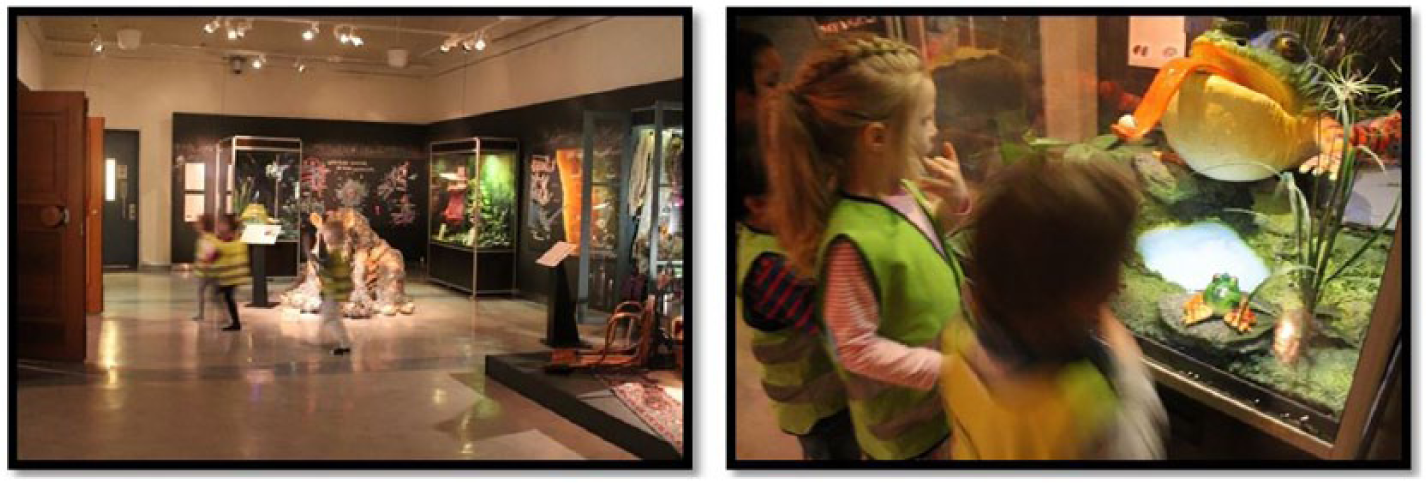
The children’s wayfaring in the museum.
The exhibition was displayed on one floor, and one extra room included one exhibit and an area with a table, chairs and pencils where the children could sit and draw. Each participating child had with him or her a drawing book with pencils from the kindergarten classroom, since it was discussed that they would have the opportunity to draw the animals – if they wished – during the visit. As Martin had visited the exhibition some time before with his family, he was very familiar with the museum. Martin could easily find his way and was willing to show the other children around. He wandered around the exhibition, pointing out and naming some of the animals. Here, we see that Martin’s previous embodied experiences reflected on the way he met the physical material environment. In addition, some of the children remembered some of the animals from the brochure the teacher had showed them in the kindergarten classroom. I noticed that the children showed much interest in the stories related to the animals and asked repeatedly to listen to their teachers tell them. The teachers also mentioned that the children asked to listen to the same stories again back in the kindergarten classroom. The photographs taken by the children and their teachers showed a timeline of their visit – the ordering of which shows the children’s movements around the exhibits and, additionally, shows which exhibits children visited several times or how many children and teachers were gathered around the same exhibits. Through their embodied movements inside the museum, children came down to the exploration of the place, and emplaced knowing of the place by wayfaring (Ingold, 2007) inside the different rooms and by stopping and watching the exhibits.
‘Moving’ to the pencils
As mentioned, children had with them a drawing book and pencils during their visits to the museum. Martin was especially interested in one of the animals that was displayed in the room next to the main exhibition, one named Scorpio Lunaris (Måneskorionen). Martin took his drawing book and his pencil and started to draw (Figure 2).
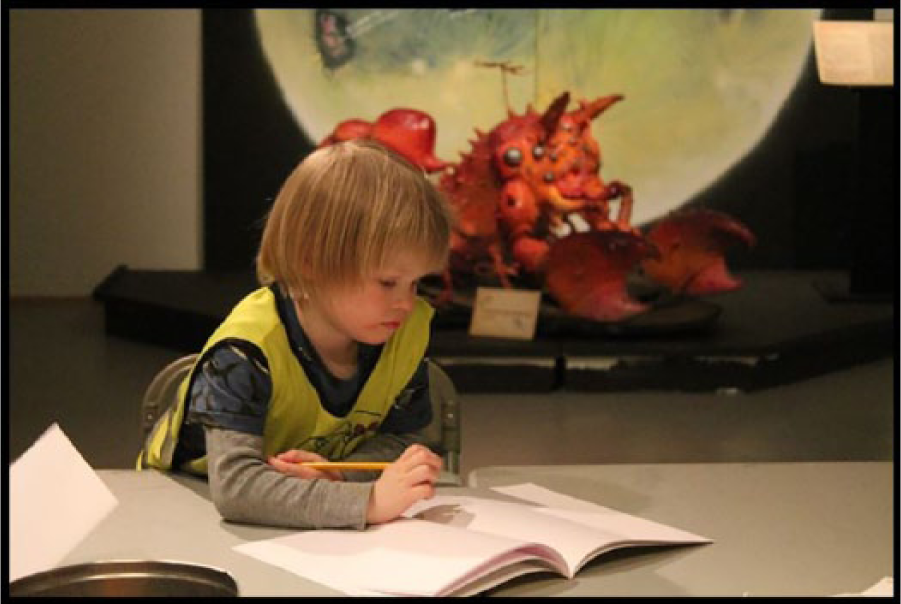
Martin with his pencils and drawing pad inside the museum.
Figure 3 illustrates Martin’s drawing of the Scorpio Lunaris (Måneskorionen). It gives a sense of how he conceptualized the exhibit, extending it with his pencils, with colours and giving it another dimension. This is Martin’s perspective of the animal presented and visualized by him. Through his drawing, Martin actively communicated with the exhibit and the place. In addition, I observed that Martin did not sit and draw constantly; he often left his drawing book and pencils, wandered around closer to the Scorpio Lunaris and came back to draw a little more. Sometimes, he even asked whether I could look after his drawings so he could go and look around. Movement in place seemed to be important for Martin, as well as his drawings, since he was coming back again after a few minutes. Martin learned about the exhibits through his bodily movement in the museum, his wayfaring and by its representation in the drawings. Therefore, he perceived, according to my interpretation, the museum as both an embodied and sensory experience, as well as an active visualization through his drawings. The drawings became a means of communication between the exhibits and Martin’s embodied experience with them (Ingold, 2010).
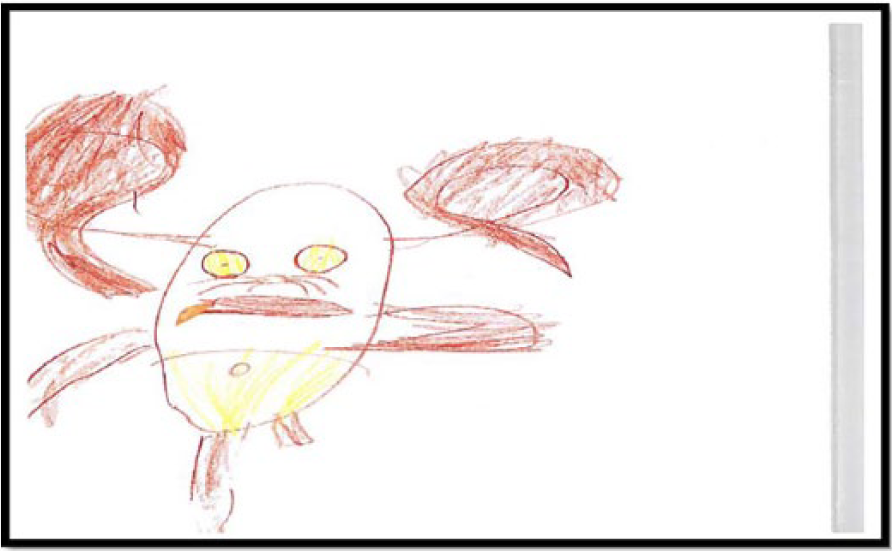
The Scorpio Lunaris (Måneskorionen) drawn by Martin.
Digital wayfaring
In the vignette following below, it will be presented Rune’s – one of the participant children – first meeting with the exhibition:
Rune (pseudonym used), four years old, entered the museum and was heading together with the other children up the stairs that led to the room where the exhibits of the special exhibition were found. Rune stopped in the middle of the stairway and said that he wanted to sit a little and rest. The other children continued and entered the exhibition with two teachers, while the third waited back with Rune. The teacher noticed that Rune was sceptical to enter the exhibition. She sat on the stairs with him. Rune informed his teacher that he did not wish to go inside the exhibition. The teacher respected his wish and asked him if there was anything she could do for him. Rune looked over to the room and saw his friends wandering around the exhibition, some sitting on the floor drawing. Rune asked his teacher, ‘Can you just go and take photos of the animals so I can see them?’ The teacher went and took photographs with her mobile phone and went back to the stairs to show them to Rune. In the meantime, two of the other children noticed Rune sitting on the stairs and sat down with him. When the teacher showed the photographs of the exhibition animals to Rune, the children started to tell Rune the stories they were told by the other teachers. As Rune listened to the stories and looked at the photographs, he took his drawing book and started drawing. The other two children did the same (Figure 4).
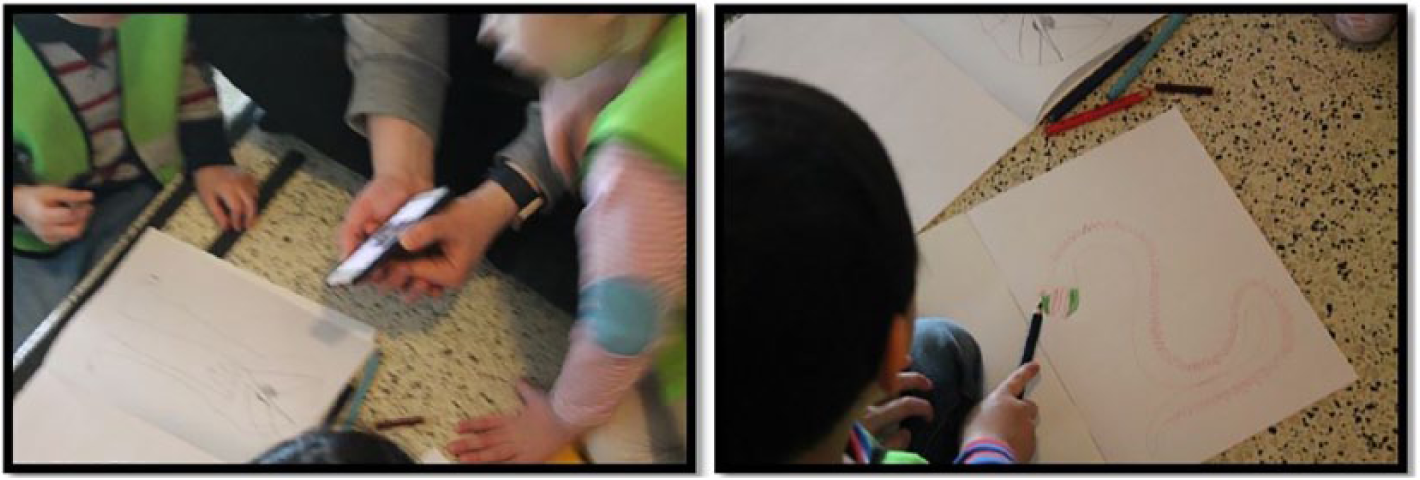
Digital devices as a means of wayfaring.
In this sequence, Rune was unable to embody participation in the exhibition. His fear of the animals did not allow him to experience the museum through an embodied experience (Hackett, 2012). However, the mobile phone provided Rune the opportunity to participate in this excursion with the other children. Rune could wayfare inside the museum through the photos taken with the teacher’s mobile phone. The photographs and the narratives of the teacher and the children became Rune’s ‘eyes’, to construct the exhibits and the museum.
The children and the teacher used time together around the mobile and while Rune was re-presenting the exhibit to his drawing. The mobile phone created a social event between the children and the teacher, between the exhibits and the visitors, between the museum and its visitors. The social network that occurred at the specific place inside the museum (the stairway) emplaces museum, visualizing and re-presenting the experience (Hjorth and Pink, 2014).
Our digital story
To make the digital story, the kindergarten teachers used iPads, and more specifically, the application Book Creator. The teachers felt that this application was easy to use, both for them and for the children. They had some experience from before with this application, and therefore, it was natural to use it. The children’s participation in making the digital story was voluntary (Norwegian Ministry of Education and Research, 2017). Martin’s special interest for the exhibition was a reason to participate, in my opinion. Rune, meanwhile, was motivated through his wayfaring with the mobile phone. The mobile phone was Rune’s means of interaction and meaning making with the exhibitions, according to my observations.
The two participating children, Martin and Rune, and one of their teachers made the digital story. The process of making the digital story included children’s active participation in all forms: deciding which of the exhibits they would like to present, choosing the photographs and drawings, the music in the background of the story and who would say what (Figure 5). The teacher took the children’s motivation throughout the process into consideration. The movements and actions from wayfaring around the exhibits took form and motion in the digital story as they were emplaced in material and digital traces (Hjorth and Pink, 2014).
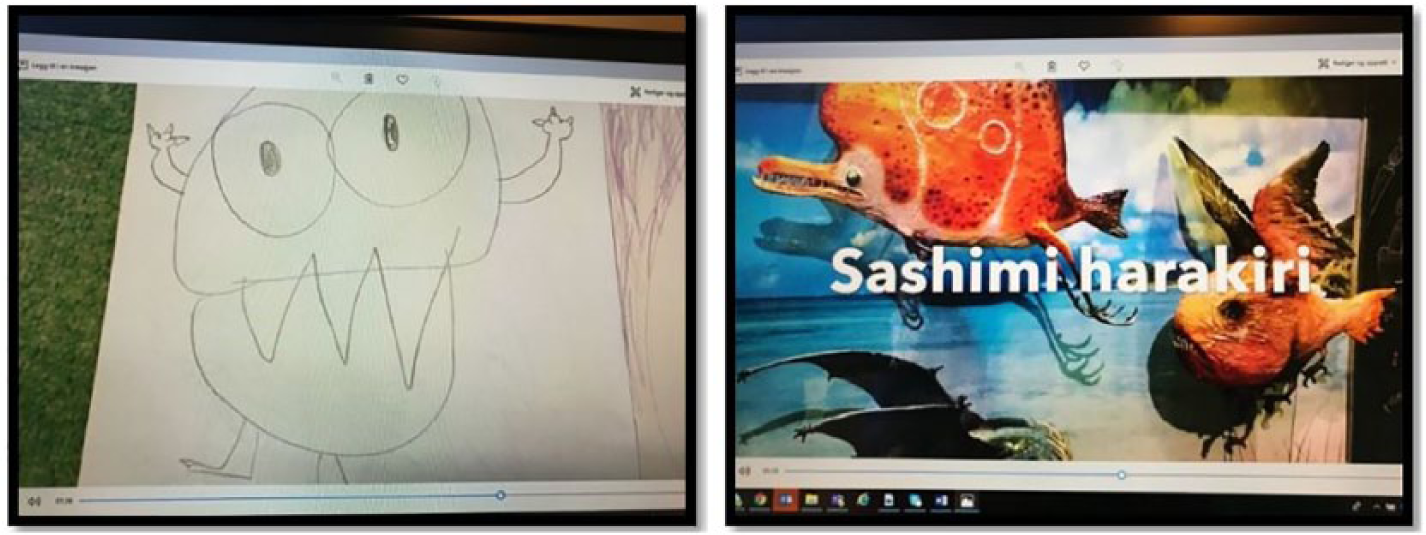
Screen shots from the digital story.
During the making of the digital story, I observed that the children used their drawings and photos to remember the exhibits and to re-tell the stories related to the exhibits. The drawings and photos were used to ‘bring’ the children back to the museum, to again become wayfarers in the museum. The children and teachers found out together the meaning of the exhibition through the process of making the digital story, through rediscovering museum as a place, as their own place and, at the same time, understanding and obtaining knowledge through the children’s steps, movements, drawings, stories, photographs and so on. The relations with the place, the exhibited animals, the teachers and themselves that the children emerged with reveal in this process knowledge as a practical social action in an active inhabitation of museum, as these processes connect and separate the here, the museum experience and the now, our common experience, as knowledge becomes a result of common practices (Verran, 2013).
Discussion and concluding remarks
At the museum, the children’s wayfaring occurred through interaction with objects, materials and the place, as well as with each other, in different moments, through sensory engagement, through interaction between the children and the world and by exploring space differently. In line with Ingold (2010), drawings engage with images in different ways than walking and wayfaring, as it visualizes images through rethinking and makes them place-holders of children’s own images, being either drawings ‘of things in the world, or like things in the world’ as ways of inhabiting place (p. 16). According to my empirical findings, during the process of making the digital story about the exhibits, the children used their drawings made and photographs taken in the museum. The children used them to find the routes and traces of their movement inside the museum. By children visualizing their routes in the museum by using those digital photographs, they were digitalizing their movements and their wayfaring and become digital wayfarers (Dardanou, 2018). The findings showed that the children’s wayfaring in the museum became visualized through images, drawings and pictures, and it became digital wayfaring as the children constructed their own lines of the world.
Drawing on the evidence of this research, I argue that the way children experienced the exhibits and the museum, through their embodied wayfaring or their wayfaring through photographs taken with a mobile phone, created new ways for relationships, presentation and re-presentation of the museum and showed aspects of their experiences (Carr et al., 2018). Place (in this case, the museum) lays the premises for interaction and dialogue between children, as it becomes meaningful by virtue of what it offers in possibilities and restrictions for children. Although we can affect the place, can place also affect us? As the children in my study discovered and rediscovered museum as a place through their bodies, they transferred them into images through their drawings and visualized their whole experience, and their meaning making of the exhibits with the digital story and their narratives (Garvis, 2018). The children’s digital story was a way to communicate back with the museum. The children created a story, a narrative of the place, by emplacing their own bodies and the other children, by producing visual content of the museum and by giving movement to this story through their own lines of movement. Through these story lines in the process of making the story, we find children’s wayfaring. The digital stories, as a product of the children’s construction of meaning of museum as a place, are a possible way to create new lines of movement inside the museum. Viewed from these perspectives, the children’s drawings and digital story can be their own lines of movement back to the museum and back to their experiences. Since the lines of children’s movement are lines of relations that move along (Ingold, 2011) with each other in the museum and through their digital story, can they be considered the means for a sense of experience and knowledge? Can, therefore, this be their way of conducting knowledge and making meaning of museum as a place? Can there be a way for reflexive knowledge about museum and exhibits, and a way children interpret and represent their experiences and their meaning making?
The findings demonstrated that the experiences that the children engaged in are characterized by social actions and interactions within a discrete location, a place (museum) and are firsthand experiences in a sense of a common experience in specific settings. Children’s exploration of the museum through digital technologies (the mobile phones and tablets) can be a meaning making of real experiences (Bird, 2017). Children become social actors through their embodied and emplaced experiences, through their movements, gestures and through the representation of these experiences in their digital stories. Thus, children’s wayfaring is the way to feel how to make sense and meaning of place and objects, to understand and inhabit place (Hackett, 2015). In addition, it was apparent that the interaction between the children when all the participants expressed themselves in different ways (drawings, their stories/narratives, etc.) during the process of re-presenting that their experience in their digital story contains a dynamic element in the contextual meaning making of museum as a place. That can be illustrated in different ways of acting, such as in the case of the participating child Rune, who used other ways to experience and express his experience of the museum by using the mobile phone and his drawings. The museum experience made meaning for the child sitting on the stairs through a mobile phone and the stories told by the other children and the teacher. It is when the child’s museum experience becomes a concrete personal achievement, a part of his learning of the world through his experience with the digital device. Children experience museum as their own place, by looking back at photographs taken by themselves. Art expressions (e.g. through their drawings) that are connected with their narratives expresses a personal involvement and a personal representation (Sakr et al., 2016). For the two children in this study, museum became a place through a sense of sharing with others. This connection situates museum in the sense of a place and identifies it as a place for their shared experience. Place (in this case, museum), therefore, matters and makes meaning for the two participating children, according to my interpretations.
To conclude, as shown in this study, a museum was emplaced in a digital story and became children’s digital lines of movement and wayfaring. Children became digital wayfarers through their digital story making. To see museum experiences in light of the relation between places, bodies and movement contributes to new insights in children’s experiences of museums. A personalization of a museum experience for children through visualization, their own narrative version of the experience, can address new ways of interaction and relations between children and the museum (Birch, 2018). Children as digital wayfarers provide their own perspectives of the museum. That may imply that a visit to the local museum becomes more than just a visit, as it opens up new expressions for children and open-ended relations and communication with local communities. Thus, understanding children’s practices in digital/non-digital aspects provides implications for educational settings such as early childhood settings and practices. Further research is needed to investigate these practices and the processes that may occur during children’s explorations in digital/non-digital contexts.
Footnotes
Funding
The author received no financial support for the research, authorship and/or publication of this article.
