




Abstract
Research has demonstrated that teachers who know more about the literate lives of their students outside of the classroom are more able to set up positive connections between home and school. In this article, we theorise the notion of ‘deficit’ discourses in education. Using two cases as examples, we seek to disrupt deficit discourses about children in communities of high poverty. The first case describes children’s responses when asked to draw and talk about learning to write, and highlights children’s explication of the role of the family in literacy learning. The second case describes an outside school media space where children engaged over time with a variety of new media and digital texts. These examples make the point that listening to young people can provide surprising insights into children’s aspirations and their understandings of the affordances of learning literacy. Our findings challenge the assumptions that underpin deficit understandings of children and young people growing up in communities of high poverty, and suggest that listening to children and young people in schools may well support the goal of providing quality schooling for all students.
Introduction
Poverty is many things, all of them bad. It is material deprivation and desperation. It is lack of security and dignity. It is exposure to risk and high costs for thin comforts. It is inequality materialized. It diminishes its victims.
Research has demonstrated that teachers who know more about the literate lives of their students outside of the classroom are more able to set up positive connections between home and school. This has been shown to lead to improved student outcomes in literacy (Freebody and Ludwig, 1998; Luke et al., 2000). Yet, we know from recent research that gaps remain in teachers’ knowledge about what literacies children and young people are engaged in outside of school and the people, tools and practices that support that learning. In this article, we argue that children have rich literate lives outside of schools. However, our research over many years suggests that children in high poverty locations are often constituted in schools through deficit understandings of their families and communities (Alford and Woods, 2017), and that this can lead to a failure to acknowledge the rich ‘funds of knowledge’ (Moll and Gonzalez, 2004) that these families and communities possess. This is particularly evident in discussions around poor educational attainment of children being schooled in communities of high poverty. In recent times, we have seen a trend in Western education systems towards standardisation and national testing as a measure of accountability. In such a context, the educational attainment of children and young people is represented by their performance on these standardised measures of literacy, such as we see each year in Australia through the use of the National Assessment Program in Literacy and Numeracy (NAPLAN).
The logic of this narrative argues that standardised testing, high definition standardised curriculum, and moves to limit content to basics will lead to increased quality (Luke and Woods, 2009). Therefore, as an extension of this logic, to improve quality and thus student outcomes, the solution that becomes logical is to do more testing which increasingly narrows the curriculum. While much research has challenged these assumptions, the default position of education policy continues to promote this narrative. The impact of such an approach is that the blame for perceived issues of declining standards or improved outcomes sits within individuals – teachers, children or their families and communities. When media report on educational attainment in communities of high poverty, schools that are successful become ‘heroic exceptions’ (Thomson, 2000). The results are often discussed as unlikely to be repeated, as such, schools in high poverty areas who produce improved outcomes or high results are seen as ‘punching above their weight’.
In this article, we theorise the notion of ‘deficit’ discourses in education. Next, we outline two cases where we took explicit measures to listen to children and young people as a way to learn more about their literate lives. Such approaches may be ways to counter deficit understandings of children growing up in communities of high poverty and to privilege these children’s funds of knowledge. We explore data collected over a number of studies of learning literacy. Our eclectic data set includes children’s drawings, survey and interview responses, work samples and textual artefacts and we aim to make audible the perspectives of children on the support they receive from people, materials and resources as they learn literacy. Our focus is to consider the possibilities of teachers knowing more about the literate lives of their students. We outline two cases that function as examples that disrupt deficit discourses about children in communities of high poverty. The first case describes children’s responses when asked to draw and talk about learning to write, and highlights children’s explication of the role of the family in literacy learning. The second case describes an outside school media space where children engaged over time with a variety of new media and digital texts and makes the point that listening to young people can provide surprising insights into children’s aspirations and their understandings of the affordances of learning literacy. Our findings challenge the assumptions that underpin deficit understandings of children and young people growing up in current contexts, and suggest that listening to children and young people in schools may well support the goal of providing quality schooling for all students.
Conceptualising deficit
Deficit discourses disproportionally affect individuals from non-dominant communities and the economically poor (Dyson, 2015); from the early years of schooling through to higher education (McKay and Devlin, 2016) and particularly for children from Aboriginal and Torres Strait Islander communities (Bunda, 2017; Luke et al., 2013). Comber (1998) has problematised the popular practice whereby populations are frequently described in terms of deficit constructions based on their ‘background’ such as ‘socio-economic background, family background, poor background, cultural background, minority background, linguistic background and so on’ suggesting that ‘home background’ is a particularly dangerous descriptor for poor literacy performance (pp. 3, 6). Deficit thinking can be targeted towards children, families, communities or even teachers. When aimed at children, these ways of understanding children as literacy learners, usually focus on biological and sociological elements of difference, locating ‘problems’ or deficits within the individual child or their families.
‘Deficit’ is often identified as endogenous in that any so-called inadequacies in the performance of children is attributed to individual deficiencies or internal deficits (Valencia, 2010). This attributes the blame for a presumed lack of academic resources to the children and their families (Comber and Kamler, 2004; McKay and Devlin, 2016; Valencia, 1997, 2010), when in fact, the children and their families are more likely to be ‘victims of discrimination’ (McKay and Devlin, 2016: 349), low expectations or inadequate curriculum (Woods, Dooley, Luke, et al., 2014). Socioeconomic disadvantage has been shown to have a negative impact on the educational outcomes of children (Organisation for Economic Co-operation and Development (OECD), 2015) but despite current trends towards simplistic answers to complex issues, the cause of this is likely to have social, economic, cultural as well as cognitive dimensions and the solutions provided should focus on the institution of schooling as well as other means. Some research on children’s outcomes and poverty demonstrates that in large-scale analyses of student outcomes, the ‘within school’ variance is as large as the ‘between school’ variance, indicating that teachers, curriculum and expectations may be as important as the neighbourhood that a child grows up in (see, for example, Ladwig, 2010). Once the performance of individuals is generalised to the expectations held for cohorts of children, or their communities, what teachers ‘know’ about the children they teach becomes less defined or specific. So, teachers may begin to talk about how it is for these children, or children living in these communities and this generalisation means that there is often little need for evidence to support claims of lack or deficit.
A perceived mismatch of resources and achievements between home and school can have the same effect in this regard as any real or actual lack or deficit. Poor results and under achievement are normalised for children growing up in high poverty communities through simplistic equations such as ‘poverty = illiteracy’ (Comber and Kamler, 2004: 295) or ‘poverty = stupid’ (McKay and Devlin, 2016). These ways of thinking are not only resilient but tenacious. Finding ways to support teachers to move beyond deficit understandings of the children they teach is instrumental in moving the institution of schooling beyond a position of collusion with disadvantage in enabling failure for some students and success for others.
When addressing school failure, many well-meaning educators and education systems (Lam, 2006) erroneously locate the problem of failure to learn literacy within characteristics of children, their families and communities (Gutiérrez et al., 2009; Valencia, 2010) which risks amplifying social injustices. The assumption is that ‘poor’ families do not or cannot support their children’s learning needs (Compton-Lilly, 2009). As Comber and Kamler (2004) suggest, one of the most damning failures of pre-service and in-service teacher education has been that for generations, children from poor families have been constituted as deficit. These shortcomings are still perhaps characteristic of some schools and can at times inform teachers’ practices, particularly if curricular decisions are predominantly based on the outcomes of standardised test scores (Shapiro, 2014). However, there is also evidence to suggest that it is possible to turn such deficit explanations around when children are well-known by their teachers, and through a focus on pedagogy rather than students’ supposed deficits (Luke et al., 2013). Comber and Kamler (2004) framed this focus on equitable high quality pedagogy through the concept of ‘turn around pedagogies’ (Kamler and Comber, 2005), while McNaughton (2002) discussed a meeting of minds between those entrenched in schools and those who journey from communities to schools to engage in education. Others have discussed the power of shifting teachers’ use of language when talking about children (Alford and Woods, 2017; Paugh and Dudley-Marling, 2011) and of listening to children and their families (Compton-Lilly, 2009; Shapiro, 2014). All of these approaches are based on an assumption that the goal of any democratic society should be to facilitate and ‘strengthen the capacity of the poor to exercise “voice”’(Appadurai, 2004: 67).
Despite children’s experiences of poverty being diverse, essentialist categorisations of poverty and its implications can work to homogenise populations. The result being that children are further stigmatised and access to the benefits of a quality education further limited. Such failure on the part of education as an institution works to further disadvantage the disadvantaged, and further disenfranchise the already disenfranchised. Claims that there are linguistic deficiencies in poor children and their families have been discredited (Blachowicz et al., 2006; Dudley-Marling and Lucas, 2009; Dyson, 2015). As landmark research by Heath (1983) more than 30 years ago detailed, children from diverse communities have rich and complex literacy lives at home. Heath’s insights demonstrate that the characterisation of children as potentially unsuccessful literacy learners within school contexts occurs because their ‘ways with words’ are mismatched with those of the school. Being ‘at risk’ of failing to learn literacy has the same effect as actually failing to learn literacy (Woods and Henderson, 2008). These perceptions of young children being schooled in communities of high poverty can pathologise the language and culture of poor children and fail to acknowledge or value the ‘funds of knowledge’ that all children bring to school (Dudley-Marling and Lucas, 2009; Thomson, 2002). A funds of knowledge approach recognises the diversity and abundant knowledge that underlies the learners’ lives outside of the classroom, thereby understanding the productive aspects of the children’s broader social lives (Gonzalez et al., 2005; Moll and Gonzalez, 2004).
Approach to research and methods
In our research, we are careful not to inadvertently exemplify these or other deficit perspectives through ‘analytic reductiveness’ (Gutiérrez and Orellana, 2006: 504). That is, we do not focus on what children and their families ‘can’t do or don’t know’, instead identifying a more generative research focus on what children and their families can do and do know (Orellana and Gutiérrez, 2006: 120; Paugh and Dudley-Marling, 2011). In this way, we work to counter deficit framings of communities of high poverty. As such, when exploring the topic of children’s literate lives outside of school, we shift the ‘onus for adaptation’ or change from the child or the family to the educational or political institutions (Orellana and Gutiérrez, 2006: 119). In so doing, we also shift the notion of ‘blame’ away from children and their families, and shift to thinking about how systems and schools might better engage with the strengths of children, their families and communities to improve access and benefit of schooling systems for all children.
As described by Fielding (2004), we advocate for a ‘dialogic alternative’ in schooling. By this we mean that we are of the opinion that children have the capacity to speak for themselves, and as such, educators should learn to speak ‘with’ rather than ‘for’ children (p. 305). Our methodological approach advocates for children’s ‘pedagogic voice’ (Baroutsis, McGregor and Mills, 2016) that foregrounds the active participation of all children in their learning through having the opportunity to voice perspectives, ideologies and ways of knowing. Often, student voice is understood as a key component of democratic education (Beane and Apple, 1999; Fielding and Moss, 2011). The most common way in which educators incorporate children’s voices in systems is through the practices and processes that enable them to be heard, which is similar to the representative form of democratic education (Mitra, 2006). The United Nations Convention on the Right of the Child (United Nations General Assembly resolution 44/25, 1989) states that children have a right to be heard and that their opinions should be taken into account on all matters that relate to them and their futures, as well as how their past and current lives are represented. This includes their education. Therefore, in socially just democratic societies, there is a requirement for the recognition of all voices, beliefs, values and opinions.
Disrupting deficit perceptions of children in communities of high poverty
Given this focus on accepting and valuing diverse values, beliefs and perspectives, and the understanding that children have rich literate lives outside of the classroom, we move to provide two cases drawn from two different research projects and different school settings. We present these examples to counter the deficit discourses that circulate about children and their families in communities of high poverty. In each case, we consider what these data can tell us about children’s outside of school experiences with literacy and present simple techniques for teachers to consider as ways to know more about the children they teach.
Case 1: drawing and talking about learning to write
The first example is drawn from data gathered during a larger study that investigated how, when, where, with what and with whom children are writing in the early years of schooling. 1 The school is a government primary school, in a community where poverty impacts on the daily lives of many children. The community is in a location that is part of the suburban sprawl of a state capital city in Australia. The school population is just over 500 students and steadily increasing, with 10%–12% of students identifying as Aboriginal and/or Torres Strait Islander people and more than 50% of the children attending identifying as having a language background other than English. The school has a low Index of Community Socio-Educational Advantage (ICSEA) score of 913, well below the Australian average of 1000, indicating significant disadvantage (Australian Curriculum, Assessment and Reporting Authority (ACARA), 2017).
The data reported here were collected using a survey administered to children in foundation to year 3 (4- to 8-year-olds) by the researchers in an interview-style format. The survey consisted of a series of open-ended questions about the children’s writing experiences and was followed by an invitation for the children to draw themselves writing. The following survey questions informed the case:
What would you like your teacher to know about what helps you learn to write?
Who helps you to write?
Who do you know that is a good writer? What makes them a good writer?
Can you draw a picture of what learning to write looks like to you?
These data were tabulated into a spreadsheet and a content analysis was undertaken to identify simple descriptive statistics and a thematic analysis to identify the key ideas. The content analysis involved identifying the prevalence of an item across a category. One question or drawing can be represented across multiple categories therefore the number of instances would usually exceed the number of participants.
Here, we report on two themes circulating across the children’s responses: the acknowledgement of family members’ literacy capacity and the literacy skills, knowledge and practices attributed to the family and home environments as children were encouraged to talk about learning to write.
Family as ‘informed others’
When children were asked about who helps them with their writing, just under a third of the responses identified family members as being significant in the children’s writing experiences. By way of comparison, based on 274 instances where children identified ‘who’ helps them with writing, 29% indicated family members and 38% identified their teachers (Baroutsis, Kervin, Woods et al., 2017). Of the 29% of responses that identified family members as being involved in their writing, parents and siblings were the main sources of support for writing. Other family members mentioned included grandparents, cousins, aunties, uncles and family friends. What was interesting about the children’s responses to this question was that when identifying who helped them, they delineated between home and school. This was not something the children were asked to do; however, there were many instances where they responded in this way. For example, a year 2 child stated, At home, my mum and dad. My mum helps me write how to put the letters and full stops and if I have a problem. My dad helps me put words together and then speak them out – if you have a problem with a word you have to speak them out. At school, I help myself.
In another example, a year 3 child explained, ‘My older sister, my mum and dad at home. My teacher and my friends at school’. This suggests that the young children considered different groups of people helping them in different learning spaces.
The children’s responses also provided insights about the cultural diversity of some children’s home lives. A foundation year child alluded to her migrant background through her statement: ‘My mummy helped me to write when we first came here’. Similarly, a year 2 child stated, ‘Mum [helped me], not dad. He can’t speak English’. This reinforces the notion that regardless of cultural background and language, families are important supports to children’s literacy learning.
In another question, children were asked to identify people they knew who were good writers (n = 212 instances). Friends and classmates accounted for 52% of the responses, with more than 39% of responses identifying family members as good writers. Interestingly, only 9% of instances represented teachers as being good writers. We surmise that this might be as a result of their not having the opportunity to see their teachers write often, which is a problem associated with the current over crowded, back to the basics pedagogical approaches being pushed upon teachers in classrooms at the moment. When responses referred to family members, 89% identified immediate family members such as parents and siblings, while 11% referred to extended family members. For example, a foundation year child indicated, ‘My mum, dad and younger brother – they are good writers because they think and learn’. In another example, a year 2 child told us, ‘My cousin is a good writer because he can write fancy writing and stories’.
These ideas were also evident in the drawings although perhaps not as pronounced when compared to the survey data. When children were asked to draw what writing looked like to them, some identified collaborations with family members (see Figure 1). This seemingly minor focus on family involvement needs to be understood in the context of children’s low overall responses to collaboration when writing. For example, only 26% of children drew pictures that included any collaborations with either teachers, their classmates or members of their family (Baroutsis, Kervin, Woods et al., 2017). Most children in this survey represented writing as a solitary activity.
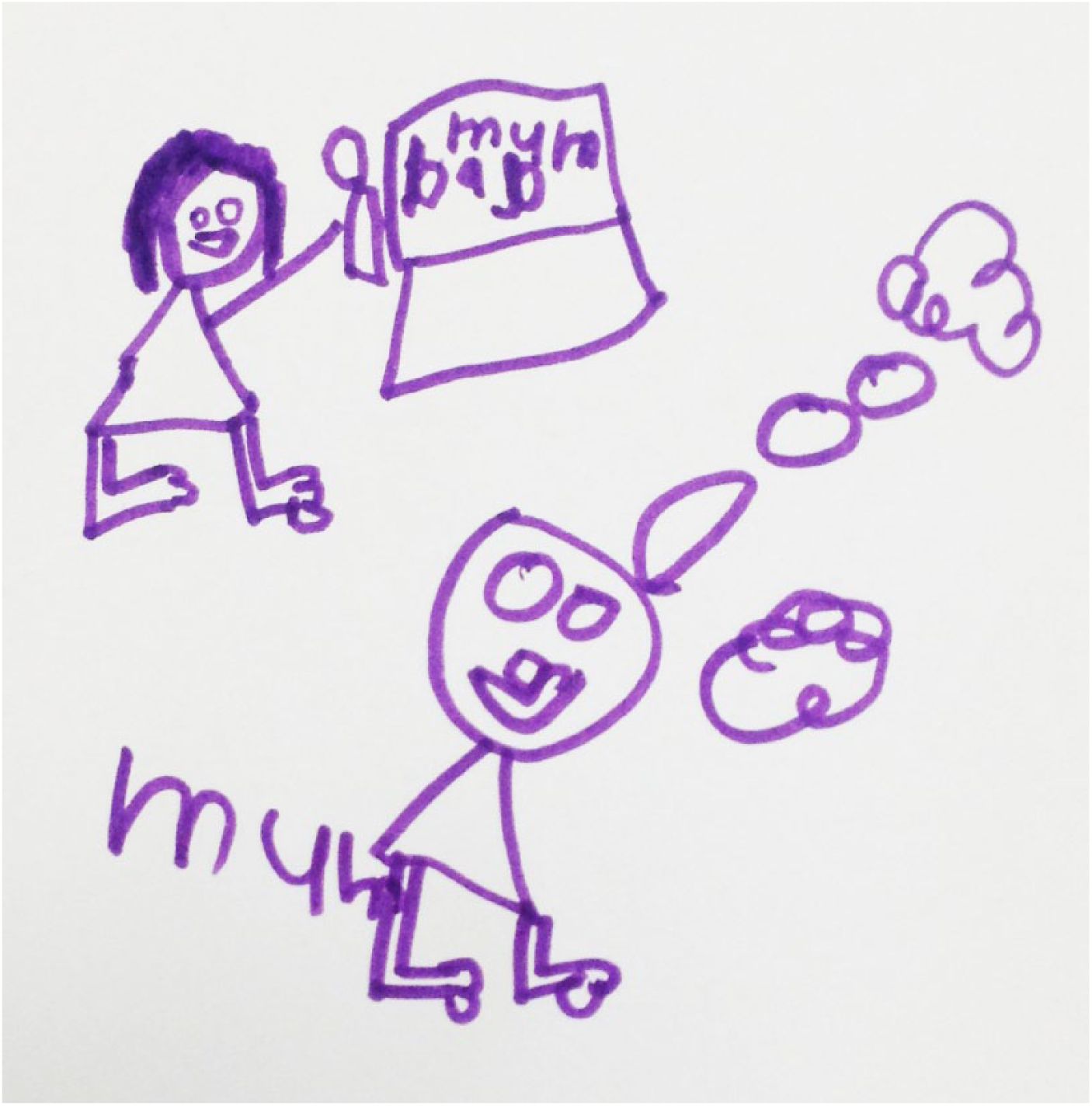
Foundation student representing writing collaborations with her mother.
Family as ‘purveyors of literacy’
The children identified a range of literacy skills and knowledge that they associated with their families, that enabled and supported their learning to continue in their home environments. Children acknowledged their family’s long history with writing as being a significant factor in their capacity to help. For example, a year 1 child stated, ‘My mum and my dad had to go to school and learn to write’. Similarly, a year 2 child acknowledged the family members’ expertise derived from engaging in writing: ‘My sister, aunty, mum, dad, cousins. My family, they are good [at writing] because they practice a lot’.
The literacy expertise within a family was often associated with family members teaching the children aspects of writing. A year 3 child, when asked what he wanted his teacher to know about what helps him to learn to write stated, ‘I usually get taught by my mum’. In another example, a foundation year child stated her mother taught her to write her name. Such examples demonstrate the central role the family plays in children’s literacy learning and children’s understandings of the importance of this in their learning. In other examples, numerous children indicated that their family helped them with practising their writing. For example, this year 3 child who spoke English as a second language stated, In grade 1, I wasn’t a very good speller. My cousins and mum and dad say, ‘Spell your name’. And if I don’t get it right, I have to do it a lot until I remember, and they let me spell words and I had to write sentences for my mum and my dad. He says, ‘Spell this’ and I have to write it in my book.
Most of the children’s responses indicated that their family supported their learning through activities including repetitive, opportunities to practise their writing. Other skills, included spelling, learning and practising the letters of the alphabet, punctuation, writing sentences, pencil grips or developing their neatness.
What we see here is the construction of family as ‘informed others’ in the literacy lives of children, by children. Despite common deficit talk about children not being supported by families as learners of literacy, for many of the children who responded to our survey, literacy learning did not end with the school bell. Instead, the children acknowledged and valued the support of family members and the contribution made by family to their literacy learning. Children identified their families as possessing the skills and knowledge necessary to advance their literacy learning. Our analysis of these data makes us wonder how listening to the views of children might help shift deficit thinking in schools.
Case 2: MediaClub
In this second case, we present data collected as part of a 5-year school reform study. Known as the URLearning Project, 2 the purpose of the larger study was to consider how school reform for equity and improved outcomes might work in current times. The school where this project was undertaken was in the same community as the school in Case 1. The student and teacher population is similar in both cases, with the student population at this school being culturally diverse and economically disadvantaged, and the teacher population being a mix of experienced teachers and new graduates, many of whom travelled from other communities to work at the school. As one part of the larger reform project, the research team ran an outside school hours media club once a week for students in years 4–7 (9- to 13-year-olds).
MediaClub 3 (see Woods, Levido, Dezuanni et al., 2014) was originally formulated as part of the research design of the URLearning project for two key reasons. First, to act as a space where young people could develop expertise in new technologies, digital literacies and media arts as a way to shift the pedagogical relationships in classrooms. Second, to provide a space for teaching and learning that connected to children and young people’s outside school lives. We envisaged the outside school hours context would enable connections to the important issues in young people’s outside school lives and provide new ways for them to communicate about issues of concern to them (this is in the tradition of projects such as the DUSTY Project, see, for example, Nelson and Hull, 2008). Each term, the young people were interviewed about their plans, futures and reasons behind their choice to engage in the after-school media space. By regularly listening to young people, we not only were able to use insights gained to redesign the programme as we went along, but also able to gain insight from the young people about the assumptions we were making about their literacy learning and how they saw participation in MediaClub positioned within the contexts for learning generally. In what follows, we briefly discuss MediaClub as a space to learn media and digital technology skills, followed by a discussion of the opportunities afforded by MediaClub to connect the school with the outside school lives of the MediaClub children.
A space to learn skills ‘for the classroom’
We created a space where students could develop their capacity and expertise in media arts and work with digital texts and digital technologies with the aim of up-skilling students in useful ways. We knew that the young people had limited access to technology and digital text production outside of school. The MediaClub team predicted that new expertise in digital ways of working would allow the students to engage in new and positive ways in their learning. Therefore, MediaClub was configured as an alternative learning space to the classroom. It was designed as a way to help students answer back to deficit constructions of their lives by providing a new way for them to interact with the pedagogical expectations of schooling. MediaClub was a space that worked to trouble assumed lived experiences of these young people, an intervention that would allow students to engage differently as learners. Thus, equipping students with ways to answer back to how they are represented as literacy learners through the talk and practices of schooling. However, as we worked and listened to the young people in the MediaClub space, it became evident that the ways in which students discussed their new skills and their reasons for participating in MediaClub suggested a much less straightforward line of sight between the MediaClub and other learning spaces.
MediaClub was organised by researchers, all of whom were originally teachers, and was attended by approximately 20 young people each term (Woods, Levido, Dezuanni et al., 2014). The programme was modualised, so that each term a different focus was used to organise the programme. Programmes included such foci as GarageBand, animation, gaming, documentary film-making, robotics and macro photography. MediaClub ran for 4 years at the school and was held one afternoon each week. The programme was held in the library, the computer lab and other outside areas around the school grounds. The afternoon programme began with all participants sharing afternoon tea and conversation together, before a short, explicit teaching sequence that introduced the young people to a new way of working with the technology at hand. This was followed by the young people working individually or in small groups producing texts or solving problems (Dooley et al., 2012). For the most part, any instruction was provided only as required, and usually only offered as a result of direct requests for help or support from the young people. The young people called on peers as much as they called on the adults when they needed support, and a great deal of the learning occurred through the young people providing demonstrations of new methods and approaches to each other.
The MediaClub young people refused to interact in the MediaClub spaces as ‘students’. While learning new skills was often discussed as a part of why they attended, having fun with friends, getting access to technology such as cameras and iPads, and just hanging out were also repeatedly offered as reasons for participation by the young people. The young people were involved in deciding what and how MediaClub would be. As one MediaClub participant explained, ‘It’s different here ’cause we get to decide what stuff we’ll do and it’s fun too’.
While our original focus was targeted at providing skills for the classroom, the MediaClub participants saw their new skills as directly impacting on their engagement in spaces well beyond the classroom. When asked to discuss this, some students identified how they used their skills within the community and family spaces. For example, one young person discussed using MediaClub as a way to improve her information technology skills so that she could be ‘better than her big sister’ which she thought would bring with it added benefits of increased access to the family’s relatively limited technology resources. She was sure that once she became the ‘most’ expert within her family, she would be the one most likely to have time on the home laptop computer.
Other participants discussed using new found skills when engaging globally on the Internet, whether within social media spaces, or by using Google ‘in assignments and to get better marks’. One of the female students discussed the shifting common perceptions of herself as a learner directly when she said that within her friendship groups and her family she could now ‘show off and be the best’ as she taught others how to do things. Several young boys discussed how working in MediaClub was preparing them for the future by requiring them to work in groups, ‘like they’d have to once they had a job’. While complaining that there were sometimes issues when working together, they indicated that when they worked well ‘they ended up with a bit of everybody’s ideas here’. These young people were interacting across spaces to change how they were able to ‘be’ literacy learners and text users. Listening to these young people provided us with insights well beyond what we had assumed would be the benefits of running MediaClub.
MediaClub had provided a space where many students learnt new skills and engaged in positive ways with new ways of communicating. However, the MediaClub participants did not think of this as being just about having skills to use in class. By listening to young people, we learnt about their understandings of how skills could be used outside of their school lives, including future jobs and life pathways.
A space for building connections
One dimension of the reform goals of the larger project was to encourage engagement between the school and the community within which the project was located. As part of this, MediaClub was configured as a space where students could engage and connect with their life worlds and the issues they saw as important, in ways that perhaps were not possible within classrooms. The MediaClub space was originally configured as a place where young people, volunteers and researchers could come together to re-imagine and remake the links between curriculum and their lifeworld experiences (Martin and Te Riele, 2011). Our original vision was that MediaClub would become a space characterised by contestation, dialogue and re-inscribing of opinions and perspectives. Without the same constraints on teachers’ pedagogical autonomy or on the young people’s potential for innovative and imaginary thought, those of us working within the space predicted that MediaClub might become a critical space where participants were encouraged to view the world differently, to think about social issues, to question the knowledge they gained, and to challenge existing power relationships (Steinberg and Kincheloe, 1998). However, this proved more difficult than we imagined.
Within this complex terrain, the challenge was to find ways to create moments of critical learning through dialogue. Importantly, dialogue, as Giroux and McLaren (1994) argue, is not just affectively listening to or ‘affirming and celebrating the interplay of different voices and experiences’ (p. 40). Rather, dialogue places importance on questioning ‘why’ and ‘how’ we think about things and the connections between this thinking and our life’s experiences and ways of being, that is, a place of listening differently. MediaClub did become a place where the students’ voices were listened to differently, and young people entered into dialogue with others in ways that they might not in more formal classroom spaces. However, in terms of content covered, the young people were hesitant to bring issues of contestation or substance into the MediaClub curriculum, working instead with content that they seemed to think the adults would consider palatable for an afterschool space such as MediaClub.
As an example, in an early iteration of MediaClub, the focus was on documentary film-making. The topic of the film was left open for participants to decide upon. There were suggestions given and a good deal of dialogue about topical issues before two groups decided upon creating a ‘don’t bully’ film and another produced a film about littering. Pratt’s (1991) notion of a contact zone where ‘disparate cultures meet, clash, and grapple with each other’ (p. 34) was not constructed through the inclusion of such ‘schooled’ topics. Instead, the young people seemed to be providing us with what they thought we wanted. This may have been to create time and space for their own ideas outside of the film requirements – ideas that they had no intention of sharing more widely or allowing to be embedded into the content covered in the ‘formal’ MediaClub curriculum. The irony of the situation was that we had hoped to provide a space for the young people to articulate and provide dialogue around issues important to them. Instead, they used the space to complete work that they thought fitted within the constraints of school, and then used the free time created to engage with their own material and communication channels. This was how the young MediaClub participants made this space their own.
As researchers, we worked together to identify how we could encourage the young people to bring more of their outside school lives into the sessions. One way in which we did this was to run GarageBand as the focus of one of the term modules. 4 We thought that music might provide a safe way for students to draw on their interests and passions as they learnt skills related to music mixing and making. Interestingly, we were inundated with Bieber, boy bands, LMFAO, and a choice array of heavy metal options. For the time and space, this is what we expected. However, we were also surprised by some of the content. There was a great deal of Elvis and other country and Western music influences in the music created, music genres that were from different times and contexts.
Working within the cultures and sub-cultures of the young people involved provided ways for the pedagogy and curriculum of MediaClub to ‘outgrow its container’ (Morris and Stommel, 2013). The young people began to work and share in quite different ways than we had originally configured in the MediaClub design. Learning was stimulated through the movement of ‘infectious’ ideas, knowledge and pieces of work redistributed throughout the group, and eventually outside the group. For example, several girls relayed to us how their music mixes were featured at the school disco, and they ‘were paid in lollies’ for their services. Therefore, the connections between the learning that occurred in MediaClub and classroom, school and outside school contexts were built through a process that is gradual, active, collective and cumulative.
Conclusion
In conclusion, we go back to the question we posed in the title of our article: What can children tell us about their literate lives? In talking and listening to the young people, we are able to redefine ideas of what ‘significant’ connections to children’s and young people’s outside school lives might look like. We have provided two examples of ways for students to express themselves and to connect their literate lives outside of school to their lives within school. In listening and working with the students’ ideas and literate experiences outside of the classroom, the two cases demonstrate that this can generate change within the classroom, affording instances where children might develop a sense of belonging within their educational spaces (Comber and Woods, 2018). Such changes can be the result of educators learning more about the children and young people that they teach, and these new understandings of children’s lives can have broad and far reaching effects, and not just to the individual children involved. When schools are in a position to consider the strong and diverse backgrounds of the children who enter the grounds each day as positive, then they are also more likely to focus on the preparation of these children towards diverse futures. Such a focus requires high expectations of themselves and the children and young people for whom they are expected to provide a high quality and high equity education.
At times, our approaches encapsulated what Zembylas and Boler (2002) refer to as a ‘pedagogy of discomfort’. Here, the aim of such critical pedagogy is not political indoctrination but rather helping teachers and students to co-construct their own critical frameworks together. Thereby drawing on, or engaging with, pedagogical weaving (Kwek, 2012) of the out of school literacy experiences and knowledges of children. Rather than using flawed perspectives based on one-dimensional understandings of literacy learners that essentialise particular narratives of pasts, presents and futures and focus on deficit understandings of children, we have demonstrated through our cases the rich experiences that can result from acknowledging diversity and using this diversity as a resource that enables, directs and promotes learning (Gutiérrez et al., 2009). In turn, this might enable an awareness that things can look very differently through different positionings where the focus is on the plethora of richness of the socio-cultural lives of the children we teach, thereby resisting deficit discourses of children, their parents and communities.
Footnotes
Funding
The author(s) disclosed receipt of the following financial support for the research, authorship, and/or publication of this article: This work was supported by the Australian Research Council (ARC) through its Linkage and Discovery programs - LP0990289 and DP150101240. The opinions expressed are those of the authors and not the Australian Research Council.
