




Abstract
Investigating children’s pop cultures that rely on myth-making provide understandings about how children are active agents in the socialization into cultural and moral practices in their everyday lives. An annual visit to Santa Claus is important in children’s pop culture in the Western world, however, the social practices associated with the continuation of the myth are under-reported. Drawing on the related methodologies of ethnomethodology, conversation analysis and membership categorization analysis, this article examines video-recordings of children talking to Santa at a North American shopping mall. An inherent problem for Santa across the interactions is how to talk about the children’s wished-for item without actually promising the gift. Analyses show that Santa manages this problem through the design of his turn and responses, which allows him to mitigate and propose why certain items might not be delivered. Despite the infrequency of the interaction between Santa Claus and a child, a visit to Santa highlights the interplay between child, adult and societal agendas. Findings presented focus on how culture-in-action is produced through the resources of conversation and permeating cultural practices.
Keywords
Introduction
In children’s pop culture in the Western world, Santa Claus (henceforth known as Santa) is ‘real’ to many children and a well-established part of social life (Clark, 1995; Corsaro, 2014). An annual visit to Santa increasingly dominates children’s celebrations associated with a now secular Christmas. Santa is present in commercial venues such as at shopping centres, work gatherings and preschool centres. Santa is a recognized figure with a standardized appearance. Children may believe that Santa can make and deliver presents to children all over the world on the very same night. Children in Western cultures may approach an annual visit to Santa in a variety of ways, often with excitement and sometimes with a little uncertainty or even ‘distress’ (Hagstrom, 1966: 252). Anecdotal accounts suggest that a visit to Santa is a rich interaction where children tell their Christmas wishes (Clark, 1995).
Children’s pop culture is established through an interactive process of the socialization of children. Characters such as Santa are interwoven into children’s everyday lives and become ‘deeply cherished rituals’ (Corsaro, 2014: 133), often recalled by families when talking about childhood memories. Adults are active in constructing the scripts that are associated with this practice because they see it as innocent and fun, and their collusion contributes to the ritualization of this practice (Belk, 1987; Thompson and Hickey, 1989). While these rituals are routinely associated with the concept of ‘childhood’, less is known about how the co-production of social practices that maintain cultural myth-making take place.
The process of ‘socialization’, that is, ‘how people become skilled in the ways of society’ (Cromdal, 2006: 462) is especially pertinent when attempting to understand the continuation of cultural practices such as myth-making. Research into the socialization of children has typically been dominated with expectations, interactions and beliefs, according to various stages of development, based on age. This developmental approach, however, tends to ignore a more nuanced approach in research that focuses on how cultural practices emerge from being an active member of that culture. From this standpoint, culture is situated ‘inside action’ (Baker, 2000: 101) and culture is understood as being created in relation to interactions, knowledge and relationships of that culture (Corsaro, 2014; Hester and Eglin, 1997; Theobald and Danby 2017). Of interest then is the intersection between child, adult and societal agendas.
To understand how pop culture is coproduced and maintained, this article is interested in investigating how interactions unfold between Santa and children as a part of ‘culture-in-action’ (Hester and Eglin, 1997). From this standpoint, cultural knowledge is a demonstration of social practices that are routinely recognized as specific activities relating to a cultural event or custom (Francis and Hester, 2004; Hester and Eglin, 1997). Such an approach positions culture inside action, rather than from considering culture as an already established and organized set of expectations (Cromdal, 2006). In other words, while routines are established, these practices are interactional and therefore constantly ‘in flux’ (Danby, 2009; Danby and Baker, 2000). They are reinforced and reconstituted as they are repeated and transferred through socialization practices.
Cultural knowledge is displayed as one becomes au fait with the expectations of the social setting (Theobald and Danby, 2017). Using the sequential analysis of ethnomethodology (EM), conversation analysis (CA) and membership categorization analysis (MCA), this article aims to show how talk about what a child wants for Christmas is introduced as a telling, and the moral work associated with the interaction embedded within these interactions. Our investigation examines a video-recording of children talking to Santa at a suburban shopping mall in Nevada, USA. After reviewing the literature on the role of Santa in children’s culture, we present our analysis of conversations where children tell Santa their Christmas wishes. We explicate two straightforward sequences of children’s interaction with Santa, that is, these are treated as unproblematic with the interaction proceeding without pause or hesitation. We then examine two sequences that are not treated as straightforward, because of what is wished for or the telling of the wished for item is verbally absent. Findings show how Santa manages these interactions to address his inherent problem of how to talk with the children about their wished-for item while keeping true to the his responsibilities as Santa.
Myth-making in children’s pop culture
Using a culture-in-action framework, we understand that children and adults are active participants in the production of characters that rely on myth-making (Clark, 1995). While children are understood to be able to distinguish between reality and fantasy from as young as 3 years of age (Sharon and Woolley, 2004), children during early childhood (3–9) draw heavily on the statements of others as evidence that fantasy characters are real (Woolley et al., 2011). Children’s implicit understandings are important in establishing beliefs about mythical characters without the need for direct contact (Woolley et al., 2011). Tully and Woolley (2009) found that children identified evidence to support their beliefs in mythical characters. For example, a gift appearing under the Christmas tree is proof that Santa is real. These studies show that children’s belief in fantastical characters is high despite being able to assess reality from fantasy. Much of the evidence pertaining to the ‘realness’ of mythical characters is ‘engineered’ by adults (Principe and Smith, 2008: 92) and co-produced in response to the social, cultural, religious expectations of the context.
The adults’ role in continuing the myth involves adults telling children ‘untruths’ in that they build a ‘story’ about Santa including artefacts, rituals or performance (Belk, 1987). Telling untruths is part of social life (Sacks, 1975). In greetings, for example, when people are asked ‘how are you,’ they respond with ‘I’m fine’ when, in fact, they may not be fine, they are indeed lying (Sacks, 1975). Children also become socialized into this social practice. Unlike the formulaic greeting sequences explored by Sacks (1975), the deception about how Santa is maintained uses a different set of interactional resources. As discussed, these interactional resources including storytelling and rituals perpetuate the Santa Claus myth.
The socialization of children through moral work
The socialization of children is also accomplished through moral work associated with children’s pop culture. One example of the moral work attributed to Santa is his categorization of children according to behaviour, that is, whether they have been naughty or nice (Coots and Gillespie, 1934). In so doing, these practices socialize young children for a particular moral purpose by telling stories of how good behaviour is rewarded and naughty children are not rewarded. Adults (Santa and parents) as well as recipients of the categorization (children) are held accountable for the categories they attribute (Bergmann, 1998: 287). The codependent relationship of morality and interaction often go unnoticed until there is some breach of accepted moral norms of society (Bergmann, 1998). Members accomplish moral work through their orientation to, and ‘selection of categories’, and their associated actions (Bergmann, 1998: 287).
While children are not always credited as knowing participants in adult social worlds, they are central participants in the morality work associated with the Santa experience. Adults assume that children will engage in and display their understandings of adult-formulated cultural rules and practices (Baker and Freebody, 1989; Theobald and Danby, 2017). For example, the act of telling Santa what they want has associated moral work in terms of the kind of gifts that they might name. Moral work is usually invisible because it is intertwined in our everyday social worlds. As we demonstrate in this article, the moral work of telling Santa their wishes can be breached through asking for items that might be considered too expensive (such as a computer), or might challenge certain moral views (such as a violent video game). We see morality work in the situated practices of participants (Sterponi, 2009) with children telling Santa their wishes.
Children have some pre-existing knowledge of Santa, including what he looks like, where he lives, with whom he lives, that he knows about them and that they can tell him their Christmas wishes. This information is procured via the popular press, including advertisements and children’s books and through interactions with family and peers (Belk, 1987). Cultural opportunities such as the real-life interactions between Santa and a child are typically infrequent.
Previous research about Santa has drawn on interviews and observations (see Clark, 1995; Thompson and Hickey, 1989) or drawn on reports of children in experimental encounters (Principe and Smith, 2008; Tully and Woolley, 2009; Woolley et al., 2011). Other research has examined the content of children’s request letters to Santa to show that children are ‘brand orientated in their request behavior’ (O’Cass and Clarke, 2002: 38). Much of the research on Santa’s encounters with children has an interest from marketing or consumer perspectives (Corsaro, 2014; Hancock, 2013), rather than situated in social lives and interactions of children with Santa. Examining Santa–child interactions highlights the socialization practices within the visit itself. Such a focus highlights how children themselves learn cultural practices through actively interacting and maintaining the conception of reality and the moral work associated with this.
The institutional context of a visit to Santa
An encounter with Santa is institutional in the sense that there is a common goal to which participants orient (Drew and Heritage, 1992). Many people selected to ‘be’ Santa receive specialist training. Such training appears to ‘teach’ the recruits how to ‘be’ Santa and to deal with what children tell Santa. In other words, Santa needs to be ‘convincingly’ real (Garfinkel, 1967).
Children may receive instructions about what to say as parents ‘school them up’ before visiting Santa. Santa has an expected job to do: the business of the visit is to find out children’s Christmas wish. Common expectations about the visit result in a number of procedural consequences (Schegloff, 1992: 111). This means that the encounter is shaped by the participants’ orientation to the business at hand, that is, telling Santa their Christmas wish. Such orientation shapes the ‘form, trajectory, content or character of the interaction’ (Schegloff, 1992: 111). An encounter with Santa has specific inferential frameworks (Drew and Heritage, 1992). In other words, an institutional purpose to the interaction and a pre-chosen category of topic can be observed. Membership categories play out in these interactions so that participants orient to who is speaking and respond in a categorically appropriate way (Speier, 1973).
Santa has multiple roles as he engages with children in sites such as shopping malls. These include, being a mythical figure for children and a photographic subject included as part of the documenting of childhood. An important aspect of his role is that of acting as a moral agent in his role as Santa. The problem for those working within the category of Santa lies therein, how to make children believe this is Santa and how to manage children’s Christmas wishes without committing to the delivery of named items. We examine closely the interactions that occur between Santa and young children to identify how Santa introduces the question of what the child wants for Christmas, how he manages children’s tellings and the cultural work that ensues.
Data and setting
Our investigation draws on data from video-recordings of interactions with Santa at a suburban shopping mall in Nevada, USA. Taking children to visit Santa at a shopping mall is a popular way in which the myth of Santa is constructed. Four extracts are chosen from a broadcast that captured children’s visits to Santa, and presented on Hearst Television KCRN Television Network Santa hears Christmas Wishes (https://www.youtube.com/watch?v = e2wvOdmApzU). There were 10 extracts in total in the broadcast. Four selected sequences are chosen as examples of different ways children and Santa interact during a visit to Santa.
There is a preference for ‘naturally occurring’ data to be used in the analysis of ‘talk-in-interaction’ (Psathas, 1995; Speier, 1973). An interaction is defined as ‘naturally’ occurring if the interaction would have taken place without the researcher’s presence. This article examines interactions that are naturally occurring in the sense that from the children’s standpoint, the interaction is real with the purpose of the interaction to talk to Santa. Whether the television news network was present or not, the interaction between the children and Santa would have occurred. The interaction is unscripted and is not produced for the purposes of the research.
Given that a television network sought to video-record the interaction as it was occurring marks it as ‘newsworthy’. Using an ethnomethodological (EM) lens news is considered ‘a frame through which the social world is routinely constructed’ (Van Dijk, 2013: 8). In other words, what is reported in the news reflects what is locally constructed as important to a society or generation at that point in time. As a lens through which social world is replayed, the news recordings have been made publicly available using YouTube.
The inclusion of these recordings on YouTube also reflects the public nature of children’s lives and experiences of childhood, and the active social construction of pop culture. A number of researchers in the field of conversation analysis have examined interactions recorded and loaded onto YouTube (see Harris, 2006; Pihlaja, 2014; Reynolds, 2011). As Laurier (2016) suggests, YouTube provides a ‘reconfiguration of the private sphere’. This highlights how children’s everyday lives are displayed and monitored in public forums. One possible concern of using data on YouTube is that it has been edited prior to being uploaded onto the web. Given this possible concern the sequences selected were carefully examined, selecting only those that appeared not to be cut.
The selected sequences highlight different ways children told their wishes and how Santa managed these. Initially, we considered the children’s naming items as requests, an action of talk that has been examined extensively in conversation analytic (CA) literature. As Curl and Drew (2008) explain, requesting is a pervasive action in interaction where people make requests for help, information and items. With younger children, requests often begin with ‘I want x’ (a declarative form) or ‘Can I have/do x’ (an interrogative form) and re-requests are characterized by ‘I want’ (Wootton, 1981: 514). ‘Can I’ requests can occur when a child solicits a reply following no response from the recipient or if the recipient has ‘responded in a prevaricating manner’ (Wootton, 1981: 514). After closely examining the sequence of turns as well as the content, we have specifically used the term ‘telling’ to describe the action accomplished by the child’s turn. Thus, because of the position of the child’s asking, we propose that these turns can be viewed as different to requests. In all the tellings, the children display a high sense of entitlement, that is, that Santa will deliver the named item to them. It is in the work, then, of how Santa manages these tellings, to mitigate/propose why certain items might not be delivered.
The extracts were transcribed using Jeffersonian transcription conventions (Jefferson, 2004) (see Appendix 1). The adults accompanying the child to his or her encounter with Santa are an ‘over hearing audience’ (Heritage, 1985) to the conversation between Santa and the child. These adults include the parent/s of the children talking to Santa, waiting parents and children, passersby, the photographer and the television staff video-recording the interactions. Some interactions between the child and Santa are to support the photographer who is capturing the child’s visit to Santa, and some are to do with publicly video-recording the interaction for the TV station, and the nearby parents. While these adults have a part to play in the ensuing interaction, a limitation of the data means that it is not possible to analyse these influences. Therefore, the focus of this article is on Santa’s management of the children’s tellings.
Analysis
Analysis draws on EM and CA approaches that offer the opportunity to analyse interaction as it naturally occurs. In employing an EM approach, the viewpoint ‘from within’ makes obvious the ways in which participants themselves organize and make sense of their activities in a social arena (Garfinkel, 1967). Through its fine-grained description of talk-in-interaction, conversation analysis examines the organization of underlying social orders. ‘Order is assumed. The problem is to discover, describe and analyze that order’ by explicating the associated rules and structures produced (Psathas, 1995: 45).
MCA includes ‘the doing of descriptions, the making of claims, the organisation of social relations, and other aspects of the micro politics of everyday and institutional life’ (Baker, 2000: 99). In everyday life, participants use categories to describe themselves and others as they talk and understand each other (Hester and Eglin, 1997). These categories are labels through which one can identify and refer to other people. A person may be seen as ‘belonging’ to different categories depending on their actions and attributes at the time, and thus be described in different ways; for example, the same person may be categorized at various times as a teacher, mother or woman. A membership categorization device provides order for understanding the organization of descriptions of people and the meanings inferred. Much of this understanding is framed within the lens of understanding the moral order underway.
The first two extracts, of the four, include tellings that we identify as ‘straightforward’. By straightforward, we mean that the telling is treated as unproblematic as the telling is verbally hearable and the interaction proceeds without pause or hesitation. Extracts 3 and 4 illustrate how Santa manages interactions when wished-for items are not straightforward in terms of what is being asked for or when the telling is verbally absent.
Straightforward tellings
The first extract shows a straightforward telling, when the telling proceeds without hesitation in an unproblematic manner for both members.
Santa welcomes the boy asking him if he gave a big smile to the camera and asks to see the child’s smile. This works to move the boy into a closer proximity to Santa before the interaction continues. We next see Santa moving to the business of the interaction marked with the discourse marker ‘now’ marking a new sequence (Schiffrin, 1982) and asking the child what he wants for Christmas. The boy names the toys that he wishes for Christmas, a dune buggy and a devastator.
In the next turn, Santa provides a formulation of the toys that the boy indicated that he wanted for Christmas. Beginning with the turn, ‘You want’, he refers back to what the child said. As interactional resources, formulations work in three ways: ‘(1) to preserve the preceding talk, (2) to negate the preceding talk or (3) transform the preceding talk into something else’ (Heritage and Watson, 1979: 123–162). This formulation works in the third way, to transform the telling by repeating what the child wishes and thus making a moral assessment of the toy as ‘good toys’. This provides approval of the toys as being morally acceptable. As well as providing this moral account of the boy’s named item, Santa successfully evades making a commitment to providing the item. Here, his formulation is one that would be difficult about which to disagree. In this way, Santa is engaged in moral work that is typically unseen and unnoticed: The boy has named appropriate toys, and Santa can be seen to characterize the named toys using a commentary that identified the implications (‘good toys’) and potential of the items (that they would be ‘fun’).
Santa treats the next telling, extract 2, as similarly straightforward. Embedded in the interaction, however, are moral associations.
Santa welcomes the young girl with the greeting ‘Hi honey’ using the term of endearment, honey. Santa’s first turn is extended as he comments on her outfit using a positive assessment ‘that’s nice’, showing his approval. Santa’s commentary accomplishes moral work placing her in a category of a ‘nice’ girl. This work also fills in time for the girl to be in position to be photographed. Both the girl and Santa gaze at the camera as Santa says ‘ah oh’. During this turn Santa moves the young girl to face the camera and to sit on his lap. Talking with Santa involves close physical proximity, marking this as a special and personal conversation. We next see Santa moving to the business of the interaction evident with the discourse marker ‘now’ indicating a new sequence (Schiffrin, 1982). The term of endearment, ‘sweetheart’ implies familiarity and also enables Santa to continue the interaction with the child without having to know or use her name.
The construction of Santa’s turn includes a yes/no interrogative (Schegloff, 2007), requiring a yes or no response rather than naming an item. The young girl, however, provides a name of a desired object in a quiet voice. Santa replies that he could not hear her response and he turns her to face him. Thus, in the following turn, the girl repeats and extends her turn to provide further information about the item. This interchange highlights an orientation to the purpose of the interaction with Santa: to tell him her Christmas wishes. Santa receipts her turn using the receipt marker ‘Oh’, a change of state token (Heritage, 1984) that accepts this new information. His further description, of the game being about ‘fashion’, displays himself as one who knows about the game, portraying him as one who is in touch with children’s toys. The girl nods to confirm that Santa’s information is correct. Santa next provides an assessment of the game as ‘a good one’ and one that ‘young ladies want’. His positive assessment, ‘a good one’, is in the form of a compliment (Shaw and Kitzinger, 2012).
Assessments do more than continue talk. Assessments can show alignment (or otherwise) to a speaker and bring a topic to a close (Goodwin, 1986; Goodwin and Goodwin, 1987). Santa’s assessment accomplishes moral work inferring that by choosing a good game, she has made a good choice. His following description, ‘there are a lot of young ladies want th
Tellings that are not straightforward
In the first extracts we observed a straightforward interactional pattern in which Santa provides an interrogative that produces a response from the child who then told him a desired item. The next two extracts illustrate how Santa manages the interaction when named items are not straightforward or when the telling itself is absent. In Extract 3, Santa has to manage a child’s wish for an expensive item.
Starting with ‘and’, Santa’s turn is a continuation of the interaction that has gone before (not shown here). Santa asks the girl to directly name the item that she wants for Christmas and, as in previous examples, the term of endearment is used. The girl looks up, and with a slight pause and then clearly names her desired item, a laptop. Santa’s repeat of the item is emphasized and elongated. After a slight pause, Santa continues his turn beginning with ‘nnr-’, which signals some kind of uncertainty about this named item. In his category-bound activity to deliver named items, Santa continues by providing an account to justify why this might not be a straightforward wish. Rather than giving a moral judgment of why this item might not be appropriate, for example, it is expensive, Santa provides a reason that does not discount the girl’s telling as ridiculous or inappropriate, or a moral breach of gifts in terms of its expense, thus potentially calling to question her moral agency (Danby and Emmison, 2014). Rather, he brings into question the technological competency of his elves. The ‘okay’ at the end of his turn works to confirm that the girl has recognized Santa’s potential problem with his elves and their technical capabilities.
Extracts 3 highlights the moral work that comes into play as Santa responds to children’s wishes. Santa is making decisions about what may or may not be possible for parents to deliver to the children on Christmas Day. For some families, a ‘dune buggy’ (Extract 1) could be seen as an expensive toy, and equally for other families, a laptop (Extract 3) could be a perfectly reasonable expectation. These sequences show how Santa draws on his own assumptions and assessments of what is ‘reasonable’ or ‘expensive’ to determine his response.
In Extract 4, no verbal telling is forthcoming by the child. Instead, a girl stands in front of Santa who is holding two sheets of paper. As the interaction unfolds, we examine how Santa manages the ambiguity in this interaction.
This extract begins with girl standing in front of and slightly to the side of Santa, and Santa is holding a couple of sheets of paper with some writing-type symbols on it. After his yes/no interrogative to confirm whether she made the drawings, to which she nods, he provides a compliment, telling her that she has done a ‘beautiful job’. His non-specific compliment is one way of avoiding talking specifically about the drawings on the paper. The girl holds up a small piece of paper with a drawing on it, and she brings it closer so that Santa’s gaze falls on it. In overlap, she begins her request, ‘I want th-’, which seems to be cut off by Santa’s next turn. His question is designed to confirm that this drawing is a representation of what she wants; his use of the indexical ‘this’ suggests that both he and the girl know what ‘this’ is referring to. The drawing appears to be of a person, or doll or robot, but it is not labeled or discussed.
Santa avoids ever specifically naming the drawn item by saying that he will pass her drawing onto the elves who will look after this matter. In this way, he does not have to attempt to label or name it here. He maintains his moral character of ‘knowing’ what children want for Christmas.
Santa next refers to well-known characters in Santa’s world – the elves and Mrs. Claus, members of the membership group or device, ‘Santa and Christmas’. The elves and Mrs. Claus are being charged with responsibilities related to the drawings – the elves will know what she wants for Christmas, and Mrs. Claus is going to display it. Putting artwork on the refrigerator in the kitchen to display the child’s accomplishment is a common practice in many Western homes (Boone, 2008). In this way, he is displaying his local knowledge of social life by participating in a typical family practice. Santa avoids having to work out the girl’s wish and possibly get it wrong, which would call into account her competence in producing a recognizable drawing, and also call into account his competence as Santa in labelling and knowing her wish correctly.
Discussion
The analysis provided makes visible the socialization practices into pop culture of an annual visit to Santa. In order to investigate these practices, we examined (1) children’s tellings and Santa’s response and (2) the moral work that is embedded in Santa’s responses to children’s tellings. Extracts 1 and 2 showed Santa’s management of straightforward tellings initiated with the discourse marker, ‘now’ that signalled the business of the interaction and followed with an interrogative during which Santa asking about a Christmas wish. A preferred response was identified, that is, that child named the wished-for item. A problem emerged for Santa in Extracts 3 and 4, when Santa was faced with items that the children wanted that were treated as problematic, or where there was limited verbal information given or the requested item was unclear.
An inherent problem for Santa across the interactions was how to talk about the children’s wished-for item without actually promising the gift. This moral challenge goes back to his role as a mythical figure promulgated in children’s culture (Belk, 1987). While children believe that Santa has the power to deliver the presents and, therefore, make requests to Santa, the reality is that Santa does not actually provide the item. We see Santa carefully manage this problem. At no time did he promise an item, instead he manages this problem in the design of his turn and his responses to the children. The design of Santa’s turn is that the ‘telling’ is positioned as a second pair part. This occurs by asking the children a question, such as, ‘do you know what you want for Christmas?’. Thus the child’s telling is produced as a second pair part to Santa’s question. This means that Santa is not interactionally required to respond to the child’s telling as a ‘request’ in the sense that he does not need to go along with or deny the wished-for item.
These sequences have similarities to an established sequence of questioning known as the Initiation-Response-Evaluation (IRE) pattern (Mehan, 1979). As observed in classroom talk, the IRE pattern shows how teachers often take the first turn (initiation), the student provides a response (response) and an assessment is given on that response (evaluation). The teacher’s third turn expansion can do additional work such as providing further information and emphasizing particular aspects of the student’s turn (Gardner, 2013; Lee, 2007). In the interactional sequence of talk observed in these extracts, Santa used a third pair part to evaluate the children’s wished-for items or do additional work associated with the ‘requests’ (i.e. by invoking the ‘Christmas’ device and placing onus on the ‘elves’ to determine what the request is and whether it is viable). He provided an account that commented on the choice of the game and took a moral stance.
In the problematic interactions (Extracts 3 and 4), there was a lack of any kind of assessment of the named items, instead Santa managed potentialy difficult items and ambiguity by problematizing the delivery of the wished-for items and provide an account that called on other members (elves and Mrs. Claus) for why an item might not be delivered. For example, in Extract 4, where the requested item was unclear, Santa drew on other members of category of ‘Santa and Christmas’ to account for interpreting the drawing. Such an interactional response was required because an explicit refusal of the possibility of delivery of the item is an explicit breach of the moral work required of Santa knowing about the items. Thus, as seen in Extract 3, Santa provided a self-initiated repair that followed a cut-off of the dispreferred response ‘no’.
Children were further socialized into this cultural practice when membership categories attributed to children and the activities attributed to the members. ‘Santa and Christmas’ was the Membership Categorization Device (MCD; Figure 1) that was potentially always relevant during the interaction between Santa and the children. Within the MCD, members included Santa, Mrs Claus, the children, the elves and the parents of the children with activities attributed to each member. Known as category-bound activities, for Santa these included knowing the children, inviting the children to tell their Christmas wishes, listening to the children’s tellings, commenting on and assessing the named items, consulting with the elves or Mrs Claus and delivering the items on Christmas Day. As members of the MCD, the children oriented to Santa’s category-bound activities, so each of the children either articulated their wished-for item or presented a list.
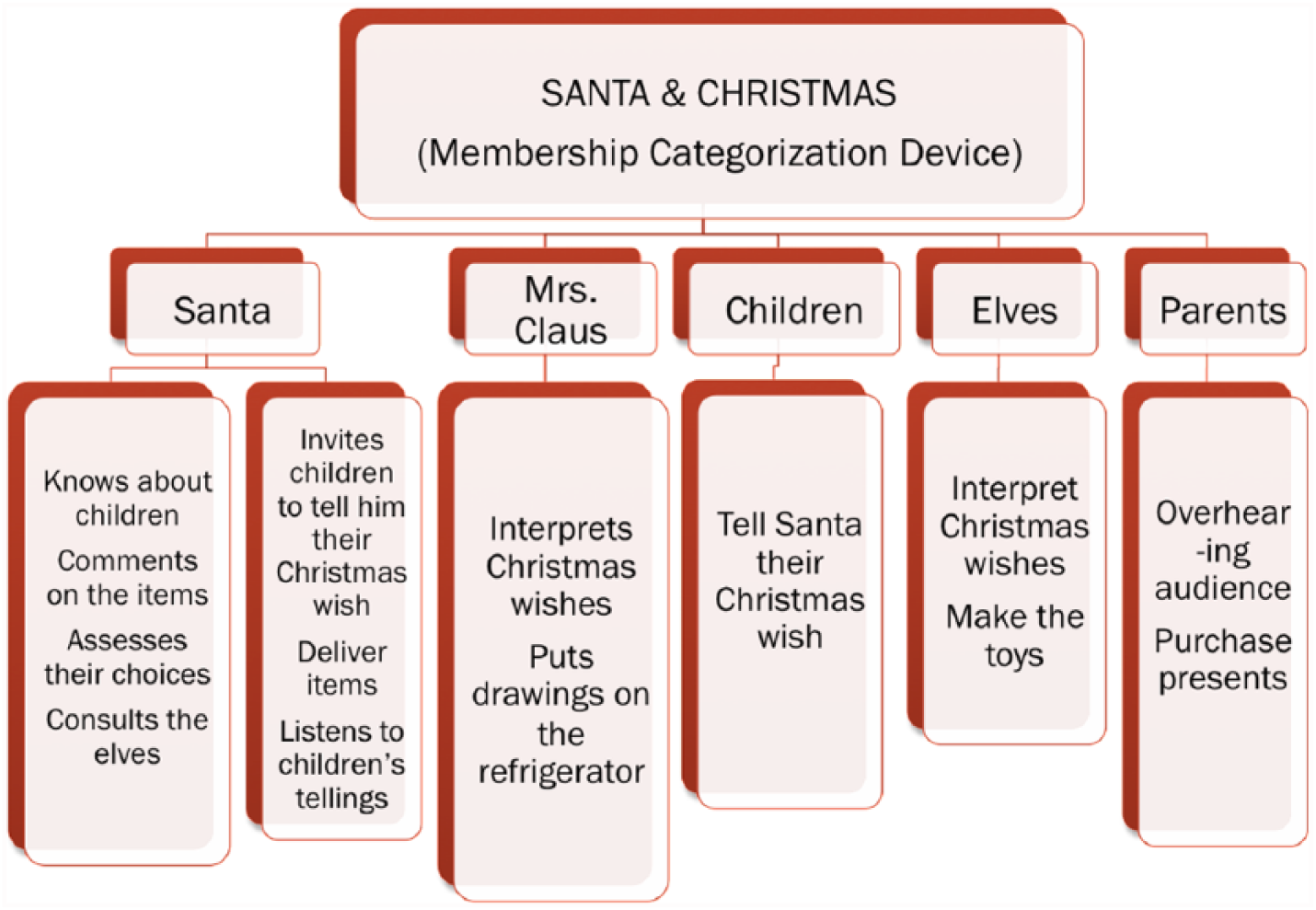
Membership Categorization Device – Santa and Christmas.
Culture-in-action was further accomplished in Santa’s third turn responses of assessments. Given that the action of telling Santa is an activity bound to the child, an assessment reflected a positive review of the child and named item. Santa drew on the membership category of gender when he placed the child into a particular membership category. For example, Extract 2 showed Santa naming the category ‘young lady’, attributing the girl to that category because of her choice of toy. In addition, as a member of the category Santa Claus, Santa assumed particular rights and responsibilities (Jayyusi, 1984). Santa assumed rights to use terms of endearment such as ‘honey’ when he has no pre-existing familial relationship, and also to make assessments about the child’s outfits and requested items. Santa was able to carefully dodge his associated responsibilities by not committing to the delivery of an item. This interactional work contributed to the continuation of the myth of Santa and its associated cultural practices.
Conclusion
Investigating adults’ and children’s social practices for myth-making and myth-maintaining provide understandings of ‘culture in action’ (Baker, 2000; Hester and Eglin, 1997) and ‘morality-in-action’ (Danby and Emmison, 2014). Parents, children and Santa are primed through cultural experiences of perpetuating and continuing the myth of Santa so that this practice remains one of the rituals of childhood (Clark, 1995; Corsaro, 2014). Speier’s work identified that young children have restricted interactional rights when communicating with adults because of their membership of the category child (Sacks, 1995; Speier, 1976). During a visit to Santa, children are invited to tell Santa their Christmas wishes and thus have access to the conversational floor; however, given that Santa is an adult and also revered character, children experienced restricted interactional rights in an interaction with Santa. Although the children had the opportunity to have the conversational floor (Speier, 1973), analysis showed that the children were not really in charge of the conversation until Santa introduced talk about their Christmas wishes, usually through the form of a question. By producing the ‘telling’ as second pair parts, the children were able to ask for their wished-for item without having to formulate a standalone request. They could simply produce a response to a question which was far less morally loaded than walking up to a stranger and asking for toys. Thus, Santa retained significant interactional control over the conversation and how it unfolded. Such talk is a site of moral work produced through the resources of conversation and through cultural and ritualized social practices. Findings highlights the interplay between child, adult and societal agendas.
Footnotes
Appendix 1
Acknowledgements
The Queensland University of Technology (QUT) Professional Development Leave Scheme supported Maryanne Theobald to complete this work. The authors acknowledge the generous feedback by colleague Jessica Harris as we developed this article.
Funding
The author(s) received no financial support for the research, authorship and/or publication of this article.