




Abstract
This article aims at taking a look at a genre that is popular with both children and adults, yet mostly neglected in curricula: animated films. As a study conducted in a German secondary school demonstrated, the potential of this genre for Teaching English as a Foreign Language lies mostly in its strong visual language as well as its connection to the daily lives of the students. After briefly discussing why animated films by Pixar can be considered as a genre and how this genre (re-)presents popular culture, the theoretical basis for the integration of the films into Teaching English as a Foreign Language will be laid out. The topics addressed by Pixar animated films will then be described. Also, a task typology and some actual tasks that can be used when addressing the topic in the English as a Foreign Language classroom will be introduced. Finally, one task that was actually used during the empirical study, and how the students responded to it, will be brought into focus. The main example will be the film Up (2009) but other films from the Pixar œuvre will occasionally be referenced to illustrate certain points.
Introduction
Animated feature films, especially those by Disney and Pixar, are largely considered to be suitable for kids. In fact, they may be the one genre that immediately comes to mind when you think of kids’ movies. Actually, in order to appeal to as many age groups as possible, most animated films offer more than one way of reading them. They are easy to understand and fun for kids, they have some rebellious potential for teenagers and young adults, and they offer adult viewers another reading by using intertextual references or referring to more sinister topics (cf. Booker, 2010: 110; cf. Eder, 2007: 290). That, among others, is one reason why watching animated films is a pleasure we love as children and still enjoy as adults. However, we also have to face the fact that “not all is well in the Disney kingdom when it comes to questions of morality” (Müller-Hartmann, 2008: 401): one well-known example is the Disney Princesses franchise. We are perhaps all aware that these princesses are not a beacon of feminist values. But there are also more subtle messages in Pixar movies. The Cars franchise, for example, is full of stereotypes about rednecks, Italians, women, and more. In Monsters University or Monsters, Inc. (Monsters University, 2013), bullying is portrayed as not only a part of characters’ everyday lives, but also an acceptable reality that some just have to deal with. Children who watch these movies are, mostly, not aware that they are being indoctrinated with certain messages, positive or negative. We cannot deny that Disney (and, being part of the Walt Disney Corporation, Pixar) is a powerful force in the education of children, since “it provides many of the first narratives children use to learn about the world” (Ward, 2002: 1), teaching them about good and bad, about gender roles, and about foreign cultures. Of course, Pixar films offer positive messages: they show that values such as friendship or solidarity are important. At the same time, they often deliver very subtle messages which need to be recognized by viewers in order to prevent uncritical reception of them. Children are impressionable and they need to be equipped not only with an awareness of the sometimes hidden messages but also with tools to decode them. Yet, looking into school curricula (in Germany), there is a certain canon of works that is considered “teachable.” This canon has several sources: curricular specifications (e.g. about the works that need to be covered for the preparation of final exams) are probably the most powerful agencies; but since academic research and teaching manuals mostly cover genres such as (young adult) novels, dramas, and high-brow movies (often film adaptations of novels), this canon neither includes animated films nor many other works of popular culture. Both areas seem to be reserved for the children’s (and teachers’) free time. Yet, as Müller-Hartmann (2008) puts it, “the viewing of certain popular texts needs educational support without automatically destroying all the fun.”
Pixar animated films: a popular culture genre
In order to shed light on why and how animated films can be meaningfully integrated into the classroom, we will, first of all, have a look at the films themselves. Considering the fact that children need tools to decode animated films, it is necessary to describe them and analyze their way of telling a story, and to sound out how they (re-)present popular culture. Also, we need to question whether animated films by Pixar can be called a genre. There are quite a few scholars, such as James Clarke, who say that “animation is not a genre and never has been” (Clarke, 2013: 27). There might be some evidence for this, given the diverse range of topics or plotlines, even the many different ways of animation itself—stop-motion, clay, and computer-generated imagery (CGI), to name but a few. We might even ask ourselves whether we actually have to define Pixar animated films as a genre. The answer to that question is easy: No, we don’t have to—and yet, it makes sense to at least try, for “genres help us to describe texts by singling out textual components worthy of attention such as plot structure; in turn, description helps to classify a text by placing it among similar texts” (Pyrhönen, 2007: 109). So why can we single out Pixar movies as a genre?
One part of the answer is the studio: it takes up the function of the auteur of the films. This is as common for CGI animation as it is to have the director functioning as the auteur in live-action films (such as ‘Steven Spielberg films’) or the producer in traditional animated films (such as ‘Walt Disney films’; cf. Kohlmann, 2007: 57, 58). Also, the studio’s hyper-real aesthetic was groundbreaking: “[It] prompted a definite artistic shift at Disney, while also helping to shape what would become the dominant form of feature animation at the beginning of the new millennium” (Pallant, 2013: 131). We can, thus, call Pixar movies “brand-name movies” (employing terminology of cf. Rick Altman, 1999: 115). These movies do not want to explicitly stress “sharable determinants like genre”; instead, they rely on “proprietary characteristics” (Altman, 1999: 117, emphasis in original), most importantly the studio’s name and its previous successful films, and a “positive brand-awareness” (Pallant, 2013: 128).
The other part of the answer can be found by looking at the content of the films. The basis for this is an understanding of genre as a “group of films which share specific features and which were, in a certain historic context, associated with each other” (Kuhn et al., 2013: 22; translation: J.H.). The Pixar company itself created the triad “story, character, and world” to describe their way of making movies (cf. Bundeskunsthalle, 2012). Following this triad, the films share the following specific features:
Plot structure: Pixar claims to create stories that are not only full of emotions, but also relatable (cf. Bundeskunsthalle, 2012: n.p.). Looking at the movies Pixar released so far, the relatable aspects of the films are mainly the conflicts the characters have to go through. For example, they have to deal with rivals for their job (Monsters, Inc., 2001; Toy Story, 1995), overcome grief (Up, 2009), or fight with their parents (Brave, 2012). The stories usually follow the three-act paradigm of screenplays (cf. Field, 2005 [1979]), with a plot point at the end of each act which drives the action forward.
Topics: the topics that Pixar movies address seem, at first sight, not to be so different from topics that traditional Disney films deal with—the pursuit of dreams and goals, friendship, community and solidarity, or bildung and initiation. On a subtler level, the films also include topics such age and generational conflicts or gender. What is important to note is that all Pixar movies usually address all of these thematic fields—some of them are more prominent than others, but they are all always there. I will take a closer look at the topics and how they are represented in the films below.
Characters: as they do with their stories, Pixar aims at creating relatable characters. This seems to be a rather tough ideal, as the characters are often animals (or robots or even cars), or caricaturized humans. Also, they are artificial products made of digital code (as opposed to human actors the viewers can more easily see themselves represented by). However, using anthropomorphized animals or machines and caricaturized humans as characters is actually a clever tactic in many ways. First, creating stories with nonhuman characters was not invented by Pixar. In fact, this tradition goes as far back as the fables written in ancient Greece, and it is more or less usual to use nonhuman characters as stand-ins or similitudes for human behavior. Also, by creating caricaturized human characters, the studio avoids the problem of the so-called “uncanny valley” that makes viewers dislike near-perfect (but not completely perfect) digital representations of humans (cf. Pallant, 2013: 133; Telotte, 2010: 208). Interestingly caricature alienates the appearance of human characters but, at the same time, serves as a means of identification. By observing characters that have simplified, accentuated features that are visibly artificially created, viewers are able to immerse themselves in a suspension of disbelief and into the characters. This mixture of alienation and identification is typical for animated films.
A particular way of creating fictional worlds: the fictional words created by Pixar can be described as a “self-regulated mediation of the ‘real’” (Pallant, 2013: 133). Not one of their films tries to present a completely realistic replica of the world we live in. Instead, there are always at least a few details that are ‘unrealistic.’ Of course, in films such as Cars, the ‘unrealism’ is quite obvious (the world is inhabited by cars instead of humans), but even in those films that seem quite close to ‘real life,’ such as Up, there are a few details that are off—a house that is elevated by balloons and can fly from North to South America in a matter of hours, or a collar that translates dogs’ barks into human language. The available CGI is by now so potent that it is possible to create photorealistic pictures that are often not only indistinguishable but even better than live-action imagery (cf. Pallant, 2013: 133, 136). In describing and presenting the fictional world, the technical means of animation take over the role that a narrator in written texts such as novels or short stories usually occupies, for example, in describing the surroundings or taking over a certain point of view (cf. Chatman, 1980 [1978]: 158 f.). As in written texts, in which the readers have to construct their own mental models of the fictional world, animated films can create very detailed visual representations of the fictional world, and not only represent places that really exist, but, as opposed to live-action movies, also completely made-up places, or make things visible that are normally hidden: “Animation provides a convenient way of showing things that are not visible […]” (Bordwell and Thompson, 2001 [1979]: 144; if live-action movies do that, they have to use animated special effects). If we assume that this is a parallel to narrative texts, what, then, is the surplus value of animated films? Following Halberstam, it can be described as follows: “While much children’s literature simply offers a new world too closely matched to the old one it left behind, recent animated films actually revel in innovation […]” (Halberstam, 2011: 28).
Genres are also “not only a group of films, but actually exist only through the circulation and reception of texts in a cultural context” (Kuhn et al., 2013: 23; translation: J.H.). One cultural context of Pixar films is popular culture. Given the premise that films are a medium in which culture materializes itself (cf. Posner, 1991), “[t]he characters of animated films do not only serve as identification figures in the films themselves, but cut through the whole spectrum of popular culture production and are present everywhere in our daily lives” (Eder, 2007: 291, translation: J.H.). This means that animated films and popular culture have a reciprocal relationship. They present and represent popular culture at the same time; they are part of it while simultaneously shaping it. Since Pixar animated films deal with topics that are meaningful to a broad range of people in the Western world (and beyond) and “appeal across a broad range of political and subject positions” (Freccero, 1999: 16), they can indeed be called ‘popular’—but this does not necessarily mean that they are free of contradictions. Freccero even goes as far as claiming that, “Popular culture representations, in their most popular or mass form, often bear contradictions within them and send very mixed political messages, covert messages, or even unconscious messages, so that a variety of people can consent to them” (Freccero, 1999: 16). And since “popular culture [is] the culture that ‘sticks to the skin,’ that becomes so much part of us that it becomes increasingly hard to examine it from a distance” (Jenkins et al., 2003: 3), it becomes all the more important to look at animated films as a popular culture-genre as early as in school. (This, of course, does not mean that animated films that are not popular are less valuable to the classroom; they only need to be viewed in light of a different cultural context.) In doing so, students not only learn how to ‘read’ animated films (and, concurrently, techniques for reading other films as well), but they also learn about the cultural context of the films, since texts from popular culture are especially interesting when it comes to analyzing how cultural norms, values and identities are influenced (cf. Donnerstag, 1998: 352). Consequently, analyzing animated films as popular texts is important for EFL teaching, since it makes certain cultural contexts visible, observable, and experienceable (cf. Henseler et al., 2011: 10).
Animated films in the EFL classroom: theoretical background
TEFL has accepted, if not embraced films as a medium that is suitable for the classroom. There is, however, the tendency to only use certain genres for TEFL, mainly film adaptions of canonical school novels, or critically acclaimed high-brow movies. But, of course, there are a lot of other genres, and the movies that students watch in their free time are those that can, according to Schädler (2009: 67), be considered “blockbusters saturated with clichés” (translation: J.H.). Of course, animated films by Disney and Pixar are no exception. However, the fact that they do transport a lot of cultural messages and that they are loved by people of all ages can be the key to why we should use them in the foreign language classroom.
Students in secondary schools are in a stage of personal development right between childhood and adolescence. “For these crucial years the classroom becomes a focal point where the creativity unleashed by puberty and adolescence can inspire learning, but where the ambiguities and turbulence of these phases can also render learning quite difficult or even problematic” (Legutke, 2012: 112). Thus, we have to consider these years as a chance to help students make sense of the world around them and to shape their identity. This of course does not imply that that it is not important to read and interpret classical poems or Shakespeare plays; at the same time, especially in the EFL classroom, we also need to make use of the fact that students consume a great deal of popular culture in English. However, “many teachers do not seem to take their students’ free-time involvement with English language texts seriously, neither as a potential context for learning English nor as a relevant activity they could contribute to by providing students with listening and viewing strategies in class” (Grau, 2009: 171). If we keep in mind that students actually like animated films and watch (or, depending on their age, used to watch) them in their free time, we have a strong reason why we can use animated films in the classroom. “If we take the learner-centered approach to language teaching seriously, we need to deal with popular culture as one of the major areas of media use” (Müller-Hartmann, 2008: 400).
The fact that the films deal with issues that are close to the real world of the students is one more reason why they are suitable for the EFL classroom. This might seem a bit far-fetched at first sight, but a close observation of animated films proves otherwise. Lightning McQueen might be a car, but he is also going through the same problems as a typical protagonist from a bildungsroman. The same is true for Remy the Rat (Ratatouille), Arlo the Dinosaur (The Good Dinosaur), or Merida the Scottish Princess (Brave, cf. Hofmann, 2017: 133–136). Carl Frederickson from Up may be using thousands of balloons to fly away with his house, but with his story, the question of how society deals with elderly people and what options they have left for their lives is raised. By using these films in the classroom, we can create authentic problems and reasons to actually discuss these problems in the foreign language. Michael Legutke (2012) names three functions that these films as authentic texts can fulfill:
By trying to make sense of the characters’ [sic]—their conflicts and hopes—learners can explore their own lives in an indirect and nonthreatening way;
Through empathizing with and distancing themselves from the characters, they can acquire fundamental skills for understanding other people […];
In articulating their reading experiences and expressing their views by means of spoken and written texts, they can participate in the discourse on what it means to grow up in present society (Legutke, 2012: 115).
By seeing the fictional characters going through troubles and accompanying them, students get the chance to work through the conflicts with them. At the same time, they are not directly part of the conflict, making it easier for them to talk about the key issues and reflect on their thoughts and feelings. Legutke’s second point suggests that students are enabled to realize what the characters feel, take over the perspective of the characters, and empathize with or distance themselves from them. And, finally, he points out that students are encouraged to talk about issues and conflicts that are closely related to their lives.
Another advantage of this genre of films is the fact that students often already feel like they do know a lot about them. This motivates them and lets them know that their expertise is valued. At the same time, they can discover new aspects about the films and see them from a different point of view. Thus, they get the chance to see their own cultural experiences with fresh eyes: “Enjoying the aesthetics of animated films does not preclude an enjoyment of being able to discover other aspects of a text and putting the text into perspective” (Müller-Hartmann, 2008: 413).
Topics of Pixar animated films
As mentioned above, animated films deal with topics that are close to the students’ real world. In analyzing the films, five thematic units that those films usually address could be identified. These thematic units are:
The pursuit of dreams and goals
Friendship, community, and solidarity
bildung and initiation
Age and generation conflicts
Gender.
All of these units can be found in every Pixar film, some more obviously than others. Of course, one also has to look at the specific techniques used in animated films. This will be exemplified by taking a closer look at the movie Up. The movie is about Carl Fredericksen, a 78-year-old widower who, instead of moving into a retirement home, attaches thousands of balloons to his house and plans on flying away with it to the fictional Paradise Falls in South America. However, due to a series of coincidences, he has a stowaway on board, 9-year-old boy scout Russell. The two characters do in fact make it to South America. There, they need to find the way to Paradise Falls, find a way to bring Russell home, and face a few unexpected challenges along the way.
The pursuit of dreams and goals is one of the most obvious thematic units of Pixar films. Virtually every protagonist of the films either has a dream (i.e. an aspiration that has some kind of mythical character and is associated with a significant improvement of one’s living conditions) or a goal (i.e. a more defined aim that appears to be more realistic to achieve, often emerging from some kind of need or necessity). This can be related to the importance of the narrative of the American Dream: one can achieve anything if one only works hard enough. However, M. Keith Booker sees a contradiction between the emphasis on the self-improvement ethic of the American Dream and the way characters in Disney and Pixar movies achieve their dreams/goals. In the films, the characters succeed in the end because they were “meant to be” (cf. Booker, 2010: 13). Wooden and Gillam even go so far to say that self-improvement is viewed negatively in a lot of Pixar films, almost like cheating, compared with a character who just deserves to achieve his goal (cf. Wooden and Gillam, 2014: 73). In fact, when looking at the different characters from Pixar movies, a lot of them succeed in the end because they concentrate on ‘who they really are,’ focusing on their natural talents and skills instead of working really hard. Nevertheless, they still go through some kind of personal development. Lightning McQueen from Cars, for instance, turns from an egoistic loner into a more open and loving person and can thus achieve his dream of winning the Piston Cup. The message of this thematic complex is, therefore, ambiguous: on one hand, it is vital for the characters’ development to have a dream/goal; on the other hand, the way to achieve this goal is not always as smooth as it appears to be.
This thematic unit is easy to recognize in the plot of Up. There’s Carl, who had the dream of traveling to Paradise Falls with his wife, and, after her death, he feels like he owes it to her to go there and do right by her (cf. Hofmann, 2017: 268). In order to achieve this dream, Carl has to come out of his self-chosen isolation and learn to trust others again. Also, there’s Russell, who has the goal of becoming a “Wilderness Explorer,” which means he has to gain all the badges that are required for that by his boy scout chapter. He hopes that by achieving that goal, he will also gain the love and respect of his father, who divorced his mother and seems to be absent from his life most of the time (cf. Thomas McCarthy, one of the film’s screenwriters, in Pixar, n.d. a). He has to overcome his naiveté and become more mature in the process.
Since Pixar films are made (not only) for children, it is no surprise that the topics of friendship, solidarity, and community are important: “Disney helps shape children’s views of right and wrong, their morality” (Ward, 2002: 2). In this regard, Müller-Hartmann’s claim that “[t]he films often show the importance of friendship, of helping others, or the necessity of assuming responsibility in life” (Müller-Hartmann, 2008: 401) seems to be a positive aspect of the films. However, there is again another side to this: “The Pixar films, for all their wholesome surface messages, do nothing to rewrite the bully script by which many American kids suffer” (Wooden and Gillam, 2014: 80). So even though there are a lot of positive examples on how characters succeed only because they have friends, family, and a community to rely on, the fact that bullying is sometimes depicted to be normal and okay cannot be denied (one of the most recent examples being the treatment of the sea lion Gerald in Finding Dory, who is bullied by two other sea lions for no obvious reason except that he might be mentally handicapped).
In Up, the topics friendship, community, and solidarity are also easy to identify. Carl and Russell do not want to be friends at the beginning of the film. Carl is lonely and depressed, and this seems to be okay for him. He is not looking for new contacts, he feels like he failed his wife and thus has to live in isolation and sadness for the rest of his life (cf. Hofmann, 2017: 271). Russell also does not want to be friends with Carl. He wants to earn his ‘Assist the Elderly’-badge and is not able to see the bigger meaning behind this badge—it is just something he wants to cross off his list. After being stranded in South America, however, they have to work together to solve the problems they are facing. Russell, who is actually in need of a strong father figure (Wooden and Gillam, 2014: 139), is able to trust Carl rather quickly and to accept him as a fatherly friend. It takes a bit longer for Carl to realize the value of friendship, but in the end, he is able to embrace Russell’s friendship. This is the key for them to overcome most of their problems and to successfully complete all the challenges they have to face.
The next thematic unit, bildung and initiation, is closely connected to the pursuit of dreams and goals, but in its focus on typical elements from the classical German genre of the bildungsroman another typical feature of Pixar films. If we compare the plot of a classical bildungsroman with the basic framework of a lot of Pixar movies, the similarities cannot be denied: an ordinary young person (mostly male) sets out into the world on a quest to find his fortune. They have to overcome certain conflicts and challenges and, finally, they find their place in the world (cf. Freese, 1971: 153 f.; Schweikle, 1990 [1984]: 55). Pixar films usually focus on a shorter period of time than a classical bildungsroman (which depicts the protagonist’s development from youth to adolescence). Some Pixar films are more true to the classical plot of a bildungsroman (Gillam and Wooden even call Cars, 2006 a “twenty-first-century bildungsroman”; Gillam and Wooden, 2008: 2), while others just use certain topoi from the bildungsroman-plot, but virtually every Pixar protagonist undergoes a journey of self-development like the one described above.
Looking at the movie Up, this thematic unit is mostly connected to Russell. Of course, he does not go through all the stages that a protagonist from a traditional bildungsroman has to go through, but there are similarities: the departure from home, the unknown territory and the challenges he has to face, the discovery of evil in the world, the guiding figure who serves as a mentor, the becoming more mature and returning home as a different person (cf. Freese, 1971: 103, 153, 167). You can even read the name of the journey’s original goal “Paradise Falls” as a metaphor for what happens during the transition to adulthood (cf. Clarke, 2013: 144). The story is, interestingly, a story of two initiations, for Carl goes through a similar process—he has to leave his self-imposed isolation and learn to trust other people, to forgive himself, and to take responsibility for others again (cf. Pete Docter, the film director, in Pixar, n.d.a; cf. Hofmann, 2017: 275).
Age and aging is another thematic unit that is important for Pixar movies. In most of the studio’s films, it is approached though looking at families and different models of parenting. It is implied that a good relationship between parents and children is vital for the development of the protagonists. I already touched upon this by emphasizing that Russell is in need of a strong father figure and that he is only able to thrive after Carl accepts this role. What is special about Pixar films is that, even though their viewers are mainly children, they also focus on old age and life models for this period of life to a certain extent. This can, again, be nicely illustrated by looking at Up: Carl and his wife had no children, so the option of them taking care of Carl is off the table. Apparently, the film suggests that a retirement home is an option, but certainly not a desirable one (cf. Hofmann, 2017: 143). The question of whether flying away to Venezuela really is the only other alternative is raised by the film (and should be discussed by the students).
And finally, there is the topic of gender. This topic is, actually, conspicuous by its absence in a lot of Pixar films. Only three Pixar films have female protagonists (Brave, 2012; Finding Dory, 2016; Inside Out, 2015), all of the other films focus on their male leading characters. Although there are a few strong female roles in the films, who are “smart, strong and capable, often even professional” (Wooden and Gillam, 2014: xxiii; e.g. Jessie in Toy Story 2, 1999; Toy Story 3, 2010; Colette in Ratatouille, 2007; Elastigirl/Mrs. Incredible in The Incredibles, 2004; or Eve in WALL-E, 2008), they are often mere sidekicks or need to influence the development of the male protagonists in one way or another. Up is no exception: there are only three female characters in the film, and the only one of them who has a few lines is killed off after about 15 minutes (cf. Tyler, 2013: 273, 274). The other one is mistaken for a male for quite a while and is called “Kevin,” and the third one can be seen for maybe 2 seconds right before the end of the film. The film is, thus, dominated by the male friendship between Carl and Russell, which has a lot of parallels to well-known so-called buddy films: an odd couple is thrown together for whatever reasons; the two dislike each other at first but learn how to work together (cf. Gates, 2003: 73, 74). After successfully facing a few challenges, they gain respect for each other, and, in the end, the homosocial friendship replaces the need for a romantic relationship (cf. Gates, 2003: 74).
For a thorough analysis of the film, we also have to look at the animated film techniques that are used. Of course, they are already important for all the other topics as well—after all, no technique serves itself but always has a deeper purpose—for example, guiding the audiences’ affections and sympathy. However, it is especially important to point out these techniques to students. Most of the time, students do not realize how they are influenced by, for example, light, color, or sound. This can be illustrated by having a look at the characters and their appearances. Carl is, as even the creators of the film describe, one of the most caricatured characters Pixar has ever animated (cf. Scott Clark, the film’s supervising animator, in Pixar, n.d. b). By looking at him, one can already see a lot of his character traits: he looks relatively grumpy with his frowny face, his muddy-colored clothes, and mostly his square-shaped appearance. You can already tell that he does not seem to be very flexible, neither in his movements, nor in his attitude (cf. Pixar, n.d.b). Russell, in contrast, has more colorful clothes, a happy face, and, most importantly, is shaped like a balloon or an egg, something that you want to protect (cf. Pixar, n.d.a). How these topics and the animated film techniques can be meaningfully integrated into EFL teaching will be discussed in the next part of the article.
Animated films in the EFL classroom: task typology
“One of the obvious problems teachers have when confronted with designing possible tasks for teaching Disney’s animated films in the English language classroom is the question of how to help learners engage the ideological subtexts. […] The design of individual tasks must allow learners to discover the hidden meanings by leaving them sufficient choice to come up with their own meanings and suggestions and by making the learning situation as discovery-oriented as possible” (Müller-Hartmann, 2008: 408–409).
This “problem” can be addressed by using task-based language teaching (TBLT) as “an approach to language education in which students are given functional tasks that invite them to focus primarily on meaning exchange and to use language for real-word non-linguistic purposes” (Van den Branden, 2006: 1). Good tasks fulfill several criteria: they need to focus on meaning, not on form, which means that the communicative aspect is more important than the correct use of grammatic forms (cf. Nunan, 1989: 10; Willis, 1996: 36). Also, they are goal-oriented and have a specific outcome; to reach this, the students need to actively use language (cf. Van den Branden, 2006: 4; Willis, 1996: 36). For working with animated films, it makes sense to adapt a task typology that Freitag-Hild originally developed for working with British Fictions of Migration (cf. Freitag-Hild, 2010: 111). By using tasks from this typology, students can not only gain a deep understanding of the movie itself, but also find their own ways of making sense of the movie, the issues it addresses, and how it is connected to their own reality. Ideally, this holistic approach creates a balance between understanding, experiencing, and enjoying the film.
The first task-category comprises warming up-tasks. “In order to create a positive mind-set for dealing with the film, it can be helpful to raise the learners’ curiosity by using for example visual prompts such as a film poster, character names, title etc” (Freitag-Hild, 2016: 210). For Up, it makes sense to start by simply showing a picture of Carl and letting the students talk about what they see. What does he look like? What colors are used? What is his facial expression, his posture? What do they expect him to be like and why do they expect certain things? The second category belongs to tasks for self-reflection: “Understanding others requires ‘decentering’ from one’s own perspective, of becoming aware how one’s own view is shaped by culture, family, friends etc. Especially the discussion of the learners’ reactions to characters and their actions can be used as a starting point for critical self-reflection” (Freitag-Hild, 2016: 210–211). If the thematic unit while working with Up focuses on the relationship between Carl and Russell, it is possible to ask the students how they feel about the relationship. With whom can they identify? With the child or the geriatric? Why? The next type of tasks takes this a step further. Using tasks for understanding and changing perspectives, “[l]earners have to reconstruct and take over other perspectives in order to develop empathy and understanding. This can be done with the help of interpretive tasks, scenic interpretation or creative writing tasks which help to explore the characters’ perspectives” (Freitag-Hild, 2016: 211). Here, students should be in the position to ask themselves: what would I do if I were in that situation? What if I had lost a loved one? Or what if I had to live in a retirement home? Also, they can try to analyze relationships, for example, the relationship between Carl and Russell, with scenic interpretations. To focus more on the film techniques, analytical tasks can be used. “It is important to understand the specific ‘voice’ that a film represents and to reflect how the filmic devices influence the audience’s reception” (Freitag-Hild, 2016: 211). Students can analyze how certain moods are expressed in a scene that is crucial for the development of the relationship between Carl and Russell, for example, with a silent viewing of the respective scene.
The next few types of tasks shift the focus away from the movie and toward the context. There are tasks for interaction and negotiation. Here, “learners interact with each other and negotiate their views” (Freitag-Hild, 2016: 211). This can, for example, be achieved by writing a film recommendation that is addressed to a certain audience. Do the students think the film is for children, for adults, or both? And why do they think so? Then, there are contextualization tasks: “Texts (including films) take part in the cultural discourses of their time(s). In order to understand which particular view or voice is expressed in the text learners need to explore the cultural context(s) with the help of other texts” (Freitag-Hild, 2016: 211). It is possible to read nonfictional texts about aging or elderly people in different societies to get a broader view of the film’s context. Also, students can compare different portrayals of elderly people in other animated films, live-action films, novels, and so on. And, finally, there are reflection tasks: “In order to help learners acquire strategies for communication outside the classroom, it is necessary to reflect about one’s own learning process and to think about how and why one’s own views have changed or not” (Freitag-Hild, 2016: 211). Students can reflect on questions such as: how realistic are the options for living your life as an elderly person presented in the films? Is there a privileging of a certain perspective? Which one and why? What would be alternatives?
By using these types of tasks, we can ensure that the students get the opportunity to develop different skills and competencies that are required for an overall film literacy. They learn how to analyze and understand a film, they also become able to critically question what they see, to relate it to cultural contexts and previous knowledge, and to reflect on their film experience and own learning processes. All of these are rather general examples of how students can engage with the film. We are now going to look at actual tasks that the students from my case study were assigned.
An example from the classroom
The study presented here is a part of a larger project that was conducted over the course of 5 months in a secondary school in the German state of Hesse. Altogether, 2 teachers, 3 classes, and 82 students took part in the project. It was subdivided into 3 studies during which 27 lessons were videotaped, transcribed, and analyzed using qualitative content analysis. Here, one brief task from one of the studies that illustrates how the students worked with the animated films will be presented. The students were in the 11th grade and around 16 years old. Most were in their seventh year of learning English. The viewing and analysis of the film were part of the overall topic “Making a difference,” which is mandatory for EFL in German secondary schools. With the film, the students were supposed to take a closer look at the situation of elderly people in different societies. Considering the aforementioned contextualization tasks, which were supposed to help the students understand the view expressed in the film and to relate it to a wider cultural context, the viewing of the film was framed by two texts: an excerpt from the novel These Foolish Things (Moggach, 2005) and part of an article from guardian.co.uk called “Let Elderly People ‘Hurry Up and Die,’ Says Japanese Minister” (McCurry, 2013). While the article took an intercultural perspective on the topic of age and aging by addressing the question of how Japanese society deals with the growing number of elderly people, the excerpt from the novel took on a more personal angle, describing the life of Evelyn, an old lady living in a retirement home that is about to be closed. The goal of the task was to compare the animated film with fictional and nonfictional texts and thus get a grip on its “ideological subtexts” (Müller-Hartmann, 2008: 408) and relevance for the students’ lives.
The students did a close reading of the excerpt which was guided by some questions in order to facilitate the understanding of the text. This served as a preparation for the comparison between Carl’s and Evelyn’s respective situations, as well as the discussion about the difference between getting to know a character in a film and in a novel. The comparison of the respective situations was introduced by the teacher by recalling a collection of adjectives the students had collected after viewing the film up until Carl is forced to move into a retirement home. Those were compared with attributes the students had ascribed to Evelyn. They were able to point out that the two characters show several similarities (both of them had lost their spouse, both are very sad and unhappy with their situation, both feel lonely) as well as some differences (in contrast to Carl, Evelyn has children and seems to have at least one friend). Subsequently, the class talked about what difference it makes to see a character in a film in comparison to reading about a character in a novel.
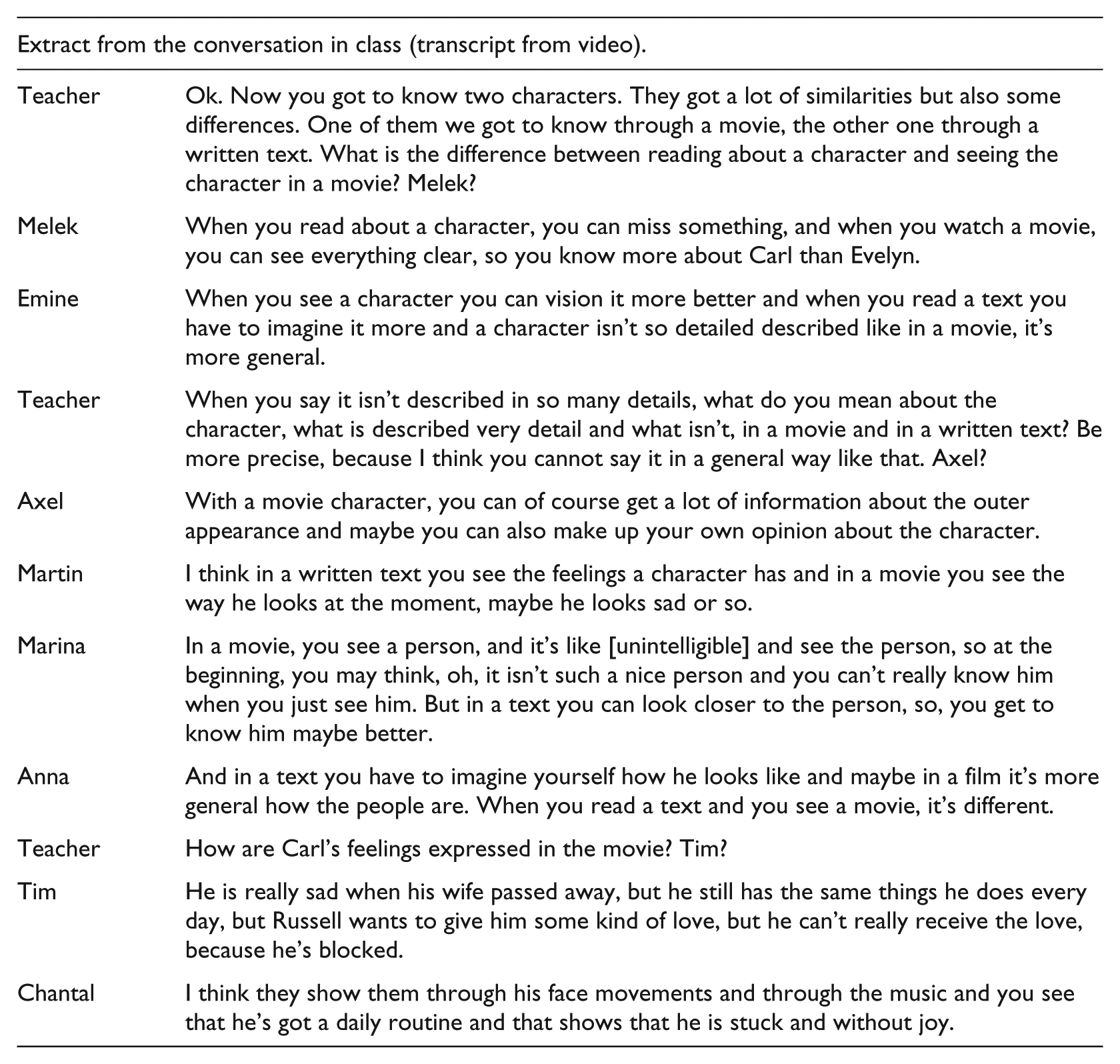
This extract from the discussion shows that by actively using language, the students were able to reflect rather well on the difference in perceiving a character through the different genre lenses. Although there are some grammatical insecurities, they can name the aspects that, in their opinion, can be pictured more clearly in a film (appearance) and those that a novel describes in a more detailed way (feelings). Clearly, the focus here is on communication and meaning, so the teacher does not intervene and correct the small mistakes the students make. It is interesting to note that the students are aware of the fact that a film has to use certain techniques to express a character’s feelings to the viewer, such as music or facial expressions. Especially the latter is considered a strong advantage of animated films. The animators are able to define the facial expressions of the characters much more distinctively and in more detail than a “real” actor can. Combined with the characters’ caricatured features, this is an important means of scaffolding in EFL teaching: the students can recognize more easily how a character feels than in a live action movie, even if they do not understand every spoken word. Furthermore, the students do not seem to prefer one genre over the other. They simply acknowledge that both genres have their strengths and weaknesses (Axel’s statement “maybe you can also make up your own opinion about the character” illustrates this nicely). Some students prefer films and find it easier to understand and analyze a character within this genre (cf. Melek’s and Emine’s statements).
During the unit, it became apparent that the students were able to develop certain skills and competencies that are essential for an overall film literacy (cf. Henseler et al., 2011: 23): They showed the ability to critically analyze and evaluate the film. By working with this goal-oriented, open task that focuses on communication and language use (cf. Van den Branden, 2006: 4), the students are able to take a step back from the texts and look at them from an analytical point of view, to reflect upon genre techniques and to place the text into context.
Conclusion
Although this is just one brief example from the classroom, it illustrates how the genre features as well as the cultural context of animated films can be used in the EFL classroom. Through “the inclusion of other texts which help learners reflect on hidden structures, symbolism and stereotypes” (Müller-Hartmann, 2008: 408) and the combination with relevant and meaningful tasks, authentic communication situations can be created (cf. Henseler et al., 2011: 9) and students reach a deeper understanding of the film as well its cultural context. Even in lower grades, animated short films can be used, as their hyperexpressive visuals can serve as a type of scaffolding and also encourage the students to actively use the foreign language (cf. Hofmann, 2017). This is just a glimpse into the vast potential of popular culture-texts for teaching. At the same time, it is a call for action and more open school curricula. Although German curricula do include films into their ‘canons,’ one can see a clear privileging of certain genres that are considered to be suitable for the classroom (cf. Roller, 2006: 49). A lot of popular culture-films, however, are still excluded from the curricula, even though they play a major role in the education and socialization of children and young people (cf. Roller, 2006: 49). The focus on output and competencies does not mean that only certain ‘classics’ can be included into the classroom—in fact, the combination of these ‘classics’ with popular culture-texts can be fruitful for a broad and holistic media and genre education.
Footnotes
Funding
The author(s) received no financial support for the research, authorship, and/or publication of this article.