




Abstract
The global shift toward neoliberalism, which frames the education of young children through markets, credentials, and individualism, creates a range of challenges for those who call for and seek out democratic teaching practices that strive to address the sociocultural worlds of the children in their programs. This article begins to address this issue. It does so by examining the findings from a qualitative case study that investigated how the practical conceptions of sample of early childhood graduate students in the United States were affected by developing and implementing a learning activity with children that reflected issues central to their lives in and/or outside their classrooms. Investigating and analyzing their experiences provide members of the early childhood community with steps they might take to assist early educators in framing their roles as teachers through democratic conceptions of practice that they can then implement within their early education context.
Introduction
Globally, neoliberalism, 1 which frames the act of governance through economic rather than democratic terms (Apple, 2001), continues to impact the field of early childhood education (ECE) in numerous ways (Nxumalo et al., 2011; Otterstad and Braathe, 2017). By framing ECE as a governmental investment in children, such programs are to produce successful learners who become earners and consumers that will repay the state for these initial costs by requiring less governmental support and paying taxes through employment in later life (Ailwood, 2008; Heckman, 2000; United Nations International Children’s Emergency Fund, 2016). This, in turn, positions early educators as technicians who are to teach all children the same sets of knowledge and skills needed to succeed in elementary school and later life (Minicozzi, 2016) and creates a range of challenges for those within ECE who call for and seek out democratic teaching practices that strive to address the sociocultural worlds of the children in their early education programs (Pérez and Saavedra, 2017).
The case study (Thomas, 2016) examined in this article, which took place in the United States, attempted to unpack this issue in greater detail by examining how being asked to formulate and implement a learning activity that reflected issues central to children’s lives in and/or outside their neoliberal classroom contexts appeared to impact a sample of early childhood graduate students’ conceptions of teaching children (Fenstermacher, 1994; Wood and Bennett, 2000). Examining how these graduate students attempted to focus their instruction on the lives of the children in their own classrooms provides insight into how members of the early educators can respond to neoliberal reforms that focus on markets, credentials, and individualism while attempting to engage in educational experiences that reflect their students’ sociocultural worlds. Such descriptions also provide teacher educators and other members of the early education community with insight into possible practices they can offer preservice and classroom teachers in formulating context-based instructional strategies that foster engaged democratic citizens (Apple, 2010).
Neoliberalism and early childhood education
Those who adhere to neoliberalism seek to foster a society governed “through the regulated choices of individual citizens” who identify themselves as consumers, and the goal for individuals within this system of governance is to make choices that attain “self-actualization and self-fulfillment” (Rose, 1996: 41). Such an understanding of governance frames learning and education as individual rather than societal goods, which repurposes the role of the state in the education process as a “regulator and auditor of the ‘learning market’” (Biesta, 2006: 175). Whereby, the process of education, and the institution itself, is transformed into entities that provide individuals with the commodity of credentials (e.g. high school or teaching certificate) needed to gain employment in the open market so that they can earn the financial capital necessary to participate in the consumer-based markets defining society (Ball and Vincent, 2007; Baltodano, 2012).
Under this conception of governance, governmental expenditures for the education of young children “in the early years translates into tangible economic returns” for the student and the state (Einboden et al., 2013: 560). This positions early educators as professionals who are to provide children with the necessary “inputs” so that they can attain the required “outputs” on specific standardized achievement tests (Ball, 2007: 28). These neoliberal “accountability discourses discipline” the subjectivities of teachers and “limit the terms of engagement” within their own classrooms and larger school context (Lipman, 2013: 569). They also frame teachers as disposable commodities that are easily replaced by those who are willing to teach where and how their state or local system dictates (Einboden et al., 2013). Moreover, neoliberal education reforms require teachers to become “salespeople for their own pedagogical performances” and demonstrate their worth through their ability to produce students who achieve high test scores (De Lissovoy, 2014: 428). As Roberts-Holmes (2015) argued, these reforms have “resulted in the ‘datafication’ of early years teachers and children in which the public and constant hierarchical ranking, ordering and classification of children, teachers and schools constrained such democratic pedagogical spaces, visions and possibilities” (p. 313).
Early childhood teacher education
This neoliberal shift in early education has led to teacher education programs across the globe to “focus on the managerial, instrumental, or technical aspects of the teaching profession” (Jelink, 2017: 164). Reid and O’Donoghue (2004) noted that policymakers have done this because they “understand that the preparation of new teachers (and the continuing development of current teachers) is an important mechanism through which policy agendas are realized, and so try to shape teacher education programs in particular ways” (p. 559). Furlong (2013) added that “many of them see the reform and progressive management of teacher education as a key component in that systemic reform process” (p. 46). In the United States, this has led to the “professional standards approach” to teacher development, such as the National Council for Accreditation of Teacher Education (2008) or edTPA (SCALE, 2015), both of which provide detailed lists of expectations for teacher development and performance that “tend to remain fixed and to ossify rather than being dynamic and open to change” (Reid and O’Donoghue, 2004: 563). This commodification of teacher education has also led to the expansion of non-traditional certification programs (e.g. Teach For America) that “dismiss the notion that teachers need formal teacher education before stepping in a classroom” (Baltodano, 2012: 496).
The critical perspectives in early childhood education (CPECE) class
The class the graduate students in this case study were enrolled in was designed to assist them in challenging this neoliberal conception of the early education process by assisting them in becoming critical scholars of ECE research, practice, and curricula. Because critical research focuses on in issues of power (Crotty, 1998), be it the power that exists between a teacher/parent and a child, state policymakers and district administrators, or various cultural groups in specific contexts, the course framed critical scholars in ECE as being interested in using a range of conceptual frameworks to investigate and expose the inequalities and injustices that exist for these marginalized groups and/or individuals (e.g. Bloch et al., 2014).
To foster the skill of becoming a critical scholar and educator, students were asked to read a range of works that question or deconstruct many of the assumptions that are foundational to the field of ECE (see Table 1 for a partial outline of classes and readings from the course). Furthermore, they completed two primary academic exercises that were designed to assist them in critically analyzing their thoughts, perceptions, and understandings of the work they wanted to do either as teachers or as researchers.
Examples of the CPECE classes.
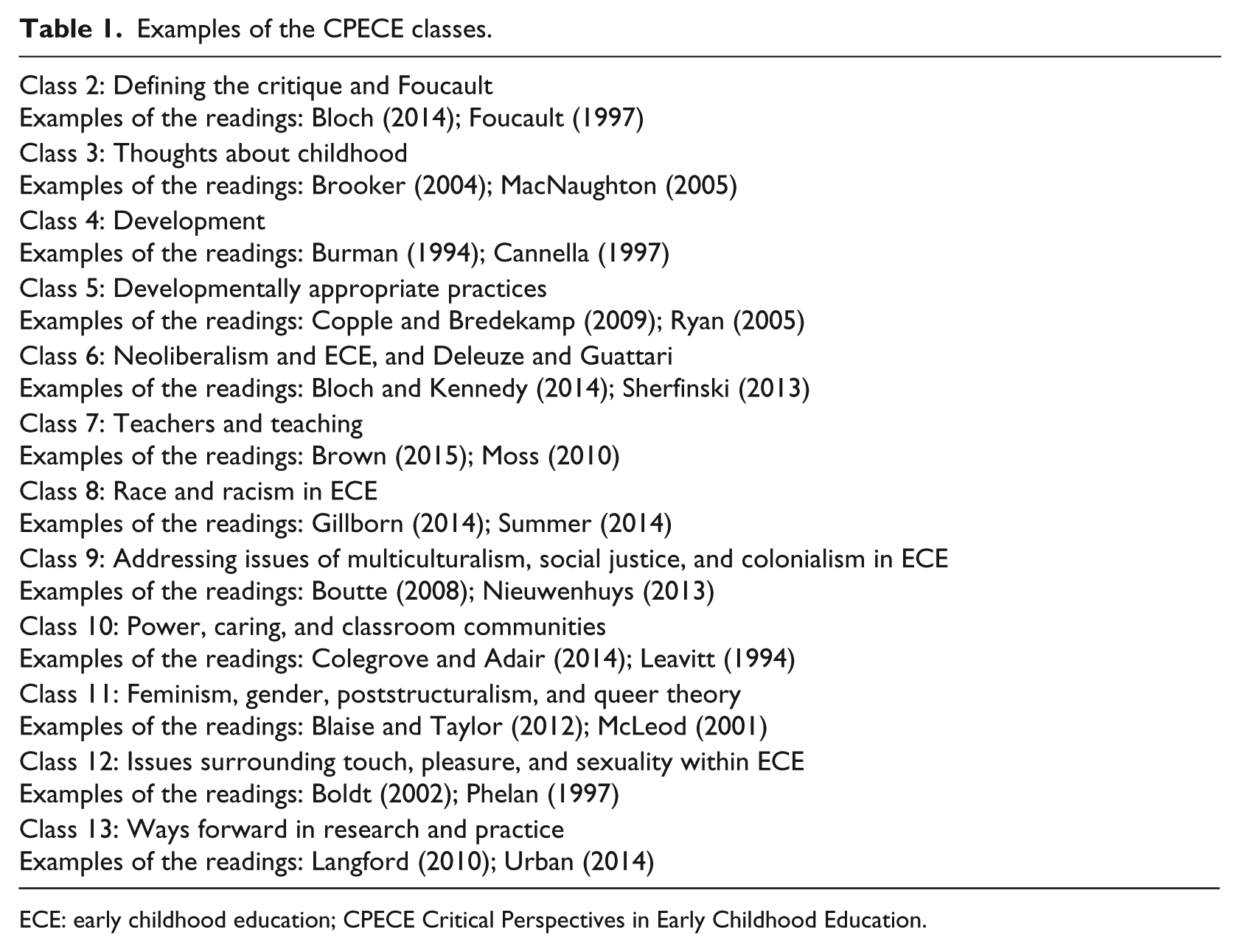
ECE: early childhood education; CPECE Critical Perspectives in Early Childhood Education.
The first, titled “Developing Your Conceptual Framework Project,” asked them to complete a series of four activities that would help them develop their own conceptual framework about either research or teaching. The process began by asking students to identify a topic of interest within ECE that they would like to think about critically over the course of the semester. They then provided a summary of a conceptual framework they employed in either their instruction as a teacher or as a researcher. Next, they wrote a reflection paper that discussed how engaging with the theories, critiques, conceptual frameworks, and/or ideas that class examined in the required readings and class discussions affected their understanding of their topic of interest. Finally, over the course of the semester, they were asked to investigate their conceptual framework in more detail using both class and external resources and then turned in an essay in the last class that described how they have reconceptualized or refined their conceptual frameworks.
The second assignment, titled “Creating and Enacting a Critical Lesson Plan” (CLP), which is the focus of this article, asked the students to work with a classmate to translate the class discussions about critical issues in ECE into an investigation of a critical issue/topic with a group (small or large) of students. Specifically, they were to research, develop, and implement learning activities with their students that reflected issues central to their lives in and/or outside their classrooms. To do this, they had to complete a series of five activities. First, identify their student population, get to know them, and then identify the issue they will explore with them. Second, write up their CLP using a class template that asked the students to identify such things as the objectives, big ideas, procedures, evaluation, and so on. Third, implement the CLP. Fourth, present to the class what their lesson was and what they learned from this experience. Finally, each student had to turn in a final reflection paper that discussed how they selected their topic for investigation, the process of writing up the lesson, and the implementation of it and that provided a self-critique of what occurred, including what they would do differently if they were to teach this lesson again. They were also asked to discuss how this lesson affected their conceptions of teaching and student learning as well as how this class has altered and/or reinforced their conceptions of these constructs.
Defining how these graduate students conceptualized their practices
Conceptually, Wood and Bennett’s (2000) framing of practice was employed to examine how engaging in the CPECE class and the assigned learning activities appeared to impact sample of graduate students’ conceptions of teaching young children in their neoliberal early education contexts. For Wood and Bennett (2000), teachers’ conceptions of practice reflect their “personal stock of information, skills, experiences, beliefs and memories” (p. 637). This conception of their teaching shapes how they teach. What happens in their classroom is affected by the interaction of their intentions for teaching and the context in which they work. For Wood and Bennett (2000), context includes the children they are working with, the curriculum they are expected follow in the CPECE class, the curriculum they are expected to implement in their own classrooms, and other mediating factors such as graduate school faculty, school administrators, the families of students, and state, district, or school policies.
Wood and Bennett (2000), similar to Fenstermacher (1994), found through their study of early educators that change in teachers’ conceptions of practice occurs in a three-stage process. The first is a “reflective understanding” of teachers’ conceptions of practice; the process of becoming consciously aware of how they are conceptualizing their instruction. The second “involves problematizing practice on the basis of perceived constraints, dilemmas and discontinuities to ascertain how knowledge changes in subsequent action” (Wood and Bennett, 2000: 644). This includes providing teachers with a theoretical foundation that assists them in naming as well as understanding what it is they do in their classrooms and why. Finally, teachers alter or realign their conceptions of practice through this reflective process and consider what these changes mean in relation to their future teaching.
In brief, Wood and Bennett (2000) contend that conceptual change first requires teachers to be aware of their practical framing of instruction. Then, they need an opportunity to problematize what they know through analyzing both the context and constraints as well as being provided with theoretical orientations of instruction. Finally, teachers should examine of the consequences of this reflective process in relation to their future instruction.
Methods
Data analyzed for this article come from a larger case study. Case studies “are analyses of persons, events, decisions, periods, projects, policies, institutions, or other systems which are studied holistically by one or more methods” (Thomas, 2016: 23). They are “especially good for … getting a rich picture and gaining analytical insights from it” (p. 23). The larger case study examined the experiences of a sample of graduate students in a course that asked them to critically analyze the field of ECE, including theories, curricula, policies, and practices. Such a study brings to light opportunities for members of the early education community to assist practicing and preservice teachers in countering the neoliberal shift toward markets, credentials, and individualism, so that they can create early learning environments that foster engaged democratic citizens.
This article focuses on one question from this larger case study that examined how these graduate students became or evolved as critical scholars of ECE research, practice, and curricula, and that question is, how were the practical conceptions of sample of graduate students affected by developing and implementing a learning activity with children that reflected issues central to their lives in and/or outside their classrooms?
The graduate program
Students in the study reported in this article were either pursuing a master’s or doctoral degree in a college of education at a large urban state university. This college has over 1000 graduate students enrolled across five departments, and approximately 75% of them are full-time students. Students in this class were part of the Teaching and Learning Department which enrolls over approximately 220 graduate students. The aim of this department is to enhance and advance the practice of and knowledge about teaching and learning so that members of the education community can address the educational needs of the larger society through democratic and socially just practices.
Participants
Participants for this study (n = 15) come from the same class on critical perspectives in ECE (see Table 2 for more details about the participants).
The participants (all names are pseudonyms).
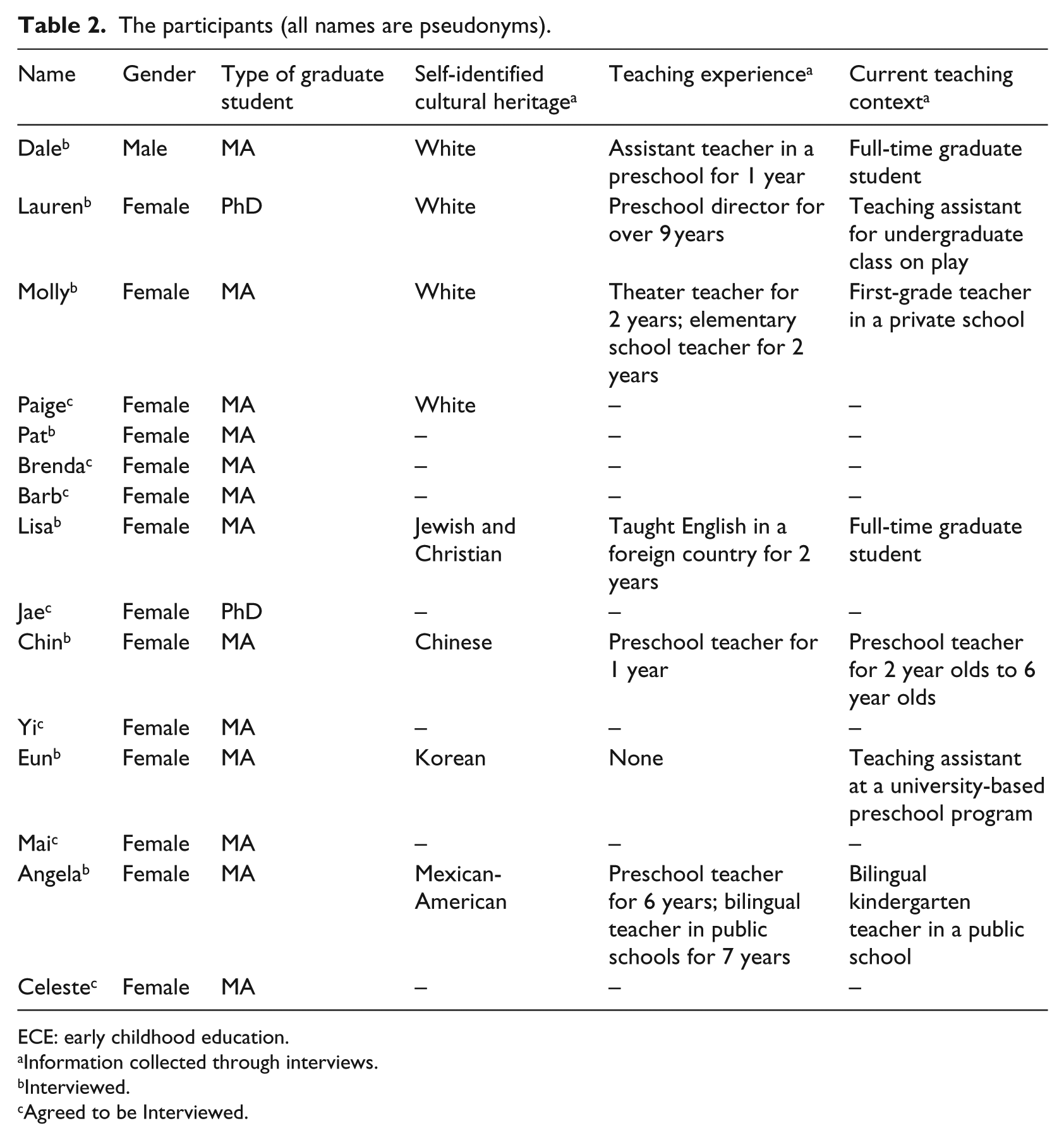
ECE: early childhood education.
Information collected through interviews.
Interviewed.
Agreed to be Interviewed.
Participant recruitment
The researcher recruited participants via email for this study after their professor submitted final grades to the Office of the Registrar. Students were given the opportunity to participate in the study in one of three ways: (a) having all of their assignments, which were submitted electronically and posted on a university-based digital learning management system, copied and analyzed as well as be willing to participate in a semi-structured interview with the professor who taught the course; (b) having all of their assignments copied and analyzed; and (c) not at all. All 16 chose option (a).
Public school teaching context
Policymakers in the Midwestern state this graduate program is located in implemented a series of high-stakes reforms that hold students enrolled in publicly funded Pre-k through grade 12 (Pre-k–12) classrooms, their teachers, and school personnel accountable. These policymakers also provide funding to support the district’s full day voluntary Pre-k program. It is an intervention program offered to 4-year-old children whom state’s policymakers deem at-risk for school failure; these markers of risk are an inability to speak or comprehend the English language, low-income status, homelessness, or in the foster care system.
State-mandated assessments begin in Pre-k with every school district being required to assess their Pre-k through Grade 1 students’ emergent literacy skills at least twice a year using a state-approved standardized assessment measure. This state’s policymakers measure public school students’ attainment of the mandated Pre-k–12 content standards by requiring those in Grades 3 through 11 to take a series of high-stakes exams. The high-stakes for students, which use their achievement scores to determine grade promotion or high school completion, begin in Grade 5 and appear again in Grades 8 and 11. A statewide ranking system determines whether or not teachers in these schools and districts attained an acceptable level of progress in improving students’ academic achievement. If not, this triggers a series of mandated interventions and sanctions which can eventually lead to schools being closed or reconstituted and district administrators replaced.
Data collection
Data for this study were collected in 2015 to document how the practical conceptions of sample of graduate students were affected by developing and implementing a learning activity with children that reflected issues central to their lives in and/or outside their classrooms. To do this, each of the participants’ two major assignments, the “Developing Your Conceptual Framework Project” and the CLP, were copied digitally via a university-based digital learning management system once the instructor had submitted their final grades to the Office of the Registrar and received the participants’ informed consent (see Table 3 for a summary of the CLPs). Second, eight focal participants participated in a semi-structured interview after their course grades were submitted to the Office of the Registrar (Lindlof and Taylor, 2002). These interviewees (Angela, Chin, Dale, Eun, Lauren, Lisa, Molly, and Pat; all names are pseudonyms) were randomly selected from the pool of students who agreed to be interviewed (n = 15).
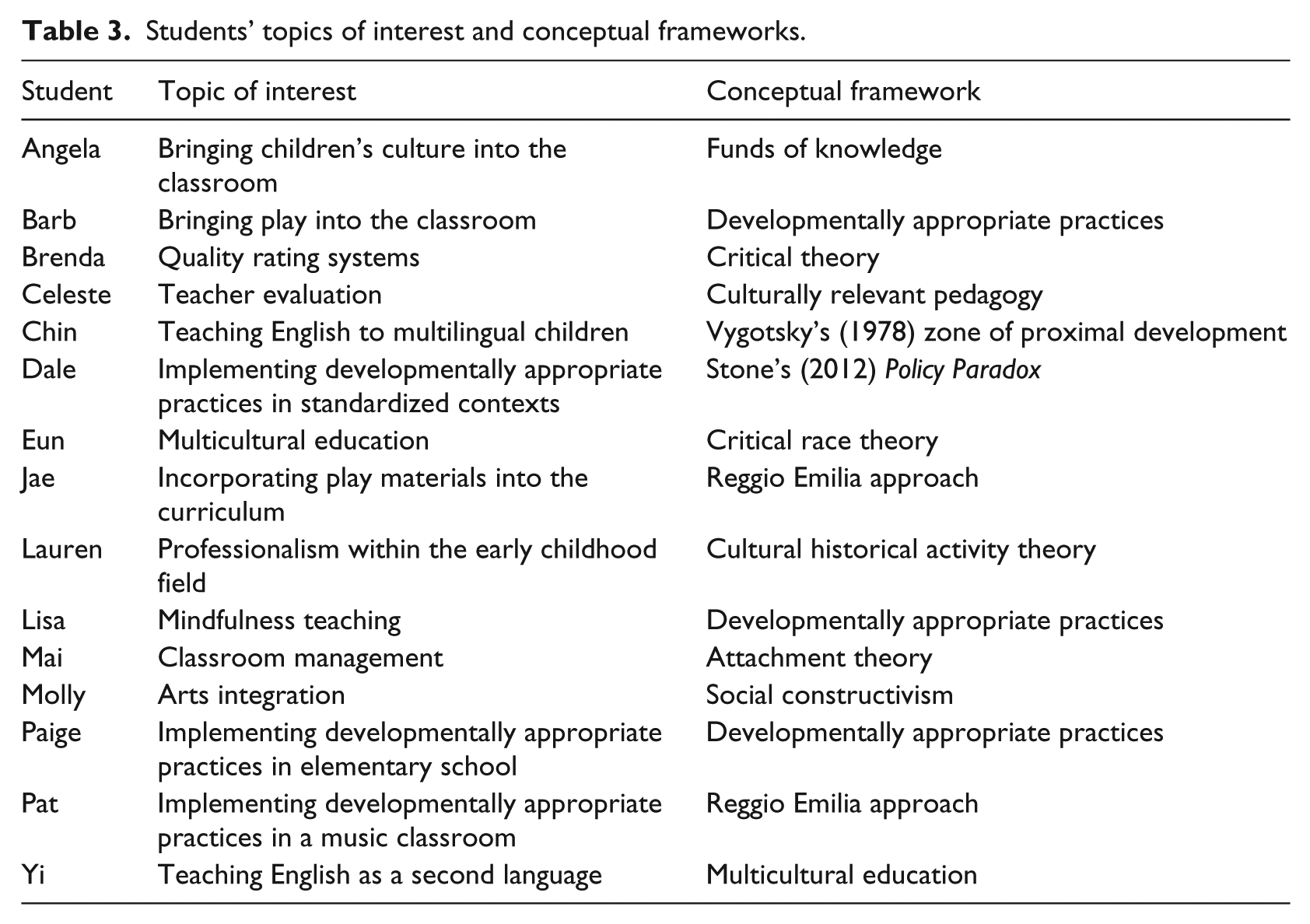
Students’ topics of interest and conceptual frameworks.
In the interviews, participants were asked questions that covered such topics as their conceptions of teaching young children and ECE, their thoughts about the goals for the CPECE class, how they went about selecting the students they worked with, the topic of study they explored with those students, how they conceptualized the CLP in relation to goals for the CPECE class, what they might do differently if they were to teach their CLP again, and how teaching the CLP affected their understandings of teaching young children. Finally, artifacts were collected from the CPECE class, such as the students’ PowerPoint presentations from their presentations of the CLPs, and memos were collected documenting his teaching experiences over the course of the semester (Emerson et al., 1995).
In sum, their topic of interest within ECE paper and their conceptual framework paper (CFP) provided the data needed to investigate how they framed teaching young children. Their CLPs and their end of the semester interviews (ESIs) document how they went about problematizing their instruction as they formulated and implemented a lesson that reflected their students’ sociocultural worlds. Finally, their CLPs as well as their ESIs also provide insight into how these graduate students conceptualized the consequences of this reflective process in relation to their future instruction.
Data analysis
Traditional qualitative analytic methods were used to analyze the data (Erikson, 1986). First, all interviews were transcribed. Then, data that included the transcribed interviews, students’ written assignments, artifacts from the CPECE class, and memos the instructor took across the course of the semester were analyzed deductively using a set of external and internal codes (Miles and Huberman, 1994). The external codes reflect the constructs of neoliberalism (e.g. markets, credentials, individualism), critical perspectives in ECE, teaching and learning, and lesson planning. All of the data were read through several times and coded using these external codes (Erlandson et al., 1993). As the data were coded using the external codes, a list of internal codes was generated. These internal codes emerged in the coding process and represented unexpected matters that did not align with the external codes (Miles and Huberman, 1994). Examples of the internal codes included: “kill and drill,” “all about me,” “student pride,” and “one time event.”
An example of how data were marked using the external and internal codes comes from Angela (all names are pseudonyms), a part-time MEd student and practicing bilingual kindergarten teacher. She stated, “The job of an educator is more than just teaching the curriculum. She needs to instill pride in her students—a pride for who they are, pride in their culture and to become aware of it and other cultures.” The researcher marked this statement with the external codes: “teacher’s job,” “developmentally appropriate practice,” “culturally relevant teaching,” and “curriculum” and the internal code: “student pride.”
The coded data were then analyzed using the constant comparative method to develop themes that emerged in relation to the research question (Erlandson et al., 1993). This required the researcher to go through the coded data repeatedly “comparing each element” of the coded interviews, artifacts, and memos with each other in order to generate a set of themes that reflected the essence of these graduate students’ experiences in relation to the research question (Thomas, 2016: 204). To verify the themes, the researcher read them against the entire data set in search of contradictory evidence and refined them through further analysis and discussion (Thomas, 2016). In the end, three themes emerged describing how the practical conceptions of these graduate students were affected by developing and implementing a learning activity with children that reflected issues central to their lives in and/or outside their classrooms: “traditional conceptions,” “Problematizing their practices primarily through their own interests,” and “Individualized conceptual change/ing” (Denzin and Lincoln, 2003).
Issue of trustworthiness
The investigation discussed in this article addressed a limited set of issues, with a small sample of graduate students (n = 15), in a single graduate program, in one state in the United States (Yin, 2014). Other limitations of this study include these data were collected during one semester of their graduate studies, and thus, their attitudes and beliefs may change as they continue through their graduate program. In addition, the researcher was the instructor of the course and did not begin to collect data for this study until the students’ final grades were submitted. Thus, the researcher was unable to interview participants until they had completed their CLPs. Finally, the purpose of this study was to examine how the practical conceptions of sample of graduate students were affected by developing and implementing a learning activity with children that reflected issues central to their lives in and/or outside their classrooms, and because these students self-selected into a class that examined critical issues within ECE, they may be more willing to make sense of the process of pedagogical change than in teachers or preservice teachers not interested in examining critical issues within ECE.
To address these issues and strengthen the trustworthiness of this case study, several strategies that qualitative researchers typically engage in to enhance the trustworthiness of their work were employed (Erlandson et al., 1993; Yin, 2014): member checking, triangulation, and peer debriefing (Lincoln and Guba, 1985; Thomas, 2016). For instance, triangulation was achieved through comparing participants’ statements across several of their written assignments and their interviews.
Findings
The themes that emerged through the analysis of the coded data for the research question examined in this article are organized in relation to Wood and Bennett’s (2000) process of conceptual awareness and change. To do this, this first theme, “traditional conceptions,” examines their initial conception of teaching young children. The second, “Problematizing their practices primarily through their own interests,” investigates whether and how they went about investing issues relevant to their students’ sociocultural worlds. The final theme, “Individualized conceptual change/ing,” unpacks how this process affected their conceptions of teaching young children.
Traditional conceptions
As the semester began, these graduate students’ initial conceptions of practice were revealed in their initial two assignments: the first asked them to name a topic of interest they would like to examine deeply over the course of the semester, which was turned in at the beginning of the second of 14 classes, and the second, the CFP, asked them to identify a conceptual framework they would like to examine at length which was turned in at the beginning of the fourth class (see Table 3). Within these assignments, these graduate students began to reveal their conceptions of practice. Across the 15 students who participated in this class, each seemed to position their conceptions of practice in what may be deemed traditional notions of ECE.
For example, Paige, a former public school second grade teacher who was a full-time MEd ECE student, and Pat, a part-time ECE MEd student who taught music in a public elementary school, were both were interested in fostering developmentally appropriate practices in their teaching environments (e.g. Copple and Bredekamp, 2009). Paige noted that as an early educator she wanted “to foster a developmentally appropriate learning environment for children—one that focuses on the developmental needs of each child” (CFP). Another student, Barb, who had taught kindergarten and now pre-kindergarten in the same public school and was a part-time ECE MEd student, also was selected developmentally appropriate practices (DAP) as her framework. She noted that “DAP appealed specifically to me because it upholds my firm belief that a curriculum should be student-centered, not teacher-centered or standards-centered, meeting each child’s individual learning needs” (CFP). Across both these statements, these graduate students appear to frame the purpose of education to be fostering the developmental needs of each child.
Such rhetoric seems to mimic what others have documented in that there is an inherent belief that no matter the context, both politically and systematically, DAP should be the central focus of the classroom teacher (Goldstein, 2007; Minicozzi, 2016). Yet, prioritizing a theory of practice rooted in much of the same individualistic logic found in neoliberalism, such as “to be effective, teachers must get to know each child in the group well … from the information and insights gathered, teachers make plans and adjustments to promote each child’s individual development and learning as fully as possible” (Copple and Bredekamp, 2009: 9), exemplifies how these graduate students appeared to be unaware of their own participation in a system of governance that “connects individual freedom to capitalism, where individuals can be ‘successful’ and achieve what they want through the accumulation of wealth” (Smith et al., 2016: 124).
While the remainder of the graduate students examined a range of issues (e.g. Brenda and quality rating systems) and conceptual frameworks (e.g. Dale and Stone’s (2012) Policy Paradox), they often discussed across these assignments what it meant to engage in a developmentally appropriate learning experiences with children as an early educator. For example, Lisa, a former preschool and second language instructor enrolled full-time as an ECE MEd student, stated, “I see my role as an early childhood teacher as one in which I help children develop a foundation for learning, and part of that is me just being emotionally supportive as well as providing children with intellectual stimulation” (CFP). Dale, a kindergarten teacher and part-time ECE MEd student, made a similar statement when he wrote, A teacher’s role is to create stimulating learning experiences so that students can learn from them … the teacher should use teaching strategies that are playful in nature and allow students to share their thoughts and ideas while allowing them to think about their thinking. (CFP)
Celeste, a full-time ECE MEd student and former kindergarten and second grade teacher, and Chin, a former preschool teacher and full-time ECE MEd student linked these notions of promoting students’ growth and development to the significance of early educators preparing children for success in school, which as Copple and Bredekamp (2009) noted, “We must close existing learning gaps and enable all children to succeed at higher levels” (p. 3). Specifically, Chin stated, “The most important role of the teacher is to help children to learn the skills and knowledge needed to do well in school.”
While the finding that this sample of graduate students appeared to conceptualize the practices of the early educator through the practices of DAP is not unexpected (e.g. Riojas-Cortez et al., 2013), what it appears to reveal is that these early educators, no matter their training or experience, seem to know the value of the currency of DAP. As Pratt (2016) noted, “one aspect of neoliberal professional life is the changing emphasis from practice that is effective to practice that has the hallmark of effectiveness” (p. 896). While empirically, the ability of DAP to improve children’s academic performance has been questioned (e.g. Brown and Lan, 2013; Van Horn et al., 2005), it does exist as a hallmark of effectiveness within ECE (e.g. Alford et al., 2016; Bredekamp, 2016). Moreover, across these graduate students’ statements, there seems as if there is a clear connection between DAP and improving students’ learning. As such, this rhetoric echoes the notions of getting children “ready for a lifetime of learning or earning” that underlie the neoliberal argument for ECE (Ailwood, 2004: 30).
Problematizing their practices primarily through their own interests
As the course progressed, the students were asked to read a range of works that questioned and/or deconstructed many of the assumptions that are foundational to the field of ECE (e.g. Bloch, 1992), introduced them to the central tenets of neoliberalism (e.g. Pacini-Ketchabaw et al., 2014), and were provided with examples to demonstrate how they might implement a CLP with a classmate that investigated a critical issue/topic with a group students that reflected their sociocultural worlds (e.g. Colegrove and Adair, 2014; Souto-Manning, 2013). This was done to assist them in “problematizing practice on the basis of perceived constraints, dilemmas and discontinuities to ascertain how knowledge changes in subsequent action” (Wood and Bennett, 2000: 644). Yet, when analyzing these graduate students’ CLPs, summaries of their activities, PowerPoint presentations, and ESIs to identify how they named as well as understood the process by which they are to implement lessons in their neoliberal teaching contexts reflecting their students’ sociocultural worlds, it becomes apparent that the majority struggled with this conceptual and practical task. Specifically, they had difficulty in moving beyond their own interests when selecting and then implementing a critical lesson with their students.
Only two of the seven groups appeared to examine issues that emerged from their students’ lives: Angela and Celeste and Molly and Paige (see Table 4). Both pairs seemed to recognize that the purpose of the activity, as Molly noted, was to select
Summary of critical lesson plans.
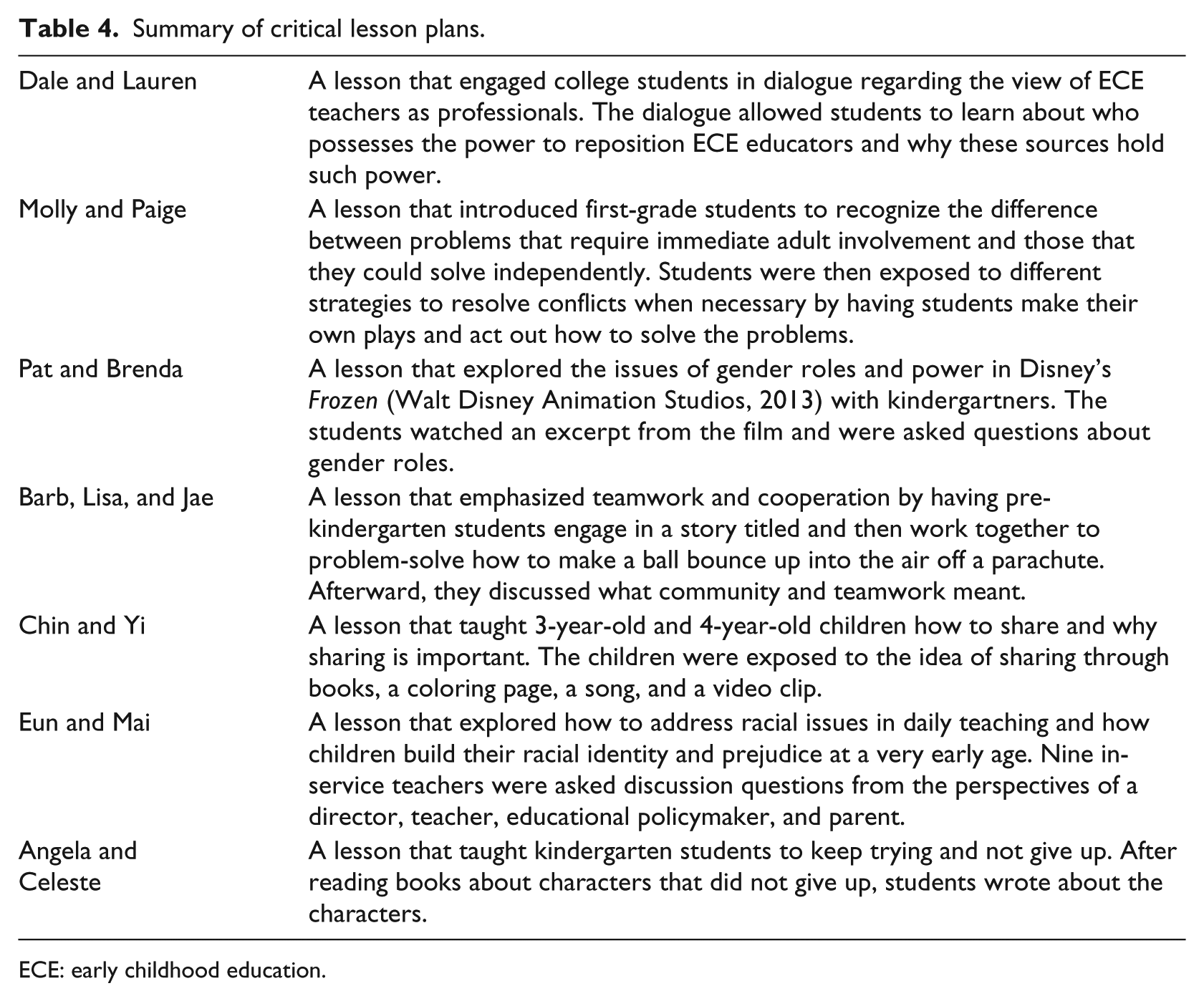
ECE: early childhood education.
something that was truly and immediately relevant and important to those students … that is something that wouldn’t be in their normal curriculum that they really could learn from or grow from based on what’s going on in that specific classroom. (ESI)
Her statement appears to reflect that the intent of this CLP was to problematize the constraints of the normal curriculum and engage in a lesson that challenged her typical practices (Wood and Bennett, 2000).
Although Molly seemed to understand the process by which this assignment was to assist her in challenging her conceptions of teaching, she stated that she was “afraid I would be unable to choose a topic that was truly critical to them” (CLPR). Nevertheless, she and Paige selected a topic that came out of Molly’s observations of her students in her classroom. Molly noted, We came up with our activity based on what I had been seeing in my classroom, which was a lot of disagreements between students, a lot of fighting, and name calling, and the kids never really seemed to be able to resolve any of it on their own and always looked to an adult to help them solve every conflict that came up. It affected our ability to learn as a class. The kids would dwell on whatever the conflict was at the time. (ESI)
By implementing a lesson on conflict resolution, Paige stated, “We sought to disrupt the idea of teacher as omnipotent problem-solver and provide students with agency to solve problems between each other” (CLPR). Molly stated that she believed the lesson led to the students having “a lot more confidence in themselves; viewing themselves as a problem solvers and as individuals that are capable of having discussions with their classmates about what the problem is” (ESI). Combined, their statements about their CLP appear to demonstrate that through this experience, their students were learning how to manage “openly differing viewpoints,” which, as Meier (2000) pointed out, is a skill needed to maintain the “healthy tension in a democratic, pluralistic society” (p. 16).
Members of the remaining five groups selected topics that they felt their students might be interested in (Pat and Brenda; Chin and Yi) or they themselves were interested in (Dale and Lauren; Barb, Lisa, and Jae; Eun and Mai). When examining their interpretations of this activity, Pat, who taught a lesson with Brenda exploring gender roles, noted, “When I think about the articles we read, I think the exercise of the class and was to get us to reconsider what these kids are capable of and also what their experiences are” (ESI). Yet, they selected a topic of study, which Brenda summarized, Critically examining with the class the idea that Frozen [Walt Disney Animation Studios, 2013] was a movie for girls. Secondly, we had read a lot of articles that suggested Frozen was progressive for messages of female empowerment and wondered if the children would get these same messages of feminism and empowerment. (CLPR)
While neither of them found the lesson to achieve their goals, Pat noted, “During our critical lesson and after, I realized that our goal was actually somewhat superficial. It came from us and not the children” (CLPR). Pat unpacked this idea further by stating, In the process of planning our lesson, I felt the overwhelming shadow of the traditional lesson plan. I am well versed in the discourse of the public elementary school lesson plan. One of the most important features of a “correct” lesson plan, would be to plan some form of action or activity that would result in the students engaging in the information presented by the teacher. (CLPR)
As Bansel (2007) noted, the “specific practices of government shape our expectations, our desires, our selves and our possibilities” (p. 299), and for Pat, it appears the practices of the correct lesson within her school community affected her ability to problematize what she does in the classroom with her students so that she could implement a lesson based on the students’ sociocultural worlds.
For those groups that sought to examine topics with their students that, as Eun pointed out, “we were interested in” (ESI), such comments may reflect how these graduate students themselves are operating in neoliberal system of graduate education that is rooted in “individual success and personal endeavor” (Pratt, 2016: 902). Lauren and Dale made similar comments. Dale noted in his ESI, “We thought about what we wanted to teach.” Laruen stated, It was more of a selfish lesson plan in that had an agenda of what I wanted them to get out of it, not necessarily something that I thought that they were interested in or that would be directly impactful to them. (ESI)
While it may be argued that through the CLP, these graduate students were attempting to problematize their practices, which Wood and Bennett (2000) noted as being a “critical point” in changing one’s teaching (p. 645), the majority of these graduate students did so in a way that seemed to help them grow as learners and not their students. Such logic, which Lauren statement about the CLP above appears to reflect, mimics the neoliberal framing of education as an “input–output” education system that reduces teaching and learning to what Olssen and Peters (2005) termed “an economic production function” (p. 324). As such, engaging in the CLP may be seen as a transactional activity for these graduate students that not only was designed to help them grow in their own teaching but also provide them with a vehicle to obtain a grade in their CPECE class. Doing so also fulfills a requirement that leads to the acquisition of the credentials (an MA or PhD) needed to succeed in the larger neoliberal system of education. What seems to be left out of this transaction are the children who were to experience and possibly benefit from engaging in a lesson that reflected their sociocultural worlds.
Individualized conceptual change/ing
Under Wood and Bennett’s (2000) three-step process to change one’s conception of practice, the final step requires teachers to alter their conceptions of teaching and reflect on what these changes mean in terms of their future teaching. While the majority of teachers in this graduate class did not implement lessons that reflected issues central to their students’ lives in and out of school, many of them “were engaged in an ongoing process of professional learning” (Wood and Bennett, 2000: 642). For example, all of the students, either in their ESI or CLPR paper, did state the class and the assignments had impacted the ways in which they conceptualized their future teaching. For example, Pat noted, Enacting a critical lesson plan made me aware of the differences in understanding critical issues, how we, the adults, make ourselves blind to the fact of children already assessing and making meaning of the world regarding issues of race, gender, and ethnicity … The biggest task before me is to be critical of myself and what I bring into the learning space. Before problematizing critical issues for others, I must make a critical evaluation of my own beliefs and actions. (CLPR)
In Pat’s statement, she appears to frame her students as being capable of taking on critical issues that challenge the norms of schooling. What seems to be her struggle in changing her instruction is being aware of and altering her own role within the classroom. Yet, by framing change through her individual actions, in many ways, Pat’s apparent beliefs about teacher change reproduces the “neoliberal, individualized rhetoric” of teaching and learning (Clark and Richards, 2017: 137). This differs from Wood and Bennett’s (2000) emphasis on the significance of the learning community in changing one’s practice as a teacher, which includes fellow graduate students, colleagues within the schools in which one works, and one’s own students. Such communities assist teachers by providing “intellectual resources” and “shared ways of thinking and communicating” (p. 646).
Another example of this individualized conceptual change that many of the graduate students appeared to be going through as a result of the CPECE class was made by Dale. He noted, I was a firm believer in the power of DAP and other child-center pedagogy approaches. I had no awareness of how these teaching philosophies can potentially alienate female students, non-White students, and other students who do not fit the White hetero-normative culture created by developmental and modernist views of the child. As I look at the role of the teacher, I now see an individual, who has a responsibility to his/her students to create space in which dominant discourses are challenged and examined and spaces in which new possibilities are explored and valued. Through planning and implementing a critical lesson plan and engaging in critical conversation through course readings and class discussion I have altered my thinking around the roles of teachers and students to recognize diversity and the values of other. (CLPR)
Although Dale and his teaching partner, Lauren, decided to pursue a lesson based on their own interests, he seemed willing “to engage in critical reflection and problematize key areas of discontinuity between [his] theories” about best practices and the practices, the readings as well as the members of the learning community were pushing him to consider implementing in his classroom (Wood and Bennett, 2000: 640). As Smith et al. (2016) pointed out, “thinking with theory … is a first step to disrupting the mechanisms of control and regulation” (p. 133), and Dale, through his statement, seems to be working toward a formulating an understanding of teaching that may speak back to and/or resist the impact of neoliberal reform on early education. Still, like Pat, Dale seems to frame such change through notions of “individual success and personal endeavor” (Pratt, 2016: 902).
While these and other statements made by the graduate students appear to represent an evolutionary shift (Brown, 2009) in their practical conceptions of the early education process rooted in individualized changed, some of the students continued to root their ideas of teaching in what might be considered traditional developmentally appropriate practices. For instance, Chin noted that she wanted to ensure, that as a teacher, she saw “hands-on learning is much better than learning from watching” and “teaching should be age appropriate” (CLPR). Yi, her teaching partner for the CLP, has noted that teaching young children should “be age appropriate and fun,” and she noted that “play is an important role in creating lessons that support children’s development” (CLPR). Such traditional conceptions of best practice within ECE (Copple and Bredekamp, 2009) stand in stark contrast to the arguments made by Cannella (1997) and others, such as Burman (1994), both of which were assigned readings for the CPECE class, in which they argue statements such as those made by Yi and Chin go against the goals of creating a lesson that reflects issues rooted in children’s sociocultural worlds. Instead, their statements seem “to further their own [and students’] interests within the parameters” of the early childhood classroom, which as Baerg (2009) pointed out, mimic how “a neoliberal free market economy functions” (p. 119).
Although these students’ conceptions of practice fell on a continuum from traditional to more critical at the end of the CPECE class, several of the student who appeared to demonstrate an evolutionary shift in thinking struggled in conceptualizing how they might put their new-found theories into practice. For example, Celeste, who did engage in a lesson connected to children’s lives in their classroom, noted, After executing the lesson, it felt to me like we were still teaching the students, from the top down, what we wanted them to know. I think we had too much ownership of the ideas involved … This showed me that it is very difficult to give up teacher control. Even during child-centered activities it is natural to want to guide students toward one particular “aha” moment, but in the process, I may miss other opportunities for growth and discussion.
Celeste’s statement illuminates that difficulty that early educators face in trying to counter a neoliberal framing of early education in which the effectiveness of their “pedagogical intervention” is evaluated through “whether individual performance is being heightened” (Kaščák and Pupala, 2013: 324).
It appears these graduate students recognized the “individualizing and totalizing” (Ball, 2012: 31) nature of this process of teaching young children in which it is their “responsibility … to manage their own affairs, to secure their own security with a prudential eye on the future” (Rose, 2007: 4). Still, a few of them (Celeste, Lisa, Molly, and Pat) seemed willing to challenge such notions of teaching. For example, Lisa noted, It is now my understanding to allow myself to be more present with my future students, allowing a more mutual learning to take place, rather than being as concerned about achieving objectives. As a teacher, I will likely be graded on objectives I do not value, but I feel that I am now more willing to fall somewhat shorter in those measures. (CLPR)
Lisa’s statement reflects Teague’s (2014) argument that teachers must walk what she terms a “tightrope” so that they remain recognisable enough as a class teacher so as not to, in an extreme case, lose my job or, more likely, invite further scrutiny of my practice from senior management which would make political action to disrupt inequalities even more difficult. (p. 9)
Finally, Lauren’s statement seems to summarize the difficulty many of these graduate students had in changing their conceptions of practice. She noted, Most of us had never been told by anybody to create something that was critical to the children we work with. So, when you think about lesson planning and what you’re going to do with children, it kind of shifted. You had to shift to think about how to do it differently, and how to make it critical for them. So when I think about teaching children, what I’ve done in the past may not always be the best way, but it’s okay to challenge myself and to challenge others on why we are doing things this way. (ESI)
For Wood and Bennett (2000), the final stage in the change process requires teachers to restructure “theories, or practice, or both. The teachers engaged in a process of reflection based on a more conscious awareness of their everyday practical problem-solving strategies and pedagogical interactions” (p. 645). In her statement, Lauren appears to be engaged in this process by making it apparent to herself that to move forward, she needs to challenge herself. As Dilts (2011) noted, to counter neoliberalism, Lauren and her classmates need “to think not just about how to resist the use of power, but how to conduct [them]selves under those rules” (p. 143). While not all these students appeared to be at a point where they had begun to change their practices, they all at least appeared willing to challenge their own conceptions of teaching. Although this seems to be a positive result from participating in the CPECE class, an apparent shortcoming is that these students’ initial steps in the change process are still at the individualized rather than community level (Wood and Bennett, 2000).
Discussion
When reviewing how these graduate students’ practical conceptions were impacted by developing and implementing a learning activity that reflected issues central to their students’ lives in and/or outside their neoliberal classroom context, it becomes apparent that the majority of graduate students who completed the CPECE course continued to struggle in altering their conceptions of and practices in teaching young children within their neoliberal early education contexts. When examining the data presented in this case study using Wood and Bennett’s (2000) three-phased model of change in teachers’ conceptions of practice, it seems these graduate students began the CPECE course framing their conceptions of teaching through notions of DAP (Copple and Bredekamp, 2009). While often framed as a counter-discourse to the standardization of early childhood (e.g. Goldstein, 2007; Minicozzi, 2016), the danger with DAP is that it “normalises teachers’ pedagogical practices to those that are time-tested and proven to be both efficient and effective in delivering the outcomes that are necessary for market competition and branding” of the teaching of young children (Loh and Hu, 2014: 20). While DAP may speak back to calls for standardization and increased accountability, it does so through “notions of preparation for compulsory schooling” while ensuring teachers, administrators, and children’s families that such practices are “laying the foundations for lifelong learning” (Ailwood, 2004: 30). As such, these students, as well as the teachers studied by Wood and Bennett (2000), appeared to operate in a neoliberal system of education that has reduced “professional expertise” to “a set of skills and competencies” they either need to possess or be able to espouse to teach young children (p. 644).
As these graduate students implemented and then reflected on their CLPs with their students, five of the seven groups did so in a manner that reflected the “neoliberal individualisation of educational practice” (Kaščák and Pupala, 2013: 327). Meaning their focus was on improving their own teaching at the apparent expense of the students whom they taught. By focusing on their own development, it seems that many of these graduate students framed themselves as entrepreneurial individuals who saw this assignment as vehicle they had to complete to attain the credentials they were seeking by attending graduate school so that they could maximize their own human capital (Baez, 2007: 10). Such a finding demonstrates the need for teacher education students and the programs themselves to question the intent and purpose behind their actions, be it the teaching of young children or the training of teachers and researchers.
Finally, when reviewing Wood and Bennett’s (2000) conceptual model in altering teachers’ conceptions toward practice, the final stage involves teachers reflecting on their practices and planning for changes in their future instruction. For the graduate students in this case study, the majority of these graduate students did appear to recognize their own shortcomings in planning for an implement of their CLPs, and through this reflection process, they did seem interested in changing their practices so that they would incorporate issues relevant to their own students’ sociocultural worlds. However, for many of these graduate students, such as Pat and Barb, they continued to work in neoliberal early education settings in which they “must do accountability work; that is, they must act in particular ways that are valued within the school system and make these visible to others” (Pratt, 2016: 896). Nevertheless, the “points of contact” that emerged in their CPECE course assignments and ESIs did appear to demonstrate a willingness by many of these students (e.g. Lisa) to engage with what Ball (2016) termed “the possibility of refusal” to these neoliberal demands (p. 1143). It seems that this class gave many of these students the opportunity to challenge the “established patterns” of neoliberalism so that they could “ascertain what it is that is no longer indispensable” in their teaching contexts (Ball, 2016: 1136).
When reviewing these findings, a rival hypothesis (Yin, 2014) might suggest that these graduate students’ experience demonstrate that it is nearly impossible to escape the neoliberal framing teaching and learning within ECE and teacher education. However, such a hypothesis misses the complexity of these graduate students’ conceptions of teaching and own awareness of the challenges of teaching young children in their own neoliberal teaching contexts. Instead, the findings of this study illuminate at least two opportunities for members of the early childhood community, such as early childhood teacher educators, researchers, advocates, and teachers, to assist others as well as themselves in questioning, as well as reconceptualizing, their practical conceptions of teaching young children in their neoliberal early education contexts.
Implications
The findings of this study demonstrate that, if given the time and space, early educators appear willing to challenge their current conceptions of teaching, which in most nations like the United States are shaped by neoliberal education reforms, and begin to consider ways in which they can refuse (Ball, 2016) and/or counter the framing of teaching as an economic transaction. Thus, members of the ECE community should consider what opportunities early educators are being provided with to assist them in questioning the current framings of ECE so that they can “continue to struggle for more democratic definitions of education that are being currently pushed out, and to open up new and more ethical questions” (Stevenson, 2010: 356). The goal of such opportunities should be to provide them with grounded practical and theoretical dialogical struggles through a range of learning opportunities that will assist them in developing an understanding of the education process that goes beyond the transactional framing of teaching and learning leading to credentials, earning, and consuming. Doing so may assist them in coming to frame the purpose of ECE as being on in which it is “to educate all children well … address the deep inequities embedded in schooling, and … build an equitable democracy that becomes the center of who we all are as a people together” (McKenzie and Scheurich, 2004: 443).
Still, the findings of this case study demonstrate that simply having ECE teachers read empirical research articles that document how neoliberal teaching contexts shape teachers’ thinking and practice (e.g. Brown and Weber, 2016) or having them engage in activities that ask them to change their instructional practices or focus (e.g. the CPECE lesson) is not enough for them to develop the skills needed to “push-back” against the “common sense” that frame these reforms (Gatti and Catalano, 2015: 157). The work of Wood and Bennett’s (2000) demonstrates that such practical change is a long-term process that is “fundamentally socially and culturally situated,” which means it requires early educators to develop “communities” in and out of their programs that help “empower” them “to improve pedagogical practice” (p. 646). Such communities, be it through the program/school they work in, an undergraduate/graduate studies program, or professional development opportunities can assist early educators in considering “multiple perspectives and trouble social issues and normative perceptions in a critically conscious manner, positioning themselves as agents of change in their classrooms and beyond” (Souto-Manning, 2017: 96).
Second, every early childhood educator operating in these neoliberal early education systems should question their role in perpetuating a framing of an early education system/process rooted in markets, credentials, and individualism. As De Lissovoy (2014) pointed out, these current neoliberal “regimes of accountability, processes of teaching and learning are converted from experiments in democratic relationships and inquiry to performance of rituals aimed … at inculcating a set” of dispositions in all those who participate in them so that this economic framing of teaching and learning is continuously reproduced (p. 429). To counter such logic and reproduction, early educators, as Meier (2000) noted, need to become “agents of democracy” (p. 17) whom not only document such changes (e.g. Gatti and Catalano, 2015) but also advocate for democratic practices and policies throughout the education system—be it the teaching of young children or the training of the early education workforce. This requires possessing a “neoliberal literacy” (Loh and Hu, 2014: 20) needed to read and interpret the current governing and political discourses shaping ECE.
Such actions will assist members of the early education community in challenging the “established patterns” of ECE so that they begin “to ascertain what it is that is no longer indispensable” (Ball, 2016: 1136). It may also support early educators in formulating and implementing policies and practices that respond to and challenge this economic conception of teaching and learning—be it through lesson planning, assessment practices, program development, policy development (e.g. formulating content standards), or developing/reforming teacher education programs. Thus, if “creating [a] critically democratic citizenship” is the “ultimate goal” for early educators (Apple, 2007: 114), it will require a multi-pronged conceptual and practical approach toward change that assists members of the ECE community toward countering the current neoliberal logic/framing of ECE. As such, this study adds to a growing body of literature (e.g. Nxumalo et al., 2011; Smith et al., 2016) that is beginning to formulate such a response.
Footnotes
Acknowledgements
The author would like to thank Da Hei Ku for her assistance in coding the data examined in this article.
Funding
The author(s) received no financial support for the research, authorship, and/or publication of this article.