




Abstract
This study examines social narratives of Korean immigrant families with their young children focusing on how Korean immigrant families describe themselves based on their ethnic community experiences. This study helps uncover their dynamic identities as a Korean, which cannot be bound by a single level of racial identity development. The findings indicate that the parents repeatedly expressed strong resistance against certain stereotypes attributed to their ethnic group, problematizing such stereotypes and critically consciously setting themselves apart, different from the label of “Typical Korean,” whereas the children showed a firm and positive perspective toward their ethnic and sociocultural identity as either Korean or Korean American. Findings suggest that immigrant parents may pay more careful attention building strong and healthy communities where children can develop a positive sense of identity. This study also sheds light on diverse aspects that have not yet been emphasized in the research on how the Korean families negotiate their identities and communities while living as immigrants.
Introduction
Although racial and ethnic identity development processes have been examined by various researchers (Cross, 1995; Helms, 1990; Kim, 1981; Kitano, 1982; Sue and Sue, 2012), there continues to be insufficient information about Asian American racial and ethnic identity (Goodwin, 2003), and more specifically, Korean immigrants’ identity development. Lee (1991) criticized these early-stage models (Kim, 1981; Kitano, 1982; Sue and Sue, 1971) have been criticized by being too simplistic in how they account for the complexities of racial identity development. Furthermore, straight-line assimilation theories based on the adaptation processes of European immigrants and their children have had little success when applied to today’s immigrants of color (Pyke and Dang, 2003).
I contend that we should closely examine the self-perception of Korean immigrants and their experiences within the contexts of family, school, and community. I contend that these may impact their sense of self, fostering stereotypical views and assumptions toward the monolithic category named Asian which cannot be deconstructed. This in turn would continue to mask Korean immigrants’ hybrid, complex, and contradictory identities, preventing them from developing a positive and robust identity. Sue and Sue (2012) argue that there is a need for exploration and investigation of how interpersonal, institutional, societal, and cultural factors may either facilitate or impede cultural identity development. Thus, examining how Korean immigrant families describe themselves based on their ethnic community experiences helps uncover their dynamic identities as a Korean, which cannot be bound by a single level of racial identity development.
Additionally, ethnic identities are formed not only along national, racial, and ethnic borders but also along the internal boundaries that mark cultural differences within ethnic group (Pyke, 2010; Pyke and Dang, 2003). As a Korean immigrant and scholar, I have observed that the Korean immigrant parents frequently used some terms that refer to different Korean ethnic identities within their community, for example, “Typical Korean” and “Atypical Korean.” It is imperative to be aware and to problematize why a certain group of Korean immigrants are othering themselves from other Korean immigrants, by denigrating coethnic group as too ethnically traditional, so-called “Typical Koreans,” and ascribing negative behaviors to this group while creating a non-stigmatized and positive identity for themselves as “Atypical Korean.”
In this study, I take these concerns as a starting point in my investigation of sub-ethnic identities among first-generation Korean parents. Through an in-depth interview with the Korean immigrant parents and their children who were participating in a community-based chorus, I sought to uncover how they understand and present themselves. By interviewing second-generation young children, I also explored what has influenced young children’s identity construction. Through a close examination of the Korean immigrant children and their parents’ identities, this study sought to gain a better understanding of diverse sociocultural factors, such as how Korean immigrant families’ culture, language, religion, or immigration have influenced the way they described their identities.
Theoretical framework
This study employed sociocultural theory, which emphasizes that ethnicity is a socially constructed phenomenon that can embody various social meanings in multiple contexts (Gee, 2001; McCarthey and Moje, 2002; Norton, 2000; Vygotsky, 1978). Based on sociocultural views of identity, Norton (2000) defines identity as “how people understand their relationship to the world, how that relationship is constructed across time and space, and how people understand their possibilities for the future” (p. 5). This view posits that individuals are active agents in the development of the various meanings associated with their ethnic groups rather than passive recipients of ethnic labels (Chhuon and Hudley, 2010).
Adopting a sociocultural lens, I started from the assumption that Korean immigrant families have sociocultural experiences that are important building blocks for understanding these families’ perceptions. Thus, sociocultural theory helps to understand and analyze the Korean immigrant families’ identities construction and negotiation through different social practices within particular relationships and settings.
Ethnic identity conflict
For people of color in the United States, developing a positive identity remains a constant challenge in the face of persistent discrimination. Racial identity theory describes the process of how “members of racially oppressed groups respond to and internalize race-related stress and discrimination into their overall identity or self-consciousness” (Alvarez and Helms, 2001: 218). The racial identity model, according to Helms (1995), is a dynamic and interactive process consisting of the following hypothesized racial-identity-formation statuses: conformity, dissonance, immersion–emersion, and internalization. However, racial identity reflects a dynamic process in which people of color do not necessarily follow a linear trajectory. Individuals often recycle or move from one status to another (Alvarez and Helms, 2001; Sue and Sue, 2012) depending on life events and experiences.
In Hurh’s (1980) Korean American identity model, he depicted the complex process of forming Korean American ethnic identity, for example, isolationist (neither Korean nor American), traditionalist (more Korean than American), assimilationist (Americanized Korean), and pluralist (both Korean and American), and defined this ethnic pluralism as the synthesis of a new identity where both Korean and American cultures are more than a sum of the two cultures and are not necessarily mutually exclusive. Hurh’s work deepened my understanding and analysis of the parents’ identities in this study. By denigrating coethnic group as too ethnically traditional, the parents deployed the term, “Typical Korean” in their narratives, which may be ascribed to “Traditionalist” in Hurh’s model. The parents also created a non-stigmatized and positive identity for themselves, so-called “Atypical Korean,” showing that they were engaging in embracing some US norms, which described similar characteristics of Hurh’s “Assimilationist.” However, as Hurh pointed out ethnic pluralism, it is important to note that an individual develops one ethnic identity type over another, and the notions of “typicality” must be demystified and reconsidered what is typical and how they define “typicality.”
Many research on Asian American identity show that Asian American families reveal the complexities of identities and conflicts of experience. Through the interview with nine Asian American students, Goodwin (2003) points out that Asian parents continue to hold on to the illusion or the dream that their children can become what they are not: simultaneously fully bicultural in order to satisfy the demands of assimilation and upholding traditions. Being an Asian American involves a shuttling between the two cultures that leaves immigrants feeling stuck or having no sense of belonging in one community (Chu and Mustafa, 2006). In the same vein, Asian American scholars have employed Du Bois’ (1903) double consciousness concept to scrutinize the awareness of belonging to two conflicting cultures (Chen, 2000; Ling, 1989). Min and Park (1999) also point out that many second-generation Asian American students reported to have inner conflicts over their ethnic identity due to two distinct and seemingly opposite cultural values.
Among Asian Americans, according to Min (1999), Korean immigrants have the highest level of homogeneity within its ethnic group compared to Filipino or Indian groups which have many subgroup cultural/religious differences. A high level of homogeneity among Korean immigrants also entails that they have higher chance of maintaining ethnic solidarity. However, the concept of homogeneous Korean culture needs to be re-examined closely since it may mask a unique culture that each Korean family or individual has, which can reproduce stereotypes toward the group of Korean immigrants.
Unlike previous research, Kang and Lo (2004) investigated what it means to be Korean with 18 Korean American students in Los Angeles. The students were in their late teens and 20s. The research found that the students used some terms that refer to different Korean ethnic identities within their community; for example, they used “whitewashed,” “Korean-Korean,” “American-Korean,” “Koreanized,” “Westernized,” “Korean-washed,” and “FOB (Fresh Off the Boat),” which reflected different kinds of social types, and often denigrated coethnic others. Similarly, Pyke and Dang (2003) examined the terms “FOB” and “whitewashed” that were commonly deployed to denigrate coethnic “others” by Korean and Vietnamese immigrants and explored how the racial beliefs, meanings, and stereotypes shaped their identities and views of coethnics. Pyke and Dang found that stereotype, racism, and derogatory images of their ethnics often lead to intra-racial racism.
However, there is still a paucity of research on how Korean immigrant families develop and negotiate their identities, living between two cultural worlds. Therefore, through the in-depth interview with Korean immigrant families in this study, I seek to uncover how they understand and present themselves.
Methodology
The context and participants
The context of this study was a Korean community that is comprised mostly of first-generation immigrant parents in New Jersey. The setting is significant because New Jersey is one of the states with the highest Korean population, and the concentration of Koreans in the county where the participants of this study reside is the highest in the United States (US Census Bureau, 2011). One of the group musical activities for young Korean children in this area is a Korean community–based chorus, which was designed specifically for Korean children between the ages of 5 and10 years and run every Saturday by a Korean early childhood educator. As the goal of this chorus was to create a space where children can learn to sing Korean songs and learn about Korean language and culture through singing, many second-generation children whose parents were life-long immigrants participated in this community program.
I interviewed four Korean immigrant families (5 first-generation Korean immigrant parents and 6 second-generation young children) who met two criteria: (1) the parents are Korean immigrants living in the New Jersey area, and (2) their children are 5 (the youngest child was 5 in the chorus) to 8 years based on National Association for the Education of Young Children’s (NAEYC) (Bredekamp and Copple, 2009) definition of young children. To recruit the participants, I contacted the director of the chorus, and through her, received the parents’ contact information. I contacted those who fitted my selection criteria by phone, explaining my research to them. The criterion for the final selection of the participants was their willingness to participate in more in-depth interviews.
Table 1 presents the demographic data of the participants and their family.
Demographic data of the participants.
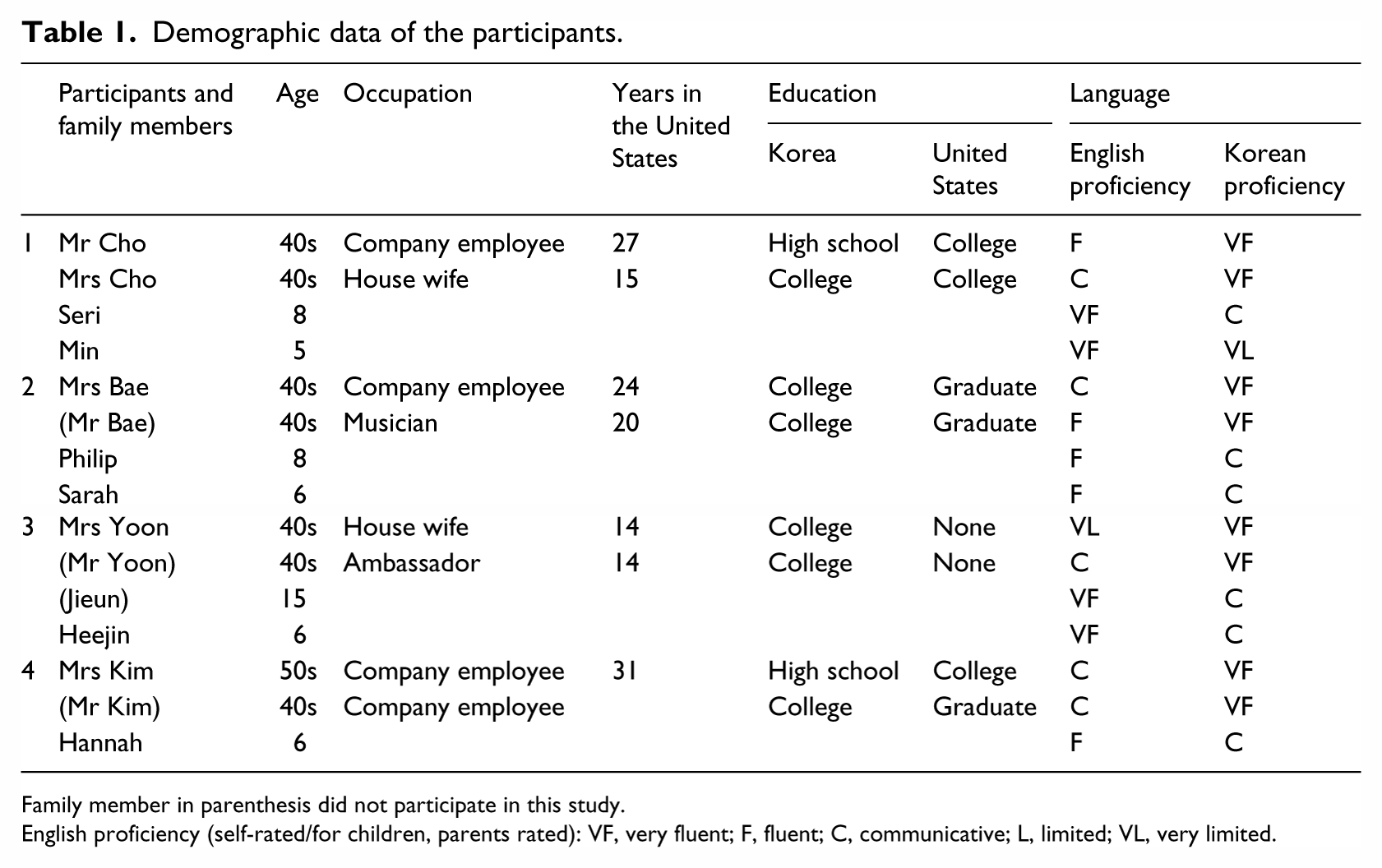
Family member in parenthesis did not participate in this study.
English proficiency (self-rated/for children, parents rated): VF, very fluent; F, fluent; C, communicative; L, limited; VL, very limited.
Data collection and analysis
In order to generate detailed descriptions concerning their experiences, sociocultural influences on their perceptions, and the sociocultural contexts within which they are situated (Bogdan and Biklen, 2007), I conducted individual interviews with the participants and recorded my reflections on the interviews in journals. I conducted two formal 60- to 90-minute interviews with the participants. Interviews were conducted either in English or Korean. As a bilingual researcher, I provided each participant a chance to choose the language with which they felt most comfortable. The interviews with the parents were conducted in Korean and those with the children in English.
Data analysis began immediately after completing the first interview and continued throughout the research process (Marshall and Rossman, 2006). By employing a constant comparative analytical method (Strauss and Corbin, 1994), the initial codes were reorganized and changed during the coding process, which led to new codes and reduced redundant ones. Since I found that reading the original language used by the parents allowed me to more accurately capture and understand the meaning, I initially analyzed data from the interviews with the parents in Korean and translated the transcripts into English after the initial analysis process.
Findings and discussion
Parents: “We are atypical Koreans”
The parents of this study have developed and maintained a strong Korean identity and wished to preserve it so that it was passed on to their children. All of them were struggling to place themselves in the same group with other Koreans not only in their community but also in general. They expressed strong resistance toward certain attributes of their ethnic group, which seemed to have been influenced by their sociocultural backgrounds and other experiences, which included their religion, their surrounding culture, educational history, and community members. The parents of four families commonly pointed out their excessively competitive and selfish attitudes when it comes to their children’s academic success as being one of their ethnic group’s negative traits: I do not like the side effects from the typical Korean way of living and educating children. If people come to the U.S. only for their children’s education, they usually bring what they used to do in Korea to the U.S. We call them Korean Koreans … I wish for my children to experience the U.S. as other Americans do. I do not agree with their idea of maintaining typical Korean ways of living in the U.S. (Mr Cho) I am a different Korean. I feel shame whenever I see typical Korean parents worrying too much about their children’s success. (Mrs Bae)
All the parents in this study commonly described that they are “different from other Koreans,” or that they are “atypical Koreans,” separating themselves from their ethnic group: I am very different from typical Koreans. I don’t like following other Koreans foot steps. I’ve been pursuing my way alone, and I will continue to do it. (Mrs Kim)
Since they understood the benefits from the Korean community as immigrants, the four families carefully selected and engaged with the Korean communities only where they could feel comfortable interacting with others who have similar philosophy in terms of educating children. Mrs Yoon described that she felt comfortable interacting with the “atypical Korean parents” in the chorus since she found that they had a similar philosophy of child education as hers and were less competitive than “Korean Korean” groups: I found they are very similar to me. I mean, we don’t want to put too much pressure on children to compete against each other … we would like to avoid that kind of atmosphere as much as possible. I think this was possible because this is a chorus, a group musical activity, not an individual music lesson.
The parents of four families deployed the terms “Korean Korean,” “Typical Korean,” or “Korean” in their narratives to socially categorize and describe coethnic group on different acculturative trajectories. By denigrating coethnic group as too ethnically traditional (“Korean Korean,” “Typical Korean,” and “Korean”) and assigning certain negative behaviors into this group, the parents created a non-stigmatized and positive identity for themselves, such as “Different Korean” or “Atypical Korean.” This also showed while they were problematizing the minority myth, they were also engaging in embracing some US norms.
Based on the parents’ narratives, it became evident that their responses to Korean Americans could be categorized into three sub-ethnic groups:
Korean American/1.5 generation—a person who was either US-born or foreign-born arriving in the United States at a young age, is assimilated to the US culture, and speaks mostly English.
Korean Korean/Typical Korean/Korean—a person who resists acculturation, and is usually a recent immigrant, or someone who has come to the United States only for a higher education or employment for a short period of time. This is a person who subscribes to the model minority myth.
Atypical Korean/Different Korean—a person who resides as a life-long immigrant, resists the model minority myth, and embraces the ideas of US norms and who is eager to maintain Korean language and some cultures
The parents clearly and repeatedly indicated that they belonged to the third category. The parents hardly mentioned the “Korean American” group; they acknowledged that they are different from the Korean American group in terms of the first language and the eagerness for children to maintain Korean language and culture. They, however, problematized the “Korean Korean” group, criticizing that they have brought a negative Korean education culture into the United States and maintained the typical Korean ways of living in the United States. However, it is noteworthy that their resistance to a certain aspect of Korean culture did not necessarily mean their desire of engaging more in American communities. Based on the notion of “syncretism” (Gregory et al., 2004, 2013; Souto-Manning, 2013b; Volk, 2013), the parents, as syncretic immigrants, created the chorus where they and their children could draw actively on their language, culture, and religion across normative binaries of two cultures, Korean and American. They viewed themselves as falling in the middle of the continuum; they seemed to consider their hybridity as atypical, and only this atypicality as healthy and normal, which must be problematized and challenged.
What stood out very problematic in their narratives was when they used the general ethnic group’s term Korean to degrade coethnics. When repeated it twice, Korean Korean, it stressed a negative meaning, implying that the person is “too traditional” and “too competitive.” It was surprising that its usage went largely uncontested among Korean immigrant communities. Those labels clearly captured dynamics of model minority, which was initially used to resist the stereotypes and racisms. However, it has not served to resist racial oppressions toward Korean immigrants in a broader society, but reaffirmed those negative sub-ethnic identities, which may cause them to turn their hostility inward and to develop a form of racial self-hatred (Pyke and Dang, 2003; Sue and Sue, 2012). Thus, it is imperative that we see them (re)affirming their Korean identity by engaging in an ethnically based community group as a social and political practice and call for scrutiny, problematizing larger issues. By recognizing, naming, and problematizing, we can help the next generation of immigrants complicate the dichotomous Korean versus American discourse. As Souto-Manning (2007) notes, we will collectively create “places for possibilities and choices” (p. 404).
Children: “We are Koreans”
Research to date on young immigrant children’s heritage, language, and identity argued that in order to survive and to feel a sense of belonging in new communities and environments with native English speaking peers, young immigrant students adopt negative perspectives of their heritage culture, identity, and mother tongue (Corson, 2001; Fillmore, 1991; Kwon et al., 2010; Li, 2002; Tse, 2001). Unlike previous studies’ findings, the six children aged 5–8 years in this study, whose families were engaging in an ethnic community-based chorus, showed a firm and positive perspective toward their ethnic and sociocultural identity as either Korean or Korean American. Except Seri and Min who identified themselves as Korean American, other children in this study, Philip, Sarah, Heejin, and Hannah, presented themselves as Koreans even though they all had been born in the United States. The children’s identities were formed combining with their families’ and close friends’ racial identity. For Seri’s case, as she retained a strong emotional attachment to her extended family members in Korea, her identity as Korean was closely related to her ability of speaking the language and a sense of belonging to the group: I have to be Korean because I want to meet my grandparents in Korea and everyone in my family is Korean … If I am not Korean and do not know how to speak Korean, I cannot talk to them at all and cannot be part of their family. (Seri)
Mentioning the parents’ ethnicity, Min initially presented herself as Korean; however, Seri corrected her Korean American, explaining that they could speak both languages. Then, Min changed her initial answer to Korean American, repeating what her sister presented. For Heejin and Hannah, parents’ racial identity influenced their identity formation as Korean; both said, “I am Korean because my parents are Koreans.” For Philip and Sarah, their parents’ as well as their close friends’ Korean ethnicity was also mentioned for the reason of their Korean identity.
Interestingly, all of the children expressed greater preferences for socializing with Korean children. The parents commonly mentioned that it seemed that their children felt very comfortable around Korean friends who speak same languages: I like Korean friends in chorus … because they are very polite to my dad and mom, they are like … Insajalhae (bow appropriately), and they love my sister as well. They treat me like they want to be treated. (Seri) I like to hang out with my Korean friends who are nicer and more fun (than American friends). They always listen to me whatever I say … We speak English, sometimes Korean. (Sarah)
That is, their linguistic alignment and cultural alignment were significant in their “affinity group membership” (Souto-Manning, 2013a: 311). Thus, how the children described their identity showed that various sociocultural practices, such as their language usage, parents’ Korean-origin background, and influential people around them, have contributed to young children’s identity formation.
Although the children in this study have presented themselves as Korean/Korean American and showed their preference to socialize with Korean friends, what they meant “Korean friends” was already becoming to be limited to the second-generation Koreans living in the United States. Based on what they heard from their parents, the children shared some negative feelings about Korean children living in Korea: It was boring, kind of. I had to stay home all the time, not going outside to play because there was no one I could play with in playground. (Sarah) I don’t know. I don’t really want to go to Korea. Because … when I went to kindergarten in Korea, I had to study all day, and my teacher was scary. She hit me with a ruler. She hit me because she thought I did not listen to her … But I didn’t understand what she asked me to do because I didn’t speak Korean very well. (Philip) My mom told me Korean children don’t play. They only study … I want to go to Korea with my friends and play with them. (Heejin)
It can be assumed that their parents’ continuous negative descriptions on Korean culture may transmit messages about shame and frustration toward Koreans to their children, which may prevent their children from developing and maintaining a positive and robust Korean identity after all.
Implications
The findings indicate that Korean immigrant families exhibited diverse, complex, and contextualized experiences with regard to their identity formation. Given the lack of attention and research in such areas, this study will contribute to the discourse that focuses on Korean immigrants’ experiences beyond the model minority stereotype, de-essentializing the racial category of Korean. Overwhelmingly, the findings reveal that the parents repeatedly expressed strong resistance against certain stereotypes attributed to their ethnic group. They indicated that these included competition, independence, and placing academic work above all other educational and social experiences which would begin to unearth the voices of Korean immigrants, providing much more complex and fluid ways in which Korean immigrants construct and negotiate their identities. Thus, teacher educators preparing pre-service and in-service teachers can use the findings of this study as a starting point for a broader discussion on stereotypes and assumptions toward other racial groups, transcending the specific immigrant group featured in this study.
Also, as this study showed, the children’s identity and knowledge about Korean culture have developed mostly through their parents. The children identified themselves as Korean/Korean American, expressing in-group social preference. However, the parents distanced themselves from the more ethnically traditional group of Koreans, assigning derogatory stereotypes to the group, and constructed themselves as distinct and superior (Pyke and Dang, 2003). The parents mocked the group attributing negative traits to them and calling them Korean, Korean Korean, or Typical Korean, which seemed very problematic for children’s Korean identity and understanding of the term Korean—especially when so many of the children defined themselves as Koreans.
It became evident that immigrant parents should resist engaging in this process of intra-ethnic othering, which reproduces racial stereotypes that may lead to self-hatred toward their own ethnic group. It is suggested here that Korean immigrant parents may pay more careful attention to building strong and healthy Korean communities where their children can develop a positive sense of identity. My wish is that what Min, the youngest participant, said during the interview, “I just love being Korean,” can be well maintained as she grows up as a second-generation Korean in the United States, developing her curiosity and openness for interethnic groups as well. I wish this could have been heard from many more children. As we seek to develop strong and positive identities in young immigrant children, it is important that we educators remember the great responsibility we have and the potential power of our actions and interactions. As the intra-ethnic othering process was also examined in other ethno-racial groups (Jensen, 2011; Pyke and Dang, 2003; Schwalbe et al., 2000; Schwalbe and Mason-Shrock, 1996), this study will contribute to create a supportive community with other immigrant parents in developing their and their children’s positive and robust racial identity.
Footnotes
Funding
The author(s) received no financial support for the research, authorship, and/or publication of this article.