




Abstract
Currently, Myanmar, and in particular Yangon, is in the process of huge social, economic and political change. While there seems to be growing opportunity for some, the impact of this growth and change is not always clear, particularly in the way that it has already begun to affect the poor; food prices, rental and transport costs are all increasing, putting growing pressure on disadvantaged families and individuals. There have been some attempts by the government to consult with communities about these changes; however, seldom, if ever, are the thoughts and voices of children taken into consideration. In the context of this massive change, this article identifies and reflects upon the factors that affect the lives, behaviour and aspirations of a small group of children in a poor urban township of Yangon. The author has been a voluntary teacher in their community for the past year and will draw on his own experience as well as interviews and focus group discussions with these children (boys and girls between the ages of 10 and 12 years) to better describe the way in which these children perceive their own childhood and the various social, cultural and economic factors that have an impact on it. The article also includes a comparison with (memories of) the author’s own childhood, acknowledging the potential impact this might have on objectivity as well as helping to broaden the picture that emerges about childhood in modern-day Myanmar.
Children in Myanmar
Myanmar, officially the Republic of the Union of Myanmar, is situated in Southeast Asia bordered by Thailand, China, Laos, India and Bangladesh (Figure 1). According to the census (Department of Population, Ministry of Immigration and Population, 2015) conducted in 2014, Myanmar has a population of 51 million (24 million males and 26 million females) and a total number of 10,889,348 households. Myanmar is divided into seven states (Kachin, Kayah, Kayin, Chin, Mon, Rakhine and Shan) and regions (Yangon, Mandalay, Ayeyarwaddy, Sagaing, Magway, Bago and Tanintharyi). There are 135 distinct ethnic groups in the country and eight ‘major national ethnic races’: Kachin, Kayah, Kayin, Chin, Mon, Bamar, Rakhine and Shan. With the election of a civilian government in November 2010, Myanmar began to experience tremendous change. The major elements of this transformation included (1) transition from a military dictatorship to a constitutional democracy, (2) transition from a controlled economy to a market-based system and (3) transition from an isolated society to one that is regionally and internationally integrated. In addition, there has been the release of political prisoners, elimination of press censorship, abolition of laws restricting public demonstrations and visits by prominent heads of State.
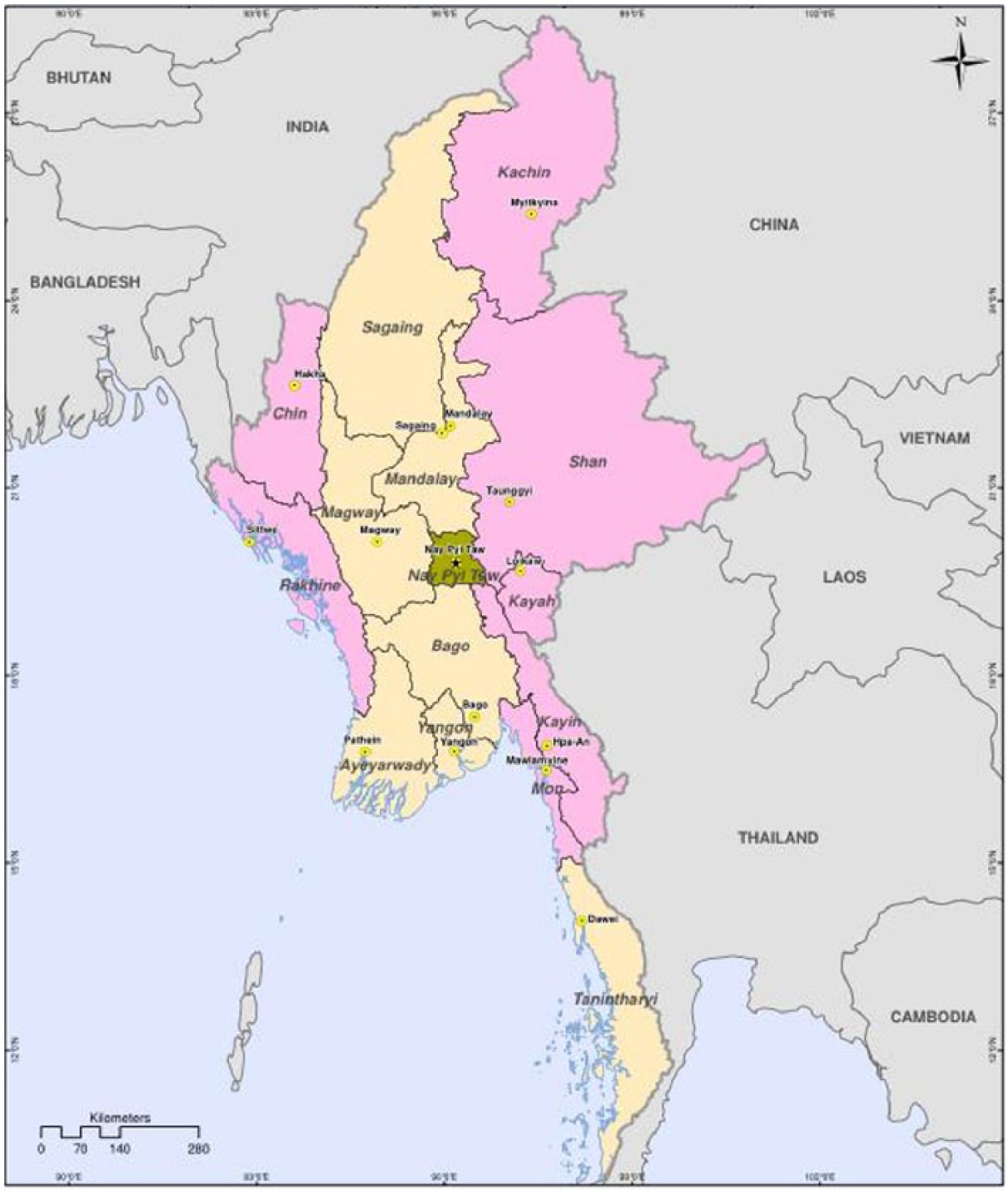
Myanmar map.
Despite the rapid change, Myanmar still remains close to the bottom of the United Nations Development Programme (UNDP, 2014) Human Development Index, ranking 150 of 180 countries. This is a result of the legacy of military rule and over 60 years of political and economic isolation. Ethnic and inter-communal fighting, especially in Kachin and Rakhine States, continues to affect national security and development.
A recent analysis of budget allocations by the United Nations Children’s Fund (UNICEF, 2013) found that public expenditure in the social sector is strikingly low by international standards. For financial year 2012–2013, 11%, 5.7% and 0.29% of total government spending were for education, health and social welfare respectively.
According to the Myanmar Child Law (State Law and Order Restoration Council, 1993), every child shall have the right to acquire a free basic (primary level) education at schools opened by the State. In reality, it is still challenging for many children (e.g. poor children, children living in remote area, children from ethnic minority groups) to access school. According to UNICEF’s Multiple Indicator Cluster Survey (Ministry of National Planning and Economic Development, Ministry of Health, 2011), 74.4% of children of primary school entry age attend grade 1 (Kindergarten). It is notable that 63.5% of children from the poorest household entered primary school. Only 31.2% of 9-year-old children from the poorest households reached the last grade of primary school, compared to 78.7% of 9-year-olds from the richest households. Overall, primary school completion rate is 54.2%.
With regard to early childhood education, overall 22.9% of Myanmar children aged 36–59 months were attending classes. Urban–rural differences are significant, with 39.1% of children in urban areas attending early childhood education, compared to 15.9% in rural areas. The economic status of households is one of the key factors influencing whether children attend early childhood education. In all, 46% of children in the richest households attend early childhood education, while the rate of the poorest is 7.6%.
In Myanmar, it is not uncommon for young children aged 3–5 years who do not have access to early childhood education to be looked after by an older and primary aged sibling. While there are no official data, my personal experience of including observations of development programmes I have worked on would suggest that it is not unusual for school age children to drop out of school in order to care for younger siblings.
While progress has been made in improving children’s health through child immunisation and nutrition initiatives, Myanmar continues to have high infant and under-5 mortality rates, with 50% of all child deaths attributable to preventable causes. One in three children under 5 years of age is still malnourished. Although water and sanitation coverage has substantially increased in recent years, many households still lack access to safe water and sanitary facilities, and water-borne diseases remain a major killer of children under 5 years of age across the country. High primary school dropout rates and widespread poverty have had the effect of rendering large numbers of Myanmar’s children and youth vulnerable to various forms of exploitation. Many children are employed in factories, teashops and other business enterprises where they work long hours under arduous conditions for very little pay. Other children take to the streets to beg, some run afoul of the law and others are conscripted into the military despite national laws prohibiting this practice. Many of those children are vulnerable to trafficking and many trafficked children are forced to work in the commercial sex industry (UNICEF in Myanmar Protecting Lives, Nurturing Dreams).
Children in Myanmar are vulnerable in terms of education, health and protection, but these are not only factors influencing the lives of children. This article explores the economic, social and culture factors that influence children from a poor community in Tha Ma Ta Kan Chay, Dala Township in Yangon. This community consists of approximately 35 households. They have come from different parts of Myanmar to find job opportunities in Yangon. The Township is a 15-minute boat trip across the Yangon River to the city of Yangon. Since the main livelihood is casual work, often on construction sites or hawking food, people living in Tha Ma Ta Kan Chay generally struggle with income security and find it difficult to meet the economic needs of their households (Figure 2). Poor housing condition, lack of proper sanitary latrines, small-scale gambling, fighting, sexual misconduct, insanitary environment and so on are the characteristics of this community.
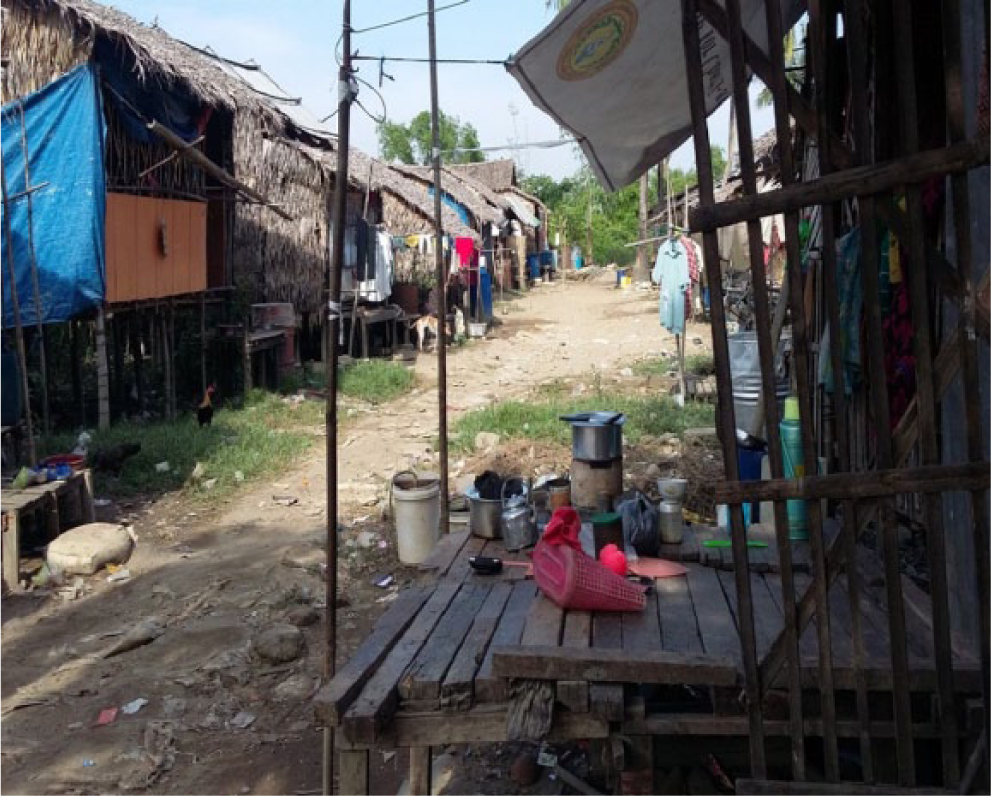
Tha Ma Ta Kan Chay where a group of vulnerable community lives in.
Methodology
Data for this study were collected through focus group discussion with children, informal interviews with parents and children and a desk review of relevant literature. Two Participatory Learning and Action (PLA) data collection tools are used in the focus group discussion with children:
Wealth ranking. This tool is a method for collecting and analysing data on perceptions of wealth differences and inequalities in a community and for identifying and understanding local indicators and criteria of wealth, well-being and poverty.
Venn diagram. This can be used to explore the roles and relationships of groups and individuals and the links between them.
In order to collect data on the economic, social and culture factors influencing the children, the two PLA tools were modified. For example, during the wealth ranking exercise (Figure 3), children were asked to locate their own house on the horizon line and then explore and discuss social and economic factors that influence their lives through a major question, ‘what are the differences between children from poor and rich families?’ The Venn diagram exercise enabled the identification of people who are important in the lives of children and why. In addition to these PLA tools, a ‘Good and Bad behaviours exercise’ was conducted. Children were asked to identify specific behaviours of people around them and then discussed among themselves which behaviour they felt was ‘good’ or ‘bad’ and why. Finally, informal interviews were conducted with children and their parents. In total, three children participated in the exercises. Basic information of the children appears in Table 1. Note that the names of the children have been changed.
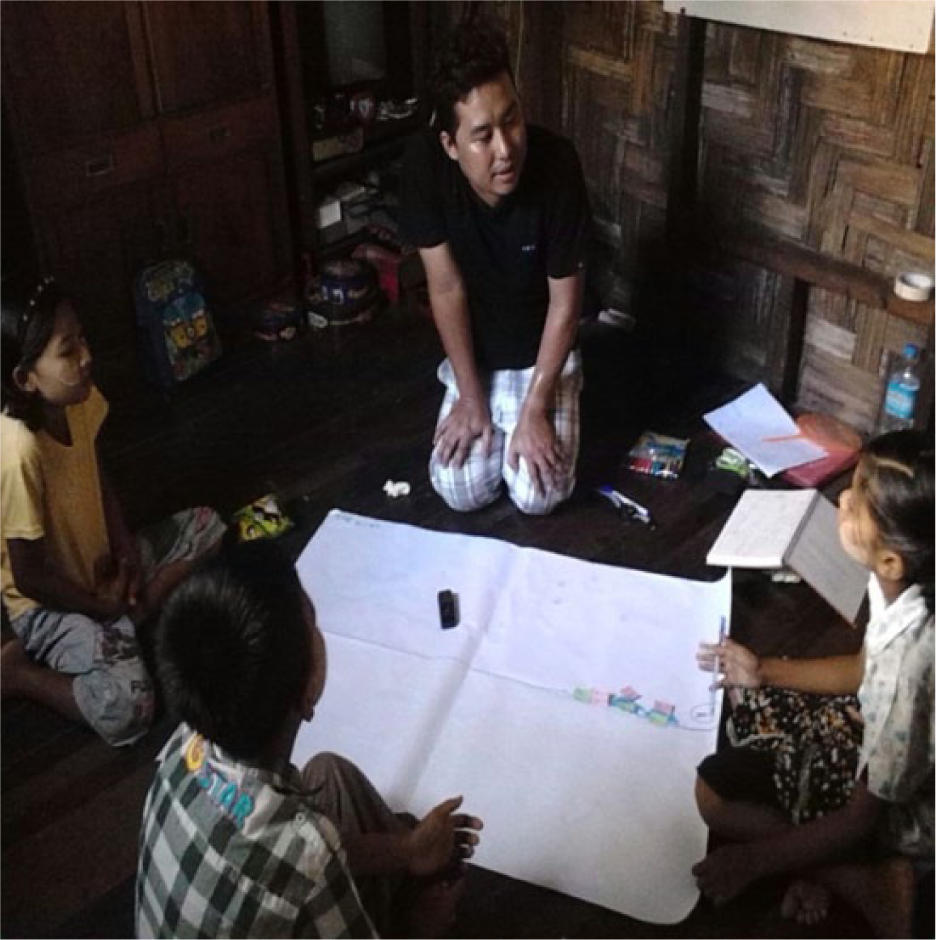
Wealth ranking exercise.
Details of respondents.

Data collection constraints
The original plan for this research project was to collect data from two groups of children, and a total of 10 children (both boys and girls). The number was based on the class size of the small tuition programme I had been holding over the past 2 years. However, as the children began to attend the tuition infrequently, due to a range of issues including having to help their parents on weekends, going to festivals and preferring to play rather than going to the class on weekends, it was decided to include only the three regular attendees.
What the children talked about
The three children included in the study came from families with a similar economic background, which to them seemed different to many others in their community. All three children said, ‘we have less time to play compared with children from wealthier as we have to do housework like washing, cooking and going to the market to buy food’. Su Su added, ‘I need to get up early to do housework on school days and after getting back from school. Most of my time is spent doing housework since my family is poor and my brothers are younger than me’.
All children had experienced ‘going to the bed hungry’. Mg Mg said it happens 2–3 days a month. All children said that they were less cared for by their parents compared to children from wealthier families. All children said, ‘We do not have a chance to have breakfast, lunch and dinner with our parents or to go to the park or pagoda as our parents work hard and do not have the time for us’. The children also observed they were different from wealthier children in terms of the type of housing they had and the clothes that they could afford. Being from a poor family made their day-to-day lives very difficult in comparison with their more well-to-do peers. They said they were ‘pressured with having to give school fees’. Both girls said, ‘We need to spend our pocket money to pay for school’.
The word ‘discrimination’ was repeated by all three children throughout the exercise. All children mentioned that ‘We do not have a chance to participate in school events such as football, dancing and so on because we are not able to pay the event fee’. Children from wealthier families received favour from their teachers through giving presents. Aye Aye said, ‘we share food and play with the friends whose families are poor like us. Rich parents and children do not want to associate with us’. They were sometimes accused of stealing. Mg Mg said that ‘One day I went to the snack shop and left without buying anything. I went on to the next shop and bought a snack. I was accused of taking snacks by the first shop owner’. Su Su added, ‘I am very sad and upset when I am accused of being a thief’. Children felt that not only themselves but also their family were discriminated against due to being poor. Mg Mg and Su Su said, ‘our families are not invited to weddings as they think we cannot afford to buy a wedding gift’, and Su Su added that ‘I am very sad there is big discrimination between the rich and the poor. When my mother borrowed money from the wealthy money lender, my mother had to sit on the floor and the rich man sat in the chair’.
Through the ‘Good and Bad Behaviour Exercise’ (Table 2), the children spoke and reflected about the behaviour of the people around them.
Good and bad behaviours.
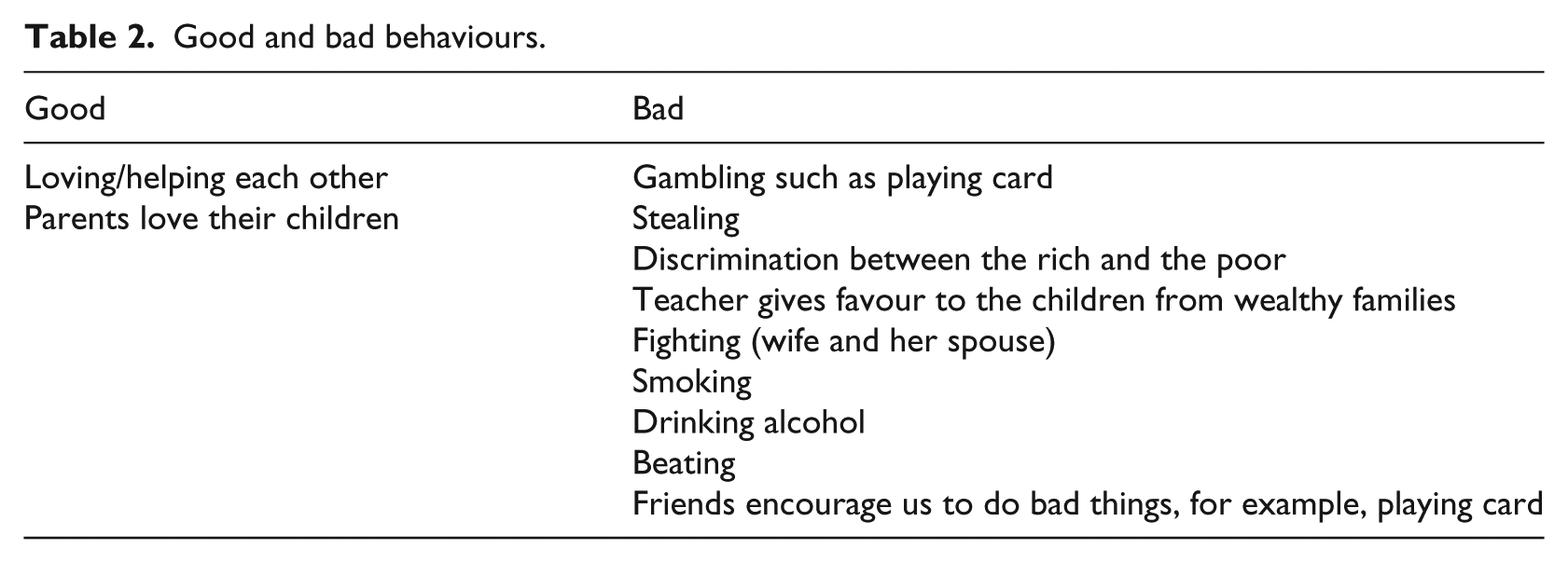
The children noted a significant amount of violence in the community – violence between adults, among children and commonly used by parents to discipline their children. They all agreed that ‘fighting is not good; women are beaten by men since men are stronger’. Su Su said, ‘I am unhappy if my parents are fighting. I feel sad as my two younger brothers are waiting for food till my parent finish fighting’. All children talked about beating. They said, ‘Beating is a common punishment for children in Myanmar’ and noted that when children are beaten severely, they would end up bruised and bleeding. They said it was better for parents to talk about their children’s mistakes rather than beating them if they did something wrong. Gambling and alcohol abuse are also seen as a community problem. Card playing in their community was often associated with gambling. However they said that they could all play cards and have learned from their neighbors. They said it was not difficult. ‘We learn from our neighbor how to play cards but we know gambling, alcohol abuse and stealing are not good since they are socially unacceptable activities’. All three children mentioned that they received support from their neighbours whose socio-economic status was similar to their own. For example, they said, ‘We can borrow money from them and they allow their children to play with us and share toys with us’. Both girls said, ‘We have friends at school whose family situation is the same as us. We share food and help each other. This is good’.
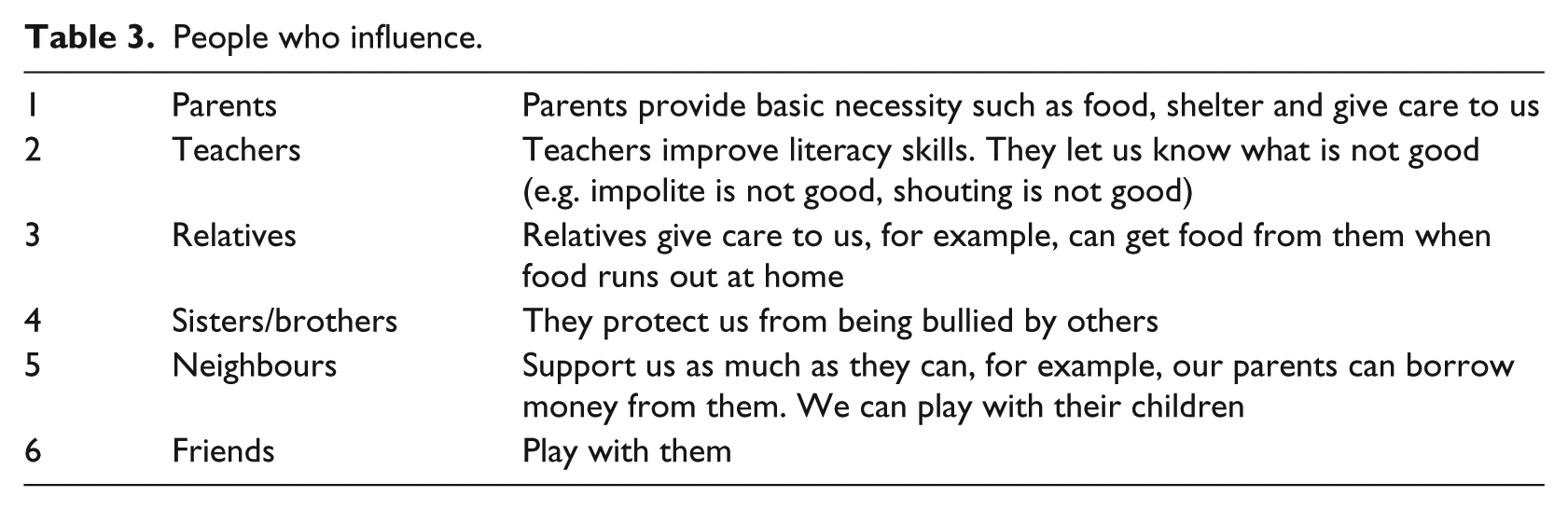
The children noted positive influences and people in their lives. They said that they are happy when parents love their children. The children said that parents, teachers, relatives, sisters/brothers, neighbours and friends play an important role in their lives in a range of ways as summarised in Table 3.
People who influence.
Children also noted the importance of education; they said that through education, they would like to create a better future and support their parents as much as they can: ‘Parents of children from better-off families are educated and their education enables them to do proper jobs and to support their children well’. When asked how they would define the word ‘Child’, all agreed that ‘A child has to play, go to school, help parents and obey what the teacher and parents said. In addition, a child should not inquisitive’.
Discussion and conclusion
Gittens (1998) advocates that any research into children must be predicated on an understanding of what we, as researchers, bring to the analysis. We see children and childhood through the lens of our own experience of being children, as well as through the filtering disciplines of social science, psychology and history that we have learned or absorbed or have inculcated in later stages of life. So it is in discussing the above results that it is important for the author to reflect also on his own childhood experience and the potential impact this might have on the analysis of the data. Ultimately, both will help extend the knowledge and understanding about Myanmar childhoods. With this in mind, the following is written in the first person as it enables me, as the author, to make the mental shift from observer of other children’s lives while reflecting on my own and the influence that has on my interpretation.
I decide to become a volunteer teacher for a number of reasons. First, I have been working with different Humanitarian Organisations in Myanmar since 2003 as a paid worker. I felt it is important to volunteer and give something back. As a child, I always loved to play as a teacher, and so volunteering as a teacher made a lot of sense to me. Throughout my life, I have seen a few good teachers. Among them, I have never forgotten my language teacher, a Buddhist monk from my native town. The monk committed his time and energy to enable many young people to learn foreign languages. He made me realise the importance of education for our country.
The children in this study, along with another eight who could not continue through the data collection process, have been my students for the past 2 years. I have been their volunteer teacher on weekends, helping them with their studies. It may be stating the obvious to say that different people have different childhoods depending on the many social, economic and culture factors that influence their lives. However, it has constantly amazed me that the experience of growing up of the children in this research has been so different to my own. After all, we come from the same country, speak the same language and identify with the same cultural heritage. What I found, however, is that their lives and my own as a child almost seem as though we were from different countries. The first year of teaching them was an emotional and mental challenge. I found them aggressive and excessively noisy during class. Over the 2 years that I have been teaching them, I have realised that their culture (i.e. the environment in which they have grown up) is almost totally different to my own. I have thought long and hard as to why this was the case, and the idea of studying this through more than an emotional response became the driving factor of putting this research together. My findings have not been startling, but they help to make sense in my own mind as to why children in a community such as this behave the way they do. From that perspective, I hope these findings might help to inform others, individuals and programme that seek to support such children.
Children need care and support from parents
During the exercise, the children’s self-identified need for care and support from their parents became very clear. They said they wanted to have meals with their parents, go to pagoda and park with them, just to be with them. Despite my own childhood being materially poor, I realised that this was a major difference. In reflecting on my own upbringing, I feel that I received care and support from my parents and a lot of love. My mother told me stories before going to bed. I remember fondly the special meals prepared by my father once each week. Although my parents were not educated, they were literate. My father helped me with my school lessons when I was at primary school. Children, especially from ‘vulnerable’ families, need to support their parents through work and helping around the house. When I was child, I also needed to help my parents doing housework, but the main difference between the children in this research and me is that I never felt that I was different from my friends since I had time to play and study – the same as all of my friends had.
Teachers are crucial in the lives of children
Children referred to ‘discrimination’ at school throughout the discussions I had with them. They were treated differently at school. In many Myanmar schools, children have to attend after-school tuition run by the same teachers who take day-time classes in school. Children need to pay for tuition, and if they do not attend, they will not generally get attention of teacher in the classroom compared with children those attend. As a result, it is challenged for the children from poor families those are not able to do well at school to pass school exams. This is a way in which teachers can make money to compensate for poor wages. While this practice is gradually being addressed by the present government, it will take time to change. Children who cannot afford to pay for the tuition often suffer discrimination from teachers and from their peers who tease them because they can’t afford to pay. My own school days were quite different. I had good teachers during my childhood and teenage years. I had the opportunity to join night tuition without fees.
Good neighbours help children to grow up well
The community in which I grew up is very different from that of children who participated in this research. Their community was characterised by small-scale crime, gambling, fighting and sexual misconduct. Over the 2 years of teaching, I have observed that from the perspective of Myanmar culture, these children have developed socially unacceptable behaviour – aggressiveness, using rude and offensive language, disrespect to elders and so on. According to my observations and much of the data collected, it can be hypothesised that much of this is learned behaviour and that the community in which the children live has played a major role in influencing their socialisation and their behaviour patterns.
Relatives
A key part of the community, relatives, is vital when we speak about children in Myanmar. Both extended and nuclear family types are found, although the extended family unit is more common. I myself grew up in an extended family. The three children articulated how relatives are important people in their lives; however, there was a subtle difference to my own experience. For these children, the support of relatives was seen more in a functional way; for example, they all mentioned that when they ran out of food at home, they would go to their relatives for help. My childhood experience was slightly different in that relatives were there more from the perspective of moral support, nurturing and helping to socialise me. It seemed as though the prevailing poverty and economic environment in which the children had grown up had reduced the relationships with extended family to a basic survival level.
Disciplining of children in Myanmar
Corporal punishment of children is not unusual in Myanmar; it has been commonly used through successive generations as a disciplinary tool by teachers, parents and others. While my own childhood was uncharacteristically lacking in this form of disciplining, for the children in Dala who were my research subjects, their experience could not have been more different to my own. While data did not show any causal relationship between the way they are disciplined and the aggressive behaviour that they displayed, I cannot help to wonder whether this is the case and believe that this along with many other questions this article has raised would benefit from rigorous academic analysis through a further study. This is important as violence is an ever-present underlying motif of Myanmar contemporary society and indeed present throughout our history.
Religion
The importance of religion in the lives of children and adults alike cannot be underestimated in Myanmar society. While the children interviewed in this study were all Buddhist, Myanmar’s complex religious tapestry includes Christianity, Hinduism, Judaism and many more minor religions. Unlike many Western countries where the importance of Christianity in particular seems to be declining, the influence of religious thinking here seems only to get stronger. A case in point, and a concerning trend, is the increase in conservative religious forces such as the Ma Ba Tha, a conservative and outspoken Buddhist group that is beginning to have a considerable influence on politics and law making in Myanmar. For the lives of these children in Dala, their religion, Buddhism, is most important. In Buddhism, there are five benefactors: Buddha, Preaching of the Buddha, Monk, Parents and Teachers. The children defined a child as someone who must ‘obey what parents and teacher say’. They believed very strongly in the concept of going to hell if they committed bad deeds. Religion seemed to have a very controlling effect over the lives of these children and arguably it does generally in Myanmar society. It controls their social interactions and what they can and cannot say to different people. When I asked them further about what a child is, they said, ‘A child should not be inquisitive’, very much reflecting the religious belief that children should always listen and obey their parents, teachers, elders and religious leaders.
This article brings to light many areas for further research into the lives of children in Myanmar. This is a country not well known and, since the days of its socialist government that began in the early 1960s, had very little international academic interest. The situation is changing now. As Myanmar continues to develop its own democratic tradition, it is important that all citizens, including children, have a voice and, at the very least, are understood and respected as valued members of this society. My hope is that this article provides inspiration and motivation for greater research into the many and varied childhoods that can be found here.
Footnotes
Funding
The author(s) received no financial support for the research, authorship and/or publication of this article.