




Abstract
Myanmar is a signatory to the ‘Education for All’ Declarations as well as UN Conventions on the Rights of the Child and the Rights of Persons with Disabilities. This research aims to contribute towards bridging the gap in evidence about access of children with disabilities to education in Yangon, Myanmar. The research used a qualitative methodology including interviews and focus groups with 222 participants in 11 schools in Yangon as well as interviews with 19 parents and children who were out of school. Overall, the research found adult perceptions of children with disabilities based on notions of vulnerability and dependence. However, there was some evidence of more positive perceptions, as well as instances of children with disabilities resisting discrimination and actively participating in education. At the same time, the research found that while there was evidence of inclusive learning environments in some individual schools, there was limited evidence of children’s rights to inclusive education being met in most of the regular schools that participated in the research. Although children with disabilities’ rights to education are protected through international instruments such as the Convention on the Rights of Persons with Disabilities and the Education for All agenda, there remain significant gaps in the ways in which these commitments have been translated in the everyday practice in the schools in Yangon, Myanmar.
Introduction
Myanmar is a country which is undergoing significant political, social and economic change. Following the elections in 2010, the government of Myanmar has committed to widespread reforms, supported by international agencies. Among these, the education sector is undertaking a Comprehensive Education Sector Review (CESR) launched in 2012 and a new national Education Law was passed by Parliament in 2014. Myanmar is signatory of international instruments which seek to protect the rights of children with disabilities to education including the Convention on the Rights of Child (1989) and the Convention on the Rights of Persons with Disabilities (2006). Myanmar has also committed to Education for All (EFA) which provides for all children having access to basic education of good quality (UNESCO, 2000). Within this rapidly changing education context, there is an emerging call particularly by civil society organizations and international non-governmental organizations (NGOs) in Myanmar, of the need to create an education system that meets the needs of all children.
Background
The first Myanmar National Disability Survey conducted in 2008–2009 estimated that 2.3% of Myanmar’s population had a disability (Department of Social Welfare (DSW) and The Leprosy Mission International Myanmar (TLMI), 2010). However, this estimate is much lower than current international estimates of the prevalence of disability: about 15% of the world’s population are estimated to live with some form of disability (WHO, 2011). The relatively low estimation of the number of people with disabilities in Myanmar may be linked to the lack of a clear definition of disability in the national context.
There is also no clear evidence on the number of children with disabilities in Myanmar. At the time of writing, the government of Myanmar was conducting the first population census in 30 years, which will include data on the number of people with disabilities (Ministry of Immigration and Population, 2014). Furthermore, reports from the Ministry of Education (2012, 2014) suggest that 9738 children with disabilities are enrolled in primary schools, 11,536 children with disabilities are enrolled in middle schools, 47 children with disabilities are enrolled in high schools and 1450 children with disabilities are enrolled in special schools.
There is also no clear evidence of the number of children with disabilities who are out of school. However, evidence suggests that the numbers are very high and that as many as one in every two children with disabilities never attended school (DSW and TLMI, 2010). Moreover, of those who did attend school, only 33.5% progressed beyond primary level, which translates to a net secondary enrolment rate of 15.8% which is well below the national average of 38% (DSW and TLMI, 2010). Furthermore, evidence suggests that pass rates at matriculation, a national examination which enables students to graduate from high school as well as gain entry to university, for children with disabilities in Myanmar are much lower than for children without disabilities (Japanese International Cooperation Agency (JICA), 2013).
Myanmar has endorsed Education for All (EFA) and the Millennium Development Goals. The Ministry of Education’s Review Report (2014) on EFA outlines EFA activities in Myanmar between 2007 and 2014 and states that Myanmar has initiated Inclusive Education for children [with disabilities] … [Children with disabilities] are accepted in basic education schools as well as in the Non-Formal Primary Education (NFPE) programme, at monastic schools in addition to special schools for the blind and the deaf.
However, in practice, the main state provisions for the education of children with disabilities are focused on education provided by a small number of special schools in urban areas. There are eight special schools for children with disabilities, mainly located in Yangon (JICA, 2013). These include schools for children with visual impairments, hearing impairments as well as training for young people with disabilities. Two of the special schools in Yangon and Mandalay are managed by the government, under the DSW of the Ministry of Social Welfare, Relief and Resettlement (MSWRR), while the others are managed by NGOs.
There is a dearth of evidence in Myanmar about the needs and experiences of children with disabilities in education to inform the development of policy and practice. This qualitative research study sought to contribute towards bridging this gap by exploring the experiences of children with disabilities.
Methodology
The research used a qualitative methodology. It explored the reality on the ground of education for children with disabilities through an in-depth study conducted between July and September 2014 in 11 schools in Yangon. The research involved 222 participants including children and young people with disabilities, their peers without disabilities, parents, teachers and principals. In so doing, the research seeks to enable understanding of the lived experiences of children with disabilities and key actors around them as well as illuminating relationships between different factors that affect their participation in education.
Geographical scope and sample
The geographical scope of the study was Yangon, the largest city in Myanmar. Research participants were selected through purposive sampling, namely, they were selected in a non-random way based on the objectives of the study. The study focused on seven regular schools, while two special schools, one monastic school and one private international school were included as a means of comparison.
A total of 5 of the regular schools were selected from a group of 40 schools which Eden Centre for Disabled Children (ECDC) had existing links with, based on criteria such as school level (primary, middle and high schools), geographical location (down town and outskirts of town) and different degrees of receptiveness of the school to inclusive education. Furthermore, characteristics of the children with disabilities including age, gender and type of impairment were considered. Two regular schools with no support from ECDC were also selected as a means of avoiding bias.
Two special schools were included in the study, run by the MSWRR. These special schools only included children with disabilities: one school was for children with hearing impairments and the other for children with visual impairments. An international private school was selected, furthermore, as it included a separate unit for children with specific educational needs, including autism, intellectual and behavioural needs. One monastic school was also included.
Finally, 19 out-of-school children and their parents were selected from a list of children with disabilities in Yangon based on the Disability Survey provided by the DSW and TLMI (2010). The main criteria for selection included children being out of school as well as a broad representation based on characteristics such as the child’s age, gender and type of impairment.
Research methods and participants
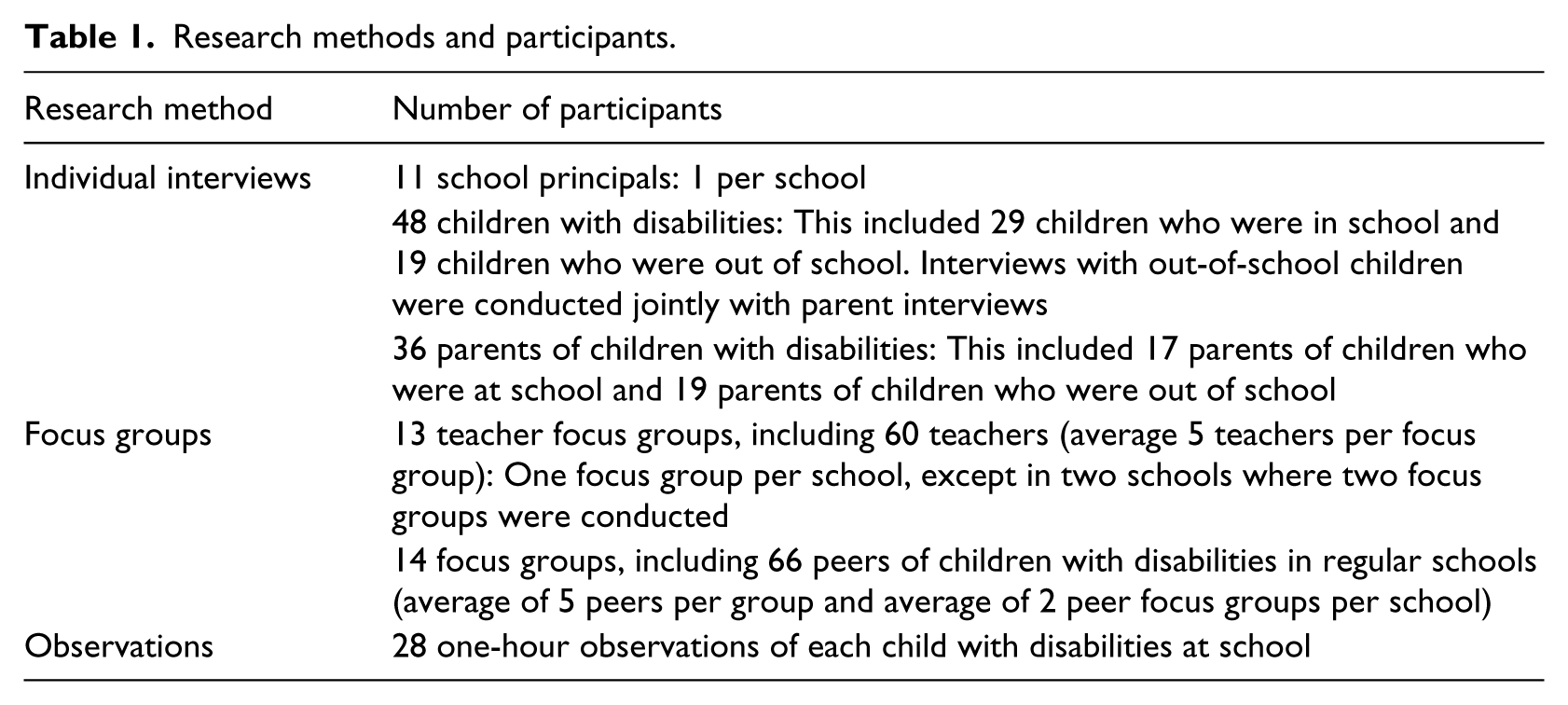
Table 1 summarizes the key research methods used for this study.
Research methods and participants.
Data collection and analysis
Data collection tools including focus group topic guides, interview schedules and observation guides were developed based on the findings from the literature review and a research inception workshop.
Visual research tools were developed for children with disabilities. These included symbols from Boardmaker® and Widgit as well as an adapted version of The Three Houses, which was originally developed to communicate with children in child protection cases (Munro, 2011). Children were presented with images such as ‘teacher’, ‘friends’ and ‘play’ and asked to place each image either into the house of worries or the house of good things as a means of gauging their feelings about each aspect of school.
Trained ECDC staff collected data in the field using digital recorders, which was then transcribed and translated to English. The research team then undertook a thematic analysis of the data. Following analysis of the data, a consultation workshop was held with key stakeholders to give feedback on the findings and agree recommendations for change.
Ethical considerations
Information sheets and consent forms were developed by ECDC staff for all research participants. Details of the information sheets were explained verbally to participants prior to the start of the interview. Participants were also asked to sign consent forms to indicate their consent to participate or not. Parents or carers and children with disabilities were both asked to sign the consent form relating to children’s participation in the research, in line with good practice guidance (Grieg et al., 2007; UNICEF, 2002).
Conceptual framework
Defining disability
Disability is defined based on a ‘social model’ approach as a problem in the organization of society rather than individual functional limitations or differences (Barnes and Mercer, 2010: 29). Therefore, in the context of education, children may face barriers to learning and participation due to ‘the interaction between students and their contexts: the people, policies, institutions, cultures and social and economic circumstances that affect their lives’ (Booth and Ainscow, 2002: 10).
The CRPD (2006) includes a definition of disability which combines limitations caused by impairment as well as barriers, which can include social and environmental barriers: Persons with disabilities include those who have long-term physical, mental, intellectual or sensory impairments which in interaction with various barriers may hinder their full and effective participation in society on an equal basis with others. (Article 1)
While recognizing that disability is a complex and contested concept, this article uses the above-mentioned CRPD (2006) definition, which recognizes that disability results from the interaction between individual impairments and the physical and social environments.
Disability and childhood
Research has highlighted that within the field of disability, there is a failure to distinguish how disability affects people in different ways depending on the person’s life stage. Research has found that children with disabilities occupy a unique position where experiences of disability and childhood overlap (Watson et al., 2000).
Both disability and childhood can be understood as social constructs (James et al., 1998). Priestley’s (1999) research in schools in the United Kingdom found that narratives related to childhood and disability were often associated with notions of children with disabilities as ‘passive, dependant and vulnerable’ (p. 93). Importantly, however, he also found evidence of resistance among children with disabilities to such narratives, which provided evidence of children engaging directly in social action. Ideas from Priestley’s research underlie some of the interpretations in this article, in seeking to steer away from assumptions of passivity, vulnerability and dependency towards understandings of children with disabilities as actors with a role in participating in social change.
Education for All and inclusive education
Inclusive education is often framed within the wider context of the UN organizations’ agenda of Education for All (EFA) as outlined above. Moreover, the commitments to ‘EFA’ are underpinned by key international conventions including the Convention on the Rights of the Children (1989), ratified by Myanmar in 1993, and the Convention on the Rights of Persons with Disabilities (2006), ratified by Myanmar in 2011. For example, the CRPD (2006) states that States Parties shall ensure that … persons with disabilities are not excluded from the general education system on the basis of disability. (Article 24)
In common with the social model of disability, inclusive education understands the problem of the participation of children with disabilities in education, as being not so much the child’s impairment as the nature of the education system itself. Therefore, change needs to happen at a system level. In this way, UNESCO (2005) suggests that inclusive education involves … changes and modifications in content, approaches, structures and strategies [in the education system]. (p. 13)
Therefore, founded on these concepts of inclusive education, one of the key questions the research seeks to explore is whether and how inclusive education is being implemented, what are the barriers and what facilitates the implementation of inclusive education as well as to gauge the perspectives of key actors on this issue.
Findings
Perspectives on childhood and disability
Notions of vulnerability and dependence were evident in the attitudes of parents as well as schoolteachers and principals towards children with disabilities, similar to Priestley’s research (1999). Parents were asked whether they preferred their children to attend school only with other children with disabilities, for example, in special schools or other special education programmes, or to be educated with children without disabilities in regular schools. Parents who expressed a preference for their children to be educated in regular schools cited reasons such as children being helped and supported by children without disabilities. For example, I prefer regular schools … If they’re kept together amongst themselves, they’ll only have their intellect. With able children, they can learn. (Parent of out-of-school child 2)
Parents’ expressions of protective feelings towards their children may also be associated with perceptions of their child as vulnerable. Parents expressed feelings such as ‘worry’ and ‘pity’, as well as less positive feelings of ‘shame’ (10 parents). Parents expressed worry about their child being bullied or ‘looked down on’ by others. Parents also expressed worries about whether or not their children could ‘cope’ in education, would be taken care of and accepted by teachers and peers as well as how their children would survive after the parents had passed away. For example, I am worried about him getting bullied by others when I pass away. I always tell him to try hard and learn how to read and write so that people won’t look down on him. (Parent, regular school 4)
Relationships with school principals and teachers were some of the key social relationships mentioned by parents in relation to their child’s education. Teachers providing ‘help’ and ‘support’ were valued by parents as well as attitudes among teachers and principals such as ‘acceptance’ and ‘understanding’: Teachers do everything for him not to face any difficulties. They also accepted him so there was no problem. (Parent, regular school 4)
Parents also described the importance of their children’s friends in supporting their participation in school. Often parents valued the helping or supportive aspects of these relationships and the role of peers taking on caring roles in relation to children with disabilities. For example, one parent explained, He gets along well with his peers. They pick him up and get him to school. (Parent, regular school 6)
This finding was also confirmed through the focus groups with school peers. In addition to describing friendship, many of the peers described taking on roles as informal carers, including helping to get water, lending things and support with writing. This evidence further suggests that parent and peer perspectives are based on the dependency and vulnerability of children with disabilities.
Parents and peers further described how children with physical impairments were excluded from some important school activities such as sports, play and activities such as cleaning the school. For example, one parent explained, There are many activities in school – games in December, my child can’t play then. There’s no involvement. The child isn’t fit. That time, the teacher doesn’t let him play. He has to sit quietly at school. He cannot play; he’s made to watch others play. Of course, the teacher’s worried that he’ll slip and fall. This can happen. (Parent, regular school 1)
This quote provides insights into adult ideas about disability, whereby the parent and teacher perceive the child as ‘vulnerable’ and as the cause of the problem.
At the same time, however, the research also found evidence of more positive attitudes where parents highlighted their children’s strengths, particularly in relation to academic success: He got prizes from Grade 1 until Grade 7. He got 3rd or 4th prize every year … [He] gets good grades like 5 or 6 among 47 students. He gets good marks. (Parent, regular school 6) If the teacher asks who can answer, she can answer first. Others can’t answer, but she can. The teacher tells her that she is smart. Other children say the same. (Parent, regular school 2)
Parents’ responses also revealed understandings of education of their children in terms of achieving independence in the future, particularly after parents themselves had passed away. Parents also saw education as a means of finding employment as well as overcoming discrimination from others related to disability: I want him to be hard working to stand on his own feet. If he graduates, he can work for himself. (Parent, regular school 6) They oppressed him at first. Not family members but other relatives. We as parents cannot stand it when others look down on him. But they stopped looking down on him when he started school. We are also protecting him so people don’t usually look down on him now. (Parent, regular school 4)
Furthermore, the research found evidence of resistance among children and parents towards more negative attitudes and actions taken to overcome these. For example, For instance, cleaning time. He can sweep and collect rubbish with his legs. But he cannot carry very heavy things. His friends cannot help him for those tasks. They ask him to sit. Teachers also don’t let him do as well. But he still comes to school at cleaning day. He tries his best to help. (Parent, regular school 6) Mom even wanted him to drop out from school because we moved to another place. But he didn’t want to drop out. He said how he will survive if he is not educated. He told mum to leave him there with grandpa. So we left him there. (Sister, school 1) Two of her friends bullied her so I reported to the principal. So the principal sent those two children to the back [of the class]. I talked to them as well. I didn’t say anything rude to them. The child stays by herself. While she’s writing, they keeping scratching from the back and … she gets scratched too. (Parent, regular school 2)
Perspectives of children with disabilities
Interviews with children with disabilities highlighted their perspectives on things that helped and hindered their participation in school as well as their aspirations for the future. Table 2 shows that children felt most worried about examinations, using the toilets and travelling to and from school. Table 3 demonstrates that most children interviewed reported that teachers and friends helped them the most at school, highlighting the importance of social relationships for children with disabilities.
Things that children with disabilities said they felt most worried about at school (n = 26).

Things that children with disabilities said helped them in school (n = 18).

Children were also asked about their expectations for the future. Most children with disabilities who were at school, expressed that they wanted to be doctors or engineers in the future (Table 4). Both of these professions in Myanmar require high grades at matriculation to gain entrance to universities. The peers of the children with disabilities whom we interviewed similarly most frequently expressed that their ambition was to become a doctor. This suggests that the expectations of children with disabilities for their future were similar to those of their peers.
Hopes and dreams of children with disabilities for the future (n = 39).
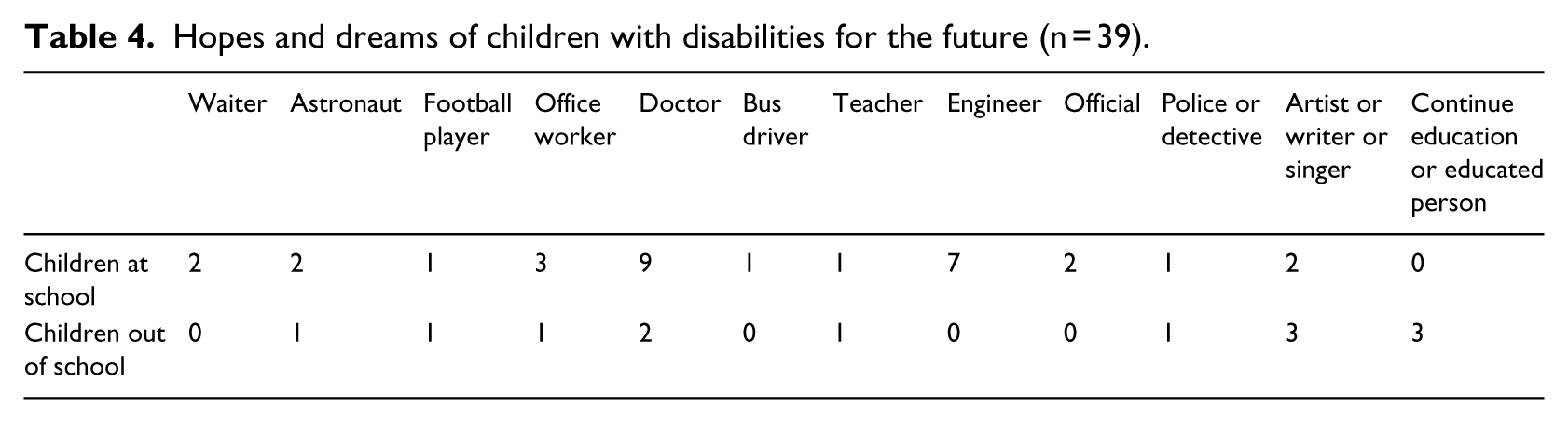
The children who were out of school were least likely to express ambitions to enter into professions such as medicine and engineering, many simply expressing a desire to return to school or to join other professions which may be considered less academic, such as sports and the arts (Table 4). Comparing this to the expectations of the children with disabilities who attended school suggests formal education may shape children’s expectations in life and, therefore, perhaps also their future outcomes. Children’s expectations in school may also be related to the emphasis on a limited number of core knowledge-based subjects in the education curriculum as opposed to co-curricular subjects (JICA, 2013). This may limit the opportunities for some children, including children with disabilities, to develop in subjects where their aspirations and perhaps also their strengths may lie.
Enrolment and assessment of disability
Most of the parents whose children were attending school explained that they had no difficulties with the school enrolment process. Similarly, most of the principals we asked about their school’s policy on the admission of children with disabilities stated that all children could enrol and often associated this with children’s rights to education. One of the principals who was committed to inclusive education principles, when asked about the school’s policy of enrolment of children with disabilities stated simply, Nothing special. We do not make refusals. (Principal, regular school 2)
However, evidence from principal interviews suggests of lack of guidance from national level about enrolment and the need for this: In order for children with disabilities to be involved, we need a specific policy. (Principal, regular school 4)
Where principals were less committed to inclusive education, there was evidence of schools not admitting or retaining children with disabilities and particularly children with intellectual impairments and cerebral palsy (CP): We don’t accept children with intellectual impairment. (Principal, monastic school)
We also found evidence of a child with CP and a child with physical disabilities being refused admission to regular schools because of their disability: I want her to attend school … [and] there’s a school close to home … but the principal didn’t accept because she couldn’t stand up. I tried to enrol her last year … I had to carry her and the principal asked me why I was carrying her and commented that this wasn’t nursery. So, I told her and she didn’t accept and told me that teachers can’t teach individually, they can’t do it for her and that she might get bullied. (Mother of a female child aged 8 who is out of school 1)
In terms of assessment of disability, the international private school and special schools involved in the research expressed conducting assessments of children’s needs when they were enrolled. The private school reported using hearing and visual tests as well as psychology assessments. The two special schools described using questionnaires for parents to complete about the child’s disability as well as requesting a medical report.
None of the regular schools undertook any assessments of disability. Most of the regular schools stated that they relied on parents for information about their child’s disability. There was also evidence of teachers and principals identifying children’s needs through observation and their experience of teaching the children: There is no assessment. Mental or intellectually impaired children … the conditions aren’t obvious. The physical ones are obvious. We start to know once we get closer … just that we don’t exactly know the type of impairment. (Principal, regular school 4)
The lack of assessment may lead to children, particularly with non-visible impairments, not being identified. In one school, the school principal explained that there was no need for assessment as We can see it, visually. (Principal, regular school 9)
However, in one school, we found that a child with a number of physical impairments as well as a visual impairment was placed at the back of the class where she could not see well. The lack of assessment meant the school did not identify or respond to this need. Furthermore, evidence provided by schools stated that most schools reported that less than 1% of the student population had a disability. The reported prevalence in these schools is very low and may suggest that disability among some students may have been undetected and/or that some children with disabilities were not able to access these schools. Without screening, schools are less likely to identify and respond to disability, leading to children being unsupported at school or at worst dropping out.
Curriculum and examinations
Barriers faced by teachers in regular schools included working with a high-curriculum content and having limited time. This meant that teachers felt under-pressure and less able to pay attention to individual student needs, especially for students in older grades. Furthermore, teachers felt disempowered in making decisions regarding adaptations to the curriculum and examinations. As students progressed in education, they had to complete national examinations which were prescribed by the national level. Principals and teachers could not make any curriculum adaptations to suit their students’ needs and the local context.
Teachers in one school, for example, expressed concerns about how a child with disabilities in grade 2 who had difficulties with writing would be able to progress to higher grades in the school as a result. They were concerned about how the child would cope with the larger number of subjects to study as well as the reduced ability of peers and teachers to support the child by writing for her: The thing is, since it’s a government test, it’s worse – there are more things to study. There are 9 main subjects altogether. That’s why it won’t be easy for her … Things like writing [for the child] won’t work for older grades. [We] can’t wait for her like in the 2nd grade. We teachers have many exercises and subjects. It won’t be easy for other children to help [her]. They also have to finish their task. (Teacher, regular school 2)
Furthermore, barriers in the curriculum and examinations were faced by children with disabilities. Teachers from a special school for children with hearing impairment highlighted the barriers for children with hearing impairments related to the content of the curriculum and the need to reduce this: The curriculum should be balanced for hearing impaired students. If there are 16 lessons and the teacher wants to finish it all, it is impossible. Our children can only study 8 lessons per year compared to other children. But regular schools don’t accept this system. They want to teach all 16 lessons and finish them. But our children cannot follow all the 16 chapters from the textbook. (Teacher, special school for children with hearing impairment)
Teachers from this school also highlighted barriers relating to the differences between sign language and spoken and written language, which made understanding of teaching and examinations for children with hearing impairments particularly difficult: They have weakness in communicating with others because they have hearing impairment since they were born. We [learn and gain knowledge] because we can hear what others are saying. Another thing is language originated from speech and becomes sentences. So people with hearing impairment face big difficulties in learning because they cannot hear. Children with hearing impairments learn visually only. (Teacher, special school for children with hearing impairment)
Teachers highlighted how children with hearing impairments in regular schools were likely to simply copy what the teacher wrote on the board without understanding the meaning. Similarly, teachers explained that in examinations, children who could memorize text would do well but may not understand the meaning. Therefore, teachers highlighted how subjects such as history and Myanmar language could be particularly difficult in terms of communicating meaning for children with hearing impairments, whereas maths was relatively easy.
Many of the parents and children interviewed also highlighted the limited time available for completing examinations as presenting barriers to participation. The research found conflicting evidence as to whether or not children with disabilities were allowed extra time if needed for examinations: some schools made allowances for this, while others did not. For example, one of the school principals, when asked whether students were allowed extra time for examinations, responded, We let them do things according to the school rules. There is no other adaptation for them. (Principal, regular school 6)
However, in this school, teachers interviewed separately reported that they did make adaptations such as giving students extra time for examinations and reducing the curriculum content where possible. This suggests a lack of a consistent approach within schools themselves.
In regular schools, adaptations to the curriculum and examinations were often informally arranged and were at the discretion of individual principals and teachers, often with encouragement by NGOs. Adaptations at school level seemed easier for students in lower grades and mainly included giving students extra time for examinations, particularly for children with physical disabilities. There was some evidence of adaptations during examinations through partnerships between special and regular schools, as well as in the private school which followed the international curriculum.
Overall, the research found that the current centralized nature of the curriculum and examination system did not allow schools to make modifications based on student needs. This presented difficulties particularly as children progressed towards the national examinations and matriculation. These findings may provide some insights into the low retention of children with disabilities in education as well as the reduced likelihood of children with disabilities passing matriculation.
Teaching practices
Modification to teaching practices and learning materials is an important aspect of inclusive education (UNECSO, 2005). However, in Myanmar, while teachers in special schools are trained as part of their pre-service training in teaching methods for children with disabilities, teachers in regular schools are not.
The research found evidence of good teaching practices relating to inclusion of children with disabilities in more well-resourced and specialist learning environments, including the international private school and special schools. Teachers highlighted a number of different methods they used in teaching children with disabilities. These included using student-centred methods, use of creative methods, being accommodating to student’s behaviours, accessing training and utilizing additional resources to aid teaching such as support teachers and peers in the class.
During observations in regular schools, we saw very little evidence of adaptations to teaching practices to cater to the needs of individual students. In these schools, we observed whole-class teacher-centred teaching and memorization as opposed to student-centred methods, lack of awareness among teachers on how to adapt teaching methods in response to student’s individual needs, lack of training on teaching methods, limited time and high teacher–student ratios and use of methods that were unresponsive to student’s individual needs. There were some exceptions to this, particularly in schools with smaller classes and for younger students where teachers described giving students more individual attention. There was also evidence of teachers in regular schools assigning roles to peers to help children such as acting as scribes.
Some of the teachers in regular schools when asked about problems they faced in teaching children with disabilities and how they adapted their practice, responded from a ‘child as problem’ perspective highlighting how limitations related to the child’s disability meant that the child did not fit into their classes. For example, Here, we have no time. We can’t give time either because we finish everything within the assigned time so other children can cope but this child can’t. (Teacher, regular school 5) If the children have extreme impairment, we cannot teach them in proper way … It is difficult to teach children with intellectual impairment. (Teacher, regular school 9)
Some teachers suggested that there was a need for more training on how to adapt teaching practices for children with disabilities: We need training about how to handle children with disabilities. Since every school has children with disabilities, we need trainings that teach us which methods to use. Government should plan a project and do something about it. (Teachers, monastic school)
Furthermore, some principals in regular schools raised the issues of limited time and of the number of students in classes being too high to enable teachers to provide individual attention to students. While national evidence suggests that teacher–student ratios are relatively low, at 28.9 in primary school, 36.3 in middle school and 25.7 in high school (JICA, 2013), evidence in this research found wide variations in the numbers of students in classrooms, ranging from 20 to 80 students. This suggests that teacher–student ratios may be a significant barrier for some schools.
Environment in and around the school
Children with physical and visual impairments were affected by barriers related to the physical accessibility not only within the school site itself but also the environment surrounding the school. This provides insights into answers provided by children about worries in travelling to and from school (Table 2). For example, a parent of a child with physical impairment explained, In the rainy season, he faces difficulties with mobility since the roads are damaged … the crutch gets stuck in the mud, so then, I have to carry him. (Parent, regular school 3)
Another parent described accompanying her 14-year-old daughter with visual impairment to school as the journey involved crossing a road. Two of the parents of the out-of-school children interviewed, furthermore, cited travelling to and from school as one of the main barriers to their children going to school. Barriers included lack of accessible transportation and an assistive device such as a wheelchair.
There was also evidence of barriers faced by children within the school environment. These included mobilizing around the class and use of the toilets. Children with disabilities reported, for example, that the ‘bathroom’ was one of the main worries about school (Table 2). A further challenge relating the built environment raised by a teacher from a special school for children with visual impairment included inappropriate use of equipment in schools such as white boards.
None of the schools involved in the research reported receiving any additional government funding for adaptations to the environment in and around the school for children with disabilities. We found evidence that NGOs filled this gap by providing some funding for adaptations, although this was limited and at a very small scale. However, the majority of the support was provided by extra caring responsibilities taken on by parents, teachers and peers. Teachers and peers, for example, assisted children with disabilities to use the toilets. Parents helped their children travelling to and from school.
Teachers in a regular school also reported that adaptations they made for a child with visual impairments in their class included pairing the child up with their peers for support as well as letting the child sit at the front of the class. Further adaptations included arranging classes on the ground floor for students with mobility impairments.
Conclusion
The research found that adult perceptions of children with disabilities were based on notions of vulnerability and dependence. However, we also found evidence of more positive perceptions among parents of children with disabilities based on academic success and, related to this, independence in later life. Importantly, the research found instances of children with disabilities resisting discrimination as well as actively seeking to participate in education despite adverse circumstances.
The research also highlighted the experiences of children with disabilities in education. These included the social, environmental and institutional barriers that children with disabilities faced as well facilitating factors that can make education possible and enjoyable. We found that currently the legal and policy framework mainly supports the education of children with disabilities in special schools. The evidence presented demonstrates that the institutional framework in the regular schools included in this study does not support the implementation of inclusive education. We found a lack of guidance on enrolment and assessment of disability in regular schools. We also found that teachers in regular schools did not receive training on teaching methods for children with disabilities, and the centralized curriculum and examination framework did not allow schools to make adaptations based on the needs of students in teaching and examinations.
Overall, the research found that while there was evidence of inclusive learning environments in some individual schools, there was limited evidence of children’s rights to inclusive education being met in most of the regular schools that participated in the research. Implementation of inclusive education in regular schools is mainly due to the determination of children with disabilities and the drive and vision of individual principals, teachers, parents and peers, often supported by NGOs. They seek to make this possible through a creative use of limited resources and using their discretion wherever possible.
Although children with disabilities’ rights to education are protected through international instruments such as the CRPD (2006) and the EFA agenda, there remain significant gaps in the ways in which these commitments have been translated into the everyday practice of schools in Yangon, Myanmar. Although significant reforms are currently happening in the education sector, some important opportunities have been missed, and more needs to be done to ensure that there is a space to learn for all children in the education system.
Footnotes
Funding
This article has been written by Myrtha Waite, in her role as Research Advisor with Eden Centre for Disabled Children (ECDC) and Voluntary Service Overseas (VSO), Myanmar. The initial concept for the research was developed through a partnership between ECDC and VSO. The research has been generously funded by VSO, the National Union of Teachers, United Kingdom, the Amatae Programme (British Council) and Welthungerhilfe (WHH). The research was conducted between July and December 2014 in Myanmar. The research would not have been possible without the inputs of staff at ECDC, who developed the concept for the research, the research tools, carried out data collection, wrote transcripts and supported analysis of the data. Staff from VSO and Handicap International have also advised on drafts of this research article. A more detailed report on the findings of this research study can be downloaded at:  .
.