



Abstract
This article seeks to disrupt contemporary cultural imaginations about children and childhood; we offer some provocations to think differently about the regulation and governance of gender by taking a step back to consider children and childhoods more expansively and generatively, as becomings. Underpinning these concerns is the principal objective to explore ways in which posthumanist theorizing can be translated into posthumanist methodology through arts-based practice. In an attempt to illustrate how we have approached this we revisit several core onto-epistemological dilemmas posed by Lather (1993) when she asks: what counts as valid knowledge? Which then leads us onto ask what counts as data? What does data do? And what do we do with what the data does? By experimenting with a range of mediums (photography, artwork and poetry) ‘in a game of cat’s cradle’ (Haraway, 1994) we explore the potential that posthumanist approaches offer to extend and stretch the parameters that have come to shape established ways of knowing and becoming in early childhood.
Introduction
In this article, we attempt to think differently about the regulation and governance of gender in early childhood. We do this with the help of posthumanist thought and particularly the work of feminist scholar Donna Haraway (1994, 2004, 2008). By taking a step back from contemporary cultural imaginations about children, childhood(s), gender and play, we endeavour to reach more expansive and generative conceptualizations. We pay attention to the material-semiotic exchange between humans, non-human and the more than human to emphasize how subjects are constituted in and by their relationality. As Haraway (2008) stresses, Inquiry becomes inextricably rich and detailed in the flesh of complexity and nonlinear difference and its required semiotic figures. Encounters among human beings and other animals change in this web. Not least people can stop looking for some single defining difference between them and everybody else and understand that they are in rich and largely uncharted, material-semiotic, flesh to flesh, face to face connection with a host of significant others. (p. 235)
Inspired by Haraway, this article is the enactment of our explorations and experimentation with arts-based approaches to research where posthumanist theory is translated into method through art. We consider ourselves ‘modest witnesses’ (Haraway, 1997) as accountable, nomadic subjects engaged in open-ended dialogue and critical thinking that aims at witnessing rather than judging. ‘Consumed by the project of materialized figuration’ (Haraway, 1997: 23), for Haraway the ‘modest witness’ is neither detached nor uncaring but a border-crossing figure who attempts to recontextualize her practice within constantly changing social-cultural-technological contexts. As ‘modest witnesses’ we offer multi-sensibility, multi-layered analyses of gender in early childhood. This article moves beyond textual representation alone (a mode so valourized in academia) in a deliberate nomadic commitment to work with video, photos, sounded poetry and original artwork generated by the ‘composers’ of this article. These arts-based methods provide crucial illustrations of our enactments and performances of materialized reconfigurations (of the governance and regulation of gender in early childhood). The ‘research’ reported in this article, and the article itself are experimental and intended to create space for the reader to join us in asking a series of onto-epistemological questions. Crucially, what counts as valid knowledge (Lather, 1993)? What counts as data? What does data do? And what do we do with what the data does? Our experimentation with a range of mediums allows an exploration of the potentialities of posthumanist approaches to extend and stretch the parameters that have come to shape established ways of knowing and becoming in early childhood.
The posthuman ‘turn’ in early childhood research?
There is extensive debate about the potential of posthumanist theorizing in the field of early childhood and a broad consensus that there has been something of a paradigm shift, but there is less focus on the methodologies employed to harness and mobilize posthumanist approaches. When taking up posthumanist theories, we must also ask what it entails to adopt a posthumanist methodology.
Like others (MacLure, 2013; Braidotti, 2013; Haraway, 2008), we would argue that posthumanism is praxis; it criticizes anthropocentric humanism and opens its enquiry to the more-than-human world (including animals, Artificial Intelligence, aliens, and to other hypothetical entities found in a MultiVerse). Posthumanism articulates the conditions for an onto-epistemology (Barad, 2007) concerned with more-than-human experiences as a site for knowledge. We see a symbolic relocation of bodies, matter, senses, human, non-human into a non-hierarchic value system (Haraway, 1994). The posthuman refusal of the ontological primacy of human existence opens up possibilities to view and engage with the world differently: The point is not just to read the webs of knowledge production; the point is to reconfigure what counts as knowledge in the interests of reconstituting the generative forces of embodiment. I am calling this practice materialized refiguration; both words matter. The point is, in short, to make a difference, however modestly, however partially, however much without either narrative or scientific guarantees. (Haraway, 1994: 61)
Posthumanism does not neglect metanarratives or metaphysics; instead, it recognizes their instrumental use for intellectual and existential investigations so that it is still possible to hold on to metanarratives such as patriarchy, capitalism and so on as they provide the ‘conditions of possibility’ (Deleuze and Guattari, 2004). Following Barad (2007), posthumanism questions anthropocentrism and blurs the boundaries between the animate and inanimate, in a quantum approach to the physics of existence; the molecular Knowing is a direct material engagement, a practice of intra-acting with the world as part of the world in its dynamic material configuring, its ongoing articulation … Ethics is about mattering, about taking account of the entangled materialisations of which we are part, including new configurations, new subjectivities, new possibilities – even the smallest cuts matter. (p. xx)
Posthumanist ‘methodology’ breaks free from the orthodoxy surrounding research and finds its rhizomatic outlines in the postmodern critique of objective knowledge and absolute truth. It is not definitive; rather, it is dynamic, shifting and mutating; it has to be aware of ‘the state of things’ or the ‘conditions of possibility’ in order to acknowledge current challenges and be open to possibilities: A posthumanist methodology has to be adaptable and sensitive; it has to indulge in its own semiotics, hermeneutics, pragmatics, metalinguistics, in order to be aware of the possible consequences which they might enact on a political, social, cultural, ecological level. (Ferrando, 2014: 3)
A posthumanist methodology does not privilege textual representations; rather, posthumanism can be performed, enacted and embodied in a multiplicity of ways; through arts practice including movement, poetry among other mediums. It involves distribution and divulging so as to promote knowledge through sharing and offering an accessible cultural heritage in public spaces. Here we might think about on-line communities and networks and the endless possibilities offered by the Internet, to share/make visible and by creating open sources. Adopting a dialectic approach facilitates an attitude of intellectual curiosity in a constant search for knowledge which enables the researcher, when discovering new knowledge, to perceive it and recognize it as such.
Posthumanist methodology carries certain risks in the pursuit of knowledge production – which is ultimately what academic research is about. In the doing of posthumanist methodology, there are many risks which can be encountered; the most profound for feminists concerned with exposing social injustices is the possibility of flattening difference (Luft, 2009), that is, obscuring the importance of gender, male privilege, and the persistence of patriarchal systems. Hughes and Lury (2013) are among many feminist scholars to debate challenges involved in engaging in new materialist and posthumanist research practices. They highlight the persistence of long-standing feminist concerns with positionality, relationality and interdisciplinarity, with what can be known and who can be a knower, and with the centrality of ethical, transformative practices within relations of power, as well as the acknowledgement that we live in, and are of, a more-and-other-than-human world. They argue that we must re-turn to one of the most significant concepts in feminist epistemology, that of situated knowledge or situatedness – but in such a way that takes account of how ‘“the human” is no less a subject of ongoing co-fabrication than any other sociomaterial assemblage’ (Whatmore, 2006: 603 cited in Hughes and Lury, 2013).
Haraway (2008) suggests that posthumanism offers an invitation to move beyond critiquing/deconstructing/resisting to embracing/promoting a dynamic openness which reflects intellectual and existential enquiry. Committed to envisioning a future, we must be attuned to what Haraway (2008) terms ‘pastpresences’; the idea that the future is already present. A posthumanist framework informed by the work of Haraway invites difficult questions about the self and our relational entanglements with the non-human (animals, matter, technology). To that end, naturecultures and pastpresences offer the means to constantly grapple with everyday life and come to recognize and celebrate that we (human and more than human) live together in an entanglement of differences; we constantly negotiate as well as generate them and become them.
Reconfiguring gender in early childhood
We want to map some of this by focusing on everyday lives-lived as a means to illustrate how and when posthumanism ultimately exceeds academic theory and becomes a way of life. We work with posthumanist logic to revisit and reconfigure engagements and entanglements of gender and the material and affective worlds in which early childhood plays out. We draw upon some minute happenings to consider how we might make sense of ‘gender’ within and through engagements with matter, bodies and emotional-sensory entanglements of all kinds.
It is our contention that by moving away from hegemonic framings of gender and by inviting an engagement with curiosities, human and non-human bodies, and desires it is possible to map new territories about gender in the context of early childhood and hopefully contribute to a shift in debates about how gender looks and feels in processes of be(com)ing (Braidotti, 2013). We want to consider the ways that ideas surrounding gender might be reconfigured by deploying some posthumanist concepts so that the inherent injustices and potentialities of reclaiming what we might mean by gender are explored.
In order to think differently about gender and childhood, it is imperative that we (adults, teachers, researchers, parents) take account of our personal philosophies, political motivations, subjectivities, identities and relationships – with people, matter and the more-than-human world. We want to urge that attention is turned to the material-affective-semiotic entanglements of everyday lives to reconstitute our understandings of gender. In doing this, we might realize possibilities to unsettle dominant ideas around gender that either reinforce stereotypical or biological deterministic ways of thinking; and/or obscure/deny the significance of gender in early childhood (Osgood, 2014).
In taking up posthumanist concepts, subjectivity goes beyond the individual towards a collective and connected affective assemblage of other bodies, matter and things which provides a more opened out view of subjectivity. So it becomes possible to move beyond gender as a discourse, and to begin to ‘figure’ gender as multiplicities of vibrant matter, emotions, encounters, relationships and happenings that are uncertain, shifting and contingent (Osgood, 2014, 2015). We are urged to question and challenge and to think differently, to consider what ‘figuring’ gender differently might afford us when seeking to reconfigure playing with gender in childhood. Reconfiguring is central to a posthuman politics of resistance and central to the work of Haraway (2004, 2008) who prompts investigations into assemblages of relational entanglements to reimagine – not in search of utopia – but so that we might become immersed in the politics of difference and multiplicities.
A game of cat’s cradle
Our posthumanist approach to reconfiguring gender in early childhood might be understood as ‘a game of cat’s cradle’ (Haraway, 1994): Cat’s cradle is about patterns and knots … and can result in some serious surprises … Cat’s cradle invites a sense of collective work, of one person not being able to make all the patterns alone. One does not ‘win’ at cat’s cradle; the goal is more interesting and more open-ended than that. It is not always possible to repeat interesting patterns, and figuring out what happened to result in intriguing patterns is an embodied analytical skill … [it] is a game about complex, collaborative practices for making and passing on culturally interesting patterns.
Cat’s cradle is a game of figuring, refiguring, reconfiguring. It is generated between hands, string, creativity in a macrame of onto-epistemological patterns and knots. It is not, like other string weaving arts, one that produces a product; indeed, a game of cat’s cradle is flourishing transmogrification created within mattering tracks of thought, both imagined and geo-historical. It is a political game that affords its composers an opportunity to play with known, not known and potentially to-be-known practices of everyday life. Cat’s cradle collects and becomes in threads of assemblages of valid knowledges. It counts.
Moving beyond textual representations
We want to focus on the entanglements of a 4-year-old child with kin, animals, matter – through everyday life lived – mostly in a Tutu. The posthumanist methodology employed takes up the invitation to avoid privileging textual representation; instead, it is performed through a collection of mediums including narrative, sounded Ode, photographic and cinematic artwork. The very generation of these matterings within and through stringy thread counts, as both theory and method.
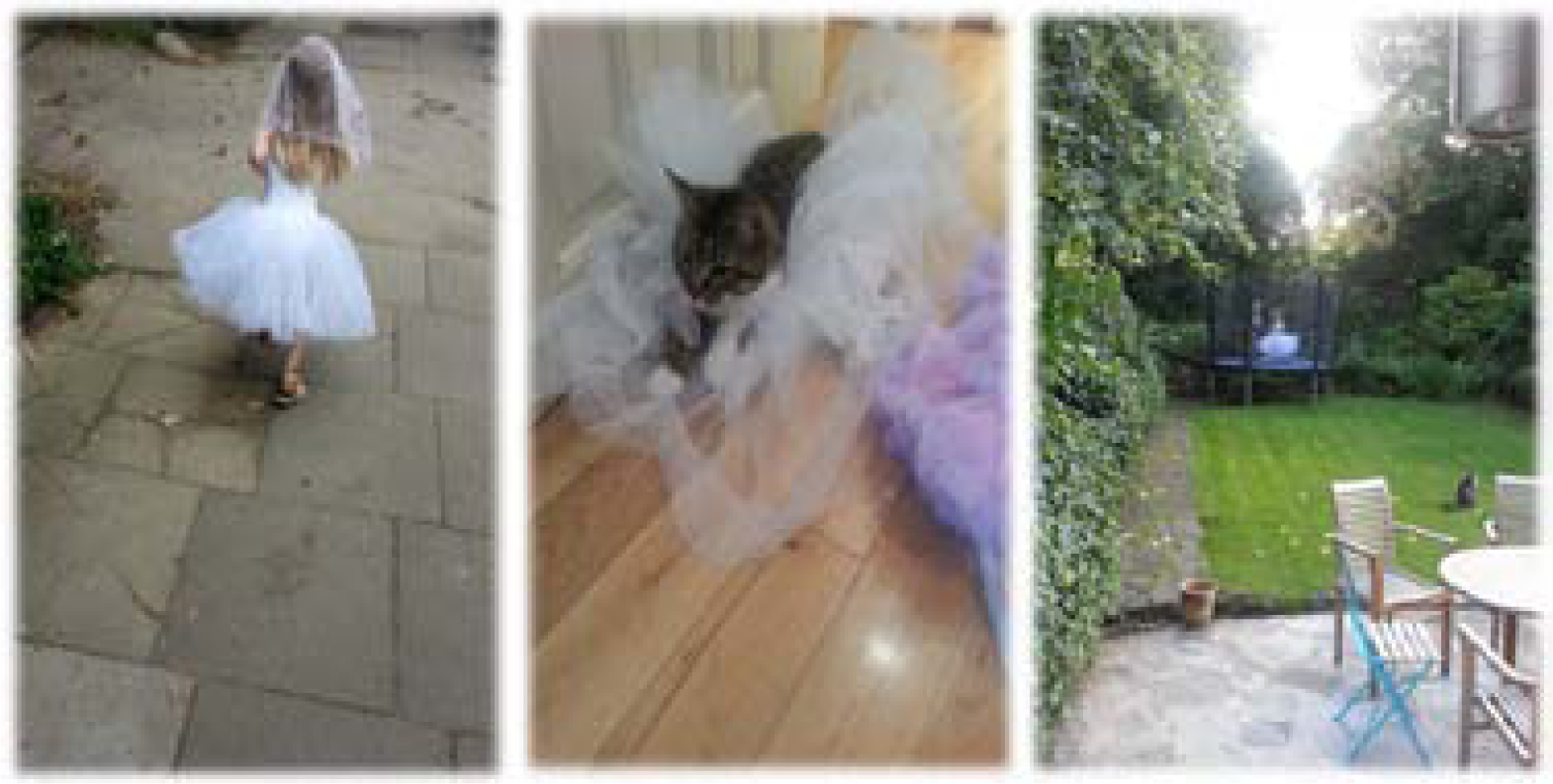
We draw attention to certain play events and offer provocative analyses to demonstrate how a posthumanist methodology can retain deeply political motivations to question gender in childhood in an expansive and playful way. By attending to several fairly routine, everyday events, focus is placed on the means by which matter; notably a swishing skirt and an oversized tutu – are ways to take up space; especially from spatially dominant boys. The heteronormative rules governing childhood determine that boys are considered good when they stand still; but the ‘goodness’ of girls goes unnoticed (Davies, 1993; Walkerdine et al., 2001) unless they are becoming-with a swishing swashbuckling dress or very large tutu. Posthumanist theorizing of the swishing skirt and the scratchy tutu can be understood as a feminine/ist reconfiguration of fabric. Following Jones (2013), a number of posthumanist inspired questions about play and gender present themselves: what does becoming swashbuckling swishing skirt make possible? What are its foundations and connections with other things? What does it transmit? What intensities does it induce, condone or negate? Ultimately: what can a swirly skirt and a too-tutu do when inhabited by a young child playing (with gender)? Here our cat’s cradle transmogrifies threads of thought into vast fabrications that enable the composers of this article to become ‘bag ladies’ as they knot together a collection of naturecultures and pastpresences.
Be(com)ing-with swishing swashbuckling skirt
What follows is video footage of a seemingly unremarkable play ‘event’ within the wider context of a boy-child’s seventh birthday party. The party was hosted at the child’s home with around a dozen children (which included his 4-year-old sister) and several parents in attendance. It is perhaps important to note that the 4-year-old girl-child and her 7-year-old brother are related to one of the authors. We recognize that certain ethical dilemmas are presented when researchers undertake research with young children (Dockett et al., 2009; Skånfors, 2009; Warming, 2011) which might be exacerbated when a child is a relative – not least anonymity. However, we argue that a posthumanist framework, and the methodologies used in processes of reconfiguring to reach diffractive understandings (in this case of gender in early childhood) addresses many of the concerns raised in research methodology and ethics literature concerned with children’s rights and agency. Like Hultman and Lenz Taguchi (2010), we argue that a de-centring of the human subject and a concern to investigate the intra-actions and relationality of all the elements of an assemblage (which we achieve via art-based methods) displace the human as in anyway more significant than the other co-constituents. The focus of our research endeavour does not take the human subject as its focus; rather, our aim is to focus on processes of multi-sensory and affective intra-action (Barad, 2007). And crucially, as we illustrate in this article, of equal concern to us is what the data does and what we do with what the data does – to enable us to think diffractively, generatively and expansively.
As Sellers (2010) deftly illustrates through her Deleuzian-framed research, children’s play is full of activity and energy, and the physical territory of a game as well as the surrounding environment (including natural resources and material artefacts) are already chaotically becoming-with, in and through a multiplicity of story lines. This extract caught on film at a birthday party captures an example of such play characterized by multi-sensory ebbs and flows of noise, movement, touch, and enduring frenetic energies. Central to the piece though is a swishing swirly party dress, which oscillates and darts between, around and through. The dress is made from layered white taffeta, adorned with stiff bows and has billowing energy; the dress is partnered with a pink foam sword, bare feet and long blond hair swishing in the breeze of sunny spring afternoon in North London.
Unlike formal early childhood education settings, the familial home environment, and specifically the context of a child’s party in which this event plays out, is governed and regulated differently. There is no curricular guidance and no specific expectations for learning to take place. Nonetheless, there are implicit regulatory regimes and practices that shape children’s parties and family celebrations (Robinson and Jones-Diaz, 2015). This video footage, captured by a parent at the party, reveals spontaneity, innovation, creativity and imagination and presents interesting questions about gender in childhood, and gendered play events that we take up through artistic creation of Ode and PhArt.
The dress–sword–(girl)child–hair–bare-feet–grassy-lawn assemblage offered in this film is open to multiple interpretations and as feminists, presents us with a sticky knot. From psycho-sociological perspectives, the girl in this film might be read as performing hyper-femininity. The events, spaces, movements, matter and objects captured can be read as highly feminized and therefore interpreted as providing the means by which gender stereotypical behaviours and heteronormativity might become reinforced (Robinson, 2012).
As Renold and Mellor (2013) remind us, dominant systems of power (class, race, gender, age and so on) are omnipresent – they are the mechanics which provide the ‘conditions of possibility’ for certain subjectivities to emerge, while others are less possible. In early childhood, these conditions are deeply embedded at the molar level of sexed subjectivities (Butler, 2005), that is, dominant ideas about what it is to be/do boy/girl; but where gender circulates in multiple ways at the molecular level; through and across bodies. A discursive analysis of this film footage, while troubling (for the apparent heteronormativity and hyper-femininity discourses circulating) does little more than reflect back what we think we already know. Like Mazzei (2014), we wanted a means to transcend the distancing of subject and object. Moving away from the identification of themes and discourses – which can only take us back to what is known already and acts to obscure differences that cannot be captured. Mazzei (2014) argues for a diffractive rather than reductive form of analysis which leads in different directions and ensures knowledge production remains active, or as Barad (2007) stresses, A diffractive methodology is a critical practice for making a difference in the world. It is a commitment to understanding which differences matter, how they matter and for whom. It is a critical practice of engagement, not a distance-learning practice of reflecting from afar. (p. 90)
By pursuing other string figures (Haraway, 1994) in our cat’s cradle, we were enabled to move beyond sedimented figurations and narrations of gender in early childhood by going beyond conventional meanings and meaning-making practices that govern representations of data. We encountered a rupture – a moment when it became possible to ask different questions of the data; to question what data is, what data does and what we might do with what the data does.
Attending to a microscopic multi-sensory examination of play through arts-based-methodologies with/in and stemming from the swishing skirt–swashbuckling princess–boy-gang–garden party assemblage reveals complexity, uncertainty, ambiguity and transgression. Posthumanist ‘methodology’ invites us to reconfigure this constellation of heterogeneous relations comprising boisterous noises; combative boys; a lush leafy green garden in an affluent pocket of London; the swishing frenetic energy of a party dress; foam/wooden/plastic weaponry; hovering adults; the just out of view but ever present companion species cat, mud on bare feet – all of which de-centre the protagonist-girl but do not discount gendered relationality. A posthumanist lens allows us to recognize and celebrate that humans are both entangled and de-centred. They are relationally constituted and transformed through shared events and material-semiotic intra-actions. This generative relational ontology is what Haraway (2008) figures as ‘becoming with’ which is captured in this quote from her earlier work: Bag lady story telling would instead proceed by pitting unexpected partners and irreducible details into a frayed, porous carrier bag. Engaging halting conversations, the encounter transmutes and reconstitutes all the partners and all the details. The stories do not have beginnings or ends; they have continuations, interruptions, and reformulations – just the kind of survivable stories we could use these days. (Haraway, 2004: 127–128)
Figuring the data as a ‘bag lady story’, we are offered the possibility to view the elements of the event (dress, grass, swords, girl-child, boy-gang, cat, mud, sunshine, hair and so on) as relationally constituted and transformed through the ebbs, flows, collisions and chaotic happenings. Much of which makes us ontologically stammer; but Haraway (2008) urges us to ‘stay with the trouble’. Such trouble might be borne of liberal-feminist fears and anxieties that the enactment and embodiment of hyper-femininity (as read from the swirly party dress, long swishing hair, pink accessories) might limit and contain gendered ways of be(com)ing. However, a posthumanist methodology urges us to call such fears into question and to reconfigure this assemblage of entangled bodies, matter and senses to reach diffractive understandings: Diffraction does not produce ‘the same’ displaced, as reflection and refraction do. Diffraction is a mapping of interference, not of replication, reflection or reproduction. A diffraction pattern does not map where differences appear, but rather maps where the effects of difference appear. (Haraway, 1992: 300)
By taking a step back to more closely observe the assemblages, and map where the effects of difference appear, it becomes possible to see the becoming child reworking and negotiating gendered becomings and transgressing what is thought knowable/doable/acceptable. It destabilizes anthropocentric gendered binaries and allows for attention to be focused upon the transgressive spaces evoked by the ‘data’. Through our arts-based methodologies, we linger among the ebbs, flows, intensities of potentially contradictory positions to work through how chaotic, messy, unsettling entanglements are both marked by and resist gendered politics. This raises important questions about what happens when gendered expectations are transcended and complicated and forces us to ask a Baradian inspired question: what do we have the response-ability to do? What is at issue is response-ability – the ability to respond. The range of possible responses that are invited, the kinds of responses that are disinvited or ruled out as fitting re-sponses, are constrained and conditioned by the questions asked, where questions are not simply innocent queries, but particular practices of engagement. So the conditions of possibility of response-ability include accountability for the specific histories or particular practices of engagement. (Barad in Kleinmann, 2012: 81)
Our experimental, arts-based enquiry is concerned with the ways in which the vitality of matter, affect, discourse, bodies (human and non-human) and place ‘intra-act’ in assemblages in ways which enable us to create opportunities to take up Baradian ‘response-ability’ of what might be questioned, shared, politicized and transformed.
Haraway (2008) urges that we ‘live responsively’ through questioning relationships and that we keep grappling with ‘sticky knots’ in uncomfortable ‘contact zones’ whence we encounter difference(s) so that we might ‘stay with the trouble’. The goal is not to reach a resolution or end point – but rather to continually grapple with that which makes us feel uncertain. The video engendered uncertainty and disquiet; an immediate interpretative reading of the video footage offered up discourses of heternormativity, hyper-femininity, and placed the female-human-child-subject centre-stage. Our sense of disquiet and unease enveloped us and signalled a precise moment to grapple – a rupture. This takes us to question: what does the data do? What does this film clip evoke in us? And what do we do with those intensities? If we resist sentimentalizing and depoliticizing children’s relations with each other, with the non-human and the more-than human, we are enabled to view childhood and children’s entanglements, enactments and embodiments of (gendered) play more generatively and expansively.
The following Ode 1 to SylviEnnocent: A Racey Spacey Tutu Pandrogynic Tail provides a powerful illustrative example of posthumanist method-theory-art in practice. Through the sounding of the Ode, the call to question relationality (between humans, cultural contexts, matter, and the more than human world, which pose endless sticky knots that morph into one another and collide in multiple contact zones) is embraced and celebrated. Echoing Haraway’s (2008) conceptualizations of queer kin and questioning relationships, the Ode is as political as it is ethical; it is hopeful while maintaining a playfulness. It offers an alternative frame through which to view childhood, children and gender – which moves us away from, and beyond romanticized and reductionist accounts of childhood that are so readily presented in public spaces through the media and educational technologies, such as curriculum frameworks, parenting manuals and so on. The Ode captures the relationally entangled, politically framed, kaleidoscopic and inconclusive culture(s) of contemporary childhood(s).
Ode to SylviEnnocent (Scarlet, 2014a).
Note: To listen to the audio clip, we recommend opening this PDF in Acrobat Reader on Windows PC or Mac.

Reconfiguring gender in early childhood through diffractive arts-based practices
The sounding of Odes and the generation of photographic artwork (PhArt) is central to our experimental arts-based methodologies to reach diffractive understandings of gender. Through our onto-epistemological endeavours, we take up Haraway’s concepts of naturecultures and pastpresences, captured here by Davies (2014): A diffractive approach opens up an onto-epistemological space of encounter where a researchers’ task is not to tell of something that exists independent of the encounter (producing the appearance of truth), but to open up an immanent subjective truth – that which becomes true, ontologically and epistemologically, in the moment of the encounter. (p. 734)
Ode and PhArt both capture and are moments of encounter and seek to achieve posthuman ambitions of seeking out interference patterns to consider the human, non-human and more than human as relationally and asymmetrically produced through processes and entanglements (Van der Tuin, 2014). Working with arts-based methodologies creates opportunities for non-linear, dialectic, expansive modes of meaning-making: crucially Ode and PhArt are in conversation and crafted in response to each other. The processes involved in the creation and composition of the Ode and PhArt are in themselves a game of cat’s cradle offering an academic-artistic inter/intra-relational engagement with ‘data’ (the video footage, family photographs, policy documents, and other routine artefacts and matterings from lives-lived).
It is not our intention to decode the Odes and PhArts presented in this article; rather, we invite the reader to engage with them as valid knowledges, generated as non-representational figurations that capture the intensities, fragments, impressions and politics of gendered childhoods as intra-actions with bodies, environments, matter constantly connecting and intra- and inter-acting diffractively (Barad, 2014). They are central to our posthumanist arts-based methodology and we believe they count. This mode of enquiry captures posthuman concerns with qualia (which we have explored elsewhere, Osgood and Scarlet, in press, 2015) and which stresses multi-sensibilities of sound, smell, taste, touch as well as inter- and intra-relationality of bodies, matter and tactile spaces.
Here, Ode is but one materialization of posthumanist logic to reconfigure and offer diffractive readings so that we might question dominant ideas about children and childhood(s) (encapsulated in curriculum frameworks, parenting manuals and developmentalism more generally) that implicitly promote ideas around normativity and biological determinism and which justify the measurement and regulation of all aspects of childhood – including gender. As Taylor et al. (2012) stress, The notion of the autonomous child perpetuated in child development theory is not only an illusion, it is also a grossly inadequate conceptual framework for responding to the challenges of growing up in an increasingly complex, mixed up, boundary blurring, heterogeneous, interdependent and ethically confronting world. (p. 81)
Braidotti (2013) stresses that sensory encounters (movement and touch) are important ways of being in the world but that they are inextricably embedded in wider social, political and economic contexts shaped by hierarchies and injustices. This takes us back to the metanarratives and conditions of possibility – however, posthumanist methodology invites a refocusing on the miniscule happenings within particular early childhood assemblages to provide the means of engaging in everyday happenings within early childhood that recognize young children as both agentic and relationally interdependent to the worlds in which they are located and the assemblages of which they form part (Giugni, 2012).
Rossholt (2012) draws attention to children’s bodies as more than simply inscribed by external, societal discourses (e.g. about how to do child, do gender and do play). Rather, children participate in the material production of themselves and others as doing bodies. It is to these bodily, material and affective practices that we have focused on through our engagement with the ‘data’ which presents the entanglements of objects, subjects and matter and offers up, in a ‘frayed porous carrier bag’, the means to engage in halting conversation where all the details are transmuted and reconstituted, with no beginning or end (Haraway, 2008). What has been made possible then is a fresh way to reconfigure gender in early childhood and to recognize its relationality – to everything.
The artistic generation of photographic artwork (PhArt, see opposite) is central to a generative and experimental approach to reach new understandings of childhood that we have sought to outline in this article. The PhArt created here captures the dialectic nature of the arts-based methodology since they were created in response to the Ode. The crafting of Odes and PhArts is integral to reconfiguring gender in early childhood and exemplifies our firm commitment to specific epistemological positions (informed by feminist, poststructuralist, posthumanist, postcolonialist theories and activisms) which we realize through our research, scholarship and indeed the artwork itself. The question at the heart of our posthumanist onto-epistemology (Barad, 2007) rests with Lather (1993) who asks: ‘What counts as valid knowledge? Who decides? Who consents? Why? and On what grounds?’ This questioning, and responses to it, accounts for shifts towards ethical geopolitical feminist engagements with everyday worldliness (Haraway, 2008). The PhArts offer an academic and artistic dialectic engagement with ‘data’ and are generated from our ‘Cat’s Cradle’ (Haraway, 1994) of scholarly, professional, personal and cyborgian virtual entanglements. The artistic creation of PhArt and Ode are, to borrow from Haraway (1994), ‘intersecting and co-constitutive threads of analysis … because each of them does indispensable work for the project of dealing with sites of transformation, heterogeneous complexity and complex objects’ (p. 63).
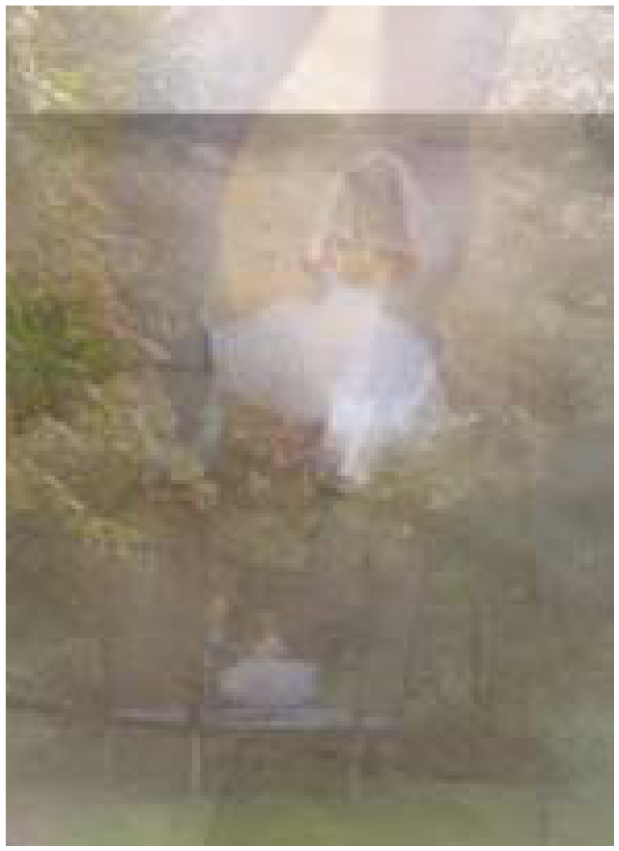
White converse SylviEnnocent (Scarlet, 2014b).
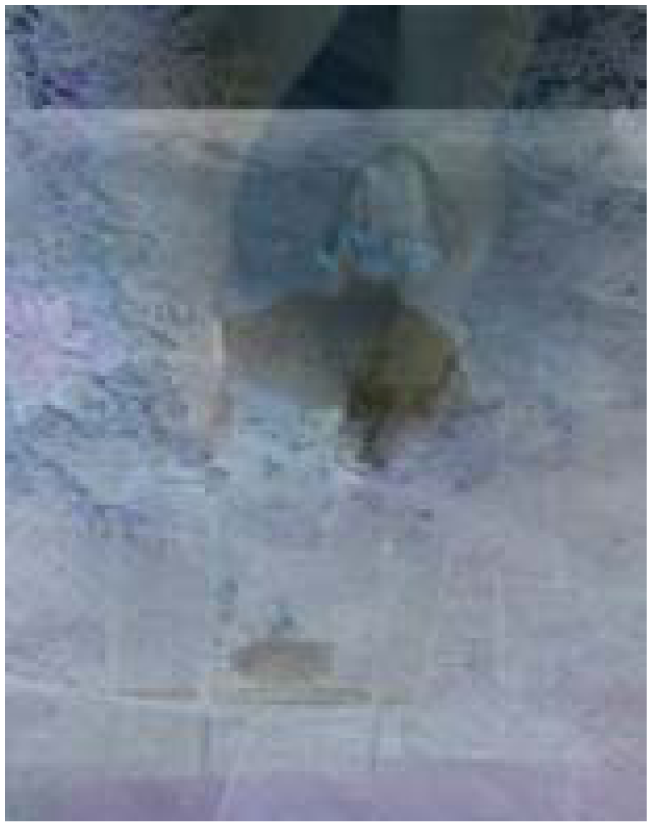
Black inverse SylviEnnocent (Scarlet, 2014c).
What did we do with what the data did?
In this article, we have mapped our generative arts-based experimentation with posthumanist logic to illustrate opportunities created to think differently about children and childhoods lived. We have reached diffractive understandings of the culture of childhood and gendered becomings with and through bodies and matter. Drawing upon the work of a range of posthumanist theorists, but most notably Haraway and Barad has provided us with the means to question, to grapple with the sticky knots, to stay with the trouble so that we can reconfigure and reach beyond narrow constructions of gender that limit and distract what children can be and do. This mode of enquiry offers the potential to engage with multiplicities, material as mattering, and to be alert to the interconnections, intra-actions and entanglements that allow us to the see the child as a series of lots of little be(com)ings that shift, slide and mutate and reconfigure through time and space.
Posthumanist theorizing offers us a means to view the world differently and to have the conceptual, political, parental and professional confidence to make-meanings of gender through the everyday events and be(com)ings of life with young children in our more-and-other-than-human world. As we have sought to illustrate within this article, posthumanist methodologies can be performed variously. We have endeavoured to go beyond paying lipservice to a fashionable academic trend by illustrating that posthumanist research is theory and method and art. Posthumanism acknowledges the entire human experience in order to be receptive to the non-human and be open to unknown possibilities. We have attempted to illustrate this inclusiveness as it is reflected in our methodological approach(es). Such methodology is not sustained by exclusive traditions of thought but instead is dynamic and shifting, engaging in pluralist epistemological accounts, not in order to get it right but to pursue less partial and therefore more expansive perspectives to radically challenge what we think we know. Our posthumanist approach to reconfiguring gender in early childhood here is ‘a game of cat’s cradle’ (Haraway, 1994) as it ‘invites and produces a sense of collective work, of one person [or thing] not being able to make all the patterns alone’.
By way of (in)-conclusion, we borrow from Hughes and Lury (2013) who ask, If we are to practice knowing in an expanded universe of becomings, if we are always in the middle – part of what we study, not above or beyond what we observe, if we are not on the way to some kind of synthesis or final conclusion, if knowledge is one practice among others, how are we to make a start or come to an end? If the concept of situatedness within ecological epistemologies is to do more than reinforce fixed locatedness, if it is also to be practised, how will knowledge that makes a difference emerge.
The aim of this article was to generate as many questions as we sought to address. The diffractive, arts-based experimental approach we have taken comes with risks – not least the question posed at the outset by Lather (1993): what counts as valid knowledge? Our approach rejects representationalism, and through Ode and PhArt, we have been afforded spaces to advance performative enactments of natureculture(sculptures) and pastpresents through generative kinds of knowledge-making practices about gender in early childhood – we were not seeking synthesis or conclusion but rather to create a space to encourage halting conversations about gender that transmute and reconstitute irreducible details along lines of continuation, interruption and reformulation.
Footnotes
Acknowledgements
We would also like to thank the two anonymous reviewers of an earlier draft of this article for their detailed engagement with our ideas and for pushing us to grapple further. We would also like to acknowledge the patience and encouragement of the editor of this Special Issue.
Funding
This research received no specific grant from any funding agency in the public, commercial or not-for-profit sectors.
Notes
Author biographies
