



Abstract
In this article, we propose to critique the way in which a hegemonic understanding of quality in early childhood settings is imposed upon practitioners, families and children through legislated quality assurance processes. The reality of neoliberalism is played out in the establishment and maintenance of the Australian early childhood quality assurance processes as they operate up to 2015, and the definition of approved qualifications for those working in early childhood. In both cases a tightly defined, top-down approach is used to assure quality. This has the effect of limiting flexibility and de-professionalising the work of early childhood professionals. It is our contention that in this neoliberal climate, early childhood practitioners have failed to construct their arguments in ways that could be better understood by outsiders to the profession; instead they are focusing on how best to be compliant. Challenging these hegemonic positions may even be perceived as being ‘anti-quality’ and not in the best interests of the early childhood sector. We analyse the current context in Australia (which reflects international trends) and explore possible strategies to re-empower the early childhood profession.
Introduction
The National Quality Agenda (Council of Australian Governments, 2009) for the early childhood system in Australia was established under the previous Labour government and continues to evolve in a neoliberal political context directing current policy reformulations. This political context offers a particular way of thinking about the world that shapes what are perceived to be:
The desired outcomes of a good quality early childhood service;
The underlying causes of extant problems in early childhood service delivery;
How best to create a system to deliver quality early childhood services.
So strong is neoliberal thinking around the world that many of the answers to these issues are considered ‘objective, natural and technocratic truisms’ (McCarthy and Prudham, 2004: 276). Neoliberalism has become something ‘widely taken up as natural and inevitable … still accepted as the only possible economic and social order available to us’ (Davies and Bansel, 2007: 258, 253). In this article, we aim to discuss the way the neoliberal position influences early childhood policy and service development in Australia and, using this critique, explore how this has resulted in top-down governance and control. We argue the end result of this is the creation of a compliant citizenry:
Compliant early childhood educators who focus on how to meet quality accreditation requirements (and not critique the standards they are required to address);
Compliant children who receive learning experiences proscribed by the official definitions and understandings of quality: students who ‘learn what will be on the test rather than seeking answers to questions that cry out for answers’ (Hursh and Henderson, 2011: 182).
Neoliberalism
The first step in our exploration needs to review neoliberalism itself, and what we know of its impact on the education system which we can then, (in Step 2), extrapolate to early childhood. Neoliberalism as defined by Giroux (2015) … casts all dimensions of life in terms of market rationality, constructs profit-making as the arbiter and essence of democracy, consuming as the only operable form of citizenship, and upholds the irrational belief that the market can both solve all problems and serve as a model for structuring all social relations. (p. 170)
Neoliberalism has become the dominant political discourse in countries such as Australia and New Zealand, generally in the northern hemisphere (Davies and Bansel, 2007) and across all western nation states (Olssen and Peters, 2005). Neoliberal thinking focuses on corporatisation, privatisation, quality assurance, efficiency, accountability and globalisation (Baltodana, 2012; Waugh, 2014) and privileges marketisation over citizenship and human rights.
Neoliberalism and education
The neoliberal focus on the primacy of the market creates a bridge between education and the employment market (industry, business, corporations) which results in the increased presence of for-profit entities in education (as demonstrated by Sloan, 2008 in the United States), more involvement of corporate executives in school and university boards and greater industry involvement in curriculum development (in order to create the employable citizens they need in their workplaces; Baltodana, 2012). Giroux (2015) argues that schools are no longer about education but rather about training as preparation for employment; education has become an ‘adjunct of corporate control’ (p. 123). For example, in the United States, Bill Gates of Microsoft fame promotes the development of private charter schools where ‘administrators can impose on teachers educational approaches emphasising standards and high-stakes standardised tests’ (Hursh and Henderson, 2011: 180). In these schools, lead teachers are excluded from the Gates-funded board, ensuring that the driving force shaping education in the schools is that of Gates and the corporate body. This take-over of education by industry results in the curriculum becoming ‘increasingly vocationalised, and is now viewed in terms of human capital formations, rather than as a way of developing an informed national citizenry’ (Rizvi and Lingard, 2011: 12).
Under neoliberal hegemony, the key aim of education is to produce improvements in students’ test scores (at universities this translates into performance criteria for research and teaching) in a manner that is most cost efficient. Education has become a place where ‘an audit culture triumphs over critical thinking …’ (Giroux, 2015: 123). The key concern has become a focus on measurable outputs which has led to the development of national measures of student performance (in Australia, for example, National Assessment Programme – Literacy and Numeracy (NAPLAN), and in early childhood, the Australian Early Development Index (AEDI)). In the United States, there are attempts to link the pay of teachers to their students’ scores on standardised tests, so that the focus of teaching and learning becomes one of preparing for these standardised tests (Hursh and Henderson, 2011). This focus on measureable outcomes identified through standardised tests will, Giroux (2015) argues, ‘… homogenize all knowledge and meaning’ resulting in a form of ‘civic and social death’ (p. 43) through ‘… reproducing the culture of ignorance and instrumental rationality …’ (p. 44) which runs the risk of increasing the rate of ‘transition into authoritarianism’ (p. 47), allowing ‘tyranny to take root, and history to repeat itself again and again’ (p. 46).
De-professionalisation and accountability
As identified by Ball and Olmedo (2013) what matters is what works, and teachers/academics are valued for what they produce. Along with this focus on productivity, is a ‘routine of constant reporting and recording of our practice’ (Ball and Olmedo, 2013: 90), which is aimed to measure output along with compliance to ‘both externally imposed levers, and internally reinforced targets’ (Olssen and Peters, 2005: 319–320). This increased accountability is demonstrated in the following:
Hierarchical management structures aimed to ensure every employee is accountable via specified outputs, to someone else higher in the chain;
Increased specificity of workloads to make accountability easier. Teachers/academics are no longer trusted to work autonomously: this is a commodification of teaching and research (Olssen and Peters, 2005);
Increased outside imposition of curriculum against which performance (student outcomes) can be measured. Teachers/academics are no longer trusted to use their professional expertise to determine what (and how) they teach;
Standardisation ‘in the name of accountability’ (Baltodana, 2012: 495).
Such a culture of accountability results in a lack of autonomy for teachers/academics that has been identified as de-professionalisation (Sims et al., 2014). This growing distrust of professionalism (Olssen and Peters, 2005) has undermined teacher/academic authority, ‘… shifting authority away from both students and teachers to state curriculum and surveillance authorities’ (Davies and Bansel, 2007: 256) and imposed accountability regimes (specifying through national curricula what can be taught and how, along with specified performance measures to enforce compliance). In this discourse, a successful professional is one who meets performance targets: for example, Gates argues that ‘we can clearly identify good teachers by their students’ high test scores’ (Hursh and Henderson, 2011: 180). Using this lens, good teachers will strive to meet imposed performance criteria: wanting for themselves what is wanted from them by the state (Ball and Olmedo, 2013: 89). Davies and Bansel (2007: 249) see this as rather like a sleight of hand: neoliberal ideology produces ‘… docile subjects who are tightly governed, and who, at the same time define themselves as free’ and who ‘find it difficult to imagine those choices as being shaped by anything other than his/her own naturalised desire or his/her own rational calculations’ (p. 251). This is a position Foucault defines as governmentality (Foucault, 1980). By this he means ‘the process by which governments work to produce citizens who help them enact their policies’ (Blum and Ullman, 2012: 370). This results in professionals who construct new identities that align more closely with managerialism (Olssen and Peters, 2005), immersed in targets, performance criteria and the way in which they are required to report against these. Through this self-policing they become neoliberal subjects (Blum and Ullman, 2012).
Neoliberal subjects
At one time, public education was conceived as responsible for developing a citizenry who had the necessary skills to operate in a democracy. Under neoliberalism, the function of education has shifted to aim to create a citizenry who have the necessary skills to be economically productive (Baltodana, 2012); neoliberal subjects are an economic commodity (Waugh, 2014). Economically productive citizens need not be articulate nor be capable of critical thinking (Baltodana, 2012). Instead, they have internalised ‘social norms’ (Blum and Ullman, 2012: 370) that shape their behaviour along lines congruent with the neoliberal state. Baltodana (2012: 490) calls on Freire’s (1973) work to call this the ‘banking concept of education’ which aims to train ‘students to become docile citizens’ resulting in ‘the lack of an articulate public and the reduction of public spheres to contest the dominant neoliberal vision of society’ (p. 489). In this context, the creation of Homo oeconomicus is the ultimate output; a citizen who is more governable, unquestionably accepting the productivity imposed on him/her as both necessary for self-fulfilment and for the well-being of the state. Giroux (2015) takes this idea further, claiming that ‘religious and ideological fundamentalism are at the root of a right-wing political movement to miseducate young people, keep the American public ignorant’ (p. 18) resulting an American public and political life characterised by ‘Ignorance, stupidity, thoughtlessness, and anti-intellectualism … and the emergence of a culture of conformity that have become the DNA of American politics and society’ (p. 19). Similar arguments can be made in other western nations where neoliberalism is the hegemonic ideology. Homo oeconomicus then, as the creation of neoliberalism, is compliant, unquestioning and complicit in his or her oppression. In the following section, we will analyse how this is played out in early childhood in Australia.
Neoliberalism and early childhood
The neoliberal positioning of the aim of education as the creation of Homo oeconomicus means that the key driver in the development of early childhood is a human capital discourse. The justification for developing early childhood services, their rationale for existence and the reason governments are interested in funding them is based around the notion of children as an investment for the future. Young children are not valued for who they are now, but rather for who they will become; the aim is to create compliant, productive, employable citizens. The rhetoric focuses around an investment framework in which the work of economists such as James Heckman (1998, 2006, 2008, 2011, 2014), Heckman and Lochner (2000), Heckman and Masterov (2007) is reified. This work is taken up by international bodies such as the United Nations (UN) and the Organisation for Economic Co-operation and Development (OECD). In their latest Human Development report, the UN (2014), for example, places a strong focus on investing in early childhood as the best guarantee for longer term returns to society. Likewise, the Economist Intelligence Unit (2012) from the United Kingdom declares, As countries transition towards knowledge-based economies, policymakers need to consider what all can be done to develop their stock of human capital … Those countries that do this best will position themselves well for success in the decades ahead. Put another way, as countries increasingly compete on the basis of their talent and human capital, they need to invest in all their people as early in life as possible. (p. 31)
In Australia, we see this in an early report of the Productivity Commission (2006) which placed early childhood, education, skills and workforce development policies together in a human capital frame aimed at increasing national productivity. In the final report, the Productivity Commission (2014: 203) refers to the link between children’s academic achievement and the nation’s gross domestic product (GDP). As a consequence of this human capital focus, early childhood curriculum places emphasis on the skills and attributes children will need to learn to become neoliberal subjects.
We see this exemplified in continuing calls for improvements in numeracy and literacy skills. These skills are perceived as fundamentally important for employment (Shomos, 2010) and failure of early childhood services to explicitly address these core academic skills is seen as a weakness. In New Zealand, for example, McLachlan and colleagues (McLachlan and Arrow, 2011; McLachlan et al., 2012) criticise the internationally respected early childhood curriculum, Te Whāriki as not providing adequate guidance to teachers in literacy and numeracy. They hold Te Whāriki responsible for poor outcomes in these areas by New Zealand children. In Australia, there is also an increasing emphasis on these academic skills in early childhood. The focus of the national Professional Standards for Teaching includes the development of students’ literacy and numeracy skills: ‘Through their teaching practice, teachers develop students’ literacy and numeracy within their subject areas’ (NSW Institute of Teachers, 2014: 5). Early childhood teachers in NSW are expected to be accredited under these standards (http://www.nswteachers.nsw.edu.au/current-teachers/accreditation-of-all-teachers/accrediting-early-childhood-teachers/). If this policy is confirmed, early childhood professionals will need to demonstrate how all that they do with young children supports the development of literacy and numeracy. The Early Years Learning Framework in Australia may have begun with a different aim: ‘We anticipate that the Framework may also invigorate discussion and debate about alternative visions and courses of action, and offer ways of exploring spaces between the possible and not (yet) possible’ (Sumsion and Grieshaber, 2012: 241). However, that aim has been high-jacked by the pervasive neoliberal agenda as acknowledged by the developers: Nevertheless, there is a marked shift from the progressive tone of much of the initial Discussion Paper, which acknowledges children ‘as active members of society’ (Excerpt 1), to the investment in human capital focus of the Fact Sheet with its concern for ‘providing the most stimulus for brain development’ (Excerpt 8), which positions children above all as learners. The shift could suggest capitulation to negative response from News Corporation and from some members of the public, and a retreat to the politically palatable side of an acutely felt dividing line. (Sumsion and Grieshaber, 2012: 239)
As identified above, in a neoliberal context, failure to create the perfect Homo oeconomicus is identified as a failure of teachers (and parents, but given the state has not yet chosen to regulate parenting, the focus continues to remain on teachers). Bill Gates demonstrates this clearly through his work in education whereby he argues ‘we can identify good teachers by their students’ high test scores’ (Hursh and Henderson, 2011: 180) and that the best way to develop good teachers is for them to be ‘controlled rather than consulted’ (p. 180).
Application to Australia
In a neoliberal context, control occurs through regulation and the National Reform Agenda in Australia (Productivity Commission, 2006) clearly positioned regulation as one of the key elements needing reform (along with competition and human capital development). Regulation ‘facilitates many everyday transactions and can help deliver economic, social and environmental outcomes that may not have been achieved with the normal workings of markets’ (p. 133). In early childhood in Australia the National Quality Framework was introduced via a discussion paper released in 2008 which aimed to deliver against the human capital outcomes identified as part of the National Reform Agenda (Productivity Agenda Working Group Early Childhood Development Subgroup, 2008). This subsequently evolved into a range of reforms that included a new national framework (curriculum) the Early Years Learning Framework (Department of Education Employment and Workplace Relations, 2009), the National Law and Regulations and the National Quality Standard (Australian Children’s Education and Care Quality Authority (ACECQA), 2011). In 2015, this suite of national reforms were expanded to include the application of the Australian Professional Standards for Teachers (NSW Institute of Teachers, 2014) to early childhood teachers in the State of New South Wales (NSW), the largest state (http://www.nswteachers.nsw.edu.au/current-teachers/accreditation-of-all-teachers/accrediting-early-childhood-teachers/).
These documents reflect the neoliberal ideal: a tightly defined, top-down approach used to assure quality. This has the effect of limiting flexibility and re-professionalising (Oberhuemer, 2005; Williamson and Morgan, 2009) the work of early childhood professionals. It is our contention that, in this climate (shaped by political, public and media discourse), early childhood practitioners are losing the ability to engage in professional debate and are instead focusing on how to best be compliant. Such a position is reflected in our recent work with early childhood leaders (Sims et al., 2014). Participants in this research were focused more on learning HOW to implement the new frameworks rather than reflecting on their own localised, contextualised understandings of quality service provision.
Regulation and control in early childhood: The neoliberal requirements
This response to quality control and regulation is not limited to Australia: research in the United Kingdom also identifies a similar pattern of behaviour by early childhood practitioners. Both Oberhuemer (2005) and Williamson and Morgan (2009) use the term re-professionalisation to reflect the imposition of a way of working onto teachers whose professional judgement is thus called into question as deficient. Teachers cannot be trusted to deliver a quality service; therefore, they need to have a system imposed upon them to control what they do and how they do it.
The impacts of this increasing regulation and control are being felt around the neoliberal world. In the United Kingdom, there are concerns that compliance requires early childhood workers to modify their practice: ‘when childminders engage in performative professionalism, it is proposed, they gain recognition as bona fide members of the children’s workforce, but their work is changed in ways which make it less meaningful for them’ (O’Connell, 2011: 782). Likewise, Taggart (2011) and Sims (2014) argue this is because the ethic of care is excluded from the professional discourse. In New Zealand, Stover (2013) wrote: ‘What happens to children’s free play when learning outcomes are required? What happens when safety is fore-grounded over exploration? When does accountability become surveillance? When does visualising children as an investment opportunity make children “too precious”?’ (p. 4). Participants in her research identify feeling a sense of loss arising from what they see as the unintended consequences of their lifetime of advocacy for improvements in early childhood. Stover quotes Marie Bell, a highly respected early childhood leader in the 1970s and 1980s in New Zealand who said, I just don’t think you can tread with heavy boots on early childhood. And you can call it what you damn well like, but a lot of what they’re doing now is just that. It’s not respecting the importance of that time. It’s imposing adult values on what is so precious. (p. 7)
Along with controls on teachers working with young children have come controls on academics working in teacher education and the content they are required to teach to their students, the next generation of teachers. In Australia, the Australian Children’s Education and Care Quality Authority specify what is to be included in courses preparing early childhood teachers to work with young children before these courses can be accredited (see http://acecqa.gov.au/educators-and-providers1/qualifications). Content in courses is identified and policed. Specifying course content, and tighter accreditation controls on teacher education courses are intended to improve the quality of teachers (Bretherton, 2010; Gibbons and Farquhar, 2014). Along with this has come the development of courses in ‘educational leadership to train school administrators, with the ultimate goal of improving academic achievement as measured by test scores’ (Baltodana, 2012: 500). We believe we are not the only academics who feel concerned that we are increasingly educating students (even at higher degree levels) to accept the official discourse and to operate within that discourse, rather than questioning and contributing to the evolution of new ways of seeing and behaving in the world (a theme we explore later in this article). Here, we are not arguing that new necessarily means better, but we do believe that a stronger focus on social justice needs to inform our thinking and our practice and that such a focus is incompatible with neoliberalism (Baltodana, 2012; Berrey, 2014; Giroux, 2015; Springer, 2010).
Does neoliberalism result in high-quality early childhood services?
Has all this regulation and control resulted in improved quality of service delivery to young children and their families and better outcomes? The Australian Children’s Education and Care Quality Authority reports on the numbers of services across Australia that have been accredited (see ACECQA, 2014, for example), but this is a measure of the number of services that have demonstrated compliance to the standards. There is yet little evidence to indicate children’s outcomes have improved because of this compliance. The Australian Research Alliance for Children and Youth publish an annual report card, reporting against indicators of children’s well-being (loved and safe, material basics, healthy, learning and participating). The most recent report (Australian Research Alliance for Children and Youth, 2013) still places Australia in the bottom third of OECD countries for measures of participation of 3- to 5-year-olds in education, and reading and science performance in Year 4 of formal schooling. In 2009, the Australian government collected information on 97.5% of all children beginning school (AEDI) and again in 2012 (Australian Government, 2013; Centre for Community Child Health and Telethon Institute for Child Health Research, 2009). Changes in children’s outcomes over time are illustrated in Table 1:
Changes in outcomes for Australian children as measured by the AEDI (Australian Government, 2013; Centre for Community Child Health and Telethon Institute for Child Health Research, 2009).
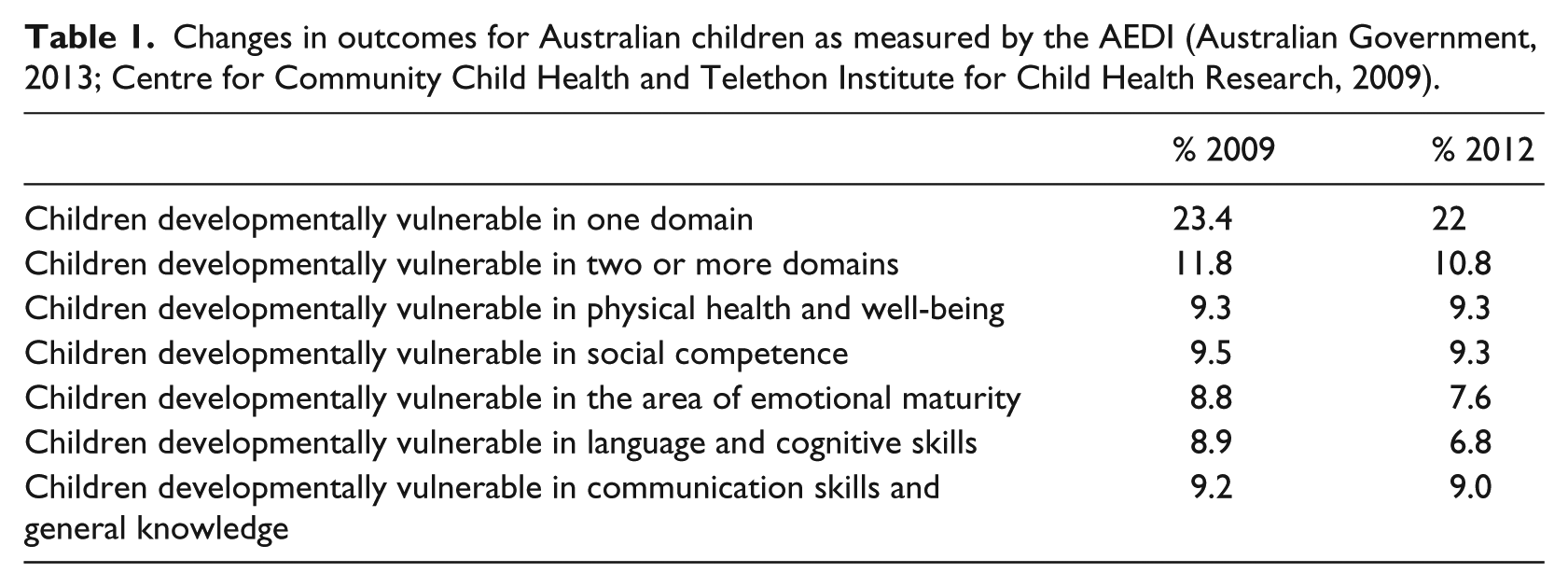
The biggest change in outcomes is in children’s cognitive and language skills suggesting that the required focus on employability skills (and the creation of Homo oeconomicus) is having an impact. However, this impact is limited and the lack of change in other areas is of considerable concern given what is understood about the significant impact all-round health and emotional/social well-being has on long-term outcomes (Boyle et al., 2007; Carneiro et al., 2010; Coley et al., 2013; Feldman and Steptoe, 2004; Li et al., 2008), assuming of course that these measurable outcomes are what one desires to produce in our children.
Challenges to neoliberalism
Policy changes are always associated with unintended consequences. 1 As this plays out in early childhood (and in other areas of education), the increasing focus on governance, quality and accountability has, and continues to, result in the development of an increasingly compliant citizenry: those who are ‘productive, rather than critical employees’ (Hursh and Henderson, 2011: 181). The disjunction between early childhood and neoliberal ideals is so great that Davies and Bansel (2007) see ‘the latest iteration of neoliberal discourse as a travesty of their early childhood ideals’ (p. 257).
‘The time for widespread resistance and radical democratic change has never been so urgent’ (Giroux, 2015: 32). However, challenging the hegemony of neoliberalism is difficult; for example, an international group of experts at the World Social Forum at the beginning of the 21st century failed to agree on an alternative (Harris, 2003). While one approach to social change is that of revolution (Draper and Marx, 1978), Barnett (2005) warns that we need to be careful to guard against a ‘romanticised picture of rebellion, contestation, or protest against domination’ (p. 11). Resistance to neoliberalism around the world is extensive (Harris, 2003) and can be evolutionary rather than revolutionary. Springer (2010) argues that coping and surviving under a neoliberal regime is in itself a form of resistance: … is it actually necessary for individuals to consciously know that they are resisting neoliberalism? Can resistance on some level not occur in spite of not ‘knowing the enemy’, or at least through knowing an antagonist only via its material outcomes (i.e. poverty, inequality and violence), rather than being fully aware of its ideological assumptions? (p. 482)
Can we resist neoliberalism without having a clear idea of an alternative? And how do we develop alternative positions? We argue engaging in critical dialogue is an important first step in both identifying the impact of neoliberalism and debating alternatives. Critical dialogue in education can result in the organisation of ‘grassroots movement comprised of teachers, students, community activists, union leaders, and faculty at colleges of education and liberal arts who are concerned with the demise of education as a public good’ (Baltodana, 2012: 502). Engaging in critical dialogue is something familiar to most educators who use reflection to critique their own practice and/or participatory action research strategies to evaluate their work and we encourage educators to debate the issues raised in this article, along with their own experiences of the impact of neoliberalism on their practice.
A second part of this process requires a rethinking of teacher professional identity (Baltodana, 2012). Is a high-quality teacher one who scores well on the pre-set professional standards for teachers or are there other ways of determining ‘high quality’ when applying to a teacher that perhaps align with democratic teaching and learning processes and strategies to address social justice? Equity, inclusivity and justice are silences neoliberalists see no necessity to address. Is it even possible to define one way of being a high quality teacher or does an excellent teacher look different in different contexts? Again we encourage educators to engage in critical reflection and debate on these issues. Can we identify alternatives that reflect the diversity of the contemporary workforce before being boxed into an unpalatable position where we will again have to work on resisting change instead of leading reform?
In Latin America, a range of what Harris (2003) calls ‘extralegal activities’ (such as occupation of public buildings, acts of sabotage, crime, land seizures and occupations and guerrilla warfare) are often used to resist neoliberalism. Such acts of resistance are often positioned as negative because of their illegal nature. Other acts of resistance may include following the letter of the regulations but not the intent. These acts might skirt the boundaries between legality and illegality although aiming to stay on the side of legality. One might see the actions of educators working for the corporate chain ABC Early Learning in this light in relation to the report by Rush and Downey (2006) of numerous behaviours which challenged the ‘rules’. These behaviours included moving toys and staff into a centre immediately prior to an accreditation visit, and exclusion of children whose needs required adjustments to a standardised daily programme. In such cases, resistance does not benefit children and families though it does benefit the corporation.
We believe in other acts of resistance that are not harmful and are preferably beneficial to children and families, perhaps because early childhood educators are at heart ‘nice ladies’ (Stonehouse, 1989). Reflecting the work of scholars such as Duignan (2012) who perceive educational leadership as a moral commitment, we suggest a more acceptable form of resistance could involve committing to a different philosophy of early childhood in a way that does not challenge the imposed standards, but instead positions them in a different light. In other words, an alternative early childhood philosophy enables educators to deliver what they believe as quality service but in a manner that interprets the ‘rules’ of the hegemonic system in a slightly different way. We argue that the growing commitment we see from our own experiences in Australia to alternative early childhood ideologies signals a level of quiet resistance. Steiner education, for example, may have points of departure from the Early Years Learning Framework but Australian Steiner educators actively seek to find ways to blend the two different approaches to early childhood education in a manner that still honours the precepts of Steiner (Horne-Kennedy, 2014). The large following of Reggio approaches in Australia is also, we argue, a sign of resistance to the hegemonic neoliberal discourse as is the recent commitment of early childhood educators to the Magda Gerber’s RIE approach for working with infants (http://www.rie.org/educaring/ries-basic-principles/). Following alternative approaches enables early childhood professionals to morally commit to their work but to do so in a manner that is slightly different from the orthodoxy. Tesar (2014) sees this as disturbing the balance of power; given that conformity pressures others to also conform, nonconformity can be seen as providing space for others to reflect on nonconformity. This nonconformity provides information and experiences that feed into professional reflection and critical debate and it is important that these are shared widely to disturb the balance of power of compliance-oriented early childhood professionals.
Another approach suggested by White (2014) is that of carnavalesque: an approach early childhood professionals could use ‘to reclaim a means of speaking back to officialdom through the employment of underground humour’ (p. 4). Carnavalesque operates in the peer underground which for early childhood professionals may mean the social media, and the discussions over morning and afternoon tea with colleagues at work and at professional development workshops. Perhaps networking with others, sharing black humour about concerns and the realities of daily life as early childhood educators and through laughing at oneself there are opportunities to create ‘a boiling cauldron of potential creativity that may either scald or nourish, but it will certainly never congeal’ (Barsky, 1998: 106).
Conclusion
So back to the questions that began this article: how children are regulated to become normalised as compliant schoolchildren, and how early childhood care and education may be governed and controlled by the State. We have argued that neoliberalism aims to create regulated, normalised citizens and this process operates on children, those who teach them and those who teach the teachers. Education is about creating Homo oeconomicus through the imposition of rules, regulations and procedures for accountability. Creative thinking and critique are discouraged. There is even a sense that criticism of the quality agenda in early childhood is traitorous: that early childhood has fought so long to be valued that criticising the mechanisms through which professionalism is painfully being born is analogous to performing an abortion without anaesthetic. It means we must comply, we must accept a neoliberal identity (both personal and professional) and we must ‘come to want for ourselves what is wanted from us’ (Ball and Olmedo, 2013: 89). If this leaves us demoralised, depressed, frustrated and stressed (Ball and Olmedo, 2013), that is our problem; we are still expected to meet our performance targets and failure to do so diminishes our worth as professionals. ‘We are in danger of becoming transparent but empty, unrecognisable to ourselves’ (Ball and Olmedo, 2013: 91).
Our resistance begins with our ability to rethink what education is all about and our role as educators. The Reverend Martin Luther King (1963) once declared ‘I have a dream’ and changed the world. We also have a dream, a vision for the future of the early childhood profession: that as early childhood practitioners we will be expected, and supported, to ensure that children are free to learn, develop and grow to reach their potential, whatever that might be, and that our education system becomes a vehicle to ensure the development of a socially just society. We commit ourselves willingly to create this path together with others, to travel, to strive and work towards realising this vision. We believe that the first step in this path involves asking questions and prompting debate. We hope that this article serves that end.
Footnotes
Funding
This research received no specific grant from any funding agency in the public, commercial or not-for-profit sectors.