



Abstract
This qualitative study explores five children’s perspectives of their experiences in both a university laboratory school and in their current public school setting. The perceptions of the children, aged between 4 and 6, provide innovative and significant information on how early childhood education is being realised in Ontario, Canada, as the government’s full-day kindergarten curriculum is being fully implemented across the province. Children express their thoughts and opinions on their learning through semi-structured conversations and child-produced drawings. Employing the ‘new’ sociology of childhood, critical pedagogy and a child rights–based perspective as theoretical frameworks, an overarching theme of power and hierarchy is established throughout the children’s descriptions of their experiences in their current public elementary school setting. More specifically, this central theme of power and hierarchy, and how it is realised in classroom environments in order to regulate and control children, is explored through the children’s descriptions of space, pedagogical practice, rules, and their decision-making and influence on curriculum.
Keywords
Introduction
When planning services and implementing policy for a specific adult population, such as support or health services, the particular group in question is generally consulted regarding how such services might best work for them, and in fact, failure to do so would likely produce questions of legitimacy and worth (Catt and Murphy, 2003). This, however, is not typically the practice when planning services for children, at least in Canada, and more specifically in Ontario where when planning and implementing pedagogical practice, the perceptions of children are often unheard. Adults, drawing from adult experiences and perspectives, often decide what is considered ‘best’ for children. Literature acknowledges the perspectives of children vary from those of adults, and adults often have a narrow comprehension of children’s perceptions and experiences (Dockett and Perry, 2005b). It is problematic that educational practices and policies are often implemented without considering the views of those they aim to serve. The purpose of this research study is to explore a small group of children’s perspectives of their experiences in a university laboratory school and compare these with their experiences in a public elementary school setting. This research study not only provides innovative and significant information on how early childhood education is being realised in Ontario, as the government’s full-day kindergarten curriculum is being fully implemented across the province, but it also explores children’s marginalisation in an adult-dominated society.
Theoretical frameworks
The ‘new’ sociology of childhood underpins all stages of this research. This framework seeks to establish children as active participants in their lives, in the lives of others and in the world around them (Matthews, 2007; Mayall, 2002; Prout and James, 1997). Within this framework, children are recognised as having agency. Humans not only construct their knowledge through social interaction but also through human action that involves agency. Kincheloe (2011) states, the ‘vision of a desirable politics of childhood helps children articulate their own agendas and construct their own cultural experiences and facilitates their understanding of the complex dynamics that shape their relationships and interactions with adults and the adult world’ (p. 39). By listening to children and valuing the ways in which they perceive the world around them, this study aims to move past objectifying children in research, to acknowledging them as competent experts in their own ideas and experiences.
A child rights–based perspective, drawing from the United Nations Convention on the Rights of the Child (United Nations, 1989), also underpins this study. The Convention on the Rights of the Child (CRC) recognises children as citizens who have distinct human rights, and who should be respected as active members in their communities. Articles 12 and 13 of the CRC explicitly state children have the right to be consulted on matters affecting them. These Articles further maintain children have a right not only to voice their opinions but for these views to be given due weight and be heard, as Noyes (2005) indicates, ‘voices are nothing without hearers’ (p. 536).
As this research study explores children’s perceptions of their experiences within the institution of school, critical theory also serves as a theoretical framework. Critical theory strives to ‘probe beneath the surface’ of systemic practices which perpetuate ‘observable phenomena’, thereby helping individuals to understand them (Sears and Cairns, 2010: 48). Critical theory challenges the status quo and how it perpetuates inequality by moving away from examining and focusing on the individual, to investigating the larger system in which the individual is a part (Schneider, 2004).
Children’s everyday lives are experienced through social encounters, not only with their peers but also with adults ‘who control institutions that justify and support the type of dependency that children experience’ (Matthews, 2007: 327). Developed from critical theory, critical pedagogy can be employed to challenge familiar everyday values and practices, within school systems by exploring the relationship between power and knowledge, and by recognising that knowledge is socially constructed and is deeply influenced by power structures (Barakett and Cleghorn, 2008). Critical pedagogy questions the way in which knowledge is constructed and challenges educational settings where the teacher owns, controls and transfers knowledge to children (Burke, 2005).
Methodology
Within this qualitative research study, I seek to address the questions of ‘What are children’s perceptions about their past experiences in a university laboratory school and about their experiences in their current learning environment?’
Participants
In Ontario, kindergarten refers to a 2-year programme comprising junior and senior kindergarten. This allows for the participants of the study to experience kindergarten programmes in two different educational environments. The study’s sample includes five children who transitioned from a university laboratory school kindergarten programme to a public school setting within the last 8–10 months. The participants had completed the previous school year at the same university laboratory school; however, they are currently enrolled at different public schools. Three of the five children in the study are currently enrolled in Ontario’s full-day kindergarten programme. One child is in a half-day kindergarten programme at a school, which will transition into the full-day programme in 3 months. One child is enrolled in Grade 1. The children range in age from 4 years and 11 months and 6 years and 9 months. In order to help ensure the confidentiality of the children in this research project, throughout the discussion of findings all names have been replaced by pseudonyms.
Location
The data collection took place in the children’s homes. The choice to speak with children in their homes and not at their school was a purposeful one. Mayall (2008) acknowledges that methodologically the home and the school both present different challenges to the data collection process. Although the school space is a familiar space to children, it is a space that is controlled by adults and one in which children are positioned as dependent on adults (Matthews, 2007; Punch, 2002). Children are conditioned to behave a certain way in a school environment, and this setting may promote the idea of right or wrong answers. Burke (2005) maintains, in a school setting, children may respond in a format in which they believe is expected of them in that setting. Thus, it was purposeful not to collect data in a school setting, as I did not want the power imbalance present in these settings to influence the children’s discussions.
Conversations
Semi-structured conversations were employed to collect the data for this research project. A semi-structured conversation guide was used in this study, which provided the children with broad areas of discussion. From these open-ended questions, the children guided the conversations by discussing points that were of interest to them. A semi-structured format allows for the child to speak freely and guide the direction of the conversation and provides opportunity for the children to nominate areas of discussion that are of importance to them (Spratling et al., 2012).
Drawings
During the conversations, the children were asked to draw a map of their current classrooms as well as to draw a picture of what they remembered from their past classroom. The drawings not only aided in visualising the children’s learning environments but also served to highlight areas of the classrooms that the children thought to be important and which they wished to discuss. By asking the children to draw pictures of both of their classrooms, information was generated not only on each setting but also on how they compared the two learning environments.
Punch (2002) explores the question of whether research methods with children should be different from research methods with adults. Drawing from the ‘new’ sociology of childhood, Punch acknowledges children are marginalised in an adult-dominated world, and often children are so acclimatised to this power imbalance that they are accustomed to adults not regarding them as equals. When conducting research with children, it is imperative that researchers are cognisant of children’s marginalised position in society and establish research methods that aim to diminish, or at least recognise, the power imbalance between child participant and adult researcher. Einarsdottir, Dockett and Perry (2009) maintain that through the use of drawing, children may feel more comfortable as they do not need to maintain eye contact with the researcher, and they are engaged in an activity that is familiar to them. Furthermore, Punch (2002) notes that drawings, which are fluid and can be altered and added to, allow children the time and control to form what they wish to convey.
Findings/discussion
Through a thematic network analysis of the data generated from the conversations with the children, and from their drawings, an overarching theme of power and hierarchy is prominent throughout the children’s descriptions of their experiences. More specifically, the theme of power and hierarchical structures is located in the children’s discussions and descriptions of space, pedagogical practice, rules, and decision-making and influence on curriculum. Through the children’s explicit and implicit comparisons, there is a notable difference in the children’s discussions of their experiences in the kindergarten programme at the university laboratory school and of their experiences in a public school setting. Issues of power imbalance and hierarchical structures distinctly dominated less of the children’s accounts of their experiences within the laboratory school setting. These data may support discussions on how learning environments may be otherwise realised; however, for the purpose of this article, the children’s perceptions of their current school settings will be discussed in further detail.
Space
Space, and how it is utilised and designated within a learning environment, can illustrate freedom or the lack of it. Cole (2009) states, ‘adults structure public spaces in ways that marginalize children’ (p. 23). Through their conversations and their drawings, the children discuss teacher spaces, children spaces and spaces which are occupied by both teacher and child. Throughout these conversations, issues of power imbalance, hierarchical structures and children’s marginalisation are explored.
Adult owned spaces
When discussing their current classrooms, three children make direct references to teacher-owned spaces within their classrooms. The children discuss the teachers’ desks, chairs and separate rooms. When drawing his current classroom, Ethan states that he is going ‘to make her [the teacher’s] chair right here. I am going to make it giant’, and he places the chair next to his teacher’s ‘big screen’. Ethan’s description and drawing of the teacher’s property as large, in relation to the other classroom elements, may illustrate a power imbalance between his teacher and the children in the classroom. The scale assigned to the teacher’s property may denote a sense of importance that is absent from the other elements of the classroom.
When drawing his current classroom, Ethan also refers to ‘Madame’s room’, which is off the main classroom. The room is separated from the classroom by a fence, thereby inhibiting the children from entering the space. This is a clear division between teacher and child space. Within this classroom, the teacher has created a space of her own, which is forbidden to the children. This perpetuates a power imbalance between the teacher and children in the classroom, as the teacher has additional space that the children are aware they cannot enter. The physical barricade, constructed by the teacher, further reinforces the hierarchical structure of the classroom, especially as the participants do not mention any spaces that are forbidden to adults.
In his discussion, Matthew also makes reference to an adult-owned space. He states that when children are in ‘big trouble’, they go to the office ‘because there’s a principal in our school’. It appears that the teachers and principal have constructed the office as a place that students should fear, as it is a place where children who do not follow the rules and expectations of the classroom go as a punishment. Within this construction, the presence of the office and the principal can be viewed as a means of maintaining control and governing through fear. The threat of having to go to the office for disrupting the rules of the classroom is a means in which the teacher upholds the rules of the classroom. Foucault (1979) maintains hierarchical structures are often reinforced by public displays of punishment. The occurrence of children being singled out in class, and being sent to the office, appears to have had an impact on Matthew, as he can recall the names of children in his class who have been to the principal’s office; ‘Robert and Lucy and Sam are also sometimes silly, but they have been to the office before that means they are in big trouble’. This finding is consistent with those of Docket and Perry’s (1999) study, which recognises children’s awareness of the hieratical nature of the school context. Through these descriptions, Matthew appears to acknowledge the social standing of the principal as higher than that of his teacher.
Adult-dominated spaces
Through their conversations and drawings of their current classrooms, the participants identify spaces, which appear to be child owned, but which are, in reality, controlled by adults. When discussing their current classrooms, Ethan and Emily refer to ‘our tables’ and ‘our desks’; however, such spaces, which may be at first impression, identified as child-owned areas within the classroom, are in reality illusory child-owned spaces. Although through the use of possessive pronouns they appear to ‘belong’ to the children, they offer a false sense of ownership, as they are in fact heavily controlled and limited by the teachers in the classrooms. Although children are given their own spaces in the classroom, this appears to be tokenistic, as in reality these spaces are in fact regulated by the teacher.
Hart’s (1992) ladder of participation identifies the lowest level of children’s participation being that of adult manipulation. Although the children discuss ‘our tables’ and ‘our desks’, these spaces are in reality areas of adult manipulation. It is the teachers who decide which activities are done at these tables. Ethan states that when the children enter the classroom in the morning, ‘we sit at our tables, we read French books in our head’, and that at their tables, the children ‘do our note journals’. Although the children refer to the tables and desks as their own, the teacher controls the activities performed in these spaces.
It is not only the activities that are controlled by adults in these spaces but also who uses which space. Ethan and Emily discuss how, in each of their current classrooms, they sit at the same tables every day. Emily maintains that the teacher selects where each child sits ‘so you don’t talk to people’. This further establishes the hierarchical structure of the classroom, as even spaces which are identified as ‘belonging’ to children are, in fact, controlled by adults.
The classroom carpet, and the activities which take place on the carpet, feature significantly in all discussions of the children’s current classrooms. The carpet appears to be central to the routines of each of the classrooms. Hannah states ‘that’s where we go for story time and other stuff like when its home time we have to go to the carpet when we are going somewhere we have to go to the carpet’. Sebastian notes that the first thing the children in his class do in the morning is go to the carpet, as that is where ‘we learn about what we are doing for work today’. The carpet also features in all three of the current classroom drawings. Figures 1 to 3 illustrate how the carpet appears to be an item of great significance in each of the children’s drawings of their current learning environments. In all three drawings, the carpet is the classroom feature that is given the most amount of time and detail. Hannah begins her drawing with the carpet and spends much time replicating the chequered pattern of the carpet. Ethan illustrates the letter pattern of the carpet, and Emily describes the carpet in her classroom as a ‘world carpet’ and in her drawing she shows the details of the different countries and the oceans.
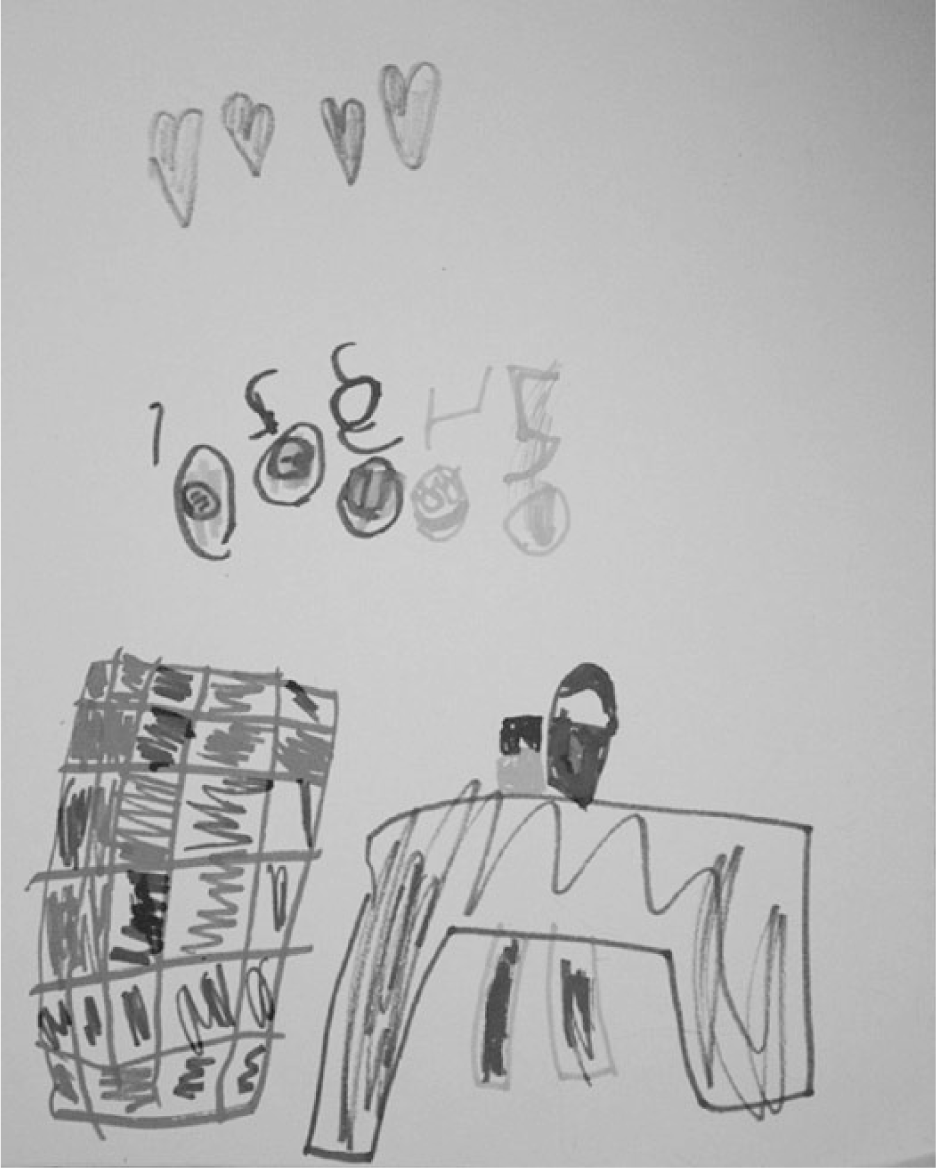
Hannah’s drawing of her current classroom. The carpet can be seen on the bottom left.
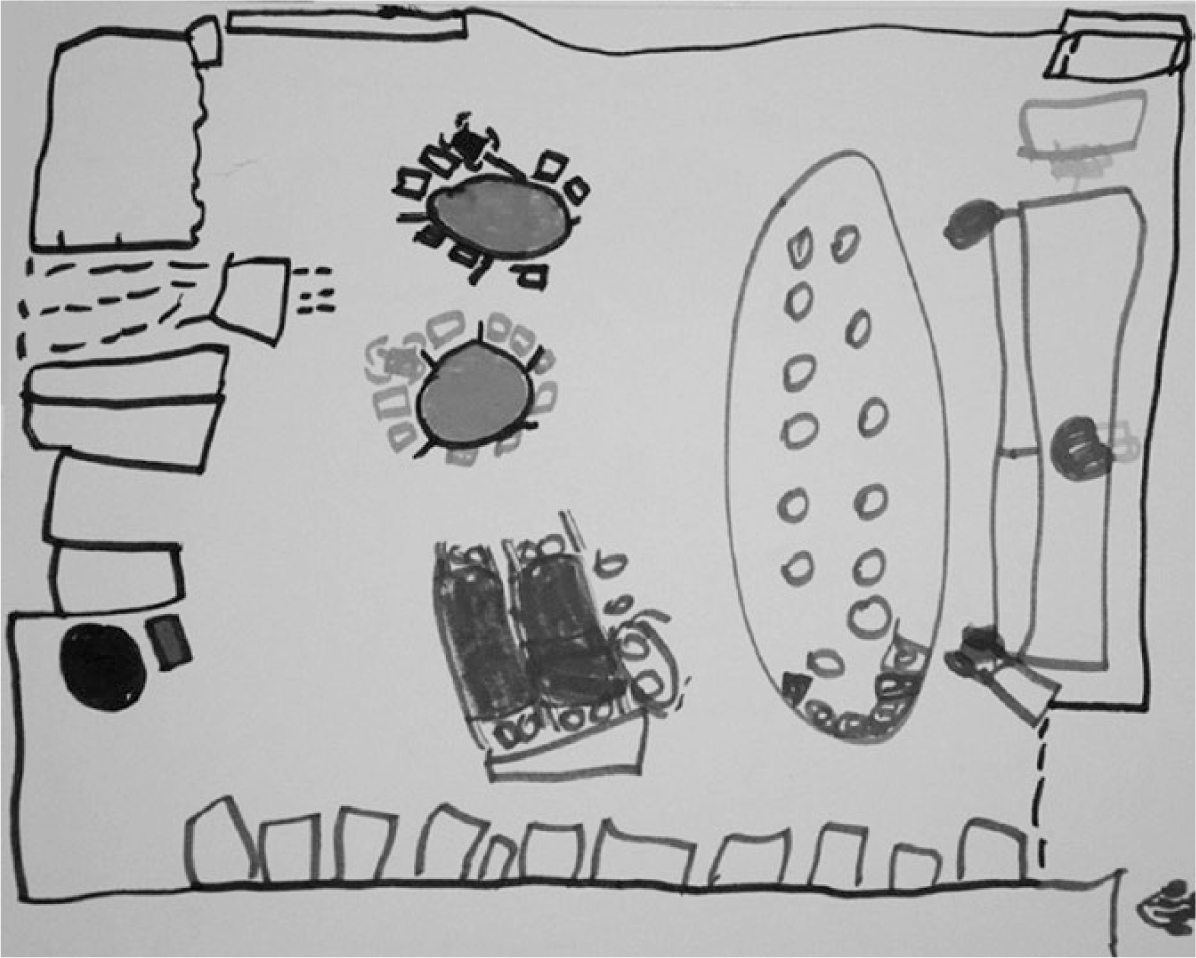
Ethan’s drawing of his current classroom. The carpet can be seen on the right side of the page.
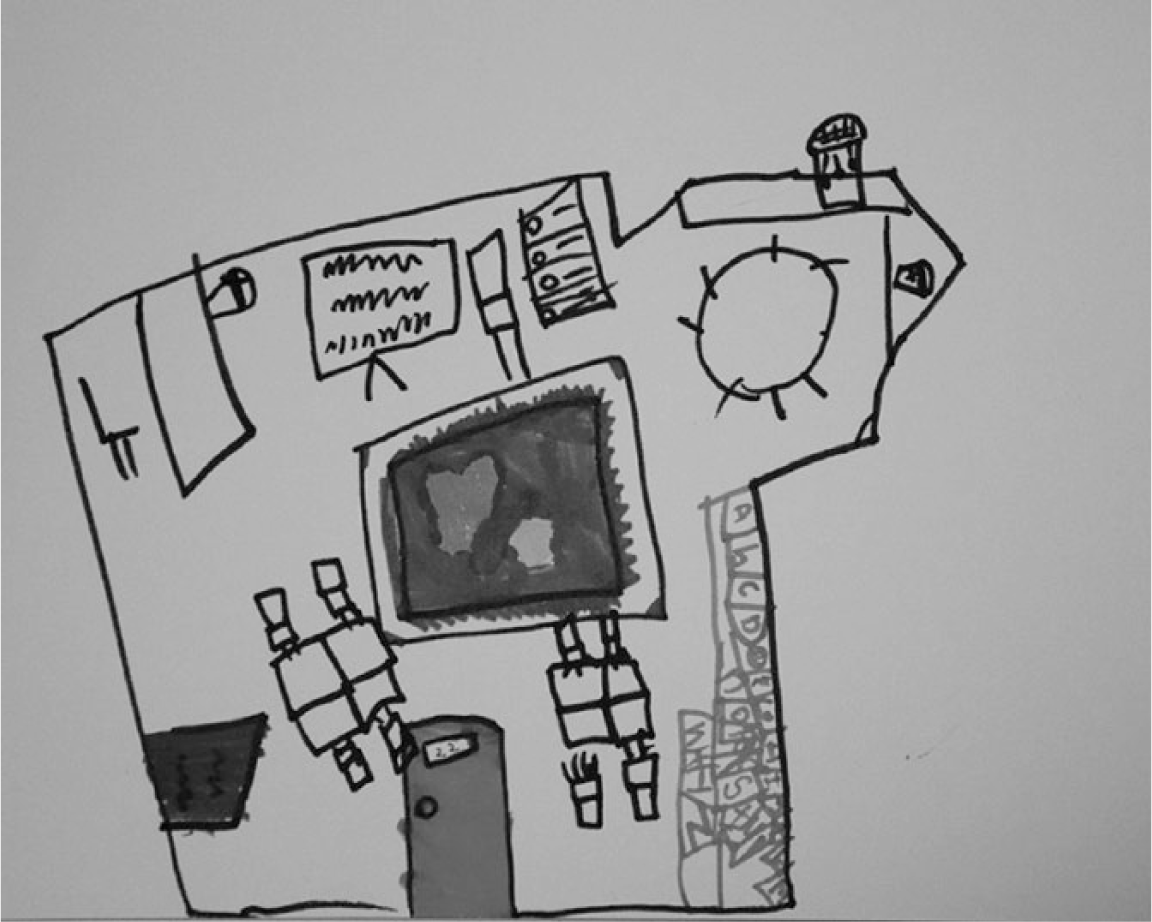
Emily’s drawing of her current classroom. The carpet can be seen in the centre of the page.
Through the children’s discussions and their drawings, it is evident that the carpet is a central space in the daily goings-on of their current classrooms. The activities the children engage with on the carpet and the physical set up of the carpet time appear to further maintain the teacher as controlling the space and the children as marginalised within the classroom environment. Ethan and Emily both mention that they have specific spaces on their classroom carpets, assigned by their teachers, on which they must sit. Ethan states, ‘squares are where we sit, Q is my letter’. As with the tables and desks, the teacher also controls where the children sit on the carpet. The children sit on the floor facing the teacher who sits elevated on her ‘big chair’. This represents, in a visual manner, the hierarchical structure of the classroom, as the teacher is literally not at the level of the children but is situated above them. The power of this image can be taken a step further to argue that the children sitting facing the elevated teacher serves to illustrate Freire’s (2000) ‘banking concept’ of education where students are viewed as empty bank accounts in which teachers ‘deposit’ information. The learning here is one-directional whereby the elevated teacher is passing on knowledge to the children below. Through physical placement, and through teacher-directed activities, the carpet further upholds the power imbalance and hierarchical structures of the classroom.
Children’s free-spaces
Cole (2009) refers to ‘free-spaces’ as areas in which children can establish their agency within the school landscape. They are often spaces that many adults view as insignificant; however, they are ‘critical, contested and empowering’ spaces for children (Cole, 2009: 27). In their conversations, all the children make reference to washrooms and/or to snack and lunch tables. These are spaces and times that are much less controlled by adults.
When drawing his current classroom, Ethan begins by drawing where the washroom is located. Typically, school washrooms are spaces that are free of, or have minimal, adult supervision. Three of the five children make reference to washroom spaces. This may illustrate how important these spaces are to the children and, in turn, how important spaces free from adult control are to children. These results appear to support the findings of Olwig (2011) who maintains that washrooms are often ‘special places’, identified by children, as somewhere to congregate and to develop sociality.
In his conversation, Matthew comments on how during carpet time, only children who need to go to the washroom or who need to get a drink may leave the carpet. Emily notes that during rest time children are also allowed to leave to use the washroom. Within these contexts, the washroom offers a permitted break from the classroom routine. It allows children the opportunity to step away, if only briefly, from the adult-dominated classroom.
In their conversations about their experiences in their current classrooms, all of the children discuss snack and/or lunch time. Olwig (2011) maintains that many children describe lunch time as a highlight of their school day, as this time provides opportunities for social interaction and less adult control. Ethan notes that what he really likes about school is ‘eating lunch … yeah and snack’. Lunch tables, like the washrooms, are spaces in which ‘children create and participate in their own unique peer cultures by creatively taking or appropriating information from the adult world to address their own peer concerns’ (Corsaro, 2015: 18). In an environment controlled and limited by adults, children often use the opportunity that unmonitored spaces provide to demonstrate their agency and to socially negotiate with each other.
Space: a summary
In Western nations, a larger proportion of children’s daily activities occur in classrooms (Theobald et al., 2011). Room arrangement and usage project messages about what is valued and expected in certain environments. Cole (2009) argues that adults organise space to further marginalise children. Within their current classrooms, the teachers appear to organise the classroom space in order to uphold the governing status of the teacher and the subordinate status of the children. The conversations with the children identify many issues of power imbalances and hierarchical structures deriving from the organisation and management of the space of their classrooms. The children also recognise spaces, in which children might escape some of the control of adults; these spaces appear to be valued by children in each of the educational settings.
Pedagogical practice
The children, when discussing the learning in their current classrooms, often describe one-directional learning in which the children listen to the teacher. When discussing how his teacher uses ‘her big screen’ to teach the children, who are sitting on the carpet, Ethan states, ‘she makes us watch TV so that we can learn stuff. She thinks watching TV is how we learn except really it’s not for me’. He goes on to comment, ‘she thinks if we hear it one time we will really learn it except I need a bunch of times for my learning’. These comments illustrate the banking approach to education, an approach that reinforces the hierarchical nature of the school. These statements also serve to highlight children as reflective and competent experts on their lived experiences. Ethan not only recognised the educational approach employed by his teacher, but he is aware that it is not conducive for his learning. This further illustrates the possible knowledge that can be gained in the field of pedagogical practices, if children, the ones who experience the educational system first hand, are consulted and their views valued.
Thornberg (2010) notes that educators often ask children questions in order to evaluate their knowledge, not to provide them with ‘opportunities to think aloud, formulate ideas, make suggestions, or have a say’ (p. 930). This is reflective of the banking approach to education as children are viewed as passive and empty vessels that the teacher must fill with knowledge. When asked what the teacher does when the children are on the carpet, Emily replies that she ‘just teaches us stuff’ and the children ‘raise [their] hand when the teacher asks us a question’. This appears to reinforce a conceptualisation of children as ‘objects, not subjects of learning – receivers, not actors’ (Cole, 2009: 25). Within this construction, children are not viewed as social actors, but rather as passive recipients. It appears that passive teacher-directed learning dominates classroom activities in the children’s current classrooms.
Rules
When the children are asked what another child unfamiliar with the classroom would need to know about their current classrooms, rules feature predominately. These findings appear to mirror Dockett and Perry’s (2005a) findings from the Starting School Research Project, which reports children often mentioned rules they thought other children needed to know before starting school. Ethan states that a child would need ‘to learn the rules of the class’, and Matthew maintains it would be important for the child to ‘listen to the teacher’. This indicates that the children are aware of what is expected of their behaviour in a school context. Dockett and Perry (1999) argue that children’s awareness of rules indicates their understanding of the hierarchical nature of school. They maintain that children are likely to accept the power of teachers and principals to create and enforce rules, as these are the people children perceive to hold the power in school contexts.
Fielding (2000) describes the school classroom as ‘a “hot bed” of moral geographies – of moral codes about and where children ought to learn and behave’ (p. 231). Some of the rules in schools and in classrooms, to which children are expected to comply, are explicit; others, however, are implicit. Implicit rules can be understood as, what sociologists refer to as, the ‘hidden curriculum’. Skelton (1997) defines a hidden curriculum as a ‘set of implicit messages relating to knowledge, values, norms of behaviour and attitudes that learners experience in and through educational processes’ (p. 188). It functions as a form of social control. The children’s conversations indicate that the children are aware of what is expected of their behaviour in their classrooms’ contexts. Hannah states that it would be important for a new child in her current classroom to know how to ‘sit in the five-point check’. She further explains that this is a checklist of how children must sit and behave during carpet time, and lists the elements of the checklist: ‘hands in your lap’, ‘listening ears’, ‘quiet’ and ‘looking at your teacher’. These are explicit rules of the classroom that appear to be openly stated by the teacher. Although not explicitly stated by the teacher, the implicit rule of this setting is that the teacher is the one who holds all the power and control of the classroom. In this learning environment, the teacher exerts control of and maintains power over the children through the employment of strict rules of behaviour. Within this context, classroom rules are what Millei and Raby (2010), drawing from Foucault (1979), describe as ‘a technology of the school to deliver social training and to regulate the student population’ (p. 28).
When Hannah is first asked to discuss her current teacher, she replies, ‘my teacher’s name is Mr. Woodly, and if you are being silly you have to go to the white chair and you have to think about what you have done’. It is significant that the first thing Hannah chose to discuss about her teacher, beyond his name, was what happens to children when they are ‘silly’ or do not uphold the expected behaviours in the classroom. Matthew also discusses the use of time-out practices in his classroom. He states, ‘if you are not listening you have to go in time out … it’s where you have to go off the carpet and sit in a chair and do nothing’. Both children identify practices in which teachers single out children and remove them from group situations in order to promote compliance and maintain control of the children. This appears to further echo Foucault’s (1979) assertion that hierarchical structures are often reinforced by public displays of punishment.
When Hannah is asked what is considered being silly, she replies, ‘talking or doing actions with your body’. Within this classroom, during carpet time children are expected to sit still and remain quiet, so not to ‘disrupt’ the on-goings of the classroom. Foucault (1979) states that, within the institution of school, punishments are handed out to children for the ‘slightest departures from correct behaviour’ (p. 178). Time-out is a means in which the authority of the teachers, through the employment of punishment and rewards, conditions children to the unquestioning compliance of classroom rules (Millei, 2012).
Classroom rules are often autocratic, not democratic. They ‘are frequently presented as fostering responsibility, respect and self-discipline, yet rules are top-down and hinge on mute obedience’ (Raby, 2008: 77). Children are often not permitted or empowered to create, modify or challenge classroom rules through classroom discussions (Thornberg and Elvstrand, 2012). Classroom rules, which foster unquestioning compliance, uphold the authority of the teacher in order to maintain ‘control’ of the classroom and do not foster children’s critical and reflective thinking. This lack of critical thought and democratic practice will be explored in the following section.
Decision-making/influence on curriculum
Through their conversations and drawings, the children discuss the extent to which they are active in asserting their agency within their classrooms settings. Dewey (1916) argues in order for people to continue to live democratically, they must have opportunities to learn, the meaning of a democratic way of life and how it may be realised. How children’s agency is realised and supported within a classroom setting is dependent on the ways in which teachers conceptualise children and their roles as educators. As Roche (1999) argues, there needs to be a change in many societal and educational practices and assumptions in order to support children in the assertion of their participation and citizenship.
The caretaker model
Raby (2008) refers to the caretaker model as one in which children’s rights are carried out by adults and ‘in which children are prepared for future self-governance and decision-making through an absence of participation in the present’ (Raby, 2008: 78–79). As mentioned above, teacher-directed activities and teacher-organised spaces dominate the children’s conversation about their experiences in their current classrooms. The children do refer to playtime in their classroom. A previous study by King (1979) finds that children distinguish play activities from work activities, by defining them as both voluntary and self-directed. In the children’s current classrooms, however, play activities appear to at times be directed by adults.
When discussing her current classroom, Hannah states that during playtime, ‘sometimes the teacher asks you what centre you want to go to, you have to tell her or else you can’t go to any centre’. When I ask Matthew if he chooses where to go during playtime, he notes, Sometimes, but sometimes we don’t have to tell them [teachers] where we want to go. Sometimes they say free playtime and that means we don’t have to tell them where to go, we can just go without telling them or asking them.
He further states that if it is not free playtime, ‘you have to tell the teacher what you want to play in’. In both Hannah’s and Matthew’s current classrooms, playtime is, at times, controlled by the teacher. Teacher-directed playtime seems inherently paradoxical. Children value play as self-directed (King, 1979), and yet in these classrooms the teachers appear to control this activity. Do the teachers see the children as incapable of making their own decisions and monitoring their own behaviours during this time? Do the teachers view the children as incapable, in need of constant assistance? Whatever the reason, these restrictions limit the opportunities for the children to engage in decision-making and problem solving and, therefore, in critical thinking. Freire (2000) discusses the ‘paternalistic student-teacher relationship’ (p. 32) which positions children as subordinate and argues that educators must refuse to be tempted by the view that children are inherently incapable. In order for teachers to support children in establishing their agency and developing their critical thinking skills, they need to recognise how they view children in society. Furthermore, as Lundy (2007) maintains, the involvement of children in democratic practice should not be regarded as an optional award bestowed on children by adults; however, it must be realised as a right of children.
The power to change
Echoing the writings of Dewey, Matthews and Limb (1999) maintain democratic responsibility is achieved through participatory opportunities and ‘does not arise suddenly in adulthood through maturation’ (p. 66). Children who are given opportunities to exercise their agency in the classroom may be better prepared to be active democratic citizens, not just in the future but also in the present. As important as children having opportunities to make decisions and influence curriculum is children’s belief that they have the power to make such changes. This, as laid out in the CRC, is in fact the right of all children. Articles 12 and 13 of the CRC (United Nations, 1989) state that all children have the right to form and express their opinion on matters that affect them and that they have a right for these views to be given due weight.
It is significant that when asked if they would change anything about their current classroom experience, only Emily mentions that she would add a playground to her classroom. The other children say they would not change anything. One could assume that this confirms that the children are content with their current situation; however, I would argue that children, and adults, should be encouraged to continually question and strive for change in order to improve situations, and that the children’s responses should be viewed as further illustrations of the power imbalances and hierarchical structures present in school environments and in society at large.
Devine (2002) states that ‘children are positioned as subordinate within the school, with negative implications for their perception of themselves as active contributors to the schooling process’ (pp. 303–304). This is reflected in Stafford et al.’s (2003) study that finds students did not ask for certain changes in their school because they believe they cannot change them, in other words, that the school’s policies are too inflexible and in fact work to disempower the children. Furthermore, Thornberg and Elvstrand’s (2012) study reports some children believe that children are not capable of making ‘good’ decisions in the classroom, as they only want to do ‘fun things’, and Punch (2002) maintains that children are so accustomed to being marginalised in society that they are used to adults positioning them as inferior. Their subordinate status has become normalised. Foucault (1979) discusses the ‘judges of normality’ that are present throughout society and further notes, We are in the society of the teacher-judge, the doctor-judge, the educator-judge, the ‘social-worker’-judge; it is on them that the universal reign of the normative is based; and each individual, wherever he may find himself, subjects to it his body, his gestures, his behaviour, his aptitudes, his achievements. (p. 304)
The institution of school, through its familiar practices, upholds and promotes dominant normative societal assumptions, including the conceptualisation of children as incompetent, dependent and naive. This construction of children must be challenged, particularly in educational settings, in order for children to ‘locate themselves as subjects (and rights-holders) in the present, rather than in the future’ (Raby, 2008: 78).
Conclusion: Final thoughts
This research study has two aims: first, to explore children’s perceptions of their experiences in two different learning environments and, second, through the research process, to establish children as competent experts on their lived experiences. Although interlaced, through the realisation of these aims, innovative and significant information is generated and explored.
The questions regarding their learning environments that were discussed with the children were very broad and open-ended. It is striking that when given the opportunity to discuss any aspect of their current learning environments, so much of what was discussed revolved around issues of power imbalance within the classroom. These issues are explored through the children’s descriptions of space, pedagogical practice, rules, and their decision-making and influence on curriculum. This research project uncovers a disappointing reality; not only is a substantial proportion of these children’s experiences within their current classrooms dominated by power imbalances and hierarchical structures, but the institution of school, through its familiar practices, upholds and promotes dominant and normative societal assumptions of children, childhood and education.
As Thornberg (2010) states, we need to challenge ‘the hegemony or dominating discourse of the subordinated and incompetent child in our society’ (p. 930). Critical pedagogy offers a theoretical framework by which to unpack and deconstruct dominant practices; however, it is imperative to also reconstruct these practices. This framework offers insights to re-examine normative practices; however, these insights are not fully beneficial unless practices and curricula are re-built to reflect this newly generated knowledge.
Glazzard (2012) notes the listening and acting upon children’s perceptions about learning ‘demands a cultural shift in schools from a position whereby pupils are viewed as recipients of education to a position whereby pupils are viewed as partners in the processes of teaching and learning’ (p. 60). I call for educators and administrators to work together to challenge dominant constructions of children and to unpack and reconstruct standard and familiar school practices and curricula. In doing so, educators can become key agents in challenging the established view of children as incompetent, dependent and naive. It is my hope that a recognition of children as competent social actors will lead to a society that recognises not only the positive influence adults can have on children but also the positive impact children can have on adults, pedagogical practice and society at large: a society, which celebrates children as significant and active citizens of the present, not just of the future.
Footnotes
Funding
This research received no specific grant from any funding agency in the public, commercial or not-for-profit sectors.