




Abstract
In this article, we use a multidimensional approach to empirically study the concepts of dialogue and contact zones in the setting of the World Social Forum Tunis 2013, with a special emphasis on young, local volunteers. Although young Tunisians played a crucial role in the revolution, they have been side-lined in the construction of the country’s new democracy. Furthermore, although many studies have paid attention to the creativity of young activists in the World Social Forum, very few have thoroughly analysed the engagements and experiences of young, local participants. This is surprising, especially since the youth represent one of the biggest groups of participants in World Social Forums. Moreover, many World Social Forum volunteers, the backbone of the forum, are young locals. This article presents a combination of Jabberi’s autoethnographic work and Laine’s ethnographic work on the World Social Forum Tunis 2013. Using the concepts of de Sousa Santos, the article shows how young World Social Forum volunteers actively produced translations of knowledge and practices that enabled multicultural contact zones that connected the different actors in the forum.
Introduction: World Social Forums as open spaces of dialogue?
Figure 1 depicts the situation in which the authors of this article met for the first time. It clearly shows the different perspectives of the authors: That is, Sofia Laine shot the photo of Fatma Jabberi. The authors recalled this moment as follows:
The daily press conference is an occasion for attendees to ask questions and get authentic answers from one of the representatives of the steering committee of the World Social Forum (WSF). March 28th, as interpreters were needed, I ensured the translation for the press conference. Being an interpreter/translator, I could provide simultaneous translation from Arabic to English and vice versa. The WSF is said to be a plural, diverse and open space for encounters, exchange and discovery. I believe that, by helping with translation, I helped in deepening understanding and fostering the beneficial exchange. As misunderstanding can occur at any time, I believe that the task of interpreters is very tricky. I often refer to interpreters as ‘messengers’.
In addition to being accredited by the WSF Tunis as an ordinary participant, and member of the press, I got an invitation to this press conference, where the organising committee of the WSF would answer journalists’ queries. During the press conference, I was impressed by the calm, clear and talented interpreter. At one point, she moved out of her role as a translator and answered the questions herself, describing her position as the WSF volunteers’ coordinator. This was the most important thing that the press conference provided for my research. As I was doing an ethnographic study of young, local WSF volunteers, getting to know the volunteers’ coordinator was highly relevant. And she was young herself.
* *
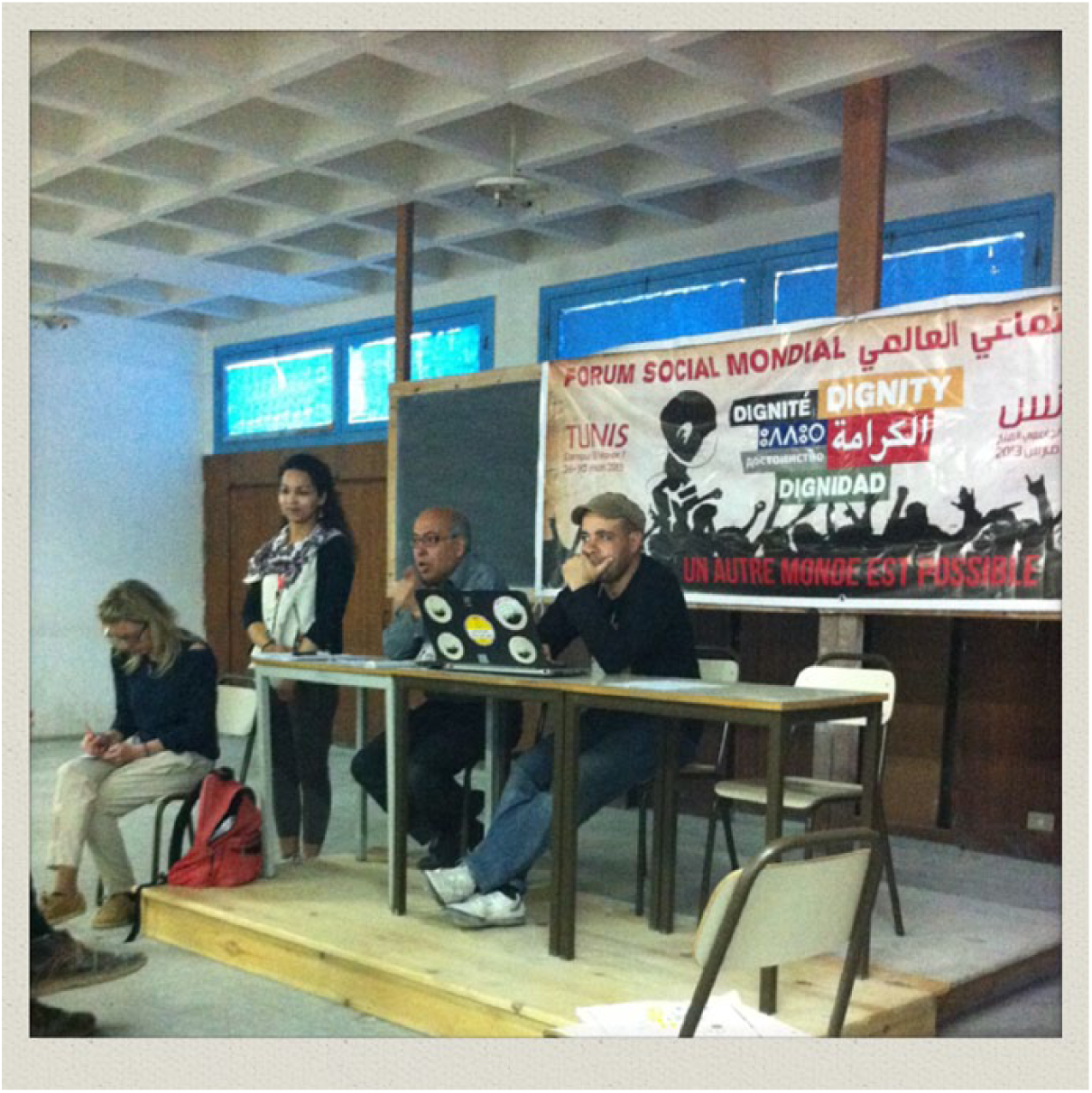
World Social Forum Tunis, Press Conference, 28 March 2013 (Photo: Sofia Laine).
The WSF is a mass international meeting that allows civil society actors, non-governmental organisations (NGOs) and movements to meet, interact, exchange experiences and develop democratic projects. It is a large gathering for those who fight for ‘another possible world’ to share perspectives, encouragement and commitment. The WSF has often been described as a transnational public sphere based upon a diversity of views and a hope for an alternative future to neoliberalism. Alternatively, Marlene Mortensen (2012) describes the forum as follows: Launched in Brazil in 2001 as an alternative forum to World Economic Forum [WEF], the World Social Forum [WSF] marks a clear case of approaching global issues with other tools than hard power, money and economic theory. But in the neoliberal hegemony of today’s world, a conference of NGOs and activists with no economical hard power cannot be understood and interpreted outside the neoliberal discourse, where these actors are marginalized, especially compared to its mirror, the World Economic Forum.
Since 2001, the WSF has been organised annually (and, from 2007 onwards, biennially) in South America, Asia or Africa. 1 After the first forum in 2001, the Charter of Principles of the WSF was defined, and this charter became the sole criterion for a person to take part in the WSF. It asserts that anyone except for government representatives, military organisations and political parties can attend the forum. The Charter of Principles, therefore, emphasises horizontality, a respect for diversity, a lack of spokespeople, a lack of directivity, a lack of a final document and the auto-management of activities.
These definitions point towards the ethos of dialogism. For Bakhtin (1981), dialogism – and the plural consciousness it involves – is fundamental to human relationships. Each voice has its own standpoint, approach, style and validity; however, at the same time, each person is influenced by others. Dialogism forms the core of the WSF, which can be defined as a space for dialogues between and inside movements, between local and international actors, between youths and adults, between men and women, between the secular and the religious, between autonomists and the institutionalised, between informality and formality and between culture and politics.
In reality, the WSF is not equally ‘open’ or dialogical to every participant (Conway, 2013; Laine, 2012, 2013). Not everyone’s voice is heard or understood, and some participants have more resources for participation and visibility than others. The WSF is also full of contradictions and inequalities. Many attendees spend the majority of their time at the forum with like-minded individuals, with their own identity groups or with members of the social movements to which they belong. Therefore, our interest in this article lies in the local–global dialogue and its diversity. As such, we investigate how to begin a dialogue with a ‘stranger’: that is, with one who is not quite ‘us’ or ‘them’ (see Ahmed, 2000: 5). The WSF can be seen as a ‘place of strangers’, as the mass meeting radically changes the geographical space it lands itself by combining all international participants who are concretely displaced from ‘home’ (Ahmed, 2000: 6).
In January 2011, the international council (IC) of the WSF restricted the choice of potential host countries to Egypt and Tunisia. Since their peaceful uprisings and mass demonstrations, which forced former dictators to step down, both countries have witnessed remarkable resurrections of their civil societies – a situation that represents the core of the WSF. Following a lengthy assessment, Egypt made it clear that it could not host the WSF due to security concerns. Given the opportunity, Tunisia welcomed the idea of a ‘premiere’ after a long stagnation. ‘We would not have been able to receive you if it was not for the people’s struggle in the region’, said Abdurrahman Hedhili, Coordinator of the WSF. 2 Thus, the forum in Tunisia was seen, first, as an initiative to develop an understanding of the overall situation in countries that have experienced revolutions and powerful social movements. Second, it was viewed as an opportunity to provide similar movements a path to thrive and to allow the involved actors to share their aspirations concerning democracy, plurality and equality through different encounters. Third, it was conceived as a way to establish a platform for collaboration between international civil societies and the Tunisian civil society, which had only recently emerged during and after the revolutionary period.
The WSF was held on the campus of El Manar University in Tunis between 26 and 30 March 2013. It brought together 60,000 participants from formal and informal social movements and networks all over the world for interaction and mutual exchange. The IC of the WSF decided that the next WSF will be held in Tunisia between 24 and 28 March 2015 – a choice that signals the importance and success of the previous WSF Tunis 2013. In other words, according to the majority of the IC’s members, it is crucial for the WSF to remain in Tunisia. Therefore, the study of the WSF 2013 may also provide relevant perspectives on which to reflect WSF 2015.
Research approach: Contact zones of ‘open space’
In this article, through both our multidimensional methodology and our empirical data, which particularly emphasise young, local volunteers, we seek to approach the concept of dialogue in the setting of the WSF Tunis 2013. Although young Tunisians played a crucial role in the revolution (Honwana, 2013), they have been side-lined in the construction of the country’s new democracy. Furthermore, while many studies have highlighted the creativity of young activists in the WSF (Conway, 2013; Juris, 2008; Juris and Pleyers, 2009), very few have thoroughly analysed the engagements and experiences of young, local participants (Laine, 2013). This is surprising, especially since the local youth represent one of the biggest groups of participants in the WSFs. Moreover, many WSF volunteers (i.e. the backbone of the forum) are young locals. In this article, we shall define ‘youth’ as a socially constructed category comprising individuals who differ from both their elders (i.e. older generations) and children in terms of roles, orientations, experiences, rights and responsibilities.
Our interest in studying the diversity of dialogues involving young, local Tunisians during the WSF stems from our motivation to understand how the different groups and actors in the WSF develop contacts with each other. Here, Mary Louise Pratt’s (1992: 4) ‘contact zone’ concept is very useful. She defines contact zones as ‘social spaces where disparate cultures meet, clash, and grapple with each other, often in highly asymmetrical relations of domination and subordination – like colonialism, slavery, or their aftermaths as they are lived out across the globe today’. At their best, these contact zones may produce transculturation (Pratt, 1992: 4).
Boaventura de Sousa Santos (2005, 2008) and, more recently, Janet Conway (2011) have analysed the WSFs as contact zones or ‘open meeting places’ where activists from all over the world can meet, despite speaking different languages. de Sousa Santos (2005) sees interpretation and translation as important factors in the process of building contact zones: The exercise of translation aims to identify and reinforce what is common in the diversity of counter-hegemonic drive. Cancelling out what separates is out of the question. The goal is to have host-difference replace fortress-difference. Through translation work, diversity is celebrated, not as a factor of fragmentation and isolationism, but rather as a condition of sharing and solidarity. (p. 17)
For de Sousa Santos (2005), ‘[The] work of translation among knowledges starts from the idea that all cultures are incomplete and can, therefore, be enriched by dialogue and confrontation with other cultures’ (pp. 18–19). de Sousa Santos (2005) separates the translation of knowledge from the translation of practices, arguing that the latter focuses on ‘mutual intelligibility among forms of organisation and objectives and styles of action types of struggle’ (p. 19). He continues as follows: Translation is a dialogical and political work. It has an emotional dimension as well, because it presupposes both a non-conformist attitude vis-à-vis the limits of one’s knowledge and practice and the readiness to be surprised and learn with the other’s knowledge and practice. (de Sousa Santos, 2005: 20)
Following Sara Ahmed’s (2000) idea of knowledge production, our aim in this article is to trace ‘the relations of knowledge that allow the stranger to enter the community […] with the “who” that knows’ (p. 17). Thus, the article touches upon three different types of ‘communities’, in which the authors’ positions vary. These communities are as follows: Tunisia’s civil society (Sofia as a stranger, Fatma as the ‘who’ that knows), the WSF (both authors as strangers) and academic journal publishing (Fatma as a stranger, Sofia as the ‘who’ that knows). Furthermore, the WSF functions as a contact zone that enabled an encounter between the two authors, thus allowing them to begin the process of translating their knowledge and practices (related to Tunisian civil society, the WSF and academic publishing) for one another.
In the next two sections, we will describe the co-author setting for this article, which stems from a combination of Jabberi’s autoethnographic work and Laine’s ethnographic work on the WSF Tunis. Next, we will discuss the methods and results of co-writing this article, which are partially intertwined. In the concluding section, we will discuss what our experiences of the WSF Tunis evince regarding the global–local dialogue and contact zones from the perspectives of young, local WSF volunteers.
Jabberi’s autoethnography
The autoethnographic perspective of the WSF is realised by the author Fatma Jabberi. In her master’s thesis (Jabberi, 2013 Email: Inexperienced in this field, I decided to run this risk with the humble means I had. So, I just checked on the Internet, got some hints and read about a few methods, such as note-taking and meaning translation only. As far as available equipment, I worked in a wooden booth at the end of the hall, with only a microphone and a transmitter inside it. There were no headphones, but there was a loudspeaker near the cabinet. We were three English interpreters, among whom there was no experienced candidate. The techniques I used were simple: I used to write down quick notes and then try to translate the main idea in a way to ensure the transmission of the message with maximum ‘faithfulness’ to the source message. (Jabberi, 2013: 11–12)
While writing her thesis, Jabberi was unaware of the autoethnographic method; the method was later introduced to her by Laine for the purpose of collectively writing this article. Autoethnography is a form of self-reflection and writing that explores the researcher’s personal experience and connects her story to wider experiences, meanings and understandings; here, this approach is undertaken from an actor’s perspective in the context of the WSF Tunis (see Ellis, 2004). An autoethnographer is, first and foremost, a communicator and a storyteller (Bochner and Ellis, 2006: 111). This description perfectly fits Jabberi’s roles before, during and after the WSF Tunis. By valuing Jabberi’s autoethnographic narrative, we argue that the basic unit of culture is individuals who can actively interpret their social surroundings (see Chang, 2008: 44). Jabberi’s thesis can also be described as a ‘reflexive ethnography’ because it includes narratives of the WSF process and her role within it, as well her personal experiences in the different phases of the process and her feelings from the field (as is evident in the quotation above). Moreover, Jabberi’s role as a co-author and her autoethnography are particularly relevant because, at the time of her writing of the autoethnography, she was a young WSF volunteer (24-years-old): February 2013, the OC (organizing committee) chose universities as target audiences for volunteers and raising awareness campaign. First, students are easy to convince, as we are digging to implement a new culture of volunteering; hence, volunteerism is not well rooted within the community. Instead, it is perceived as a waste of time, seen worthless. On the other hand, students are the best allies in the critical phase that our country is going through. […] We started with basics, such as flyers, posters and the Charter of Principles of the WSF. The first day wasn’t easy given the constraints of objection and reluctance, yet the situation improved each day. From a broader perspective, our campaign was successful, as we were collecting an average of 40 to 60 filled-forms. […] In addition to on-field stands and tents, online campaigns were launched on social networks and cooperating organizations. […] recruitment of volunteers stressed diversity and the rights of the underserved components of society. By 20 March 2013, we ended up with 1,400 volunteers […]. (Jabberi, 2013: 17–18)
The subjective position allows the researcher to insert his/her personal interpretation into the research process. Autoethnography connects the personal to the cultural, linking the self and the social (Chang, 2008: 46). It refers to both the process and the product. It seeks to gain an understanding of others (i.e. culture/society) through the self, using personal experiences as the primary data. In previous studies, autoethnography has been recognised as a useful and powerful tool for researchers and practitioners who deal with human relations in multicultural settings (Chang, 2008: 51). Its benefits include reader friendliness and an enhancement of one’s cultural understanding of the self and others, as well as a potential for transformation of the self and others – a process that can facilitate cross-cultural coalition-building, fix cultural misunderstandings, develop cross-cultural sensitivity and encourage effective responses to the needs of cultural others (Chang, 2008: 51). These benefits are closely aligned with the prosperity of successful contact zones, which are the kinds of spaces that Jabberi tried to provide through her work in the WSF Tunis – first as an interpreter and later as the volunteer coordinator: […] The main challenge was information monopoly, […which] poisoned the creativity and working atmosphere. In fact, Steering Committee meetings were exclusive. This frequency of underestimating the efforts of youth resulted in a spirit of us (youth) against them (elderly) as a reaction to the feeling young volunteers got that they were belittled and dependent to older generations. (Jabberi, 2013: 25, 32)
As illustrated from the quotation above, young people were side-lined, not only through the intergenerational power setting in Tunisia but also in the WSF steering committee. This bias is also visible at the family level: As Fatma later describes in an interview with Sofia and her research colleague Tiina-Maria Levamo, her parents did not fully support her during the phase of preparing for the forum:
[…] The idea of working without pay ‘they’ [my family] didn’t welcome it. […But] most importantly, for the first time, they felt that I was doing something with … umm, umm … with joy. […] what was really a question in their minds was why I never picked up the phone and said that I had had enough of this job, […] and the first time I stood against the word of my family, I told them, ‘I am very convinced of what I’m doing, and I feel that I fit in.’
And you did a lot.
Thank you. And by the days of the forum, the first day, Mama just heard me on the radio. She called me [and said], ‘I’m very proud of you, and I didn’t think that you could …’ Oh please!
I’m starting to cry, too!
I’m just very emotional!
Thank you. I had tears that day, because I felt that I did not do something for nothing, you know. So did my father, he called me to express his pride of me … umm and … please stop it, I’m going to ….
Autoethnographies may also have a therapeutic and caregiving function. Communication embodies both the personal and the cultural; it brings experiences to language and to life. As Arthur B. Bochner describes (Bochner and Ellis, 2006), ‘Sense-making involves turning experiences into stories that theorize experience. The autoethnographer theorizes experience as a storyteller. The story is a theory’ (p. 116).
Laine’s ethnography
Laine landed at Tunis Airport 3 days before the opening march of the WSF, along with five other members of a research team studying youth political engagement in contemporary Africa. 3 Laine had done ethnographic fieldwork three times at previous WSFs, and she had suggested in the project proposal that the entire research group conduct a team ethnography at the WSF Tunis (Laine et al., 2015: 120). What she had not experienced at previous WSFs was her first sight upon landing: WSF volunteers were already at the airport, next to the baggage claim, welcoming foreign forum participants to Tunisia (see Figure 2). It soon became evident that the local WSF volunteers were doing an amazing job. They were extremely helpful and friendly, and most had very good language skills. In addition, many of the volunteers were university students, who had several different abilities that they could use throughout the forum (e.g. communication and technology students were facilitating live streamings of the sessions). The research team reflected later on feelings of being comfortable and welcomed during the forum, particularly because of the atmosphere created by the volunteers. Laine heard expressions like ‘pleased to help you’ and ‘we are doing this for the whole of Tunisia’ from the young, local WSF volunteers.
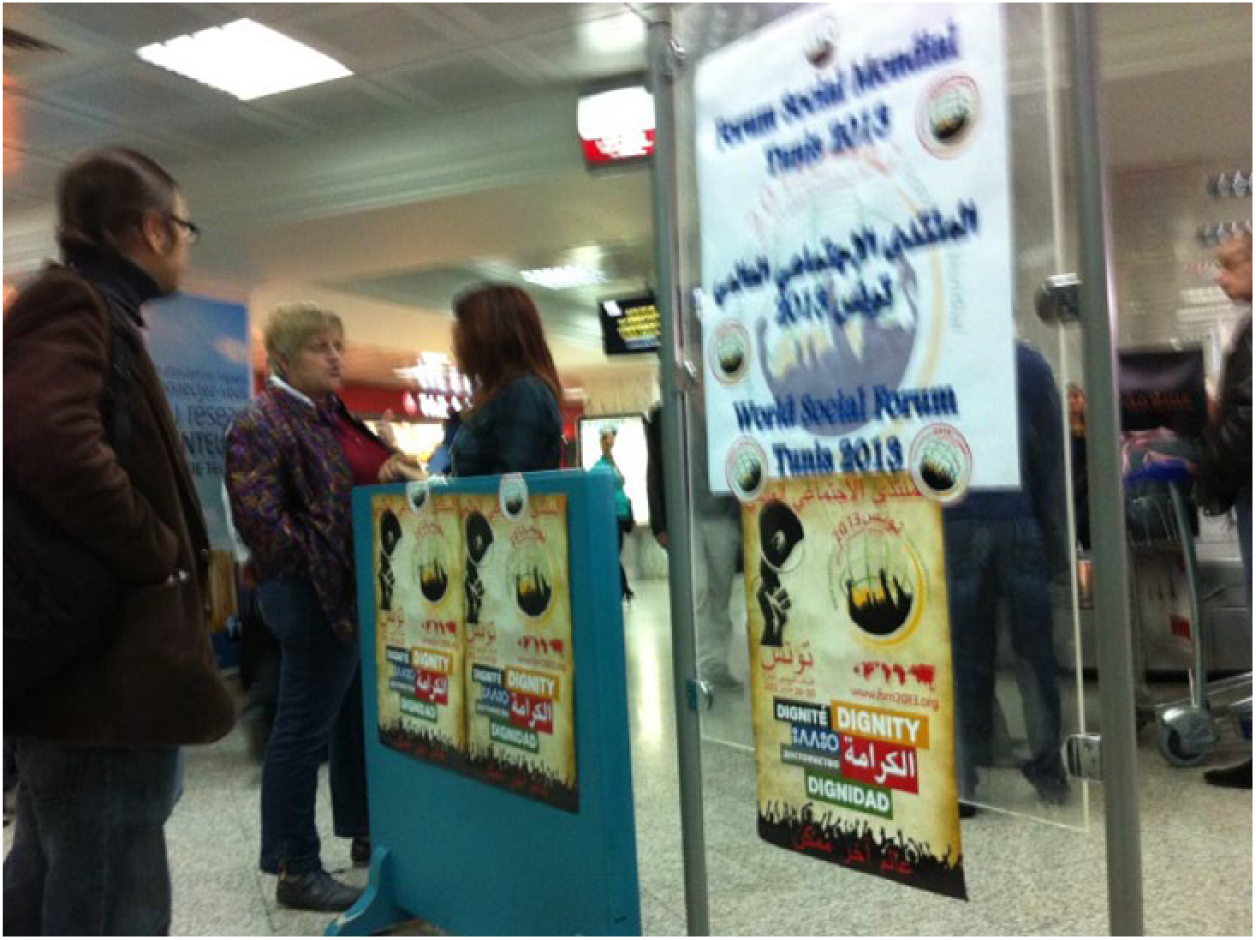
Tunis airport, baggage claim, 23 March 2013 (Photo: Sofia Laine).
As a place for ethnographic fieldwork, the forum is easy to access. No research permission is necessary, and anyone can join simply by paying the WSF’s participation fee. However, the forum’s hectic rhythm makes it a challenging place for interviews. Based on her experience with previous fieldwork phases at WSFs, Laine used her time at the WSF Tunis observing the local activists, holding brief discussions with them and asking them for the opportunity to hold more in-depth interviews after the forum. During the forum, in addition to conducting participant observations, Laine shot pictures and recorded videos, participated in different WSF events and organised one session. Instead of trying to write a proper diary during the short hours outside the forum, Laine designed a day chart, on which she shortly marked, for each hour of the day, what she had done, whom she had met and what kinds of data existed for recollection. During the forum days, the research group also independently conducted short interviews. In total, Laine and Levamo conducted 21 interviews (12 with males, 20 to 24 years old, and 9 with females, 18 to 24 years old) with young Tunisian WSF volunteers. In all of these interviews, the researchers asked about the informants’ backgrounds and motivations (i.e. why they wanted to participate as volunteers in the WSF).
Following completion of the fieldwork, transcriptions were made using a transcription service. After the researchers had left Tunis, their discussions with the informants – especially with Fatma – continued via email and Facebook messages. As a first step in her analysis, Laine carefully read all the interview data, examined similarities and differences and identified main themes to focus on and analyse in the study. Not all of the volunteers had previous volunteering experience or experience working in a civil society. For example, Wiem (pseudonym, female, 24 years old, 5th year biology student, living in the southern suburbs of Tunis), who volunteered in the media centre of the WSF, said in an interview that she had not previously been active in any organisations, but that she spent part of her free time volunteering in hospitals and helping autistic children.
I heard about the WSF 2 or 3 weeks ago, and I thought that it was happening in Tunisia for the first – and maybe last – time, so I needed to be a part of it, and I needed to come and do anything I could. I stopped my training […] so I could come here. […] I’m supposed to work from 8 to 11 or 12 at this conference, but I always come back in the afternoon to help in the press room […] because, sometimes, there aren’t enough volunteers. […] They all want to go out and try the activities and see people […]
Have you found this interesting, what is happening?
Yes, really interesting. First of all, I meet a lot of people from all over the world. That’s a first for me […] Knowing people, meeting new people – it’s refreshing; it’s really good, and I’m planning to move to Europe, maybe next year.
[…] As a Muslim Arab, it’s hard to get a visa to Europe, so I must work hard to get my visa.
It became evident that the young Tunisian WSF volunteers were very excited about the prospect of engaging in multicultural learning and exchange at the forum. During their working hours, the WSF volunteers were primarily responsible for their work assignments, which served as their main source of interactions with other WSF participants. Outside their working hours as volunteers, the young Tunisians were free to participate in the sessions or the youth camp and to enjoy the music. From the perspective of Ahmed (pseudonym, 24 years old, male, 5th year pharmacy student at the University of Monastir), it was a pity that the volunteers somehow missed an instructive opportunity of the WSF although the WSF had the potential to be very educational in terms of children’s rights, democratic participation and politics. Volunteers were so overwhelmed by the unusual mass event that they passed over its instructional side; Ahmed, hence, regrets seeing volunteers missing an opportunity to learn from simply because they misconceived their crucial role, from organisers (as they belong to the organising committee) to visitors sightseeing the festivities.
[…] the revolution started with young people, but then elder people took the power […] those who were in the opposition during the 80s. And now, they have come back [to Tunisia] after 30 years [of living abroad], and they don’t know what the society looks like, what youngsters have in mind. […] And the thing about the youngsters … I think they lack confidence in themselves, like they’ve never been engaged. They’ve just been living like that. I’m part of them. I’m saying that we lack political education. […] Some of [the youngsters] are really engaged and have the tools, but others don’t have them. And some of them are working to have the tools. […] And during the forum, many youngsters were engaged in other things besides politics.
An in-depth interview with Jabberi right after the forum deepened Laine’s understanding of the importance of the WSF Tunis for Tunisian civil society. Fatma described how the young volunteers of the WSF decided to form their own initiative – the Youth Social Forum – while still participating in the forum. In addition, she noted how the government positively recognised the work of the young Tunisian volunteers during the forum:
The government has started to fear civil society, as it’s getting more powerful. […] So, there is a certain dialogue […] The Minister of Social Affairs and the Minister of Justice and the Secretary of Immigrants, who just threw a party in our [volunteers of the WSF] honour at the Sheraton two days ago, attributing the efforts of the OC […] We are not experts in such convocations, gathering government representatives and civil society, but we are trying.
Multicultural contact zones as a method and a result
The translation of knowledge between the two authors took a new step after the WSF Tunis, when Laine interviewed Jabberi about her involvement in the WSF. This interaction sets the ground for dialogism, careful listening, trustful speaking and mutual respect. It was both the knowledge and the atmosphere that led Laine to make her proposal during the interview:
And you know what? Why don’t we, like … after you have written your thesis, why don’t we … umm, umm … continue, and write an article together?
The first full version of this article was Laine’s compilation of Jabberi’s autoethnographic thesis reflections and relevant information from the interviews she had conducted, in addition to some preliminary discussions of the WSF and its contact zones, challenges and opportunities for dialogue. Jabberi revised, commented on and edited this version in May 2014. In June 2014, a face-to-face seminar was organised in Helsinki, Finland, to facilitate the two working together, obtain comments from colleagues and find a way to complete and submit the article.
Inspired by Heewon Chang’s (2008: 101) book, the authors undertook two joint writing exercises while in Helsinki. The first followed the example of Chang’s book: The authors introduced themselves to each other in more detail and mind-mapped their commonalities and differences. From the perspective of this article, it is relevant to mention that both authors experienced a feeling of a lack of knowledge. The process of co-authoring their different experiences and the knowledge that they gained from the WSF Tunis added value to their collective and individual knowledge and strengthened the argument in the article. Moreover, Jabberi’s professional knowledge of Tunisia’s civil society and Laine’s previous research on the WSF, as well as her knowledge of international academic journal publishing, were resources that were brought together and shared. Another writing exercise focused on the authors’ emotions, roles and practices before, during and after the WSF Tunis. Here, too, the similarities and differences became visible. As Pratt (1992: 4) describes, contact zone situations are often asymmetrical. This was also the case with the co-authoring: Laine had research funding to write this article; so, during the latest round of writing prior to the article’s submission, reimbursement for Jabberi’s work was negotiated through the project in which Laine was already involved.
Author crossroad
Although this article depicts societal changes in a post-revolutionary country – namely, Tunisia – this article is also revolutionary in itself: The drafting of this research paper cuts with the common and the agreed upon in terms of methodologies and analysis. Through this risky and self-taught technique, it echoes a will to break with the typical. Here lies the intersection of both authors: a strong motivation to open a new discourse in academic research paper writing.
The teamwork process starts with the dialogue, with the art of listening and asking questions, with an understanding of one another, with a respect for different perspectives and viewpoints and with a sharing of one’s own feelings and thoughts. To be successful, teamwork requires an environment of trust and safety: Members of the team should feel confident, accepted and supported, and they should all have a commitment to the set goal. Teamwork, as a method, underscores the importance of a willingness to reflect on individual research orientations with other team members. It requires a readiness to share personal experiences and responses from the field. A commitment to working collaboratively, supportively and non-hierarchically – both alone and together – is required (see also Siltanen et al., 2008). For us, all these elements, when successful, create an ethos of dialogism during the research process.
Working ‘separately together’ (Siltanen et al., 2008) enabled the researchers to see the diversity of the topic, and this diversity needed to be regarded as a source of both interest and potential creativity. It was a constant critical conversation between the self, the research subjects and the other members of the research team, with the goal of constructing a common understanding of the research subject. Moreover, given the differences between Laine’s and Jabberi’s kinds of knowledge of the WSF, of Tunisian civil society and of academic publishing, the teamwork enabled each of the authors to ‘go beyond the known’.
Concluding thoughts
This article focused on the global–local dialogue and on the contact zones between young, Tunisian volunteers and foreign participants in the WSF Tunis 2013. It traced the relations of knowledge (i.e. both the translations of knowledge and the translations of practice) that allow a stranger to enter a community with the ‘who’ that knows. Particularly, this article showed how the WSF Tunis 2013 functioned as a space for dialogue and as a contact zone at many levels. First, the forum was shown as a space where young activists in Tunisian civil society could network with one another and form a new initiative, namely, the Youth Social Forum. For those local youth who, during WSF Tunis 2013, discovered a hidden part of themselves and enjoyed their duties for the first time and for those who fought to include youth leadership in the forum and who dealt with all issues regarding generational dysfunction and rejection, it was high time for the youth to have their own event. Thus, the idea of the Youth Social Forum was the result of both frustration and self-confidence. The event was set for March 2014, and it met the expectations of those who saw it as a first self-organised event. Social Forums are now perceived as a meeting space for empowerment and exchange among youth. The protocol for exchange and mutual benefit has already been morally ratified through the 2013 WSF. The challenges have been comparatively identified. As the core of the organising committee, the young volunteers of the WSF 2013 began to see the desired fruition of their battles: that is, social justice and the inclusion of youth in the social life and the political arena.
In this article, we described how the roles and actions of the co-authors were not only sites of dialogue and a contact zone, but also a method. What we found relevant during this writing process was how Jabberi’s autoethnography showed what went on behind the scenes of the WSF process – and, complementarily, how Laine’s ethnography was at the forefront of the forum. This article, as one of the outcomes of the sharing and solidarity that started at the WSF, is also our contribution to increasing the non-Eurocentric dialogue, to amplifying local voices and to encouraging young people’s agency, which is often absent in the various outcomes of the WSFs (and, especially, in scientific articles and reports). In the academic contributions stemming of the WSFs, very few authors come from the host country, and even fewer have played an active role in organising the forum. Our desire to combine autoethnographic and ethnographic perspectives was also a way to reject the binary oppositions between the researcher and the researched, objectivity and subjectivity, process and product, the self and others and the personal and political. The WSF, where everyone is a stranger and which serves as a space that no one really knows, provided a fruitful ground to start this collaboration.
The WSF 2013 was the first global civil society space for young, Tunisian civil society actors to engage in a dialogue or put themselves in a contact zone that included global and foreign actors. For local movements that were just finding their way into transnational spaces or that have minimal coalition experience, the WSF functioned as a place in which the leaders could learn from others, network, highlight their work and present it to local and international actors. Revisiting de Sousa Santos’ theorisation of the WSF as a contact zone, in the light of our study, it seems that the young, local WSF volunteers have a strong motivation to translate knowledge (i.e. to get to know people from all over the world). They were open both to sharing their knowledge and to receiving new knowledge. Moreover, in order to establish fruitful contact zones, the translation of practices is a necessity; here, the young WSF volunteers had the capacity to be both creative and professional in organising the event sites. What is more, the young WSF volunteers not only built but also enjoyed and used (and even consumed) different styles of action types (from seminars to concerts to ‘hanging out’). It is possible that the revolution also had an impact on these youth, motivating them to stay actively ready to be surprised and learn from others’ knowledge and practices – and something from this revolutionary atmosphere was embodied in and assimilated into the ethnographic practices of the northern scholar, as well.
Footnotes
Funding
This research received funding from the research consortium Youth and Political Engagement in Contemporary Africa (2012–2016, YoPo [258235], Academy of Finland, PI: E. Oinas).