




Abstract
This article sought to analyse the implementation and promotion of children’s rights in Algeria from a historical and contextual perspective. This analysis was backed with legislative texts and research evidence. The results indicate that during the colonial era (1830–1962), no tangible policies were sought to protect the people and their children from poverty and ignorance. But the post-colonial era witnessed a beginning of interest in the status of the children and their needs within a socialist orientation. However, the democratic shift of 1989 was accompanied with social turmoil for about 10 years. During these tragic events, the country started to adapt its national child legislation to the requirements of the international legislation since some successes have been achieved in the areas of registering new births and providing education and health-care opportunities for children. But a great deal of work is yet to be done in the areas of ensuring quality education; quality health care; efficient protection from abuse and violence in families, schools and public spaces; enhancing participation in family and school decision-making; and provisions for leisure and culture opportunities. Recommendations include the call for the Algerian government to appoint an official body to provide indicators to evaluate and monitor the protection, respect and promotion of the rights of the child nationwide and collect and combine research data. Leisure and culture opportunities and child’s participation should also be prioritised. Furthermore, the Ministry of Education should reinforce the teaching of child’s rights in official curricula, use modern information technologies and should issue compulsory measures to publicise Convention on the Rights of the Child in school spaces. The role of scientific research, mass media, non-governmental organisations and youth organisations should also be further supported.
Introduction
This article is about the situation of children’s rights in Algeria, a North African, and mostly Arab and Muslim, country. Algeria moved to a multi-party political system after 27 years of single-party socialist regime on 23 February 1989 (Algerian Constitution 1989). But this democratic shift was very costly. During the process of change, a religious party, the Front Islamic du Salut (FIS), won the first round of the first-ever plural parliamentary elections of 1991. The response of governors was to totally nullify those elections and later banned the FIS. That was the beginning of an open-ended armed conflict between armed Islamist groups (mainly of the FIS) and the Algerian army, with the civil population caught in between. This period, known in Algeria as ‘the black decade’, resulted in a death toll of around 200,000 victims and billions of dollars worth of damage. The ‘National Reconciliation Initiative’, a series of political, economic and social reforms, contributed positively in gradually restoring peace and security throughout the country.
Unlike many other countries in the Arab World, due to the long political crisis and massive amount of violence, Algeria did not witness an uprising and was not part of the Arab Spring as initiated in the neighbouring Tunisia in 2011. The country is enjoying a fair amount of stability, but its record in relation to the promotion of freedom and the protection of vulnerable segments of the population remain comparatively low. For instance, Algeria’s score on the Political Freedom Index in 2012 1 was 6 out of 10, just above the average score of 4.9 of the whole Organisation of Islamic Cooperation (OIC), and its score on the Civil Liberties Index of 2012 was 5 out of 10, also just above the OIC states which is 4.4 (Estes and Tiliouine, 2014).
This article seeks specifically to examine, in a descriptive way, the related issue of children’s rights protection and promotion in Algeria. It outlines the main historical phases and contexts through which the notion of child’s rights has evolved and discusses the main achievements in that direction in terms of both legislation and tangible actions.
Research questions
The following questions represent the main focus of this article:
What was the situation of Algerian children during the colonial era and at the aftermath of independence?
How did the security crisis of the 1990s affect Algerian children?
To what extent do provisions with regard to children’s rights (i.e. birth registration; health care; education; protection from abuse in family, school and public space; participation in family and school decision-making; and leisure and culture opportunities) respond to Convention on the Rights of the Child (CRC) and related national legislation in effective terms?
Referring to research evidence, do Algerian children and adults know the rights of children, and how do they perceive them?
Method
To provide a comprehensive answer to the research questions, a historical–contextual approach has been adopted. It consists mainly of a content analysis of some historical documents, children’s legislative texts, legislation-related documents, a sample of Algerian past research evidence and a series of qualitative and quantitative data, including a school manual and some international reports and research. These techniques allow social scientists to analyse data and events within a specific context and go beyond the observable to explore inherent meanings (Krippendorff, 2012).
Data sources
Official texts have been retrieved from the Official Bulletin of the Republic of Algeria (www.joradp.dz), relevant ministries’ official websites and Office National des Statistiques (ONS; www.ons.dz) and a number of international and Algerian-published research reports (as listed in the ‘Reference’ section). Many international reports and websites have also been consulted as documented throughout the text.
Situation of children in the colonial era
From a historical perspective, Algeria has certainly inherited from the Islamic religion much of its culture of education and caring for children and their well-being (Tiliouine, 2014a). In Islam, for instance, the right to life of the human being is preserved starting from forbidding all forms of abortion, except for utmost medical reasons of the pregnant woman. Abortion after the fourth month of pregnancy is treated as homicide, unless done to save the life of the mother (Kabir and az-Zubair, 2007). Similarly, the institution of marriage is aimed to provide its partners with ‘rest and tranquility’ as a consequence of mutual love and ‘mercy put in their hearts’ (Qur’an, 30:21). The duties of parents to provide for the survival needs of their children have been clearly regulated. Even issues such as breastfeeding are given space in Islamic jurisprudence (Kabir and az-Zubair, 2007).
Algeria also inherited from the Islamic tradition a well-organised educational system which was fully financed through the population’s donations (details in Heggoy, 1984; Tiliouine, 2014a). As a result, the prevalence of illiteracy at the arrival of the French colonisers was much lower compared to when they left in 1962 (Heggoy, 1984).
All reports indicate that life of the community was deeply disrupted as a consequence of French colonialism. Algeria was the first country to be colonised by a European power during the 19th century and then was incorporated administratively and politically into France in 1848 (Gemie, 1998). ‘Le Code d’Indigénat’, the Native Code, served as a legal base to restrict freedom of movement, expression or political organisation and consecrated natives as second-class citizens (Gemie, 1998). Consequently, their resistance spanned all across the colonisation period. By 1954, approximately a million European colonists were facing almost nine million native Algerians (Stora, 1989).
Children’s education system formed the forefront of the battle, in addition to the judiciary and the health-care systems (Turin, 1983). However, the traditional educational system continued to have popular support. For instance, in 1945, 50,000 children were enrolled in Qur’anic schools. Also important is that a part of that system was modernising under the initiatives of L’association des Olémas Musulmans Algériens (Association of Reformist Ulama, founded by Ben Badis in 1931). This association enrolled 40,000 students, and French schools had 300,000 Algerian students (Saurier, 1982; Tiliouine, 2014a). This means that in 1954, 86% of the Algerian school-age population was unschooled (Saurier, 1982).
For the small number of Algerian children who accessed French education beyond the primary level, their school experience was very painful as they suffered from the discrimination exercised on them by the French. This alienation was immortalised in the literature written in French by Algerian novelists. Malek Haddad, for instance, declared, ‘The French language is my exile’ (Chiviges, 2000: 9).
Provisions for child as well as adult health care were also meagre and relied solely on traditional wisdom and medication all along the colonial era. 2 This was worsened through widespread famine (e.g. 500,000 dead in 1867; Gouëset, 2002) and frequent sporadic epidemics (Histoire de l’Algérie médicale, n.d.). In comparison, by the middle of the 20th century, life expectancy of Europeans of Algeria was 60 years for men and 67 years for women, twice higher than that of native people (Kateb, 2001: 296). When Algeria was liberated, the health-care system consisted of only 1 physician per 33,000 people (GlobalSurance, 2015).
Children’s rights after the independence
The mass departure of French settlers (Pieds-Noirs) 3 created a big vacuum in all institutions. Thousands of the people were homeless and displaced, and some 70% of the workforce was unemployed. Education sector also suffered from this mass departure. Only 25% of the French teachers remained in their teaching positions in Algeria in 1962, while only 15% of the teachers of that time were Algerians (Saurier, 1982).
In contrast, the claim for schooling as a price of independence among Algerian parents soared. The number of enrolled students doubled in 3 years to reach 1,332,208 students. A total of 19,908 new teachers were recruited in 1 year (1962–1963), which increased the presence of native ones to 46% (Tiliouine, 2014a). This exceptional situation forced the recruitment of teachers with very low instructional abilities. Independent Algeria tried to recuperate the most salient characteristics of its identity constituents, such as the adoption of Arabic language in education. Tamazight (the language of the Berber ethnic group) was officially recognised at a much later time, by the country’s constitution of 1989, as the third component of the Algerian identity. Currently, Tamazight is also taught in schools.
Starting from 1976, education became compulsory to all Algerian children until the age of 16 years, within the socialist orientation of that time, and the expenditure on education reached one-quarter of its national budget. In 1985, it reached 16.5%, and in 1990, it was as high as 29.7% of the national budget (The World Factbook, 2014).
Independent Algeria gave much attention to generalising free modern health care. Since the 1970s, it adopted immunisation programmes, and since the 1990s, health services started to become privatised (Histoire de l’Algérie médicale, n.d.). Also, with much pride, Ben Bella, the first president after the independence, decided to abolish a practice that characterised the colonial era: ‘Shoeshine Kids’ (Les enfants cireurs de chaussures). For him, these children should be learning in schools rather than doing this ‘dehumanising’ job.
However, change was imposed from the top of the country’s political sphere and, therefore, was done in the absence of a real consultation of the Algerian masses. Of course, that attitude was not strange within a socialist single-party, egalitarian political system, which preached for historical legitimacy, instead of democratic choice. Hence, in 1988, and in a much similar way to the events of the later Arab Spring of 2011, the political regime was forced to respond to the population’s yearnings for democracy (Entelis, 2011). In the middle of that process of change, as described in the ‘Introduction’ section, an open-ended armed conflict between armed Islamist groups and security services took place, with chaos gradually sweeping the whole country.
Some of the effects of ‘the black decade’ (1992–2011) on children
Researchers have described a wide range of negative consequences for children exposed to warlike situations, such as severe manifestations of anxiety, depression, post-traumatic stress disorders (PTSD) and emotional and conduct disorders (Ait Sidhoum et al., 2001; Boudef et al., 2007; Paeans, 1994; Terr, 1991).
In the case of Algeria, the prevalence of PTSD among youth, aged between 12 and 19 years, was well documented (e.g. Ait Sidhoum et al., 2001; Boudef et al., 2007). Boudef et al. (2007) reported that the prevalence of PTSD concerned nearly 30% of the young people involved in their study in regions of Chelf and Medea; more than 20% in Saida and Tlemcen; and more than 15% in Algiers, Jijel and Tizi-Ouzou. So, the estimations would be about one in three students in Chlef, nearly one in four in Medea, and about one in five students in Saida, Tlemcen and Algiers.
A network of help centres were set up by the Ministry of Health to facilitate the social reintegration of distressed and traumatised people, next to a large number of non-governmental organisations (NGOs) active in this area. But these were not sufficient regarding the scale of destruction. Also, these institutions mostly lacked adapted equipments and specialised and in-service training for their personnel so as to deal effectively with the situation.
Children’s rights in Algeria: Official commitments and actions
As any legal entity, children in Algeria have acquired rights through a body of specific legislation. At the height of its multifaceted crisis of the 1990s, Algeria has ratified almost all international conventions relating to children’s rights, including the international CRC (United Nations (UN), 1989). However, this did not occur in Algeria without the state having reservations as in the case of many Islamic states. The main reservations of Algeria to the CRC are with relation to article 14 (paragraphs 1 and 2) and articles 13, 16 and 17. For Algeria, respecting ‘the right of the child to freedom of thought, conscience and religion’ should be interpreted in compliance with the basic foundations of the Algerian legal system. For instance, the State Constitution stipulates that Islam is the state religion and in its article 35, it says that ‘there shall be no infringement of the inviolability of the freedom of conviction and the inviolability of the freedom of opinion’. The Family Code also specifies that a child’s education has to take place in accordance with the religion of its father. Humanium (2015) organisation has criticised this position by emphasising that such reservations ‘indirectly reduce the liberty of religion’.
Moreover, article 13 of the CRC concerning the child’s right to freedom of expression and articles 16 and 17 stipulating that the child should not be ‘subjected to arbitrary or unlawful interference with his or her privacy, family, or correspondence, nor to unlawful attacks on his or her honour and reputation’ were also subject to interpretative reservations. The Algerian government emphasised that all these articles should be applied while taking into account ‘the interest of the child and the need to safeguard its physical and mental integrity’. Moreover, the Algerian government stressed that the application of these articles should take into account the provisions of its Penal Code, ‘in particular those sections relating to breaches of public order, to public decency and to the incitement of minors to immorality and debauchery’ and the provisions of ‘Law No. 90-07 of 3 April 1990, comprising the Information Code, and particularly its article 24 stipulating that “the director of a publication destined for children must be assisted by an educational advisory body”’ (Ait-Zai, 2005). Discussing the implications and pertinence of such reservations in legal terms needs specialised skills, which are beyond the scope of this article. Nevertheless, it should be stressed that the ratification of CRC by Algeria had many benefits. For instance, at the institutional level, the definition of a national policy for children was recognised as a priority (Ait-Zai, 2005). The direct fruits of such effort were the launch of the Childhood Action Plan, Plan National d’Action pour les enfants (Ministère délégué Chargé de la Famille et de la Condition Féminine (MDCFCF), 2008) covering the period 2008–2015 with the aim of ensuring that all children and adolescents enjoy (1) their rights and participate in the development of policies that affect them, (2) a quality health care including protection against HIV or AIDS and sexually transmitted diseases (STD), (3) a high standard education at all levels and (4) a protective environment against abuse, violence and exploitation. The following sections discuss some more specific steps taken by the country to reinforce children’s rights.
Identity and nationality
In Algeria, within 5 days of being born, every child has to be registered with the local authority. The law has reinforced this practice since 1970 (Ait-Zai, 2005). Despite this, the percentage of children registered according to the Multiple Indicator Cluster Surveys – Round 3 (MICS3), whether boys or girls, is 99.4% in cities and 99.1% in the countryside (Ministère de la Santé, de la Protection et de la Réforma Hospitalière (MSPRH) and ONS, 2008). Missing the opportunity to be registered in public records at birth does not mean that the person will be deprived from the right to an identity all his life. There are many legal routes to catch up once such cases are known to official institutions. However, no official reports are published to determine who are these people and why they are not reported at birth. Additionally, since 2005, the Family Code has stipulated that Algerian mothers can bestow their nationality to their children (a right hitherto reserved to fathers only), thus reinforcing protection of all children under the law (Gouvernement Algérien, 2007).
Health
The current Algerian health legislation provides for systematic medical examination and screening of all children registered in pre-schools and primary-, middle- and secondary-level schools, with full free health-care support to those affected by chronic illnesses, such as cancer, respiratory diseases, diabetes and so on. This was reinforced in 2005 by a prenatal programme to reduce both neonatal and maternal mortality rates by 30% (MDCFCF, 2008). With regard to this, UNICEF (2014) reported that maternal mortality was 70.3 per thousand live births in 2012, whereas it was 215 per thousand live births in 1992. This improvement is partly due to the relatively high percentage of births attended by qualified personnel (presently 95%). Nevertheless, Algeria has not achieved the expectations of the UN Millennium Development Goals achievement Index (MDGI), with a percentage deviation of Millennium Development Goals (MDGs) of −21 points in infant mortality rate and −10 points in maternal mortality (Tiliouine, 2014a). With the current rate of 20%, it is far behind statistics for Tunisia and Libya (Table 1).
Level of realisation of children’s rights in North Africa (in alphabetical order).
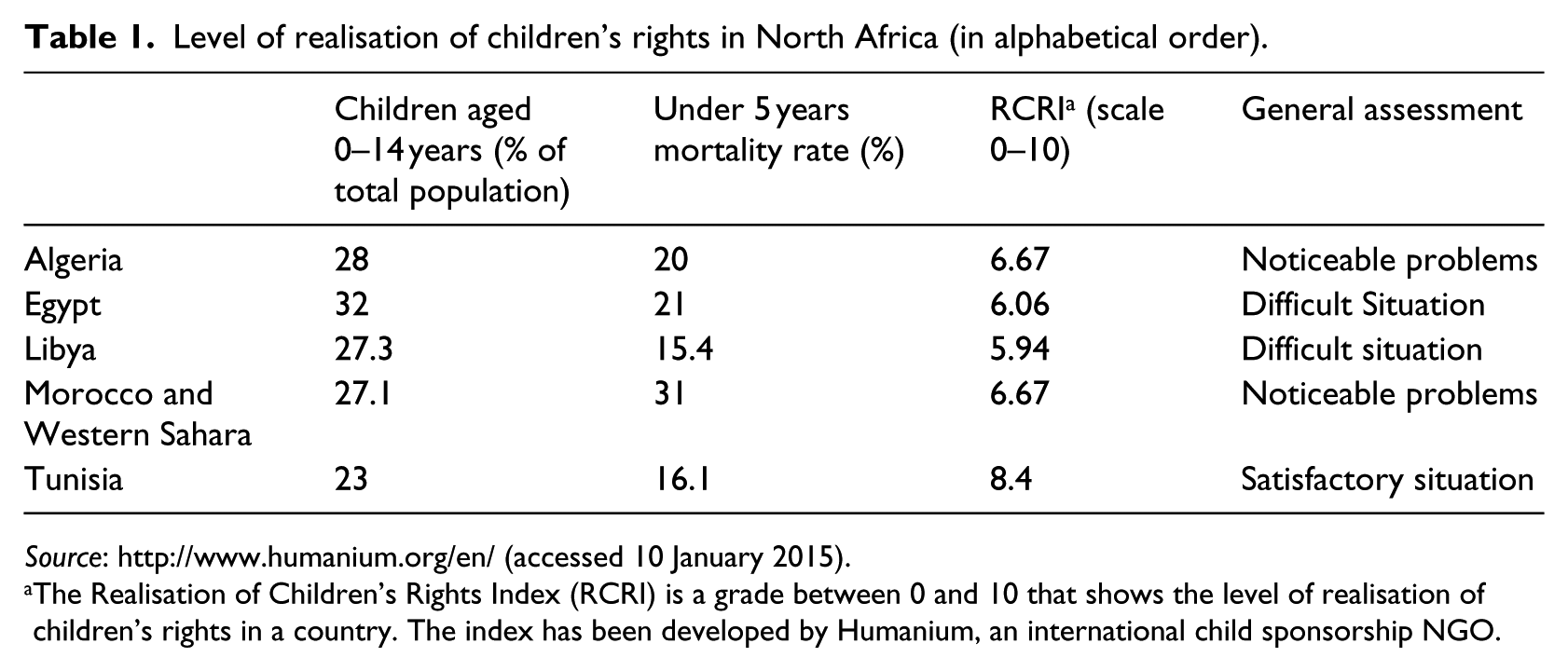
Source: http://www.humanium.org/en/ (accessed 10 January 2015).
The Realisation of Children’s Rights Index (RCRI) is a grade between 0 and 10 that shows the level of realisation of children’s rights in a country. The index has been developed by Humanium, an international child sponsorship NGO.
Education
The enrolment rate in compulsory education (6- to 16-year-olds) is estimated to be around 94%, and there is hardly any disparity between girls and boys as the girls-to-boys ratio is 0.99 (Boussena et al., 2009). Similarly, UNICEF (2014) reports on the education situation by specifying levels of net enrolment rate: in primary education, 98% for boys and 97% for girls and in the middle and secondary schools, 57% for boys and 65% for girls. These rates suggest clearly that there is a quite satisfactorily situation regarding basic levels, but efforts remain to be made in others education levels.
Many other weaknesses are registered in the educational system. The nationwide occupancy rate of primary school premises is 30 pupils instead of 25 as advocated by the Education Act of 2008 (Journal Officiel de la République Algérienne, 2008). Teacher preparation and in-service education are also diffident: teacher qualifications are below the academic standards required to teach which is a bachelor’s degree. At primary school level, only 17% of teachers have this qualification, and almost 70% of middle schoolteachers do not meet this requirement. Moreover, the internal efficiency of the educational system is far below the aspirations of society, for example, the rate of students repeating years and school dropout rates are very high. For instance, the success rate in the year 2008–2009, without repetition, is extremely low. Only 61% of pupils in the initial cohort reached fifth-grade primary school, 55% went to first-year middle school, less than 15% gained access to the first year of secondary school and just over 4% out of the cohort obtained the baccalaureate (Boussena et al., 2009; Lakhdar et al., 2012). Also, regional disparities in education provisions in general are apparently wide.
In the same vein, it should be noted that the institution devoted to children before school age and children with disabilities of all ages in Algeria are run under the auspices of the Ministry of National Solidarity. The Ministry of National Education is directly responsible of educational institutions of primary, middle and secondary schools only. The integration of children with disabilities in regular schools is officially recommended but in effective terms remains limited. Available figures indicate that some progress was made with numbers of children attending ‘integrated classes’ increasing from 302 in 2002 to 1033 students in 2007 (MSPRH and ONS, 2008).
Protection
Efforts towards guaranteeing the need to protect vulnerable children have produced an arsenal of measures targeting different contexts, especially in the family code, the code of civil and administrative procedure, the penal code and labour relationships. Despite these initiatives, recent surveys show that the number of children in need of protection is not only significant but is increasing. Humanium organisation 4 estimates that some 5000 babies are abandoned every year because they are born out of the legal union of marriage, known also as ‘love children’. According to Rekik (2011), about 3000 of these babies are received every year in specialised nurseries. Some of these children are adopted by ordinary families, under the Islamic system of kafala, which is a mechanism of protective social action. But except in Tunisia, in all Muslim countries, kafala prohibits giving to the adopted child the adoptive parents’ filiation (name). Nevertheless, Algeria introduced changes with the executive decree (n° 92-24 du 13 janvier 1992, relatif au changement de noms) that permits filiation between ‘kafil’ (adoptive parents) and ‘mekfoul’ (adopted) if the child is of unknown ancestry or if his or her biological mother has approved in writing this possibility. These children enjoy rights to health care and education as any other child but may suffer social prejudice as a consequence of people’s condemnation of sexual relationships and child births out of the institution of marriage. Recently, laws that force biologic parents to accept their children after DNA testing were passed. Some of this progress was the result of the efforts of NGO’s campaigns, such as ‘L’Association Algérienne, Enfance et Famille d’Accueil Bénévole’ (Joussour, 2014).
Cases of abuse of children within their own families and in schools are also reported (CNES, 2009; MSPRH and ONS, 2008; Rouag et al., 2009). The Centre d’Information et de Documentation sur les Droits de L’Enfant et de la Femme (CIDDEF, 2009) survey found that one-quarter of the interviewed adolescents (total number of participants was not reported), equally across the two gender groups (aged 14–17 years), declare having been victims of family violence during the preceding year. Perpetrators are in half of the cases the fathers, the mothers in about 40% of the cases and fewer than 20% are the brothers. Furthermore, 70% of violent acts towards male adolescents are from fathers and 20% from mothers, while in one half of the cases, the perpetrators against girls are mothers, fathers are responsible for 30% of cases and brothers for 20% of acts of violence against their sisters (p. 33). The survey indicates that violence is less frequent in families with educated parents, that is, holders of university degrees (18% of the acts of violence) compared to parents with low educational levels, that is, primary or no formal instruction (29% of those acts targeting adolescents). The authors of the survey report briefly that victims of violence also come from families where fathers and mothers use violent behaviours against each other (conjugal violence). MICS3 results (MSPRH and ONS, 2008) corroborate these findings, showing that 86% of children received a form of physical or psychological punishment (i.e. verbal threats and emotional pressures) during the month preceding the research. Among those physically punished, 22.5% received severe physical punishments (e.g. hit on the face or head or hit using a hard stick; MSPRH and ONS, 2008: 160).
Violence at schools is also frequent. During the school year 2007–2008, 36% of boys and 15% of girls, aged 14–17 years, declare having at least once been victims of an aggression by a member of school personnel and in 70% of the cases by teachers (CIDDEF, 2009). The cited reasons are mostly as disciplinary measures (pp. 49–50).
Bullying in schools is also reaching worrying scales. Tiliouine (2014c) found that 15.1%, 9.9% and 12.3% of 8-, 10- and 12-year-old students, respectively, were victims of active (physical) bullying, and 16.3%, 15.8% and 20.6%, respectively, had been victims of passive bullying (being left out by classmates) during the month that preceded data collection. The sample consisted of 1452 schoolchildren.
Several factors are at the source of these problems for children, such as poverty in some families, the rapid socio-economic change of society as a whole and the lack of knowledge of adults and children of children’s rights. Indeed, the result of a recent investigation shows that 14% of parents, and 21% of children, do not seem to consider it essential that a child should be legally protected against violence, and only 7.9% of parents who deem it necessary say that they do so naturally (Ecotechnics, Etudes et Conseil, 2009).
Another noteworthy aspect concerning child protection is the fact that a number of marriages take place before the authorised legal age, which is 19 years for women (child marriage). MICS3 data revealed that 7.8% of women aged between 15 and 49 years were married before the age of 18 years and even 0.8% were married before the age of 15 years. This goes in contradiction with children’s rights? Obviously, young and unprepared mothers may encourage wrong practices in bringing up children.
In addition, Algeria is hosting many refugee populations immigrating mainly from Occidental Sahara, a disputed region between Polisario and Morocco (about 196,000 persons according to Humanium, 2015), and also from Libya and Syria and ‘illegal’ immigrants from the African Sahel. The official numbers are not made public, but the situation of refugee children is generally described as difficult and challenging for the Algerian government.
Participation
On legislative grounds, the right of participation is guaranteed by article 31 of the Algerian Constitution, which clearly states that the exercise of this right by all should be without any constraints. The Algerian Education Act (articles 04–08) considers the school space as the most appropriate environment for students, to exercise their rights to participation. Despite this, the execution of these texts remains very limited (Boussena et al., 2009). Benamar (2008) described the school environment as a space managed through internal rules which had been based on obligations and constraints to ensure order and silence among pupils rather than encouraging their participation. Moreover, pupils are hardly invited to participate in life of the school; even class delegates have no, or little, chance of representing their fellow pupils (CRASC, 2009). Participation of pupils in Algerian schools from the elementary level to the secondary one is limited to some cultural and sporting activities which in most cases are defined and controlled by adults.
Moreover, conservative values are dominant in Algerian families; thus, children are to be found usually in situations that require them to listen and to obey adults, essentially their parents, rather than participate in decision-making matters and events of family life. A recent study has illustrated that the home environment allows teenagers to be informed and to be heard on certain subjects, but they remain almost completely excluded from decision-making (CRASC, 2009). In the same lines, the CIDDEF (2009) study indicates that parents discuss often a multitude of topics with their children, but the majority of children are not systematically consulted or involved in family decision-making.
However, it is important to recognise that a number of researchers report that in many other countries, children’s right to participation is largely ignored comparatively to the rights to meet basic human needs (Zihni, 2014). Many local NGOs in Algeria are leading initiatives, among other things, to disseminate ideas on systematically encouraging children’s participation in decisions in relation to their own lives (MDCFCF, 2008). For instance, the Algerian network for the defence of children’s rights (NADA), includes more than 100 associations and NGOs which are active through a sustainable partnership with institutions, other associations and sponsors in order to promote the respect of the rights of the child and defend them from all forms of violence, exploitation, abuse and discrimination (Joussour, 2014). NADA and other NGOs may gain a lot from sharing their experiences with other NGOs and coalitions to promote the right of the child in neighbouring Arab countries, mainly those of Egypt and Tunisia who are to some extent facing similar challenges.
Leisure and culture
Physical education is compulsory for all pupils from the beginning to the end of their schooling period, as prescribed by article 37 of the Education Act of 2008 (Journal Officiel de la République Algérienne, 2008). However, this can only occur if educational institutions possess the necessary infrastructure. The first point to make here is that the majority of primary schools seem not to be equipped with proper sports facilities, and regional discrepancies are large (Boussena et al., 2009; MDCFCF, 2008).
Knowledge and perceptions of children’s rights among Algerian adults and youth: A review of research
In relation to the knowledge and perceptions of children’s rights among adults and youth in Algeria, a survey was carried out in the city of Oran by Benamar (2008). The results show that the basic principles of children’s rights are not known by most of the interviewed educators: 36 teachers, 17 school headmasters and 3 inspectors. Furthermore, the internal rules of the schools included in this investigation did not take the rights of children into account. The teachers’ answers when asked if they knew about the UN CRC and the African Charter on the Rights and Well-Being of children proved clearly that they had very little knowledge regarding these issues. However, Ecotechnics, Etudes et Conseil (2009) survey reported that 40% of fathers and 33% of mothers, 27% of girls and 37% of boys (aged 14–17 years) had heard of the CRC, whereas, a higher proportion declared knowing what children’s rights are (77% fathers, 72.1% mothers, 84.3% of the girls and 81.4% of the boys; p. 13). The slight discrepancy between fathers and mothers was interpreted by the impression that men were better informed than women. Maybe because many women stay at home as housewives, meanwhile more men have the opportunity to interact with other people at work and in public spaces and hence are better informed.
As for the most known children’s rights, they found that education and then health ranked the highest. They were followed by the right to appropriate food, leisure activities and protection from all forms of exploitation and violence. These latter rights are known by about half of all parents. The right to participation came far behind other rights with less than 20% of parents’ responses. The same prioritisation is observed among children, but, unexpectedly, fewer children knew these rights compared to parents (16 percentage point difference). Also questionable was the result that boys knowing those rights outnumbered girls (up to 8 percentage point difference). The reasons behind this discrepancy are unclear but are possibly related to a social practice which encourages girls to stay at home with mothers.
In a third study, Tiliouine and Boussena (in press) presented empirical data with regard to the knowledge of young children of these issues (n = 962). Two age groups participated: 10-year-olds enrolled in the fifth-grade primary schools and 12-year-olds enrolled in the first-year middle schools. The results showed that less than half of the respondents declared knowing what children’s rights were, and a closer percentage were not sure that they knew them. Meanwhile, one-third of them had heard of the CRC and a similar proportion declared categorically not having heard of that convention. Finally, one-fifth of them totally refused the idea that adults in the country respected those rights, but 45% held an opposite view. Moreover, this study indicated that only 43.8% of children (mean age: 11.13 years, standard deviation (SD): 1.24 years) declared knowing what children’s rights were. This proportion is much lower than the results reported in the CIDDEF (2009) survey. On one hand, this discrepancy may imply that children as they grow up they become more aware of their rights. On the other hand, this also may indicate that schools neglect advertising the CRC and do not make sufficient efforts to inform and teach children’s rights at schools using adapted instructional activities and aids. The Ministry of Education should take the necessary actions to propagate information on children’s rights and ensure that CRC is appropriately implemented in schools and elsewhere.
Discussion
The consequences of neglecting or down-playing children’s rights on any society are certainly drastic. They not only render any development effort futile and reversible but also jeopardise its future in the long run. For instance, bringing up children in an atmosphere of violence will undoubtedly increase social disorder and insecurity. However, reinforcing children’s rights is much linked to the local history, political, cultural and economic development levels and current socio-cultural dynamics of any society. In this respect, multidisciplinary readings of the history of local traditions of a country such as Algeria remain rare (Tiliouine, 2014a). As shown earlier, the colonial presence and the subsequent war of liberation (1954–1962) created much suffering particularly for children and their families (Gemie, 1998; Heggoy, 1984).
The policies which were followed within the totalitarian socialist regime that ruled Algeria after the independence have not succeeded to heal the situation and to build an all-inclusive societal project. The few successes in the areas of child’s rights, such as access to modern education and to health care, have been proven fragile and reversible. Consequently, during the 1990s, the country plunged again into social turmoil leading to destructive consequences on families and their children such as increased prevalence of PTSD, greater number of orphans and homeless people (e.g. Ait Sidhoum et al., 2001; Boudef et al., 2007).
Fortunately, that situation did not deter the country from engaging in some actions for the benefit of children. In 1992, the CRC was ratified along with other international child protection laws. Nevertheless, the reservations of the government, as mentioned earlier, leave space to criticism and can be interpreted as limiting the freedom of choice of families and their children. This issue should attract more specialised efforts to promote suitable actions to help safeguard the highest interests of Algerian children. Comparisons with other North African countries such as Tunisia corroborate the findings of this article. Table 1 (column 4) shows that as assessed through the Realisation of Children’s Rights Index (RCRI), Algeria’s score is yet meagre. The stability and the financial ease that the country is presently enjoying should motivate the government to engage in more substantial actions to promote further children’s protection.
However, it should be reiterated that the ratification of the CRC by Algeria has been beneficial on many grounds. First, the arsenal of national laws regarding children has gradually been adapting to these international engagements although with reservations. Also, a strategy favouring children’s protection has been formulated within the childhood national plan (Plan National d’Action pour les enfants, MDCFCF, 2008). Some advances were outlined earlier in new birth registration (MSPRH and ONS, 2008), vaccinations against children’s diseases (Sous-direction de la Prévention en Milieu Educatif, 2010–2011), and free health care for children with chronic illnesses such as cancer, respiratory illnesses, diabetes and so on. Children with disabilities are also receiving free health care. Even so, these and other steps forward have not led to completely achieving the UN MDGs, especially in the areas of reducing infant mortality rate and maternal mortality (Tiliouine, 2014b). As shown in Table 1 (column 3), infant mortality rate in Algeria is substantially higher than in the countries of Tunisia and Libya.
In the field of education, primary school enrolment rate is at about 97% of school-age children. But challenges are yet numerous: high rates of dropouts and the need to rehabilitate and adapt school spaces and equipments to children’s characteristics, extend preparatory education to children aged 5 years and pre-schooling for children of 3–4 years, evaluate and regularly review school curricula, improve the conditions of schooling and combat violence and bullying, improve teacher preparation and in-service education at all levels, combat regional disparities and social exclusion mainly of children with disabilities and generalise the use of modern information technologies in teaching (e.g. Boussena et al., 2009; Lakhdar et al., 2012; Tiliouine, 2014c). Obviously, such objectives call for a national strategy that invites a tight collaboration between and engagement of all the society’s partners and also should secure the necessary funds through the state budget and other forms of sponsorships and donations.
The other sector where huge efforts should be deployed is children’s right to protection. Here too, the official Plan National d’Action pour les enfants of 2008 should be followed with concrete actions of evaluation and monitoring. Violation in this respect, by parents, school staff or in public spaces, should be according to the law severely punished. The number of violence victims among children is alarming (e.g. Ecotechnics, Etudes et Conseil, 2009; MSPRH and ONS, 2008; Tiliouine, 2014c) and exposure to drugs and juvenile delinquency seem to have increased as Algerian society is undergoing huge social changes. Such change is a natural consequence of women’s emancipation and access to jobs, the family structure shift from an extended to a nuclear type, the increasing demand on housing and expanding economic difficulties and rising regional and other forms of inequalities. Here too, policy-makers should follow realistic measures within a well-worked out strategy to meet these challenges.
The school environment in Algeria is unfortunately managed through obligations and constraints as ways to ensure order and silence instead of enhancing participation (e.g. Benamar, 2008). Very little importance is given to class representatives (CRASC, 2009), and children’s free choice of study specialty is often played down. Other practices such as physical punishments deter children from participation. Research institutions, the media and NGOs should campaign fiercely to deter using violent means against children.
Finally, the right to leisure and cultural opportunities for children should be reinforced through the availability of suitable spaces and equipments and well-trained personnel. Knowing that less than 20% of children practice a sport regularly and less than 10% engage in cultural or manual activities (CIDDEF, 2009) is worrying because of the probable negative implications on the physical and mental health of the whole nation on the long run.
Furthermore, one of the obstacles towards the implementation of CRC requirements is the limited knowledge of the child legislation in Algeria as shown in the figures reported in Benamar (2008), Ecotechnics, Etudes et Conseil (2009), CIDDEF (2009) and Tiliouine and Boussena (in press). This may prove that the school system and curricula are not effectively playing their role in explaining legal texts and ensuring that school regulations meet CRC requirements. Additional actions aiming to properly inform people through mass media and religious institutions and encourage NGO’s proximity work with parents and educators alike have the potential on the long run to contribute in propagating a culture of protection of children and enhance respect of the legislation.
At a more specific level, we recommend that the government should appoint an official and qualified body to produce indicators to evaluate and monitor the protection, respect and promotion of children’s rights all over the country in application of the CRC reporting and monitoring processes. Organisation for Economic Co-operation and Development (OECD, 2009): ‘Doing better for children’ and the European Union Agency for Fundamental Rights (FRA, 2010): ‘Developing indicators for the protection, respect and promotion of the rights of the child in the European Union’ could be inspiring in this respect. The role of researchers in collecting and analysing data on children aged 0–14 years who represent 28% of the population (Table 1) should be properly strengthened and lead other efforts. NGO’s work should also be highly valued through a well-worked out merit system. Incentives should be given to successful initiatives. NGO’s coalitions, such as NADA (Joussour, 2014), should be further encouraged.
NGO’s work is essential as society is undergoing important changes because of continuously increased urbanisation, widening social inequalities and lack of public debate on issues such as violence within family and empowerment of young people voices. Political parties also have to play their role to put on the governmental agenda issues related to children’s rights and to ensure funding of initiatives to protect youth who represent the future of the country.
Finally, the present research has many limitations. It is basically descriptive and uses scarce published reports. However, it has the merit of raising a vital issue towards introducing some harmony in the Algerian development model.
Footnotes
Funding
This research received no specific grant from any funding agency in the public, commercial or not-for-profit sectors.