



Abstract
Performative participatory research projects conducted with people of immigrant backgrounds, especially those conducted by Maggie O’Neill in the East Midlands, United Kingdom (1999–2009), have the potential to create new spaces for ‘new homes’. They also provide insights into migrant youth’s homing desire and the way it relates to cultural and national citizenship and diasporic imaginings. In this article, I analyse productions made together with a group of Somali youths in Finland: a book, a radio programme, a documentary film, photographs and a video installation, wherein the youths, by reflecting on their childhood memories, focus on issues of belonging and negotiations of Finnishness. I argue that as youths with immigrant backgrounds participate in making their own audio-visual narrations, they challenge and broaden the images of ‘ideal Finnishness’ presented to them by mainstream discourses and practices. I present some examples of the work the youths have done and discuss some of the conclusions they present in their artworks. I aim to demonstrate the ways in which second-generation immigrant youths’ perspectives could be and should be used in reframing social, cultural, political and educational discourses, supporting new kinds of constructions and representations of what citizenship and belonging in the Finnish society entails.
Keywords
Introduction
The performative research approach differs from traditional data collection and analysis, as productions become part of research reporting. In my performative research, the youths participated in creating and performing narrations that were shared with a large audience in media, cultural and educational settings. The youths have also given talks on many occasions and presented their works and ideas in the media. One of the aims of my performative research project is to involve them in ways that make them active, intimate, hands-on participants and producers and creators of the knowledge concerning themselves (Conquergood, 2009). Additionally, I have presented the project and its results in traditional academic contexts; for example, in this article, where my own voice dominates, the conclusions are drawn by myself and based as much on the existing research and theory as on the data and reporting produced with the young people. In this article, I use interpretive thematic analysis, concentrating on the issues of citizenship, home and belongings in the youths’ productions.
Anh Hua (2011) remarks that even though the moral recognition as personhood is distributed unequally among individuals and communities within various nation-states, diasporic subjects perform citizenship as personhood for creative survival and claim multiple modes of belonging and multiple locations of home and affiliations. In our project, it was apparent that in the process of performing and narrating their belongings, the youths were rewriting the (symbolic) nation as an exclusionary site or uneven social–human geography. In creating new spaces for new homes, they revealed that homing desire is tied to cultural citizenship and diasporic imaginings (Hua, 2011: 54–55).
Even though the participating youths were already young adults, I think that from their stories, based on their memories, it is possible to throw light on their childhood experiences, too. Also, when young people with immigrant backgrounds describe and deconstruct their experiences, they create a new language, images and expressions, and in this way support later generations in their efforts to approach and deal with similar kinds of experiences (Ibrahim, 2009; Midolo, 2011). I have often witnessed this when the participants have shared their productions with younger children in classrooms, exhibitions and research settings. At their best, their works have inspired younger children to narrate their own stories and deal with questions of belonging and citizenship. Even though we have minorities in Finland and their constitutional rights have been under public consideration for decades, generally speaking, Finland has been considered to be a mono-cultural society until the late 20th century. Accordingly, there has been relatively little discussion about diverse citizenships and belongings, and in educational and cultural context, Finnishness is usually presented in ethnic (Finnish) and racial (white) terms (Lappalainen, 2006). This was also a point often highlighted by the participants of the project and shared with their young audience.
The overall project
In 2009–2010, we conducted workshops with photographer Sami Sallinen at the Young People’s Multicultural Living Room in Helsinki. Most of the participants, who were all 18–20 years old at the time, happened to have a Somali background. By way of introduction, they were asked to tell about their everyday experiences in, and relations to, Helsinki and other places where they had lived or which they had visited. This was done through photographs, videos and stories. Based on the material produced during the workshops and by the young people in their leisure time, we produced a photograph exhibition and the video documentary Minun Helsinkini/My Helsinki/Magaaladeydii Helsinki in 2010 that were presented in Library 10 located in downtown Helsinki. Since then, the exhibition has been presented on several occasions.
In spring 2011, together with five young Somali men and one young woman, I made a radio programme Mis on mun tila? (Where Is My Space?) as a joint production with a team from YLE, Finland’s national public service broadcasting company. A book Mun stadi (My Town) by Oikarinen-Jabai, based on the visual and audio-visual material created by the youngsters, was published in 2012.
During March–September 2013, Somali Youth in the Institute of Migration, Turku, Finland presented the materials produced by the young Somali men together with the photographic and audio-visual material produced by a young Somali woman in the exhibition Through My Eyes – View Points to the World. The material includes photographs, a short film and a book produced by the group of young men, as well as photographs and audio narration from the female participant. The visual and narrative productions of the young Somali men participating in the exhibition are on show mainly in Helsinki. The contributions of the female participant – photographs on the walls of the exhibition space and a video narrative with photographs and story – circulate between Finland, England (where she studied for three years) and Somalia (which she visited in summer 2010).
In all the projects, the participating youths had photograph and/or video cameras, and they themselves chose what they wanted to shoot and present. For example, in the documentary video, they present their childhood memories and leisure time activities. They also interview each other and other youths, discussing issues like racism, nationality, ethnic identities, military service and youth cultures. By participating in the reporting process, the young people become co-researchers of the study (Wang et al., 2004). In their productions, the participants’ voice and perspectives are shared with the wider public. For example, in the pages of the book My Town, their stories and photographs converse with each other and with the audience. The book includes chapters such as Childhood, Youth, School, Helsinki, Upbringing, Racism, Languages, Military Service, Religion, Somalia, Family and Community, Guards and Cops, Finnishness/Somaliness and Media and Dark People (referring to Roma People who in Finnish society are usually called Dark, or by the word Mustalainen that can be translated as Blackish). These are all themes that arose from the narratives of the young men.
Methodology
In my research, the academic and popular texts produced, for example films, photograph exhibitions, books and radio programmes, the diasporic spaces and multiple voices, intersect and produce ‘unfinished knowledge’ (Yuval-Davis, 1997). Unfinished knowledge is based on transversal politics emerging from dialogue, so that the different voices and positions of the participants are accepted as well as the knowledge that every different position can produce. Transversal politics differs from universalism and relativism. It identifies a difference between social identities and social values and postulates epistemological communities that share similar kinds of value, even though they are rooted differently (Yuval-Davis, 2011). Transversal politics are based on the symmetrical politics of the Buberian ‘I-You’ approach (Buber, 1993 [1923]). I think that this kind of approach helps in valourizing the multiple positioning that the second-generation immigrants in Finland often experience and also helps other participants to shift from their epistemological standpoints.
I have defined my research in different contexts, respectively as art-based research or practically orientated performative research that uses participatory practices. I think that performative approaches are important in creating intercultural understandings and communication because they simultaneously allow considering the ‘messy’ physical, social and abstract realities from several perspectives (Jungnickel and Hjort, 2014). This also helps to approve different epistemological understandings and ways of knowing (Oikarinen-Jabai, 2008).
The performative approach can be seen as an alternative to quantitative and qualitative paradigms. The artistic and practical procedures it involves enable research strategies with new kinds of positioning for researcher, researched and research setting. The data and the results can be presented in both symbolic and presentational forms (Haseman, 2006; O’Neill, 2009). Richardson (1997) argues that narrative and poetic representation can touch our bodies in ways that are different from the effects of standard scientific transcriptions. This makes it possible to reflect the research story on a sensory and cognitive level. As a sociologist, she thinks that turning data into poetry can make visible the underlying labour of sociological production and its conventional rhetoric. As she continues, a ‘“sociopoetics” then, in this postmodernist juncture, is both framework and method for representing the sociological’ (Richardson, 1997: 144).
The results that I present in this article are based on stories that all research participants created together – on the audio-visual narratives and perspectives they wanted to share in their productions. These narrations as performative symbolic data are not only expressions of the research, but these expressions become the research itself (Denzin, 2003; Haseman, 2006). O’Neill defines her approach that involves working in collaboration with artists, performance artists, writers, poets, photographers and participants in the space between ethnography and art as ‘ethno-mimesis’. ‘Ethno-mimesis’ involves a methodological practice, a process that enables the inter-textuality of biography/narrative (ethnography) and art (mimesis) to become a ‘potential space’ for transformative possibilities (O’Neill, 2008: 3).
It seems that when the youths participating in the project talk about their childhood memories or other experiences, they often have a standpoint that is simultaneously inside(r’s) and outside(r’s). Avtar Brah (1996) argues that social relations, experience, subjectivity and identity are ‘differential’ categories situated in multiaxial fields of power relations. The similarities and differences across axes of differentiations – with regard to class, race, gender and equality, for example – are articulated (or disarticulated) in the diasporic space within a complex web of power. In the intersectional landscape of diaspora space where insights emerging from multiple landscapes of differentiations and power relations merge, theoretical and methodological creolization can be conducted. Participatory approaches are especially useful when dealing with transnational and diasporic experiences because they involve praxis as purposeful knowledge, which tells us, in a relational and phenomenological sense, something about what it is to feel ‘at home’ and have ‘a sense of belonging’ (O’Neill, 2009). In the landscape that we created in our project and in the productions created by the youths, practices of differentiation could be exposed (O’Neill, 2008).
In this article, I have looked at the above-mentioned productions focusing on the themes of citizenship, belonging, home and experienced othering, which were the topics that the participating youths – both females and males – often dealt with in their different artworks, approaching them from various perspectives. Especially, I focused on how they expressed and narrated their childhood memories, their experiences of growing up in Finland and how they positioned themselves as citizens and members of nations. When doing my analysis and interpretations, I tried to give presence to the voice, perspectives and embodied experience of the youths. As Jon Prosser and Andrew Loxley (2008) write, the images created in participatory research can be put to a number of different uses (descriptive, documentary, analytical, symbolic and rhetorical, etc.), but the core of this is a phenomenological ‘centring’ of participants’ lived experience. In any case, biographical and art-based research may involve inquiry that shows the embeddedness of the small-scale phenomena in the broader social totality (O’Neill, 2011).
In-between spaces, nationalities and languages
Apparently, the young people participating in the project are at least as familiar with the locations of borders as with (their) imaginable homes in different countries and cultural spheres. The transnational spaces, to which they concretely belong through the kinship relations and the diasporic community, make it also possible for them to share a kind of ‘horizontal or nomadic citizenship’ (Ashcroft, 2001: 187; Joseph, 1999: 155) and an experience of home reaching over the different continents (Oikarinen-Jabai, 2010). According to Bill Ashcroft (2001), the notion of horizon can be used to challenge the concept of boundary – so important to the Western epistemology – and in this way, different dimensions of postcolonial subjectivity can emerge. Second-generation immigrants have become used to challenging boundaries and negotiating the in-between spaces of different cultures, languages and value systems. ‘One is like James Bond, playing a role in a cover story’, as one male participant described his placement in-between cultures.
The participating youths emphasized in their productions that because of their skin colour and religion, they are often seen as outsiders. This is frustrating, but it seems they also know that this position is a strength because it provides a standpoint to examine the structures of Finnish society and its connections to global value mappings. Many second-generation immigrants become specialists of the political, social, economic and psychological spheres of influence that they come across in their diasporic spaces (Brah, 2001; Simmons and Plaza, 2006). A young woman said in the radio programme: Personally I have thought for some time that it should not be this way. That these children and youths should not be all the time looking for their own place, but they should make their own place … So that they would feel that they belong to somewhere … Because in the end we don’t have a place almost anywhere. As Somalis we are also at home like bridges to everywhere, you for example take care of the issues between the outside world and your family. Then when you are in the outside world, you are expected to be a typical Somali. We should find here in between, in the centroid of the identity crisis, some nice box where everyone could go, where they would fit in. (Where Is My Space? Radio program, 2011)
In this existing reality, it seems that these young people portray their in-between or horizontal realities in multiple ways and styles, leaning also on the existing discourses in the postcolonial metaphoric and embodied realms, as well as creating their local specific interpretations. Even though living in-between different cultural systems can be seen as alienating, the youths mostly see it as a resource and possibility (Haikkola, 2012). While the young people are often ambivalent about their national belongings and spaces, they share the idea that they have at least two homes. A female participant put it this way: I think that I am a Somali who has lived in Finland, and I value Finland and also it feels like home … so maybe then I have two homes, Finland actually being the stronger, since most of the memories are based here.
Most of the youths thought that home is where the family is. Nevertheless, home could also be elsewhere. Brah (1996) talks about homing desire, which is not the same thing as desire for a ‘homeland’. The community of the estranged can be reached across different spaces, and in these spaces, multiple identifications and desires can be created through collective acts of remembering shared knowledge and memories. This may lead to a situation in which the place that is experienced most like home is not the place where one lives. Home is all the time in an emerging state (Ahmed, 2000). It can be experienced as an imaginary lost space that unites the past and present, as one could interpret the next quotation from the book My Town: One day my ex-girlfriend was reading my palm, I looked carefully and there was a kind of M-image, for me it symbolises Mogadishu, the city where I was born, hopefully one day it will become more peaceful and we can return there, continue from what we lost twenty year ago. (p. 123)
Trinh T. Minh-ha (2011) reminds us that a ‘travelling self’ can be seen as one who moves physically from one place to another, following ‘public routes and beaten tracks’, but who at the same time embarks on undetermined journeys, constantly negotiating between home and abroad, between here and there and elsewhere (p. 27). Even though the participating youths would not travel physically, still they are constantly on a journey. The elsewhere is always present (Hua, 2011). This leads to ambivalence, which is a fundamental phenomenon that one can come across when analysing the narratives of the participants (Ngo, 2010). On one hand, they seem to share the same reality as most Finnish youths. Yet simultaneously, when growing up, they have been forced to be concerned about their cultural and ‘racial’ backgrounds and ‘difference’ (Oikarinen-Jabai, 2010; Somalis in Helsinki, 2013).
The participants created their own places and followed their desire ‘to feel at home’ as they produced their visual and audio-visual narratives about Helsinki and other places. When they looked through the lens, they could make their own research and open up spaces, for themselves and for the spectator, where it was possible to deal with difference in alternative ways as well as to build bridges across difference (Tolia-Kelly, 2007). Occasionally, the transversal metaphoric spaces were presented as spaces of home and unity (Hua, 2011). In the video installation, a young woman discusses the photograph above (Picture 1).
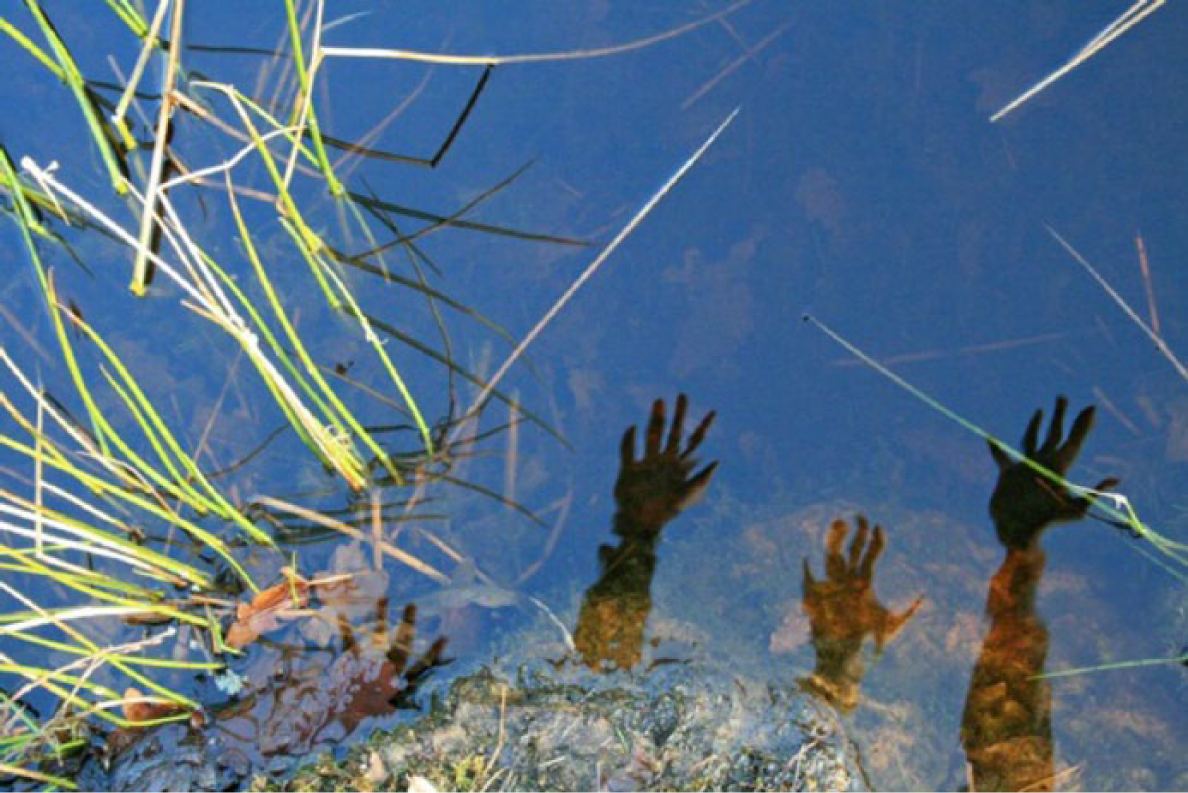
From Najma Yusuf’s By My Eyes video installation.
I think this picture is really great in the sense that every hand belongs to a person from a different continent. I wanted to see if the water reflects, but then my friends got interested in what Najma was doing. Straightaway everyone joined in and then we started to consider what kind of message this particular picture would give. And there you can perhaps see how important it is that people interact with each other, and even if there may be a lot of different opinions, this should not be seen as a restrictive factor. Everyone has the freedom to express their own opinions and their own way of thinking. The point is that you can communicate with others, and they may have something quite different to offer, something that you never imagined, and you may even like it.
According to the phenomenological idea of horizon, things may spatially appear in the ‘outer horizon’ that affects an extension of contextual meaning and also brings emerging views into vision (Ashcroft, 2001). The process of working with audio-visual means enables reflection on embodied sensory experiences in relation to conceptual structures, and in this way the creation of fresh perspectives on phenomena that can be difficult to catch concretely (Tolia-Kelly, 2007). For example, the othering experienced by the young people was an issue that they processed quite often in their productions. In this way, they found new approaches to think about and deal with the sense of ambivalence that othering may create (Oikarinen-Jabai, 2010; O’Neill, 2011). Also, from their perspectives, they contribute to an understanding of Finnishness as multiple, multilingual and border crossing, consequently enhancing awareness of the different dimensions of Finnish nationality and citizenship.
Reflecting experienced othering
In their productions, the participating youths reflected on their childhood experiences and tried to find ways to understand experienced othering and racism. Also, they attempted to ironize, recreate and change normative ideas and representations of ‘outsiders’, national identities and cultural citizenship.
When remembering their childhood experiences, the youths said that although they had experienced othering, and even racism, it was in the secondary school when they became more conscious that they were seen as differing from others. One young man said ‘there were those who are skinheads or Nazis … we had been friends in the primary school and in the secondary school they suddenly turned into something different’. Another remembered how racists used to chase his elder brothers with golf clubs when they went to school. He also said, Even though at school some people were using the n-word and so on, I didn’t understand that they were talking about me. I asked a teacher what that n-word meant and why they were saying it to me. The teacher just said that it’s not such a big deal. Don’t take any notice. Okay, then I went to ask my mother. She said don’t take any notice. If they still say something then go and tell the teacher. (My Town, p. 68)
Having difficuly in finding adults with whom they could speak about the experiences of exclusion was a common experience for the participants, but sometimes older siblings assisted. The above-mentioned young man said, ‘My big brother said that if they continue to call you names like that, then tell me’. The youths also stated that as older sisters and brothers they looked after and protected their younger siblings.
As migrant youths learn to be ‘practice-based specialists’ of diversity and discrimination, they often have a more personal and everyday insight into what happens in the field than do most educated officials. In this way, they become able to talk about those instances of everyday discrimination that are not openly discussed in Finnish society (Midolo, 2011). The young woman said in the radio programme: The teachers don’t have enough influence. They don’t do enough of what they’re supposed to do. Starting from primary school it always happens that the dark-skinned kids come and say that ‘they insulted me and then I beat them up’, but nobody ever says ‘why did you insult someone’ and ‘why did you beat them up’ … They avoid these so-called sensitive issues. But the issues are not really that sensitive. After all it’s about this kid’s life for the rest of his life. But the fact that someone calls you with the n-word does not necessarily mean that someone is a complete racist. They just want to annoy you and know how to do it. We should discuss about the roots of racism, what it is … what kinds of racism exists. There are many kind of racism. If we categorize that only white people are racist against blacks it is outrageous … And teachers are very scared to talk about racism. If you avoid the subject it does not mean that it goes away because these children are living with it all the time. There should be a racism course at school that people would understand really what it means. We all have prejudices … we should learn to deal with people as individuals … and children would learn to respects other people, black, semi-black and all … (Where Is My Space? Radio program, 2011)
The youths were vocal about the ways in which the media and authorities re(produce) stereotypes when it comes to blackness, Muslims and ‘refugees’, and they deal and play with common derogatory images in their productions (Abu El-Haj and Bonet, 2011; Deggans, 2012). Especially, the young men identified with North-American black media culture and often used its means when they wanted to ‘talk back’ (Midolo, 2011; Sawyer, 2000: 182). For example, in the video documentary, the young men play with and ironize the categorizing labels and stereotypes with their Finnish friends who have roots in different parts of the world. For example, they joke, ‘Arab, soon it will blow man’, ‘Obama, you are going to do it, black power’ or ‘Why do you give a racist attack on a black man, okay, just for him, then that is okay, just cool’. This kind of tongue-in-cheek video material can be empowering for minorities and can help viewers become aware of the limitedness of certain stereotypical views (Ibrahim, 2009; Ngo, 2010).
By performing fresh images of Finns, these young people make space for diverse Finnishness that can include different ethnical, ‘racial’ and religious identifications. For example, in the beginning of every chapter of the book My Town, we formulated a ‘poem’ based on the statements of youths. Above is the opening page of the chapter called Childhood (Picture 2). The text, as translated from Finnish, is ‘Was at the Women’s Clinic that I was born, I and my twin brother, then we used to hang out in Kannelmäki, I was the wild one’. This rhyme on the top of the graphic design merging different pictorial and visual elements, and beside the photograph (on the next page in the book) presenting a leg and ball in speed, creates a hybrid landscape and breaks normative ways of making visual narrations of Finnish childhood, which is in Finnish children’s books and pedagogical texts mostly presented by using representational pictures and by means of white subjects and middle-class environments (Oikarinen-Jabai, 2011).
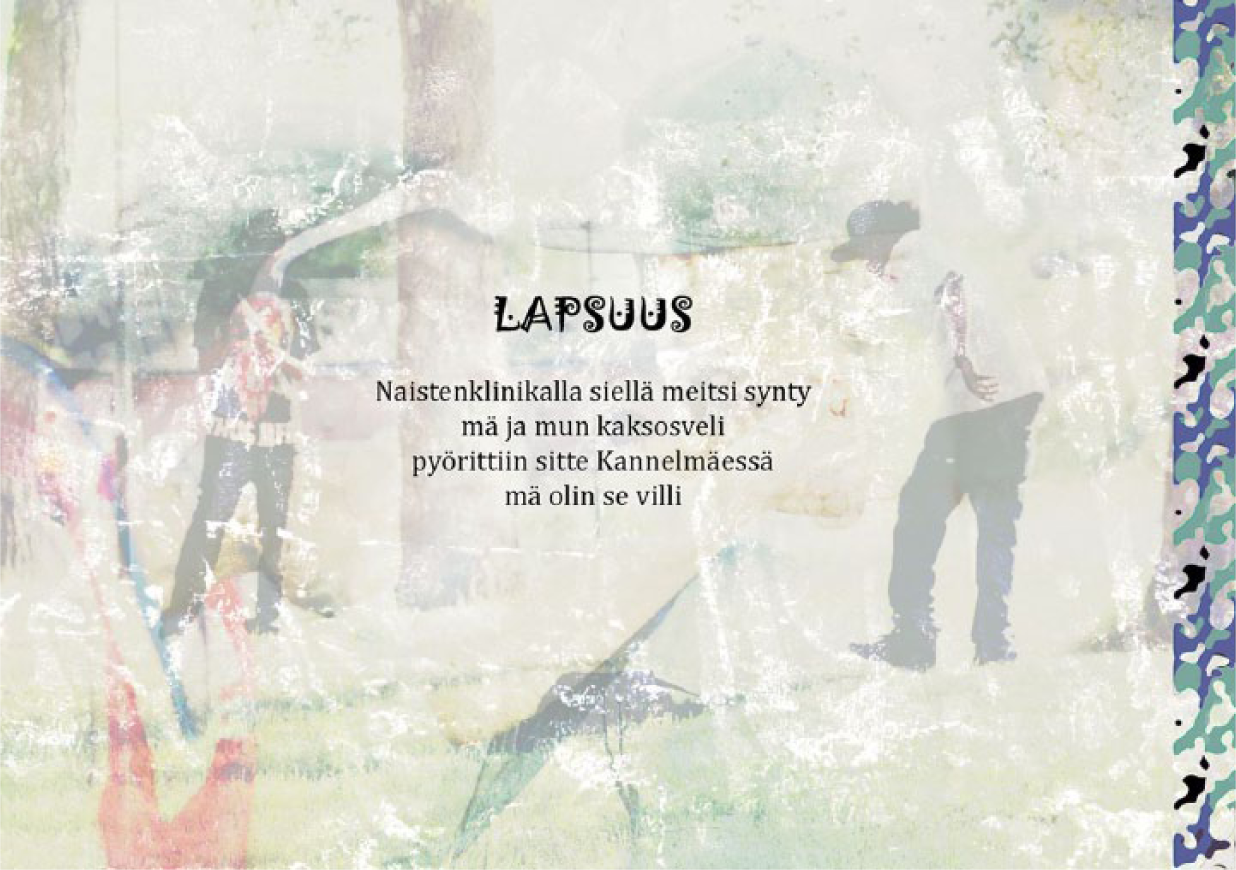
Opening page of the chapter Childhood (My Town, p. 5).
Pictures 3 and 4 come from the video installation of a female participant, in which photographs and audio story move simultaneously. In the beginning, the video maker tells how her family ended up in Eastern Finland by chance, after they had left Somalia when the civil war broke out. The starting photographs of the video depict Finnish landscapes and nature (Picture 3). There is also a photograph with a group of children in the playground. She tells that her little sister, who is also present in the photograph, was left behind in Somalia when the family fled, but arrived in Finland later. When Picture 4 is shown in the video installation she explains, My first memories are from the time when I moved to Helsinki and it was then perhaps for the first time that I encountered some kind of prejudices, but I myself have always been somehow very strong so I’ve never really let those kinds of things get to me.
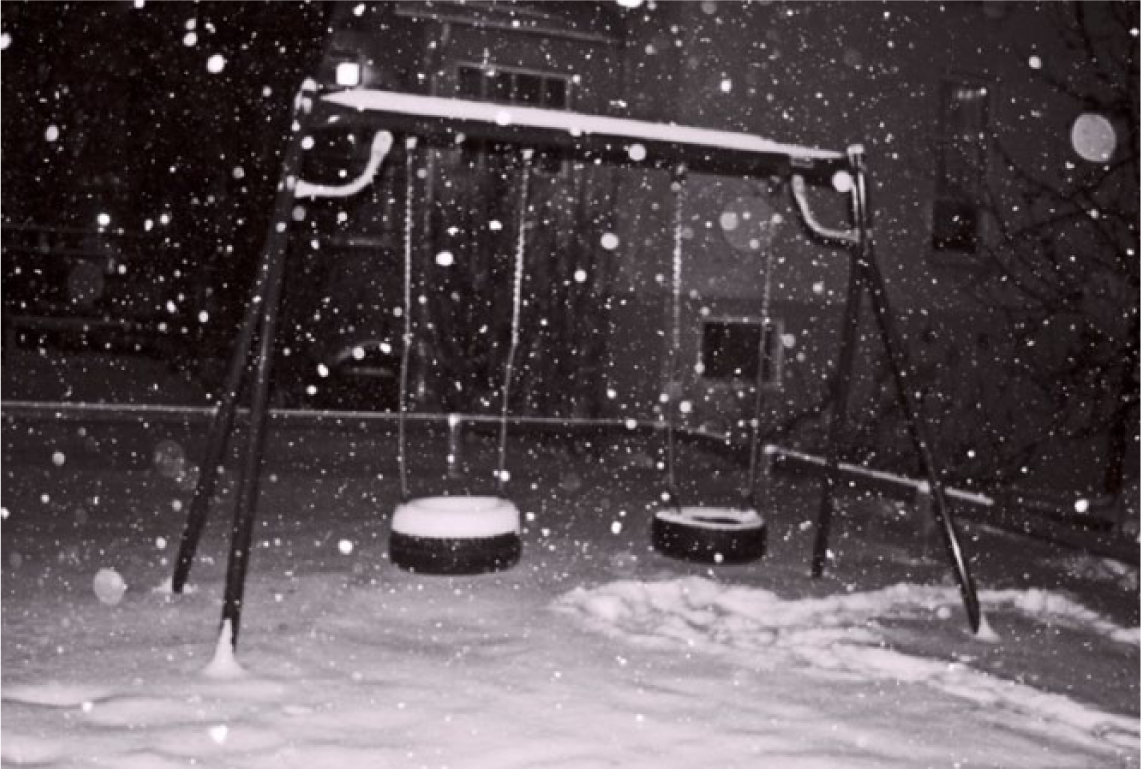
From Najma Yusuf’s By my eyes video installation.
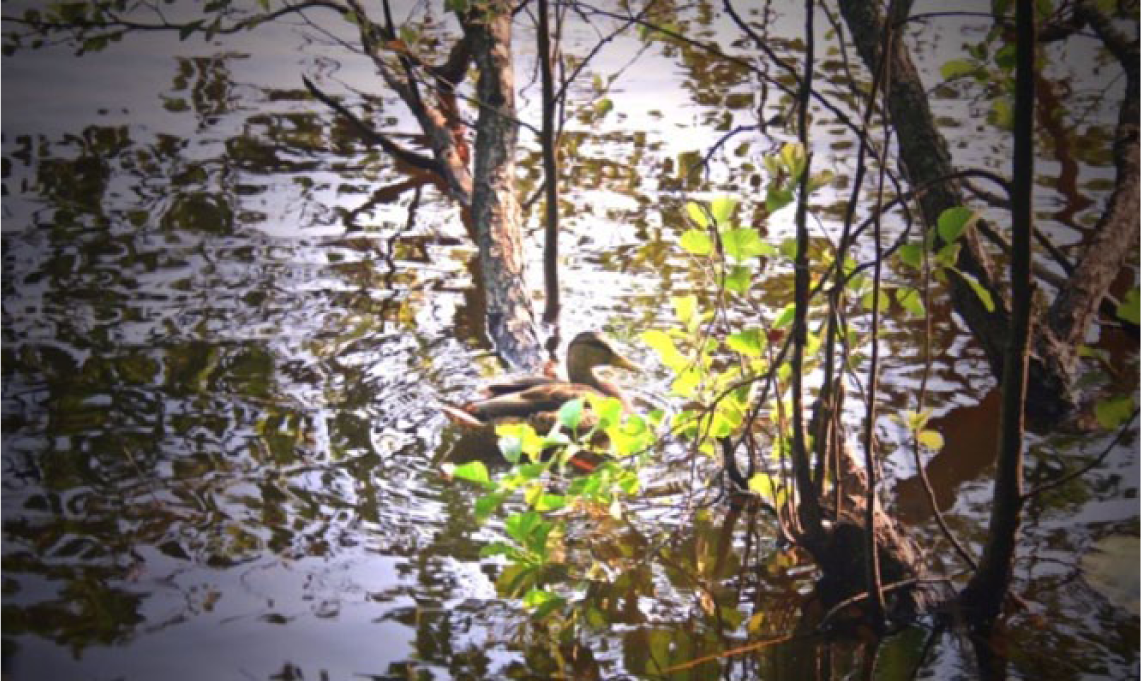
From Najma Yusuf’s By my eyes video installation.
The young women had a tendency to take a caring attitude towards little boys whom they saw as more vulnerable for racist attacks and disenfranchising. Generally speaking, young women seemed to be more concerned about the well-being of their own communities and people in diaspora. Also, they turned more to political and religious discourses that emphasize transcultural approaches, antiracism, love and understanding between different people, religions and cultures (Brah, 1996, 2001).
When the youths talk to each other, they use the Somali, Finnish and English languages, often all three in the same sentence. They express in their productions that they feel proud to know their parents’ language and recount that when visiting North America or many European countries, they have noticed that many of their cousins living there do not know Somali. Although they think that in many ways the Somalis living in England are more accepted by the multicultural society and have more opportunities, for example to establish different types of business, they also think that as Somalis in Finland they have had some advantages. One of them is the possibility to have Somali classes at school and become multilingual. Finland is also seen as a peaceful and easy-going country, where most of them prefer to live.
Generally, participants understand racialization and racism as universal problems, and with regard to Africa and Africans, they think that Europeans especially have deeply rooted stereotypes of them (Small, 1994). One of the young men put it this way: they want to show that you have to know your place, you are a second class citizen, coming from the developing countries, a tax burden, a hungry Somali. And it is in the minds of all Europeans that African countries are underdeveloped and people suffer there because of lack of food.
Although, as the youths recount in the book My Town, experiences of discrimination and stereotyping ‘make you feel down’, and political and popular discussions demonize and offend immigrants and Muslims, making one ‘live under a rock and cross our fingers that soon there will be more people and people with different backgrounds everywhere in society’, most of the youths think that they can have an impact in transforming the Finnish society to become more welcoming and open to different kinds of citizens. They have acknowledged how different cultural customs and languages are slowly influencing the youth cultures and even the youth slang in their hometown. Also, they think that the generation growing up after them experiences and expresses their belongings and national identifications slightly differently (Simmons and Plaza, 2006). Therefore, they believe that their children and grandchildren will be recognized as and feel more like Finns.
Second-generation immigrants as creators of a new kind of Finnishness
The youths participating in the workshops thought that a particular skin colour, ethnic background and religion are mostly counted as indicators of Finnishness. If minority youths do not fulfil the right markers, they may be identified as a threat or looked down upon (Lappalainen, 2006; Somalis in Helsinki, 2013). Consequently, while growing up, they have become specialists not only of the experiences of dislocation in their own lives, but also of the tensions, inclusions and exclusions of the Finnish society that they encounter constantly. In their everyday meetings, they have to think critically and deal with issues concerning their intersecting identifications and multiple belongings between different cultural systems – often being pioneers, for example, in opening discussions about racism, derogatory stereotypes and xenophobia.
Because of a given outsider position in Finnish discussions and practices, they persistently negotiate their citizenship, national identities and identifications and in this way challenge and design a new kind of understanding of nationality and citizenship (Ashcroft, 2001; Ibrahim, 2009). In the productions made during the research project, the influence of these negotiations and of the search for multiple homes and positionings was expressed both in audio-visual materials and in literal stories serving as narrative plots for the artworks produced. Even though there were gender differences in approaches and contents of the productions, both female and male participants emphasized the importance of questions of belongings and national, transnational or international identities and identifications. Moreover, they created these artworks with a desire for their perspectives to have an impact on new kinds of constructions and representations of cultural and national citizenship.
The participating youths have obtained know-how and skills that could be valuable in shaping Finnish and European educational and socio-political discourses and cultural politics. Therefore, their embodied expertise of transversal positioning – as well as that of other youths sharing similar kinds of positions – should be recognized and valued in the different national and everyday discourses and practices of cultural and social institutions (Hua, 2011; Rastas, 2013). In the Nordic countries, as well as elsewhere in Europe, people who distinguish themselves as ‘authentic’ citizens have recently begun to openly express their xenophobic thoughts and opinions (Sheikh, 2002). In this growing wave of intolerance that is based on the idea of ethnicized and racialized nations, the participatory performative research settings can offer a possibility to discuss the subject positionings. In this way, issues of multiple belongings and nationality and their embodied experiences become performative acts for change.
However, there is also and always a risk in participatory research that researched minorities are becoming even more othered (Cooke and Kothari, 2001), especially when the performative material is explored and analysed in media or academic contexts. Therefore, both from practical and theoretical standpoints, it is important to ask who is empowering whom and to which purpose, and to be careful not to reinforce social hierarchies and reproduce the dominant hegemonic agenda when de- and reconstructing minority subjectivities (Koobak, 2014). The participating youths and myself are conscious about this danger, and it has been constantly a subject of our dialogue. Anyhow, I think that the participants have found the performative and practice-based research setting rewarding in offering a possibility to express their perspectives and sway the opinions of their audience. For example, the group of participating young men suggested that they continue with the video work, and we are now working with another documentary for YLE, Finland’s national public service broadcasting company.
In practice-based activity, it is easier to deal with subject positions and practices arising from an axis of colonization or decolonization that are often familiar to children and young people with immigrant background practically but not theoretically (Frankenberg and Mani, 2001). When the youths made their own productions, they could take part in cultural acts and memorize, share and rewrite their childhood memories. They also negotiated on and played with their citizenship status, defining themselves in relation to their positions within the nation and transnational spaces. They talked back to images and placements given to them by mainstream representations in national and global maps (Ahmed, 2000; Hua, 2011). Gradually, they may also play their part in transforming the borders of these maps by illustrating the glocal horizon (Ashcroft, 2001; Ibrahim, 2009). In the horizontal space, resistance discourses and dialogue serve as ways to analyse and ironize boundary categories, such as nation, ‘race’, ethnicity and gender. These spaces can be created by using many (kinds of) ‘languages’ and processes of creolization.
Footnotes
Funding
This research received funding from Finnish Cultural Foundation, Niilo Helander Foundation Jenny and Antti Wihuri Foundation, Alfred Kordelin Foundation, Finnish Art Promotion Centre, Finnish art Council, Otto A. Malmi Foundation and Finnish Institute of Migration.