



Abstract
The Israeli occupation has shaped the lives of Palestinian families for generations. Under occupation, Palestinian children continue to craft identities connected to place, specifically in their relationship with Palestine as a nation-state. Drawing from a qualitative research project using the concept of place as a lens through which to view children’s negotiations with their environments, this article examines how Palestinian identity is related to marginalization and dislocation from place as a result of the ongoing Israeli occupation. A total of 18 interviews were conducted with Palestinian children and their families living in the West Bank and East Jerusalem. The research used a place-based methodology including collaborative family interviews, mapmaking, and drawing. The data generally reinforced the view that a history of dislocation and marginalization from place due to the longstanding occupation contributes to emotions of frustration and hope, which in turn play a significant role in the national imaginary of families and children and ultimately shape Palestinian national identity or being Palestinian.
Introduction
Today’s Palestinian children and families face multiple challenges to their identity and future. Israel’s decades-long occupation of Palestine has contributed to the emotions of marginalization and frustration for Palestinian children and families. 1 Yet there is also a sense of hope for the future and pride related to Palestinians’ strong connection to the place of Palestine. These complex emotions of marginalization, frustration, hope, and pride all contribute to the development of Palestinian national identity for children, with families playing an important role in these processes. Drawing from qualitative research with Palestinian children and families, this article argues that emotions of frustration and hope are reinforced through family practices, which shapes Palestinian national identity.
This article begins with a brief overview of the socio-political context of Palestine, including a description of the everyday challenges that characterize life for Palestinian children and families. This is followed by a discussion of relationships between place and identity and the influence of the family on these relationships. The next section of the article briefly explains the place-based research methodology used in order to understand Palestinian children and families’ experience and to understand the Palestinian nation-state and their role within it. Before concluding, the findings illustrate how the emotions of frustration and hope are repeated through family practices, which shape Palestinian children’s national identity.
The Israeli occupation of Palestine
The Israeli and Palestinian struggle for the futures of their respective nation-states has continued over the past century. An early peak in violence came during the Arab–Israeli War, which began after the State of Israel was officially formed in 1948 and resulted in a large number of Palestinians leaving, fleeing, or being expelled from their homes and land. This event is known as al-Nakba (the catastrophe in Arabic) (Caplan, 2010). Today, Palestine (encompassing the occupied West Bank, the Gaza Strip, and annexed East Jerusalem) has officially been under Israeli control since 1967, although many Palestinians view the occupation as beginning at the time of al-Nakba in 1948. Regardless of which event officially represents the start of the occupation, the Israeli occupation of Palestine marks the longest military occupation in modern history (Hajjar, 2005).
The occupation of Palestine, deemed illegal by international law, has greatly contributed to ongoing violence in the region with tens of thousands of Israelis and Palestinians injured or dead (B’Tselem, 2013). Israeli-imposed restrictions on Palestinian movement are a byproduct of the occupation, contributing to what Halper (2000) has termed as Israel’s ‘matrix of control’ over the Palestinian people. The matrix of control includes the separation wall (B’Tselem, 2011), checkpoints (Weizman, 2007), and permit system (Tawil-Souri, 2010), as well as the demolition of Palestinian homes when these regulations are defied (Jones, 2012). Perhaps the greatest source of violence and the most formidable barrier to peace in the region are the Israeli settlements constructed on Palestinian land in violation of international humanitarian law (Defence for Children International (DCI), 2010). As a result of these elements, Palestinian children are exposed to various forms of violence including Israeli-versus-Palestinian violence and intra-Palestinian violence (e.g. Palestinians accused of collaborating with Israel have been killed, and their families face extreme stigma) (DCI, 2010). Dislocated from their land and confined for years by restrictions to their movement and freedom, Palestinians negotiate everyday boundaries, borders, and barriers within their homeland (Khalidi, 1997). These delineations of place define Palestine as a nation-state and remind the Palestinian people who they are and who they are not (Khalidi, 1997). These challenges also contribute to understandings of being Palestinian and provide the context to frame the following discussion revolving around the concept of place.
Place, family, and national identity
Ambiguity regarding the concept of place continues to both vitalize and confuse scholars from a wide range of disciplines (Chow and Healey, 2008). As Cresswell (2004) notes, place is both simple and complicated, familiar and unfamiliar, full of meaning and without meaning. Cresswell’s assertion that there can be many manifestations of place culminates in his explanation of how individuals can make different spaces meaningful and how people can become attached to certain spaces in a variety of ways. This leads to one of the most straightforward and common definitions of place as ‘a meaningful location’ (Cresswell, 2004: 7). Scholars such as Casey (1993) argue that people are always connected to place, because having and identifying with place are integral to what and who we are as human beings.
Yet, to reiterate Cresswell (2004), the relationship between identity and place is complex, continually evolving through space and time. Massey (2004) suggests that the connection between place and identity is often oversimplified and depends on how these concepts are conceptualized. In this way, Massey (1996) argues against a static notion of place. Rather, for her, places are broad processes that have multiple identities. Indeed, there are historical, temporal, social, and individual practices – for example, through place-based stories and symbols – that shape particular places and one’s emotional experience of these places (Cresswell, 2004). This research, therefore, includes considerations of the changes and disruptions that shape emotions related to place for participants and in turn how those may affect aspects of their identities and well-being.
According to Haviland and Kahlbaugh (1993), emotion is the glue of identity, with different identities associated with different emotions. Identities that generate positive emotions will be played out more often and gain salience, whereas identities that cause negative emotions will become less important (Stryker, 1987). Children’s identities are shaped by developmental changes aligned with the life course in addition to emotions related to their present socio-spatial experience (Haviland et al., 1994). The process of identity formation in childhood includes the integration of the past with the present and the future to provide continuity or consistency (Marcia, 1966). This is especially relevant for Palestinian children, who carry emotions related to the history of marginalization and dislocation from place, as well as a future hope for Palestine as a people and a place.
In the context of Palestine, place represents both an emotional and central organizing concept in the fight for land (specifically, the West Bank, East Jerusalem) and identity (Palestinian/Israeli). This is coupled with a growing emotional and physical disruption and disintegration of place at the levels of the home, neighborhood-community, and nation (Akesson, 2014). Dislocation from place may affect one emotionally, thereby altering various aspects of one’s identity, particularly those aspects that place supported (Speller et al., 2002), such as one’s national identity. Rather than contributing to a loss of identity associated with being dislocated from place or ‘an impartial relativity that allows for commitment to nothing’ (Seamon and Sowers, 2008: 49), this article argues that marginalization and dislocation actually contribute to Palestinian identity.
Concepts and practices of place, identity, and family are all intimately related, both emotionally and physically. Indeed, contemporary analysis considers families as situated in both time (through the family life cycle) and space (through, for example, the home, neighborhood-community, and nation-state). In his research with Palestinian families, Harker (2011) suggests the term family spaces to describe ‘the temporal-spatial formations, relations and flows that are manifest by families’ (p. 309). This term emphasizes the importance of space and place in describing the family and its associated practices, such as identity formation. Like Cresswell’s (2004) and Massey’s (1996, 2004) approach to place, Harker conceptualizes the family as a dynamic concept. Similarly, Morgan (1996, 1999) advocates for a re-theorizing of the family as a verb (as opposed to a noun), suggesting the term family practices. Adding the word practices to family makes the term more active, reflecting the functional ways that families interact in myriad places and contribute to a sense of identity for family members. By using the verb family practices as opposed to the noun family, Morgan believes that we can broaden understandings of what family is and what activities families engage in. This reflects Thrift’s (2008) theory of non-representation, or ‘the geography of what happens’ (p. 2), emphasizing the relevance of practices in social relationships rather than what is produced from these relationships. In understanding place where family practices occur, we are better able to understand which places represent and facilitate particular kinds of performances that are important to developing a sense of identity among children, namely, an understanding of oneself as connected to the Palestinian nation-state.
The Palestinian family is generally conceptualized and practiced in two interrelated ways (Johnson, 2006). ‘A’ila is the small or nuclear family, represented by the father, mother, and children. ‘A’ila is complemented by hamula, the big extended family or, as Johnson (2006) describes, ‘a patronymic group often made up of several patrilineages’ (p. 62), represented by countless uncles, aunts, and cousins. The Palestinian family – both ‘a’ila and hamula – plays an important role in the development of identity for Palestinian children. Emotional attachment to place is conveyed between generations, with each generation reformulating their place identity, reflecting the complexity and dynamism of the interactions between place, identity, and family. In this way, the experiences of the family are stretched across the life course, rather than compartmentalized by age and generation (Vanderbeck, 2007). For example, for multiple generations of Palestinians, national identity is still strongly connected to Palestinians’ original home villages, where families were displaced from several decades ago (Khalidi, 1997). Not only do older generations share stories of these places with the younger generations, children also share these stories of emotional attachment, as if they have also lived in these places. As Vanderbeck (2007) notes, The regular birth of new members into a society necessitates the continuous transmission of culture; it also produces possibilities for social change and action given that those born at different times experience and interpret historical events from different vantage points. (p. 204)
Young Palestinians hear stories of these home villages from their families, relatives, and peers. Through these family practices, children learn and are aware that they are not only in Palestine, but they are of Palestine – the key element of their identification with the Palestinian nation-state – thereby shaping their national identity. Furthermore, these family practices are not just a part of family life, but actually constitute the family as a social system (Valentine, 2008). In this way, the individual members and the family system ‘inherit, negotiate, shape and rework’ (p. 2104) their own identity related to family.
Indeed, Palestinian identity is tied to Palestinian spaces and places, carrying symbols of more than 50 years of occupation. For example, the kûfîya is the celebrated Palestinian headscarf used to once differentiate people by rank, sect, age, gender, and (perhaps most significantly) which place they were from. It has now become a unifying symbol of Palestinian resistance (Swedenburg, 2003), with Palestinian – both within Palestine and in the broader diaspora – as well as non-Palestinians sympathetic to the Palestinian cause wearing the kûfîya. The mythical icon of the key, representing Palestinian refugees’ loss of home and a symbol of their right to return to their ancestral land, is another place-related symbol passed between generations (Zertal and Eldar, 2007). It is common to see the key depicted on children’s clothing, accessories, and artwork and prominently placed within the family home. Kûfîya and key both originally signified a particular locale – more specifically, one’s home of origin. Today, they symbolize identification with both the local (Palestinians within Palestine) and the global (the Palestinian diaspora and international supporters of Palestine). The use of these place-related symbols serves as a visual metaphor representing a common sense of identification with the Palestinian nation-state for children and families.
It is not the place per se that contributes to identity, but rather the practices and the production of identity within those places. Children’s identity is always spatialized, and place – including its related stories and symbols – remains a critical site and vehicle for children’s construction of identity. This is especially true within the Palestinian context, where, as this research indicates, Palestinian identity is tied to emotions of frustration at the unrelenting occupation of the very places that shape their identities as well as hope for the future of the Palestinian people and a Palestinian nation-state.
Methodology
This article presents findings from a larger qualitative research project exploring the concept and meaning of place for Palestinian children and families (Akesson, 2014). Data were collected in 2010 and 2012 using a rapid ethnographic approach (Handwerker, 2001; Millen, 2000). Like all forms of ethnography, rapid ethnography aims to gather a ‘thick description’ of participants’ everyday lives and practices (Geertz, 1976), with participants selected for their unique cultural perspective and expertise (Handwerker, 2001). Rapid ethnography provides a reasonable understanding of the research participants and their practices, given significant time pressures and limited time in the field (Millen, 2000). Using a rapid ethnographic approach, the researcher enters the cultural system with a specific data plan, identified informants, and specific timelines because the researcher already has some familiarity with the issue and context (Handwerker, 2001). In this research, I included core elements of rapid ethnography, including a tight focus on children’s relationships with place; the capture of rich data through the use of interactive techniques such as collaborative family interviews; and multiple data gathering techniques, such as eliciting narratives, collecting drawings, and encouraging mapmaking to increase the likelihood of discovering new concepts and a quick way of triangulating data (Millen, 2000).
A total of 18 families from various administrative regions of the West Bank and East Jerusalem participated in collaborative family interviews. Sampling from multiple sites – in various settings (refugee camp, village, city, encampment), under a range of territorial control (Israeli and/or Palestinian), and with different population densities – aimed to provide a more representative sample of Palestinians living under various manifestations of occupation. Figure 1 summarizes the sample settings.
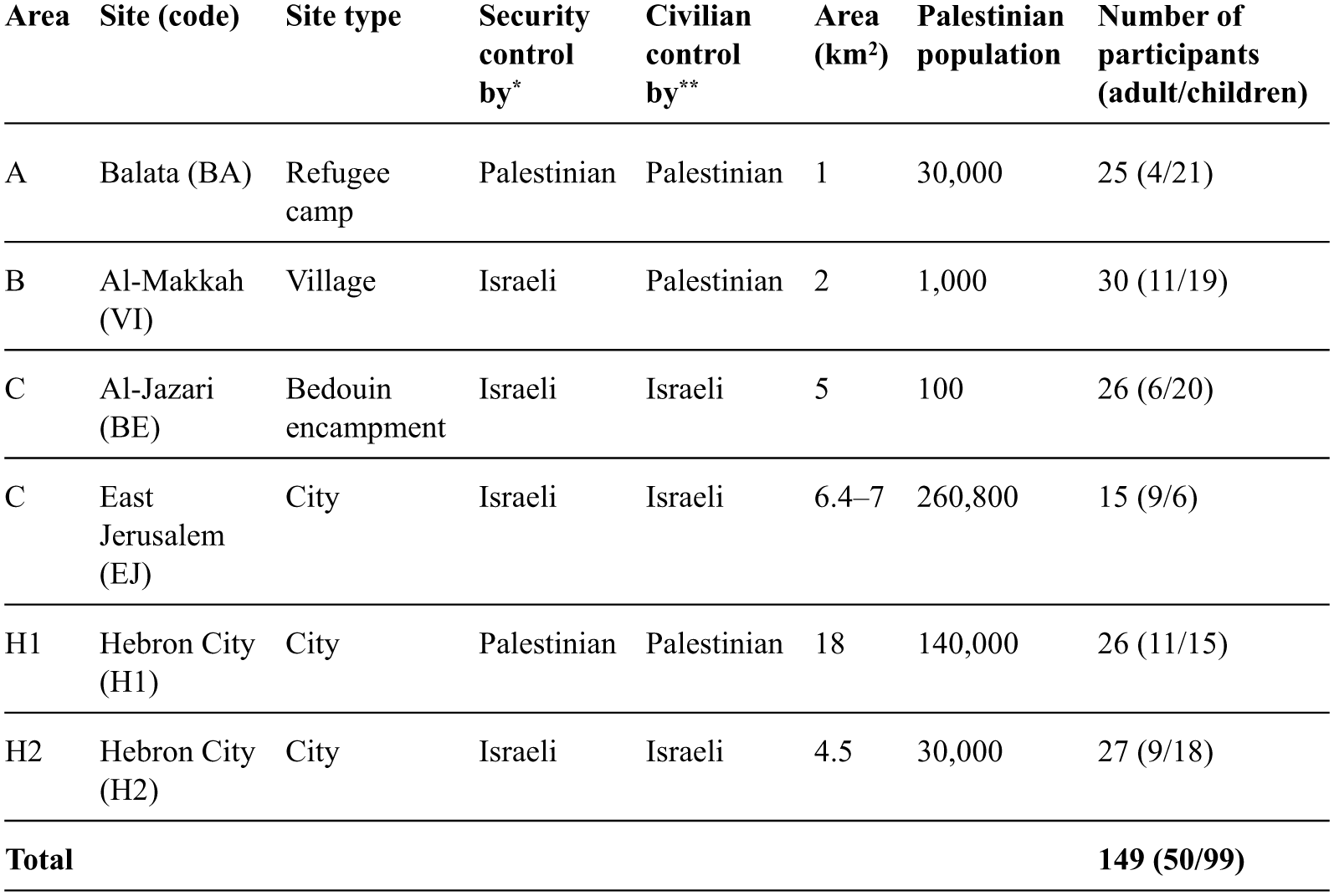
Site selection.
A minimum of three family members (parent, older child (aged 9–18 years), and younger child (8-and-under)) within the ‘a’ila were invited to take part in the collaborative family interview. Collaborative family interviews often included members of the hamula (extended family) for a total of 149 family members interviewed across all 18 collaborative family interviews. Collaborative family interviews also including the hamula in addition to ‘a’ila – as opposed to just individual interviews with children – uncovering valuable data in regard to the importance and messiness of family interactions and differences in perceptions based on generation. Interviews lasted between one and two hours and were conducted after full and informed consent by each family member had been obtained. Participants were guaranteed anonymity. Of the 18 family interviews, 16 were conducted primarily in Arabic, with a bilingual Arabic-English research assistant helping with the translation. 2 With the participants’ permission, interviews were audiotaped and subsequently transcribed by the same research assistant who translated the interview. All but two families agreed to be audiotaped. Two families asked for the audio recording to be stopped for portions of the interview when sharing especially sensitive information.
In addition to the narrative interview, participants, especially children, were encouraged to draw and make maps during the interview in order to illustrate a point or tell a story. Participants were encouraged to depict where experiences occurred (through maps), what experiences looked like (through drawings), and how experiences unfolded (through narrative). Interpretation of such visual data is not a way to unearth one true meaning, but rather to provide children and families with multiple opportunities to express their views and experiences (Clark, 2004). I also included a reflexive component to the analysis of visual materials, considering both my role and assumptions as an adult researcher (Davis, 1998), as well as my choice of methods and their application (Punch, 2002). Combining maps, narratives, and drawings ensured that participants’ lived experiences were not reduced to one aspect, and contributed to an understanding of how they interpret, understand, and navigate their environments. Pulling together these dimensions better elucidated how children and families negotiated and understood everyday places.
Overall, collaborative family interviews built a more detailed understanding of family practices within family spaces (usually the home). Interviewing the whole family also allowed me to observe how families interacted and co-constructed experiences. However, as with all types of group interviews (MacDougall and Baum, 1997), there was also the potential for groupthink, impact of censoring, and conformity among participants, especially in light of the unequal power relations within families. For example, it was difficult for me to know whether the children were saying what they wanted to say or whether they were saying what they thought that their parents or I wanted to hear. Interviewing the whole family – both children and adults together – potentially further reinforced or added to unequal power relations within the interview process. Indeed, at times, children’s voices were obscured by the voices of older family members, oftentimes by fathers who held an air of authority over the other family members. At other times, the whole interview seemed to devolve into chaos, as individual family members used raised voices and competed with each other to convey their particular opinion. Although these scenes raised process-related challenges (e.g. difficulties in translation and transcription), they also provided me with the valuable opportunity to observe the child’s role in the family and family practices in action in relation to the shaping of identities in families. Ultimately, the methodology made attempts to address the potential of eclipsing children’s voices within the family system by including activities – such as drawing and mapmaking – that emphasized children’s participation.
Analysis of the data involved careful reading and annotation of the collated information so as to ascertain the meaning and significance that participants attributed to their experiences through the lens of the researcher. Using participants’ words, a list of tentative units of meaning was created (e.g. ‘being Palestinian,’ ‘wishing for a better life,’ and ‘this is my dream place’). Using constant comparative method (Glaser and Strauss, 1967), these lists were further combined and categorized by merging any overlapping ideas. Themes were grouped around important places that children and families interacted with in Palestine – home, school, neighborhood-community, and nation-state – thereby connecting emotional experience to place. This article will focus on the place of nation-state and its relationship to Palestinian identity for children and families.
Frustration, hope, and nation under occupation
Palestinian identity is not connected to a singular monolithic place, but is rather ‘embedded in trajectories of exile’ (Peteet, 2005: 26) or a shared history of dislocation from place. In fact, Palestinian identity is still strongly connected to original home villages, from which Palestinian refugee families have been displaced for decades. In his study of Palestinian families, Ghabra (1988) has noted ‘It is meaningless … to identify a Palestinian family in isolation from its village or city of origin’ (pp. 79–80). Ghabra also indicates how Palestinian family practices influence generational connections to place, as children who have never even seen their ancestral homes still identify with these places. Many families in this study equated their home villages with a sense of family and national history, solidifying these beliefs through family practices. For example, for 33-year-old Umm-Salim living in Balata refugee camp, her home village where she was displaced from represented ‘the memory of our ancestors’ (BA2), a viewpoint she shared while her children intently listened. Another example of this came from fieldwork in Balata when I encountered some children playing in the street. The children asked me where I was from (North America), and in turn, I asked them where they were from. 3 Without any hesitation, they explained that they were from Yaffa, a former Palestinian city that is now located in Israel; yet these children had been born in Balata and had never actually been to Yaffa. Nevertheless, the connection to Yaffa – a place which their parents, grandparents, and great-grandparents identify as home – was a part of their Palestinian identity. This notion of belonging to and being dislocated from place, which passes between generations, echoes previous literature on Palestinian family practices (Hammad, 2011; Hart, 2002; Peteet, 2005).
Families in all settings often spoke of how the continuing violence contributed to a wounded Palestinian people and nation-state. They discussed how these wounds – physical, psychological, individual, familial, and collective – were perpetrated through the daily occupation and the related matrix of control. Awareness of these wounds contributed to a deep and painful understanding of the challenges facing Palestinians and a growing sense of frustration. For example, in the village of Al-Makkah, 21-year-old Fadila explained how the occupation affected her 16-year-old brother, Larbi:
4
This is suffering, suffering. This is all because of the occupation. When we see our brother angry, we think that his anger is a result of the occupation. He’s stressed out of everything and trying to shout at us all the time, because he never has a normal life. He always makes my mom angry. He destroyed my mom. He makes it so she cannot stand living in this situation anymore. (VI3)
This example illustrates Larbi’s frustration. It also illustrates how the occupation clearly has a detrimental effect not only on Larbi, but also extends to other members of the family, especially his mother. This example and several others from the study point to the intense connection between the occupation of Palestinian land and family practices. This is in line with Khalidi’s (1997) contention which describes ‘an undercurrent of frustration’ among Palestinians – dating back before World War I – that is reflected in Palestinians’ history of dislocation.
Despite a history of dislocation and ongoing collective frustration as a result of the occupation, there were expressions of hope among research participants. In the village of al-Makkah, 13-year-old Basma’s father was arrested 10 years ago and was still in prison when she participated in this study. Figure 2 shows Basma’s dream place, which consisted of a tree surrounded by images of sunshine, clouds, flowers, and several figures holding Palestinian flags. Basma described her drawing: It’s trees, flowers, and children holding the Palestinian flag. And here is written script. It says we are waiting for our father in prison, and there will be a time when he is released. It’s a saying for Palestinian[s]: There will be time for [the] sun to rise. (VI3)
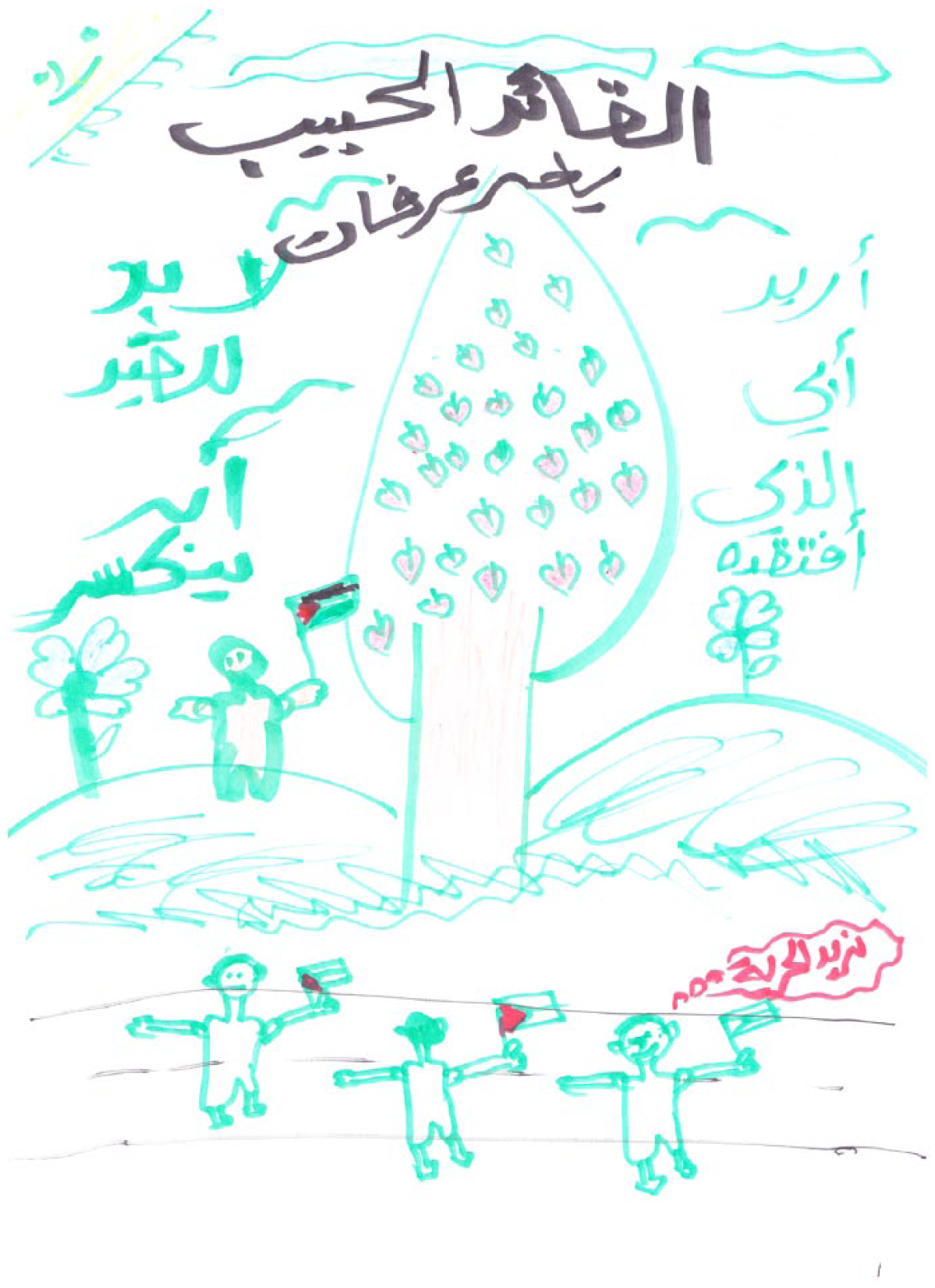
Basma’s drawing.
With her drawing of the trees and flowers underscoring the importance of land, Basma expresses a hope that things will eventually improve for her family and for Palestine. The symbolisms revolving around her father’s imprisonment clearly illustrate a hope for Palestine as a nation-state and therefore affects Basma’s understanding of her own identity as connected to the Palestinian nation-state. Basma’s drawing – mixing political slogans with sentiments of missing her father – frames an idealized representation of the place of freedom, a future she envisions for both her father and her country.
Despite facing serious challenges in their daily lives and restrictions on their present movement and future dreams, participants such as Basma expressed that they were searching for a better future. Although they acknowledged their everyday hardships and resulting frustrations, many families stated that they would never lose hope, even if they were again displaced from their homes or from Palestine. It was through hope and frustration that participants negotiated the everyday realities of the occupation and also defined Palestinian identity as related to sumud (steadfastness) in the face of hardship. This range of emotions epitomizes a Palestinian ethos that is at times worn down and fatigued from decades of oppression, while also fueling the struggle against Israel and its oppressive policies through everyday resistance, which is grounded in hope.
Pride of place also coursed through the data, represented by the large number of children’s drawings of the Palestinian flag. The ubiquitous flags in the drawings reflect support for the Palestinian national consciousness. On his drawing of the Palestinian flag, 13-year-old Khaled from the village of al-Makkah wrote ‘My country flag is my life, and I hope to be raised high’ (VI3). Khaled’s words reflect both a pride of place and a hope for the future. Even in their maps of their homes or neighborhood-communities, Palestinian flags were ubiquitous, such as in 8-year-old Younes’ drawing. The drawing depicts two flags near a line separating what he identified as his home and the neighborhood-community of Hebron. Hebron is one of the largest West Bank cities (Giroud, 2005). With a large concentration of 800 Israeli settlers living beside a much larger Palestinian population, Hebron is a frequent site of violence. Younes’ drawing of Hebron is unique in that his 22-year-old cousin Hichem helped him draw it. While Younes was drawing, Hichem leaned over and drew a small Palestinian flag on the right side of the drawing. Shortly after, Younes followed Hichem’s lead and drew his own Palestinian flag. This collaborative process illustrated one way in which the research illuminated how Palestinian nationalism is passed down through family practices.
Participants’ framing of the nation-state as home was a notable element of the family interviews. Home was not only understood as the physical structure that the family lives in, but rather the broader nation-state by which one connects one’s national identity. Like definitions of home, metaphors of nation-as-home carried an air of naturalness for participants, representing birthplace, family, and community. In this way, nation-as-home became a place to which one is naturally connected or tied to (Malkki, 1997).
But there were also ambiguities of the nation-as-home ideal. Starting from an early age, the place-based notion of Palestinian identity is being questioned on a daily basis, especially at contentious areas such as checkpoints and the separation wall (Khalidi, 1997). As Khalidi explains, [The Palestinian experience] takes place at a border, an airport, a checkpoint: in short, at any one of these many modern barriers where identities are checked and verified … For Palestinians, arrival at such barriers generates shared sources of profound anxiety … Borders are a problem for Palestinians since their identity … not only is subject to question by the powers that be, but also is in many contexts suspect almost by definition. (pp. 1–2)
Khalidi’s words illuminate the strong connection between place and identity. Families were seemingly caught in a pendulum-like process between negotiating marginalization and frustration related to simply being Palestinian, while at the same time searching for pride in Palestine’s legacy and history. Abu-Majd, a father of five from Hebron, eloquently explained how his home is connected to the broader nation-state: Home means to me, the whole of Palestine. It’s Jerusalem, it’s my home, street, and it’s Hebron. And it’s Palestine. And Palestine is Jerusalem, Haifa, Akka, Tel-Al Rabi (Tel Aviv). Palestine is the most treasured place in the whole world: sea and rivers and hills and desert. There is no place that is the same. Intellectuals and poets describe Palestine as heaven, heaven on land. I’m living in a heaven, but I can’t see anything. I just see the injustice and oppression and attacking and harassment. (H21)
Abu-Majd illustrated the division between Palestine as an imagined place (Anderson, 1983) and the lived experience of being Palestinian in the occupied and fragmented space of Palestine. This wavering between the imagined and hoped-for nation-state versus the reality of the ongoing occupation reinforces the emotions of marginalization and dislocation for these families. The final two sentences of Abu-Majd’s quote represent the anomaly of nationalism, where affiliation with a nation-state brings pride. At the same time he loves Palestine but his commitment to it brings a continuous realization of loss of the larger homeland and the current context of hardship, suffering, and frustration.
In a different way, the drawing of 15-year-old Hosni from the village of Al-Makkah, who had recently been arrested and detained for three days by the Israeli military, depicted this tension between nation-state as a site of frustration and nation-state as a site of hope. Hosni described his drawing (see Figure 3): ‘[This is] the Palestinian flag under siege, with barbed wire … [I drew it] to express the restriction’ (VI1).
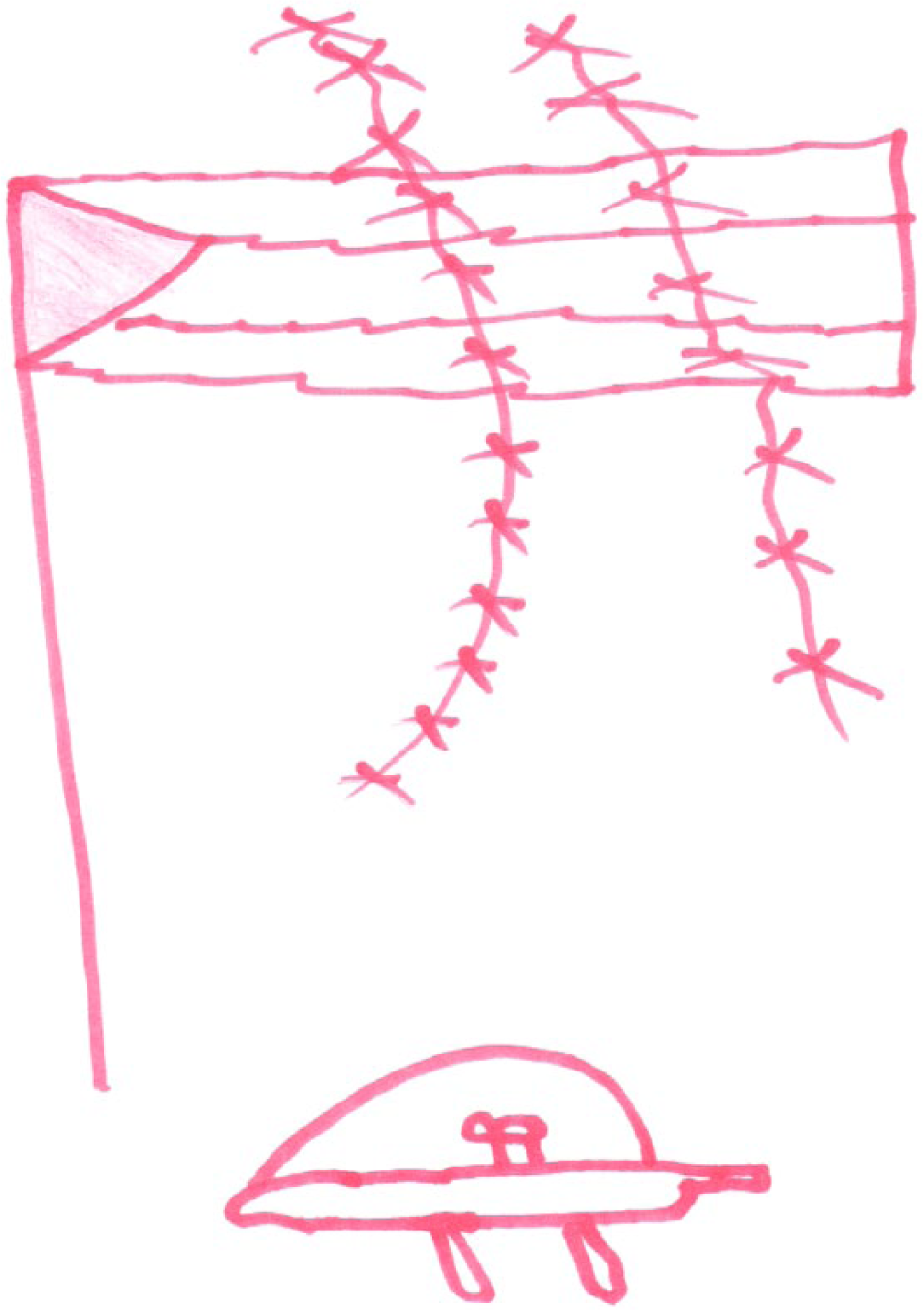
Hosni’s drawing.
By including the Palestinian flag, Hosni expressed pride of place. Overlaying the flag with barbed wire, he illustrated the reality of being Palestinian through an awareness of the impact of occupation on the place of the nation-state and the possibilities for him to be a particular kind of Palestinian.
Conclusion
For these children and families, the marginalization, dislocation, and frustration related to being Palestinian under occupation are prominent elements of their daily lives and, therefore, very real experiences and feelings that shape their identity. While Palestinian’s history of dislocation and marginalization contributed to a sense of frustration, there was also a sense of hope for Palestinians as a people and a nation-state. In fact, the participants acted out their fluid and dynamic identities in different ways: for example, enacting Palestine as a source of pride, with a hope that Palestine will one day be an official nation-state, understanding that one’s very affiliation with the place of Palestine comes with emotions of frustration and hopelessness. All of these aspects are passed on and reinforced through family practices, which ultimately shape Palestinian national identity or being Palestinian.
The impact of family practices was clear throughout the collaborative family interviews. For example, parents encouraged their children to share Palestinian history or the family’s history during the interview. These instances in the interview process indicate that historical memories and stories of dislocation, marginalization, as well as hope and pride are shared regularly within the family. In this way, Palestinian history and family history are a crucial part of the younger generation’s narrative of national identity. As Massey (1995) notes, ‘The identity of places is very much bound up with the histories which are told of them, how these histories are told, and which history turns out to be dominant’ (p. 186). Despite (or because of) the push towards national pride by older family members attached to the imaginary place of once existing Palestine, the image of nation is sacred for these children and contributes to a hope for the future of Palestinians and Palestine as a nation-state. It also reflects the ways in which generations convey and reinforce emotional attachment to place and how the place of the once existing nation legitimates families’ hope. This discussion clearly underscores the importance of the Palestinian nation-state to Palestinian children and families. The experience of being Palestinian is ultimately shaped by emotions such as frustration and hope, and within these feelings lies one’s identification with the place of Palestine: Palestine as home, nation, and identity.
Footnotes
Acknowledgements
The author would like to thank Zsuzsanna Millei and the two anonymous reviewers for their invaluable feedback on previous versions of this article.
Funding
This research received no specific grant from any funding agency in the public, commercial, or not-for-profit sectors.