




Abstract
The increasing prevalence of online courses has highlighted the importance of digital literacy for students. This study investigates the relationship between digital literacy and academic achievement among students who participate in an online course on anatomy and physiology. The study also evaluates how different aspects of digital literacy, such as age and previous education in natural science, affect students’ grades. Using logistic regression analysis, data from five areas of digital literacy that were assessed among participants with different educational backgrounds are analyzed. The results show that some aspects of digital literacy are more crucial for academic success in the online course. Students with a natural science background exhibited higher levels of digital literacy, emphasizing the importance of considering previous education in supporting students’ digital skills in online courses. The study also reveals that students were proficient in self-assessing their own digital literacy, enabling easy evaluation of the collective digital literacy within the course and facilitating targeted interventions for all students, regardless of their initial digital literacy levels. This study underscores the importance of digital literacy in online education. It highlights the specific areas of digital literacy that strongly contribute to academic achievement and emphasizes the positive impact of previous education in natural science on students’ digital skills. These findings suggest that instructors should consider these factors when designing and delivering online courses to ensure equal opportunities for students to enhance their digital literacy.
Introduction
The number of online courses has been constantly increasing. Educators and course managers can implement several steps to overcome the obstacles associated with online learning, for example, by providing possibilities for socialization and interaction between students and between students and teachers (Salmon, 2013; Shen et al., 2013) or monitoring students’ activities and encouraging struggling learners. This is especially important for less experienced online students (Shen et al., 2013). However, online courses often require students to implement self-directed learning to a great extent, which means that the burden falls upon the students to acquire knowledge on how to study online. This demands technical skills, and more importantly, digital literacy.
Evolution of digital literacy: definitions and terminology
While the phenomenon has been studied for at least 50 years, the term “digital literacy” was first coined by Paul Gilster in 1997 (Gilster, 1997; Martínez-Bravo et al., 2020), who included four core competencies. The definitions of digital literacy have transformed over the past 50 years and include both specific skills as well as general perspectives (Martínez-Bravo et al., 2020; Pool, 1997; Tang and Yen, 2016). This term varies across different geographical regions and disciplines. For example, digital literacy is used more often in Asia and the US and within the fields of health and arts, whereas digital competence is used more often in continental Europe, South America and in the fields of teacher education and economics (Spante et al., 2018). Regardless of the definition or terminology, the concept includes technical skills and the ability to understand and assemble information from different sources.
Beyond technical skills
Often, the discussion on digital literacy orbits around the technical aspect, but digital literacy is much more than that. To know how to use different hardware and software is to possess digital skills; however, digital literacy is more diverse. To be digitally literate, one must not only be able to deal with information management, copyright licensing, ethical considerations, and digital skills but also effectively use the right digital tool for the right purpose, such as collaboration, communication, and expression (Tang and Yen, 2016). In the educational context, (Udeogalanya, 2022) reported that while students favor online learning, they also want to be trained in using digital tools before assignments.
Digital environment accessibility
Exposure to digital environments plays a decisive role in being able to develop digital literacy. For example, it is easier to achieve a high level of digital literacy if one has access to the Internet at home than if one has to go to an Internet café (Yustika and Iswati, 2020). Such accessibility varies across different socioeconomic groups and in different parts of the world (Creighton, 2018).
Self-directed learning and self-efficacy
Digital literacy is also associated with self-directed learning. This refers to students’ ability to identify their own learning needs and to take responsibility for their own learning, for example, through study scheduling, source selection, and help seeking (Hung et al., 2010; Kara, 2022). Both digital literacy and self-directed learning are concerned with learners’ characteristics and their levels of engagement. Higher levels of digital literacy and self-directed learning lead to higher levels of engagement, resulting in better academic achievement (Hwang and Oh, 2021; Kara, 2022). Both terms have a strong connection with self-efficacy. Self-efficacy refers to an individual’s assessment of and belief in himself or herself to overcome obstacles and solve future problems. In other words, it concerns students’ abilities to deal with situations that contain new and unpredictable elements (Hamann et al., 2021). Individuals with high self-efficacy are more persistent and fight to a greater extent to solve their problems. Self-efficacy also differs among individuals, and these differences can be derived from their upbringing or gender (Aslan, 2021). Differences in self-efficacy may also depend on how it is measured, as men and women fall out differently depending on the outcome measures used (Hamann et al., 2021).
The European digital competence framework for citizens (DigComp)
The European Commission’s Science and Knowledge Service developed the European Digital Competence Framework for Citizens (DigComp) as a model to categorize and assess digital literacy (Carretero et al., 2017; Vuorikari et al., 2022). While there are different ways to measure and present related digital competencies and skills, DigComp is a strong tool based on a review of previously proposed frameworks (European E-Learning Institute, n.d). This framework can be used to plan and design education, but it can also be used by policymakers to assess the level of citizens’ digital literacy or by citizens themselves to self-evaluate literacy levels and identify training opportunities. DigComp was selected by the United Nations Educational, Scientific and Cultural Organization (UNESCO) to map digital literacy (Law et al., 2018).
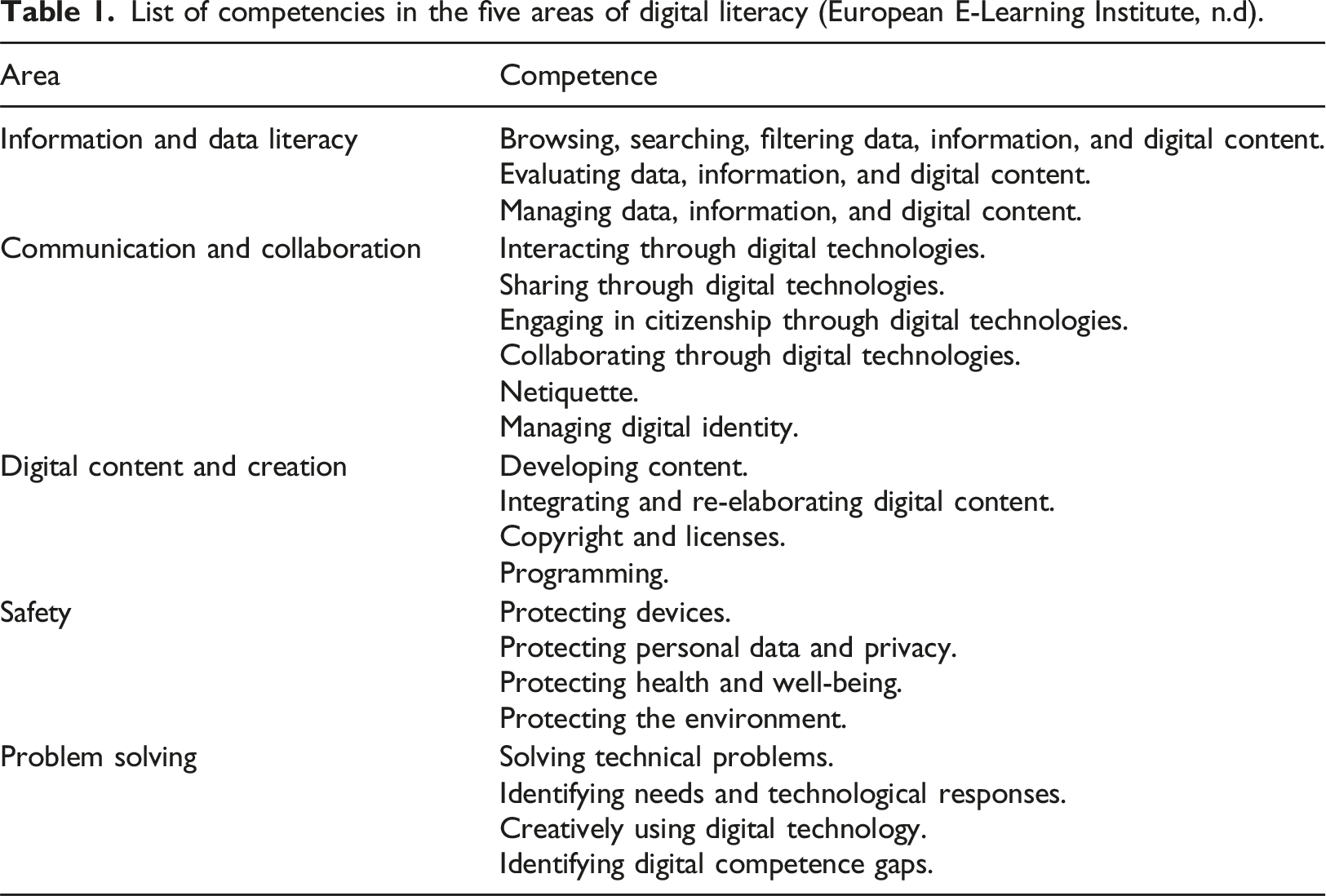
The framework divides digital literacy into 21 competencies, which are further categorized into five competence areas: Information and data literacy, Communication and collaboration, Digital content creation, Safety, and Problem solving. These competence areas can be derived from one of eight levels of proficiency using action verbs based on Bloom’s taxonomy (Bloom et al., 1956). The proficiency level also considers the level of autonomy and provides examples of use (Carretero et al., 2017).
Assessing digital literacy
Assessing digital literacy can be difficult, and often only technical competence is measured as a proxy for digital literacy (Yustika and Iswati, 2020). However, several methods have been developed to assess digital literacy (Wu et al., 2022). Studies have primarily used a four- or 5-point Likert scale for participants to self-report their abilities regarding various aspects of digital literacy. Different studies address different aspects, with some examining the extent of respondents’ exposure to digital environments. This varies depending on whether the studies address the level of digital literacy that has been achieved (Wu et al., 2022). Thus, the research field is heterogeneous in its measurement tools, making it difficult to compare different studies. The DigComp framework is widely used, especially in Europe (Alexander et al., 2017; Law et al., 2018; Vuorikari et al., 2022; Wu et al., 2022). Further, the Digital Skills Accelerator (European E-Learning Institute, n.d) developed and validated an online self-assessment tool to analyze digital literacy in line with the DigComp framework. The tool guides users to rate themselves from 1 to 6 for each of the 21 competencies included in DigComp (Carretero et al., 2017). These areas are then categorized into five areas of digital literacy, thus providing an overview of one’s digital literacy presented as a radar chart. This overview can be compared with that estimated for other individuals and with the overall average, thus indicating which competence areas need to be strengthened.
Debunking the notions of digital natives and digital immigrants
People born after 1980 are often referred to as digital natives; they have grown up with computers and have incorporated them as a natural and obvious element in their lives, similar to one’s native language (Prensky, 2001). Digital natives are considered to have a higher level of digital literacy than digital immigrants, that is, people born before 1981. Digital immigrants have to learn and adapt to the new digital environment, similar to learning a second language; however, they may still be attached to the analog past and may never really manage to naturally assimilate into the digital world (Prensky, 2001). The idea and definitions of both digital natives and immigrants have been challenged (Riordan et al., 2018). Several studies have shown no statistical differences between these two groups regarding digital skills (Guo et al., 2008) and digital literacy (Akçayır et al., 2016); moreover, the division into the two groups is to a greater extent determined by context, socio-economics, education, exposure to digital technologies, and geographic location instead of age (Akçayır et al., 2016; Creighton, 2018; Kincl and Štrach, 2021; Pangrazio et al., 2020). There are several other theories and definitions of digital literacy (Spante et al., 2018; White and Le Cornu, 2011). Instead of age, the attitude toward and purpose of the digital tools and how they are used have also been used as measures of an individual’s digital literacy (White and Le Cornu, 2011). If age must still be used as the distinguishing feature, the ideal cutoff point may not be 1980 but 1990, which represents the dawn of the Internet. The Internet plays a big role today in both education and in general. People born in 1980 or earlier did not grow up with the Internet, whereas people born in 1991 or later did; This is true at least for Sweden, where the current study is performed. Analogous to digital natives and immigrants, this study uses the terms “web natives” and “web immigrants.”
Communication and collaboration in online learning: key aspects of digital literacy
Communication and collaboration is a key aspect of digital literacy. It can be particularly difficult in an online course, where it is more difficult to achieve spontaneous meetings between teachers and students and between the students themselves. The constructivist theory asserts that learning is a socially interactive activity and that it is best performed within the learner’s zone of proximal development (ZPD) (Vygotsky, 1978). ZPD is defined as “the distance between the actual level of development determined by independent problem solving and the level of potential development determined by problem solving under adult guidance or in collaboration with more capable peers” (Vygotsky, 1978). This means that students are encouraged to learn with others outside their knowledge zones. Therefore, teachers should provide the possibility for communication between students, thereby facilitating knowledge exchange where students can learn from each other. Students with a higher level of communication and collaboration and, thus, a higher degree of digital literacy can succeed in their online studies.
Assessing academic achievement: challenges and technology
Academic achievement represents an individual’s level of success in acquiring knowledge and skills through dedicated studies and learning efforts. Assessing academic achievement is a crucial aspect of higher education as it allows teachers and institutions to gauge the effectiveness of their teaching methods and measure instructional effectiveness and students’ learning outcomes.
Assessment methods in higher education encompass a wide range of approaches, each with its own strengths and limitations (Braun, 2019). Traditional methods such as examinations, essays, and projects are commonly used to evaluate students’ knowledge and understanding of the subject matter. Assessments should also be inclusive and consider student diversity. Examinations provide a standardized format for assessing factual knowledge, conceptual understanding, and problem-solving abilities within a given timeframe. Standardization is an important factor for enabling comparisons between students, different course iterations, and different institutions (Braun, 2019).
Assessing academic achievement in higher education poses several challenges that must be addressed to ensure a fair and accurate evaluation. One challenge lies in assessing complex skills and competencies. Many disciplines require students to develop higher-order thinking skills, such as problem-solving, critical analysis, and creativity. Designing assessment tasks that effectively measure these skills can be challenging because they often involve open-ended problems or real-world scenarios. Innovative assessment methods such as case studies, simulations, and authentic assessments offer potential solutions by providing opportunities for students to apply their skills in contextually rich and realistic situations.
When choosing assessment methods, educators should consider the learning objectives, disciplinary requirements, and desired course outcomes. A combination of assessment methods can provide a more comprehensive evaluation of students’ abilities and accommodate diverse learning styles and preferences.
Technology can play a significant role in addressing assessment challenges. Online assessments, computer-based simulations, and automated grading systems offer scalability, efficiency, and opportunities for personalized feedback. However, it comes with challenges, and the need for adequate training and support for both students and instructors should be carefully addressed (Paul and Jefferson, 2019). In this context, the level of digital literacy comes into play. A low level of digital literacy can have a negative impact on students’ academic achievement simply because examinations take place via digital channels, as is prevalent in online courses.
Impact of digital literacy on academic achievement: mixed findings
Previous studies investigating how students’ academic achievement correlates with digital literacy, for example Tang and Yen (2016) have found that a higher level of digital literacy has a positive effect on students’ success in a blended learning environment. Mehrvarz et al. (2021) revealed the same effect, but also highlighted the importance of informal learning that takes place outside academia for digital literacy. In contrast, Abbas et al. (2019) found no correlation between digital literacy and academic achievement; however, the study revealed a large difference in the level of digital literacy across different areas of literacy. While there are several studies showing a correlation between digital literacy and academic achievement (Tadesse et al., 2018), some studies have shown no correlation (Katz and Macklin, 2007). Thus, the findings of previous studies were heterogeneous and did not provide a clear picture. In an online course, everything can be administered via digital channels—general information, course content, exercise materials, synchronous communication with students and teachers, and examinations. This places greater demands on students’ digital literacy.
In this context, the following questions arise: how does the level of digital literacy affect academic achievement for students participating in a course administered completely online? Are different areas of digital literacy more important than others? How does previous education affect one’s digital literacy?
Research questions and study aim
The aim of the present study is to evaluate the relationship between students’ academic achievement in an online course and their level of digital literacy. Specifically, the following questions are addressed: 1. Is there an association between the students’ digital literacy levels and their course grades? 2. Are there areas within digital literacy that are more strongly associated with higher course grades than other areas? 3. Does the student’s age and academic background affect the level of digital literacy? 4. How is the students’ ability to assessing their own level of digital literacy?
Methods
Study design
During an online freestanding course in anatomy and physiology at a mid-sized university in Sweden, students were asked to participate in a quantitative survey that graded them into different levels of digital literacy. Three course iterations were included in the study and were offered during the fall of 2020 and the spring and fall of 2021 with 80, 83, and 73 registered students, respectively. This survey used the Digital Skills Accelerator validated online self-assessment tool (European E-Learning Institute, n.d) which is based on the European Digital Competence Framework (Carretero et al., 2017). Students’ previous knowledge of the course content and their perceptions of their own digital literacy were additionally assessed. The questionnaire is available in the Supplemental Material.
Data collection and sampling
List of competencies in the five areas of digital literacy (European E-Learning Institute, n.d).
Variables
The final course grade (pass or pass with distinction) was used to measure the outcome variable, namely academic achievement. This was combined with the results of several assessments, such as exam results, a short quiz, and a smaller writing assignment, followed by a shorter seminar. The independent variables included age, sex, and previous education (whether the students had previous education in natural sciences or not).
Analysis
Multinomial logistic regression was used to analyze the relationship between the different areas of digital literacy and course grades. This method was chosen because the course grading scale used to assess academic achievement is not continuous but is assessed according to multiple levels, and therefore excludes linear methods. Logistic regression also provides the possibility of compensating for the fact that students may have different prerequisites for success in the course depending on their prior education, which was adjusted for previous education in the natural sciences. Logistic regression was also used to analyze whether prior education and age are associated with course grades. Two different analyses regarding age were performed, in which the division into two groups were made in terms of birth in 1980 or earlier (digital immigrants) and 1990 or earlier (web immigrants).
The two-sided Student’s t test was used to analyze differences in digital literacy between different age groups and educational groups, as well as differences in the students’ self-assessed digital literacy and the digital literacy measured using a digital skills accelerator (European E-Learning Institute, n.d). Both Student’s t test and Chi-squared test with Yates’s correction was used to analyze the differences between all 236 students taking the course and the 86 students who answered the questionnaire, and between educational groups regarding age and sex.
SPSS version 27 was used for all statistical analyses, and the limit of statistical significance was set at p ≤ .05.
Ethical considerations
The information collected was not considered sensitive; therefore, the risk of psychological distress during the survey was negligible or very small.
The students included in the data collection received written information about the purpose of the study and how the data were stored. Students could discontinue their participation at any time, and they had to sign an informed consent form before the study began.
All data were collected, handled, and stored on servers at Karlstad University, complying with the General Data Protection Regulation (GDPR), and the project underwent a faculty research ethics review at Karlstad University (no: HNT 2020/563).
Results
Participants’ characteristics
A total of 236 students were enrolled in the course between August 2020 and January 2022. There were 200 women and 36 men who were between 19 and 70 years of age (average: 32.3 years). Of these, 86 students participated in this research, of whom 73 were women and 13 were men (age range: 19–51 years; average: 34.4 years). There were no statistically significant differences between the participating and non-participating groups regarding age or sex (p = .12; χ2 [1, N = 236] = 0.027, p = .87). Of the participants, 37 had previous education in natural sciences, and 48 had previous education in other areas. There were no statistically significant differences between the natural sciences and other education groups regarding age or sex (p = .26; χ2 [1, N = 85] = 1.243, p = .09). Information on previous education was missing for one student who participated in the study, as well as for the students who did not participate. Furthermore, the participants and the non-participating students were heterogeneous groups. As this was a freestanding distance course administered entirely online, the enrolled students comprised people in diverse occupations and with different motivations for participating in the course. For example, while some students joined directly after high school with an interest and curiosity in anatomy, while others were high school biology teachers who directly benefit from the course’s content in their own teaching.
There were no significant differences between previous education (natural science or not) and exam credit (p = .49) or course grade (odds ratio [OR] 1.93 (confidence interval [CI] [0.62–6.0])). Moreover, age does not have any statistical significance for the difference in either exam credits or course grade regardless of whether the group is divided in terms of being born before or after 1980 (p = .26; OR 0.43 (CI [0.15–1.49])) or before or after 1990 (p = .35; OR 1.25 (CI [0.41–3.81])).
There were no statistically significant differences between the students’ self-assessment of digital literacy and their average digital literacy based on the questionnaire (p = .227).
Digital literacy and academic achievement
The effect on different aspects of digital literacy on course grade (European E-Learning Institute, n.d).
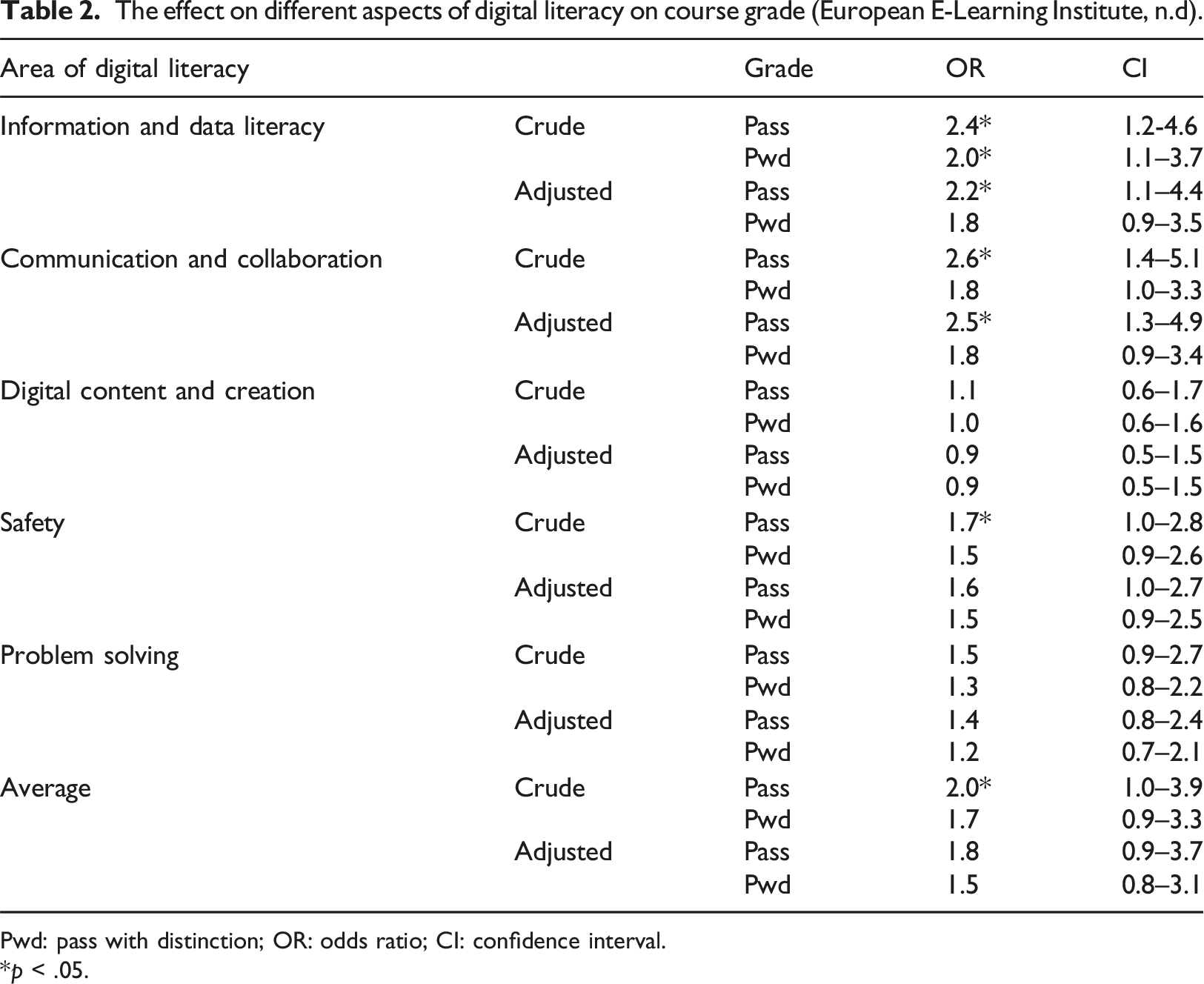
Pwd: pass with distinction; OR: odds ratio; CI: confidence interval.
*p < .05.
A comparison of the different areas of digital literacy as well as their averages was conducted between students who had previous education in the natural sciences and those who had other education. The natural sciences group had consistently higher digital literacy in all areas; however, only three areas were statistically significantly higher: Information data literacy, Digital content and creation and Problem solving (p = .004; p = .007; p = .014) (Figure 1). Average digital literacy was significantly higher for students with previous education in the natural sciences (p = .01; OR 1.96 [CI [1.14–3.39])) (Figure 1). Comparison of the average and different areas of digital literacy. (a) Between all participating students in this study (solid) and the overall average from the digital skills accelerator (dotted) (European E-Learning Institute, n.d). (b) Between two groups based on previous education: natural science (solid) or other (dotted).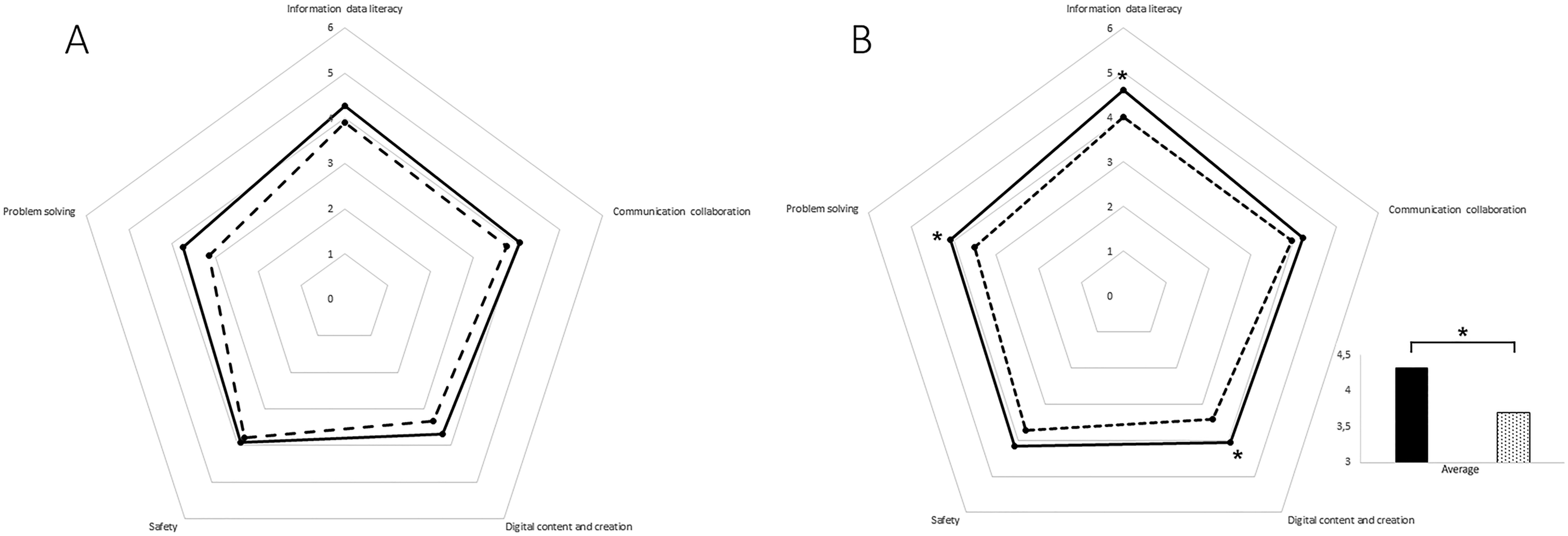
Digital literacy and age
There were no statistically significant differences in any of the digital literacy areas when comparing the different age groups, regardless of whether the group was divided at birth before or after 1980, or before or after 1990 (Figure 2). Furthermore, no effect was observed when logistic regression was used to examine the relationship between the age groups and the different digital literacy areas. All ORs were below 1. Comparison of average and different areas of digital literacy divided into two groups based on age. (a) Digital natives are depicted as the solid line, and digital immigrants are depicted as the dotted line. (b) Web natives are shown in solid and web immigrants are shown in dotted.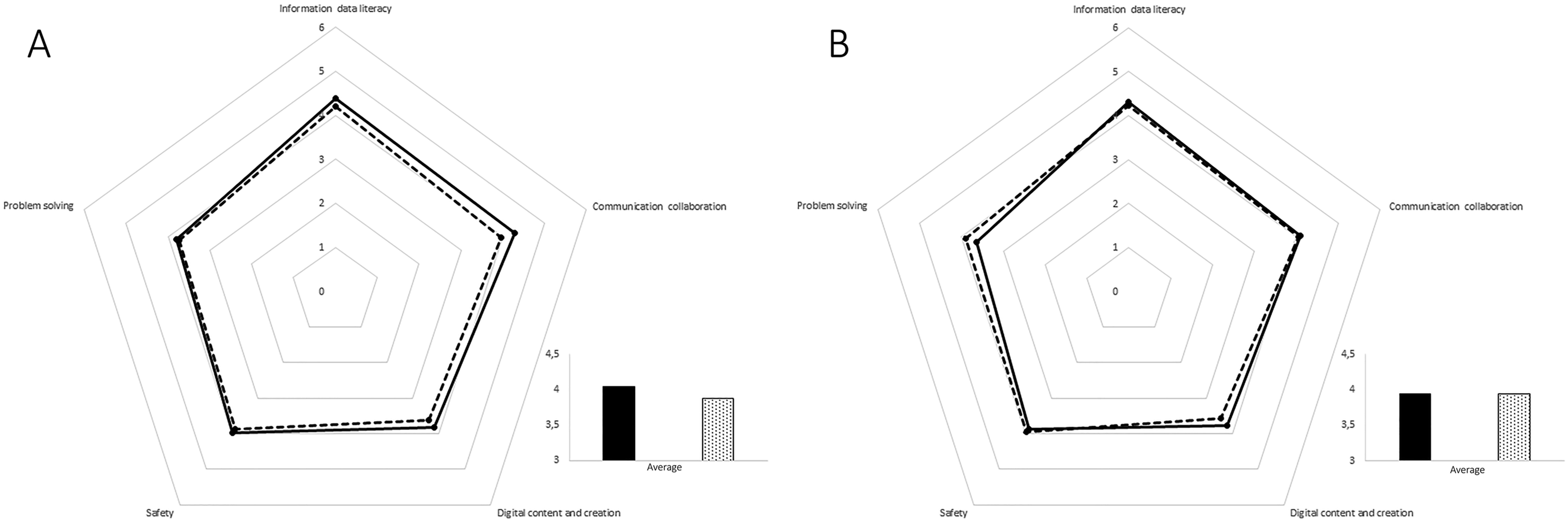
Discussion
Digital literacy is becoming increasingly important in an increasingly digitalized world. This applies to the educational system as well. Students must learn to use digital resources in their studies in a way that helps them, without being overwhelmed by all the digital tools and excessive information available online. This study aimed to investigate the factors that can affect digital literacy and whether academic achievement in an online course is affected by students’ digital literacy. The research questions guiding this study addressed how digital literacy and its different aspects affect and are affected by academic achievement and students’ background, age, and ability to self-assess their digital literacy.
The study findings indicate that students with a natural sciences background had higher digital literacy in all areas. It is difficult to determine how this relates to other backgrounds because there is a lack of research on how an individual’s background and conditions affect digital literacy, and the existing research is inconclusive (Lazonder et al., 2020; Liang et al., 2021; Ouahidi, 2020). In this study, the students were divided into groups according to whether they had previous education in natural sciences; no other fields were considered for this division. Other studies have further categorized the participants’ backgrounds and have found that engineers have higher digital literacy (Margaryan et al., 2011); this can be explained by the fact that engineers tend to use more technology in their education. Some studies have found higher digital literacy in other disciplines such as medicine, social studies, and law (Selwyn, 2008), while others have been unable to demonstrate any differences between the different disciplines (Akçayır et al., 2016). Socio-economic factors can impact digital literacy as they affect access to technical equipment during an individual’s upbringing, which in turn affects digital literacy (Liang et al., 2021). Moreover, students may not understand the potential of digital tools for learning. The crucial factors include a combination of age, subject/background, technology habits, and universities’ preferences for using digital tools in teaching. The teacher is of great importance in how students are influenced to use digital technology for learning. However, neither teachers nor students have a particularly good understanding of how digital technology supports their learning. Students often prefer conventional, linear, and passive forms of teaching (Margaryan et al., 2011).
Information on how education in different fields affects digital literacy is lacking. Students with natural sciences education exhibited consistently higher digital literacy in this study; however, the difference was statistically significant only in three areas: Problem solving, Information data literacy, Digital content and creation. An explanation for this could be that natural sciences education focuses on these three, while the other two–Safety and Communication and collaboration–are not covered in natural sciences education in the same way. Different background factors can also have varying effects on the different areas of digital literacy. Hwang and Oh (2021) showed that a higher level of self-directed learning had a positive effect on problem-solving skills in nursing students. This will be discussed further later in a future study.
Two of the digital literacy areas showed positive effects on course grades even after adjusting for previous education: Information data literacy (OR 2.2 [1.1–4.4]) and Communication and collaboration (OR 2.5 [1.3–4.9]). These results highlight the importance of these areas for students, especially in online contexts. The first area involves formulating information needs, creating personal search strategies, and then searching for information in digital sources to analyze and critically evaluate the credibility and reliability of these sources (Vuorikari et al., 2022). When students possess a higher ability to search and analyze the results, they will succeed better in an online course with higher grades, as their ability to access information and other explanatory models that can be found online will help the student progress in the course. The second area, Communication and collaboration, includes social aspects since it includes activities such as interactions and collaboration through a variety of digital technologies to share data and information with others. As learning is considered as a social process, based on the constructivist theory (Vygotsky, 1978), it is not difficult to see that a student who reaches a higher level within this area will succeed better in their studies by both giving and receiving help from others via digital tools. This area also includes dealing with digital identities, adapting communication to a specific audience, and increasing awareness of cultural and generational diversity in digital environments (Vuorikari et al., 2022). This supports White and Le Cornu’s (2011) theory of digital visitors and residents with its tool, place, and space metaphors instead of Prensky’s (2001) language and age metaphor of digital natives and immigrants.
The visitor and resident model does not depend on age but on how and for what purpose an individual uses digital tools and their attitude towards them (White and Le Cornu, 2011). Residents would get high scores in both Information data literacy and Communication and collaboration as they have a digital identity and the distinction between the online and offline is blurred. They are happy to go online to spend time with others and leave digital traces of their digital lives when they go offline. This implies that even when they are offline, they are still online. Residents use the Internet to hang out and learn things. Visitors, however, go online to perform specific tasks using a specific tool. They are anonymous and do not leave any digital traces. The web is seen as a tool similar to an encyclopedia, pen, or paper. These two categories are not binary, but are the two endpoints in a continuum. An individual can be at several points simultaneously on this continuum depending on the context. For example, a student can be a resident when it comes to their social life outside the university but become a visitor within a course at the university (White and Le Cornu, 2011). This model can be used as a basis for future discussion, to make students aware of their behavior, and to encourage them to start reflecting on their own learning (Druce and Howden, 2017).
The study findings did not support the influence of age on digital literacy. Prensky’s proposed division into digital natives and immigrants, with the groups being divided based on one’s birth after or before 1980, has been questioned, and no support for this division was found in this study either (Prensky, 2001; Riordan et al., 2018). No correlation between age group and digital literacy was observed even when the dawn of the Internet was considered with the cutoff being moved forward by 10 years. Other studies have shown that other factors, including socioeconomic factors, a sense of inclusion, and education influence digital literacy (Creighton, 2018; Shala and Grajcevci, 2018). This was also confirmed in the present study. Several factors work synergistically in this process. If an individual is excluded from higher education, has a low socioeconomic status, belongs to a minority group, or has parents with low education, the risk of low digital literacy increases significantly. These factors are often found within the same group in society, which means that these vulnerable groups have a particularly high risk of poor digital literacy (Shala and Grajcevci, 2018).
Age also affects certain aspects. Later generations tend to have unrealistic expectations and obtain higher grades for lower work efforts (Twenge, 2013). This also means that they set ambitious goals because they are overconfident about their own abilities. One could imagine that they easily overestimate their own digital literacy, but this does not seem to be the case in this study, as participants’ self-rated digital literacy does not differ from that measured using the Digital Skills Accelerator questionnaire (European E-Learning Institute, n.d).
Figure 1 shows that the students had higher digital literacy in all areas than the overall average digital literacy based on the Digital Skills Accelerator. This may be because the students, regardless of previous education, are a group of individuals who participate in higher education. These students are being compared to an average population that covers individuals with varying education levels and represents multiple socioeconomic groups and nationalities. The students in this study are all Swedish and live in a society where the digital infrastructure is well developed and is an important and integral part of everyday life.
This study shows that certain areas of digital literacy have a positive effect on academic achievement; thus, teachers should spend time helping students with lower digital literacy levels. It may not be possible to conduct a thorough evaluation of each student’s digital literacy; however, the teachers can implement general measures for the benefit of everyone. Furthermore, the present study shows that students are good at assessing their own digital literacy; therefore, a simple question in which students rate their digital literacy from 1 to 5 would be very useful as a basis for any adjustments in the course. The five-step model created by Salmon (2013) is an attractive model that considers how student engagement changes over time, which can help students with poorer digital literacy. The first two steps in this model address “access and motivation” and “online socialization.” These lay the foundation for overcoming technical obstacles, but also provide a welcoming online environment that facilitates teacher–student and student–student communication, which will help students with poorer digital literacy. This model addresses many of the reasons that students state as decisive for dropping out, and thus can contribute to higher retention and subsequently provide a better financial return for the course (van Ameijde et al., 2018). At least in Sweden, where this study was conducted, remuneration to universities depends partly on the number of students who start the course, but also partly on how many students complete it. Relatively small efforts can have a significant impact, especially on the weakest students (Shen et al., 2013). By providing a platform for communication with students and monitoring their activities, such as handing in small assignments, watching short films, or testing themselves through self-assessment quizzes, the teacher can quickly identify weaker students and communicate to them that they will not be neglected and can approach the teacher for help. Such monitoring is usually not labor-intensive for teachers, as it can often be performed automatically through the LMS.
Several factors affect students’ academic engagement and academic achievement. One such aspect is self-efficacy, which has been found to support students’ self-confidence and autonomy (Shen et al., 2013). Students with high self-efficacy are generally better at finding an appropriate strategy independently to promote their learning results than those with low self-efficacy. Students with high self-efficacy assume greater responsibility for their learning goals (Chu and Chu, 2010). This means that the probability of students with high self-efficacy being successful in online education increases (Chu and Chu, 2010; Shen et al., 2013). Prior et al. (2016) investigated how digital literacy can positively affect self-efficacy in an online environment and how this in turn has a positive effect on students’ peer engagement. Students with higher self-efficacy are likely to engage in self-directed learning. There are several definitions of self-directed learning, but they generally refer to students’ ability to take responsibility for their own learning of a certain body of knowledge, where different learning activities, evaluations, and social skills are considered (Loeng, 2020). This can occur both within and outside formal educational institutions. There is evidence that students take the initiative to learn, learn more and learn better than those who passively allow themselves to be taught. A higher degree of self-direction has also been shown to give students a sense of success compared to students with a lower level of self-direction (Loeng, 2020). Studies have shown that digital literacy positively affects self-directed learning, which in turn positively affects academic achievement (Rini et al., 2022; Wang et al., 2021).
In addition to digital literacy, there are several other forms of literacy, such as health, financial, and media literacy (Goyal and Kumar, 2021; Nutbeam and Lloyd, 2021; Rasi et al., 2021). These types of literacy can affect each other to varying degrees and are somewhat intertwined (Pangrazio et al., 2020). For example, social determinants and an individual’s ability to extract and understand information are associated with both health and media literacy, just as it is for digital literacy (Nutbeam and Lloyd, 2021; Rasi et al., 2021). This ability to extract and understand information and assess its reliability is particularly important in today’s world but has been shown to be deficient (Breakstone et al., 2018). Urgent efforts are required in this regard, particularly within the educational system, from preschool to the university level, as well as within the general population.
Limitations
A limitation of this study is that the questionnaire was sent digitally using an LMS, which could introduce a bias towards those who have higher digital literacy. More students with lower digital literacy might have answered the questionnaire if it had been paper-based and mailed to their homes. However, the participating students did not differ in terms of age and gender throughout the course. On the other hand, it is conceivable that more students with previous education in natural sciences chose to participate, as these students were shown to have higher digital literacy in this study; this would reinforce this effect and lead to overrepresentation of this group. Unfortunately, this could not be controlled for because this information was missing for students who chose to not participate in this study. Nevertheless, students with previous education in subjects other than natural sciences have higher digital literacy in all areas except Safety when compared to the overall average based on the Digital Skills Accelerator (European E-Learning Institute, n.d).
This study examines the correlation between digital literacy and other parameters such as grades, and no causal effects can be claimed. It is difficult to differentiate digital literacy as the only reason for a higher grade because it is most likely obtained due to several reasons. For example, a higher level of self-directed learning not only results in higher digital literacy but also has a direct positive effect on grades (Rini et al., 2022; Wang et al., 2021).
After this survey was conducted, DigComp was updated to version 2.2 in March 2022 (Vuorikari et al., 2022). This new version has been updated with several new examples of skills and attitudes to help residents interact confidently, critically, and safely with digital systems and new technologies such as artificial intelligence. However, the questions in the tool did not change; therefore, this update does not affect the results of this survey.
Conclusion
In summary, this study shows that for students taking an online anatomy and physiology course, certain areas of digital literacy can affect their course grades. Further, previous education affects digital literacy, with education in natural sciences exhibiting a positive effect. By contrast, age had no effect on digital literacy. These results are useful not only for anatomy and physiology education but also for all online education. The study shows that teachers should take into account and make room for students who have different preconditions for absorbing course content owing to their varying levels of digital literacy. A simple test in which students assess their own digital literacy can be very helpful in seeing the distribution of digital literacy within a course, as evidence indicates that students are good at such self-assessments. In this way, suitable measures can be implemented early in the course to help weaker students in particular, in addition to being useful for other students as well.
Supplemental Material
Supplemental Material - Impact of digital literacy on academic achievement: Evidence from an online anatomy and physiology course
Supplemental Material for Impact of digital literacy on academic achievement: Evidence from an online anatomy and physiology course by Patrik Holm in Journal of E-Learning and Digital Media.
Footnotes

Declaration of conflicting interests
The author(s) declared no potential conflicts of interest with respect to the research, authorship, and/or publication of this article.
Funding
The author(s) received no financial support for the research, authorship, and/or publication of this article.
Supplemental Material
Supplemental material for this article is available online.
Author Biography
References
Supplementary Material
Please find the following supplemental material available below.
For Open Access articles published under a Creative Commons License, all supplemental material carries the same license as the article it is associated with.
For non-Open Access articles published, all supplemental material carries a non-exclusive license, and permission requests for re-use of supplemental material or any part of supplemental material shall be sent directly to the copyright owner as specified in the copyright notice associated with the article.
