




Abstract
Let’s Play (LP) is the term used to describe the videos of people providing commentary as they play video games that follow either live streaming or pre-edited format uploaded in online video sharing platforms. Previous studies on LP have shown its possible use in literary practice and pedagogical potential. This paper goes deeper into the analysis of showing LPs’ use in pedagogy in three sections. The first section is an academic review of the previous researches on e-learning design. Results show that recommended characteristics and functions for effective e-learning environments are similar to LPs’ environment and innovation. The second section examines LPs’ use in pedagogy by analyzing the LP viewers’ behavior in the Livestream chat. Results show that the behavior of LP viewers in the Livestream chat is similar to student behavior in e-learning, such as providing comments, asking questions, and peer-teaching. The third section comprises comparisons of the game events in LP with learning activities. Results show that the game events found in LP are relatable to the activities in learning, such as taking examinations, learning concepts, and doing exercise questions. The last section of the paper describes the proposed idea of Let’s Learn (LL), which combines the technical characteristics of LP, integrated humor, application of games, integrated humor, and peer learning. This research paper contributes to the research on evidence of LP’s massive potential in literacy instruction. It proposes the concept of LL, which is an adapted format of LP applied in education.
Keywords
Introduction
Let’s Play (LP) videos originated from the gaming community. Videos of LP creators while playing video games is described as LP. In 2007 on the “Something Awful” Web site (Newman, 2013), LP was first used. In 2019, the most popular online platforms for sharing LP streams were Twitch, YouTube Gaming, Facebook Gaming, and Mixer. Twitch has the dominant number of viewers with a share of 75.6% of all the live streaming hours watched in the third quarter of 2019, followed by YouTube Gaming with 17.6%, Facebook Gaming with 3.7% and Mixer with 3.2% (Yosilewitz, 2019). Live streaming is currently the most popular video game streams provided by LP creators aside from pre-edited videos or gaming tutorials (Sawyer, 2017). For this paper, the researcher shall use LP to describe videos of people doing a commentary while playing a video game via live stream or pre-edited videos. On the other hand, the person who creates the LP and does the commentary while playing a video game is the LP creator.
Players’ behavior of creating gaming walkthroughs or guides for entertainment purposes or helping other players clear obstacles and make the correct choices (Phelps and Consalvo, 2020) gave birth to LP videos. These walkthroughs or game guides generally involve a high level of unpaid work and dedication. Past literature revealed varying motivations for online streaming. One example of this motivation is that Twitch streamers force themselves into daily practice or commitment through the streaming platform (Consalvo and Phelps, 2019). The simple illustrated text guides of playing a game later became the LP videos (Consalvo, 2003). Although LP videos are initially unpaid, popular LP streamers such as LP celebrity PewDiePie and other game commentary videos made millions of profit. Game literature describes this as a development from play to “making gameplay” and ultimately “making game pay” (Postigo, 2016). Due to monetization, it may be becoming harder for LP creators to maintain their popularity as more and more people get involved in LP creation.
LP, aside from mainly having video game content, is branching out into other interests. In these new forms of LP, people enjoy watching others do a hobby or interest. In this type of digital media, LP creators intend to inform their audience and provide entertainment at the same time. Copyright issues may have influenced this expansion to other interests aside from gaming in LP with game companies such as Nintendo Co. Ltd. and LP creators (Taylor, 2015). Since copyright issues threaten video game content, LP creators began to provide various content aside from using video games. As observed from popular LP creators, their content has been changing from pure LP of gaming content to other interests such as art, family, or lifestyle activities (Park, 2019). This expansion of LP into other types of content could pave the way for creating this research’s proposed Let’s Learn (LL) concept, which uses LP’s design in the context of literacy instruction. This paper examines the potential of LP in literacy instruction by examining the features of LP’s design, environment, and behavior of the LP audience and relating this result to the e-learning context. This paper hypothesizes that LP has high potential as a new form in literacy instruction and that the behavior of the LP audience is similar to student behavior in an e-learning context.
Comparison of the recommended designs in E-learning systems and characteristics of LP videos
The first section of this paper provides a literature review on the recommended characteristics and features of e-learning systems and then comparing these recommendations to the characteristics and features of LP videos. A wide range and number of previous research on E-learning or learning using the internet have provided several recommended qualities and methods for teaching and learning. However, for this research, only recommendations applicable for comparison with the characteristics of LP videos are covered. The recommendations from previous literature focus on using videos, chat, the interaction between students and teachers, and usage of games in e-learning systems.
Video characteristics in LP and E-learning
Research suggests that learners prefer video lectures over non-video lectures to improve their performance (Brecht, 2012). For example, in post-graduate problem-based learning format, the addition of videos increased critical thinking than using text (Balslev et al., 2005), various fields from social science to applied technology uses video-based learning (Giannakos, 2013). Thus, the use of videos in education is considered an excellent tool for educators. Examination of these researches reveals that videos’ recommended characteristics in the education context are similar to the characteristics of LP videos. For instance, LP videos have unique features such as having specific video formats of using picture-in-picture. The audience can see the LP creator’s expressions and commentary on the same video game screen. Surprisingly this video format of picture-in-picture type in the e-learning context was found to have higher learning performance effects on students (Chen and Wu, 2015). In LP, the viewers get added entertainment as they can see the reactions, body language, and expressions of the LP creator. Similarly, students prefer to see the lecturer’s facial expressions and body language in the learning context since these elements help with their understanding (Vu and Fadde, 2013). From these comparisons, it is reasonable to say that the characteristics of LP videos are following the recommended qualities of a sound e-learning system.
Usage of text chat in LP videos and E-learning
Another example of an LP feature being useful in the e-learning context is the “live chat,” wherein audiences can communicate with each other and the LP creator. The live chat feature of LP is also an important factor that increases the entertainment and sociability of the viewers. The LP creator and viewers see the messages containing text and graphical emotes sent in real-time. This usage of graphical text in e-learning in chat interactions for an online group discussion increased the students’ understanding and conveying of feelings (Kimoto et al., 2018).
Similarly, in the E-learning context, the usage of chat has been found to have positive effects on learning. For example, previous research has found that text chat: 1. It is a good channel for the students to interact about lesson information (Vu and Fadde, 2013). 2. It gives students focusing on learning or discussions through chat rooms a positive attitude in using e-learning (Lee, 2010). 3. Over face-to-face interaction in conversation training, text chat is more preferred (Koguchi, 2012). 4. Furthermore, both face-to-face discussions proved usable in computer-mediated tasks or CMC (Abe, 2013).
These findings supporting the use of live chat in improving learning give the high potential for LP’s use in literacy instruction.
Comparing the interaction in LP videos and E-learning systems
In the case of LP, viewers’ interaction with one another and with the LP creator is limited to the live chat that allows graphical and text inputs. However, the LP creator can interact with the viewers through live chat and through communicating using the LP video itself. Surprisingly, the preferred type of chat interaction in e-learning systems has low to zero interruption on the LP creator’s commentary or gameplay. Students prefer to ask questions the moment they thought about it but without interrupting the lecture (Vu and Fadde, 2013). Thus, the existence of a channel for interaction for the students and the instructors is crucial. Research suggests that learning is effective given available channels for interaction (Maki and Maki, 2007). Students have better performance in learning outcomes than self-paced e-learning systems (Hsieh and Cho, 2011). The interaction between the viewers and the LP creator supports LP videos as interactive media. In the education context, interactive media has gained colossal interest, and several pieces of research prove its effectiveness in learning, such as:
(a) Interactive media is more effective than non-interactive media in facilitating learning (Hsiao et al., 2016)
(b) Interactive video leads to better student performance and satisfaction than non-interactive video (Zhang et al., 2006). Comparison of the interaction in LP and E-learning environments reveals little difference. The type of interaction in LP is considered an effective type of interaction in an education setting.
Usage of gaming content in LP videos and E-learning
Let’s Play generally uses gaming content wherein the LP creator provides commentary while playing a video game and following the concept that people like to watch other people play games. Although some LP videos feature other content aside from gaming, games gave LP videos their current popularity. According to research demonstrating the benefits of engagement in gaming spaces and media production around games, what makes games spectacular and fun in the educational context is its features such as visual effects and interactional auditory special effects (Ito, 2005). Thus, LP videos, with their gaming nature, can be used in game-based learning environments that improve student performance.
LP and well played
“Well played” is defined in two. The first is in games; a “well played” person is someone who plays a lot. The second is saying “well done”; the game development team did a good job creating the game (Davidson, 2009). Concerning LP, most LP streamers are “well played,” top-rated players. The LP popularity is related to the proficiency of the LP streamer in the game. On the other hand, with e-learning, it is a matter of fact that learning content creators must be well versed or proficient in the content that they are teaching. Therefore, both LP streamers and e-learning content creators must have a high level of proficiency in their content.
From these comparisons and examples, we see that the features of LP are similar to the features of recommended e-learning systems with regards to the usage of video, the existence of live chat, type of interaction between the viewers (students) and the LP creators (teachers), and the usage of the game in learning. This similarity supports this paper’s hypothesis that LP has a high potential for application in literacy instruction. The second part of this paper focuses on analyzing the LP’s “live chat” behavior through text analysis further to examine the potential of LP’s application in education. The hypothesis is that the behavior in LP “live chat” is comparable or similar to how learners behave in e-learning “live chat."
Analyzing LP videos “live chat” behavior
This section examines the behavior of the LP viewers in the LP live chat and compares it with the behavior of students in an e-learning context. This paper used an LP video streamed on Twitch. The LP video content is on the fighting video game title “Street Fighter V.” The research chose Street Fighter V (SFV) because of the following reasons:
(a) it has a rich focus on character storylines (Summers, 2011);
(b) “action” games improve student visual attention (Prensky, 2003), and;
(c) for its easy identification of game events.
Reasons for selecting Twitch as source data.
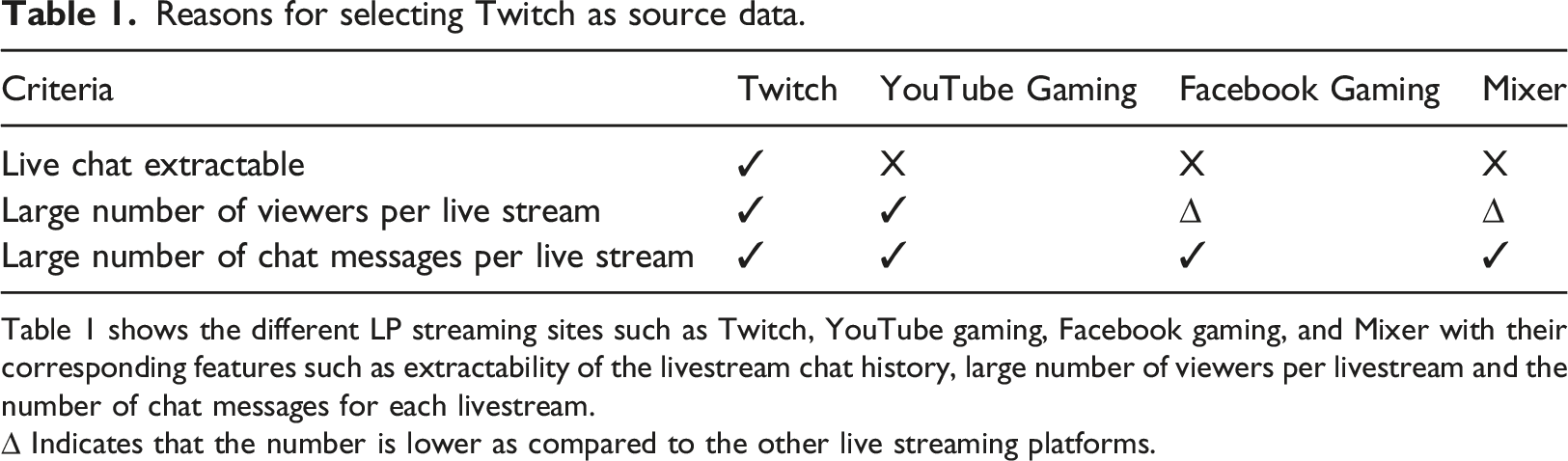
Table 1 shows the different LP streaming sites such as Twitch, YouTube gaming, Facebook gaming, and Mixer with their corresponding features such as extractability of the livestream chat history, large number of viewers per livestream and the number of chat messages for each livestream.
∆ Indicates that the number is lower as compared to the other live streaming platforms.
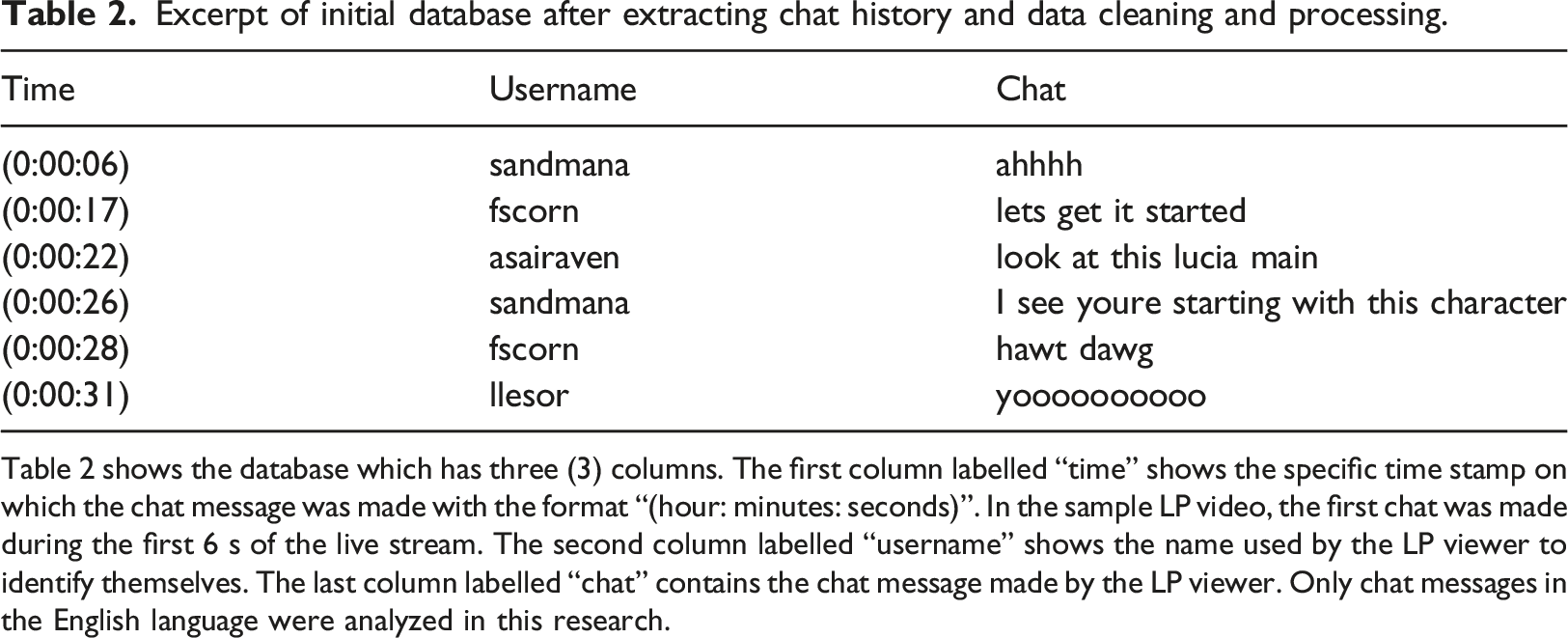
The language used in Twitch chat varies depending on the video game genre, such as “action,” “adventure,” “horror,” “strategy,” “platform,” and the like. In some cases, the gender of the LP streamer also affects the word usage in the live chat, wherein when the LP creator is female, the audience tends to use words referring to body parts (Nakandala et al., 2017). Moreover, general characteristics of Twitch chat include excessive and meaningless use of Twitch emotes (Carter and Egliston, 2018). Twitch emotes unique to Twitch and convey various types of emotions (Barbieri et al., 2017). Previous research labeled the communication in Twitch Chat as “crowd speak,” wherein several users convey a similar message during particular events (Ford et al., 2017). For instance, several users use the Twitch emote “PogChamp” whenever an exciting or fantastic play is in the live stream video. Gaming language also poses a challenge for researchers as game vocabulary is unique. Chat language consists of expressions and slang that are hard to process (Ensslin, 2011), even with natural language processing technologies (Park et al., 2015). The corresponding chart for the LP video had a total of 6156 messages from 860 unique users. The raw chat data included text, Twitch emotes, usernames, and time stamps. The researcher removed Twitch emotes from the analysis since these were considered noise. Twitch emotes often used excessively and convey emotions or intentions that may vary for each individual. Table 2 describes the contents of the database at this point. The database contains The corresponding time in the video in for each chat message, The username of the sender of the message, and The text data of the message. Excerpt of initial database after extracting chat history and data cleaning and processing. Table 2 shows the database which has three (3) columns. The first column labelled “time” shows the specific time stamp on which the chat message was made with the format “(hour: minutes: seconds)”. In the sample LP video, the first chat was made during the first 6 s of the live stream. The second column labelled “username” shows the name used by the LP viewer to identify themselves. The last column labelled “chat” contains the chat message made by the LP viewer. Only chat messages in the English language were analyzed in this research.
Next, the researcher coded each chat message according to the type of game event in the video game title “SFV.” Game events are unique for each video game title, characterized by countable processes related to outcomes in the game, such as getting results or scores (Recktenwald, 2017). The game events in SFV are easy to understand since the change in activities in the game is structured and determined. The researcher identified thirteen (13) events for SFV that were present in the LP video used in analysis and are as follows: 1. “Trials” is an SFV game event wherein the Player plays a game with a non-human opponent and must make specific moves to clear objectives and win the match; 2. “Training” is an SFV game event wherein the player practices the characters’ moves in the video game. The opponent does not attack and only receives the moves by the Player. There is no match. 3. “Story” is an SFV game event wherein the Player practices the moves/actions of the characters in the video game while going through the character’s story and background information. 4. “Select character” is an SFV game event wherein the Player chooses the character he/she wants to play in the video game. 5. “Player standings” is an SFV game event wherein the Player looks at standings and rankings of the top players in the SFV worldwide in real-time. 6. “Match win” is an SFV game event wherein the Player wins the match. 7. “Match lose” is an SFV game event wherein the Player loses the match. 8. “Round one” is an SFV game event wherein the Player plays a human opponent in a match for the first time. 9. “Round two” is an SFV game event wherein the Player plays the same human opponent in round one for a second time. 10. “Final round” is an SFV game event wherein if the Player has one win and one lose Player goes into the final round to decide the winner of the match. 11. “Character data” is an SFV game event wherein the Player looks at the character data, such as moves, health, damage, abilities, and others. 12. “Break” is an SFV game event wherein the Player does not play the video game and does other things such as conversing with the viewers or going “off-camera." 13. “Before match” is an SFV game event wherein the Player waits for the match to start. The Player waits for an opponent.
Next, the researcher labeled each line of chat in the database with one corresponding game event type. The researcher considered accounting for latency such as network traffic, the reaction of the viewers, time to type and send the chat when coding the lines of chat in the database. The estimated latency for each line of the chat is at 10 s. After labeling all chat messages, the researcher found that the events with the most significant number of chat messages were round one (20%), while player standings (0.3%) had the most diminutive messages. Figure 1 shows the summary of the number of chat messages for each game event. The difference in messages for each event might have been affected by the LP creator’s repetition of the event throughout the LP video. For example, matches (round one, round two, or final round), match result (win or lose), break, and before match have more chat messages since these events are often repeated by the LP creator throughout the LP. Pie chart of number of chat messages for each event types. Street Fighter V has 13 event types. The events with the greatest number of chat messages are Round one (20%), Round two (17%), and Before match (11%). The events with the least number of chat messages were character data (2%), trials (2%), select character (2%), and player standings (0.3%).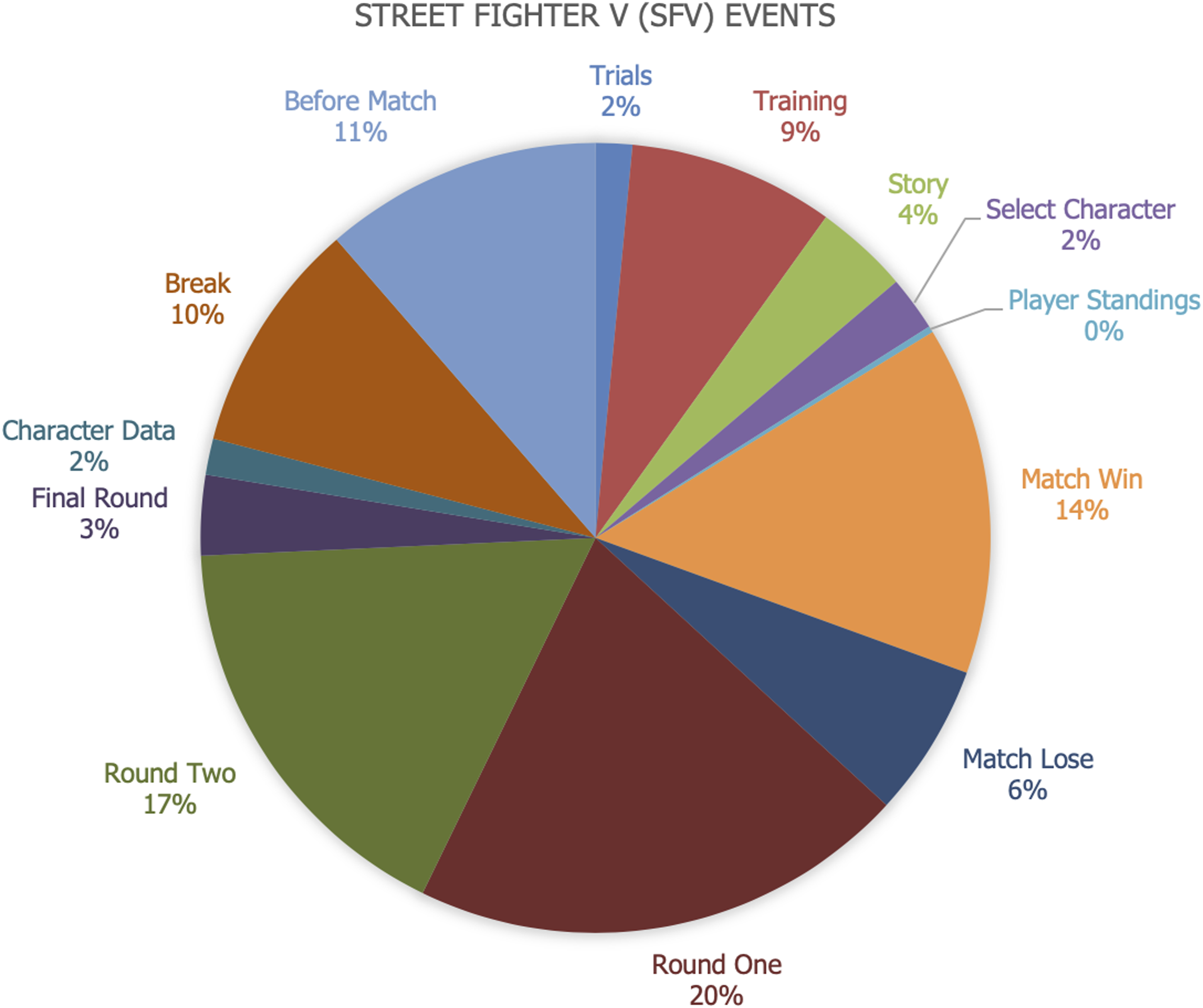
Finally, the researcher coded each line of the chat with the corresponding chat message type. A qualitative analysis of the chat messages determined the type of chat message. The researcher randomly sampled 100 chat messages, formed a group discussion with five students at higher education levels, and asked them to identify the type of chat messages. First, each student labeled the sampled chat messages one by one using their preference for categorizing. Next is a comparison of the categories created by each student. The students conducted a group vote on naming similar types. For the non-similar classes, the students discussed how to label it as a group.
For all decisions made, a majority vote was necessary.
The group discussion resulted in having ten chat message types such as (1) requests or suggestions, (2) comment to the player, (3) character action, (4) character design, (5) character information and feeling, (6) positive, (7) negative, (8) question, (9) game information, and (10) others. Afterward, the researcher labeled all 6156 lines of chat using the group discussion’s criteria for assigning the type of chat message. The researcher assigned each of the chat messages to only one type. These chat message types show the classification of the content and semantic usage. After labeling, the researcher again randomly sampled 50 chat messages for each of the ten chat types and asked the group discussion members to rate the accuracy of the labeling. Ratings for the sample labeled chat messages were above 80% for each chat type, so the researcher decided that the labels for the chat messages are acceptable. The resulting ten types of chat messages identified in detail are: 1. “Requests or suggestions” is a type of chat message wherein the viewers either (a) ask the player to do a specific action, move, or choice or (b) make a suggestion to the player regarding a specific action, move, or choice to make. An example of this is chat line 3955 with the message “give Honda a cardigan” and chat line 4319 with the message “keep Makoto away from this game please I really don’t want to see her in this game with missing moves." 2. “Comment to player” is a type of chat message wherein the viewer comments on the player, such as on the player’s looks, actions, or choices. For example, chat line 4648 with the message “winning off of lag is worse than losing for me” is coded under the “comment to player” chat type; 3. “Character Action” is a type of chat message wherein the viewer talks about the activities done by the character in the video game. For example, chat line 4666 with the message “that Ken flew” is coded under the “character action” chat type; 4. “Character Design” is a type of chat message wherein the viewer talks about the character’s design in the video game. For example, chat line 5084 with the message “her accent too thick to be low tier” is coded under the “character design” chat type; 5. “Character information and feeling” is a type of chat message wherein the viewer either (a) provides information regarding the character in the video game or (b) expresses their feelings for the character in the video game. For example, chat line 5382 with the message “Poison is my new love” and chat line 5428 with the message "Lucia’s trials are not too hard to get either” are coded under the “character information and feeling” chat type; 6. “Positive” is a type of chat message wherein the viewer makes a positive comment to the action, move, or choice made by the player. For example, chat line 5739 with the message "that’s nice” is coded under the “positive” chat type; 7. “Negative” is a type of chat message wherein the viewer makes a negative comment to the action, move, or choice made by the player. For example, chat line 5938 with the message “rip win streak” is coded under the “negative” chat type; 8. “Question” is a type of chat message wherein the viewer asks the player about the game, character, or personal information. For example, chat line 0013 with the message “bro did you see the guilty gear announcement” is coded under the “question” chat type; 9. “Game information” is a type of chat message wherein the viewers provide information about the game (excluding information about video game characters). For example, chat line 0099 with the message “bundles not out till tomorrow” is coded under the “game information” chat type; and 10. “Others” is a type of chat message wherein the viewers talk about their status or non-related events with the live stream. For example, chat line 0354 with the message “now I need a gift sub, and my life will be perfect” is coded under the “others” chat type.
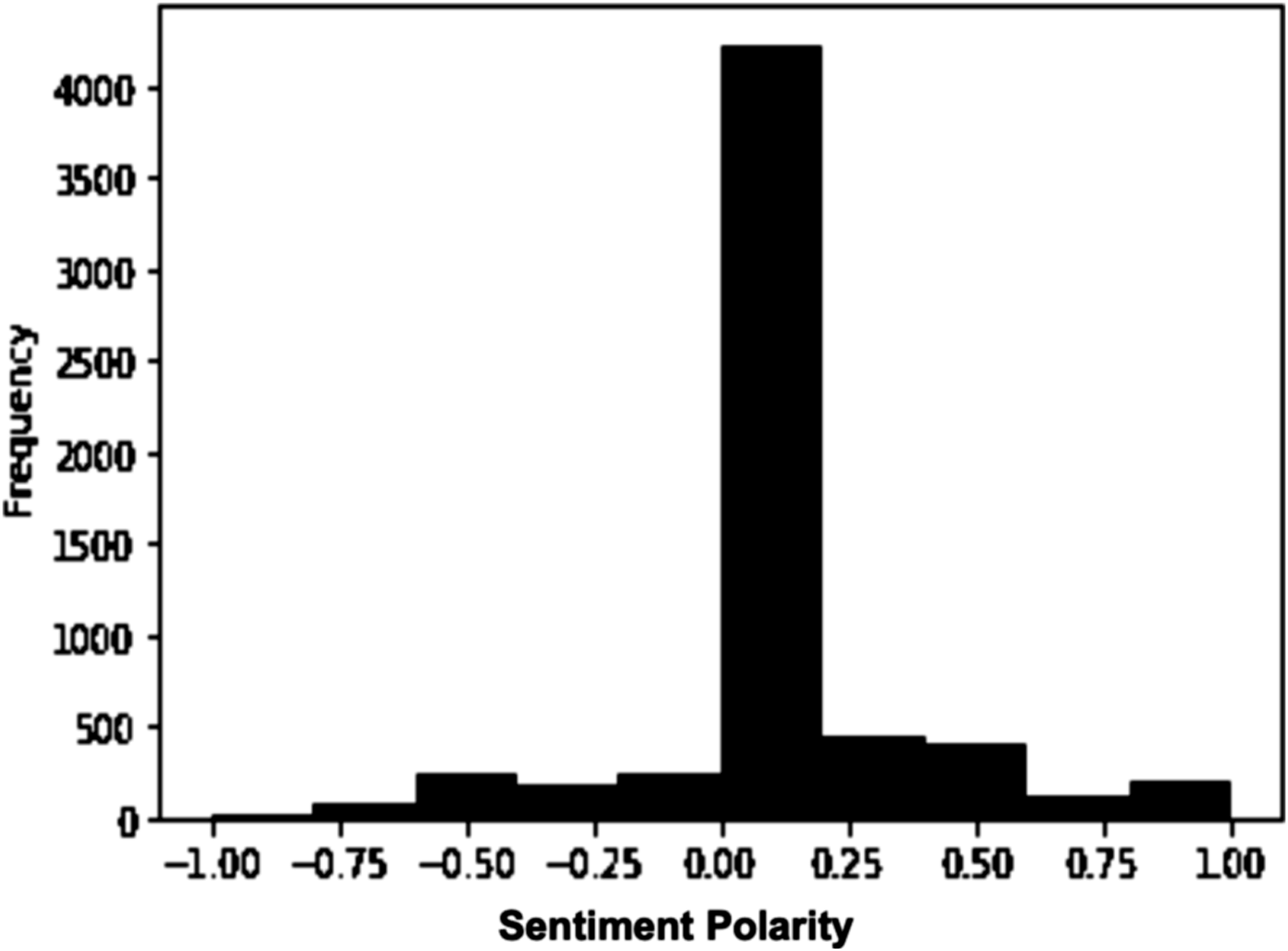
At this point, the final LP chat database consisted of information regarding the time, username, game event type, and chat message type for each line of chat. The researcher then conducted exploratory data analysis (EDA) on this database. The goal was to see what type of chat messages there are for each LP game event and how users use the chat to make meaning of the LP video. The hypothesis is that chat behavior in LP is similar to that of student behaviors in chat rooms used in e-learning environments. Initial EDA on the 6156 lines of chat from the SFV LP video showed that the majority of the chat has character counts of less than 100 (see Figure 2), which was in line with results from previous studies (Barbieri et al., 2017) and generally had a neutral sentiment. This result is also in line with previous research wherein chat messages tend to be short (Dong et al., 2006). The sentiment, however, may differ depending on the gaming community and content of the LP video (Thompson et al., 2017). As for the sample LP chat used in this paper, the gaming community generally had neutral sentiments with more positive than negative messages. Figure 3 describes the sentiment of the chat. Frequency distribution of character count of chat messages The y-axis shows the frequency counts while the x-axis shows the character counts of chat messages. Majority of the chat messages lie in the 0 to 50 characters count bucket. Frequency distribution of sentiment polarity of chat messages Y-axis refers to the frequency count while the x-axis refers to the corresponding sentiment polarity calculated for each chat message. Sentiment in LP is majorly neutral as most of the chat messages have a polarity between 0.00 and 0.25. A negative polarity value closer to 1 indicates a positive sentiment.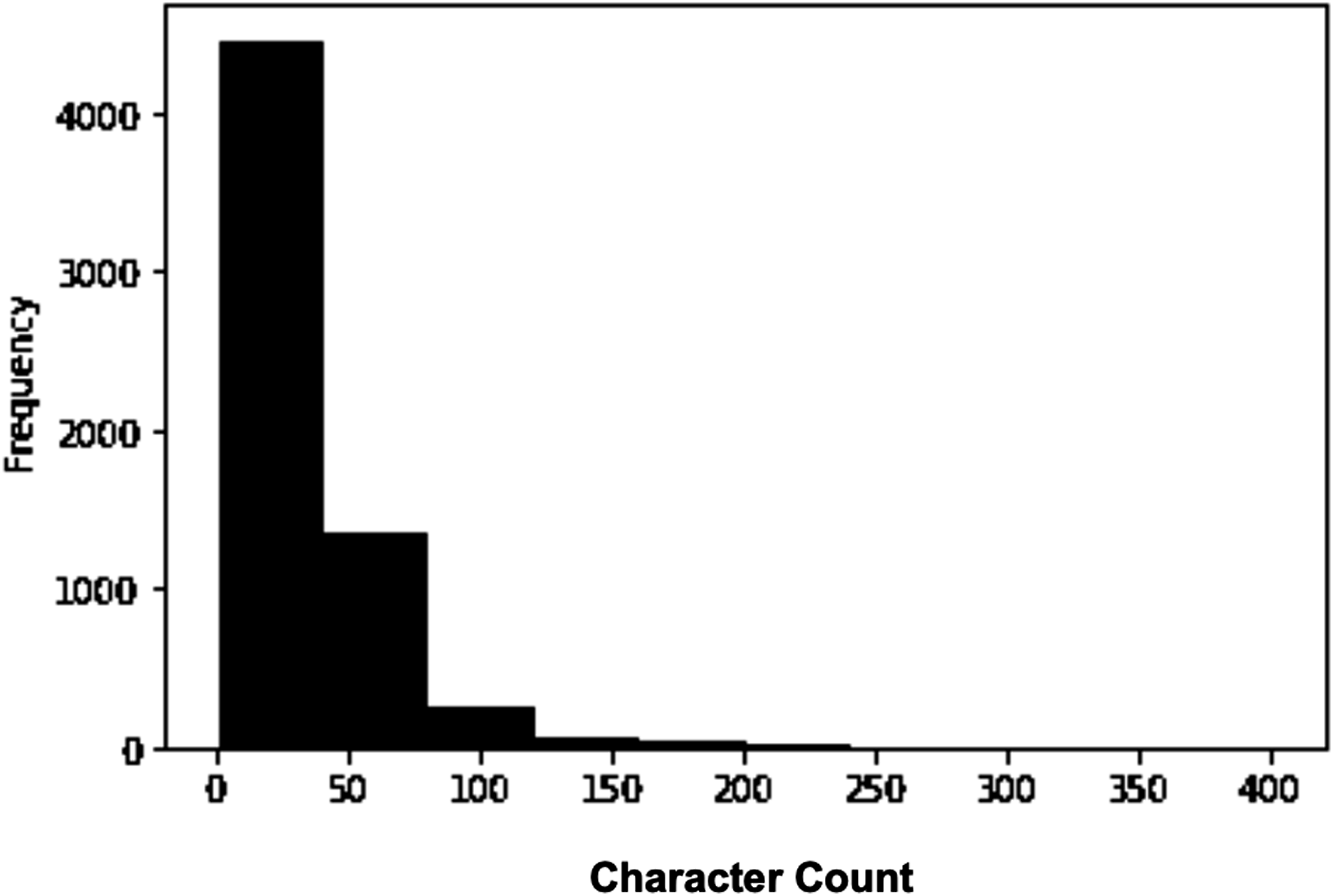
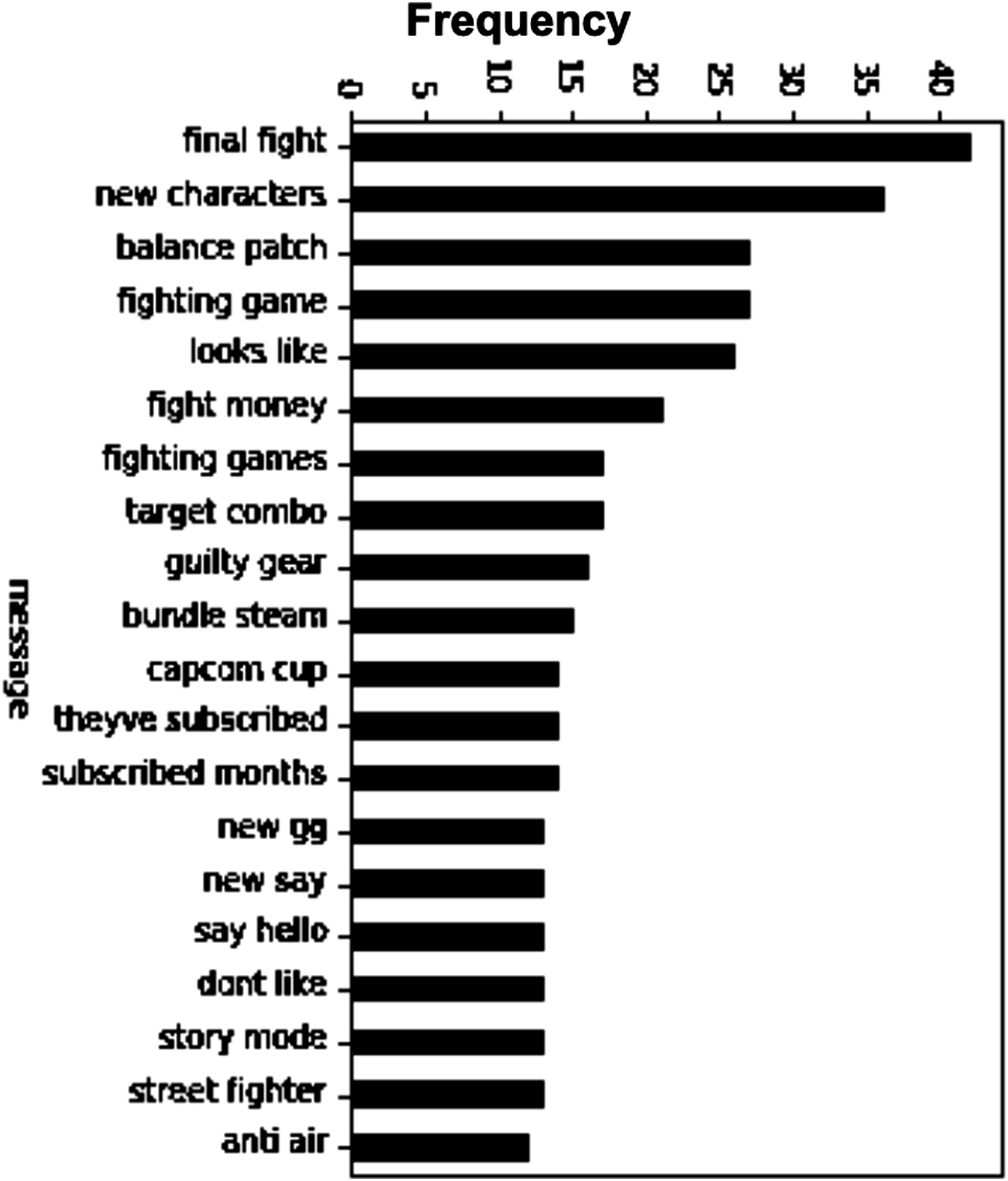
When we looked at the familiar word usage in the chat, popular unigrams (see Figure 4) are SFV character names. In contrast, popular bigrams (see Figure 5) are about the game information and character moves. The findings suggest that the audience somewhat learns and remembers technical information in the video game universe, such as character names, moves and abilities, environment, and strategies. Most of the words used in the chat are unique to the video game SFV, such as character names and game terminology for character moves, powers, and equipment. These game terminology and jargon make the LP chat appear unreadable at first to a person who has no knowledge of the video game and at the same time reveal a rich culture and high gaming knowledge (Ford et al., 2017). Frequency distribution of top unigrams The x-axis shows the frequency count and the y-axis refers to the words used in the LP chat. The words “like” and “just” are the most common words followed by the words “honda" and “lucia" which refer to the SFV video game characters. Frequency distribution of top bigrams The x-axis shows the frequency counts while the y-axis shows the corresponding word pairs that were used in the LP. The most common word pairs were “final fight” and “new characters”.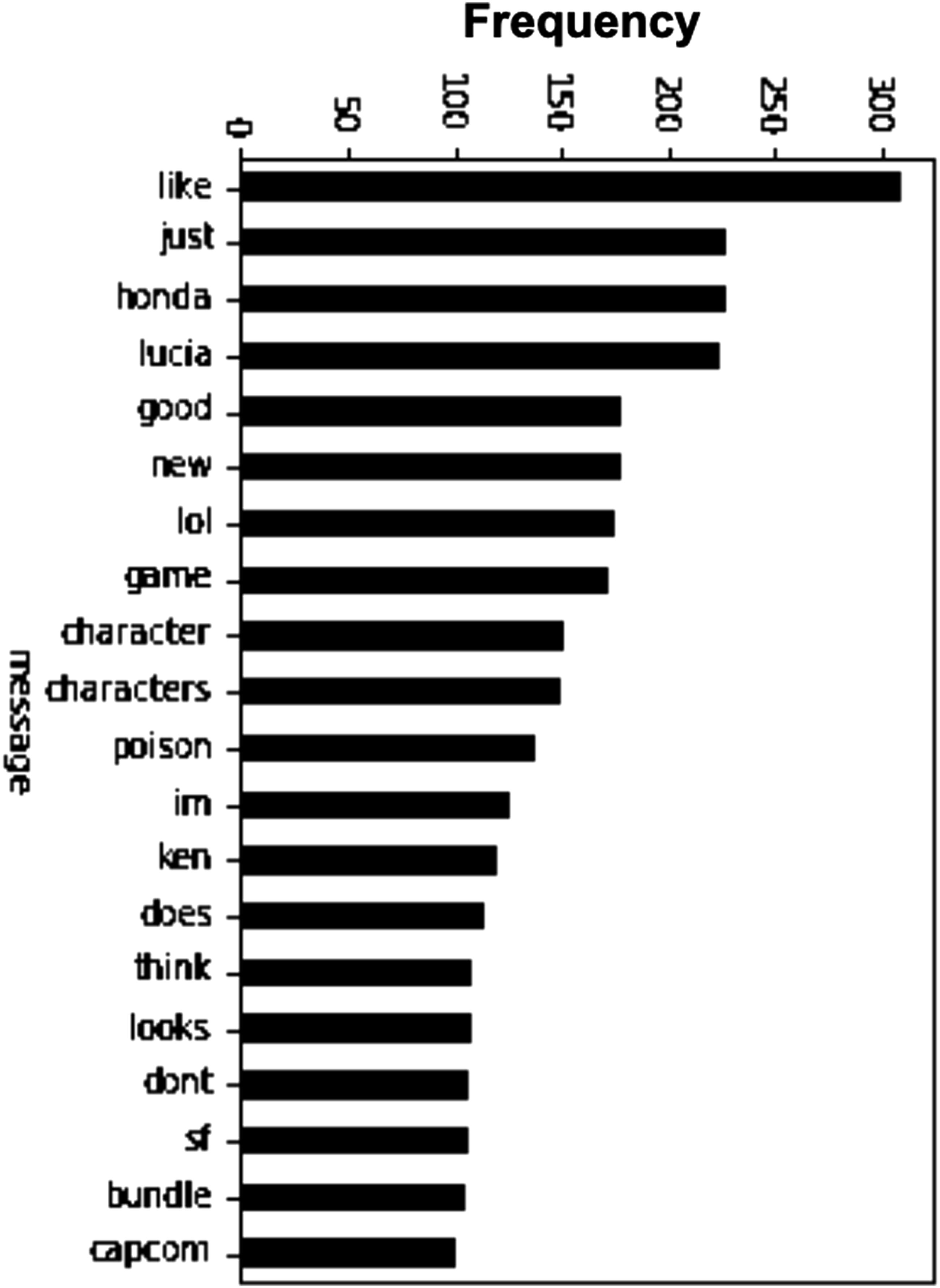
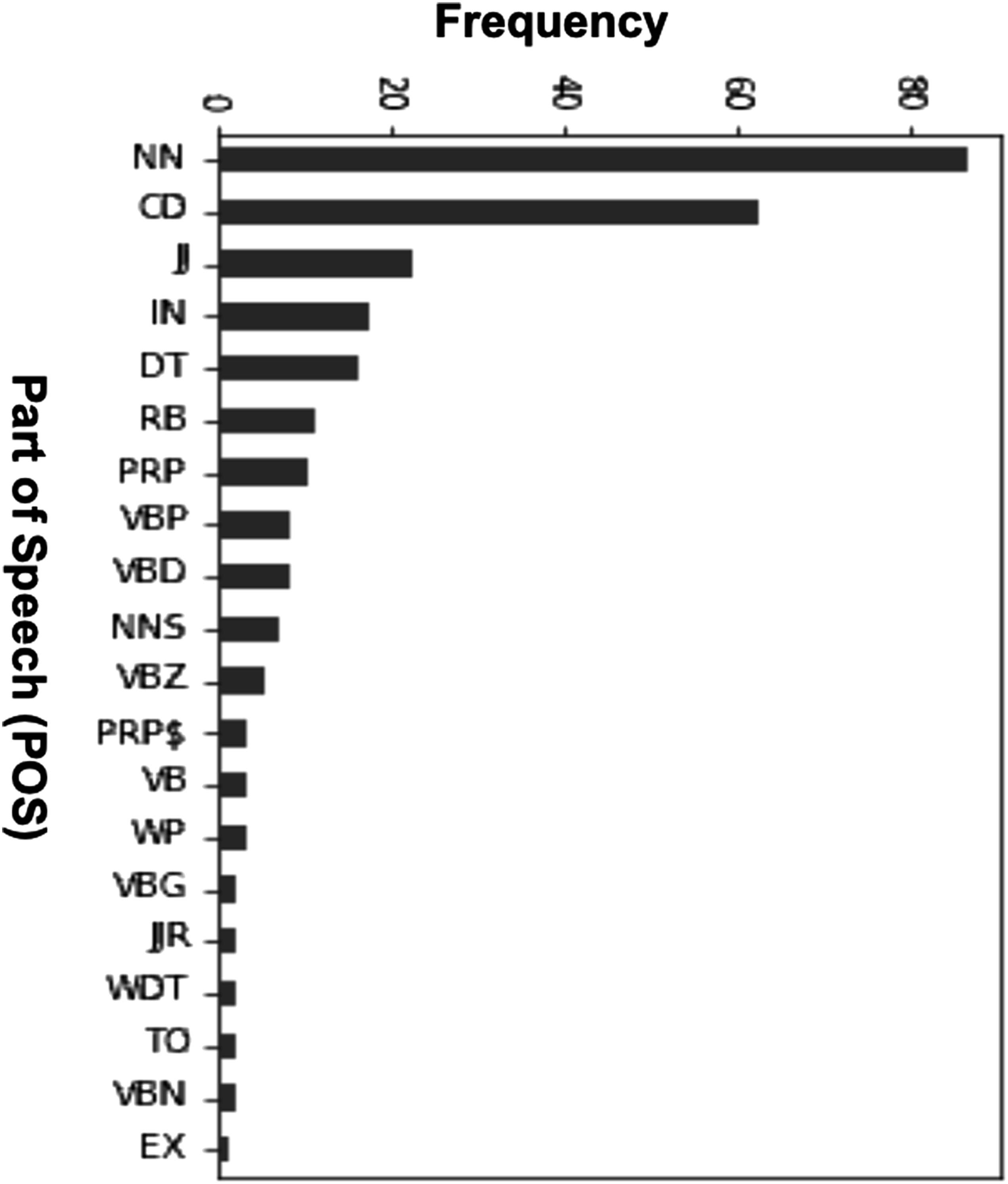
Analysis of the number of chat messages per user reveals that most users throughout the LP video had an average of 5 chat messages. Figure 6 describes the number of chat messages for each user in the LP chat. In terms of language use, the most common type of words used in the chat is singular nouns (NN), cardinal digits (CD), and adjectives (JJ). Interestingly, cardinal digits in the LP chat may infer that users are exact when talking about game information. They also often include measurements and quantities in their messages. Figure 7 summarizes the frequency distribution of the parts of speech (POS) used in the LP chat. Frequency distribution of number of chat messages per user The x-axis shows the number of chat messages per each unique user while the y-axis shows the frequency counts. Frequency distribution of parts of speech (POS) of chat messages The most common part of speech used in the sample LP chat were singular nouns (NN), cardinal digits (CD), adjectives (JJ), prepositions / subordinating conjunctions (IN), determiners (DT), adverbs (RB), personal pronouns (PRP), verb in present tense (VBP), verb in past tense (VBD), plural nouns (NNS), verb in third person singular (VBZ), possessive pronouns (PRP$), verb in base form (VB), wh-pronouns (WP), verb in gerund or present participle (VBG), adjectives in comparative form (JJR), wh-determiners (WDT), “to” (TO), verb in past participle (VBN) and existential there (EX) respectively.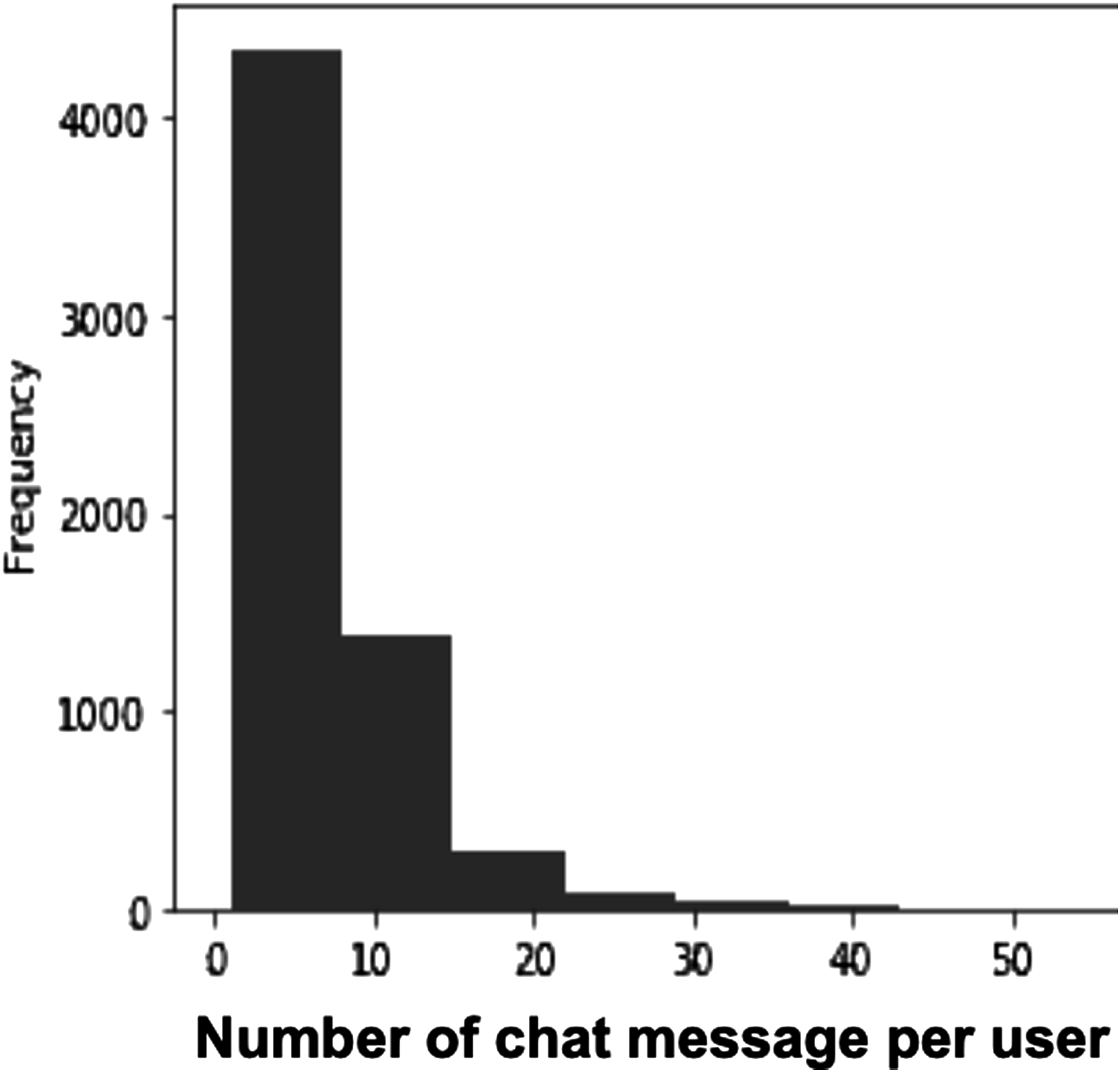
Generally, in terms of character counts, all chat categories are shown to have less than 100 characters (see Figure 8). However, it is noticeable that the “positive” and “negative” chat types have the shortest messages because these two chat categories only convey emotions or quick reactions from the viewers. On the other hand, the “game information” chat type has longer messages since viewers in this category intend to convey valuable and relevant information about the video game either to fellow viewers or to the streamer. Message length box-plot of each of the chat types The x-axis refers to the ten (10 chat types and the y-axis shows the respective character count. Each chat type’s character count box plot is represented in this figure.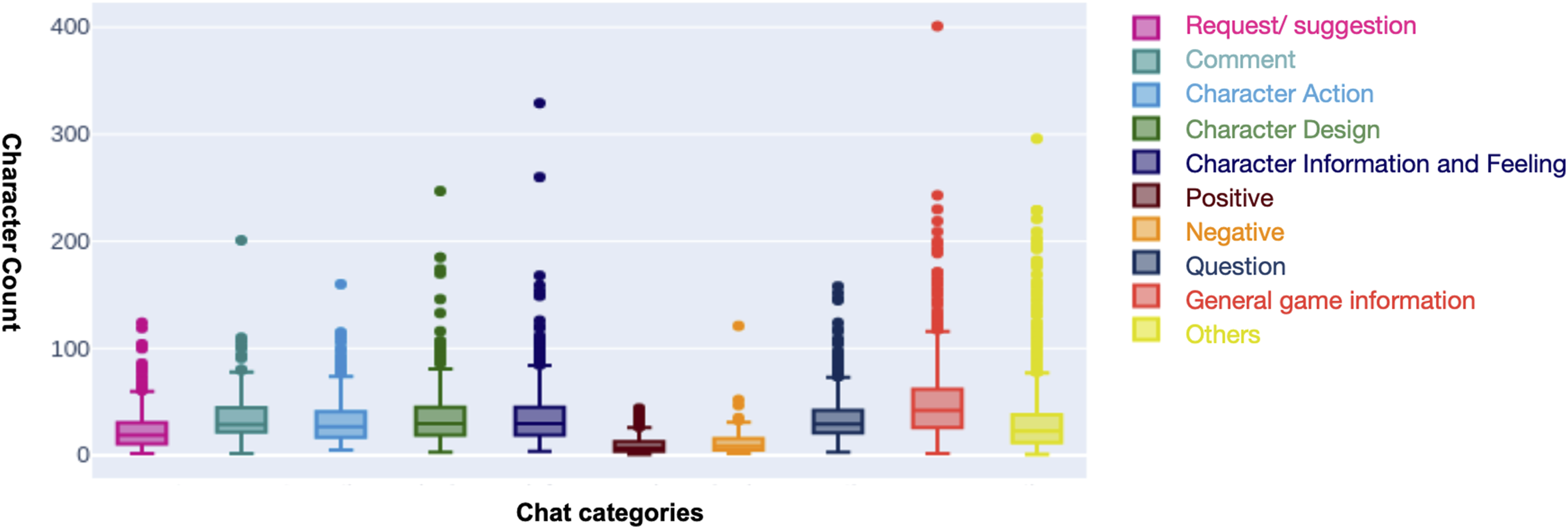
We found interesting results in the occurrence percentage of chat types in-game events such as “training,” “story,” “select character,” “player standings,” and “match lose” (see Figure 9). During “training,” viewers talk about non-game information or personal feelings and opinions; this may have happened because during “training,” nothing interesting happens in the video as the LP creator tries out different character moves, and there is no actual match going on. However, during “story,” viewers begin to talk about more of the video game characters as in “story,” focusing on the background and information about the video game characters. In “select character” and “player standing,” viewers talk more about the game, such as schedule for new releases or versions, events for professional gaming, and discussions on the gaming platform. Lastly, during “match lose,” we expected that there would be a more “negative” type of chat. However, actual results reveal a more “positive” type of chat; this may be due to LP creators generally being high-skilled gamers with a low loss percentage. Therefore, when the LP creator loses, the viewers praise or commend the winning opponent instead of giving negative comments to the LP creator who lost in the game. Another reason is that the LP viewers consist primarily of “fans” of the LP creator. Therefore, findings suggest that LP viewers do not give negative feedback to their “idol” LP creator, evidenced by a neutral sentiment. Some chat messages with positive sentiment are greater than chat messages with negative sentiment. Summary of the percentages of chat types per each SFV event The distribution of the 10 chat types for each SFV event is summarized in this figure. The chat types such as “others”, “general game information”, “character design”, “character action and feeling”, and “question” generally occur frequently in the SFV events.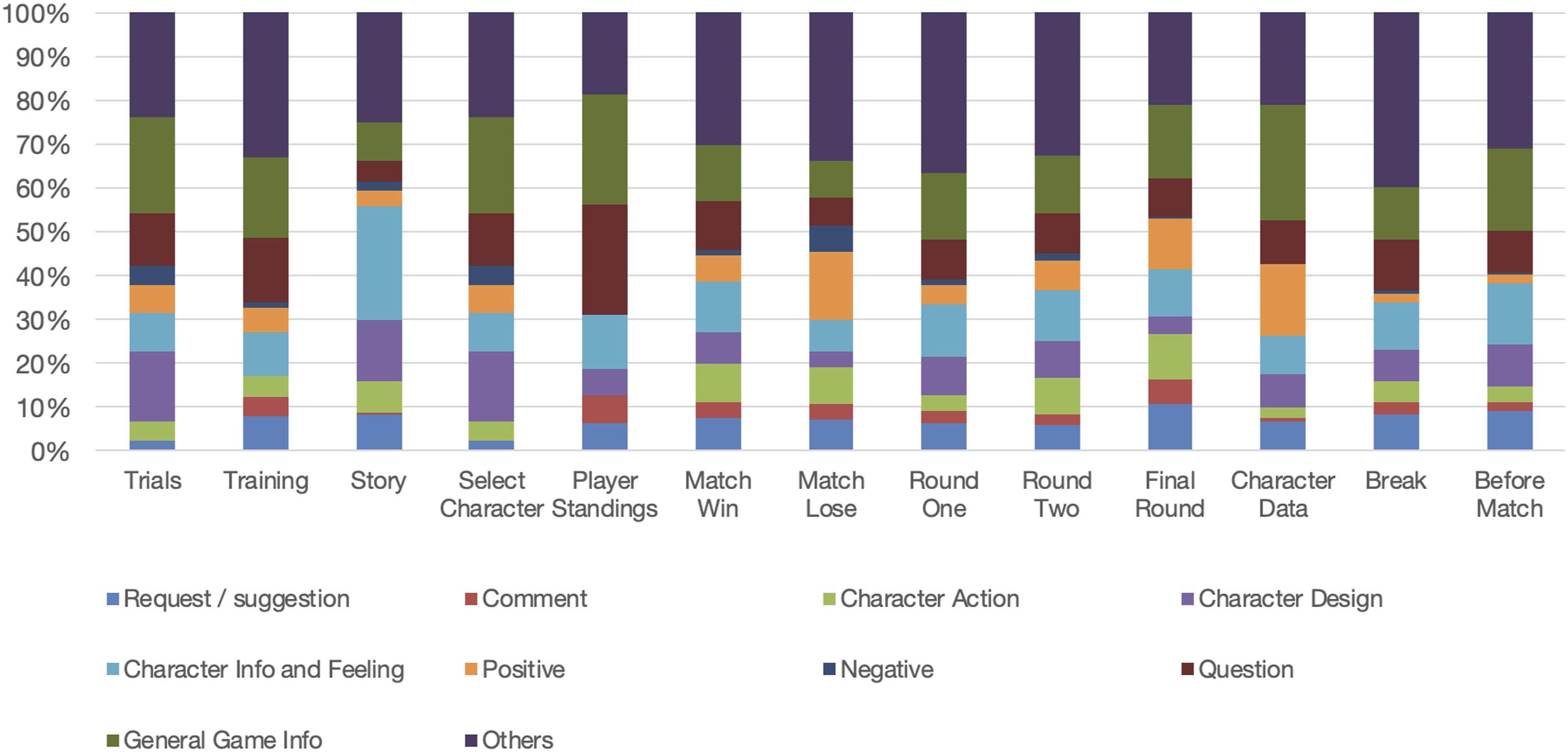
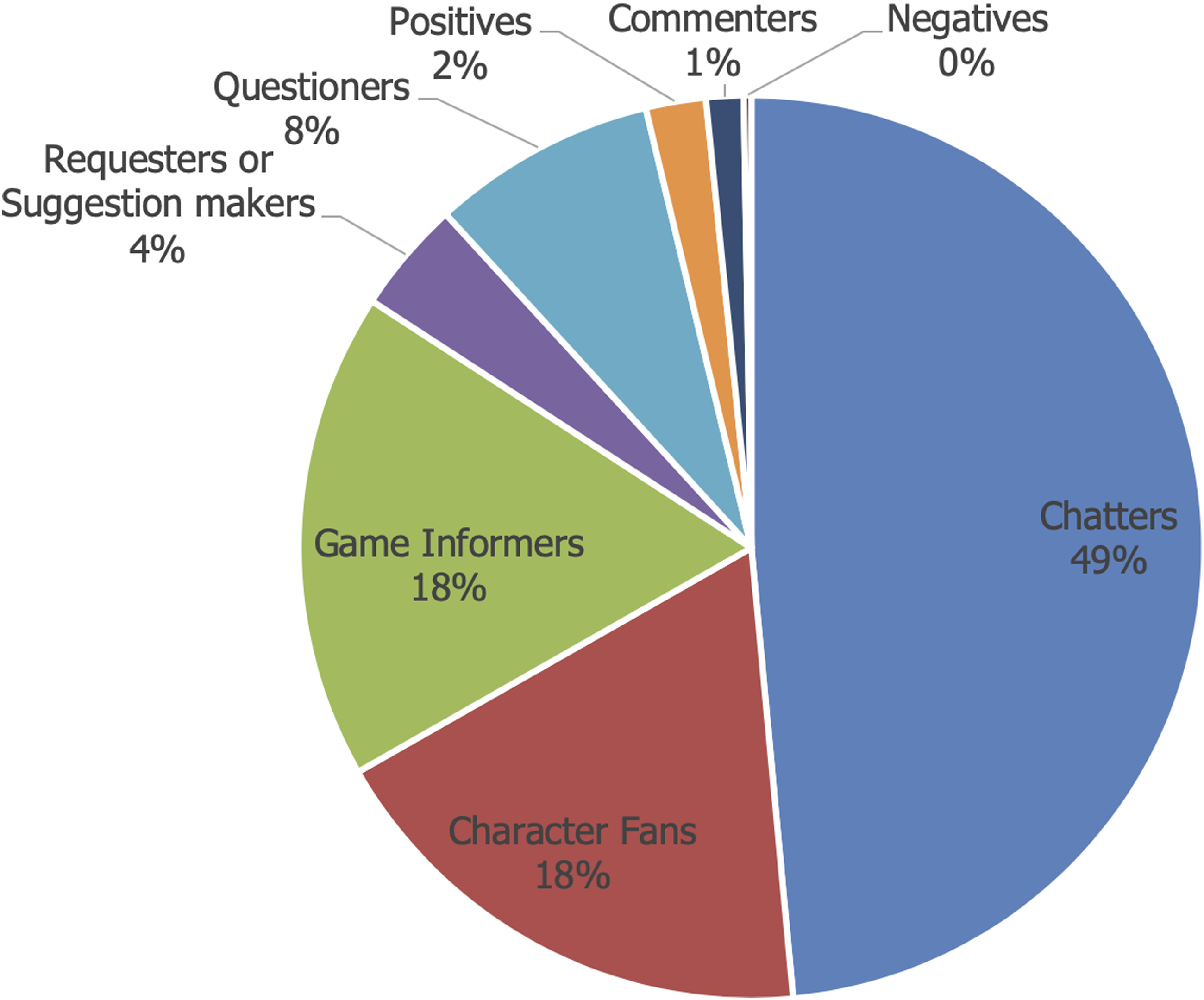
From observing the chat categories per user, eight (8) personalities were present in the LP chat. The eight personalities are (1) chatters, (2) character fans, (3) game informers, (4) questioners, (5) requesters or suggestion makers, (6) positives, (7) commenters, and (8) negatives based on the ten types of chat messages wherein “character action,” “character design” and “character information and feeling” were merged to form one personality named “character fans.” There were 860 unique users in the database, but the researcher identified only 373 with personalities or peculiar behavior.
The research used criteria to determine users’ personalities. If the user’s chat messages have 25% or more assigned to one type of chat, the user has a peculiar behavior of frequently using that type of chat. Figure 10 summarizes the personalities of the chat users. Each chat personality is described in detail as follows: 1. “Chatters” refers to users whose chat messages were dominantly coded with the “others” chat message type meaning that this personality often talks about non-game topics. The main intention for joining the live chat is to socialize with other viewers rather than make meaning of the LP video. Chatters comprised almost half (or 49%) of the total chat users in the LP video analysis. 2. “Character fans” pertains to users whose chat messages were dominantly coded with the “character action,” “character design,” and “character information and feeling” chat message type. Character fans are about 18% of the users in the live chat. This personality type is highly interested in the video game characters’ design, abilities, and performance. 3. “Game informers” comprises 18% of the users in the live chat. This personality type refers to users whose chat messages are dominantly coded with the “game information” chat message type. 4. “Questioners” are used to describe users’ personalities whose chat messages are mainly the “question” chat message type. These users often use live chat to ask their fellow viewers or the LP creator questions. 8% of the users in the live chat have this personality. 5. “Requesters or suggestion makers” refers to users whose chat messages were dominantly coded with the “request or suggestion” chat message type. Only 4% of the users have this personality type. Users here often make requests or suggestions to the LP creator on what moves to do or which character to select during matches. 6. “Positives” pertains to users whose chat messages are the “positive” chat message type. 2% of the users are in this personality type. These are users who mainly comment positive words or expressions such as praising the LP creator’s actions or choices. 7. “Commenters” personality type had only 1% of the users in the live chat. These users have the majority of their chat messages tagged as “comment to the player.” Their use of live chat is to talk with the LP creator, whether game or non-game related. 8. “Negatives” had the lowest number of users with 0.3%, or specifically, only one user has this personality. This user’s chat messages fall under the “negative” chat message type. This user characteristic is that he/she often uses negative words and expressions such as booing the actions of the LP creator or saying unpleasant things about the LP video or the video game title of the LP. Pie chart of the percentage of users per each personality Majority of the users were classified as chatters (49%) followed by character fans (36%), game informers (35%), and questioners (16%). Requesters or suggestion makers accounted for 8% of the users followed by positives and commenters at 4% and 1% respectively. The negatives (0.3%) had the lowest number of users.
Overall, this section presents an exploratory analysis of the live chat of an LP video. Results show that the type of chat messages that LP viewers make fall into ten types and that there is an existing habit or personality of each live chat user on the type of chat messages they make. For instance, some live chat users often send non-game-related messages while other live chat users mainly send helpful information, news, and updates about the video game. These findings support the central research question of examining the potential of using LP in education. Research shows that some “peer teaching” or “information exchange” happens in the Livestream chat. The analysis suggests that the LP audience does appear to make meaning of the content of the LP video and not simply make useless comments or noise. This action of making meaning of video content is an essential factor when it comes to education context.
To further show LP’s potential in pedagogy, the third section of this paper compares the live chat behavior in LP videos in the education context.
Incorporating LP videos in the education context
Relating the events in LP to learning activities.
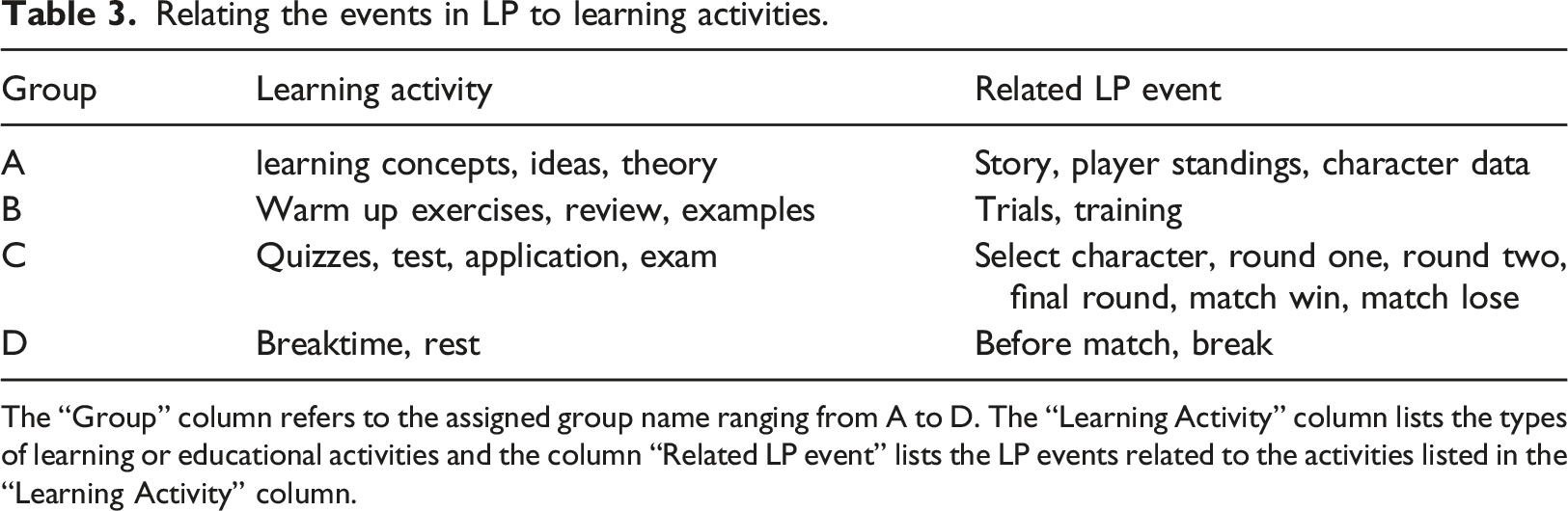
The “Group” column refers to the assigned group name ranging from A to D. The “Learning Activity” column lists the types of learning or educational activities and the column “Related LP event” lists the LP events related to the activities listed in the “Learning Activity” column.
Similarities between the events in the LP – Street Fighter V and learning activities were validated using Cosine similarity on their definitions. Cosine similarity measures similarity between two non-zero vectors of an inner product space that measures the cosine of the angle between them (Xia et al., 2015). The Cosine similarity returns a score between 0 and 1. A score near 1 indicates a substantial similarity between the two documents, while 0 indicates low similarity. A Cosine similarity score of 0.5 and higher shows strong similarity (Crocetti, 2015). Cosine similarity scores for each learning activity and related LP event were higher than 0.5, showing that they have strong similarities.
Group A: Learning concepts, ideas, and theories
Summary of types of chat of Group A events.
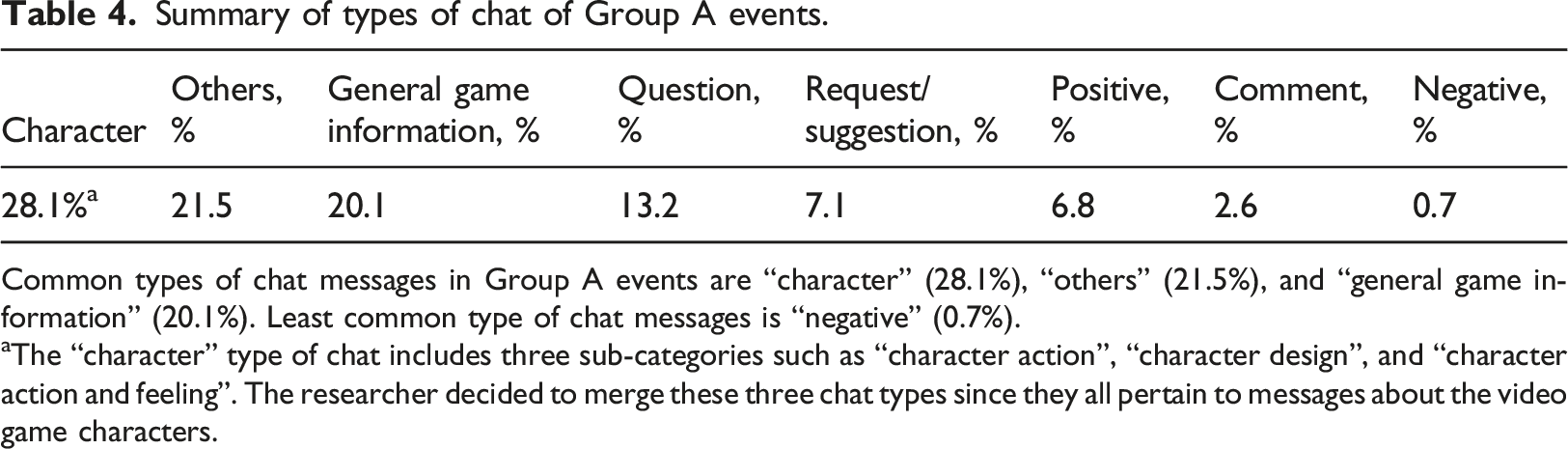
Common types of chat messages in Group A events are “character” (28.1%), “others” (21.5%), and “general game information” (20.1%). Least common type of chat messages is “negative” (0.7%).
aThe “character” type of chat includes three sub-categories such as “character action”, “character design”, and “character action and feeling”. The researcher decided to merge these three chat types since they all pertain to messages about the video game characters.
The research suggests that viewers learn from LP videos as most of their chat messages focus on the characters of the video game. It is also noticeable that the question type of chat messages is also high; this may be because when people learn something new, asking questions is also common.
Group B: Warm-up exercises, review, and providing examples
Summary of types of chat of Group B events.
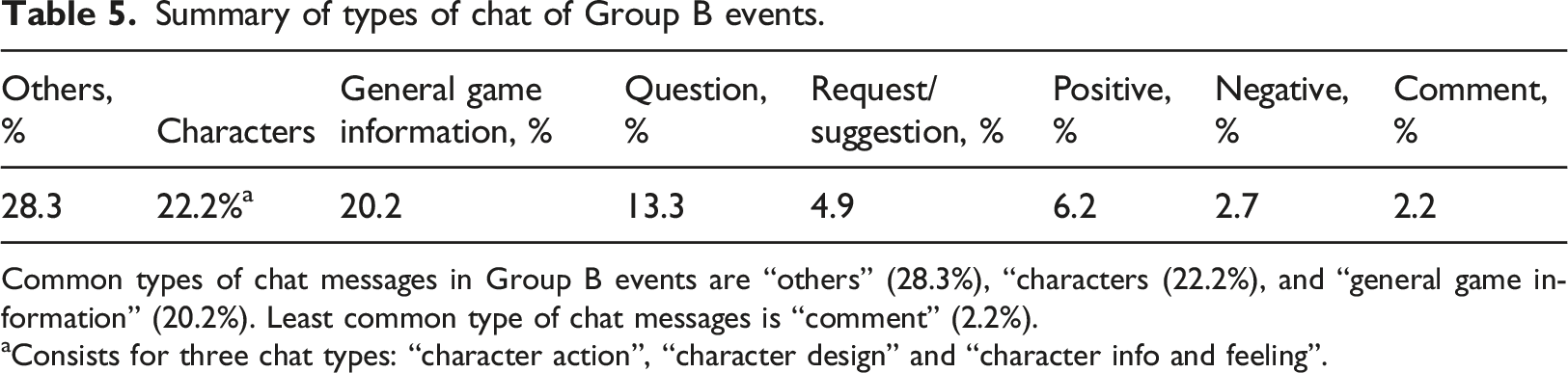
Common types of chat messages in Group B events are “others” (28.3%), “characters (22.2%), and “general game information” (20.2%). Least common type of chat messages is “comment” (2.2%).
aConsists for three chat types: “character action”, “character design” and “character info and feeling”.
It can be observed from Table 5 that the majority of chat messages during Group B events are under “others.” The research suggests that LP viewers talk about non-game topics such as the weather and other personal information; this may be the case since there is less excitement in Group B events since no match is happening. However, “characters” and “general game information” types of chat are frequent during Group B events which implies that viewers also talk about relevant game information for what is happening in the LP video. These results can be a good insight as to how LP viewers react to less exciting events.
Group C: Quizzes, test, application, exam
Summary of types of chat of Group C events.
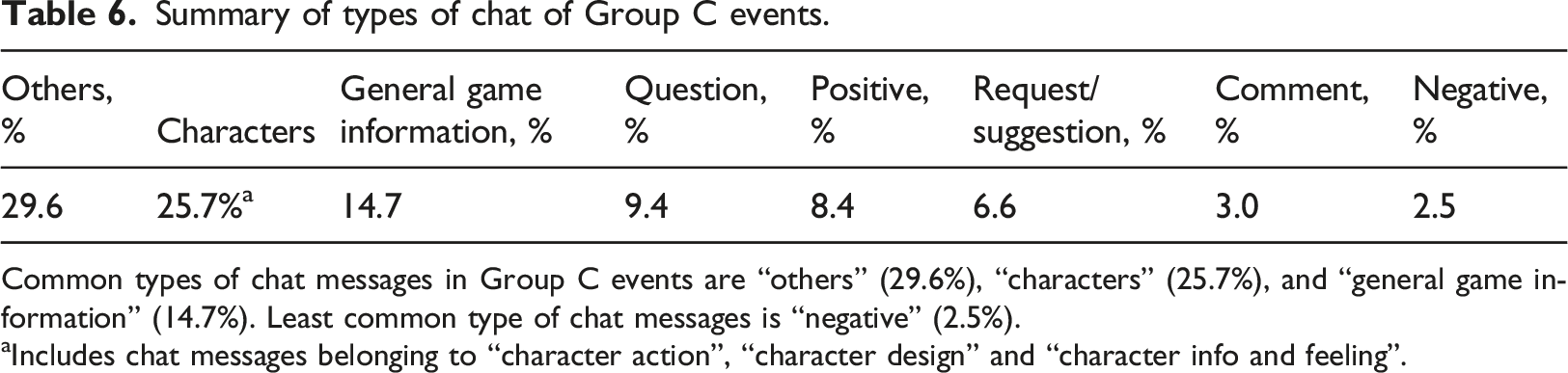
Common types of chat messages in Group C events are “others” (29.6%), “characters” (25.7%), and “general game information” (14.7%). Least common type of chat messages is “negative” (2.5%).
aIncludes chat messages belonging to “character action”, “character design” and “character info and feeling”.
It is noticeable that “others” and “characters” types of chat are the most frequently used type of chat message during Group C events which are the most exciting in the LP videos. This result can imply that although some viewers are talking about the video game, some viewers use the LP chat to socialize with other people.
Group D: Breaktime, rest
Summary of types of chat of Group D events.
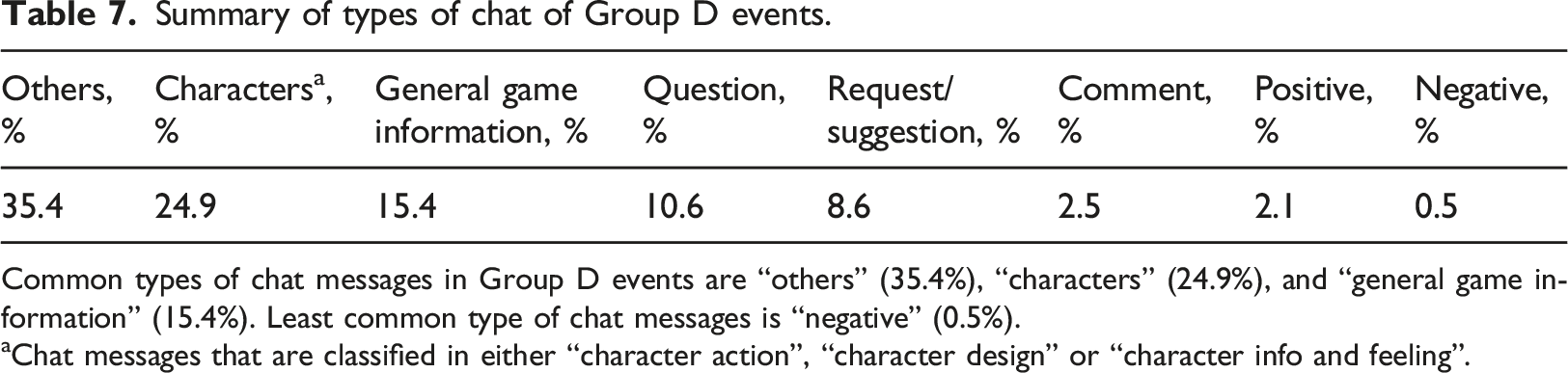
Common types of chat messages in Group D events are “others” (35.4%), “characters” (24.9%), and “general game information” (15.4%). Least common type of chat messages is “negative” (0.5%).
aChat messages that are classified in either “character action”, “character design” or “character info and feeling”.
The “others” type of chat has the highest percentage share in Group D events compared to the other groups. Group D events viewers are free to talk about anything since the LP creator is not playing the game, and there is no game-related event on the screen.
Let’s learn: Application of Let’s play in education
While there is a vast number of research on revealing the best and recommended methods for teaching and learning in the digital space, few have looked at LP for literacy instruction. Other research in the application of online streaming practices to other non-game formats such as art streaming and its relation to labor found that online streaming practices are similar in approach. Furthermore, the online streaming sites (Twitch and YouTube) push this adherence (Phelps and Consalvo, 2020). Thus, there is a high potential for applying LP practices to other non-game formats such as pedagogy.
Initial analysis of LP in literacy instruction showed that LPs could be used in teaching since the audience is involved in meaning-making. Let’s play triggers the audience to think and interpret the video through interaction in the chat (Burwell and Miller, 2016). To further contribute to the research on LP for literacy instruction, this research proposes the LL framework. Let’s Learn uses the LP practices in the literacy instruction context, a mixture of the best practices in e-learning, games in learning, integrated humor in lessons, and peer-learning. The popularity of LP does not lie on the skill of the LP creators but with the seeking of information (Sjöblom and Hamari, 2017), entertainment, and excitement, expecting the LP creators to provide their audience (Smith et al., 2013); this means that the famous LP are informative and entertaining or “humorous” to draw interest. In literacy instruction, humor helps lower the cognitive load of students in STEM education only if integrated into the lesson or the lesson is humorous (Hu et al., 2017). Thus, In line with LP’s entertaining nature, LL should have integrated humor and entertaining content focusing on playing games to draw interest and attention. The interaction of viewers in LP through the chat analysis revealed that there are “teachers” or people that are knowledgeable about the video game in the chat. This research paper proposes that education in peer learning can apply this kind of interaction. Finally, as shown in previous literature, LPs’ technical characteristics and qualities are following the recommended design for e-learning systems. Therefore, LL will keep the features of LP that are effective characteristics in e-learning systems. Therefore, this paper’s proposed LL concept combines the LP design, application of games in learning, being humorous and entertaining, and the existence of peer learning.
Conclusions
This research has shown that LP videos have characteristics and features of a sound e-learning system, such as having picture-in-picture videos, interaction channels through live chat, and the ability to capture interest and attention with its entertaining nature. The events in LP videos are also relatable to learning activities such as learning concepts, providing examples, and taking examinations to test performance and understanding. Furthermore, analysis of the LP videos viewers’ behavior in the live chat revealed that LP videos viewers behave similarly to the students in e-learning chat rooms. The researcher, therefore, proposes the concept of LL, which is the application of LP in literacy instruction. Let’s Learn combines peer-learning, learning with games, integrated humor, and e-learning. This paper has shown the potential of LL as a new form of literacy instruction. However, this concept needs further examination to confirm its usefulness in increasing student performance. Future work on the concept of LL will involve conducting experiments that measure student performance under the LL learning environment. The researcher hopes that this paper’s findings can increase the interest in adapting LP in literacy instruction and using the concept of LL as a new form of learning and instruction.
Footnotes
Declaration of conflicting interests
The author(s) declared no potential conflicts of interest with respect to the research, authorship, and/or publication of this article.
Funding
The author(s) disclosed receipt of the following financial support for the research, authorship, and/or publication of this article: This work was supported by the Special Fellows research grant from the Program for Leading Graduate Schools of the Japan Society for the Promotion of Science (JSPS) and the Ministry of Education, Culture, Sports, Science and Technology (MEXT) – Japan helped in funding this research.

Author Biography
Vera Paola Shoda is an Assistant Professor at the Center for Computational Social Science and Research Institute for Economics and Business Administration, Kobe University, Japan. She is also a Ph.D. candidate at the School of Integrative Global Majors, University of Tsukuba, Japan. Her research interests include social informatics and e-learning applications.