




Abstract
This article explores the use of modding as a formal tool for learning history. The article examines data from a formal analysis of Europa Universalis IV (EUIV), a survey of 331 EUIV forum participants and a case study of 18 university participants. Significant quantitative survey data indicated that 45% (149/331) of participants had modified EUIV, and of the 125 participants who responded with comments about modding, a significant number (86/125 responses or 68.8%) explained how they had learnt about history, geography or other subjects through the modding process. Closer analysis of survey and case study responses and mods reveals the variety of ways participants learnt and critiqued history through the modding process. The article discusses the data and the pedagogical affordance of modding in a few steps. First, the article briefly explores the evidence that indicates modding is popular within the EUIV gaming community. In this instance, it examines whether given the popularity of gaming practice, modding might also be seen as a new casual form of engagement with games. Second, the article reviews the modding process in EUIV and examines how both playing and creating mods may be beneficial for learning history. Modding is examined in terms of its pedagogical importance and the unique educational opportunities it may offer that are not otherwise accessible through other forms of game-based learning. Finally, the article explores how and what the case study participants learnt when they were tasked with creating and implementing playable mods to demonstrate their understanding of history. Overall, the article considers the growing importance of mods, how learners can create and represent history using mods and how mods can provide a platform for learners to develop their own critique and analysis of official history.
Keywords
Introduction
Edsger Dijkstra, Dutch programmer and early pioneer of computer science, was attributed with saying: ‘Computer Science is no more about computers than astronomy is about telescopes’ (Haines, 1993: 4). Comparably, the informal gaming practice of modding is more about developing new game content than simply being a computational practice. This article argues that the practice of modding has significant educational benefits, aligning with existing scholarship that has linked modding to the informal and formal learning, mainly of computing skills (El-Nasr and Smith, 2006: 17–19; Yucel et al., 2006: 144, 154–155). Scacchi (2010: 2) defines modding as the practice of customising, tailoring and remixing gaming objects such as content, software or hardware with mods being the products of this process. This article advances this existing research by examining how modding supports historical analysis and learning in Europa Universalis IV (EUIV) while also providing the opportunity for modders and gamers to reflect upon history.
This article illustrates the educational utility of modding by first examining the popularity of modding in gaming communities as a form of game engagement. The research data indicated a significant level of interest in modding by EUIV players, where the practice appeared to allow modders to engage more deeply with history than they would have if they had simply played the game. Second, the article examines the educational utility of creating and playing mods for learning history. To do this, it uses evidence from the EUIV online forum survey and a university case study to illustrate the value of using modding for learning and expressing history. Finally, the article considers the versatility of learning through modding with participants from the case study using their mods as platforms to express their historical analysis in unique and individualised ways, drawing on their own interests, values and understandings to communicate their interpretations of and perspectives on history. The article concludes that the informal learning practices of modding and the popularity of the practice could be capitalised on in a formal education setting to help students learn history and express their historical understanding.
The popularity of modding
Modding and altering games has existed in the form of analogy games, long before the appearance of digital games. Analogy games such as board games, cards games and wargames have always been altered to make new variations and new games. In the past, analog games like chess were used as models to design more complex wargames such as Koenigspiel in 1664 and then later Kriegsspiel wargames (Setear and Lastowka, 1999). Such wargames were consistently modified throughout history with new complex wargaming variants emerging to cater to the changing nature of war (Caffrey, 2000: 44–45; Perla, 1990: 109–110). In more modern contexts, the well-known game Monopoly (Magie and Darrow, 1935) is thought to have over 1500 variants (Horton, 2003), and the My Monopoly version (Darrow, 2014) encourages players to alter most aspects of the game to create their own unique Monopoly game. Boards games and hobby games have even been altered for pedagogical applications such as adapting Dungeons and Dragons (Gygax and Arneson, 1974) to teach maths, social studies, literature and writing in elementary school (Carter, 2011), or altering the board game CO₂ (Lacerda, 2012) to teach climate policy at a university (Castronova and Knowles, 2015). However, it was during the early 1990s that modding culture would take hold in the digital games community.
Digital games mods and modding tools existed during the 1980s and early 1990s for games such as Boulder Dash Construction Kit (First Star Software, 1986) and The Bard’s Tale Construction Set (Interplay, 1991) both of which had level designer tools. However, the digital game modding would not have a significant following until the release of Doom (id Software, 1993) in 1993 (Hong, 2013: 2). Doom had modding and level design capabilities built into the game, and this feature was offered as a response to the informal player modding of the developers’ previous title Wolfenstein 3D (id Software, 1992). Many other games followed with similar modding and editor tools such as Quake (id Software, 1996), Age of Empires (Ensemble Studios, 1997), The Sims (Maxis, 2000), Warcraft III (Blizzard Entertainment, 2002) and Neverwinter Nights (BioWare, 2002). At present, mods are popular in the Grand Strategy games, especially for games published by Paradox Interactive.
Many Grand Strategy games, and many other genres, allow players with little computer programming knowledge to easily create, publish and share mods. However, while playing a mod requires no initial training, certain aspects of modding itself does require specific skills. These skills are not just relevant to gaming or modding culture, but could be applied in other settings, such as education (Apperley and Walsh, 2012: 115–122). The modding process is one of the elements of gaming culture some educators identify as occurring in a unique space where unofficial but nonetheless work-relevant literacies are developed, which arguably is the purpose of education (Apperley and Walsh, 2012: 115–122; Hong and Chen, 2014: 302–303).
Chapman (2016: 22 and 222) suggests that while playing an unmodified game, player-historians 1 can to some degree customise history. However, he also explains players who are modders can escape the constraints of the game to a much greater extent and alter content as they see fit. For example, a modder of EUIV may incorporate new nations and historical content into the game, which is a significant step towards becoming what Chapman (2016: 38) terms a ‘developer-historian’. 2 Chapman’s (2016) work does not discuss the emergence of modder-historians within gaming, but his concepts of developer-historians and player-historians are relevant in this research context as they show the possibilities for players to actively create historical content, whether more factual or counterfactual. Modder-historians actively reshape the game to suit their own viewpoints and perspectives on history. However, the modder-historian’s alterations are still limited by many facets of the existing game structures. Consequently, this presents challenges in terms of altering the game to fully reflect the modder-historian’s version of history.
Despite these limitations, game design initiatives have emerged to make games more individualised and moddable. One notable aspect of this design initiative is the ability to mod games that are inclusive of marginalised cultures, including Indigenous communities. This approach is a particularly notable aspect of gaming when members of those marginalised communities’ mod content, presenting the means for cultural expression. For instance, work by LaPensée et al. (2010) examined how Native American youths in Canada became involved in developing a new game to depict the histories of the Iroquois. By persuading the Native American community in Montreal to become involved, Mohawk youths were able to convey their families’ stories in a creative, respectful and culturally sensitive manner. Here, game design and by extension modding, reaches beyond the parameters of computer skills education and directly connects modders to the study of history. Hence, the modding process may be capitalised on in formal education settings and used as a means to both learn and communicate history.
Before examining the various elements of modding as a practice, it is important to establish how modding communities operate and the involvement of game developers in related processes. Developers’ stances on modding tends to vary, with some developers, for instance Blizzard, banning community mods and add-ons outright for certain games, for example, Diablo III (Blizzard Entertainment, 2012; Sotamaa, 2003: 25, 2010: 252). Other developers, including Paradox Interactive, fully embrace mods and design their games to be highly moddable; hence, EUIV has a strong and vibrant modding culture, as shown in the EUIV survey data. Modding practices can also differ between countries. Comparative research of modding communities in China and the United States revealed marked differences (Kow and Nardi, 2010: 39). The US modding communities were shown to work together with commercial gaming companies, but were to some level absorbed by them, while Chinese modders remained isolated and distrusting of commercial gaming companies (Kow and Nardi, 2010: 39). Hence, modding as a practice varies between gaming contexts, cultures and countries.
Method and research design
This article uses three data sources to support its argument: A formal analysis of EUIV, an online survey conducted on the EUIV forum (n = 331) and a case study with university students (n = 18).
Formal analysis
The formal analysis sought to understand the pedagogically valuable elements of EUIV while additionally exploring the authenticity of the historical information embedded in the game components. A top-of-the-line gaming PC and a copy of EUIV were utilised to complete the formal analysis. The findings from the formal analysis then determined the line of inquiry in the EUIV forum survey.
EUIV forum survey method
The survey revealed player attitudes and experiences regarding EUIV, history, the game’s educational value and their gaming practices (e.g. modding the game). The EUIV forum survey queried players on how they might have informally learnt about history through the game and game-related practices. The survey consisted of multiple choice and short response questions. Surveys and opinion polls were considered an appropriate tool for reaching and exploring the views of the EUIV community as a wide range of participants could voice their opinion equally and anonymously (Barribeau et al., 2012; Fowler, 2013: 1–2; Krosnick, 1999: 538–539; Roper Centre, 2019).
EUIV forum survey participants
The survey recruited 331 survey participants via the official Paradox Interactive online EUIV discussion forums. Gaming enthusiasts visit and engage with members of the gaming community on the forums and thus for this project were viewed as a valuable source of information for the survey. The age requirement to partake in the EUIV forum is 16 years; however, if the user has parental permission, then 13 year olds can participate. On examination of participant survey responses, many revealed they were adults studying history or another discipline at university.
While the survey provided useful data about informal learning within the EUIV community, further research was necessary to provide a more in-depth understanding of participant activities and how EUIV might operate in a formal learning context. The survey data informed the design of the university case study.
EUIV forum survey design and analysis
Thematic analysis was inductively used to describe and interpret both the survey forum data and the university case study data. Thematic analysis is a useful and common method for finding, grouping and understanding themes across data and datasets (Braun and Clarke, 2006: 79; Guest et al., 2011: 10–11). While the forum survey data indicated quite general quantitative findings about modding EUIV (e.g. how many players in the survey modded EUIV), the article presents individual comments to reveal themes and small sub-themes which have been grouped under headings as themes (e.g. importance of historical research) and then into paragraph discussions as sub-themes (e.g. a brief paragraph discussion about unfinished mods as productive failures).
University case study method
The case study explored the pedagogical use of EUIV in a formal learning environment at university. Participants were divided into two groups: a historical roleplay simulation group and a modding group. The university data were collected using various methods including a face-to-face interview, examination of participants’ mods, pre/post-tests and direct observation. The case study recruited 18 university students via flyers posted on campus. This case study used convenience sampling with university students readily available and, as adults, they were predicted to be able to navigate the complex interface and gaming system of the EUIV. The historical roleplay simulation was compared with modding as the author wanted to compare a more generic form of gameplay with gaming practices that extended beyond the confines of the gaming software alone. The survey and case study participants were separate samples with the survey engaging expert gamers from the online forum, while the case study engaged university students, most of whom were not familiar with EUIV. Case study participants were randomly allocated a number from 1 to 18 and divided into two exercise groups, with nine (odd numbers) engaged in the modding and nine (even numbers) engaged in the historical roleplay simulation. Qualitative methods specifically involving descriptive research were employed in several different ways in the case study (Cohen et al., 2007: 205). These methods included researcher observation, demographic forms, written and visual pre/post-tests, interview questions and an examination of participants’ mods. Examination of the mods provided the most insightful findings.
University case study participants
The 18 case study participants were enrolled in various degrees including business, history, medicine, media, engineering and science and levels of degrees including bachelors, masters and PhD. There were 14 men and 4 women between the ages of 18 and 32 years who served as participants of the case study. The participants were of different nationalities including Australian, Chinese, Malaysian, Singaporean, Filipino and New Zealander. The case study participants were divided into two game-based learning (GBL) groups: one engaged in a historical roleplay simulation and the other modding EUIV. The article primarily draws upon and cites data from the modding group.
University case study design and analysis
The author used a single-case study analysis of one group of university students along with a knowledge-driven model as the intent was to develop knowledge that would have an application in a classroom context (Yin, 1981: 107). Critical analysis (Ennis, 1993: 180; LeJeune, 1997) was used to understand and analyse the comments, biases and arguments of the developers, survey participants and case study participants. By analysing EUIV, participant responses and the EUIV mods, the researcher was given insight into how history is understood, expressed and challenged by game developers and players. The collection of data from the survey and case study participants was authorised by the ethics committee at the researcher’s university.
Modding and the EUIV community
The responses from the EUIV forum survey question related to modding showed that while the majority of participants (182/331 or 54.98%) had not modded EUIV, a significant number (149/331 or 45.02%) had in some form. The comments on modding, of which there were 125 responses, indicated a few participants interpreted the survey question as using mods rather than creating mods. Nonetheless, these figures reveal a sizeable group of gamers well-versed in modding practices. The popularity of modding indicates it may potentially be transferable as a skill to be used in contexts such as formal education. As Apperley (2014: 49) explains, educators might capitalise on this element of popular culture and implement these informal gaming practices in formal education settings. Apperley (2014: 49) argues educators should genuinely acknowledge the skillsets required to play and master these games as legitimate forms of learning that, at least in some cases, will have real utility within a variety of disciplines.
In the EUIV gaming community, modding is perceived as a legitimate skill for players to express their views through the game. This could be considered similar to how students express their historical knowledge and understanding through written essays. Educators could utilise the modding skillset that requires computational thinking, creative thinking, analytical thinking and scripting proficiencies to allow students to express their analysis of history through a gamified experience. Although some students in higher education may not have modding skills, the uptake of this practice in the EUIV gaming community is testament to the access and ease of modding. Irrespective of their gaming skills, students could potentially learn the modding skillset quite quickly and create mods that apply to different classroom situations and different subject areas. Modding may therefore provide a unique educational opportunity for teachers and students because mods have legitimate utility to help students learn and express history that teachers can then assess.
Although the EUIV survey participants who practised modding were not in the majority, the numbers indicate modding, at least for the EUIV gaming community, is a regular practice that occurs as a function of engaging with the game. The popularity of the practice as a part of gaming culture aligns with research that indicates modding is increasingly being viewed as a professional skill (Hong and Chen, 2014: 302–303; Sotamaa, 2010: 253). A study by Hong and Chen (2014: 302–303) showed several months after a job interview with a gaming company, a modder was offered a position based on their modding skills, indicating a growing acceptance of modders as professional developers with professional skills. Moreover, in recent years different gaming companies such as Boss Key have hired modders to work on their projects (Calvin, 2015). Paradox Interactive also hired a Victoria game modder and subsequently integrated their mod into the new version of the game, Victoria II (Paradox Interactive, 2010). These examples illustrate that the modding skillset has a legitimate real-world utility beyond being simply a personal hobby.
The EUIV survey data (149/331 participants or 45.02%) suggest there is more to modding than both its popularity and its growing professionalisation. The data revealed modding is a form of media consumption and creation, whereby players can learn and communicate perspectives and knowledge using mods. In a study by Postigo (2010: 7), comparable user behaviours were analysed in terms of engagement with other digital media such as social media platforms similar to Facebook. Just as a user may set up a Facebook page and create their own content (Postigo, 2010: 7), the modder can actively create their own media content within the game, though with more technical expertise as modding does require them to access scripts in a way posting on social media does not. Moreover, as consumers of social media shape and influence their platform, so too do modders influence both their game and gaming communities. This influence has become apparent to Paradox Interactive, which facilitates modding culture by releasing various tools, guides, demonstration videos and wikis to help players to mod. Additionally, Paradox Interactive continues to shift most of its unique and detailed historical content into the easily accessible and editable scripts that modders utilise for content creation. These actions indicate a shift towards accommodating modding as a legitimate form of game engagement that requires a particular skillset that is more complex than other skills required for gaming. The educational implications of this show, as a baseline, educators can capitalise on these informal pedagogical gaming practices by working to develop these unique skills in the context of learning history.
Learning history through mods and modding
Previous research into modding has found it to be a useful tool for largely teaching and learning information technology (IT), but also history to a lesser extent (Yucel et al., 2006: 154; El-Nasr and Smith, 2006: 18–19; Squire 2011). In one particular case, researchers used modding to teach IT proficiencies to female students in middle to high school (Yucel et al., 2006: 154). It was found modding helped improve the students’ motivation and self-efficiency with computers and improved their IT skills. A similar case study found modding promoted learning about programming, geometry, modelling, animation and even architectural design (El-Nasr and Smith, 2006: 18–19). These learning outcomes were shaped by the skills and knowledge required to design the game mod. Research by Squire (2011) found students learnt about history through modding, this is to be discussed further in the article. The findings from the EUIV survey and university case study similarly explored how learning took place through modding by focusing on acquiring historical knowledge rather than the technical and programming skills. The 125 participant comments on modding revealed that forum members thought modding facilitated learning, with participants (86/125 responses or 68.8%) explaining how they had learned about history, geography or other subjects through the process of modding and its required research. As one survey participant commented: ‘Research done towards mod content led to an enriched understanding of a historical topic’. Another survey participant stated: ‘I had to read references to create the text, and the context for the triggers’, while another participant revealed that modding ‘encouraged significant delving into the history of large swathes of the world, and more importantly, why history happened how it did’. These comments suggest that creating or playing mods requires a degree of balanced and thoughtful understanding of the researched topic, and that undertaking thorough research was an important or even essential step in the modding process.
Two survey participants who started creating mods ultimately found modding required substantial work and therefore discontinued the process. Nonetheless, these participants still commented that modding provided a worthwhile experience for learning about history. As one survey participant stated: ‘I spent a while reading about historical events that I thought I could add to the game. The mod didn't work but the reading and learning was fun’. One survey participant similarly said they ‘tried to make a Friesian mod’, but learnt that Friesian history was ‘so complex’ that they abandoned the project. In cases where the mod was discontinued or did not function, survey participants evidently still learnt about history, relating findings to those by Anderson et al. (2018) who found initial failures in-game still resulted in considerable learning gains for the player, outcomes they called ‘productive failures’.
Modding helped survey participants understand and gain knowledge of specific histories of the world, often those less understood from a Western perspective. Several survey participants mentioned modding had encouraged them to research and reflect on very specific histories. As one survey participant stated: ‘I tried making a mod for ancient China, and did extensive research on the provincial system of the Three Kingdoms period’. Another survey participant commented that creating a mod on India ‘has been my motivation for purchasing a number of books on Indian history from university publishers’. An additional survey participant revealed how they had created several mods that changed the gameplay of Native American nations to allow them to grow independent of colonial and land expansion.
These participants’ mods were evidently limited by the broader framework of imperialism and the colonial logic of EUIV, a reoccurring issue which has been discussed with other similar games (Apperley, 2006, 2018; LaPensee et al., 2010; Mukherjee, 2017). However, despite this Eurocentric focus, participants found there was nonetheless an opportunity to discover marginalised histories, ideas and facts that would have been otherwise unknown to them. Squire’s research (2011: 177–178) reported a similar finding, whereby participants learnt about different nations and history through creating their own mod. It was evident from the survey data that this kind of discovery was also possible in a historical period such as the Roman era, which is outside the Early Modern era represented in EUIV. The following quote is relevant here: ‘When modding I’ve come across information I mightn’t have read otherwise. I feel that in many cases some regions seem to have little attention given to them. Like how for many, when they think of Italy in an historical context, think of the Romans, many wouldn’t know of cultures like the Gauls of Northern Italy or the Etruscans of Etruria. The first stage of making a mod for a strategy game based in history is research. I’ve learnt many new facts and discovered new information in researching for my mods I’ve made, or are making’.
This survey participant’s response shows their awareness of the marginalised status of certain historical groups, but also that they were able, through the modding process, to discover and learn about these marginalised histories. Together these examples show that through modding, participants were able to create new game content obtained through research, which participants found to be a worthwhile learning exercise.
There were similar findings in the case study, which showed participants learnt about history through the technical aspects of the EUIV mod design process. Anna, a 24-year-old computer science student who infrequently played mobile games, chose to focus her mod on a pivotal event in the Spanish conquest of Mexico (Figure 1). Anna’s mod event was the death of the Aztec King Moctezuma II and the ensuing repercussions. The mod detailed the Spanish retreat from Tenochtitlan and the relatively significant losses of Spanish soldiers. The event was known as ‘La Noche Triste’ (The Night of Sorrows) by the Spanish (Mathews, 2001). Anna’s mod demonstrates the level of research and thought necessary for creating the historical event in-game, which included the detailed information she needed to acquire before converting the content into the EUIV file format and script code. Anna’s mod relays the narrative of ‘La Noche Triste’, the significant defeat of the Spanish at the hands of the Aztecs.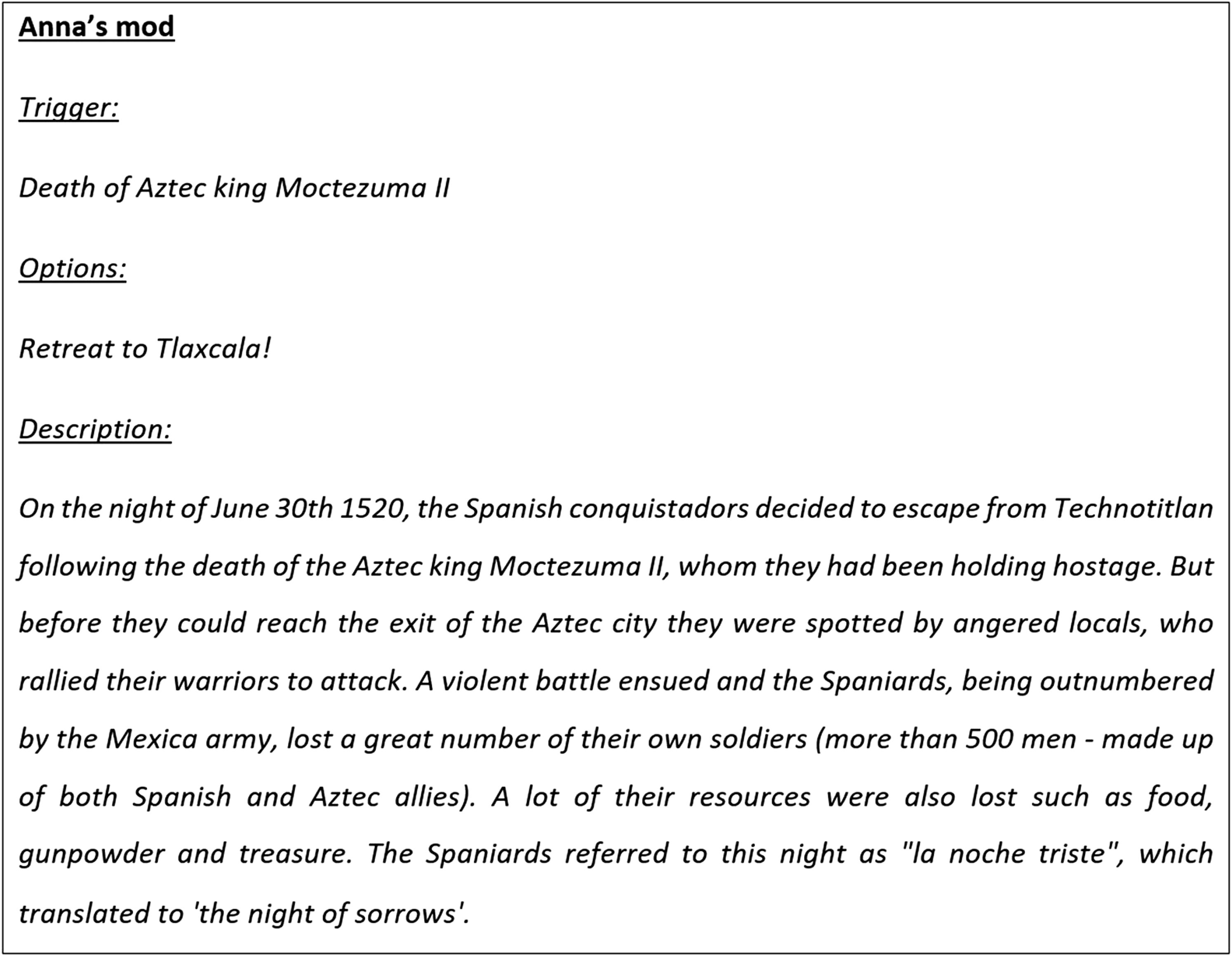
Anna’s mod cites certain important information: a date, a specific location, an important character, the nations involved in the event, the size of armies, the goods lost in the conflict and the name of the event. To create a mod with this kind of historical detail, Anna needed to conduct in-depth research on the event, which consequently led to her learning about history through mod construction.
Collectively, the survey and case study showed that mods are beneficial for learning history because the modding process necessitates research which prompted participants to find, read and reference history. It was revealed the modding process was useful for learning Western and non-Western histories and that it was a useful learning exercise, even when mods were not completed. Evidence suggests the educational importance of modding may be more about the historical research than the creation of the mod itself, even though the two were intertwined in the modding process in EUIV.
Importance of historical research
Despite the tendency towards creating counterfactuals in EUIV, the survey participants still believed in the importance of rigorous historical research. Several mentioned that more research and historical authenticity resulted in a better mod, with one survey participant stating: ‘I’m an author of a major EUIV mod and I consider the historical accuracy of the mod to be of utmost importance. While researching for the mod I have learned a great deal about history’. This participant and those with similar views saw research as an important part of the mod creation process, and they appeared to view the process of developing an accurate and authentic history as a valuable skill. The research they conducted included locating and evaluating historical sources and producing a historical analysis. This process required a very similar skillset to that used in assessment tasks in the educational domain. The development of these research and analytical skills by the modding participants highlights the educational potential of the gaming practice.
One survey participant made an interesting comment about the importance of historical research to more accurately depict marginalised nations and cultures. While believing they were not ‘learning anything new’, the participant also explained that they ‘changed some things about a region poorly represented back then’, that being South America. Arguably, despite thinking they did not learn from the process, it is clear that some level of historical learning must have occurred considering the participant’s ability to reshape this aspect of history. By correcting perceived inaccuracies in the history portrayed in EUIV, the survey participant engaged in a valuable and meaningful activity to provide another perspective on history. In Chapman’s (2016: 38–39) examination of modding culture for games such as Rome Total War II and Battlefield 2, he indicates modders were also motivated to correct history through modding as they were dissatisfied with the current content.
Indeed, historical authenticity and research forms a highly important part of modding with one survey participant noting that if a mod was not well-researched, other players in the community would point out the mod’s inaccuracies and misinformation: ‘You have to do research, otherwise people come and point it out at the mod’s page’. In this instance, social pressures, expectations and exchanges within the broader gaming community remind contributors to be more vigilant in the quality of the historical content of their mod. Therefore, mods do not exist in isolation, but form part of the processes of shared content creation and community engagement. Other games with modding tools such as the Sim and Operation Flashpoint: Cold War Crisis (Bohemia Interactive Studio, 2001) have comparable modding communities with various player interactions and discussions around modding (Hong, 2013; Sihvonen, 2011; Sotamaa, 2010). Thus, there is a wider community ready to offer critiques and support to improve the historical experience and value of the game for both modders and players.
Playing with mods
From the EUIV survey, it was evident that playing other people’s mods formed a significant part of the modding culture and community. Survey participants stated that because mods are more accurate and informative than ‘vanilla’ (unmodded) EUIV, they provide authentic simulations and a better gaming experience. As one participant explained, they especially liked the MEIOU and Taxes mod (EUIV Wiki, n.d.) because they saw it as historically plausible, while another participant indicated that MEIOU and Taxes was much better at simulating history compared to unmodded EUIV. For these participants, it was evident MEIOU and Taxes added an additional layer of historical complexity and authenticity that met participants’ expectations of what history should look like, meaning they could more meaningfully engage with the game’s content.
Other survey participants found mods historically informative when they added content about nations and histories that were not otherwise included in the game. As one survey participant commented: ‘The Veritas et Fortitudo mod expanded the timeline, pointing out some historical spots I was not acquainted with before’. Another participant explained that mods helped them learn about history outside of the game’s timeframe as these mods extended beyond the starting and finishing date of unmodded EUIV. Such mods also encouraged this participant to research history outside the timeframe of EUIV.
In other instances, participants who played mods commented on how they learnt about more detailed geography and region-specific histories through the process. One survey participant recounted: ‘I used different mods that changed the map, so I learned more details of the geography’, while another explained: ‘I played several region-specific mods that added more events and mechanics, and through these I would search up to know more about them’. Mods seemed to spark further historical interest for participants, prompting them to undertake research, creating a cyclical effect of historical interest, research and play. As such, many participants indicated that because mods were more historically informative, they were more interesting and engaging to play than the unmodified version of the game. It was evident the dynamics between mod creation and play raised the quality of the mods’ historical content. Opportunities for players and modders to explore a variety of subject matter and to utilise modding to express different historical perspectives and understandings are discussed in the next section.
Versatility of learning through modding
Analysis of the research data in both the survey and case study showed modding helped participants to learn about history from different perspectives and often in unexpected ways, revealing the versatility of the practice and the scope of its potential learning outcomes. Different participants expressed quite varied examples of this. For instance, one survey participant modded the game in an effort to balance the gameplay. However, he discovered through modding that nations had different modifiers to represent historical understandings. Modifiers are typically linked to historical information; for instance, a nation may be famed for their army discipline, naval superiority or economic savviness, all of which are represented as modifiers that affect gameplay as that nation. Through modding, the participant learnt about the history which these modifiers represented and ultimately the reason for the game’s design choices.
A similar modding project prompted one survey participant to research the names of historical places in other languages, stating the process ‘taught me a lot’. Another participant learnt about different regions and the historical reasons for the names of those regions. On this occasion, the participant encountered interesting linguistic or language learning opportunities through modding. Another interesting learning opportunity occurred when a survey participant realised while modding the game and conducting research that his preconceived theories about history were incorrect: ‘You can’t create an event chain emulating historical development without conducting proper research before. Often I find that my previous theory on the reasons why such and such events occurred is only partially true, or sometimes outright false’.
Through the modding process, the participant evidently gained a different, more informed insight into the causes of historical events. Research outside the game is important as another study showed that only playing Spore (Maxis, 2008) as a stand-alone learning tool could reinforce misconceptions about evolutionary biology (Bean et al., 2010).
The examples above show that when modders expand upon information contained in the game, or alter or improve certain historical depictions, mods can be used to confirm what modders and players already know about history, expand their knowledge on a variety of topics or even challenge their misconceptions. It was clear the participants in the study did not use any one approach to discover, research and learn history through modding, but engaged in a number of different related processes, each appeared to have educational value and encourage historical learnings. Some of the ways in which the participants achieved this is discussed in the following sections.
Counterfactual mods and scenarios to learn about history
The survey results showed that while many participants were concerned with historical accuracy in mods, some participants who modded EUIV intentionally created counterfactuals. Previous research has found similar counterfactual engagement using mods (Apperley, 2013), while other research has indicated mods were used primarily as a means to create a more historically authentic game (Chapman, 2016: 38–39). It was evident that despite their counterfactual nature, the mods still helped the participants to learn about factual history. Each mod had its own specific historical focus upon which the counterfactual was built, and required research into different historical elements. One survey participant wanted to develop a counterfactual mod where the Carthaginian Empire, from the Roman era, was a formable nation within the game, that is, playable after certain achievements were met. The Early Modern era of EUIV’s timeframe and the Roman Era are thousands of years apart; however, developing this ahistorical mod required the modder to research a significant body of information on the Carthaginian Empire to then be applied to the mod. Through modding this counterfactual, the participant thereby learnt about an entire area of history not covered by the unmodified game.
In a similar example, a survey participant learnt about the heralds of the nation Aragon (a historical nation located on the Iberian Peninsula) while creating a counterfactual mod. As they explained: ‘I’m not modding EUIV for historical accuracy. Rather, I am modding EUIV for alt-historical accuracy. That is, if Aragon formed Spain, the flag should be different. So I researched a bit about heraldry and produced an alternative flag for Spain. So it’s still related to history, but from a very different angle’.
Another participant learnt about the distribution of different demographics in the world by creating a counterfactual mod: ‘I was modding an alternative history scenario, and in so doing I familiarised myself with historical maps. It was useful for learning about historic distributions of ethnicities, religions, etc.’. In yet another case, a participant learnt about cultural titles and names while developing a fantasy mod: ‘I made a fantasy nation but rooted in history, so I had to look up traditional names and titles from the culture it was based on’. These examples clearly show that even modding counterfactuals are valuable for developing an understanding of factual history.
A similar finding emerged from the case study. Henry, a 31-year-old political science PhD student, was a regular gamer. He often played real-time and turn-based strategy games; hence, he was familiar with many concepts in EUIV. In Henry’s mod, he created a branching event mod with a counterfactual option about the interaction between the Aztecs and the Spanish displayed at Figure 2 with Figure 3 showing the in-game event. Henry’s mod illustrates a well-researched piece of analysis that allows the player to choose the factual historical outcome or a historically informed counterfactual. The event pop-up in Henry’s mod that occurred in-game placed the player at a crossroads between stopping the Aztecs’ supposed sacrificial practices or letting the practice continue.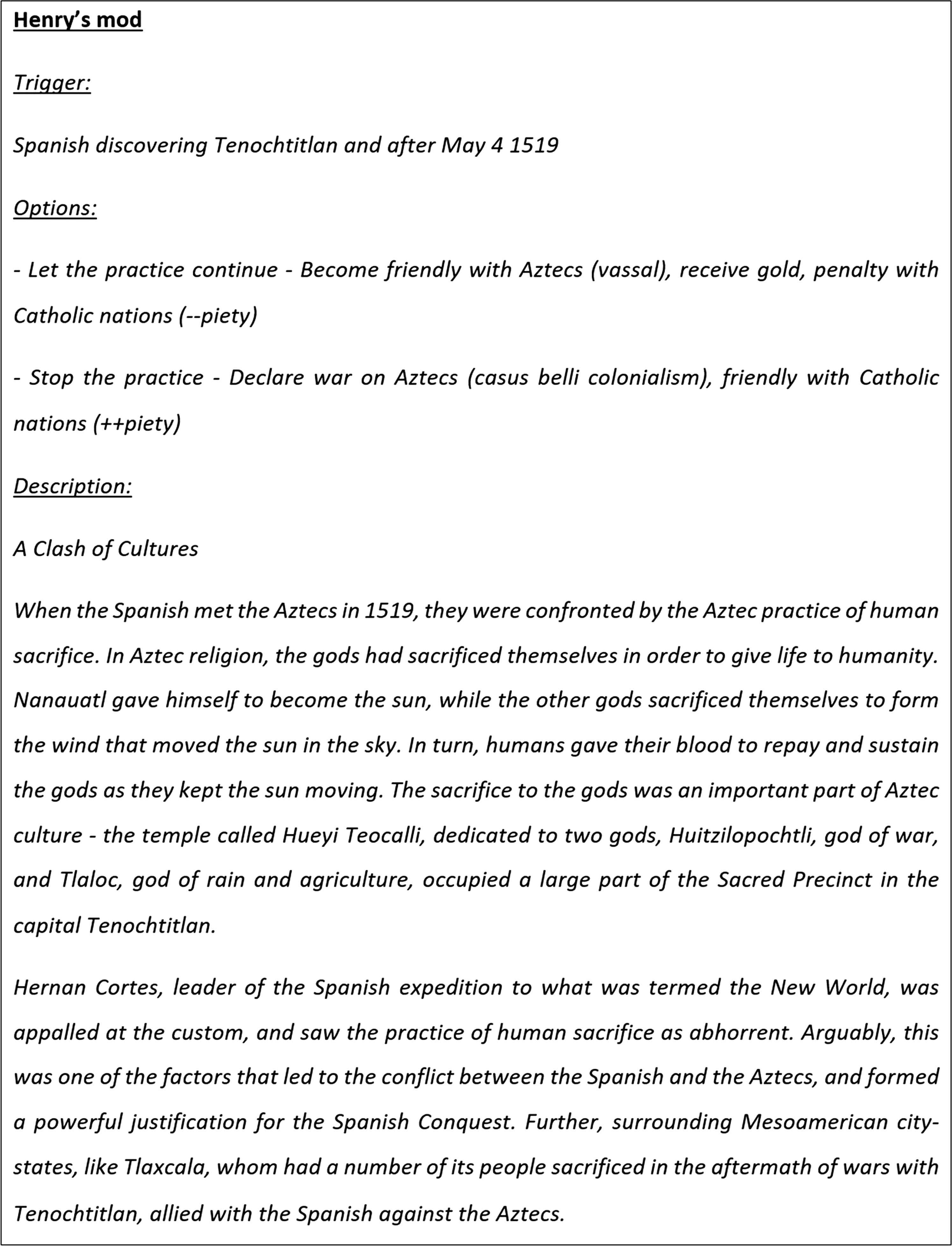
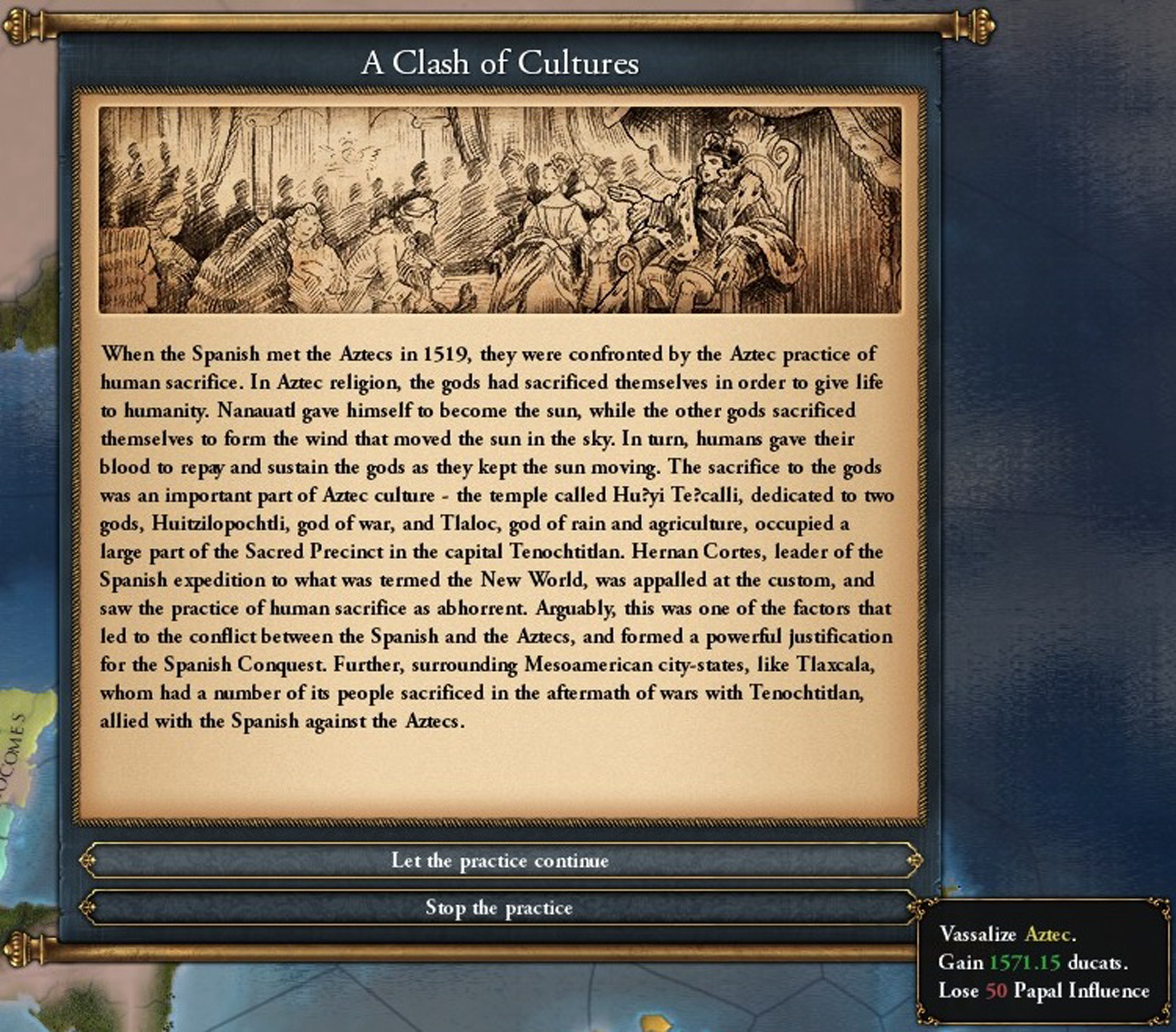
Henry’s mod encapsulates many of the themes and influences of the Aztec-Spanish conflict, even as a counterfactual. For example, the options to either stop the Aztecs from conducting human sacrifice (an apparent Aztec religious custom) or allowing the practice to continue have different modifiers and bonuses attached to each choice. Allowing the religious practice to continue, which is the counterfactual choice, negatively affects the relationship between the Spanish and Christian nations and thus lowers piety, while stopping the practice will create conflict with the Aztecs. This type of gamified process around decision-making embodies the religious and cultural climate of the time, in which spreading the word of God and Christian values and beliefs were core to the Spanish expedition. Henry’s mod also details the reasons for Aztec religious sacrifice and the Aztec’s perceived importance of their rituals. These pieces of information provide insight into the causes and ideas behind historical events and cultures, rather than acting simply as a recount of the event itself. The concept of sacrifice was understood differently between the cultures. Hence, as the title of Henry’s mod suggests, these cultural differences created a ‘Clash of Cultures’.
Henry’s mod shows a measured analysis and expression of the Aztec-Spanish conflict and some of the religious and cultural differences that led to the event occurring. Written in similar prose to an essay, Henry’s description of his mod articulates the influencing factors and their eventual outcome as a historical event that is playable in-game. The mod encapsulates a slice of history while also alluding to a much larger historical theme and the underlying factors that led not only to the conflict itself, but to the entire relationship between the Spanish and the Aztecs.
Henry’s mod shows that a counterfactual, while factually incorrect, is still grounded in a plausible historical context. Hence, this counterfactual option still communicates valuable underlying themes and influences of the era and the climate of the time. This proposition is consistent with Chapman’s (2016: 256) view of counterfactuals and shows that while counterfactual mods usually change a specific historical event, they are based in a simulation of authenticity.
A counterfactual mod as a rejection of empire building
Modding exercise participant Ethan, a 27-year-old education student, often played strategy and roleplay games and was comfortable navigating EUIV. Ethan took an alternative approach to modding EUIV compared to Henry. He constructed his outcomes into a mission format (another game mechanic whereby the player completes certain objectives to receive a reward), shown in Figure 4. Technically, the code did not work because it did not fit into the game’s data structures. However, from his unique perspective, Ethan rejected the idea of a rigid win or lose scenario and showed a more constructive and peaceful view of history. In his post-modding interview, Ethan commented that he discovered the ‘dark side’ of history while conducting research for his mod. In response, he tried to create a mission-based mod where the player could have colonised Cuba and expanded into Central and South American territories. As Figure 4 shows, the mission suggests locals and natives are those best placed to help the Spanish and aims to encourage the player to pursue a peaceful means of expansion into the New World. The mod rewards the player for establishing trade relations with Native American nations or grants greater rewards to the player for securing alliances with nations in the region. Failure to do either of these actions results in hostile relations developing with Indigenous nations, and the lowest scores result in all-out war with Indigenous nations. Ethan’s mod encourages the player to focus on peaceful interactions and expansion in the New World and punishes aggressive player behaviour.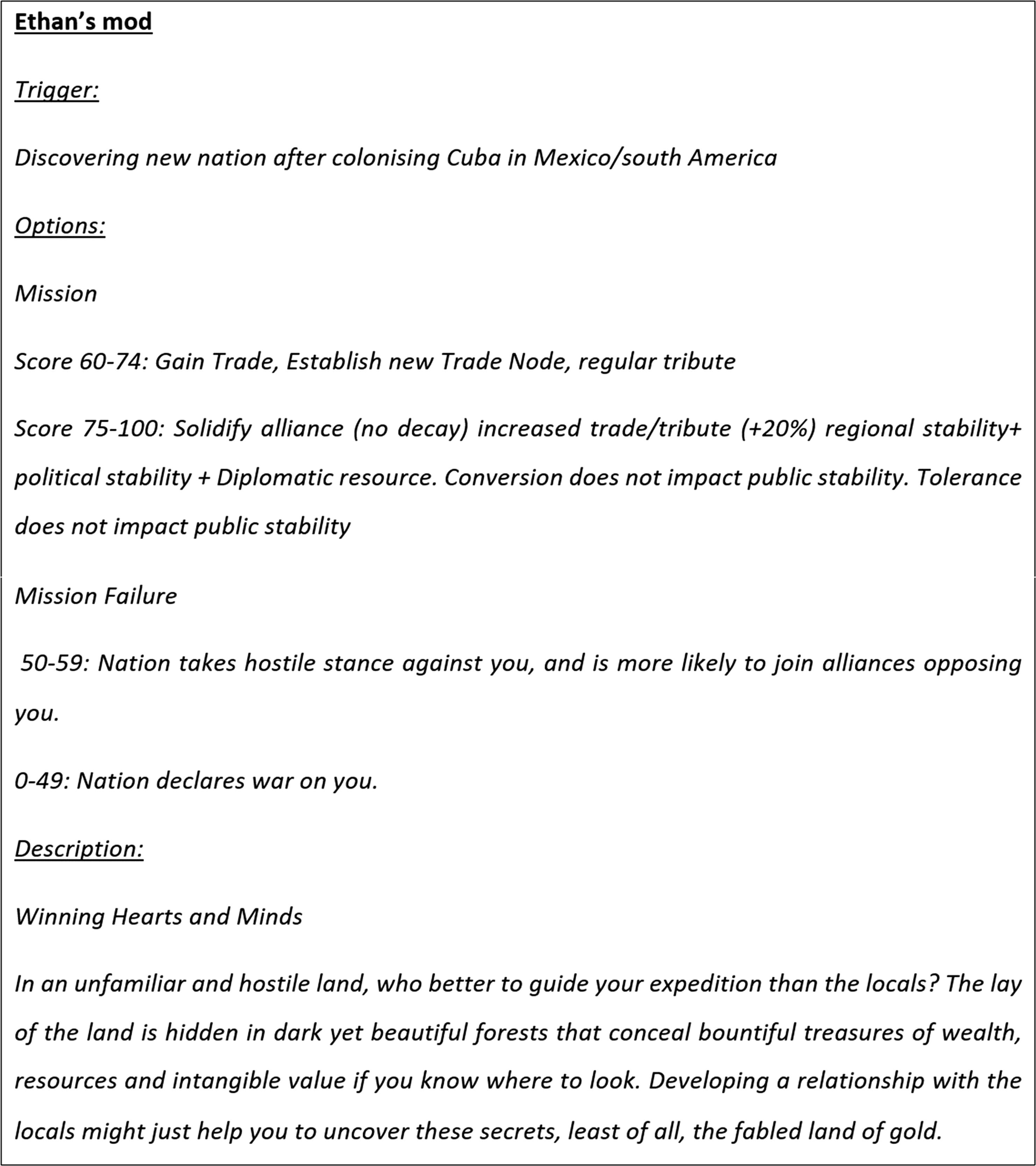
Ethan’s mission mod touches on the importance of trade and the quest for gold in Central America as the main reasons for European expansion. In this sense, it reflects well-known themes in history. However, Ethan’s emphasis on prosperous relations with Indigenous nations and expansion through peaceful means is a refreshing take and a creative alternative to the typical colonial gameplay of EUIV. The mod attempts to work in opposition to the Eurocentric, imperialist mechanics that often drive and direct the gameplay in EUIV and in various strategy games (LaPensée, 2008; Mukherjee, 2017). The mod is a prime example of Bogost (2007: 28–29) notion of procedural rhetoric, whereby Ethan used the modding process to create a scenario which influences the player to play in a certain way that reflects a specific ideology. Consequently, through his mod, Ethan created a counterfactual history that conveys his own critique of events and ideas, shaping and redeveloping content to work in opposition to the game’s underlying themes and mechanics. In this unique way, Ethan was able to share his own perspective while also gaining significant historical knowledge in the process.
Modding personal interests and expertise into the game
In another case, one participant used his knowledge from his discipline of study and personal interests to inform the creation of his mod. Paul, a 25-year-old Medical student, only infrequently played games and the games were a mix of multiplayer online battle arena (MOBA), mobile and strategy games. Paul was also tasked with creating a mod about the Spanish conquest of Mexico. Paul drew upon his medical expertise and interest in diseases to create a mod about the spread of disease that coincided with the Spanish invasion. He even listed the symptoms of smallpox in true medical fashion, as shown in Figure 5. Paul’s mod highlights the flexibility of modding and again shows how modding practices can facilitate learning about histories from multiple perspectives. This type of approach could allow for a more personalised, meaningful and interesting learning experience for any player. Paul’s mod reflects his medical interest and expertise as he focuses on the European diseases brought to the Americas, citing the symptoms of smallpox in true medical fashion.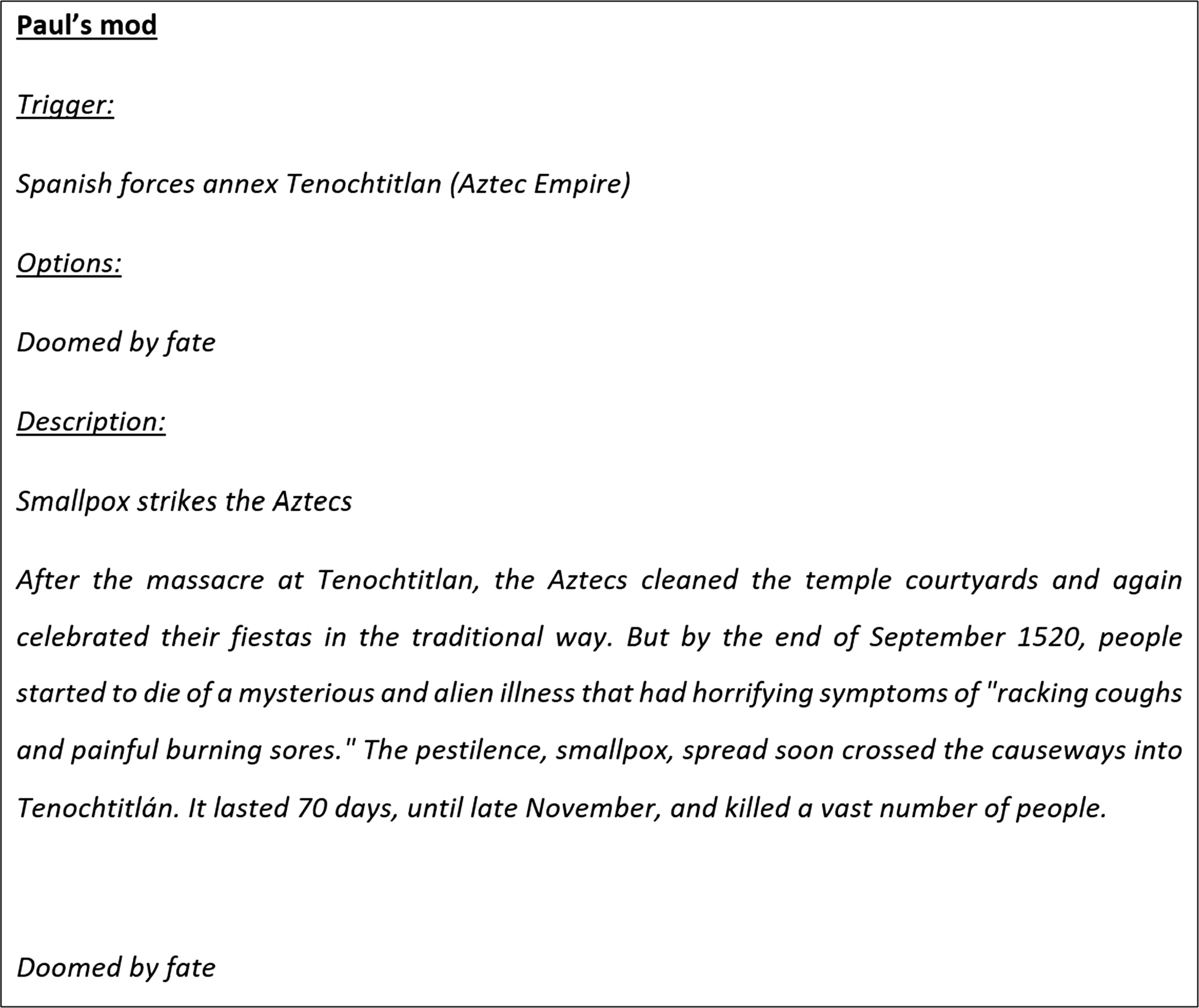
In Squire’s research (2011: 177–178), students who played Civillisation III became experts in areas of the game and history. In contrast, in this study, Paul brought his own subject matter expertise into the game to influence and enhance his mod. Paul’s expression of history reflects the false dichotomy that arguably occurs in educational contexts between what we need to learn and what we would like to learn. In terms of educational outcomes, Paul’s mod shows us that modding might be a way for students to gain knowledge about a particular subject area through the expression of their own interest. Thiel (2018) also points out how the creativity of game mods allows players to radically transform game settings into entirely new ones. For example, modders transformed the bloody first-person shooter, Unreal Tournament (Epic Games and Digital Extremes, 1999) into a dance-floor arena. In terms of education, this means even games that seem to offer only a small slice of history could be modded to communicate a vast number of historical perspectives, with modders shaping the game to best represent their historical knowledge. Rather than choosing what students are to learn, educators who use modding to teach history might grant their students creative licence to allow them to engage with subject matter in which they are interested, with creative and educational results.
History and the present
Although many of the case study participants chose to focus on larger historical events or narratives associated with the Aztec-Spanish conflict, one student developed her mod based on one specific individual. For Beth, a 26-year-old food science student, EUIV was new terrain as she more often played MOBA, puzzle and massive multiplayer online games. Nonetheless, Beth’s mod focused on Malintzin, also known as La Malinche, a translator and advisor for the Spanish and mistress to Hernán Cortés (Figure 6). Malintzin played a pivotal role in Spanish and Aztec interactions, and some Spanish soldiers held her in high esteem. However, the Aztecs and the Indigenous people of Mexico saw Malintzin as a traitor who chose the Spanish over her own people. Beth included a modern-day understanding of the role Malintzin played in the conflict in her mod, noting the use of the term ‘Malinchista’ in Mexican culture and showing a sophisticated understanding of history by linking past events to modern day connotations. A Malinchista is a derogatory term which refers to a person who prefers foreign goods or culture over their own nation’s goods or culture, a term which derives from Malinche’s supposed betrayal. By tracing the history of the contemporary Mexican insult back to the Aztec-Spanish conflict, Beth’s mod helps the player to understand the history of Mexico, which has been subject to foreign invasion and colonial settlement. The mod also relates this history to a modern-day context, showing how the influx of foreign goods into Mexico had economic and societal implications for the country. Additionally, Beth’s mod highlights how language often carries historical meaning. This type of historical analysis evidently helped Beth to recall the past and apply it to the present day context, showing how important historical events have shaped modern world views. Beth’s mod focuses on the historical figure, Malintzin, who played a pivotal role in the Aztec-Spanish conflict.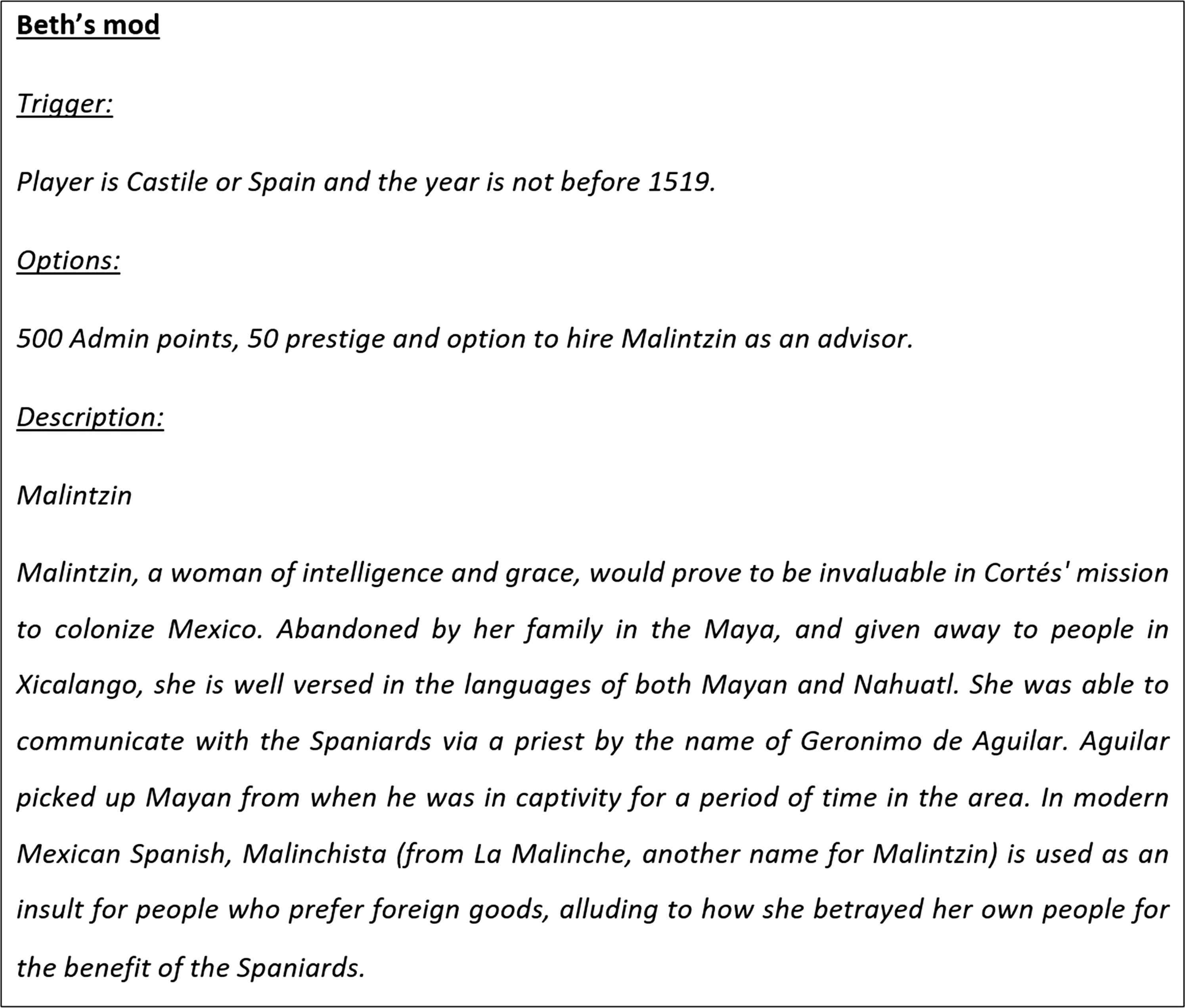
Modding as a novel form of game-based learning and expression
As this section has shown, while participants were all assigned the same modding task, there were differences in their historical focus and perceptions, and mod implementation. The mods reflected specific events in the Aztec-Spanish conflict while also describing the overarching historical narrative, and participants depicted events and individuals and their influence on contemporary society based on their own interests. They integrated their experiences and knowledge into their mods while also using them to reshape history and present their own perspectives and ideologies. While each participant took a different historical view and created a different mod, each was based on the main themes of the Early Modern era, the colonisation of the New World and the conflict between the Spanish and the Aztecs. Although the task and general topic was the same for all participants, similar to typical written assessment tasks, the critical analysis and creative outputs were widely different, yet equally valid. The versatility of the participants’ approaches indicates there may be potential to implement mods as a form of expression and learning, similar to how video games have been used more generally for educational purposes (Loh and Byun, 2009: 422; Squire, 2011). Modding is a design-orientated form of learning that allows players to represent history through game processes, mechanics and visuals rather than with just words. As such, modding may for some students be an easier and more appealing way of learning, and most importantly, a different means of expressing learning compared to traditional written forms of textbooks and assessment. Furthermore, when players are modding they need to enter a mindset, much like researching for an essay, in order to construct a narrative to communicate to the person playing the mod. The narrative includes elements of historical cause and effect, various historical factors (political, economic, social, etc.), and a number of historical themes. However, in addition to essay research type skills, modders can represent historical narratives in games in a larger variety of ways such as through different game mechanics, character interactions, objectives of the player, game processes, rewards, player strategies, etc. Moreover, games also have the added element of physical historical representations from clothing to architecture, something which is hard to communicate through written works. These different forms of game representation provide the player with a considerable suite of tools he/she can use to creatively represent history compared to a written text. Moreover, the modding process may allow research and analysis of more visual historical information (e.g. architecture, cloths, weapons, foods) that would also be hard to research and communicate through written text.
The educational value of mods is twofold. First, the process of modding provides a different avenue for experiential learning, whereby a student developing a mod learns about certain elements of history. The modding process, similar to other forms of GBL, exhibits many of the principles of deep learning (Houghton, 2004: 9–11; Ramsden, 2003: 42–43), such as active interactions, linking knowledge together, linking knowledge to real life and looking for meaning in content. Moshirnia (2007) notes that when users mod, they are engaging in higher-order thinking skills as they analyse, synthesise, evaluate and revise an existing game. These processes are involved in deep learning which requires critical engagement, analysis and other higher-order thinking attributes. The mods in this research clearly exhibited sophisticated and critical understandings of the history they portrayed.
Second, mods provide an avenue for expressing critical historical analysis. It was evident all participants understood the major historical concepts and themes of the Aztec-Spanish conflict while also producing mods from completely different perspectives and with different implications for gameplay. The case study mods showed genuine historical and educational value as the perspectives expressed through them demonstrated the participants were evaluating established historical themes as well as historical content beyond the parameters of dominant historical narratives. Consequently, modding provided participants with considerable flexibility to express critical and creative thinking around the given topic. Moreover, as in the EUIV community, modders in an educational setting would be able to share their mod with others, further building upon it based on critiques or play-testing, and could ultimately have their mod assessed by the GBL educator. Student modding as an educational tool could therefore operate within a collaborative GBL community that promotes a highly social and engaging approach to a seemingly solitary practice.
Limitations of study
Due to resource limitations, the research was unable to access a university history class to implement the case study, which may have given more contextual and insightful data on the success of EUIV in a formal university setting and as an assessment task. A further limitation was the sample size (n = 18) of the university case study and the unequal demographic numbers. For instance, there were more male students than female in the study; hence, analysing gendered differences in gameplay and modding did not reveal any balanced or insightful findings. These limitations meant the case study was unable to provide strong statistical findings relating to demographics and learning history.
Another limitation of the case study involved the findings from the historical simulation roleplay. This activity did not show consistent or strong results compared to the modding exercise. A possible explanation for this deficit was that participants did not have mastery of the game, which can take weeks to learn and comprehend. Due to the case study’s short timeframe, the historical simulation participants only had several hours to learn and then play the game; thus, they may not have been fully engaging with and learning from the game. However, these results highlight the important role of teacher instruction and integration of external historical sources to complement the history in-game. Including these elements when implementing historical games in higher education would support arguments for engaging learners with other forms of gaming practices including modding.
Recommendations for modding in an educational context
From the researcher’s perspective, the modding process includes a number of steps that the case study participants followed and that could likely be incorporated into educational settings, these being: Identifying historical ideas and interests: The educator or student identifies a historical topic for mod creation based on the curriculum or their own interest. The educator should consider the time investment and mod viability given the constraints of the game’s coding structure. Research and information collection: The student undertakes research on their topic. They must seek and evaluate different resources to acquire relevant information, including books, videos, websites or even their own experiences. Historical analysis and evaluation: The student collates, analyses and synthesises the collected information to produce their own historical analysis. The student might store a written analysis in a Microsoft Word document for later insertion into the game. Translating analysis into game content: The student inserts their historical analysis into EUIV, creating new game content. The in-game representation of the student’s analysis could vary from graphical changes to written analysis to more interactive mechanics. Most mods require some written analysis as well as different modifiers that feed into the game systems. The student needs to consider how their more abstract analysis will translate into a gamified form. Educators and students must understand the file structure of EUIV to know where to insert the historical information as well as the different elements of a mod event (trigger, option and description). Quality assurance and tweaks: Once implemented in EUIV, the student can begin the process of refining the mod and correcting any glitches in the game content. Following refinement, the modder may return to stage 1 and expand their mod by adding new content.
Figure 7 highlights the process of modding EUIV where the modder, or in the case study the student, conceives a mod idea, researches the topic, formulates a historical analysis, translates this analysis into gamified content and then further tweaks their mod. The modder may continue to expand the features of the mod, consistently building upon and improving it. The modding process will vary from mod to mod, but there will be similarities between them, each of which is based on these elements. The process for creating historically-based EUIV mods.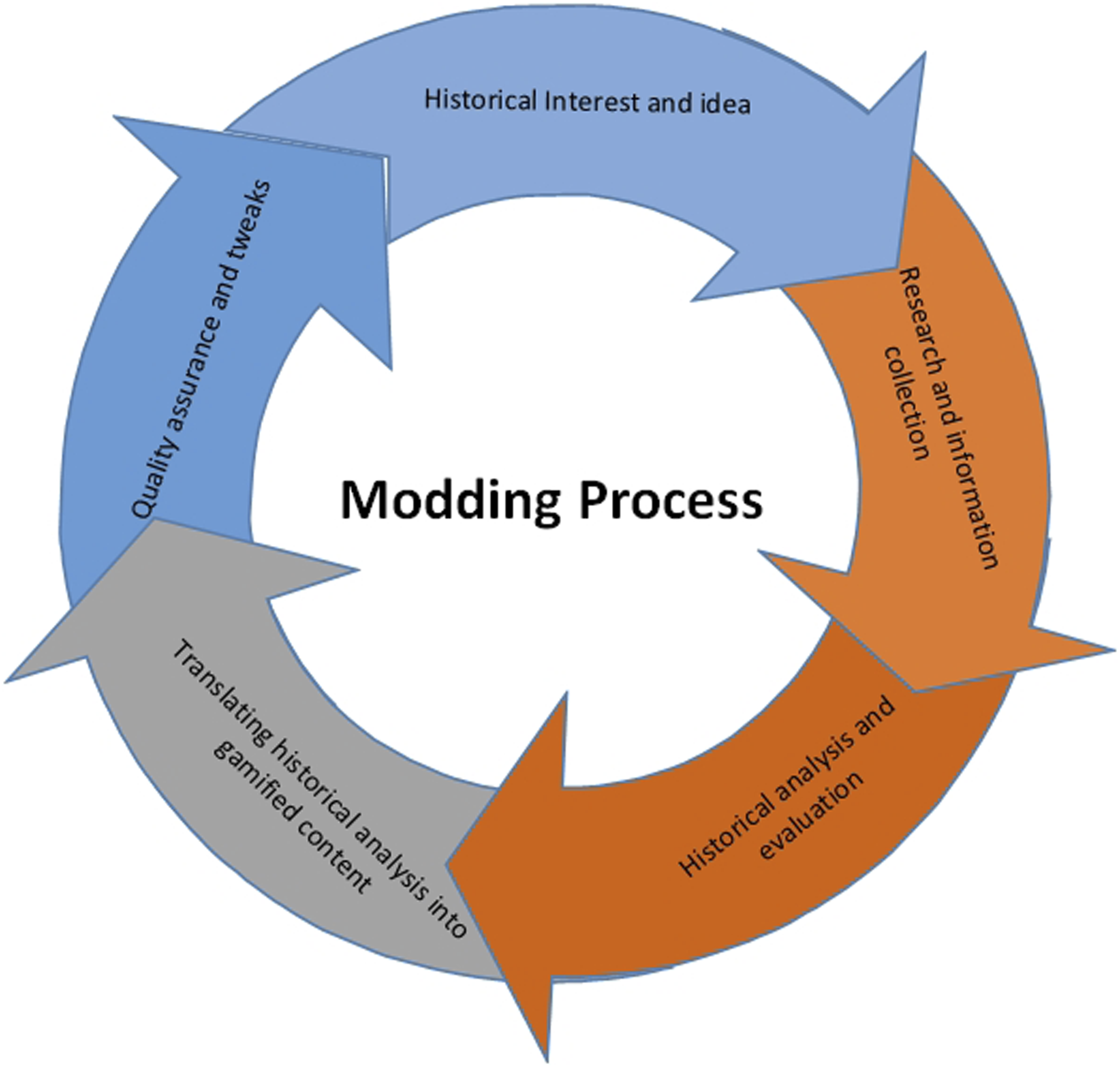
The research suggests that modding could be implemented in a formal learning setting because it does not just involve playing a game but also could involve engaging in a variety of activities that could include reading historical texts, visiting museums and historical sites, learning from history experts, holding discussions with other students on historical topics, attending modding workshops and creating accompanying documents (e.g. After Action Reports) to explain and support the mods they create. Collectively, this process helps the student to compare, contrast and interconnect the different sources of history to reflect their own content and illustrate their historical analysis. An example of how an educator might integrate EUIV and modding into a learning and assessment activity is highlighted in Figure 8. The diagram illustrates the complexity of developing a mod and how some conventional research methods and activities are able to be integrated into the modding exercise in a classroom. It is probable that those who play mods may not learn about history as deeply as modders themselves; however, the research showed that playing mods still captured the interest of participants and improved their historical learning experience, even if they could not change the fundamental mechanics of the game. The research findings therefore show the benefits of modding can be experienced by both modder-historians and player-historians, the latter who learn from the creative rendering of history in which modders invest their time, energy and resources. An example of how an educator might implement modding in the History classroom, based on learning exercises and assessments on the topic of Australian history.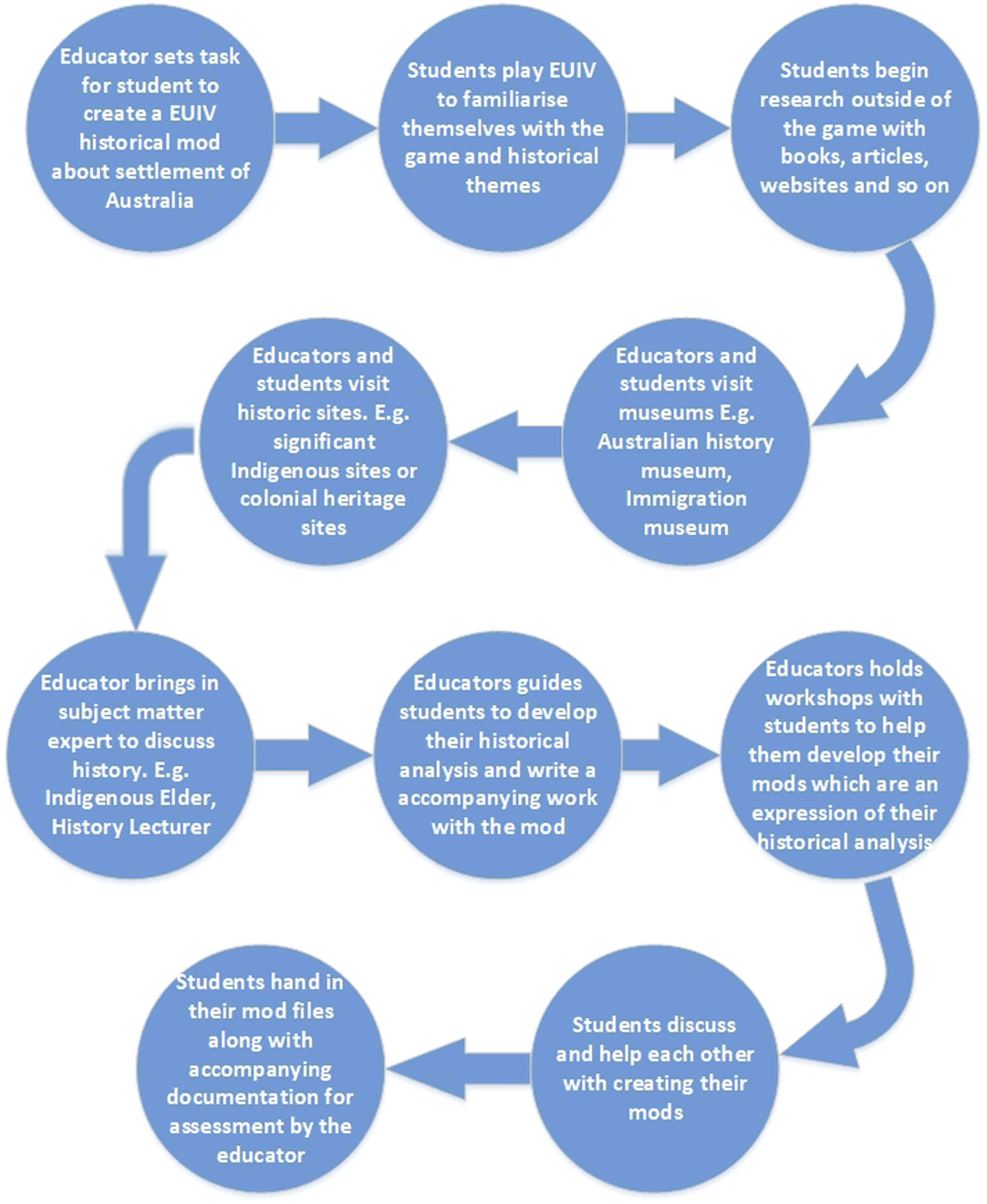
Conclusion
This article first briefly explored the popularity of modding within the EUIV gaming community, with a particular focus on how educators might capitalise on students’ interests in modding and informal ways of learning. Second, the article explored modding in EUIV and survey participants’ views of modding as a useful process for learning history. Finally, the article explored the different ways the participants from the case study learnt about and expressed history through modding EUIV. Many participants in the forum survey and university case study indicated a strong interest in games, and games appeared to play a prominent role in their media consumption. Equally so, within gaming communities modding has become mainstream and even professionalised as it provides entrance opportunities into employment with gaming companies. A game’s modding potential is now integrated into its structure and is considered by developers as the game is being created. Modding can be viewed as requiring a gaming skillset similar to mastering other elements of EUIV, and while it can be a solitary activity to some extent, more often modding promotes wider community engagement amongst gaming peers while also encouraging rigorous research to develop historically accurate mods. This presents a significant opportunity for educators to capitalise on the passions of gamers and the informal methods through which they learn. Doing so could provide more flexible ways for educators to engage with younger, digitally proficient generations of students. Hence, educators should acknowledge and utilise gaming practices such as modding as valid classroom learning practices with genuinely valuable outcomes for learning history. While the article has examined the educational use of modding for history, many participants integrated subject matter from other disciplines into their mods. This practice signals a wider potential use for modding across different disciplines.
Modding could leverage student motivation and interest in informal learning to develop engaging educational practices that promote a collaborative culture within the classroom. Students would be able to share their mods, add to their mods after feedback from peers and/or have their mods assessed by their teachers. Modding involves analytical, critical, creative and computational thinking, some of the key skills required in university environments. The New South Wales State Government (2020) in Australia identified creative, critical and computational thinking as key thinking skills for the 21st century. Ellerton (2018) also suggests that critical thinking is useful for developing greater comprehension of complex ideas and understanding with different perspectives. Ritter and Mostert (2017) explain that creative thinking is imperative in an ever-changing world and their study of 32 university students showed it can be facilitated through training. Furthermore, Wing (2019) points out the importance of computational thinking in the realm of the arts where even historic artefacts can be digitised. Through modding, students could learn how to analyse abstract historical ideas and how best to represent their analysis in a gamified framework. The modding process could provide different avenues to learn and express historical analysis for students who find more traditional speaking, reading and writing assessments a challenge. This is particularly relevant in the humanities and social sciences, where essay writing is the primary form of expression and assessment. The modding process may thereby offer many benefits in terms of improving learning outcomes beyond more traditional classroom activities.
While some teachers and students have been sceptical about GBL (Egenfeldt-Nielsen, 2006), this research shows the GBL practice of modding provides quite radical avenues for student engagement and learning with positive outcomes. Educators and students could blend and interlink mods with other learning resources to target syllabus and learning outcomes. Even in EUIV, which has certain restrictions and a limited discourse of history, modding participants still found ways to change the course of history, find peaceful resolutions, learn about important individuals and explore and create different factual or counterfactual historical narratives. Modding holds a special utility in terms of GBL because mods allow players to critically and creatively express history in ways not achievable in more traditional game forms. After a student has played through a game, a teacher may assume the student has learnt from the game. However, without other GBL activities, a teacher cannot measure the student’s understanding of the game’s subject content. In the case study, participants used mods as an analytical and creative outlet and produced significantly different understandings of history, with each mod having its own unique perspective and game content. Yet all the participants’ mods still contained fundamental themes and understandings of the Aztec-Spanish conflict, despite these deviations. Thus, the mods themselves revealed the depth of the participants’ understanding of the topic. Therefore, by using mods within the classroom, educators might direct students to learn relevant history while still allowing them the freedom to pursue and express historical perspectives and their own personal interests.
Footnotes
Acknowledgements
I am grateful to both Dr Brigid Costello and Associate Professor Andrew Murphie for their feedback and supervisory support during my PhD from which this paper was derived. I would also like to thank my colleague Associate Professor Dorothy DeWitt for her comments and mentorship. In addition, I am indebted to Associate Professor Thomas Apperley for his supervision and support. I must also thank both the survey and case study participants who gave their time, effort and valuable gaming insights. I would also like to thank the E-Learning and Digital Media reviewers and team for their constructive feedback and support publishing the paper.
Declaration of Conflicting Interests
The author(s) declared no potential conflicts of interest with respect to the research, authorship and/or publication of this article.
Funding
The author(s) received no financial support for the research, authorship and/or publication of this article.
