




Abstract
Henrik Ibsen’s play Peer Gynt digs deep into the question of what it means to be oneself. An upcoming computer game version invites players to take on the role of Peer and thereby raises new questions about identity and identification. By recording dyads of students who play an early version of the game and analysing their interaction during gameplay, we examine how students collaboratively make meaning of the computer game. This study employs a sociocultural and dialogic approach to meaning making. In the analysis, we draw on Gee’s theory on multiple player identities and see the dyads playing together as two real-world selves negotiating on creating one virtual self through a co-authorship of situated meaning in what Gee calls the projective stance. To better understand their cooperation in this undertaking, we also apply Goffman’s term activity frames. The analysis shows how the dyads approach the game in different ways by establishing frames in which they interpret, impersonate or recreate Peer, in order to make meaning of their gameplay.
Introduction
Research on game-based learning has shown the benefits of using games as learning tools across educational settings and disciplinary domains (Arnseth et al., 2018; de Freitas and Oliver, 2006; Squire and Barab, 2004; Wouters and van Oostendorp, 2013). Scholars have argued that playing games is motivating for students (Prensky, 2001), that games can contribute to active and critical learning and prepare students for future learning (Gee, 2004), that they can simulate activities that take place in real-life settings and practices (Shaffer, 2006) and that they can help students become more active in knowledge construction and gain more agency during learning trajectories in disciplinary domains (Squire and Jenkins, 2011).
Regarding the disciplinary domain of literature, some scholars have explored how games can be used to engage students in literary classics (Barab et al., 2010; Berger and McDougall, 2013; Marlatt, 2018). This body of research indicates that games can be analysed and understood by applying traditional literary analysis and that they may also offer different perspectives by way of their special affordances, such as player agency. However, these perspectives concern utility value, where the affordances or methods associated with one medium can be used to understand the other. We need more knowledge about how students collaboratively make meaning of games built on classical literature when such resources are made available to them. This is important because it generates knowledge about how students respond to the potential of games as resources to engage them in discussions about topics and issues that have traditionally been approached by discussing literature.
In this article, we employ sociocultural and dialogic theory in order to examine students who collaboratively play a computer game version of Henrik Ibsen’s famous play Peer Gynt in an educational context. Peer Gynt digs deep into the question of what it means to be oneself. With the ambition of revitalizing the play while introducing it to a new generation, Peer Gynt was converted into a video game to be used in school. In this game, players control the main character, Peer, through a linear game story and make choices for Peer in a number of dilemmas he encounters. While the 150-year-old play is still a relevant and intriguing exploration of the issue of identity, the computer game version invites players to take on the role of Peer and thereby raises new questions concerning identity and identification.
As playing in pairs is a common and efficient way of organizing gameplay in school contexts (Sullivan and Wilson, 2015), we organized 16 students in upper secondary school into dyads and followed and videotaped how they discussed their in-game experiences and actions when playing the game at school. The following research question guided our analysis: How do students collaboratively make meaning of a digital game about a literature classic?
Learning about literature through digital games
The research on digital games in school settings has seen a strong increase since the 1990s. Recent metastudies have found digital game-based learning to promote engagement and support learning (Boyle et al., 2016) and to be more efficient than learning in nongame conditions (Clark et al., 2016). More interesting to us, however, is that Clark and colleagues also did a value-added comparison of how the augmentation of specific design features enhanced learning. This led them to highlight the key role of design beyond medium. In other words, while the dichotomy of using or not using games is of some importance, it is crucial to understand how a game’s design leverages learning (Clark et al., 2016). Acknowledging this, our study is focused on one among several game design features (mechanics) that make up Peer Gynt, namely, one that involves the players in dialogues between Peer and other characters.
Earlier research has shown how the teacher can play an important role in students’ learning with games (Arnseth et al., 2018; Sandford et al., 2006; Wouters and von Oostendorp, 2013). For example, dialogues between students and their teacher can enhance meaning making by aiding the students in building a multiperspective understanding of the curricular topic in question (Silseth, 2012; de Sousa et al., 2018). The present study, however, explores the meaning making and interpretation practices of student dyads who are not scaffolded by a teacher but are in dialogue with each other and with the game. According to Games (2008), there is a dialogic relationship between the game developers and the ideal player. The game designer always has an ideal player in mind when designing games in order to make the game as engaging as possible. The present material constitutes part of the real player’s (Games, 2008) responses in such a dialogue.
Although there exists some research on the relationship between games and literature, few studies have aimed to explore students’ meaning-making processes when playing literary digital games. However, some studies have looked at how games can be used as tools for doing literary analysis. Marlatt (2018) conducted a case study of how one student with an expressed disinterest in literature conducted textual analysis of S. E. Hinton’s novel The Outsiders using Minecraft as a tool. Marlatt found that the game offered an opportunity for authentic literacy interaction. By re-creating scenes and characters from the novel inside Minecraft, the student effectively used the game as a tool for analysing the text. This aided the student in assuming agency and power to craft her own literacy identity: ‘She recognized the new pathways and destinations that literacy could offer her: that fitting in may not be nearly as important as breaking the mold’ (Marlatt, 2018: 64). Marlatt concludes by advising literacy educators to reflect upon how gaming contributes to notions of self-discovery and suggests that the way the students conceptualize and reflect while engaging with the game may reveal more about their learning than the final outcome they produce.
With the goal of using games to engage youth in reflections upon ethical and ideological dilemmas, Barab et al. (2010) created two plots, built on literary classics, in the game world of Quest Atlantis (Barab et al., 2005, 2010). The idea behind this learning design was to develop contemporary stories that would prompt players to engage and critique the ideological biases of the literary works they were built on, taking advantage of the game medium’s affordances, such as agency, consequentiality and accountability. The games were built upon Mary Shelley’s Frankenstein and Ayn Rand’s The Fountainhead. The researchers made a case for games as storytelling media for learning, stating that their immersive and interactive nature makes them ‘a vehicle of social commitment, a way of making meaning and finding self’ (Barab et al., 2010: 237). Both games challenged the students to take a stand on ethical dilemmas as well as to exercise skills of curricular relevance. The findings suggest that students became engaged in a struggle to understand the dilemmas inherent in the plots, irrespective of the students’ degree of appreciation for the original authors or of their own textual literacy.
Berger and McDougall (2013) studied the use of the video game L.A. Noir in English literature classes at the high school and undergraduate levels in the United Kingdom. The game pays homage to the movie genre Film Noir and its corresponding hard-boiled detective literature. The game was studied within the orthodox framing of the English literature curriculum in order to explore relations between ‘schooled’ and ‘new’ literacies. The study concluded that the game did function as a digitally transformed novel for the students, although somewhat less so for the teachers. The researchers identified a ‘pedagogy of the inexpert’ at work as students were able to make use of the literary theory they studied in order to understand the game. One finding of special interest to us was that students found it challenging to identify with some of the overly scripted characters. Some students found these characters to be so constructed that it left ‘little room for self-identification’ (Berger and McDougall, 2013: 144).
Thus, previous studies have demonstrated possible connections between digital games and traditional literature. Marlatt (2018) and Barab et al. (2010) showed how games can become tools for literary analysis, the former by way of a teacher’s scaffolding and the latter through in-game agency and consequentiality. Berger and McDougall (2013) showed how orthodox methods of literary analysis can be applied to games. Such studies articulate interesting insights into the intricacies of performing role-play in the fictional worlds of their studied literature. However, we need more knowledge about how topics and issues raised in classical literature can be manifested through game mechanics and how students collaboratively make meaning of such games in educational settings. By building on a sociocultural and dialogic approach, our aim is to contribute to insights about these issues.
A sociocultural and dialogic perspective on game-based learning
This study is grounded in a sociocultural and dialogic perspective on human activity, where students’ gaming activities are seen through the lens of situated meaning making (Gee, 2004; Linell, 2009). From this perspective, learning in school is seen as a social process in which students collaboratively make meaning of artefacts and resources contextualized in learning designs concerning specific topics. In addition, identity has been viewed as an important entry point for studying meaning making and learning in human activities in general (Lave and Wenger, 1991; Sfard and Prusak, 2005), as well as in game-based learning (Gaydos and Devane, 2019; Martin, 2012; Shah et al., 2017).
In the context of gaming identities, virtual worlds have been viewed as neither separate from nor identical with the real world but overlapping in a complex relationship (Evans and Wang, 2008). The relationship between the player of a role-playing game and the game character has been analysed by scholars as a tripartite separation (Fine, 2002; Gee, 2004). Fine (2002) identified three ‘levels of meaning’, studying players of pen-and-paper role-playing games. According to Fine, a player’s actions in the everyday world and in the fantasy world are connected by the player’s knowledge of the game rules.
Later, Gee (2004) developed a somewhat similar model in his theory on learning and identity when playing video games. Like Fine, Gee identified a real-world character that plays and a virtual character that performs actions in the game world. For Gee, however, the real and virtual are connected by what he calls the projective identity. Projective can refer to a projection of the player’s own values and desires onto the game character, or it can indicate that the development of the character is the player’s project. Later, he explained this as an even more active positioning, calling it a projective stance (Gee, 2005). We will regard Gee’s three identities and the projective stance as our vantage point for addressing our research question. However, in Gee’s theory, the presumed dialogue is between a single individual player and the game character, whereas in this study, dyads play and make meaning together. This is also a common and efficient way of playing in school contexts. Therefore, we will combine Gee’s theory on video game players’ identity work with insights from interactional studies of meaning making (Goffman, 1986; Linell, 2009).
For Goffman, the concept frame implies that there is a shared and usually taken-for-granted understanding between the participants of a social situation (Lantz-Andersson et al., 2009). A frame can be seen as the participants’ shared response to the question ‘What is going on here?’ (Goffman, 1986: 8). Players’ understandings of ‘what is going on’ in a game, that is, what story it wants to tell or feeling it wants to evoke through its narrative and mechanics, are prone to change during gameplay. This is not a problem as meaning is commonly ascribed to parts of texts depending on what we assume about the whole text (Linell, 2009). However, it may require frequent re-framings. Establishing and re-establishing frames may be laborious as each moment of gameplay may carry very different meanings to players. Factors such as how well they know the story, their previous experience with (this particular genre of) games and more may affect the joint meaning making of the dyads.
In general, people’s understanding of activities in which they are engaged ‘evolves when the two parties develop joint engagement and establish joint attention towards an external object, and later coordinate their understandings with the help of words and concepts’ (Linell, 2009: 258). Still, the students’ understanding may also remain fragmented and only partially shared (Rommetveit, 1974). Acknowledging this, in the analysis we take the dialogic stance of seeing students’ social interaction as the analytical prime. It is this joint engagement and attention towards the game and their role in it that interests us.
Our analytical interest, then, is how students discuss and decide upon actions in the game and what frames they establish and express their understanding through. What Linell calls a coordination of understandings we will think of as the development of a projective stance, whether that be framed more as a projection of parts of the players’ real-world identities or a shared project, as described by Gee. Therefore, our analytical focus will be on the projective identity, where the dyads share in the collective effort of playing Peer.
Context and methods
Peer Gynt: The play and the game
Often referred to as Norway’s ‘national epic’, Henrik Ibsen’s play Peer Gynt (published in 1867) chronicles the life of Peer: first as a young man in a rural community amidst the Norwegian mountains and later as a middle aged ‘man of the world’ in North Africa, with a high self-opinion and questionable ethics, and at the end as an old man coming home (Ibsen, 1905). The play deals with personal and social identity issues in complex ways, both by partly reflecting and partly mocking the contemporary national romanticist identity construction, and by probing into an individual’s authenticity. A subtle example of this interplay is the scene we will focus on in this study, where Peer stands amid the trolls in the hall of the Mountain King contemplating his own humanity.
A main affordance of computer games as medium is that it is participatory; it allows the player to act in the game world (Murray, 2017). The ways it enables the player to act is referred to as the game mechanics; something that is crucial to whether it is experienced as a good game or not. The computer game Peer Gynt builds on three core mechanics. First, the player controls the character in traversing the world and story of Peer Gynt. Second, the player collects lore. Lore is common in adventure games. It is a type of content that usually does not affect the actual gameplay but provides to the player who reads and reflects upon it, more depth to the story. Thus, it may be a suitable mechanic for bridging the students’ expectations to an adventure game with the designers’ purpose of creating a game for learning (Anderson, 2019). In the Peer Gynt game, the lore items hint to story elements that were excluded or toned down in the simplified main storyline of the game. Third, the player makes decisions on behalf of Peer in dilemmas he encounters, often in meetings with other characters. In this study, we will focus on the students’ discussion of these dilemmas, and below, we will describe the dilemma mechanic in more detail.
In the game, when the player is presented with a dilemma, they always get to choose between three alternatives (as seen in Figure 1). Peer sees the Woman in Green. He utters, ‘Uh, what...?’ The player then gets to choose what he is thinking among three alternatives: (1) What a girl! She looks different and exciting. I need to get to know her. (2) How incredibly beautiful! Everyone will look up to me if I can make her my girlfriend. (3) Help! She is coming towards me! What do I do now? We will just have to see….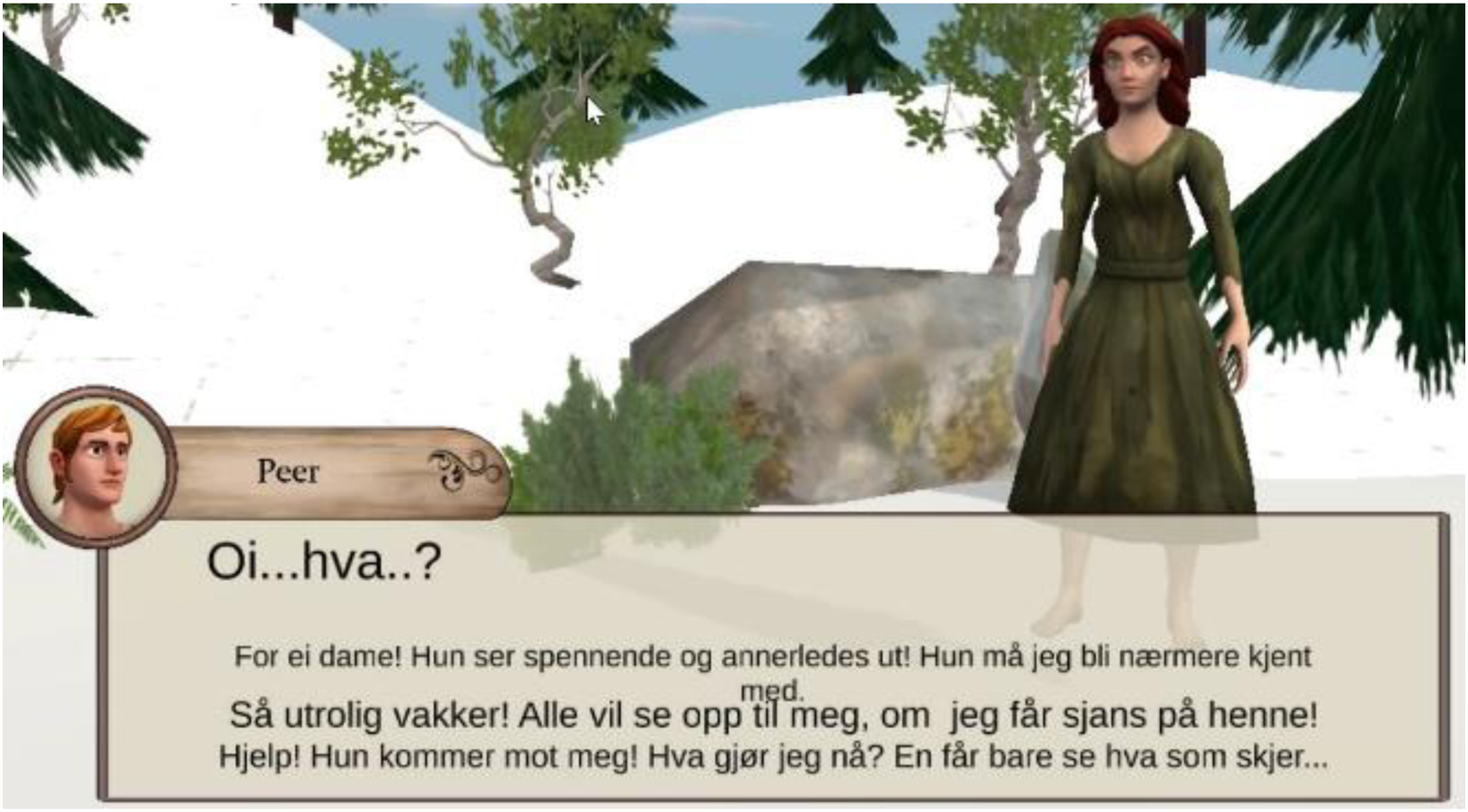
Throughout the game, each of the three alternatives is meant to represent one fundamental interpretation of Peer’s personality. One depicts Peer as creative and vigorous, a charming and optimistic character, although sometimes lost in fairy tales. Another represents an egocentric or egoistic Peer, and the third represents Peer as more of a coward who avoids making decisions and backs out of situations and responsibility. We see these alternatives as simulated frames inscribed upon the character Peer and proposed to the players as possible understandings of the situation and Peer’s options in it. These three readings of Peer are constant throughout the dilemmas of the game, and there is not one alternative which is more right or wrong than the others. This structure is, however, not communicated to the players. They only see the three concrete alternatives before them unless they figure out the pattern themselves.
Methods and empirical setting
Methodologically, the study was set up as a focused ethnography (Knoblauch, 2005, 2012). Such studies are characterized by short-term field visits, which may even be, as in our case, described as events. The short duration is compensated for by the data collection and analysis being intensive and dependent upon audiovisual recording equipment. Instead of social groups or fields, which would be common units of study in ‘conventional ethnography’, a focused ethnography is typically a study of communicative activities. Our choice of methodology was inspired by the method of game testing used by the game developers. They recruited game testers who represented the target group, let them play a segment of the game and then asked them what they thought. Whereas the developer’s intention with game testing was pragmatically focused upon course correcting towards improving the usability of the technology, a method which may be seen as a form of applied ethnography in its own right (Hughes et al., 1994), our need was to gather rich data for later analysis, to better understand the students’ meaning making while playing.
The data for this study were collected at two upper secondary schools in southeast Norway in October 2018 and January 2019, respectively. Eight students aged 17 or 18 were recruited from each school, giving a total of 16 students. They were organized into dyads, and each dyad played the same game excerpt, consisting of approximately 20 min of gameplay. The students were recruited and organized into pairs on their teacher’s discretion. The dyads played one at a time in a separate room. A researcher was present in case of technical difficulties but did not interfere. Some dyads were taken out of class in order to play, while others played during breaks or after class.
Before playing, the researcher gave the students some basic information about the activity in order to secure a minimum of common ground. They were told that Henrik Ibsen was a famous playwright in the 19th century, that the play about Peer Gynt stretches over most of the character’s life, that the storyline has many twists and turns and that it also addresses deep issues such as identity and truth. The students were also made aware of the fact that the game was still in development, so they would experience things such as glitches, bad voice-acting and unfinished graphics along the way. Finally, the dyad was given a ground rule stating that whenever a decision had to be made, they had to discuss the alternatives with their partner and agreeing on what to do before acting it out (Littleton and Mercer, 2013).
In order to study how students collaboratively made meaning of the digital game, video data were collected using screencasting software that recorded the screen while they played, with an embedded recording of the players’ faces and talk. In addition, each play-session was followed by a short semi-structured group interview with the dyad in order to recap their experience. The video data constitute the primary data for analysing how the students made meaning of the game, and the interview data provided contextual information informing the analysis of the video data.
Dilemma dialogues as unit of analysis
Whereas the excerpt of the game played by the dyads contained a good portion of traversing and a few lore objects that could be found, the students’ talk while traversing and collecting lore was found to consist mostly of comments about the visuals and controls of the game, not reflections on the character or story. This is in line with previous research on dyads who play in a learning context but who are unscaffolded (van der Meij et al., 2011). Because of this, we decided to focus on how students interacted with the third mechanic, which effectively pauses the game until a decision has been made by the dyad. This mechanic was also regarded by the designers as being the most central to the game.
Therefore, we define the dyads interactions when facing dilemmas as our unit of analysis. We understand such an interaction to start when a dilemma with its three alternative responses pops up on the screen and end when the dyad makes a choice by clicking one of the alternatives. Occasionally, the dyads would utter related comments just after a choice had been made, in which case we would regard that as part of the chosen excerpt. With each dyad facing five dilemmas and there being eight dyads, we were left with a corpus of 40 short dialogues about the dilemmas and what to do.
The analysis presented below is on how three dyads discuss one particular of the dilemmas Peer encounters. Seeing how several of the dyads coped with the same situation gives some basis for comparison and shows variations of reasoning. We chose not to focus on the first dilemma, which is displayed above (Figure 1). This was a somewhat untypical dilemma as the players were to decide Peer’s thoughts in a situation in which there had been no previous dialogue. A more typical dilemma would be where Peer is engaged in an uttered dialogue with another character. This is the case in the second dilemma, where Peer is in a negotiation with the king of the trolls, the Mountain King. There are more dilemmas during this dialogue, and those that follow are also interesting. However, as the negotiation wore on, the dyads tended to argue more implicitly and refer to or continue lines of reasoning from previous dilemmas. Thus, we considered the second dilemma to be the most suitable.
Analytic procedures
The analysis of the video data that captured the students’ gameplay focused on the uttered dialogue of the students. First, a content log was created (Derry et al., 2010), and later, the discussions of the dilemmas were transcribed. Selected transcripts of the video data were then shown and discussed in work groups in order to generate ideas and counter idiosyncratic biases (Knoblauch, 2005). The analysis was guided by interaction analysis (Jordan and Henderson, 1995). In this analytical approach, the researcher examines how interlocutors make meaning collaboratively by orienting towards each other and using different types of cultural resources to solve issues in activities. When analysing the collaborative gameplay, we looked at how the students made meaning of the game and issues that emerged in the game together, moment by moment. Acknowledging that the practice of doing analysis is itself a process of sense-making, the analytical work follows a two-step process called a first- and second-order analysis (Linell, 1998, 2009). The first-order analysis consists of a detailed description of how the participants responded to each other’s utterances turn-by-turn and built meaning together. This is followed by the second-order analysis where we apply analytical concepts outlined in the theory section. These two steps enable us to provide a fine-grained analysis of how the dyads collaboratively made meaning of the digital game Peer Gynt.
Results
The most typical characteristic of the dilemmas that players face when playing the digital game Peer Gynt is that Peer is engaged in a dialogue with another character and that the players need to take a stand on his behalf. In order to provide a detailed account of how the student dyads oriented to this feature of the game, we will present an analysis focused on one particular dilemma. Seeing how the dyads coped with the same dilemma enables us to compare and shows variation regarding student orientation and reasoning. In this dilemma, Peer encounters the king of the trolls, the Mountain King.
In the game, after having been seduced by the daughter of the Mountain King in the shape of the attractive ‘Woman in Green’ (Figure 1), Peer follows her into the mountain. Now, Peer stands before her father to ask for her hand. The Mountain King explains to Peer the difference between man and troll. He defines man by their own saying: ‘Man, to thyself be true!’, 1 which is different from the trolls’ saying: ‘Troll, to thyself be—enough!’ By this explanation, the Mountain King raises one of the overarching themes in the play: what it means to be oneself. By taking the trolls’ motto, Peer will lose some of his human ‘self’.
This is the backstory of the second dilemma that the students encountered in the game and to which they had to respond (Figure 2). As a culmination of his speech recapitulated above, the Mountain King says: ‘“Enough,” my son—that word so fraught with meaning—must be the motto written on your buckler’. The three alternative responses the players get to choose between are as follows: It could be exciting to have a life motto. Never. I am better than some stupid trolls. If that is what it takes to get the daughter of a king, then why not…? The Mountain King demands that Peer takes the trolls’ motto as his own.
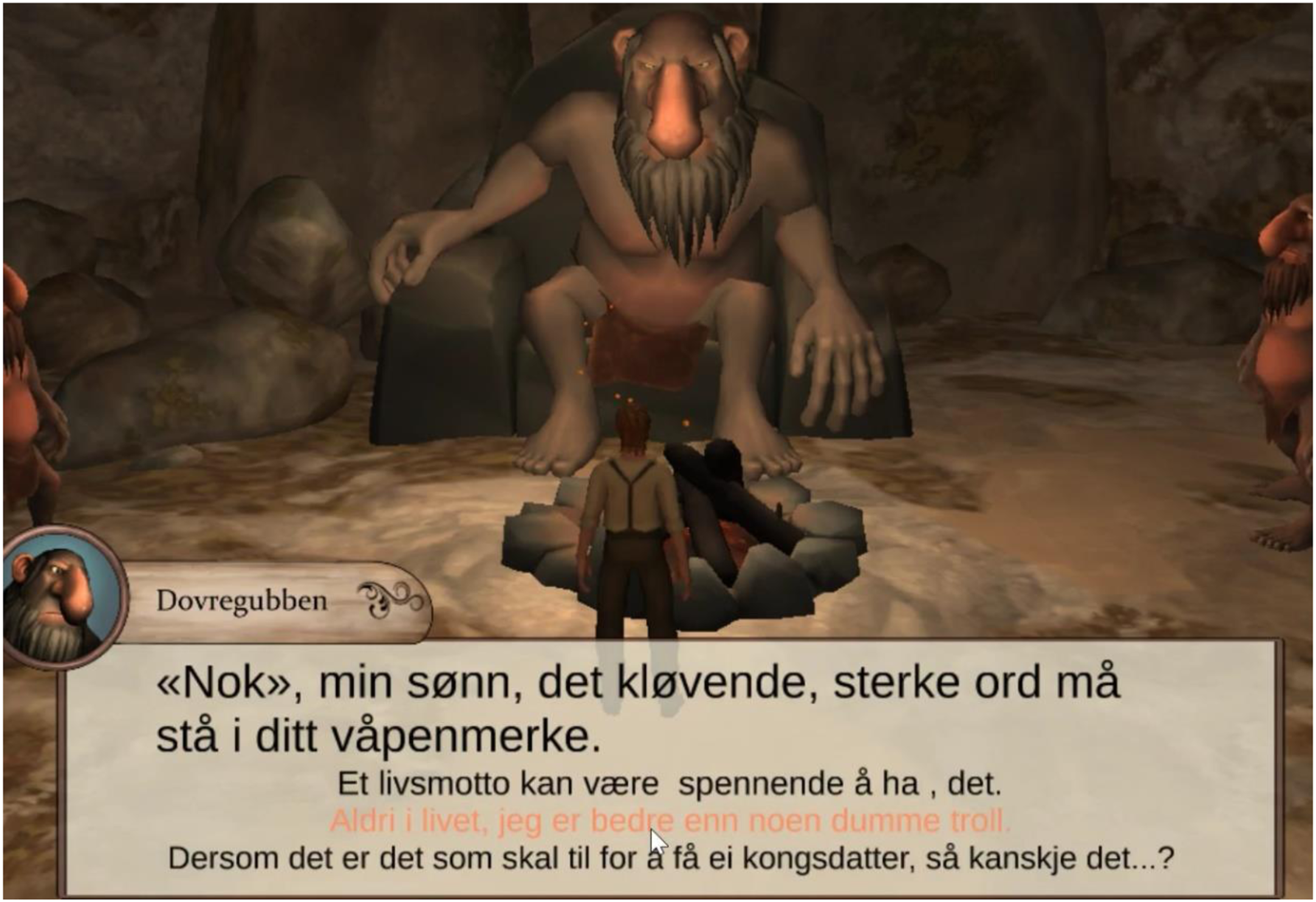
We will now analyse three dyads’ discussions when faced with this dilemma. Whereas all of them debated which of the three given alternatives to choose for their virtual character, they did so in quite different ways. These three ways of interacting with the dilemma constitutes typical patterns in the data. Dyad 1 questioned the alternatives as well as enquiring into what their task really was. Dyad 2 accepted the frames of the virtual character and limited their discussion to the given alternatives. Dyad 3 transcended the alternatives by seeing them as tools for creating their own character and story.
Challenging Peer’s frames
Dyad 1 opened their discussion by enquiring into the nature of their task as players. Then, they delved into the matter of choosing a response by presuming different characteristics of Peer. First, they based their presumptions on the three simulated frames, discussing which best fit their understanding of Peer. Then, they moved on to projecting a different understanding from those given by the game (Figure 3). ((The Mountain King’s speech finishes and the alternatives pop up on the screen)) Hanna: ((reading)) “It could be exciting to have a life motto. Never. I am better than some stupid trolls. If that is what it takes to get the daughter of a king, then why not?” Hanna: Hm, so should we now sort of put ourselves into Peer Gynt, then? Like, what would he… Vera: I don’t really know. Hanna: So:: (3.6) because I feel if, sort of, he really wants the king’s daughter, the last is perhaps the most… Vera: Yes. Hanna: …that which makes most sense. But if he should be, like, egoistic and so on as well, sort of, (.) which it makes sense that he is, then the second one makes good sense, but… Vera: [Yes] Hanna: [after all, he is] scared, so (.) or (.) I at least (.) It makes sense that he, sort of. A troll is in fact scary, so (.) I think number two might not be the best? Vera: No. I agree. Hanna: So therefore I feel that it should rather be one or [three]. Vera: [One] or three. We can go for three. Hanna: Yes, I actually agree to that. Vera: Also, it’s like “the longest is often the right.” ((clicking while uttering the above sentence)) Hanna: (h) yes. Vera: (xxx) Dyad 1 discussing dilemma two (Figure 2).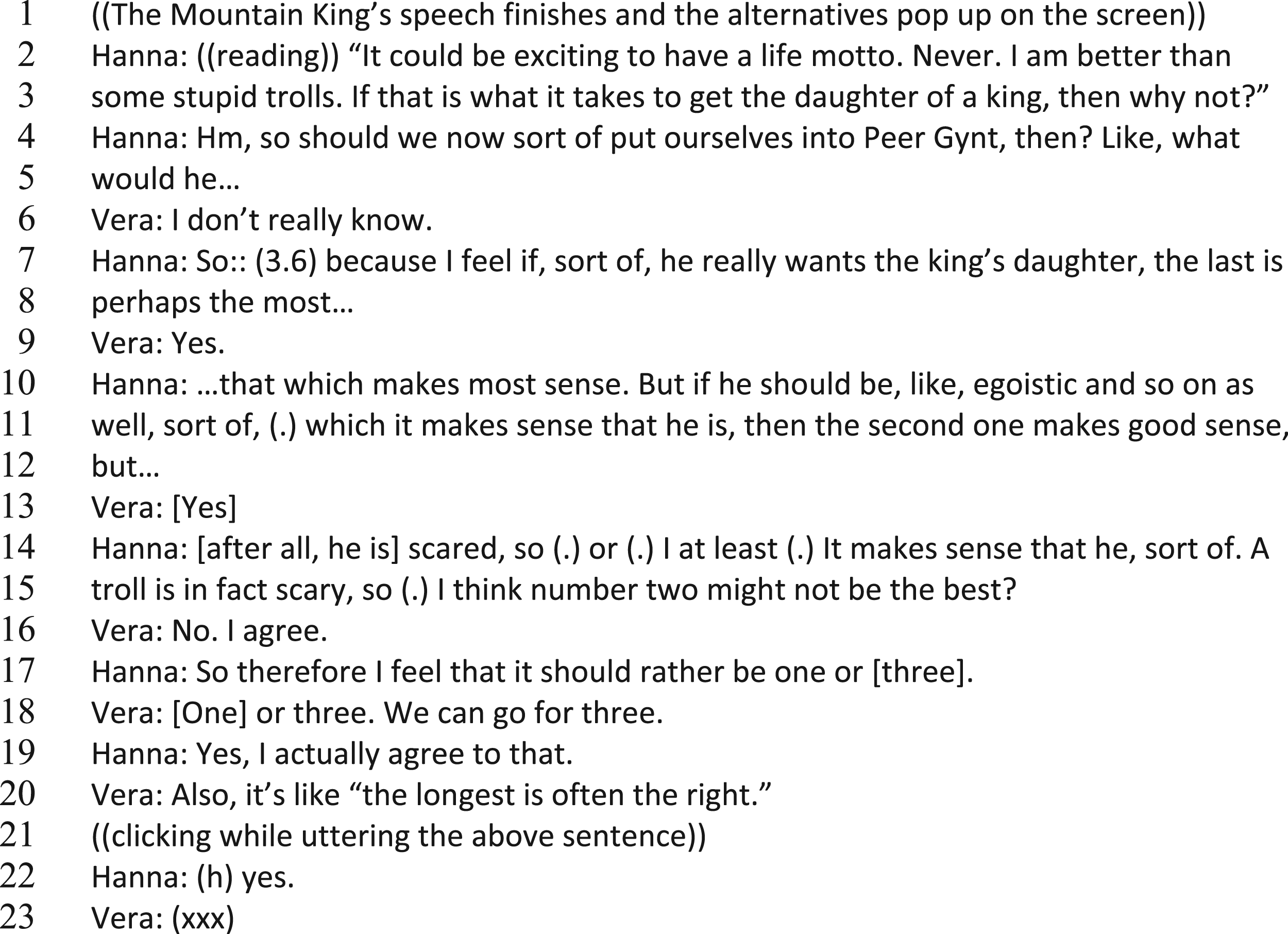
The conversation began with Hanna wanting to clarify what the game really asks of them as players: whether it is meant to be a role-play or something else (lines 4–5). In her response, Vera also displayed uncertainty about this issue (line 6). Then, Hanna took a cautious step into taking Peer’s perspective, explaining what she saw as a proper response in the game given one of two different understandings of Peer’s personality: If he really wants the Mountain King’s daughter (a hypothesis built from her understanding of the action leading up to this scene), the third response might be the best. On the other hand, if he is just an egoist, the second response would be best (lines 7–12). When Vera still did not contribute to the discussion, Hanna went on with her reasoning. She began to argue from what she herself saw as a sensible viewpoint regardless of the given alternatives, stating that trolls are ‘in fact’ creepy. Therefore, it does not ‘make sense’ to provoke them, as in alternative two (lines 14–15). After excluding alternative two, she introduced the first alternative, which she had not considered as a possibility previously (line 17). Vera, however, confirmed that number three was the better alternative, still without any explanation or reasoning (line 18). Hanna then stated that she agreed, as if it was she who endorsed Vera’s decision and not the other way around (line 19). After the decision was made, Vera expressed an argument for the first time. She said that the alternative they chose was the longest and therefore probably the correct one (line 19). Hanna agreed laughing.
When switching to a second-order level of analysis, we need to make one remark about the dialogue that precedes this excerpt: Earlier, when this dyad discussed the previous dilemma (Figure 1), it was Vera who had remarked, ‘But what if we were Peer, then?’ during their discussion. Thus, ‘thinking like Peer’ seemed to serve as a shared frame for the dyad. Hanna’s first strategy for thinking like Peer was to choose among the three possible reactions of the virtual character. We can see that in proposing two different responses as fitting Peer and clarifying the conditions for choosing each of them, Hanna was in fact interpreting Peer and the situation. She seemed to value the last option as fitting an honourable, at least in the sense ‘honest’, Peer, and the second one as an expression of egoism. Then, in order to choose between the two, she drew on a different resource: her own independent assessment of the situation. She found it scary and thought Peer should too. As the fear that she thought appropriate to the situation was not reflected in any of the three alternatives of the character, its function became to help her refute the alternative that expressed the opposite.
Hanna’s introduction of the first alternative as a possible choice at this point can be understood as a way of inviting Vera into the reasoning process. After having highlighted two alternatives as interesting and then excluded one, she may have thought that this left Vera little space to take part in the decision. While Vera’s last utterance about ‘the longest’ often being ‘the right’ was not part of the discussion before choosing, her argument strengthened the decision they had made. The fact that she said it when it was too late for it to have an impact on the decision could mean that she did not regard it as a valid argument, perhaps because it did not refer to the game world, but was a ‘strategic’ take on how multiple choice questions are made, that is, that the longest and most elaborate answer tends to be the correct one. Vera’s perspective represents a possible third frame, when, rather than relating to the situation from either Peer’s perspective or a projection of her own views into the game, she took the perspective of a real-world player who wanted to win the game. Her thought on the longest alternative being the right one was a purely strategic one removed from the situation inside the mountain altogether. Hanna’s cheerful agreement suggests that this frame was also shared between the two.
With reference to Gee’s concepts we have seen how the dyad’s shared projective stance is established both by explicit sense-making of the virtual character’s alternatives of action and by evaluating them from the students’ real-world identities of expressing a fear of trolls and a strategy of answering multiple choice questions, respectively.
Accepting Peer’s frames
The second dyad we will look at (Dyad 2) did not, in contrast to Dyad 1, attempt to clarify the task before getting on with it. They moved straight into reading and discussing the three alternatives of their virtual character. Neither did they take Peer’s personality into account. In the second dilemma (Figure 2), they chose the third alternative after a discussion in which they only considered what they themselves would have done in the situation (Figure 4). ((Mountain King’s speech finishes and the alternatives pop up on the screen)) Endre: It’s finished. Ok, now Tore: ((reading)) (h) “Never. I am better than some stupid trolls.” Endre: ((reading)) (h) “If that is what it takes to get the daughter of the king, then why not?” Endre: I do think that is a (.) If I get the daughter of a king and a kingdom, then I probably would Tore: (h) Actually I would sort of have weighed my words quite carefully when I... (h) Endre: I would not have called them stupid trolls just in front of (.) Then again if they look a bit stupid, that would Tore: (h) Yes, it’s like, I would sort of like to try it just because it is the (h) stupidest thing we could do, [but] Endre: [We can] take the bottom one. Tore: Yes, I think the bottom one. ((clicks the bottom one)) Dyad 2 discussing dilemma two (Figure 2).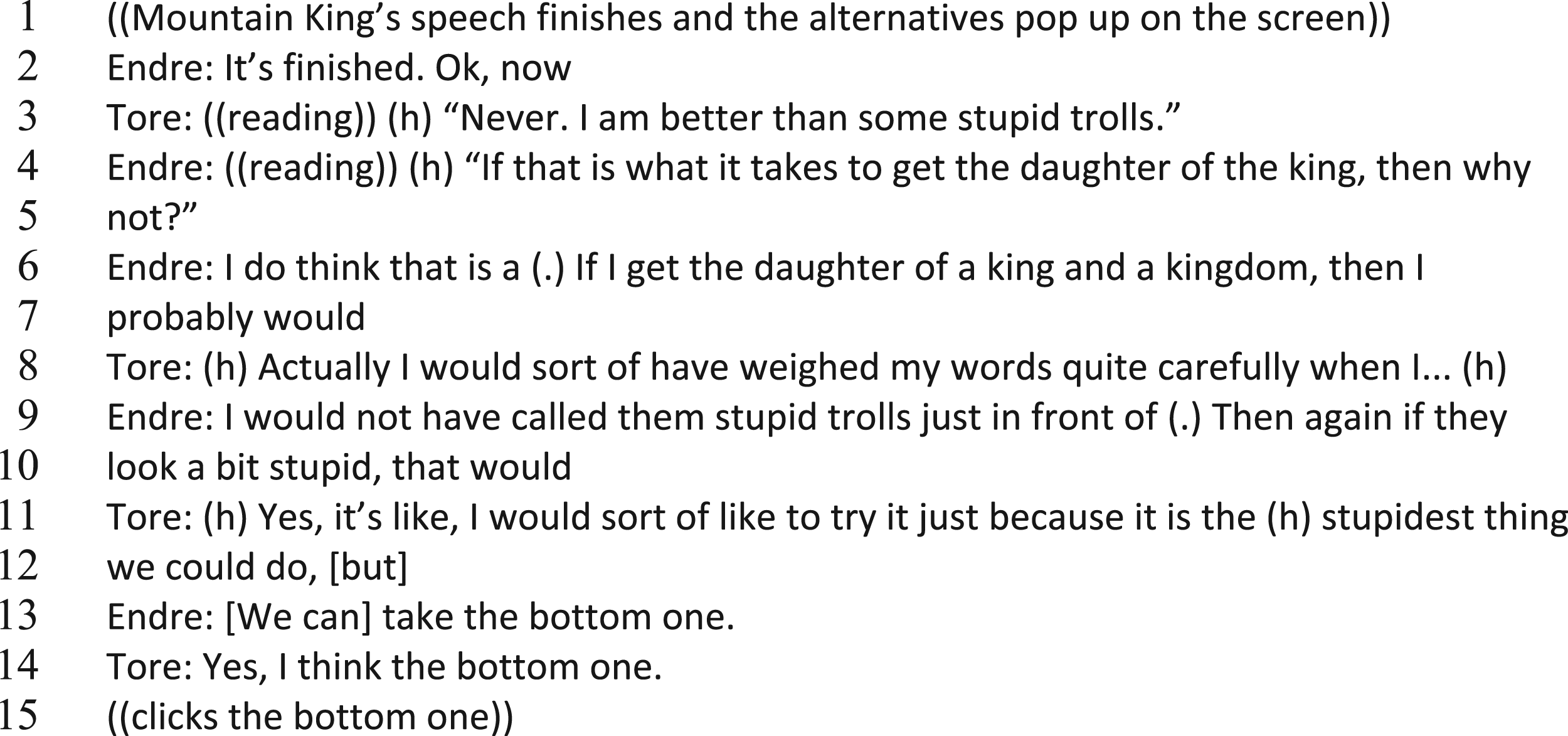
Early in this dialogue, Tore quoted alternative two, which was clearly the most provocative towards the trolls (line 3). It is not completely clear what stance Endre took at the beginning of this dialogue as he did not finish his sentences. However, he seemed to favour the third alternative (lines 4–7). Tore continued by reflecting upon the second alternative, reasoning that the situation called for cautiousness (line 8). In his response, Endre agreed, but it is somewhat unclear what exactly he meant by his utterance (lines 9–10). He might have meant that he thought the trolls did look stupid, but that it would have been a bad idea to say it aloud. Anyway, Tore did not enquire into what Endre might have meant, but instead used Endre’s unfinished sentence as a lever to admit that it would be fun to choose the most provocative response (lines 11–12). However, Endre expressed no enthusiasm for Tore’s idea, and they quickly settled for the safer answer (lines 13–15).
The first and striking difference between this dialogue and the dialogue of Hanna and Vera is that neither Endre nor Tore shared any thoughts about what their task really was. That does, of course, not mean that none of them thought about it. If any of them did, however, their thoughts did not become a shared reflection. Neither did they discuss the words of the Mountain King. Like the previous dyad, they touched upon the look of the trolls (noticing that they looked stupid) and seemed to attach meaning to that, but they did not refer at all to what the troll had said. Instead, they were immediately on-task reading and evaluating the three alternative answers. The fact that they never ventured beyond these could mean that they were not oriented to evaluating the situation independently of the predesigned frames of their virtual character. However, we may also see it as them understanding and accepting the affordances of the medium (Linell, 2009). Endre seemed to immediately favour the last alternative in a commonsensical way, and Tore was intrigued by the second alternative because of the havoc it might create. When Tore said, ‘I would sort of like to try it...’ (line 11), the pronoun ‘I’ had a different meaning than in the rest of this short dialogue. Here, Tore referred to his real-world self. As a game player, he was intrigued by choosing a risky response to see what would happen in the game. The other instances of ‘I’ referred to the situation that their shared virtual self was in. What is the best thing for Peer to say when facing the Mountain King? Still, while accepting the simulated frames inscribed upon the virtual character, there was nothing indicating that they tried to take any of Peer’s characteristics or backstory into account in their decision. Their shared virtual self, called Peer Gynt, seemed to be little more than a projection (Gee, 2004) of the players’ real-world identities.
Thus, the projective stance of Dyad 2 seems to be made up of a virtual identity consisting of the three alternatives, but no features of Peer to be understood or taken into account. Rather, the virtual identity seems to be the players’ real-world identities projected onto the situation and the alternatives. An alternative real-world understanding that is representative of one player, but seemingly not established as a shared activity frame, is the one of a spectator wanting to see the consequences of the stupidest choice played out.
Re-creating Peer
The third dyad we will examine was the most consistent in focusing on Peer as a creative project. To this dyad, it became a returning concern to solve each dilemma ‘in accordance with the Peer we have created’. When faced with the first dilemma (Figure 1), they discussed what type Peer was, that is, what kind of virtual identity they wanted to create. Then, they referred to this in every dilemma that followed with statements such as in Figure 5. Markus: […] now we have sort of [created an identity for him. Right?]. Ida: [Yes, don’t you think? Then I think we should] continue with the same thing for our Peer. Dyad 3 referring to ‘their’ Peer.
They chose the egocentric reading of Peer most of the time but deviated from it when they viewed this alternative as being too respectful to the Mountain King, stating ‘The Peer we have created doesn’t care about that’. To them, the creation of Peer became a project (Gee, 2004, 2005).
At times, however, Dyad 3 framed their task differently. They were torn between the desire to stick to the project of creating ‘their’ Peer and the urge to see the consequences of what they saw as the most extreme choices. In other words, their projective frame shifted from wanting to build the character to wanting to create the most interesting story, as is the case in the second dilemma (Figure 2). ((Mountain King’s speech finishes and the alternatives pop up on the screen)) Markus: Ok Ida: Ok Markus: ((reading)) “It could be exciting to have a life motto. Never. I am better than some stupid trolls. If that is what it takes to get the daughter of a king, then why not?” Ida: In any case I think it is stupid to choose the middle one. I think (h) then you will be killed quite fast. Markus: But it would be thrilling though. Ida: Yes, that is true. That is actually true. Markus: It is fun to take the thrilling. That is, [fun to take the middle one]. Ida: [Do you think the goal is to win or not?] Ok. E:: (.) The top one is also boring. “It could be exciting to have a life motto.” (.) And, e:: (.) but then you show mostly, like, arrogance and such things. Markus: But we have, sort of, assumed that he is a quite [egocentric guy] Ida: [Yes, don’t you think?] And then it is the bottom one which (becomes like) that, but e:: because he does want to… he tries to look beyond his own gain. Markus: M:: Ida: But it is tempting the middle one, to (h) see what he actually does. Markus: (h) should we try the middle one? ((clicks the middle alternative)) Ida: I think we are very good at this game.
Immediately after Markus had read out the three alternatives (Figure 6, lines 4–5), Ida stated that the middle one would be a stupid choice as it would provoke the trolls into killing Peer (lines 6–7). Markus seemed to agree but added that it would also be thrilling and therefore more fun. Ida agreed, but also moved on to ask if the goal of the game was to win or not (line 11). At this point, they talked over each other, which may be the reason why her question was not responded to by Markus. She quickly switched focus, stating that the first alternative was boring, and after a short pause, that it would depict Peer as arrogant (lines 11–13). Markus responded by stating that they have assumed Peer to be egocentric. Then, Ida agreed and said the bottom alternative would best reflect that (line 15). After a short pause, however, she re-introduced the second alternative because it would be interesting to see what happens. Markus agreed and immediately clicked the second alternative (lines 19–20). Ida stated laughingly that she thought they were very good at this game (line 21). Dyad 3 discussing dilemma two (Figure 2).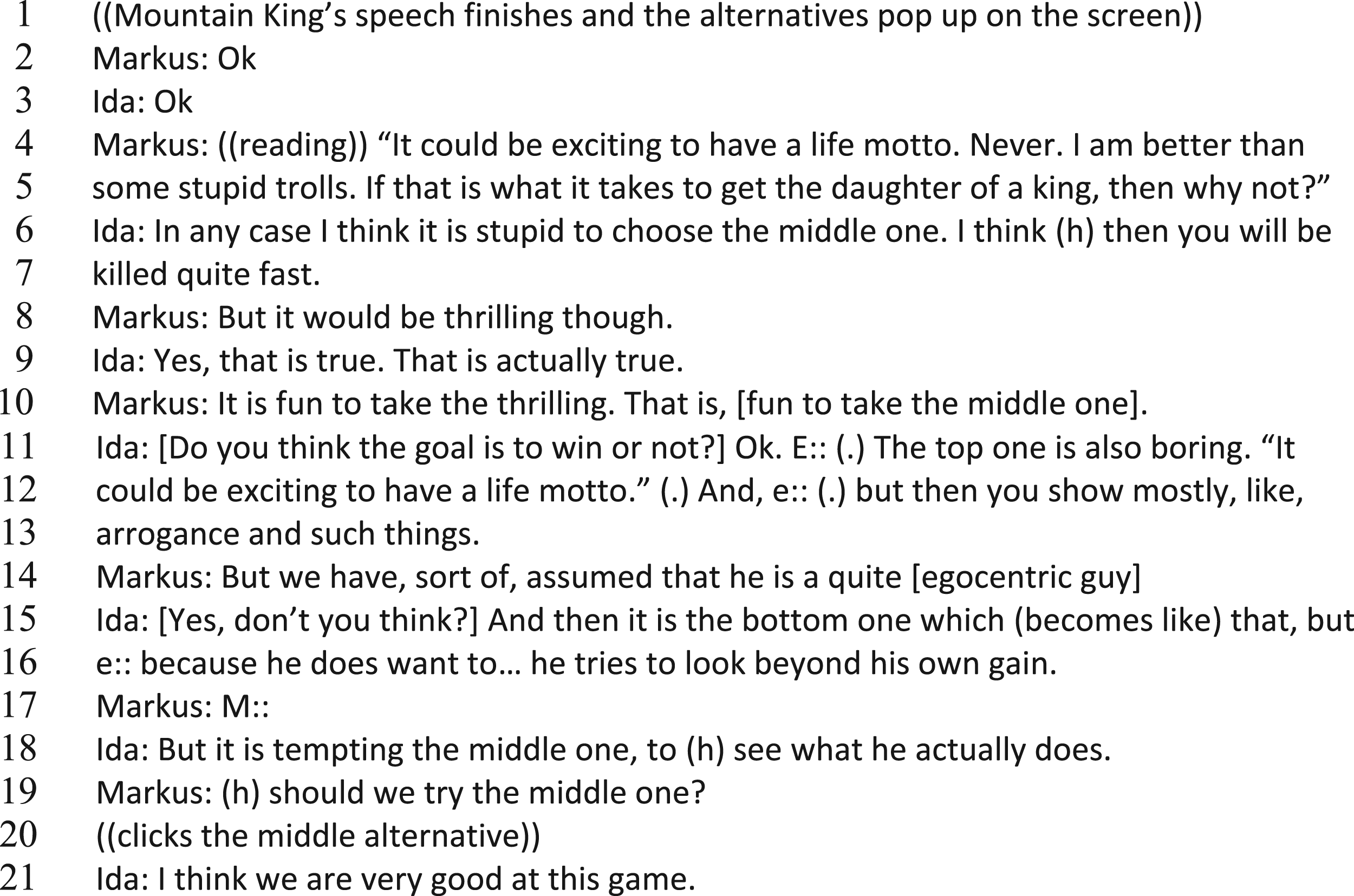
When discussing this dilemma, Dyad 3 ended up choosing the alternative they had first dismissed as stupid. Along the way, they discussed what personality traits different alternatives represented and what was more suitable for the Peer they wanted to create, and they even identified the bottom alternative as the one fitting ‘their’ Peer. The way they still ended up choosing the middle one demonstrates how they switched frames collaboratively. Even if they were in agreement about their task and responsibility of making choices consistent with what they perceived as a certain Peer-identity, they left that frame for a bit of adventure. Still, their choice was not a random pick of a different alternative. This time they chose the alternative that made the most interesting story to them as spectators in the real world. This is clear from Ida’s desire to ‘see what he actually does’ (line 18) as well as a bit earlier when she expressed uncertainty about what might be the goal of the game (line 11). She seemed to have a vague feeling about there being a correct answer but did not think their agreed-upon choice was the one.
Contrary to Dyad 2, this dyad establishes the shared frame of spectators eager to see the consequences of responding to the troll in the most provocative manner. This is, however, a re-framing from the dyad’s projective stance of creating Peer’s personality by way of his choices. To them, playing Peer seems to be an act of creation, but they also share in seeing more than one way of playing the game.
Discussion
In this article, we have examined students’ collaborative meaning making when playing a video game adaption of Henrik Ibsen’s Peer Gynt and their negotiation of a shared projective stance when playing the game together. Beyond the ground rule of always discussing the given alternatives before making choices in the game, the students were not given instructions other than to play through the game excerpt. Therefore, any expressed understanding of meaning and purpose in the game stemmed from the dialogue between the two players and the game itself. In order to understand how the two students acted as one in the virtual world, we used the concepts of frames and re-framings. Combined with the idea of multiple player identities and a projective stance, these concepts helped us to see how the students took advantage of ‘new opportunities … of intention and interpretation’ (Linell, 2009: 234) along the way.
Although the game gives the players no choice but to make decisions on behalf of Peer, we have seen how this task can be enacted in different ways. One way to play Peer is to pose questions that consider Peer’s personality, such as ‘If he really wants the king’s daughter...’. In Goffman’s terms, we could say that they frame their task as one of responding to the question, ‘What would Peer do?’. Another way would be to make decisions chiefly by asking what one would do oneself, or what one regards as common sense. This approach is expressed in utterances like ‘If I get the daughter of a king, then I would...’, which reflects a frame where the question is ‘What would I do in this situation?’. A third way of negotiating identity is to look upon the game as more of a creative tool, where the players create an identity for Peer early in their game and refine it throughout. Such an approach is represented by the quote ‘The Peer we have created would not do that’, with the frame being ‘What do I want Peer to do in this situation?’.
We have also seen how the three dyads relate differently to the projective stance that they need to take in order to perform actions in the game. The three possible actions inscribed upon the virtual character has been accepted by some, questioned by others and used creatively by a third group to form their own version of the protagonist. The dyads’ real-world identities have been recruited by imagining what they themselves would have thought or done in such a situation. However, rather than identifying with Peer, or at least wanting to ‘help him’ safely through the delicate situation he is in, several of the dyads would rather want to see a conflict escalate in the hall of the Mountain King. In other words, the negotiation of a shared player identity was not only about enacting or creating an identity for Peer. A different framing of the task, which appeared frequently, was about creating an entertaining story. Such a framing was generally motivated by an urge to make risky choices in order to ‘see what will happen’. The students who made or argued for making this choice often switched frames from one of the three above-mentioned ways of acting out Peer in his situation into seeing themselves as spectators who were curious about how the most extreme storyline would unfold. In Gee’s terms, we could say that their projective stance was less about a project imposed upon them and more about actively projecting their desires onto the game world (Gee, 2005). Several of the dyads expressed some concern about Peer’s most provocative answer being ‘wrong’. By that they revealed a ‘school framing’ of the playing that the above-mentioned frames may have been nested into (Linell, 2009).
Games’s (2008) conception of game design as a conversation between the developer and an ideal player remains a good metaphor for what we have seen. It was not easy to foresee how real players would play the dialogue, and their contributions proved interesting for the developers in their continuous work on the game. One aspect that is striking in its absence in all eight dyads is any discussion of the meaning of the troll’s words. The Mountain King expressed a complex message wrapped in rather archaic words and formulations, demanding that ‘enough’ must be the motto written on Peer’s buckler. It is unlikely that the students fathomed what this meant but found it too trivial to be worthy of a comment. Yet in all eight cases, when the troll fell silent (as described in line 1 of each of the three excerpts analysed) the dyads skipped directly to discussing the three possible responses. No one probed into the meaning of the troll’s words, which they were in fact responding to. What they seemed to take into account, however, were the visuals. When one dyad stated that the trolls were scary and another suggested that they looked stupid, they were referring to the looks rather than the words of the trolls.
Thus, all three dyads stuck to discussing Peer’s possible answers and left the Mountain King’s question undiscussed. With this observation, we might also have stumbled upon a defining function of multiple choice questions in general: Instead of requiring the student to formulate an answer to the question, they require them to choose an answer, which is a completely different and far easier task. Essentially, the three given alternatives are meant to be possible conclusions to a player’s reasoning in the situation. Could it be that the alternatives are presented to the players too early, before they have had any chance to discuss how to understand the troll’s demand? If so, understanding the possible conclusions might represent a sufficient degree of understanding ‘for current practical purposes’ (Garfinkel, 1984). More so as the players seemed to be able to create a character based on the responses without reflecting profoundly upon the dilemma the character is in.
Contrary to some of the previous research on literary classics and video games, this study on the Peer Gynt game has not been focused on the game as a tool for analysing literature (as in Marlatt, 2018) or learning specific skills (as in Barab et al., 2005). One may even argue that the game itself does the opposite of fostering pro-social skills as is common in educational games (Barab et al., 2010; Sanford et al., 2015) as it invites the players to empathize with a cynical wrong-doer and a scoundrel. Rather, Peer Gynt is about being introduced to the story as a literary classic and the deeper questions that the play raises about identity and fulfilment in life. In this respect, both the game and the present study have more in common with Berger and McDougall’s (2013) research on the entertainment title L.A. Noir than with most other games made for use in a school context. It is about experiencing a classic literary work in a new way by playing it as a game. The question, then, is how well the Peer Gynt game gives the player such an experience. Our answer based on this study is that the game seems to let players interact with the character and story in interesting ways but not to foster a profound understanding of the underlying themes of Henrik Ibsen’s play.
Implications for teachers and game designers
The findings in this study have implications for developers of games similar to Peer Gynt and for teachers using such games in school. Designers of video game adaptions of linear narratives will always have difficult decisions to make concerning how far removed from the original they may venture. This study has demonstrated that players might expect to be able to influence the story. Radical alternatives especially seem to spark an eagerness to see what happens.
It is interesting how the players managed to discuss among themselves and respond to the troll without touching upon the essence of the dilemma they were responding to. We suggest that this may have been caused by both the faithfulness to Ibsen’s archaic text and by the game offering an easy way forward by giving the player alternative answers to choose among. The studied dilemma also shows how the profoundness, that is, choosing to trade away a part of one’s humanity, may have been lost on the players. Perhaps it would have been better communicated if the players’ decision had immediate consequences visually or in the narrative.
Concerning implications for teachers, this study seems to confirm the importance of the teacher’s scaffolding of students in game-based learning activity. In narrative literary games such as Peer Gynt, students may more easily recognize and make use of the mechanics that move the game forward than identify and reflect on the themes raised in the game. The teacher plays a central role in helping the students lift their gaze to seeing and reflecting on the story.
Footnotes
Declaration of Conflicting Interests
The author(s) declared no potential conflicts of interest with respect to the research, authorship and/or publication of this article.
Funding
The author(s) received no financial support for the research, authorship and/or publication of this article.

Note
Appendix 1. Transcription key
Adapted from Jefferson (2004)
(.) Full stop inside brackets: Micropause of no significant length
(0.2) Number inside brackets: Timed pause (seconds)
[] Square brackets: Overlapping speech
((interaction/analyst comments)): Description of non-verbal activity
(xxx): Talk that was too unclear to transcribe
(word): Unclear talk/doubtful transcription
? Question mark: Inquiring intonation
:: Colons: Elongated speech
(h) Bracketed h: Laugh within the talk