




Abstract
Online collaboration has become a regular practice for many Internet users, reflecting the emergence of new participatory cultures in the virtual world. However, little is yet known about the processes and conditions for online collaboration in informally formed writing spaces and how these create opportunities for participants’ identity work. This ethnographic case study explores how four young adults, fans of the show My Little Pony: Friendship is Magic (bronies), negotiated a dialogic space for their online collaboration on a fan translation project and how this created opportunities for their identity work. After a year of participant observation, we collected interviews, ethnographic diaries and participants’ chats, which were analysed with qualitative content and discourse analysis methods. The findings showed how the Etherpad online writing platform used by the participants facilitated the construction of dialogic space through the visualization of a shared artefact and adjustable features. It was in this dialogic space where the participants negotiated their expert identities which furthered their discussions about writing, translating and technological innovations. The study advances present-day knowledge about online collaboration in affinity groups, engendering the construction of a dialogic space for collaborative writing and participants’ identity work.
Introduction
The Internet and its various social platforms have boosted online collaboration “out in the wild” serving various interest groups for recreation, work, civic engagement and learning endeavours (Benson, 2011). One of these interest groups is called a fandom, an online space formed by deeply-engaged consumers with a shared interest in specific popular culture and its products. Educational and media scholars have suggested that fandom is not only a space of affinity, but also a fruitful space for joint meaning-making, identity building and learning (Gee, 2004; Jenkins, 2006). Also, research on fandom provided educators with new insights on language learning, which then was applied to the classroom (Sauro and Sundmark, 2016). Fans share their interests, develop and maintain social relationships, and also express their creativity by producing fan products, such as fanfiction (i.e. writing alternative stories based on popular culture products), fan-art (i.e. drawing characters or themes based on popular culture products) or fan translation (i.e. amateur translation of popular culture products).
Fan translation is a frequent fan practice which includes self-organization of the fans in groups to produce amateur translations of popular culture products. There are different types of fan translation practices including fansubbing (i.e. translation of the original voice tracks of videos and editions of this translation with subtitles), scanlation (i.e. fan translation of manga) and fandubbing, fan-made dubbing of the audiovisual products (see e.g. Sauro, 2017; Vazquez-Calvo et al., 2019). Fan translation has been mostly described in terms of translating from the source language of the original product (e.g. Japanese) to the specific language of the audience of the fan community (e.g. English). In these studies, fans worked for a specific audience who waited for the desirable translation, which frequently led to deadlines, strict hierarchy, competitiveness between different translation groups and group tensions (Liu and De Seta, 2014).
The organization during fan translation in various studies has been identified as being hierarchical and distributed―every participant having certain ascribed roles (i.e., transcriber, translator or editor) and certain workloads with high commitment and quality standards (Ameri and Khoshsaligheh, 2019; Aragão, 2016; Díaz-Cintas and Muñoz Sánchez, 2006; Saadat, 2017; Valero-Porras and Cassany, 2016; Zhang and Cassany, 2016). The learning in these communities was rarely described through mentorship or feedback, but more so through individual practices of sophisticated audio-visual comprehension in case of fansubbing (Liu and de Seta, 2014; Zhang and Cassany, 2019) or reading comprehension development through multimodal cues in case of scanlation (Valero-Porras and Cassany, 2016). Interestingly, a recent study on text translation on the Chinese platform Yeeyan described fan collaboration differently; fan translation was described as collaborative, with flexible, non-ascriptive identities and involvement of the members at all stages of the process including translating, editing and proofreading (Yu, 2019). Due to these differences in collaborative processes, the question of how dialogic collaboration in fan translation is constructed remains open. The aim of this study is to clarify this question by identifying the premises of dialogic online collaboration and identity work.
Brony fandom
In the current study, we analysed the process of translation of a fanfiction novel based on the show My Little Pony: Friendship is Magic (MLP: FiM) by fans who identify themselves as bronies. Brony fandom started in 2011 with roughly 80% of the fandom being male. It attracted the attention of some scholars interested in why many men from different countries could be interested in a show aimed at little girls. The topic of gender became popular amongst media and discourse scholars, who mainly focused on how bronies were challenging the hegemonic masculinity whilst watching MLP: FiM (Hautakangas, 2015; Lehtonen, 2017; Valiente and Rasmusson, 2015). These studies showed that the traditional gender identity of many fans had shifted, i.e., fans identified themselves with the characters of the show (female ponies). However, most of these studies consisted of interviews and surveys, with less focus on the specific fan practices of bronies. Our study covers this gap by providing an ethnographic perspective on a specific fan practice of fanfiction translation.
Our research participants were translating a popular Russian fanfiction from Russian to English for the English-speaking fans. They were from various East European countries and spoke Russian as the lingua franca. They also had a target readership of English-speaking brony fandom, although they did not develop strict deadlines or experience pressure. During this translation, the participants achieved constructing a dialogic space for their online collaboration providing constructive feedback and participating in joint meaning-making. By dialogic we refer to a space that is non-hierarchical and in which the participants engage in meaning-making and work on their non-ascriptive identities (Wegerif, 2007). This study is focused on the process of collaborative construction of knowledge, which then can lead to literacy development and second language learning.
We analysed in detail the collaborative working process of fan translators focusing on their interactional processes including the identities participants negotiate. To these ends, in this study, we ask: RQ1: How did translators organize their online collaboration in the fan translation project? RQ2: What technological artefacts have contributed to the creation of dialogic space? and RQ3: How did the participants negotiate their identities in the dialogic space?
Theoretical underpinnings
Online collaboration from the dialogic perspective
This study draws on the dialogic notions of human communication, learning and identity building (Kumpulainen and Rajala, 2017; Bakhtin, 1986; Wegerif, 2007, 2013). The dialogic perspective underscores the importance of negotiating and establishing a mutual agreement for collaborative work and learning (Kumpulainen and Mutanen, 1999; Renshaw, 2004). To achieve this collaborative work, the participants need to develop an intersubjective orientation towards each other, which includes consideration of different perspectives of other participants (Wegerif, 2007), and also the ability to manage disagreement or misunderstanding (Matusov, 2001). In dialogic education, the mere construction of this collaborative work could be an endpoint for learning, when the process constitutes the learning in itself (Wegerif and Major, 2019).
We follow Wegerif (2007), who defines collaborative learning through a dialogic space construction. This dialogic space is constructed not only through the intersubjective orientation of the participants, but also through reflexivity (i.e. participants reflect on their arguments and of the others), inclusivity (i.e. everyone is included into the discussion), explicit argumentation (i.e. participants reason their propositions with explicit arguments) and creativity (i.e. participants develop creative solutions to the problems) in the collaboration. We have used these characteristics as the guiding categories of our analysis (see also Haythornthwaite et al., 2018; Mercer et al., 2010; Pifarré and Staarman, 2011) to identify if the participants construct a dialogic space during the collaboration.
Technology in dialogic space is frequently described through the socio-cultural idea of mediation when the technological artefact mediates communication or action (Vygotsky, 1986; Wegerif and Major, 2019). In our case, the participants communicated through various channels, such as Google Doc, Etherpad (a highly customizable collaborative editing platform, similar to Google Doc) and Skype. Similar technological artefacts were described in previous studies on collaborative writing in dialogic space. For instance, Wikies enabled students to construct a dialogic space with a shared digital artefact (Pifarré and Staarman, 2011). Similarly, Google Doc helps to create a dynamic and shared writing space with the feature of synchronous editing (Evans and Bunting, 2012). Further, we will describe how the participants used technological artefacts to create a dialogic space.
Online collaboration is one of the reasons why fandoms became a popular research object among educators. Fandom, as opposed to schooling, is frequently described as a collaborative and participative space (Jenkins, 2006; Lankshear and Knobel, 2006). Particular fan practices, such as fanfiction, even inspired bringing online collaborative fanfiction practice into the language classroom (Sauro and Sundmark, 2016). This study aims to shed light on the process of collaboration and identity building during fan translation to advance knowledge in the field of informal collaboration and to provide new insights on computer-mediated collaborative practices for educators.
Identity work in fan communities
We hold that the construction of dialogic space is closely connected to the participants’ identity work as it is ‘an inclusive “space” within which self and other mutually construct and reconstruct each other’ (Wegerif, 2007: 43). Following Bakhtin (1986), we view identity work as being closely connected to the language used when the process of positioning oneself in a discourse marks a negotiation of one’s identity. This interactional positioning is constructed by voices, meaning a person’s worldview or a specific perspective. In online interaction, a participant’s positioning within different perspectives can be incorporated through comments, images, links and so on, manifesting a particular voice (Shafirova and Cassany, 2019; Lehtonen et al., 2014; Valero-Porras, 2018). Meanwhile, identity work means managing different voices and choosing the ones which are more appropriate for the situation (Arnseth and Silseth, 2013).
Inevitably, voices have an intertextual relationship to previous discourses which can indicate an individual's previous experience or his/her affiliation with a specific community or group. While being affiliated with a community, members can position themselves with particular ideas, practices and artefacts circulating in this community (Kumpulainen and Rajala, 2017). We have used the idea of voices and intertextuality as theoretical and analytical tools when investigating participants’ identity work in online discussions. We considered how other participants react to these identity negotiations and consequentially co-construct these identities in their ongoing interaction (Blommaert, 2005).
Moreover, identity negotiations during online discussions can develop into a shared identity of a community (Baym, 2015; Wenger et al., 2002). Hence, we approached the online community of fan translators - the focus of our study - as a community of practice (Lave and Wenger, 1991). This online community of practice was formed by a group of people who interact with each other on a regular basis with a shared interest in translating fan fiction. Fan translators not only share and negotiate their knowledge, experiences and interpersonal relationships in their community of practice, but also develop their “common knowledge, practices, and approaches” (Wenger et al., 2002: 6). Drawing on Wenger (1998), we have defined the shared identity of fan translators through shared ways of engaging in a practice of translation, shared objectives, shared values and shared repertoire (discourse).
Study
The context of Russian speaking brony fandom
The translation team consisted of four members, Nork, Bolk, Vic and Dan; all of them form part of the Russian-speaking brony fandom, with the platform at https://tabun.everypony.ru/. The participants were from different countries in Eastern Europe (Poland, Ukraine, Belarus and Estonia) and they used Russian as their lingua franca. Fan translation was a usual practice in the Russian-speaking brony fandom, though it was mostly made from English to Russian and focused on the translation and adaptation of the episodes of the MLP:FiM show (fansubbing and fandubbing). The translation from Russian to English, presented in this study, was rare as it is a demanding task for Russian speakers. The objective of our participants also differed from usual fan translation, as they wanted to present a popular Russian fanfiction to bronies who did not speak Russian, targeting it to the Global English-speaking fandom.
Data collection
The data for this study were collected via semi-structured interviews in Russian and participant observations of a translation process, following the methodology of digital ethnography (see e.g. Black, 2005; Lam, 2006; Lee, 2016). In short, digital ethnography means adapting traditional ethnographic methods such as interviews and observation of the online terrain. The first author is from Russia and speaks Russian; she gained access to the translation team after writing to their website presenting herself as a researcher and arranging an interview with two members of the team (Bolk and Nork) in May 2017. This first exploratory interview was conducted via Skype chat in Russian. The participants were asked general questions about the translation, the expected readership, the workflow and other fan practices in which they were involved. After that interview, the first author was asked to join the team as the members recently started translating the fifth chapter of the fanfiction novel “B. T.”. The translation of the novel proceeded chapter by chapter. Later, every chapter was published on the FimFiction fanfiction repository and on the project’s website.
The first author was allowed full access to the translation process: she was introduced to the Skype group of translators and was asked to participate in the translation on the collaborative writing platforms. At this point, she started the online observation, which lasted from June 2017 to February 2018 when the translation project was practically finished. The first author was translating the novel with other members, following DeWalt and DeWalt’s (2011) definition of active participation, meaning that she was actively participating in translation, though she did not have the lead or a very important role in it. The focus of observation was on the collaborative writing practices of the participants and the strategies they used to translate the text. The researcher documented the processes of collaboration, making screenshots of discussions on Google Drive, Etherpad or Skype, and saving the results of the translation work. She also kept field notes, describing the Skype calls made by the participants, and her perception of the translation process, interactions between the participants and the use of the collaborative platforms.
After this participatory observation period, three follow-up interviews were conducted with three case participants: Nork, Bolk, and Vic. Also, there was a small conversation via chat with the fourth participant, Dan. The questions in these interviews were mainly about the workflow of the translation, the participants’ perceived role(s) in the translation process and their perceptions of the learning opportunities during collaboration. Case participants Bolk and Nork remained the key research participants in this ethnographic study, as they provided full access to their translation processes. In sum, the data of this study comprise of:
Five semi-structured interviews with the participants via Skype chat (12,613 words); Field notes (5,942 words); The participants’ comments from Google Drive on the novel’s adaptation (6,648 words, 94 comments); Chat from the Etherpad collaborative platform related to the translation (2,866 words); Screenshots of the chat and relevant fragments of Russian text with translations into English (55).
Main participants’ description
All the participants are native speakers of Russian who live in post-Soviet countries and use Russian as their lingua franca (more about the language use in Shafirova, Cassany & Bach, 2020). The participants did not know each other before the beginning of the translation project. Bolk, Vic and Dan were in their mid-20s during the period of data collection, with only Nork, the leader of the team, in his mid-thirties. The participants were not professional translators and mostly occupied the IT sector with Vic working as a web developer, Dan as a system developer and Bolk working in the support service of an IT company. Only Nork occupied the position of a graphic designer.
All the participants enjoyed the process of translation, the show MLP:FiM and the brony fandom; however, they had different attitudes about fan identification. Bolk and Vic strongly identified themselves as devoted fans and bronies; both of them participated in various fan practices (i.e. fandubbing and fansubbing) and visited brony conventions (Bolk worked as the main translator for foreign guests). Meanwhile, Nork and Dan participated in other fan practices in brony fandom but did not strongly identify as devoted fans. For instance, one of the motivational factors for Nork consisted in the fact that he did not want to be “an ordinary middle-aged man”, and this project was one of the ways he could express himself. Dan did not worship the show, but relished participating in different literary brony fan practices, i.e., he was the main editor of the Russian version of the fanfiction novel. Similar to previous studies on the fandom (Kosnác, 2016), some of our participants were more devoted fans while some of them were less devoted fans, but all four of them participated in several fan practices, so we denominate them as fans.
Also, for all the participants, being a fan was not the only motivation for this project. The translation from the first language (Russian) to a foreign language (English) is highly demanding, which requires high-level mastering of English stylistics, vocabulary and grammar. Being a challenging project, Nork and Vic also wanted to improve their English skills during the translation, whilst Bolk, with a higher level of English, wanted to improve his skills as an amateur translator.
Ethics
The ethical standards adopted in this study follow the recommendations of the International Association of Internet Researchers (Markham and Buchanan, 2012). We informed all the participants about the study and obtained the informants’ consent. To ensure the participants’ anonymity, their real names have been replaced by pseudonyms.
Analysis
We analysed interviews, field notes, and participants’ discussions by combining qualitative bottom-up content analysis (Schreier, 2012) and discourse analysis (Gee, 2011). We also used the categories of ‘reflective dialogue’ (Wegerif, 2007) to respond to our third research question that focuses on the participants’ construction of the dialogic space and identity work in the course of their online collaboration. In Figure 1, we have roughly outlined our analysis into two steps.
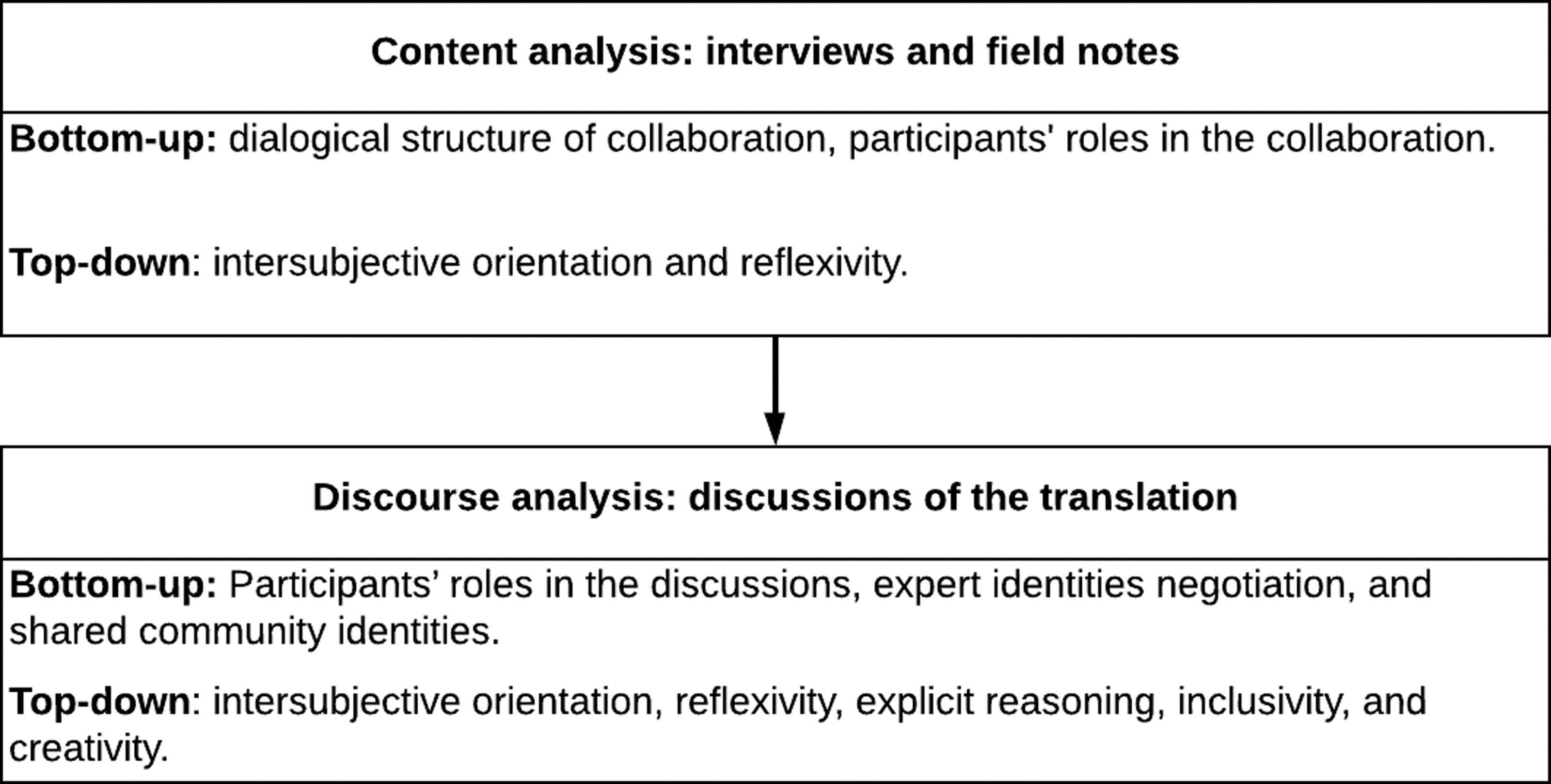
Three steps of data analysis.
Firstly, we concentrated on RQ1 and RQ2 about the participants’ organization of their online translation work and the use of technology. With these questions in mind, we coded using a bottom-up qualitative content analysis on interviews and field notes using Atlas.Ti software. The coding was made inductively on the basis of reiteration and comparison (Schreier, 2012).
To answer RQ3, we applied discourse analysis to examine the participants’ discussions on the collaborative platforms (i.e. comments on Google Drive and the chat on Etherpad). All the online discussions were analysed and codified in Atlas.Ti. We centred on the participants’ roles and identity negotiations, paying attention to the voices that manifested in the participants’ utterances (Bakhtin, 1986). We were able to distinguish two types of identity negotiation: expert identity (participants’ positioning to a certain field of expertise), and roles in the collaboration (participants’ positioning in certain duties during the collaboration). In this process, we also investigated the participants’ explicit reasoning, intersubjective orientation, reflexivity, inclusivity and creativity in the creation of dialogic space.
The results
Structure of collaborative work and use of technology
The findings show how the process of online translation was organized by the participants into three main phases: adaptation, translation, and editing (see Figure 2).
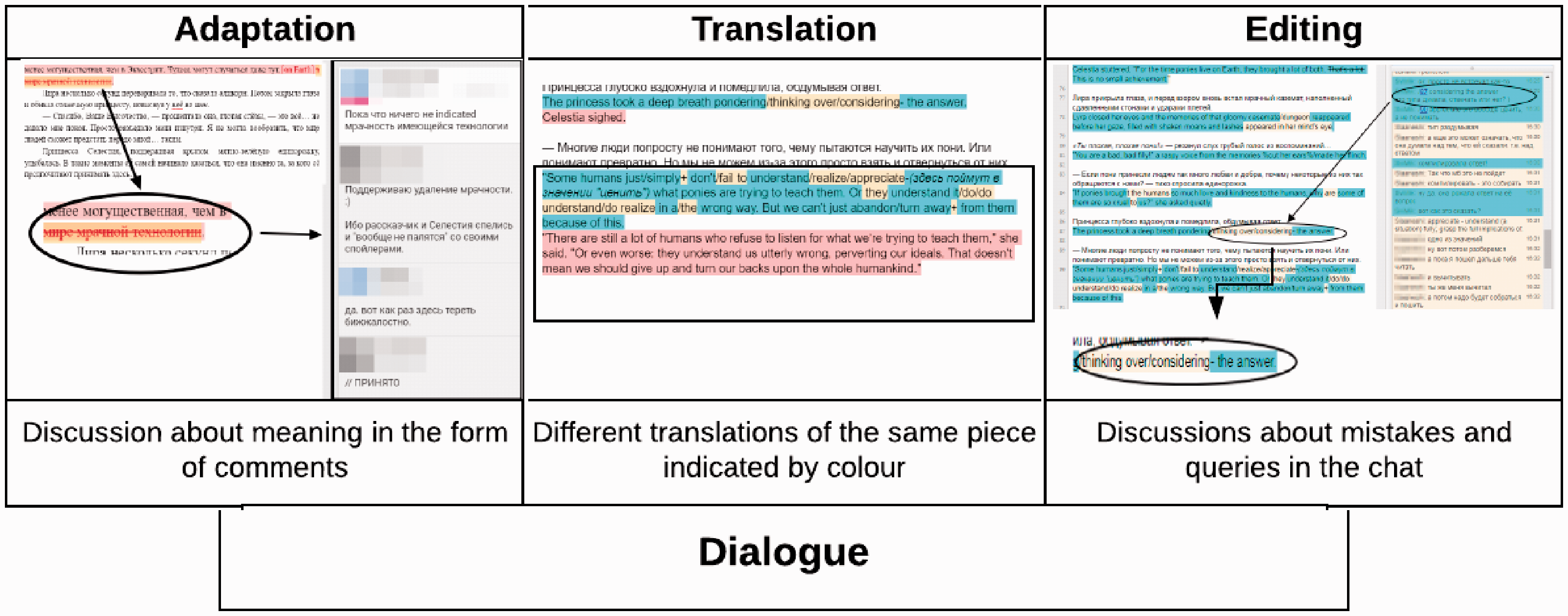
Structure of the dialogic workflow.
The participants had neither strict task divisions nor obligations during the translation process: there were no divisions between editors, reviewers or writers, meaning that everybody could be engaged in every phase of the translation. Further, the participants could choose to translate the part they wanted to and to propose their versions of other participants’ translations. This absence of hierarchy and role distribution resulted in active and engaged collaboration among the participants, who used the comment section of Google Doc, EtherPad chat, and Skype chat and calls to communicate. To illustrate these findings, the three major parts of the participants’ working processes during their online collaboration on their fan translation project are discussed below.
Adaptation of the novel for a global readership
During the adaptation phase, the research participants were discussing how to adapt the novel for an English-speaking readership. Nork described the adaptation phase as: “We are trying to keep the emotional context of the scenes and the plot, however we can change the details, which are not that important for the plot adapting them for the English-speaking readership.” 1 During this phase, each participant had to read a chapter of the novel in Russian and to make his/her comments in Google Doc concerning the necessary changes (see the adaptation stage in Figure 2) or/and used “suggesting mode” to propose changes. During a month and a half, the participants actively discussed changes to their text, reaching 94 comments on one chapter of the novel. Many of the comments were organized into long discussions, e.g. 11 comments made over one issue. The conversations were mainly asynchronous, so the participants had time to think to respond. Problematic discussions were resolved by a vote with the leader of the team, Nork, putting the comment “approved”. Google Doc resulted useful for this phase, however the participants also used Skype chat (and not Google Doc chat) for communication not related to the translation (jokes or conversations about MLP:FiM), decisions on finishing the process of adaptation or group tensions.
Translation
After making necessary changes to the text, the participants moved to the translation process. The Etherpad platform was chosen by the group as the main translation platform for this phase, as Google Doc had resulted in being inefficient during the translation of the previous chapter: the loading of the Google Doc pages was taking too long due to the number of participants’ comments. Interestingly, compared with in-school collaborative writing, in which the problem is in the lack of comments and the existence of “free riders”, the fan translation team required new technological resources that can support their collaboration (Arnold et al., 2012).
The Etherpad platform provided a shared writing space in which each translator has her/his text colour, shared writing space and a chat. The participants inserted the Russian text with changes and annotations from the adaptation phase and divided it into paragraphs. Every participant could choose any paragraph to translate, while other participants were able to propose alternative translations to their peers’ texts. In Google Doc, the participants had to use comments to propose an alternative translation, but in Etherpad the participants proposed alternative translations directly in the text using the sign “/” and inserting an alternative word, phrase or paragraph into the translation (see the colouring in Figure 2). The online platform also included a chat which worked as space for the participants to discuss difficult parts of the translation, to share their emotions regarding the translation or to provide constructive feedback to the translators, as described by Bolk: “The comments are also made here, as like, here I am not sure, here we have to correct it, here we have to look at how to make it better, and so on”. In the chat, the participants were able to refer to the paragraph they are mentioning by citing it between square brackets [].
Editing
The editing phase was the longest, as in comparison, the translation was made in a few days while the editing process lasted for months. When the core of translation was written, it had to be read by all the participants. While reading the document, they would express their doubts, discuss mistakes, and propose variations to the translation (there could be three or four different translations of one phrase to choose from). The participants resolved their doubts via chat. They also made Skype calls in which they talked about which combination of translations compiled the best choice. As Bolk pointed out:
Recently we are trying to gather by voice and read everything together. Meanwhile, one person from the team is appointed to be a “seamstress”, which means a person who will write down the corrections.
Identity building in the dialogic space
All the research participants were building their identities during the online collaboration. The identity work correlated with their roles in the team and their relevant fields of expertise. In Figure 3, we have illustrated the identities negotiated by the participants and the functions these identity negotiations played in their collaboration.
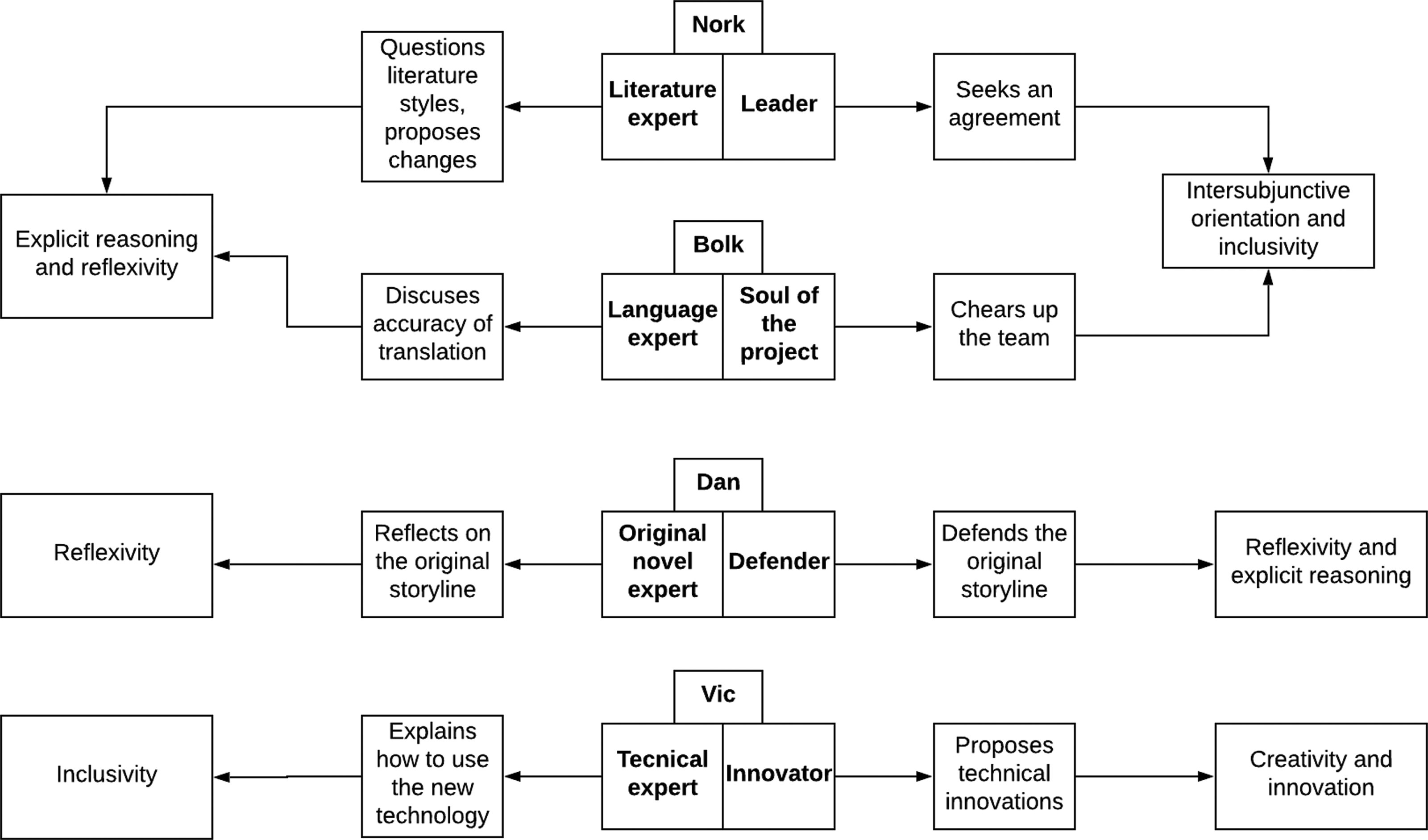
Individual identities in the dialogic space.
Drawing on Baym (2015), we asked the participants what roles they established in the translation process. In the second interview, Bolk described them as: Nork is a leader and a person who took on a lot of the workload. I am the soul of the project and a person who was kicking others in order to work. Dan is an expert in the original story, and he is a person who would write it better by himself. Vic is a kind of ‘rebel’, who was trying to move the status quo in order to improve the work and find the mistakes in the process …
Our study also shows that the participants based their comments on clear argumentation strategies which had a high level of intertextuality (Bakhtin, 1986). Their arguments contained voices based on their previous knowledge in specific areas, which means that the participants were negotiating their identities according to their field of expertise. To illustrate the participants’ identity work in the course of collaboration, we will discuss every participant’s identity in the process of creation of the dialogic space.
Nork as a leader and a literature expert
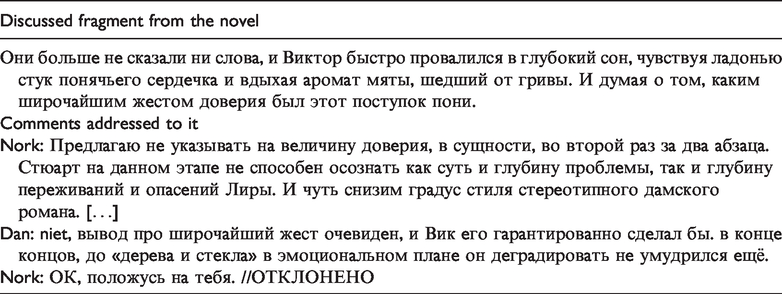
Nork identified himself as the leader of the group, however, he also negotiated his identity as a ‘literature expert’. This negotiation consisted of his active critique of the novel while making intertextual remarks about different literary genres or comparing it with other novels. Both voices of the leader and literature expert were found in the analysis of interactions. Also, as a leader, Nork exercised the norm of a democratic vote in the group. The connection between identity work and dialogic space are demonstrated in Figure 4 (Original Russian text is located in Table 1).
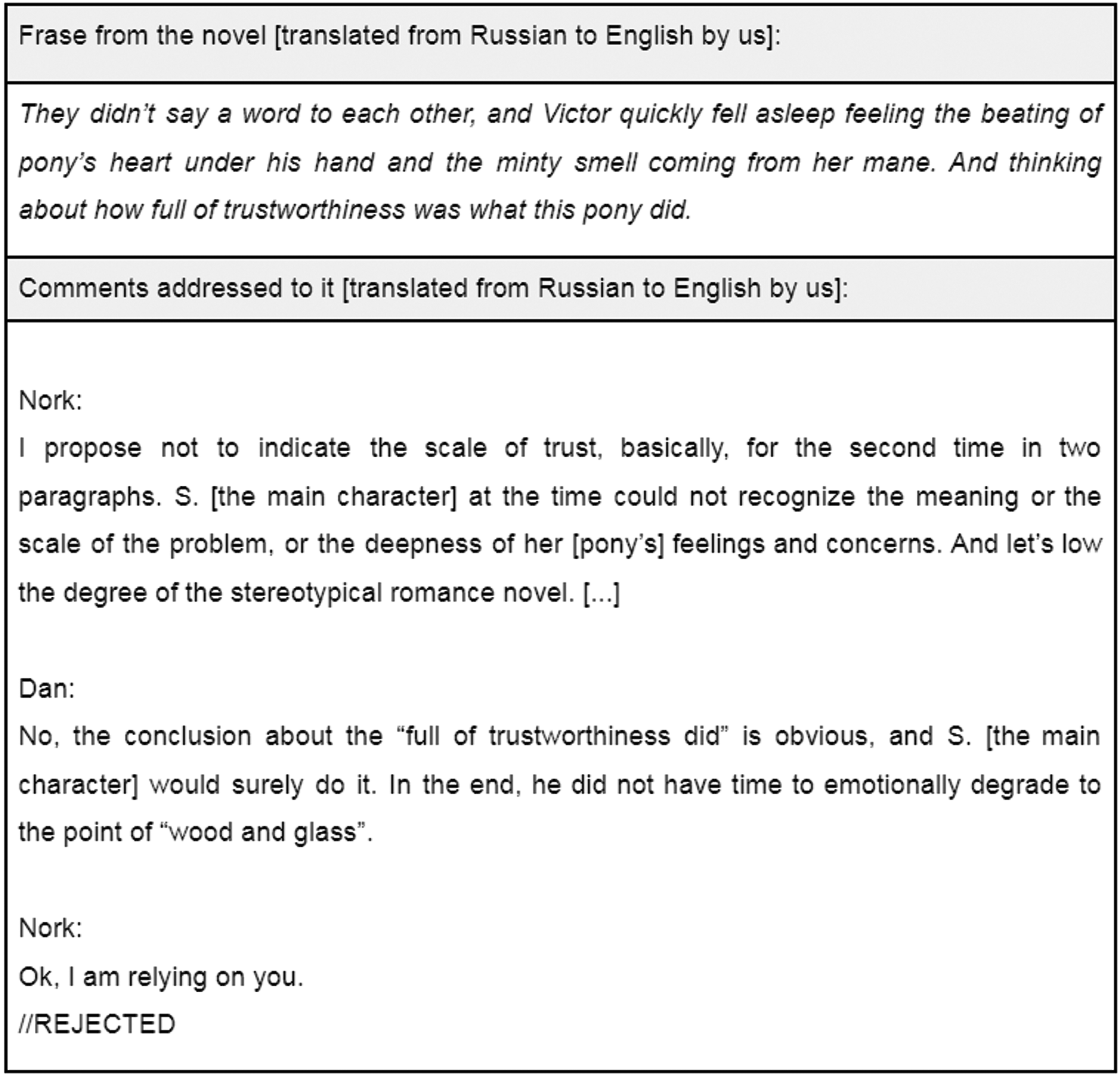
Extract of the comments from the adaptation phase of the novel.
In the first line, Nork proposes cutting one part of the phrase developing his argument according to the character development logic (S. at the time could not recognize the meaning … ) and the literature genres adequacy (stereotypical romance novel). Both argumentation points are voices of his knowledge of the literary genres and editing process, which indicates that he begins this interaction negotiating his identity as a ‘literature expert’. Being a literature expert, he reflects deeply on the text including three points of argumentation in the comment (frequency the second time in two paragraphs, character development, and literature genre adequacy). However, Nork starts his comment with the verb to propose (предлагать), which brings dialogically expansive modality to the phrase (Martin and White, 2005) and helps other team members to join the conversation. Hence, in only one comment Nork already supports the values of explicit reasoning by argumentation, reflexivity by doubting the position of the author and inclusivity by proposing the change and not imposing it (Wegerif, 2007). This prompt to open the conversation for other team members and supported the value of intersubjective orientation between the participants.
Dan answers with a confident No, denying the previous argument and proposing his argument instead. His argument is also based on the character’s development, but he comments on it from the positioning of the storyline and editing expert saying that the storyline is obvious, and the main character would surely do it. The use of such adverbs as obvious and surely indicates Dan’s positioning as a ‘novel’s storyline expert’. However even as an expert on the topic, he still felt the need to argue explicitly why he doesn’t suggest this change following the value of explicit reasoning (Wegerif, 2007).
At the end of the discussion, Nork said: I am relying on you (положусь на тебя). He used the deictic you, and the verb relying on, which haven’t necessarily meant that he agreed with Dan’s argument, but he underlined their interpersonal relationship and the level of trust between them. For Nork, it was less important to defend his identity of a literature expert than to perform his identity of the leader of the group. He wrote “rejected” at the end of the comment. As a leader, he preferred to doubt his position and to avoid the conflict by focusing on the level of trust supporting the construction of Dan’s identity of a ‘novel’s storyline expert’. This example of choosing specific voices, which are more appropriate for the situation, is an example of Nork’s identity work (Arnseth and Silseth, 2013). Moreover, with this identity work, Nork supports the dialogic space by following the values of intersubjective orientation, inclusivity, reflexivity and explicit reasoning (Wegerif, 2007).
Bolk as a language expert and a motivator
From our observations, Bolk was the most experienced translator in the group. All the participants admitted that Bolk was the English language expert and they learnt a lot from him, such as how to use different dictionaries or to develop their writing. In Figure 5, we have presented an example of Bolk’s expert identity negotiation.
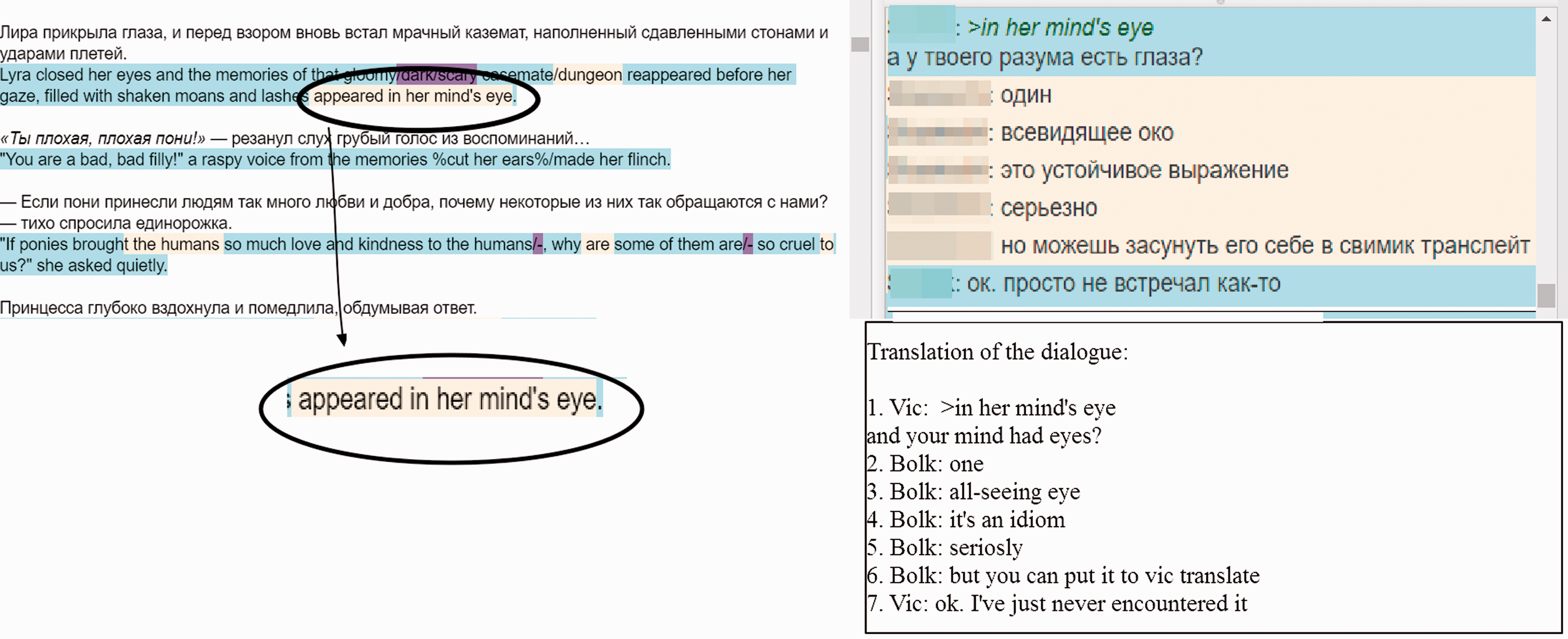
The editing stage on Etherpad. Bolk explains the meaning of an idiom.
Bolk uses a metaphorical idiom in his translation “in the mind’s eye” creatively translating the piece and indicating his level of English knowledge, hence negotiating his identity as a language expert. Vic responds to this negotiation, and without knowing this idiom, ironically asks: “does your mind have eyes?”. He does not directly correct Bolk, but rather indicates his doubt about this translation. Bolk plays with the meaning of translation and ironically mentions that it is an “all-seeing eye”. He explains without hesitation that it is an idiom, supporting his claim with only the word “seriously”, to which Vic easily agrees (line 7). In line 6, Bolk even mentions that Vic can put his translation into the “vic translate”, which is the document in which they put all the funny translations. We can see how confident is Bolk in his identity of the language expert and that Vic co-constructs his identity by relying on his expertise. This confidence helps Bolk to be more creative with his translation, without being judged by the group. He also transfers specific vocabulary knowledge to Vic.
As a language expert, Bolk also frequently corrects other participants. In Figure 6, Bolk corrects a rather basic grammatical mistake in the text (lines 1–3).
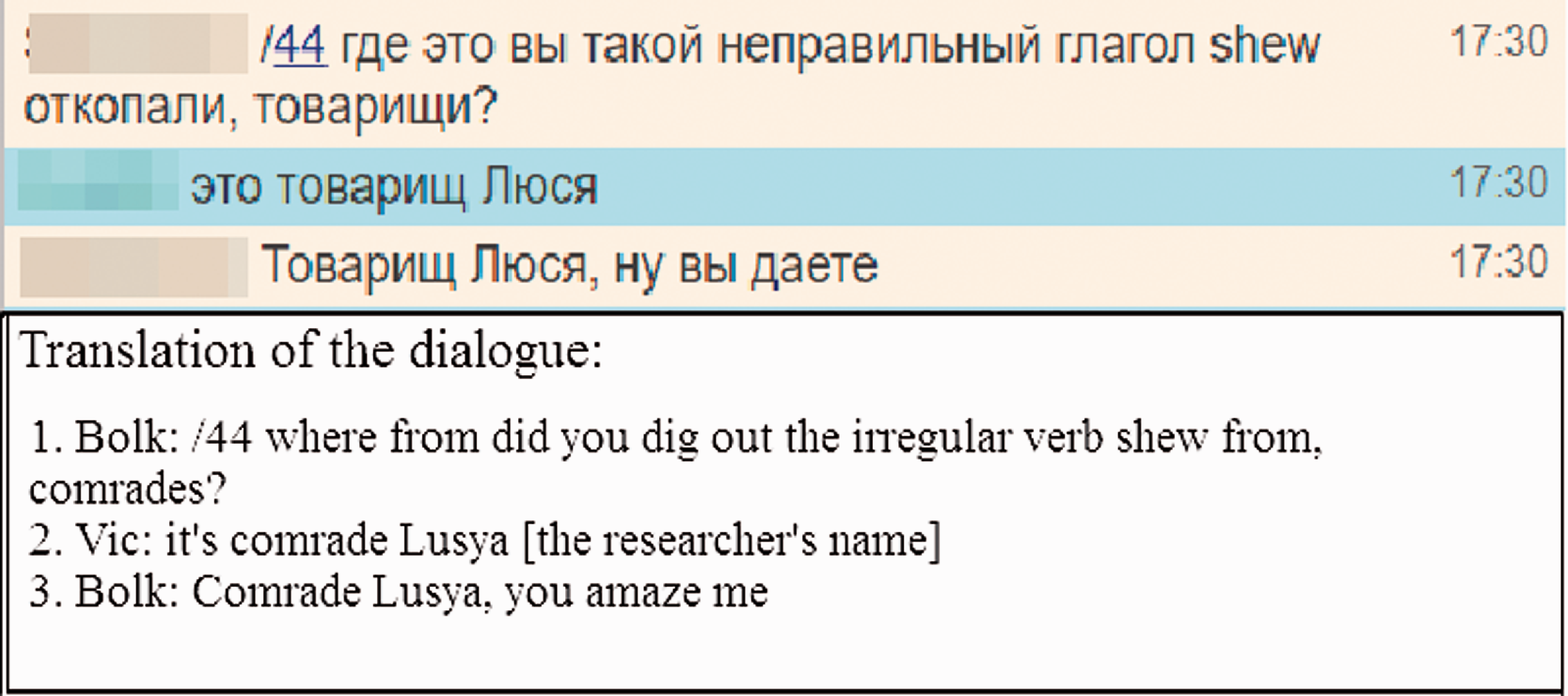
The editing stage on Etherpad. A dialogue between the participants Bolk and Vic.
In the first line, Bolk asks the team about who wrote the wrong form of irregular verb “show”, however, he maintains a rather playful tone by using the metaphor “to dig out a verb” instead of directly calling it a mistake. He also addresses the participants as comrades, 2 playing with the Soviet tradition of such addressing. He uses this rather playful talk as a strategy in order to soften the error’s discussion. Bolk doesn’t want to de-motivate the teammates, so he puts into play his identity of a team motivator. Then Vic pinpoints the error to Lusya [the researcher], however, he is still addressing her as a comrade maintaining the conversation as more playful than serious, while supporting the value of intersubjective orientation. In such situations in which Bolk has to correct others, he would normally use a similar strategy of playful talk, managing the voices of his identities of the team motivator and language expert according to the situation, somehow protecting the dialogic space.
Vic as a technical expert and an innovator
From our observations, Vic did not have the highest level of English or interest in literature, but as a web developer, he was savvy in technology, hence he easily negotiated his identity as a technical expert. His technical expertise went hand in hand with his role in the group as an innovator. When he entered the team, the group faced the problem of over-saturation of Google Doc with the comments on the translation phase which made it time-consuming to open the document. Vic was the one who introduced Etherpad as the new platform for collaboration. Because of this innovation, he frequently had to explain the use of the platform and its features. We can observe in Figure 7 how Vic was negotiating his technical expertise by explaining to Nork, the leader of the project, how to use the Etherpad platform properly.
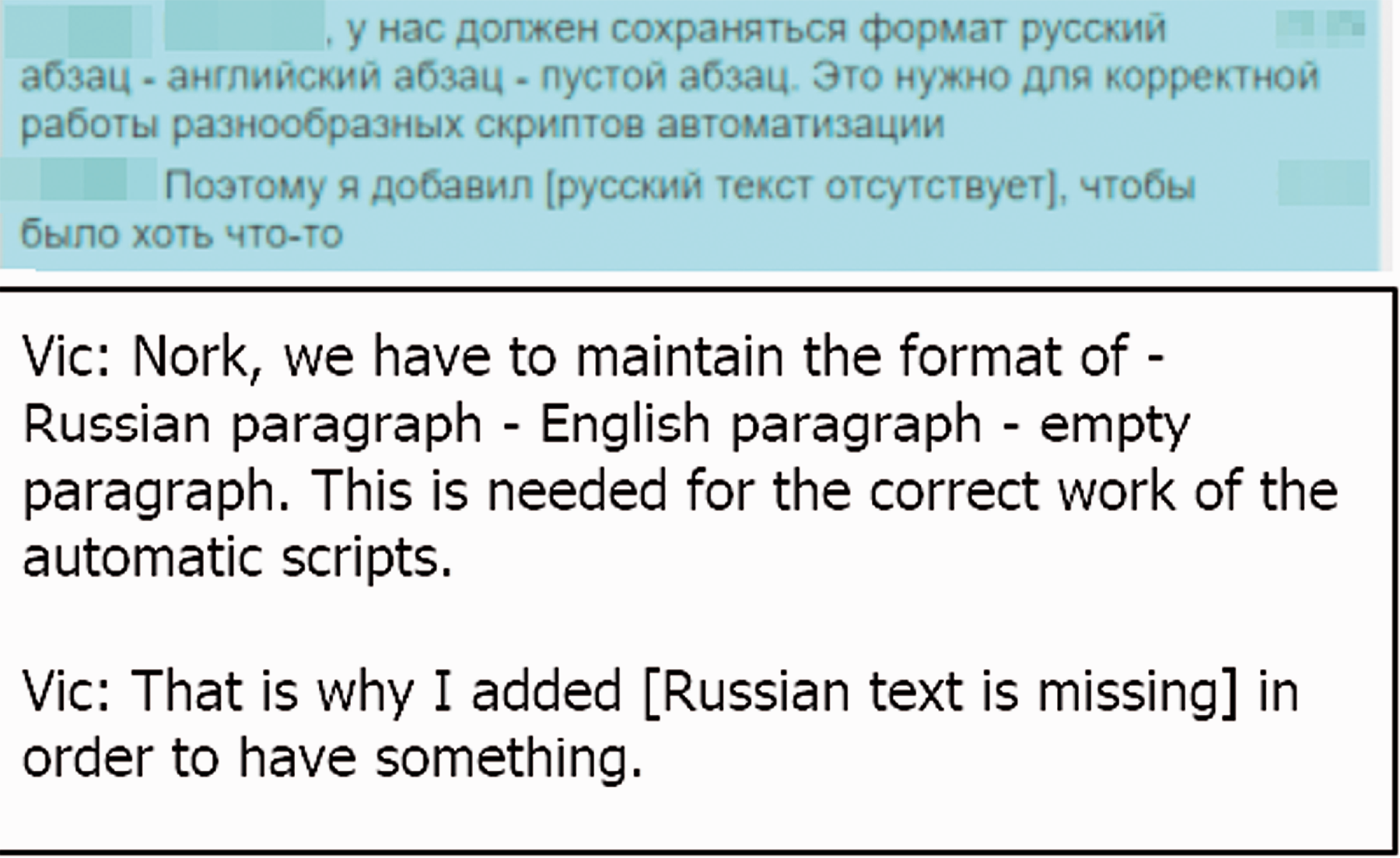
Fragment of the chat on Etherpad, editing stage.
In Figure 7, he explains the norms of using the platform from his area of technical expertise. He does not propose the norms, but he describes them by using an imperative and marking his position as an expert: we have to maintain the format … He has already built his identity as a technical expert in the group, which gave him the power to make major changes in the process of collaboration, and also the responsibility to include every participant in the use of the new technology. That is why there is a need to explain explicitly the details of use or to “teach” the other members to use the new technology. All the participants, and even the leader of the group, were co-constructing his identity as a technology expert, receiving specific knowledge about this new technology, and due our observations, using this knowledge in further collaboration.
Furthermore, Vic proposed a creative and technological innovation in order to confront the problem of English punctuation mistakes. He wrote a plugin for Etherpad with recurrent mistakes in English punctuation detected by the proof readers.
Figure 8 is an extract from this plugin which indicates the recurrent error of the use of space around dashes in English punctuation. This creative and technological innovation was made to address a specific problem in writing by making visible the participants’ recurrent mistakes. Building his identity of an innovator, Vic was supporting the value of reflexivity as he could reflect on the flows and problems of the workflow and the values of creativity or innovation as he resolved these problems with innovative and creative solutions. The role of the technical expert made him face some responsibilities of explaining the use of technology to other members which correspond to the value of inclusivity (Wegerif, 2007).

Example from punctuation plugin.
Dan as a novel expert and editor
Dan did not have to build his identity from scratch in this community as he was known as an editor of the original fanfiction written in Russian. He mainly participated in the adaptation process in which he would frequently oppose the changes proposed by Nork, a literature expert. From our observations, his opinion on such changes was normally sought as he was respected as an editor of the novel. When the researcher asked Nork in the second interview about how they achieved a compromise, he claimed: We tried to achieve if not a consensus but a compromise. Everybody had a democratic vote [ … ]. Subjectively we tried to listen to the information or the opinion of Dan as he was the best expert of the world of this novel [ … ]
Original Russian text of the Figure 4.
Shared identity of fan translators
We argue that the participants had a shared group identity of fan translators. From our observations, members of the team shared a specific goal of creating a high-quality translation for the specific readership of the brony fandom. This identity of fan translators was observed in how they called each other colleagues and treated each other with mutual respect, as Nork mentioned in his second interview: Everybody just tried to be rational and use the colleague as a “sanity check” who can say just in time: “Comrade, tune it down a notch, let’s do it in another way.”
We argue that this shared identity of fan translators positively influenced the construction of the dialogic space. For instance, the “playful talk” helped them to take the mistakes of others more lightly and create a safer space for errors (as it was discussed in the example of Figure 6). Whilst the responsibility to the real readership pushed them to be more determined and reflective in their work to create the best product possible for the brony readership.
Finally, we expected to notice the negotiation of gender identity of the participants due to the previous research on the brony fandom (Hautakangas, 2015; Lehtonen, 2017). Nevertheless, the participants did not discuss or refer to gender issues during the translation, even though they were adapting a story with female ponies as the main protagonists. We also did not find any pronounced differences in collaboration in comparison with female-dominated fandoms; bronies created a safe writing space with soft critique, similar to female-dominated fan practices such as fanfiction writing (Black, 2005; Curwood et al., 2013; Korobkova and Black, 2014).
Discussion
This study makes visible how the participants worked and collaborated on an online fan translation project in a structured way following the work phases of adaptation, translation, and editing. Similar to the study by Yu (2019), every participant took part in joint online work throughout the work phases in the role of the adaptor, translator or editor. These roles were flexible and interchangeable, as every participant played an active role at every stage of the collaboration. Moreover, the decisions were made democratically, valuing the opinion of every member, which made the collaboration non-hierarchical.
Flexible role changing and seemingly democratic decision-making opened space for various discussions in which the research participants were reflective about each other’s work proposing changes or correcting each other. While entering the discussion, the participants considered the positioning of others, sometimes even by choosing not to defend further their argument. All these features go under the definition of dialogic space including the values of reflexivity, intersubjective orientation, inclusivity, explicit argumentation and creativity (Wegerif, 2007). Hence, we argue that the participants were able to establish a dialogic space for their collaboration.
These findings differ from those of fansubbing and scanlation communities (Ameri and Khoshsaligheh, 2019; Valero-Porras and Cassany, 2016; Zhang and Cassany, 2016), in which the roles of the fan translators were typically hierarchical and narrowly-focused on a specific task. The fansubbers were able to correct each other, but due to the hierarchy, there were rarely discussions between them. In this comparison, we can see that the non-distribution of tasks and roles seems to open more opportunities for discussions and joint meaning-making (Yu, 2019).
This study also shows how the construction of a dialogic space online was supported through digital platforms, such as Google Docs and Etherpad. Similar to the findings of Wegerif (2007), these online collaborative platforms helped the participants to deepen and expand the dialogic space for their joint work. For instance, Etherpad made it possible to have two parallel spaces to construct the dialogue: one in the chat and the other one in the text of the translation. The dialogue in the text of translation was not an implicit dialogue with different ideas in one text, as described by Bakhtin (1986), but this dialogue was explicit, as we could see the competing alternative translations marked by different text colours. With so many visible alternatives, the participants had to make many decisions together to find the best solution, which could push them to additional discussions (i.e. Skype calls to choose the best translations). At the same time, those visible alternatives contributed to the creation of a shared digital artefact as the participants could see their part of work in the document at all times. Drawing on the previous findings of Mercer et al. (2010), Yu (2019) and our results, we suggest that a visually shared digital artefact can encourage collaboration during online writing. Also, from our results, the platform Etherpad encouraged the technologically savvy participants to be more creative. Only on this highly customizable platform, Vic could create a specific plugin based on the common punctuation mistakes of the participants and establish his identity as a technology expert.
Moreover, the results of our study made visible how the research participants negotiated multiple identities in the course of online collaboration. Some of these identities represented the shared identity of fan translators (Wenger, 1998), and others reflected the participants’ individual identities. The shared identity of fan translators was negotiated through playful and professional discourses, embedded in the shared objectives of translation and shared jokes. The individual identities were negotiated through the participants’ roles in the team (Baym, 2015) and their areas of expertise. The expert identities were mostly negotiated in a dialogue characterized by constructive argumentation with different intertextual references, such as literary genres or technical expressions (Bakhtin, 1986). Hence, with the negotiation about expert identities, the participants were mentoring each other, while opening opportunities for language learning, appropriation of new technology and literature discussions. In addition, the distribution of expertise constructed more balanced power relationships in which the participants were empowered to constructively critique one another (as in the case of Nork, Figure 4) achieving thoughtful discussions and joint meaning-making.
Drawing on Kumpulainen and Rajala (2017), we suggest that identity work is essential for the dialogic space construction in online collaborative affinity groups. In this study, the research participants worked on their identities when they were seeking an agreement, correcting each other or innovating the space creatively, by choosing the appropriate voices of their identities for the creation of the dialogic space. The shared identities of fan translators pushed the participants to value the opinion of the other, to reflect on their product and to enjoy this practice together creating a community of practice (Lave and Wenger, 1991). This could form a base in which to construct a safe and scaffolded environment for collaboration (Black, 2006), one in which the participants are encouraged to build their expert identities by participating in fruitful discussions.
Conclusions
This study contributes to present-day knowledge about the interactional practices and technological artefacts that foreground online collaboration in affinity groups engendering the construction of a dialogic space for joint organization of collaboration and identity work. As we have seen, not all the fan groups reach the dialogic space or the joint meaning-making (Zhang and Cassany, 2016). When comparing the results of this case study with previous ones, we found that less rigid organization of translators, the absence of specific tasks and roles distribution can encourage the participants to create a space for joint discussions (Yu, 2019) and identity work. In particular, the study makes visible how this less rigid organization relates to participants’ identity work as fan translators, roles in collaboration (i.e., leader or innovator) and experts in specific fields of literature, language or technology.
The participants’ use of online collaborative platforms, such as Google Docs or Etherpad, also supported the construction of a dialogic space for discussions about specific paragraphs in adaptation and translation. The participants preferred to use the Etherpad platform to see all of the possible translations without having to delete them, as must be done in Google Doc. This can enhance the feeling of shared ownership of the product and the collaboration of the participants (Mercer et al., 2010).
We believe that our data and the previous research on the collaborative writing in the fandom could be of great use for language educators providing them with new insights on young people’s online collaboration in writing activities (Sauro, 2017; Sauro and Sundmark, 2016). In particular, the absence of ascriptive role distribution of the participants and their own fostering of expert identities could be useful insights for teaching practices (Yu, 2019). We also hold that the concept of dialogic space is a useful heuristic to guide future educational research on informal online collaboration as it enables different types of collaboration to be categorized and gain insights on how a dialogic space is created.
Footnotes
Declaration of Conflicting Interests
The author(s) declared no potential conflicts of interest with respect to the research, authorship, and/or publication of this article.
Funding
The author(s) received no financial support for the research, authorship, and/or publication of this article.
