




Abstract
Playful learning has become a common practice in Denmark, across primary and secondary education, however, the phrase playful learning might sound like a paradox, because learning and play suggest opposite values. In playful learning, play is approached as a learning resource, able to foster understanding and critical thinking. In the Occupational Therapy (OT) education, there has been a rich exploration of different forms of digitally mediated role-play, to enable students to prepare beforehand to engage with patients, enacting clinical scenarios with each other. Current studies in OT education focus on the learning impact of digital media and role-play, not investigating how students experience their play, which is an essential pre-condition to learning. Starting from these premises, I conducted a design-oriented research study, involving students and teachers in OT in Denmark, to investigate how students experience their play during mediated role-play activities. Results show that playful learning is a complex sociomaterial practice, framed by power relationships embodied by the provided digital media, the relationships among the participants, and the institutional context. Within this framing, play is continually negotiated among the teachers and the students, who manage to gain room for self-expression through observable changes in play moods and practices.
Introduction
The introduction of digital technologies in the classroom has fostered pedagogical explorations, regarding digitally mediated forms of playful learning (Gee, 2017; Ito et al., 2013; Resnick, 2004). In this study, OT education represents a case of a higher education involving theoretical knowledge and practical skills, in which role-play mediated by digital media have become integrated in learning practices. In general, mediated role-play is employed to prepare the students beforehand to engage in the clinical dialogue, a diagnostic practice involving patients and therapists (Bennet et al., 2017). Current studies document the benefits of mediated role-play, in fostering reflections and self-confidence (Hook et al., 2015; Shoemaker et al., 2014). However, most studies discuss data from quantitative surveys on the learning effectiveness of the tested media, not fully investigating how the students engage in role-play with these media and if they are playing at all.
Starting from these premises, this study investigates how OT students experience play during playful learning, and how the provided digital tools (media and devices) and the environment contribute to framing their play. Play is seen in this study as an essential element of playful learning, but also as a transformative practice, in which players create their own reality for fun (Gee, 2007; Karoff, 2013; Vygotsky, 1978).
Data for this study was gathered through a qualitative participatory design process, aimed at designing a new digital simulation 1 , to enrich existing role-play practices in OT education. The study was part of the ErgoWorld project (Marchetti and Pedersen, 2019), which was funded by the Danish InfinIT foundation and was conducted within a consortium involving: the Alexandra Institute, the OT bachelor educations from Metropol and University College Lillebaelt (UCL), the master education from the University of Southern Denmark (SDU), clinical interns and their supervisor from Odense University Hospital (OUH), representatives of the Danish OT Union, and two local companies specialized in e-learning. This study analyses data gathered through ethnographic observations with students and teachers, which were conducted to gather design requirements for the new simulation.
In the next section the conceptual framework of the study and related work are presented (2). The empirical work and methodological framework are presented in the Methodology. A participatory approach to research through design section, and results from the study in the Analysis and discussion section, finally conclusions are provided in the last section.
Playful learning in OT – Theoretical perspectives and related work
Playful learning is defined as a harmonious integration of play and learning, in which players can simulate and imagine themselves immersed in an experience, engaging in creation of meaning, conceptual reflections, and deeper understanding of a learning topic (Gee, 2007; Resnick, 2004). Play in playful learning is generally understood in two ways: as a self-determined and pleasant activity for the players (Karoff, 2013; Sutton-Smith, 1997; Vygotsky, 1978), but also as a serious practice intellectually engaging the players (Gee, 2017; Huizinga, 1944; Vygotsky, 1978). Play can also act as a motivational element, enabling the players to learn while having fun, with the risk of being added as sugary coating to challenging or disliked subjects (Resnick, 2004). In such cases, playing become just like another homework, failing to engage the learners’ imagination and self-expression, which are necessary pre-conditions in fostering learning (Gee, 2007; Ito et al., 2013).
Building on these insights, I aim at exploring the play element in playful learning, looking into how students experience digitally mediated role-play in playful learning, while interacting with each other, and how digital media might contribute to framing their play.
The term playful learning can appear as a paradox, as play evokes images of self-determination, freedom, and fun, while learning evokes images of authority, coercion, and effort. However, playful learning has become increasingly popular in Denmark and, during my observations, OT teachers argued that mediated role-play enables students to “collaborate with each other” and “to discover knowledge on their own.” OT teachers defined their approach to learning as based on “gamification” and “role-play”, involving their students in role-play, designing and testing their knowledge in gamified quizzes, and in designing paper-based boardgames on specific topics.
In this study, I aim at investigating the “play” in playful learning, from the perspective of the players/learners, going back to the original meaning of play. Hence, this study is inspired by Latour (2013: 2) who wanted to “reassemble the social” in the social sciences, “going back to its original meaning”. According to Latour, the concept of “social”, in the social sciences, has been interpreted as a given material, able to provide explanations to social phenomena as if “the social could explain the social” in a self-referential way, without needing any definition (Latour, 2013: 3). In my view, a similar issue can be found in the concept of playful learning, where play has been interpreted as a “metaphor for all kinds of human practice” (Karoff, 2013), including learning. This seems the dominant approach in OT educational studies, where play is approached as a supportive resource to learning.
The definition of play is complex and ambiguous: play has been defined as the foundation of human culture, as humans have started playing long before building human societies (Huizinga, 1944; Sutton-Smith, 1997). Moreover, play is also a transformative practice, in which players reinvent their own world through their actions, transcending their immediate needs as if they were hallucinating, socially or on their own (Gee, 2017; Ito et al., 2013; Sutton-Smith, 1997; Vygotsky, 1978).
In the terms of Gee (2017), players create their own affinity spaces, defined as spaces delimited by the participants’ presence, their actions, and their physical or virtual context of action (Gee, 2017). In playful learning, students play double roles as learners and players, as they are supposed to acquire academic knowledge while playing with fellow students. In this respect, I am interested to investigate if and how students can create affinity spaces for self-expression in the classroom.
Furthermore, according to Bateson (2000), play is defined by its framing, which occurs through a metastatement establishing that whatever will happen from a certain moment in time has to be interpreted as “play”. This means that any following action should not be interpreted as having the same meaning that it would have in real life (Bateson, 2000: 68), laying the ground for histrionic behavior, mimicking real life situations. Through the notion of framing Bateson refocuses the question of “What is play?” into “What makes play happen?”. In this respect, this study identifies: play moods, rhythm, and sociomateriality as framing resources for play.
Play moods are defined as “the particular concept of sense and feeling of being” in play, while on the other hand play practice can be defined as “the concept of all the doing in the playing activity” (Karoff, 2013: 76). The concept of play moods is grounded on Heidegger(2001[1962]) and his notion of mood as a way of being in the world. Karoff (2013) argues that moods are inherently interconnected with play practices, so that being in play means being in a play mood. Karoff defines play moods as framing resources for specific play practices. She defines a spectrum (Table 1) in which play moods and practices are linked to each other depending on their increasing rhythm (Karoff, 2013; Toft, 2019), starting from the repetitive and quiet rhythm represented by the combination between the practice of sliding and the mood of devotion, to end with the chaotic and unpredictable rhythm represented by exceeding and euphoria.
Spectrum of play moods and their respective practices.

In sliding and devotion players continue what they were already doing, while in the following combination of shifting and intensity, the players try to break the rhythm and surprise each other, often in connection to physical play. The combination of displaying and tension is characterized by constant change, and it is typical of performing play involving “dancing or singing, taking photos of each other, or dramatic (role) playing” (Karoff, 2013: 81). Finally, exceeding and euphoria represent the opposite of sliding, players expect to be surprised all the time and their mood is defined as an “intense expectation of silliness” (Karoff, 2013: 84) to keep their euphoric mood.
Rhythm emerges as a key aspect of play also in Toft (2019), who defines play as a rhythmic assemblage in which everything vibrates, so that it is impossible to detect who acts (humans or non-humans) and whose action originates the rhythm of play. Toft’s work builds on Barad (2007) and her notion of intra-action, which is defined as a mutual entanglement between humans and non-humans, both participating in the action and influencing each other. Toft interprets intra-action in terms of ambiguity in figure-ground relationship between humans and non-humans participating in play, as one repeatably takes over on the other. Moreover, Toft emphasizes the role of repetition, intended as doing, redoing and renewing, in the aesthetics of play, like when reciting nursery rhymes (Toft, 2019). In this sense, rhythm is a sociomaterial element of play, which implies interaction with something in a physical environment, as “we always play with something” (Toft, 2019: 6).
The sociomaterial aspect of play is also emphasized by Vygotsky (1978) and Sutton-Smith (1997), who discuss how players opportunistically involve in their play different “play-things” or “play equipment”, which can be toys by design or ordinary objects. In both cases, this play equipment participates in framing the meaning of playful practice (Sutton-Smith, 1997), hence play emerges as an “entangled agency” (Barad, 2007: 33) defined by a mutual intra-action between humans and the non-human play equipment. This can be explained also in the terms of the social in Latour (2013), according to whom the social and the material are always interconnected. In this sense, Latour argues that the material participates and defines human practice, actively contributing to creation of meaning and its mediation among the human actors.
In playful learning, games are explicitly designed to lead the learners to solve relevant problems to the subject at hand, framed within the game and its narrative. The players are expected to imagine themselves as part of the game narrative and engaging in problem solving (Gee, 2017). Similarly, current studies on OT education acknowledges the role of digital media in mediating meaning and in fostering playful interactions, which are functional to learning (Bates, 2017; Hook et al., 2015), hence contributing to the students’ learning experience.
Building on these insights, I will use the notions of intra-action and rhythm as critical lenses to understand how OT students experience mediated role-play with each other and through digital media, as framing resources. Moreover, I will refer to rhythm as a characterizing element of playful intra-actions, defining players’ moods and the quality of their being in play. Furthermore, I expect that changes in rhythm, in the students’ play, will provide concrete observables for my empirical study.
In the following subsection, related work in the use of digital media in OT education are discussed, in relation to how digital media have been investigated in current research.
Digital simulations and role-play in OT-related work
Digital media are being broadly explored in OT education, mostly as video cases (Bethea et al., 2014), virtual reality and computer simulations of clinical environments (Hook et al., 2015) and virtual patients (Shoemaker et al., 2014). These media address the difficulty of preparing students for the clinical dialogue through mediated role-play, before encountering patients in clinical settings (Bennet et al., 2017). Healthcare students have limited access to patients for safety reasons, as inexperienced students might hurt a patient by accident. Moreover, arranging encounters between students and patients is challenging, hospital rooms might have insufficient capacity to gather an entire class, and the logistic of systematic transportation of students or patients from schools to hospitals might be expensive and complex (Bennet et al., 2017).
Current OT studies adopt quantitative methods, like online surveys and questionnaires, and focus on self-reported data on how students perceive their learning experience, not discussing how they engage in role-play with the provided media and with each other. For instance, Bethea et al. (2014) discuss results from a survey with circa 245 students, enrolled in entry-level programs in OT, to investigate the benefits of simulations in recreating conditions for real-time decision making, where students had to quickly formulate diagnosis and treatment for fictitious patients. According to the authors, the students perceived as useful the presence of immediate feedback on their performance, especially regarding supporting independent forms of learning, but the use of the simulation was found time consuming and expensive by the teachers. Similarly, Springfield et al. (2018) distributed a questionnaire to 100 students before and after they participated in a simulated activity on childcare. The questionnaire was aimed at measuring “perceived knowledge, confidence, and anxiety related to infant and parent interactions” from the students’ perspective (Springfield et al., 2018: 51). The authors concluded that the results from the questionnaires showed that the students reported an increase in knowledge and confidence.
Other studies, like Shoemaker et al. (2014) discuss results from a qualitative, thematic analysis of students’ written assignments, described as a simulation for the practice of formulating treatment plans for patients. The assignment targeted intraprofessional competences, defined as the set of skills necessary to cooperate with other healthcare professionals. The authors argue that simulative activities can foster competences in cooperating within interdisciplinary teams and on “the underlying philosophical approach to diagnosis and management” (Shoemaker et al., 2014: 366).
An interesting perspective on mediated role-play is provided by Hook et al. (2015), who discuss a thematic analysis of “descriptions, recorded quotes and summaries” gained from individual semi-structured interviews with students, on their experience with a digital virtual simulation (Hook et al., 2015: 576). The digital simulation reproduced a tridimensional virtual home, which the students had to explore through an avatar, as in a third person Role-Play Game, to remove any barrier that could hinder occupational performance with a wheelchair. Hook et al. (2015) provide an account on the students’ experience, reflecting on how quickly the students identified with their avatar, experiencing a state of being themselves in the simulation.
According to the mentioned studies, mediated role-play has been welcomed in OT education, for providing students flexible access to learning materials and training “with patients” in a broader sense. Bennet et al. argue that interaction with real patients is the preferable form of training for OT, also according to the students, however, in Australia it has become acceptable for mediated role-play to replace “up to 20% of the 1000 fieldwork hours required by World Federation of OT”, provided that they respect specific criteria for authenticity and complexity (Bennet et al., 2017: 323). Importantly, mediated role-play embodies elements of fantasy play (Bateson, 2000; Sutton-Smith, 1997), which are essential for the students to imagine themselves in the situation depicted in the given media, a precondition for critical thinking and learning (Gee, 2007; Vygotsky, 1978). However, most OT studies focus on academic performance and data from questionnaires, hence there is a lack of insights regarding how students really play during playful learning activities and how the tested media stimulate the students’ imagination. This study will therefore attempt to discuss how students engage in fantasy role-play with digital systems and with each other, during playful learning activities.
Methodology. A participatory approach to research through design
This paper discusses results from the ethnographic field study conducted for a broader project called Ergoworld, which aimed at investigating the design of a digital simulation targeting OT education. The Ergoworld project followed a research through design methodology (Zimmerman and Forlizzi, 2014), supported by participatory design (Björgvinsson et al., 2010). This means that the during the project OT students and teachers were involved in co-designing a digital simulation that could enrich mediated role-play in OT education. The empirical study also followed an iterative process, starting with an ethnographic study of teachers and students in action to establish requirements for the simulation, following with ideation and prototyping in cooperation with the students and teachers, and ending with testing, so to develop a new prototype and test again until the prototype met the desired requirements (Björgvinsson et al., 2010). However, in a research through design methodology prototypes are aimed at gaining new theoretical knowledge and act as exemplars: “Providing an appropriate conduit for research findings to easily transfer to the HCI research and practice communities” (Zimmerman et al., 2007: 493).
In the Ergoworld project three main iterations were run (Marchetti and Pedersen, 2019), each segmented in three stages: user study, prototyping, and testing of prototypes. During the study low-fidelity prototypes were created and tested; they were cheap mock-ups made of cardboard to show key functionalities, but not involving any real software development (Preece et al., 2015). The goal of low-fidelity prototypes is to test a concept early in the process, to gain feedback and more refined requirements.
The first iteration started with an ethnographic user study, during which observations and semi-structured interviews (Pink, 2001) were conducted with 15 to 20 students per class from each partner school, and three teachers at Metropol, four teachers at UCL, one teacher at OUH and SDU. A series of video recordings were gathered and analyzed during the second stage, focusing on how teachers and students engaged in learning practice, the role of technologies, emerging issues, and design requirements. During the third stage, a co-design workshop was organized with six teachers and four students, to start defining requirements for the prototype (Marchetti and Pedersen, 2019).
During the second iteration, the videos gathered during the first workshop were analyzed to identify recurrent challenges. A second workshop was organized, inviting four students, six teachers, and two representatives from local game companies, to envision key functionalities and create paper-based low-fidelity prototypes.
During the third iteration, further observations of students’ role-play were conducted at UCL, hence we proceeded with the design of a high-fidelity functioning prototype (Preece et al., 2015) involving actual software development in HTML, CSS and JavaScript. This prototype was finally tested in two sessions with a teacher and with a small focus group of six students from UCL, to gather rich and detailed data on the participants’ perspective 2 .
This paper discusses findings from the ethnographic observations conducted with bachelor students during the first and second iterations, regarding OT students’ experience of role-play practices. Moreover, this paper leverages data gathered through drawing as an ethnographic method, for the interpretation and translation of video material (Causey, 2017). The drawings were created a-posteriori with a tablet and stylus, from screenshots selected from the video material. During the drawing process, the actions of the students were analyzed from the perspective of play moods (Karoff, 2013), focusing on body posture, gestures, and interactions of the students with each other, the available digital artefacts, and the teacher. Colors were selectively added to the upper body of the students represented in the drawings, to emphasize changes in their body posture connected to changes in their play mood and rhythm during their role-play session. In this way, drawing acted as a magnifier, enabling the researcher to zoom in and out from specific details, identifying subtleties in the actions, attitudes and intentions of the subjects. Moreover, the drawings provide visual documentation to this paper, yet protecting the privacy of the students (see Figure 1 as an example of this drawing technique).
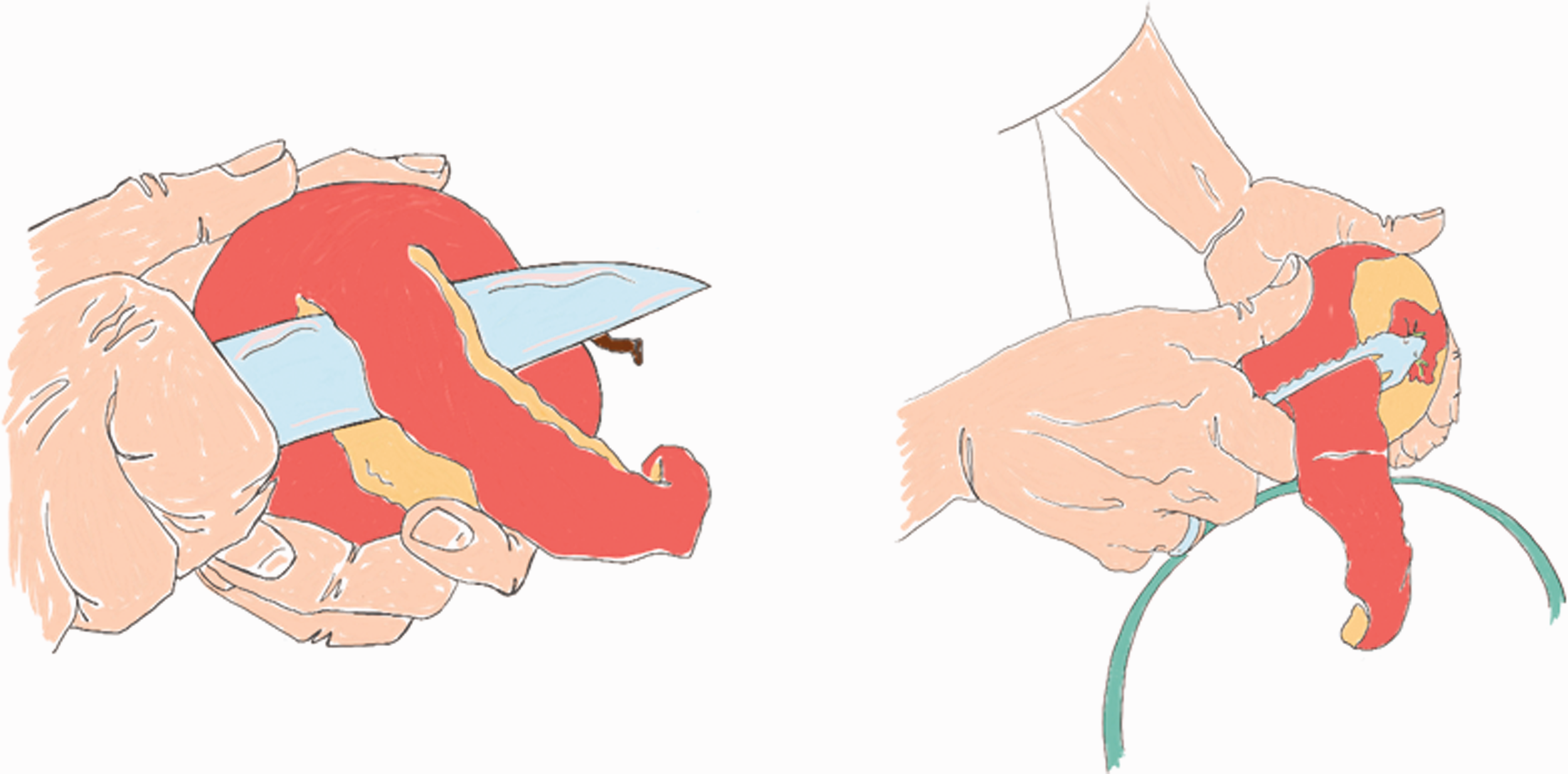
Two different ways of peeling an apple, characterized by different positions of hands and use of knife versus peeler.
Analysis and discussion
This section proposes an analysis of how OT students experience mediated role-play during playful learning activities. The clinical dialogue subsection briefly introduces the clinical dialogue, which is the professional practice mainly targeted by role-play activities in OT education. The Sociomaterial role-play and digital media subsection proposes an analysis of mediated role-play from the perspective of sociomateriality, exploring how digital media contribute to the framing of play. The Play moods, rhythm, and self-expression subsection discusses students’ experience of play, claiming room for self-expression, through the lenses of play moods and rhythm.
The clinical dialogue
In Denmark mediated role-play is mainly adopted to train OT students in the clinical dialogue, which in this study is defined as a sociomaterial, embodied intra-action (Barad, 2007) between therapists, patients, and their environment, aimed at establishing a diagnosis and a suitable therapy for the patients. During the clinical dialogue the therapist scrutinizes how the patient engages with daily activities, such as: cooking, driving, sports, but also dressing and undressing, and routines of personal hygiene. The therapist’s goal is to find out when and how intensely the patient experiences pain, lack of coordination, or mental confusion. OT teachers often mentioned peeling an apple as a typical activity to observe during the clinical dialogue. Peeling an apple is a complex entanglement of human and material tools (apple and knife or peeler), requiring fine movements, and a firm grasp (Figure 1) (Marchetti and Pedersen, 2019; Barad, 2007).
So defined, the clinical dialogue is a highly saturated sensory cognitive practice (Steffensen, 2012), requiring a collaborative intra-action (Barad, 2007), articulated through repetition, embodied thinking and intercorporeality. Beside observation and verbal communication, therapists and patients are bodily listening to each other, holding the tools together while modulating strength and rhythm of their mutual intra-actions, speeding and slowing down, and repeating the same actions over and over again (Toft, 2019). Patients and therapists mutually exchange guidance, the patient leads to show how he/she would perform the actions and the occurring challenges related to pain or coordination; the therapist would then take the lead to show how the same actions could be performed, avoiding pain or to strengthen the muscles. They both engage in repeated sequences of actions, fine tuning speed, firmness, and gesture modulations, as if patient and therapist were composing a choreographic sequence (Toft, 2019).
During the study we found that to become therapists, students must acquire the ability to relate to the scrutinized activities (related tools and environment) as mediators of clinical meaning, with respect to four main dimensions:
Diagnostic – examining the patients’ condition through their daily activities. Therapeutic – discovering healing affordances hidden in their daily activities. Motivational – discover activities that patients wish to be able to do on their own. Reflective – discover activities connected to patients’ identity.
The first and second dimensions focus on the therapeutic goal of the clinical dialogue, relating to patients as sick individuals and being aimed at uncovering the diagnostic and therapeutic affordances (Norman, 2003) hidden in the scrutinized activities. The third and fourth dimensions of the clinical dialogue focus on the patients as individuals. The third dimension leverages the patient’s motivation to regain independence, while the fourth, which I call reflective as in Norman (2003), refers to how daily activities embody values of identity for the patients. This dimension goes beyond the simple desire for independence, leveraging the patient’s desire to reaffirm their identity for social recognition after an injury. One of the teachers told an anecdote about a male patient, who was recovering from a stroke and became committed to his training and to lose weight, to be able to drive his car again and keep his identity as family provider.
Playful learning in OT is generally aimed at preparing the students to engage with future patients in the complex entanglement of the clinical dialogue, to reflect on how to interact with the patients and make sense of their condition.
Sociomaterial role-play and digital media
Role-play requires players to engage in theatrical improvisations (Sutton-Smith, 1997), collaboratively creating a fantasy world and new roles for them to play (Bateson, 2000; Gee, 2007; Vygotsky, 1978). Any available objects, toys or “play-thing”, can be incorporated in role-play and its meaning can be redefined according to the narrative constructed by the players (Bateson, 2000; Sutton-Smith, 1997; Vygotsky, 1978). In the terms of Barad (2007), role-play can be analyzed as an entanglement of humans and non-human materials engaged in mutual intra-action, where meaning is co-created through repeated sequences of actions and by acquiring more or less systematic rhythms (Barad, 2007; Karoff, 2013; Toft, 2019).
Moving back to OT education, teachers engage the students in mediated role-play, expecting them to imagine themselves interacting with real patients or to act as the patient, reflecting on the condition and needs of their future patients. These teachers leverage mediated role-play, as a resource for abstract thinking, to reflect on hypothetical courses of actions and their consequences on a hypothetical reality (Gee, 2007; Vygotsky, 1978).
The framing of the ongoing role-play activities is explicitly communicated by the teachers and their use of digital media, segmenting the class activities in three main stages. First, the teachers introduce a new topic in the classroom, for instance a therapeutic or diagnostic practice, with the use of digital media such as presentation slides and videos from the Internet. The classroom physical space and the projection of slides and videos on a large screen contribute to framing a learning session, in which the students are expected to sit at their desk, paying attention to the teacher and the large screen, both placed in front of them. At the end of this session, the teachers invite explicitly the students to ask questions and provide comments. In the second stage, the role-play session starts with the students being invited by the teachers to split into small groups and find another space, inside or outside the classroom, to try on each other the practice illustrated by the slides and videos. The students take their phones or laptops with them, to access the slides and videos during their role-play session. The change of room, the absence of the teacher, the use of personal laptops and phones participate in framing the role-play session. This framing can be articulated in the sense of the students becoming in charge of their intra-actions, without interference from the teachers. Moreover, mediated role-play in OT involves repeated physical contact between the students, including hugging each other and holding each other’s hands, arms or back (Figure 2), which is normally associated to intimacy. As in Bateson (2000), the meaning of this physical contact must be reinterpreted in relation to its role-play and learning context, and not as a form of intimacy. However, during the role-play session the students experience feeling of embarrassment, which becomes visible through the students’ facial expressions and their giggling, especially across mixed gender groups. In this sense, mastering close physical contact in a clinical context is a learning goal in itself. After about half an hour session, the teacher goes around supervising the students, reestablishing a learning framing to their role-play practice. Afterwards the students can engage more in their role-play, until they will be invited to rejoin the class for a shared wrap up session at the end of class.
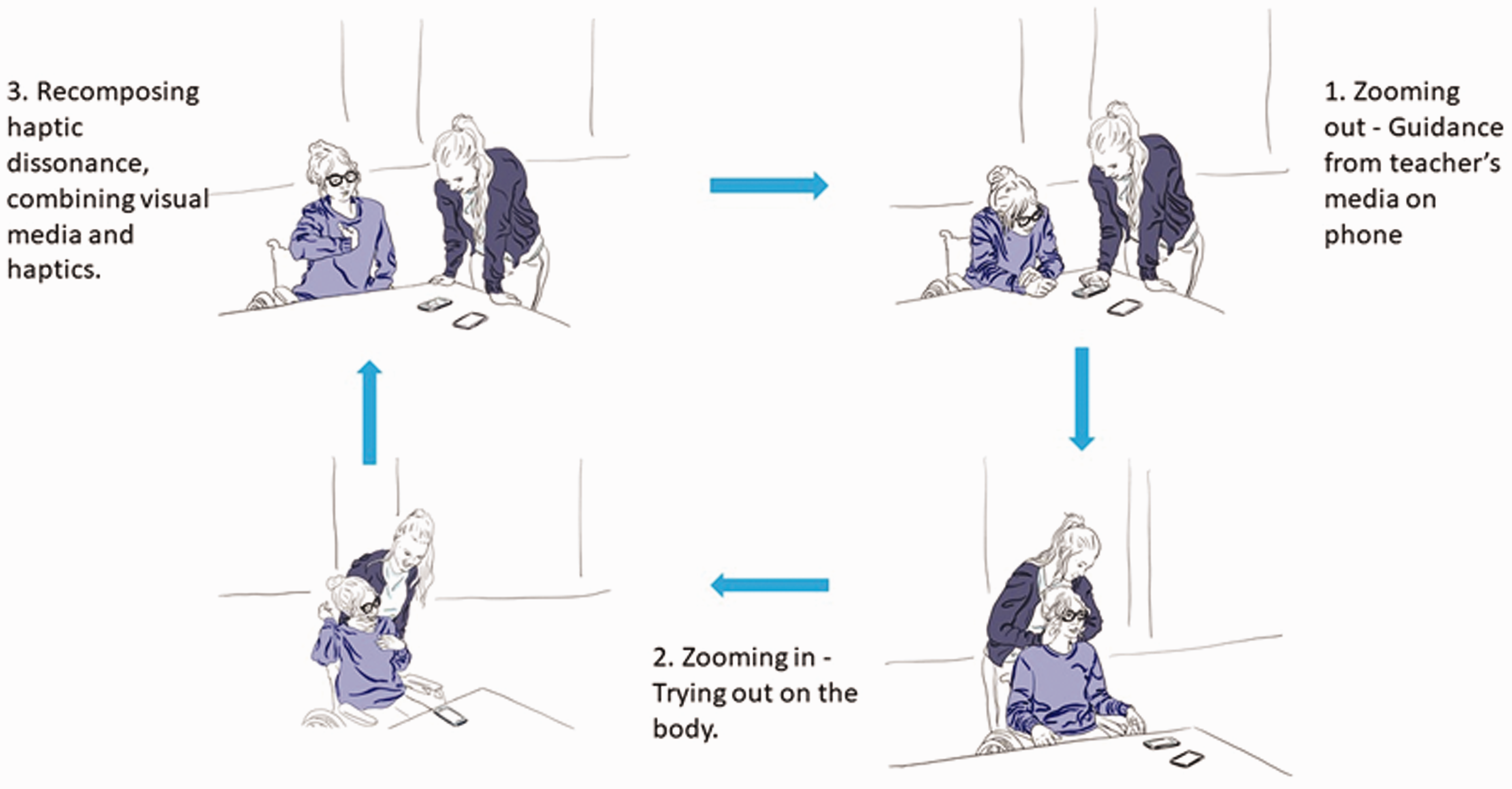
Rhythmic cycle zooming in and out of the body to digital media and back.
The students usually take turns acting as therapists and patients, simulating on each other the intercorporeal intra-action illustrated in the teachers’ material, experimenting specific techniques for holding and reading each other’s bodies, to learn how to understand the bodies of future patients. One of the students reported that once the teachers required her and her classmates to tight a leg or arm with a piece of rope, to feel on their bodies the struggle of their future patients while shopping in a supermarket, being unable to use their whole body. During one observation, the students had to learn in pairs a technique for examining people suffering from dysphagia, a difficulty in swallowing foods or liquids occurring after a stroke. The students were given glasses of juice and cookies to give to each other, reproducing the practice illustrated in the teachers’ videos and slides. A wheelchair was also provided, where the patient-acting student had to sit, bending her-his neck on the back to simulate lack of muscular control. The therapist-acting student had to perform a precise sequence of actions, holding the neck of the patient-acting student, guiding her-his hand to grasp the glass and cookies, take them slowly close to the mouth, and holding her-his neck while drinking or eating.
During the activity, a rhythmic cycle was established (Karoff, 2013; Toft, 2019), as the students iteratively watched the teacher’s visual media, mainly the videos, and performed the illustrated technique on each other (Figure 2). During each cycle, the students moved from mutual intercorporeal intra-action to visual intra-action with their phone or laptop, to check if their mutual actions fitted what they saw on the video. They then refocused on intercorporeal intra-action again, fine tuning their movements through bodily and verbal communication, trying to reflect on the effect of their actions on a real patient. Through this cycle, the students were trying to sensibly use the given visual media, during interviews they acknowledged their usefulness saying that they would like to have access to more, eventually showing embodied practices from different angles. However, the students experienced a haptic dissonance (O’Regan and Noë, 2001), as they referred to visual media to learn an embodied practice. A series of misunderstandings emerged, generating silliness and laughs as the students tried to reproduce physically what they just saw in the video material, for instance a patient-girl said laughing to her “therapist” that she was strangling her while the therapist-girl was incorrectly holding her neck (Figure 2).
To repair this haptic dissonance, the students had to continually reinterpret the meaning of actions shown in the videos, to perform them correctly on each other. As a result they approached the videos as resource to zoom out on their actions and gain an overview on the practice, saying for instance: „Oh, it should look like that, see my back has to be straight here, but here I get closer. “On the other hand, mutual intercorporeal intra-action enabled the students to zoom in on the practice, fine tuning small gestures and haptic feelings, discovering together what “felt” right. Hence, their cyclic intra-action, moving back and forth from their devices to each other’s bodies, acquired a sense-making zooming function, translating visual representations into haptic-intercorporeal feelings (Step 3 in Figure 2). The intervention of the teacher provided guidance for the students, to recompose their zooming in and out perspectives. Hence, the teachers engaged in intra-action with their students (Figure 3), pointing at specific sequences from the videos and guiding the students’ hands to the right position, saying: “You should feel a slight pressure here!” or “You should act more gently here”.
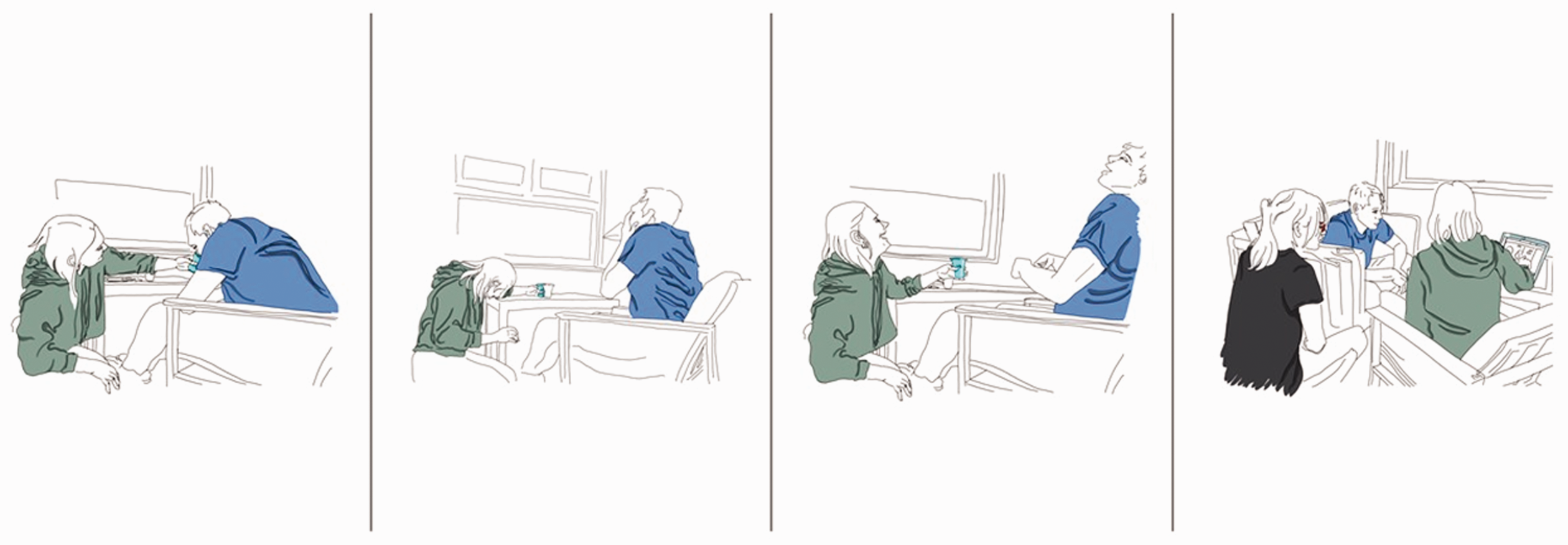
Pair of male and female students, moving from sliding to exceeding, and teacher (kneeling and wearing a black shirt) supervising at the end of the session.
Building of these insights, the teachers and her visual media contributed to framing play during role-play sessions: granting students’ autonomy in their intra-action and framing a different meaning for physical contact among the students. However, the described activity still resembles learning more than play, in the following section I will analyze students’ play from the perspective of play mood, in relation to self-expression and fun.
Play moods, rhythm, and self-expression
According to Heidegger (2001[1962]) and Karoff (2013), play is defined by being in a mood that predisposes people to be open to play and be playful with each other. Interestingly, during my observations OT students explored different play moods. As the students started their role-play, they engaged in sliding play practice and devotion mood (Karoff, 2013), their play was defined by strong repetition, reproducing the same gestures over and over again. In so doing, the students participated in an intercorporeal negotiation, while sensing each other through their body (Steffensen, 2012), to learn the practice shown in the videos, for instance while holding each other’s neck and hand to guide the glass of juice to the mouth. When the glass reached the mouth of the patient-acting student an intense pause followed, in which both students focused on feeling when the drinking started and ended, imagining how a patient and therapist would have felt and acted in such circumstances (Gee, 2007). While drinking, intercorporeal and eye contact facilitated the students’ communication, the students looked at each other attentively, as the therapist-acting student was sensing the drinking action from the vibration produced through the body of the patient-acting student (Figure 3).
Some groups moved from sliding to exceeding play practice (Karoff, 2013), applying increasingly chaotic variations to their intra-action. This change enabled the students to make room for socializing, humor, and maybe flirting, eliciting a feeling of togetherness and social understanding, and enriching their learning experience (Radford and Roth, 2011). This change was evident in two groups composed by mixed gender pairs (Figures 3 and 4). After a few iterations, each pair started laughing, while the female therapist-acting students were holding the neck or the hand of the male patient-acting students. This dynamic recalled physical intimacy, eliciting embarrassment and silliness. As they repeated the practice, they were experiencing a mood of euphoria (Karoff, 2013), which they expressed through broader gestures of their arms and bending of their torsos, while staring at each other giggling (Figures 3 and 4). It seemed as if moving to exceeding and euphoria enabled the students, to cope with the embarrassment elicited by close physical contact.
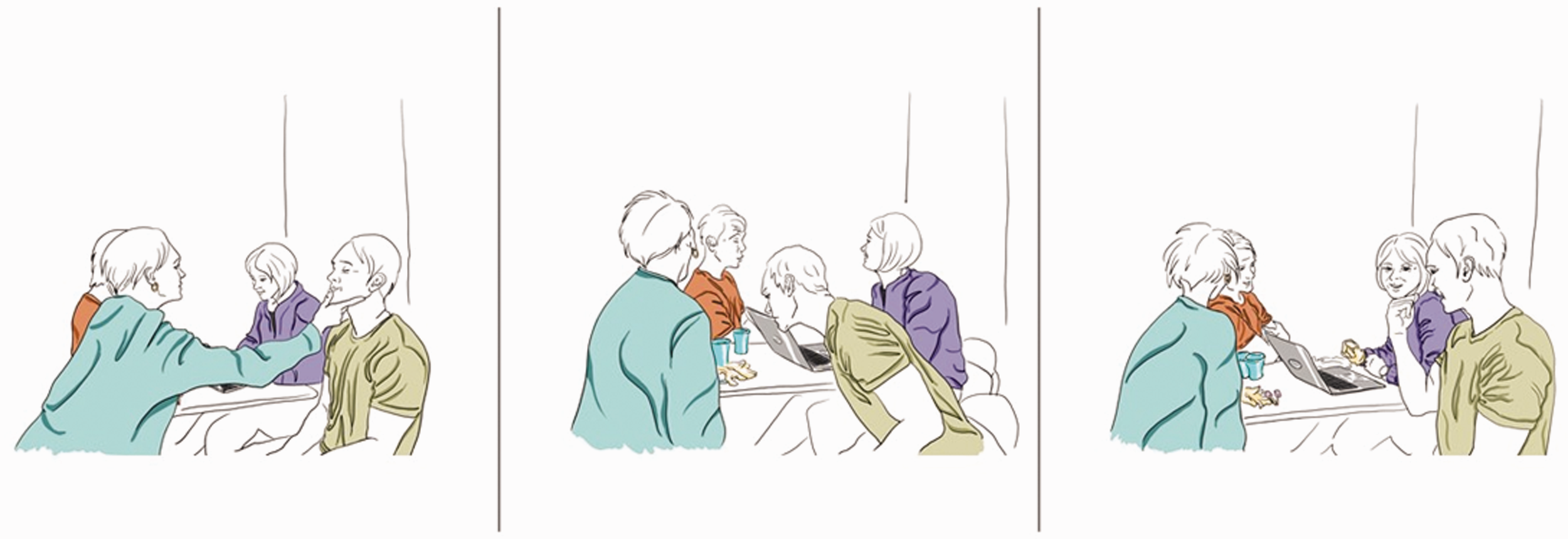
Mixed gender group moving from sliding to exceeding during their role-play session.
As the teacher came to supervise the students (Figure 3), she checked how they performed and answered their questions. The presence and absence of the teacher reframed their euphoric play into devotion and learning, but as soon as she left, the students engaged again in euphoria and exceeding play. The absence and the presence of the teacher fostered specific play practices and moods, while hindering the most extreme, hence the students moved towards exceeding when they were alone, but moved back to sliding when the teacher approached them.
Similar dynamics were experienced also within homogeneous groups. A pair of girls, who took their role-play seriously, started with a sliding-devotion mood, meticulously repeating the same sequence of actions, practicing on each other how to hold the neck of a patient suffering from dysphagia (Figure 2). As they progressed through the practice, they started looking at each other laughing, to the point that the patient-acting girl complained that her “therapist” was “strangling her” and both burst out laughing, changing posture with broad gestures of their arms and torso. Their dynamic was not as extreme as in the mixed gender group, the girls started gradually to increase elements of surprise in their play, as if they wanted to keep each other laughing. They displayed a moving play practice (Karoff, 2013), as their play integrated elements of surprise with repetition of the required sequence of actions. The girls were experiencing a mood of intensity, waiting in excitement to see what the other would do, to share a good laugh together.
This change in play practice and mood have a double function, first it enables the students to cope with the degree of intimacy required by their intercorporeal intra-action, second it enables them to create room for self-expression, turning role-play from a learning practice into a genuine playful experience, fostering fun and socialization. In this sense, the students do not just act according to the teachers’ instructions, on the contrary they create their own affinity spaces through their play, regaining freedom in a learning context (Gee, 2017).
Results from the interviews conducted through the Ergoworld study revealed that play practice embodies reflective meanings of identity and self-branding (Norman, 2003), for teachers and students. The teachers articulate their identity, while discussing the importance of role-play in their practice, saying: “We do not teach like in the past anymore!” arguing that the students must try for themselves the different techniques before engaging with real patients. In this sense, experimenting with playful learning is a way for the teachers, to characterize themselves as innovators. Bachelor students agree with their teachers, describing role-play as “fun” and “useful”, saying that: “It makes us think” (Marchetti and Pedersen, 2019). During observations, it also emerged that the students must be engaged to make role-play happen and, differently from traditional lectures, the students see themselves as leading their learning process together with the teachers. In some cases, the students are literally involved in co-creating their learning experiences, for instance designing quizzes and games for each other. On the other hand, master students are critical, saying that role-play is “fake”. They claimed to understand the intended value of role-play, however, they see it as an inadequate surrogate for clinical training with real patients. Moreover, they mentioned with frustration that many of their classmates did not take role-play “seriously”, indulging in “laughing loudly” or “overacting”, “doing it wrong in purpose” and making it “hard for anybody else to learn anything”. It must be mentioned that in Denmark, OT graduates often go to work after their bachelor and, after a few years of professional practice, come back to take a master. Most master students, who criticized role-play, were eager to mention their professional experience, as if they wanted to establish a distance between their present professional self and their past identity as bachelor students. Interestingly, the master students pointed at changing of play moods, from sliding to exceeding practice, as an obstacle to learning, indirectly acknowledging that exceeding might represent spontaneous play, emerging within playful learning. According to this perspective, genuine play should be absent from playful learning, however, the goal of playful learning is to promote independent engagement with the subject, through imagination and self-expression (Gee, 2007; Vygotsky, 1978). Hence, the observed exploration of play moods represents a valuable learning resource, to enable free exploration of knowledge, including “doing it wrong” on purpose. Playful learning emerges as learning in which the students co-create their bubbles for play through exploration of play moods, supporting each other in creating imaginary worlds in which they can explore knowledge to the limit, socialize, and express themselves. In this sense, we see changes in play moods and rhythm constituting learning resources, essential to enable the students to engage in collaborative meaning making, reflecting, and formulating questions.
Conclusion
Playful learning is defined as a harmonious combination of learning and play, in which play supports learning stimulating the learners’ imagination, enabling them to immerse themselves in problem solving in imaginary worlds (Gee, 2007; Ito et al., 2013; Vygotsky, 1978). However, combining play and learning is a complex endeavor, play reminds of freedom and fun, while learning relates to coercion and goal-oriented effort. Current studies on the use of digital media in OT education (Bennet et al., 2017) implicitly refer to playful learning, focusing on the learning relevance and efficacy of digital simulations and other media, but do not discussing students’ experience of playful learning as play. Building on Latour (2013) and play theories (Bateson, 2000; Karoff, 2013; Sutton-Smith, 1997), this paper discusses how OT students experience play with each other during playful learning activities, and how digital media contribute to the framing of play. My goal is to understand play in playful learning, in relation to its original meaning.
This paper is based on the results from ethnographic observations conducted during the ErgoWorld project, a research through design investigation on the role of digital games and simulations in enriching OT learning practice. Danish education programs at bachelor, internship, and master level, and two companies specialized in digital learning media actively participated in the project.
From a methodological perspective, the paper proposes changes in play moods and rhythm as effective observables for teachers and researchers, to analyze the students’ actions, verifying if and how they are immersed in their play. Moreover, I use the notions of intra-action and rhythm (Barad, 2007; Toft, 2019) as analytical lenses to understand how OT students experience mediated role-play with each other and through digital media, as framing resources. More specifically, rhythm provides a characterizing element of playful intra-actions, defining players’ moods and the quality of their being in play. These lenses enabled me to find new meaning in the ErgoWord’s original data (video recordings, interviews transcriptions, and drawings). Under this new light, data from the study shows that mediated role-play is, according to teachers and students, a meaningful practice to prepare the students to interact with patients, to become able to sense their body, and act professionally in a clinical context.
This reanalysis made evident how the students changed play moods and practice, altering their mutual intra-action: they started in a sliding and devotion moods to end with a shifting and intensity mood, or exceeding and euphoria mood. These changes in moods were typically marked by an increase in laughter and broad bodily gestures, they represent a negotiation resource for the students, regarding their play and through their play. Changing towards play practices, characterized by an increasingly chaotic rhythm, enabled the students to co-create a bubble for actual play, an affinity space (Gee, 2017), in which they could enjoy and express themselves, socializing and have fun, which is what play is all about (Karoff, 2013; Vygotsky, 1978). In this sense, changing through play practices and moods emerges itself as a framing resource for play (Bateson, 2000; Heidegger, 2001[1962]), together with the change of room and the digital media involved.
Regarding a potential conflict between playfulness and learning, master students tended to evaluate negatively the learning value of role-play, mentioning lack of seriousness in their classmates; but in so doing they were implicitly acknowledging that mediated role-play in playful learning can foster genuine play.
This new analysis of Ergoword’s data also suggests that students should be entitled to a large degree of freedom, during playful learning activities, which involves physical distance of the teacher. Social engagement in small groups appears as another key aspect in playful learning for OT education, and interestingly, the teachers reconfigure socially media like quizzes, which are typically addressing individual self-evaluation.
Looking at ErgoWord’s data through the new lenses, it is therefore possible to conclude that students can experience actual play during playful learning sessions and that changes in moods and rhythm are characterizing their engagement in play. However, the data discussed in this study relates to a specific educational context in Denmark and it would be beneficial to conduct further studies in other educations. For instance, embodied interaction is particularly relevant in OT education and practice, but not in other educations, where for instance verbal interaction in written or oral form, or interaction with different artefacts might be in focus. For this purpose, I am currently working at a comparison of the role of digital media and intercorporeality between OT and engineering students, with the goal of investigating the social and media-oriented dimensions of playful learning in the two educations.
Author’s note
All images were drawn by the author on a Samsung Galaxy Android tablet Tab 3 with the provided digital stylus. The software used included Autodesk Sketchbook Pro for drawing and Microsoft Power Point for composing complex images as in Figures 2 to 4. No other editing was done. The images displayed in Figures 2 to 4 were drawn from screenshots taken from video recordings and the author can at any time provide raw images, however, the features and clothing of the subjects were slightly altered to protect their privacy. Figure 1 was drawn from the description of the teachers, of how peeling an apple can be a complex activity, which can change a lot depending on the use of tools and movements of hands.
Footnotes
Acknowledgement
I wish to thank Camilla Kølsen Petersen and the InfinIT Foundation for their support.
Declaration of Conflicting Interests
The author(s) declared no potential conflicts of interest with respect to the research, authorship, and/or publication of this article.
Funding
The author(s) received no financial support for the research, authorship, and/or publication of this article.
