




Abstract
The purpose of this study was to explore four different methods of instruction: a traditional slideshow control group, and three groups using an educational video game played either individually or facilitated with a competitive or cooperative social structure. The instructional tool was an educational video game designed to teach a personal finance lesson on credit scores through individual play. The research questions focused on differences in participant performance, engagement, and attitude. The participants in the study consisted of adults from traditional extension and outreach audiences associated with a land-grant university located in the intermountain western United States. The results of this study indicated that, with one exception, there were no significant differences in outcomes between the four different methods of instruction. The broad interpretations of this study are that educational outcomes of using educational video games may not vary greatly based on social context when using precise definitions of competition and cooperation. Importantly, this affords educators the general freedom to choose among a number of social educational structures without fear of significantly compromising educational outcomes.
Introduction
In recent years, the use of video games has increased for both entertainment (Pew Research Center, 2008, 2015) and educational purposes (Gee, 2003; Squire, 2011). This research explores several video game elements related to social interaction in order to further understand on what makes them so engaging and effective as educational tools: Cooperation and competition (Loparev et al., 2014). This study adds to the existing research by exploring some of the main educational impacts of cooperation and competition as mechanisms for social engagement and their added value to the transformational play-based educational video game experience. It also adds to the research that suggests that educational video games may be an effective method for teaching financial literacy content (Liu et al., 2011; Richards et al., 2015).
Theoretical background
Transformational play
Existing literature supports the theory that human cognition and understanding are significantly aided by stories (Gadanidis and Hoogland, 2003; Kose et al., 2013; Schank and Berman, 2006). Barab et al. (2012) demonstrated that simply presenting stories to learners is not as effective as placing the learner within those stories and giving them opportunities to interact with story elements and characters. In so doing, they argue, the learner is given the opportunity to engage in personally meaningful, learner-directed experiences which appropriately challenge the learner’s current levels of knowledge and understanding according to established learning theories (see Bruner, 1960; Dewey, 1938; Vygotsky, 1978). Barab et al. (2009, 2012) suggested using transformational play as the framework for effectively immersing the learner within narratives and for maximizing the benefits of constructive learning with narrative scaffolding.
Social constructivist learning theory, on which the theory of transformational play is based, emphasizes social interactions in the learning process (Barab and Duffy, 2000; Dawley and Dede, 2014). Including social interactions as part of the learning process seem to result in significant learning gains (Ravenscroft and Matheson, 2002). Virtual worlds are no exception; they also show significant learning benefits when socio-collaborative features are present, and learners tend to naturally desire social interactions when playing games (Gee, 2012; Iqbal et al., 2010).
Social interaction within serious games such as those based on transformational play can take place in two primary ways: competitive and cooperative play (Loparev et al., 2014). Competitive play is based on each individual player outperforming other players on some type of in-game score or metric. Cooperative play is based on each individual player’s success being directly tied to the success of other players in the game who are on their “team,” and players have the ability to help each other achieve success (Loparev et al., 2014).
Cooperation and competition
This research used strict definitions of both cooperation and competition to ensure reliability and replicability of results. Stanne et al. (1999) introduced a concept of appropriate competition, which must meet the following four conditions:
There is not a heavy emphasis on winning. Opponents are equally matched, creating a challenging competition, and providing each person with a realistic chance of winning. The rules of the competition are clear and straightforward, making for a fair competition. Participants are able to gauge their progress relative to their opponent, a concept also found in Peng and Hsieh (2012, p. 2104).
Similarly, according to both Johnson et al. (1998) and Johnson and Johnson (1999), five key elements are critical for appropriate cooperative learning to take place:
Positive interdependence: Each student must perceive that his or her success can only occur if others also succeed. Individual accountability: Individual performance must be assessed, and group members must be accountable for their contributions to group success. Face-to-face promotive interaction: Group members should promote each other’s success through helping, assisting, supporting, encouraging, and praising. Social skills: Group members must possess basic social skills such as leadership, decision-making, communication, conflict management, etc. Group processing: Group members must be able to gauge their collective progress and address deficiencies.
As outlined in the methods section of this paper, these elements of competition and cooperation were used for both design and implementation of the conditions for these specific experimental groups.
Literature
The research on educational games is built upon a previously established body of literature on commercial games by such researchers as Green and Bavelier Green and Bavelier (2003, 2006, 2007) and Gee (2003, 2005, 2007). Prior research suggested more exploration on the educational outcomes of noncommercial (Badatala et al., 2016; Peng and Hsieh, 2012), nonviolent (Le Bouc and Pessiglione, 2013; McGloin et al., 2016), and non‐motor‐based (Plass et al., 2013; Waddell and Peng, 2014) games. It also encouraged exploration of additional domains like personal finance (Richards et al., 2105). A lack of effective experimental methods and use of control groups was pervasive in prior literature (Roy and Ferguson, 2016; Schmierbach et al., 2012). Small sample sizes and lack of adequate playtime were also issues in prior literature (Ewoldsen et al., 2012; Goršič et al., 2017). Many of the games used in the literature might also be considered rudimentary (Echeverría et al., 2011; Martín‐SanJosé et al., 2014). The present research sought to help close these gaps to some degree through a dynamic, noncommercial, nonviolent, educational game to teach a lesson in the domain of personal finance using experimental methods with adequate sample size, playtime, and heterogeneity among participants. And while there were many potential dependent variables related to education, the literature seemed to indicate that knowledge gain (performance), engagement, and attitude would collectively create a strong composite variable to represent educational outcomes (Cagiltay et al., 2015; Hummel et al., 2011; Lim and Reeves, 2010; Schmierbach et al., 2012; Sung and Hwang, 2013). Accordingly, scores of participants’ performance, engagement, and attitudes were used in this study as a representation of overall learning.
Research questions
The research questions were evaluated in terms of a specific transformational play-based video game called Night of the Living Debt, which was co-created by the author. The instruments that were used to measure the dependent variables included a) an author constructed knowledge (performance) test; b) the Flow Experience questionnaire by Csikszentmihalyi and Csikszentmihalyi (1992) which is designed to measure engagement from the perspective of flow experience (Csikszentmihalyi, 1997; Shernoff et al., 2014); and c) the learning attitude questionnaire by Hwang and Chang (2011). Using Night of the Living Debt and these instruments, this research attempted to answer the following research questions: RQ1: Is there a significant difference in performance, as measured by a researcher-created knowledge post-test, among adult participants in the four experimental conditions? RQ2: Is there a significant difference in learner engagement, as measured by an engagement post-test developed by Csikszentmihalyi and Csikszentmihalyi (1992), among adult participants in the four experimental conditions? RQ3: Is there a significant difference in learner attitude, as measured by an adapted attitude post-test developed by Hwang and Chang (2011), among adult participants in the four experimental conditions?
Methods
Research design
A quasi-experimental, control-group, post-test only design was used to answer these three research questions with the results from post-test measurements of participant knowledge, engagement levels, and attitudes. The study included one independent variable: class type. The four class types included (a) traditional-lecture control, (b) individual transformational play (ITP), (c) competitive transformational play (CMTP), and (d) cooperative transformational play (COTP). As a point of clarity, the game itself does not have built-in competitive or cooperative gameplay modes, but was rather facilitated in a manner that we either cooperative, competitive or individual. The dependent variables consisted of measures of (a) knowledge performance, (b) engagement, and (c) attitude. ANOVAs and alternative nonparametric analyses were used to determine the overall effect of the instructional method on the dependent variables.
The game
The educational game chosen for this study is called Night of the Living Debt (see Figure 1). This game was designed and created by a team of university cooperative extension professionals as part of a wider educational effort called the Northwest Youth Financial Education initiative. The purpose of the program is to immerse participants in an environment where credit scores have quick and meaningful consequences, thus allowing players to learn experientially from their own decisions. The premise for the fictional game environment is a financial system that has been taken over by zombies, where the players must learn how to survive financially by keeping the zombies (bills and payments) at a manageable level. Players must do this by taking action to use the financial tools at their disposal that have real-world parallels including car-buying, home-buying, income earning, insurance, credit cards, payday loans, school loans, etc. True to the sentiments of Squire (2006) the videogame is a designed experience, set in a fictional world with an accompanying fictional narrative the actions learners must take are meant to replicate the most important actions of building credit scores such as making payments on time, keeping loans balances low, avoiding payday lenders, and other important skills and actions. The concepts and objectives of the game are explicated through a combination of text-based narrative and game mechanics. While genres are not strictly defined in previous research on competition and cooperation, NLD could be loosely classified as a hybrid graphic adventure/role-playing game which also meets the criteria of the theory of transformational play. These criteria include the concept of situating the learner as the change agent who must use of educational content in a meaningful way to transform the virtual environment in context of the narrative. For further discussion of the details of this game, and other educational games under the Northwest Youth Financial Education umbrella please see Erickson, Hansen, and Chamberlin (2019).
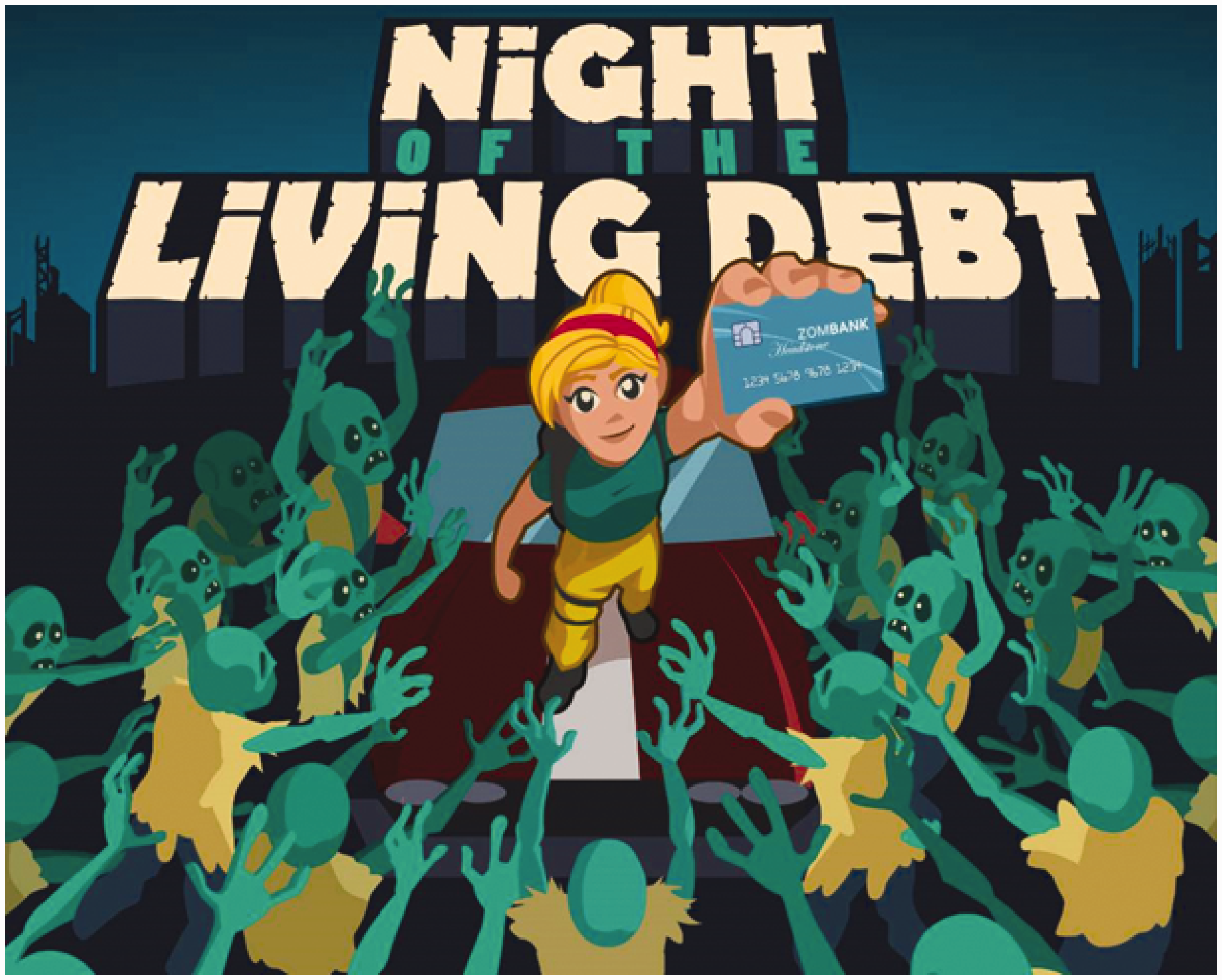
Night of the living debt – title screen.
Participants
The population for this study was comprised of adult audiences from a land-grant university extension program which tend to cater to participants in rural areas, those of relatively low socio-economic status, and minorities. Night of the Living Debt, the educational program implemented in this research, was specifically designed for high school seniors but in pilot trials was found to also work well with adult audiences. A power analysis indicated an appropriate N of 160 participants for this study; the final N was 180. Participants were randomly assigned as existing groups to one of the four following experimental conditions:
Traditional learning group
This treatment condition served as the control group. Participants received a standard PowerPoint lecture on identical content which was designed to last approximately 40-minutes – about the same amount of time allotted for the gameplay treatments. The lecture did not include any of the visual or other media elements from the game; it was limited to bullet points and stock images as visual aids. Prizes were awarded randomly by drawing names at a ratio similar to the CMTP and COPT groups.
Individual transformational play group
In the ITP group, the game was intentionally facilitated without the social elements that were present in the cooperative and competitive experimental conditions. Each student in the class received a tablet, just like the other experimental groups; however, they were not divided into small groups. Instead, they were instructed to complete the game on their own without social interaction with other players. No mention of cooperation or competition while playing the game was made by the session facilitator. Prizes were awarded randomly by drawing names at a ratio similar to the CMTP and COPT groups.
Competitive transformational play group
In the CMTP group, participants were instructed to play the game competitively. Consistent with the COTP group, small groups of three to four participants were formed. Each participant was instructed to play on his or her own tablet, and that the player who achieved the highest score within their small groups would win a prize such as a game-branded water bottle, t-shirt, or hat. This competitive structure was consistent with the definition of direct competition by Ciampa (2014) in which participants must compete against other students to achieve success. It was also consistent with Brown, Cron, and Slocum’s (1998) definition of structural competition in which an intentionally created situation motivates participants to compete for mutually exclusive rewards. The competitive structure of the game was designed and delivered according to Stanne et al.’s (1999) four conditions of appropriate competition as outlined in section 2.2.
Cooperative transformational play group
In the COTP group, participants were instructed to play the game cooperatively. According to Slavin’s guidelines (1980, 1990), small groups were formed consisting of three or four participants per group. As opposed to collaborative learning which merely requires participation, cooperative learning structure requires a specific goal (Panitz, 1999). The goal of the members of each small group was to achieve an in-game level of success, which is specifically to get each group member to a credit score of 720 or higher which is considered the “master level.” According to guidelines of Li and Lam (2013) for structured team learning, each member of the group had his or her own tablet and was accountable for achieving the master level of success in order for the entire group to be successful. Group members were allowed to communicate and to actively help each other by sharing pointers and hints. According to Slavin (1990), small game-branded items were used as small group goals for those groups whose members were able to cooperate and collectively achieve the “master level” of success. These were the same prizes described in the section 3.3.3, namely game-branded water bottles, t-shirts, hats, and other similar items. The number of prizes available was similar to the other groups, meaning that there were enough prizes for each group to receive one; therefore, the small groups did not have to compete against each other for a scarce resource/reward. The cooperative structure of the game was designed and delivered according to the five guidelines of appropriate cooperation outlined by both Johnson et al. (1998) and Johnson and Johnson (1999) as outlines in section 2.2.
Measures
Performance
The educational game examined in this research was co-created by the author and no preexisting performance assessment tool adequately aligned with the content and knowledge performance goals related to the primary objectives of the program. The primary objectives drove the design of the throughout the game, and included (1) understanding why a credit card can be the most effective way to build credit; (2) understanding that subprime/payday loans will always damage credit even when used responsibly; and (3) understanding that missing payments is the worst thing possible for a person’s credit.
The post-test questions were written specifically to align with these three primary learning objectives as well as several secondary objectives. The questions were also reviewed by five content experts and adjusted according to their feedback to ensure content validity of the instrument.
A KR-20 analysis was done on several pilot tests to determine the reliability of the final questions on the assessment. The final version of the instrument with 19 questions was sufficiently reliable (α > .763) for the purposes of this research.
Engagement
An engagement An engagement scale created and validated by Csikszentmihalyi and Csikszentmihalyi (1992) and Csikszentmihalyi, Rathunde, and Whalen (1997) was deemed the best fit by the authors for measuring engagement during the learning process. This is in part due to the influence of flow theory on educational video games (e.g. Berta, et al., 2013; Bressler and Bodzin, 2013). The only adjustment was changing question wording from present tense to past tense to reflect post-test administration of the scale. Therefore, these twelve Likert-type questions were used to measure a composite engagement score for participants in each of the study’s conditions. The twelve questions were meant to reflect the 12 dimensions of the flow experience (Mayers, 1978), and were rated on an 8-point scale ranging between strongly agree to strongly disagree. This instrument has been used in a number of previous studies (Brown, 2006; Delle Fave and Massimini, 1988; Laing et al., 2017); however only Csikszentmihalyi et al. (1997) reported any statistical analysis of reliability, finding a mean alpha index of .82, which indicates good reliability. For the present study, pilot data collected using this instrument produced good reliability, α = .798.
Attitude
A seven-question attitude scale developed by Hwang and Chang (2011) was selected by the authors as the best measure of learner attitude for this study. The reported alpha index of this instrument was .79, indicating acceptable reliability (Hwang and Chang, 2011). Other studies using this instrument reported acceptable Cronbach’s alpha values of 0.732 (Lin et al., 2014) and 0.72 (Lin and Lin, 2016). With permission from the original authors, it was adapted slightly to align with the content of this study and was used to measure the affective differences among participants.
Description of sample
In total, 12 classes were taught in different regions in the intermountain western United States. Programs were held in a variety of settings including university extension offices, community centers, churches, and hotel conference rooms. All groups were, in some way, associated with traditional outreach and extension target audiences, including but not limited to farmers, low-income families, and Hispanic groups. It is worth noting that four of the participants in the CMTP condition and two participants in the ITP condition required Spanish-translation assistance to fully participate in the program. Fortunately, qualified translators were available to assist in program and post-test participation. Though this language barrier was found in a relatively small portion of the overall sample, it should be factored into the interpretation of the results. The average participant tended to be Caucasian, female, and between the ages of 31–50.
Results
Descriptive information for data
Using this final sample data, the performance instrument was found to have acceptable reliability (α = .721). The aggregate mean for all groups was 17.4 (out of 19); the CMTP group had the lowest mean (16.58) while the TRA group had the highest mean (18.02).
The engagement instrument was found to have good reliability (α = .848). The aggregate mean score for all groups was 77.76 (out of 96 possible); the ITP group had the highest engagement score mean (80.23), while the COTP group had the lowest engagement score mean (74.26).
Last, the attitude instrument was found to have good reliability (α = .877). The aggregate mean for all groups was 26.85 (out of 28); the CMTP group had the highest attitude mean score (27.43), while the other three groups had means that were very similar (26.6).
Research question one
Research Question One asked if there were any significant differences in scores on a performance post-test between participants who learned about the personal finance topic of credit scores in one of four different conditions. Since the data had outliers and violated the assumptions of homogeneity of variance and normality, a typical one-way ANOVA was not appropriate for determining statistical significance between conditions. A Welch-ANOVA was used as an alternative because it is robust to violations of homogeneity of variances. Using this statistical tool, and a Games-Howell post-hoc test, a statistically significant difference was found between the TRA group (M = 18.02, SD = 1.13) and the CMTP group (M = 16.58, SD = 2.78), with a medium practical effect size (d = .68). However, the results of the Welch-ANOVA (F(3, 176) = 6.77, p = .010) should be interpreted with caution since the assumption of normality was not met. Due to the violation of normally distributed data, a Kruskal-Wallis test was used as a non-parametric alternative to the one-way ANOVA. This test found significance (χ2(3) = 8.27, p = .041), and further post-hoc testing also revealed a significant difference between the TRA and CMTP conditions (of χ2(1) = 8.09, p = .004) with a medium practical effect size (η2=.088). Given the findings, the null hypothesis was rejected because a statistically significant difference was found between the TRA and CMTP conditions on two separate statistical tests. Though statistical significance was found, it is counter to the findings of previous research (Lim and Reeves, 2010; Peng and Crouse, 2013; Peng and Hsieh, 2012; Plass et al., 2013; Staiano et al., 2012): The TRA or traditional lecture (control group) actually showed significantly higher performance post-test scores. Interpretation and limitations of this finding are discussed in section five.
Research question two
Research Question Two asked if there were any significant differences in composite scores on an engagement scale between participants who learned about the personal finance topic of credit scores in one of four different conditions. The data met the assumption of homogeneity of variance but violated the assumption of normality. A Kruskal-Wallis test was used as a non-parametric alternative to the one-way ANOVA. This test did not find significant differences between any of the four groups on the composite-engagement scores (χ2(3) = 5.15, p = .161). Given the findings, the null hypothesis could not be rejected, and the inference is that the condition, or type of credit-score education that the participants received, did not make a meaningful difference in participants’ overall level of engagement. Further interpretation and limitations of this finding are discussed in section five.
Research question three
Research Question Three asked if there were any significant differences in composite scores on an attitude scale between participants who learned about the personal finance topic of credit scores in four different ways, or conditions. The data reduced the effects of ten extreme outliers through a process called Winsorization. However other, non-extreme outliers remained. For a parametric ANOVA test, the data met the assumption of homogeneity of variance but not for normality. For the nonparametric Kruskal-Wallis, the data test did not meet the assumption of homogeneity of variance (F(3, 176) = 3.027, p = .031). Since ANOVA is robust to violations of normality, a classic one-way ANOVA was used to examine the attitude scores between conditions with the acceptance of an increased risk of a Type I error, or false positive. In spite of a bias toward finding significance, the results were not significant (F(3, 176) = 1.299, p = .276), meaning that the null hypothesis could not be rejected. No further post-hoc tests were necessary. The inference is that the condition, or type of credit-score education that the participants received, did not make a meaningful difference in participants’ overall attitude. Further interpretation and limitations of this finding are discussed in section five.
Discussion
As discussed in section two, few research studies have adequately defined competition and cooperation in educational settings. From the literature, distinct definitions of appropriate competition (Brown et al., 1998; Ciampa, 2014; Stanne et al., 1999) and cooperation (Johnson et al., 1998; Kapp, 2012; Panitz, 1999; Slavin, 1980) in education were derived and used as the framework for building the competitive and cooperative experimental conditions used in this study.
In examining these conditions, the findings of this study indicated that, contrary to some previous research findings (Chen and Chiu, 2016; Jong et al., 2013; Sung and Hwang, 2013), statistically significant differences between groups did not exist for the dependent variables of engagement or attitude. However, for the performance variable, a statistically significant difference was found, though not in the direction that might be expected. Though some prior studies favor competitive educational video games over traditional learning (Lim and Reeves, 2010; Peng and Crouse, 2013; Peng and Hsieh, 2012; Plass et al., 2013; Staiano et al., 2012), there are also studies with mixed and ambiguous results (Bernstein et al., 2015; DeLeeuw and Mayer, 2011; Chen, 2014a, 2014b; DiMenichi and Tricomi, 2015; Nebel et al., 2016). In many of these mixed-results studies it was clear that one or more of Stanne et al.’s (1999) four conditions for appropriate competition were violated thus leading to potentially false negatives due to poorly structured and weakly implemented forms of competition. Therefore, it was expected that the present study, with a clearly defined framework for implementing competition, would find results in favor of learning in the context of competitive game-play. But this was not the case. Instead, the traditional-lecture (control) group produced significantly higher scores on the performance post-test than did the competitive-play group.
Interpretations and implications
There are several possible interpretations of the results found in this study. First, it is possible that a combination of limitations such as attrition and differences in participant demographics like gender and ethnicity, language barriers, novelty/disruption effects, or measurement shortcomings combined to effectively cancel out the significance in the results that might align with findings from prior literature. For example, Shaffer et al. (2005) have suggested that in spite of the tremendous educative power of video game use in corporations, government and the military, certain demographic subgroups are still bound by negative stereotypes of video games, violent, misogynistic and isolating. The researchers of the present study suggest that these demographic limitations likely had some influence om the results but are not the primary explanation for the findings.
Another possible influence on the outcome was the expertise and experience of the primary researcher. Through years of teaching about credit scores, the primary researcher has become somewhat of a content expert in this area. This may have unduly influenced the results in favor of the control group. For example, the primary researcher noted, while delivering the four conditions in various randomly assigned groups, that those in the traditional control group took advantage of the opportunity to engage the researcher with questions and answers. Of course, this caused slight deviations in the prepared material for the slideshow; but given the researcher’s 11 years of experience teaching hundreds of outreach and extension courses, the primary researcher was able to effectively navigate the questions while staying on topic with the prepared material. At the same time, the participants in the three experimental conditions were usually very focused on the game itself and did not take the opportunity to ask the researcher nearly as many questions, either about the content itself or the game. They preferred learning by doing. The implication is that if all the classes had all been taught by a non-expert or novice instructor, the differences between groups may have been more pronounced and possibly more in favor of the gaming conditions.
While this possibility might partially explain a significant result favoring the traditional-lecture control group over the competitive-play group, this explanation may also partially explain the non-significance among the groups on the measures of performance, engagement, and attitude. In other words, being able to freely interact with a content expert and experienced lecturer on a topic of interest might prove to be very informative, engaging, and promote good attitudes; but this also means that, with one noted exception, the gameplay groups were able to keep pace on all three measures with what might be considered a top-line approach (Manero et al., 2015).
Another interpretation to consider is that, just as some of the prior literature has indicated, learning through competitive game-play is complex and not well understood. One of the assumptions of the present study is that by clearly defining an appropriate framework for gameplay, results would likewise be clear and unambiguous. However, this was not the case; though one might assume that the results mean that competitive gameplay is simply not effective, another interpretation might be that factors not clearly identified by the present study may have influenced the outcome. This may include factors such as learner preferences (Goršič et al., 2017; Novak et al., 2014), gender dynamics (DiMenichi and Tricomi, 2015), age, ethnicity, or something else entirely.
Last, it should be noted that the lack of significant differences between educational conditions on all but one measure in this study may be interpreted by some educators as a positive outcome since it supports choice among educational methods based on context or preference. In short, this study has confirmed that when choosing to use educational video games, a variety of methods of implementation are equally valid. If an educator or group of learners has an aversion or preference regarding any of the social structures outlined in this study, that educator may safely proceed according to those aversions or preferences without sacrificing educational outcomes, at least on the dependent measures considered in this study, with the exception of knowledge performance when the game is played competitively.
Last, it should be acknowledged that the lack of significant differences may be due to the game itself. To fully understand the effects of this game, an examination and comparison to other financial literacy games might prove useful, including comparisons of different combinations of cooperative and competitive gameplay. It would also be useful to assess this or similar games with “built-in” competitive or cooperative modes of gameplay so that the mode of play is not entirely dependent on the facilitator.
The specific framework that informed the design of the game was transformational play. This is a relatively under-researched instructional framework for educational video games based on a broader theory of the same name. The basic elements of the theory promote learning through first-person navigation, using contextually legitimate content for the player to advance in the game, and providing an immersive narrative to drive the game mechanics. This framework informed the design of the game used in this research study, and a fourth potential element of social interaction through competition or cooperation was investigated. The results of the comparison between the traditional lecture (control group) and the individual play group suggest that use of the three main elements of transformational play pose little threat of decreases in learning outcomes. However, adding a fourth element of competition vs. cooperation may introduce some threat of decreases in learning outcomes, specifically in using competitive, social, gameplay mechanics. The implications for instructional designers is that transformational play is a valid framework for informing educational video-game design. While games designed with the framework may not necessarily be superior to other traditional methods of education, they provide a suitable alternative to traditional instructional methods.
Conclusion
This study is important because it helped define standards for future research on competitive and cooperative learning. For example, much of the previous literature indicated that any degree of implementation of cooperative and competitive educational conditions might suffice, possibly leading to ill-defined conditions and inaccurate interpretations of the results. Perhaps it is precisely because the present study defined competitive and cooperative education so thoroughly that differences were not as pronounced as many previous studies. Much of the previous research also supposed that cooperative and competitive educational contexts are inherently superior to alternative approaches; however, the findings of the present study indicate that success using these methods may be conditional on things like participant characteristics, participant preferences, and lecturer dynamics. The research reported here also illuminated that, while the full value of educational video games has yet to be determined, further research should examine similar conditions with more homogenous samples, and perhaps verify this through the use of a pre-test. Future research should also examine social game-play conditions apart from a traditional-lecture control group, since this method is already accepted as effective for learning. And an individual-play condition could also be excluded so that the differences between the social-learning conditions of cooperative and competitive play might be easier to delineate. Additionally, it would be beneficial to explore having a “top-line” (expert) educator who was more actively involved in instruction before, during, and after game-play, rather than simply facilitating the game.
Further research is needed on the theory of transformational play, on learning personal finance topics through educational video games, and on social elements of competition and cooperation in learning. However, this study has suggested parameters and appropriate standards of such future research.
Footnotes
Declaration of Conflicting Interests
The author(s) declared the following potential conflicts of interest with respect to the research, authorship, and/or publication of this article: The primary researcher is also a co-creator of the educational game Night of the Living Debt. The game is available for free from iTunes, and the researcher receives no royalties or payments for game use, and therefore has no financial interest in the use or success of the game.
Funding
The author(s) disclosed receipt of the following financial support for the research, authorship, and/or publication of this article: The educational program described in this research was funded by generous gifts from Northwest Farm Credit Services and CoBank. These organizations had no involvement in the study design; data collection, analysis, or interpretation of data; in writing this report; or in submitting this article for publication.
