




Abstract
In this era of digital media, teachers are competing against technological advancements in gaining students’ engagement and attention. Incorporating game elements in the learning environment known as gamification is a new field of study that re-engages students in learning. This study was done primarily to create a gamified learning environment that will serve as another teaching strategy to engage students in learning. The learning environment was aligned with the principles of gamification and was called Gamified-Class or simply G-Class. Using data gathered from 27 freshman college students, G-Class was developed following the Analysis–Design–Development–Implementation–Evaluation model of instructional design and using the Mechanics–Dynamics–Aesthetics framework of game design. The material was implemented in a General Physics class through a quasi-experimental research design. A G-Class mobile and desktop application together with a user guide was created. G-Class was evaluated both as instructional design material and as instructional task. As an instructional design, it was assessed in terms of content and learning objectives; design, interactivity, and usability; and assessment aligned with learning outcomes. As an instructional task, G-Class was assessed using the Intrinsic Motivation Inventory which consisted of four subscales in a 7-point Likert scale, namely, interest/enjoyment, perceived competence, choice, and pressure/tension. Overall, G-Class was given positive rating both as instructional material and as instructional task. With an overall rating of 5.60, students were found to be more engaged with their subject. Applying gamification in the learning environment pointed to its beneficial effects in enhancing students’ engagement in learning.
Keywords
Introduction
From radio to televisions and game consoles decades ago, educators are now facing additional challenges since the 21st century began. This century brought a lot of technologies such as video games, the Internet, social media, cell phone applications, instant messaging, and a lot of distractions in which teachers have to contend with. These things post deep challenge to the attention and learning of students. These in turn would relatively affect the attention span of students. Students of today expect instant satisfaction from their teachers. They have the idea that everything that they would want can be readily found in the Internet. They have also developed a “consumer attitude” toward learning—seeing learning as just a procurement to purchase rather than a process they need to develop (Dichev et al., 2014). Traditional educational system encourages most of the students to be extrinsically motivated, in which many come to class because they just have to, for attendance, for grade, for requirement, and for other external motivators (Dichev et al., 2014). On the other hand, students who are intrinsically motivated are those that come to class because they want to learn and be involved in learning activities. In addition, online or distance learning as an alternative to traditional education requires more autonomy, time management, and intrinsic motivation. With these, students should have an internal drive to freely complete an activity and to independently keep themselves on track without close and constant supervision of their teachers. These situations present a gap between the teachers’ experience in school in mid-to-late 20th century and the 21st century students’ experience entering college (Osheim, 2013). This simply means that students of today learn differently than students of generation ago.
According to the Philippine Commission on Higher Education, the country has an alarming dropout rate of 87.3% or producing 2.3 million college dropouts per year in 2011. Additionally, loss of interest and lack of motivation are two of the main factors which are associated with dropping out (Nava, 2009). A well-known stimulus that engages people to take their intended learning activities is a game. People have been enjoying games in various forms since decades ago and gaming has become a popular industry today of $60 billion per year, of which around $1.5 billion comes from game-based learning (GBL)—a foundation concept in gamification (Anonas-Carpio, 2015; Mahmoodzadeh, 2014). With its wide acceptance to the public, together with the Internet, people are now more exposed to the mechanics of a game as applied to other aspects of their lives. Hence, it is just a common idea to connect the characteristics of a game and to apply these characteristics in a learning environment where engagement is usually lacking. Researchers believe that combining the fun and enjoyment of a game into the classroom can re-engage the students and that an engaged student will learn and achieve more than an uninterested one (Dichev et al., 2014; Logarta, 2014). Such research led to the emergence of gamification.
Gamification is the use of game design elements in non-game contexts (Deterding, 2015). Gamification in a learning environment is being used as a tool for engagement, motivation, and playful environment and to quantify learning activities (Ramirez and Squire, 2015). It does not necessarily mean creating games but making learning more engaging and fun. It is also a process of combining intrinsic motivation with extrinsic motivation for better performance (Dichev et al., 2014; Logarta, 2014). However, the academic community is still anxious about applying gamification in a classroom (Ramirez and Squire, 2015). This anxiety may be attributed to the drop of empirical studies having positive results and more studies reporting negative results (Dicheva and Dichev, 2015). Christine Rom, a board member of the Game Developers Association of the Philippines and the chief-executive-officer of educational games developer company PODD, believes that if game elements are harnessed and integrated into education, an avenue for enhanced learning process will open. Moreover, she added that gamification is not well understood even in countries with more mature education system and that without proper planning, it can be detrimental and may cause additional confusion (Logarta, 2014).
As technological advancements are becoming more and more accessible to the learners, a common notion is to utilize those advancements in the learning environment. A learning environment where gamification can be applied is on an e-learning environment. An e-learning environment has the advantage of developing students’ desired learning content and gives them a new and innovative way to learn through utilizing digital and electronic media (Lin et al., 2014).
Since gamification is a recent research development and is still in progress, there is still a limited sample of empirical studies in gamifying a learning environment. Recent researches are varied when it comes to the effects of gamification elements mainly due to lack of comparison groups, short treatments, singular assessments, and a lack of validated measures (Hanus and Fox, 2015; Lieberoth, 2014). Thus, this study intends to contribute to the literature concerning the development of a gamified learning environment. This will also help instructional designers in making learning materials which are aligned with the concepts of gamification. This study also aims to provide a hybrid framework to create a gamified learning environment. Gamifying the learning environment will help students be more engaged and motivated to learn in an enjoyable and entertaining way. This may indirectly, if not directly, result to an increased performance of the students in terms of their academic standing.
GBL
GBL is one of the fundamental approaches that supports and is often interchanged with gamification. It is a learning concept which focuses primarily on incorporating videogames into a curriculum (Gerber et al., 2014). The learning objective, in this concept, is different from the objective of the game. As compared to gamification, GBL incorporates a game as part of the learning process. It suggests that a game, like educational video game, can effectively involve students in GBL activities and that engagement has a positive effect on students’ learning (Hamari et al., 2016). However, there is an issue as to whether GBL can be incorporated in existing learning processes without modifying established processes (Ortiz et al., 2006).
Gamification
The term gamification has been around as early as 2002 but was not adopted until 2010 and had its peak in 2013—marking it the “Year of Gamification.” It is usually confused with terms such as behavioral games, funology, applied gaming, serious games, productivity games, or playful/gameful design. The commonly used definition of gamification is that it is the use of game elements in non-game contexts (Deterding, 2015). It is mainly utilized and applied in the industrial or corporate industry to engage employees as well as their clients. On the other hand, gamification in the educational context can put students in control of their learning and may even offer feedback on their activities in relation to their subjects’ structure and goals (Ramirez and Squire, 2015). It encourages individuals to rely on internal motivation by making everyday tasks fun and engaging (Osheim, 2013). A challenge to game designers and developers is how to use game design elements without undermining motivation. In line with this, researches argue that with careful planning, gamification can promote learning.
Analysis–Design–Development–Implementation–Evaluation (ADDIE) model and the Mechanics–Dynamics–Aesthetics (MDA) framework
The ADDIE model was developed in a unified method aligned with the principles of multimedia instructional design. ADDIE model is a project management tool which helps coordinate various steps in a given course and is a general and systematic framework for course development in instructional systems design (Castagnolo, 2008; Clay, 2014). It is the steps involved in the ADDIE that makes up the basic process of instructional design regardless of model used. The process includes the sequential phases of analysis, design, development, implementation, and evaluation. Increasing the efficacy and efficiency of education and training through aligning instruction to specific tasks is the original goal of the ADDIE model (Allen, 2006). On the other hand, MDA is a framework which relates all of game elements with different parts of an application where gamification is being utilized (Mahmoodzadeh, 2014). The three aspects of this framework are interdependent with each other making the processes in creating a game or a gamified e-learning material, from analysis and design to implementation, be implemented smoothly and with coordination.
In this study, the MDA framework was incorporated in the design and development phases of the ADDIE model to serve as the background for the development of G-Class. This was done to introduce the principles of gamification in a learning environment. Figure 1 shows the ADDIE model with the incorporation of the MDA framework.
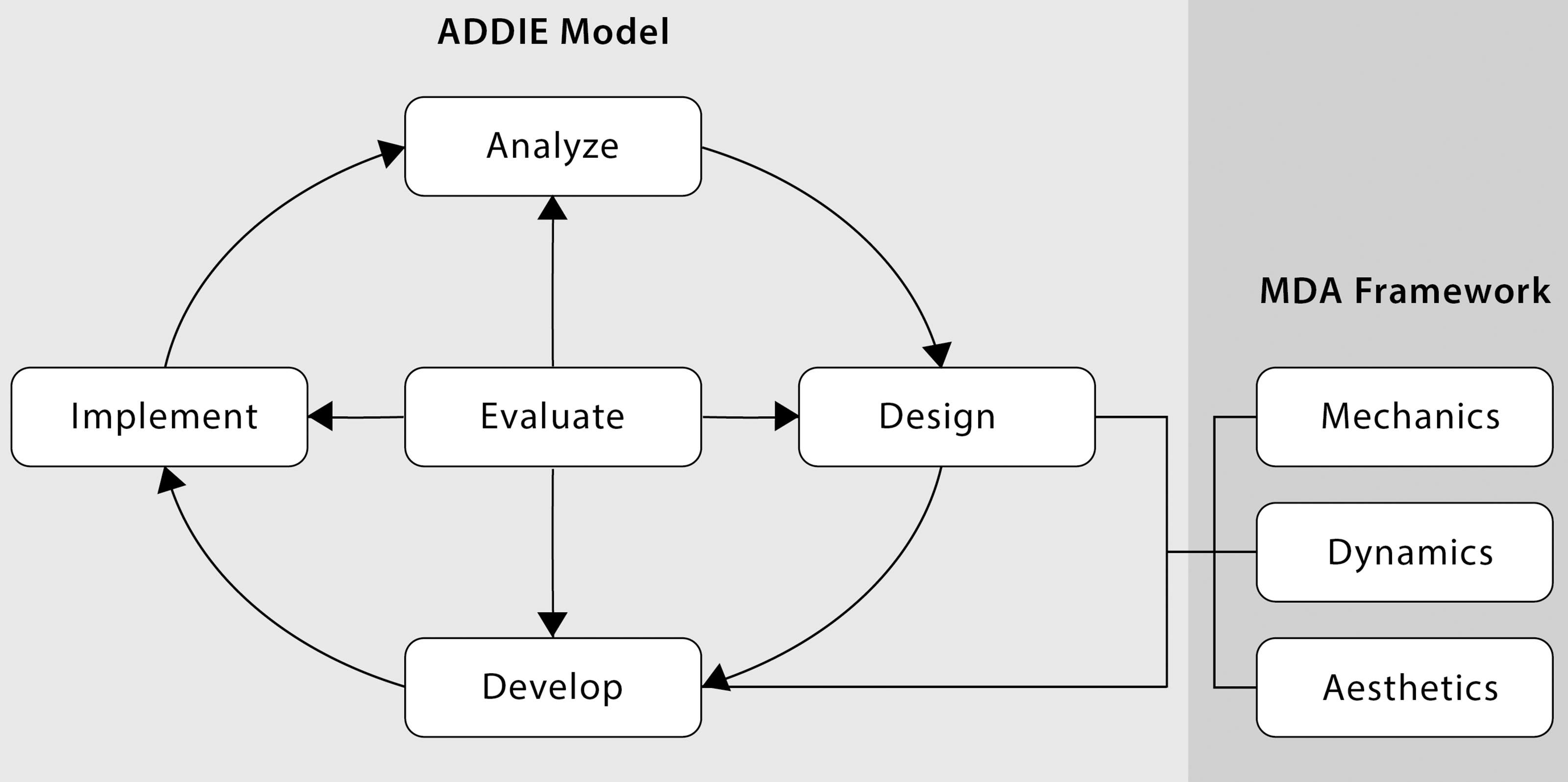
ADDIE model with the integration of the MDA framework. ADDIE: Analysis–Design–Development–Implementation–Evaluation; MDA: Mechanics–Dynamics–Aesthetics.
Methodology
Research design and the participants
The one-shot case study design was used in a predetermined group of participants. In this design, a single group is exposed to a treatment or event and a dependent variable is subsequently observed or measured in order to assess the effect of the treatment (Fraenkel et al., 2012). For the study, the treatment was the G-Class e-learning material. The students’ evaluation of G-Class using the module survey and the task evaluation survey from the Intrinsic Motivation Inventory (IMI) constituted the dependent variable. Twenty-seven participants for this study were selected purposively to comprise the sample needed for the gamified class. All of participants were freshman students from a private college in Calamba City, Laguna and were enrolled in a General Physics class. With this, total enumeration of the participants was utilized for research implementation and analysis.
Research instrument
In gamifying the learning environment, an e-learning material called G-Class was developed using different software applications. A social networking site was also used for the updates on the status of students in the gamified e-learning material. A spreadsheet application was also used to create the database of the participants’ information and status regarding their G-Class standing. Included in the e-learning material were different game elements such as the use of username and password, challenges, leaderboards, status, experience system, level system, virtual currency and shop, and achievements and rewards.
Students’ perception of the gamified e-learning material was evaluated using the module survey developed by Thelen (2015) of the University Cork College and the Task Evaluation Survey from the IMI developed by Ryan and Deci (2000). The module survey was divided into three parts: (1) content and learning objectives; (2) design, interactivity, and usability; and (3) assessment aligned with learning outcomes. It is mostly composed of yes or no questions. It was modified in such a way that the participants can further explain their answers. The IMI, on the other hand, is a multidimensional measurement instrument utilized to evaluate the experience of the participants toward an activity. It assesses the participants’ interest or enjoyment, perceived competence, effort, value/usefulness, felt pressure and tension, and perceived choice while doing a particular activity. Evaluation of the e-learning material for this study focused on four subscales: (1) interest/enjoyment, (2) perceived competence, (3) perceived choice, and (4) pressure/tension. It is composed of items which are rated in a 7-point Likert scale with 7 as very true and 1 as not all true.
Data collection procedure
The study started during the preliminary period of the semester until the end of the midterm period. Consent of all 27 students was sought at the start of class. The ADDIE model with the incorporation of the MDA framework served as the main guideline in making the gamified e-learning material G-Class. Next, an initial survey containing personality and game habits or exposure measurement was administered to determine the profile of the participants. Leaderboards and other game mechanics of the G-Class were then introduced to the gamified class. Lastly, toward the end of the class, another survey was administered to evaluate the perception of the students toward the gamified e-learning material. Final survey was given into two parts, instructional design or module survey and the task evaluation survey.
ADDIE model
Analysis phase
In this phase, observations and informal interviews with the students as well as with other instructors were the initial steps done. Observations done focused on students’ engagement and their motivations with their subjects. Informal interviews were done first with the former students of the researcher who have experienced IKONIA, a trial gamified e-learning material which served as the precursor of the G-Class. Students were asked about their insights and experience about the said e-learning environment and were also requested to give their suggestions for further improvement of the e-learning material. Initial survey was then given to the participants. The survey includes basic demographic information, the operating system of their mobile phone, and their game exposure. As the participants were introduced to the idea of having a gamified e-learning material, they were also asked to suggest items which they want to be included in the G-Class companion application.
Design phase with the mechanics phase of the MDA framework
With the design phase of ADDIE model, learning objectives for the topics were anchored on the objectives enumerated in the course outline of the subject. Aside from the learning objectives, goals of G-Class particularly the challenges were drafted. An adjusted task inventory for the gamified e-learning material objectives and goals was also done in this phase. With the MDA framework, the mechanics of the e-learning material were conceptualized and aligned with the elements of gamification. These elements include the gameplay, experience points, virtual currency and store, challenges, achievements and rewards, login system, and leaderboards.
Development phase with the dynamics and aesthetics phases of the MDA framework
The development phase of the ADDIE model includes the dynamics and the aesthetics part of the MDA framework. The dynamics of the e-learning material, on the other hand, revolved around how the participants will acquire points upon implementation of G-Class. With this, the gameplay and point system were given importance during this stage. Points were designated for academic tasks or G-Class challenges to be done by the participants. On the other hand, aesthetics of G-Class which pertains to the overall design, look, and feel of the e-learning material with emphasis on the accompanying G-Class companion application was done with a flat design theme. The graphics, icons, interface, and elements of the companion application undergone a design study and conceptualization that were then laid out to various software applications. A spreadsheet application was also utilized to create the database of the participants’ information and status regarding their G-Class standing. The G-Class landing screen in the companion is shown in Figure 2.
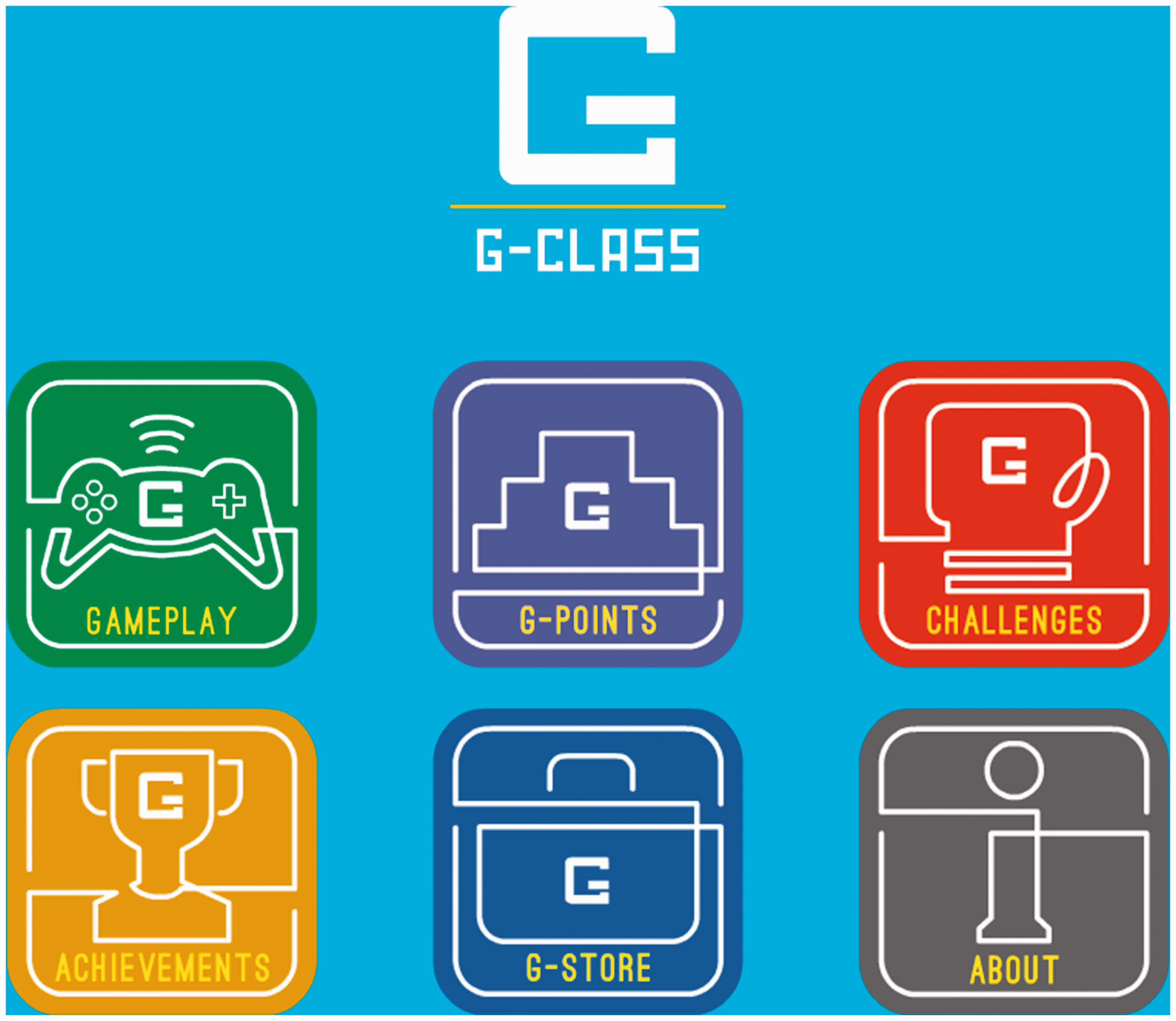
Landing screen of G-Class companion application.
Implementation
Implementation of e-learning material was initialized with the introduction of gamification to the participants. The gameplay, time allotment, and overall process of G-Class were thoroughly explained to the participants. Upon introduction and briefing of G-Class, participants were asked to provide their unique username and password which were saved in the G-Class database. As it was being implemented, lectures, discussions, and board works were done in the normal set-up but with different mindset for the participants—students associated their engagement with class subject as part of G-Class. Participants were updated regularly with their status on the G-Class through the page created in a social networking site where the leaderboard was being posted and through the leaderboard being posted on their classroom.
Evaluation
For each phase of ADDIE, an evaluation was implemented. The G-Class e-learning material and the mobile application were adjusted based on the results of the initial evaluation. Each phase was reviewed for the alignment to the principles of gamification. Important details and components of e-learning material were given emphasis during each evaluation. Toward the end of the G-Class implementation, survey questionnaires were given to assess the experience of the participants with the G-Class. One of the highlights of G-Class, which also served as a summative evaluation of the participants, was their midterm examination.
Each phase of the ADDIE model with the incorporated MDA framework and its corresponding key activities is shown in Figure 3.
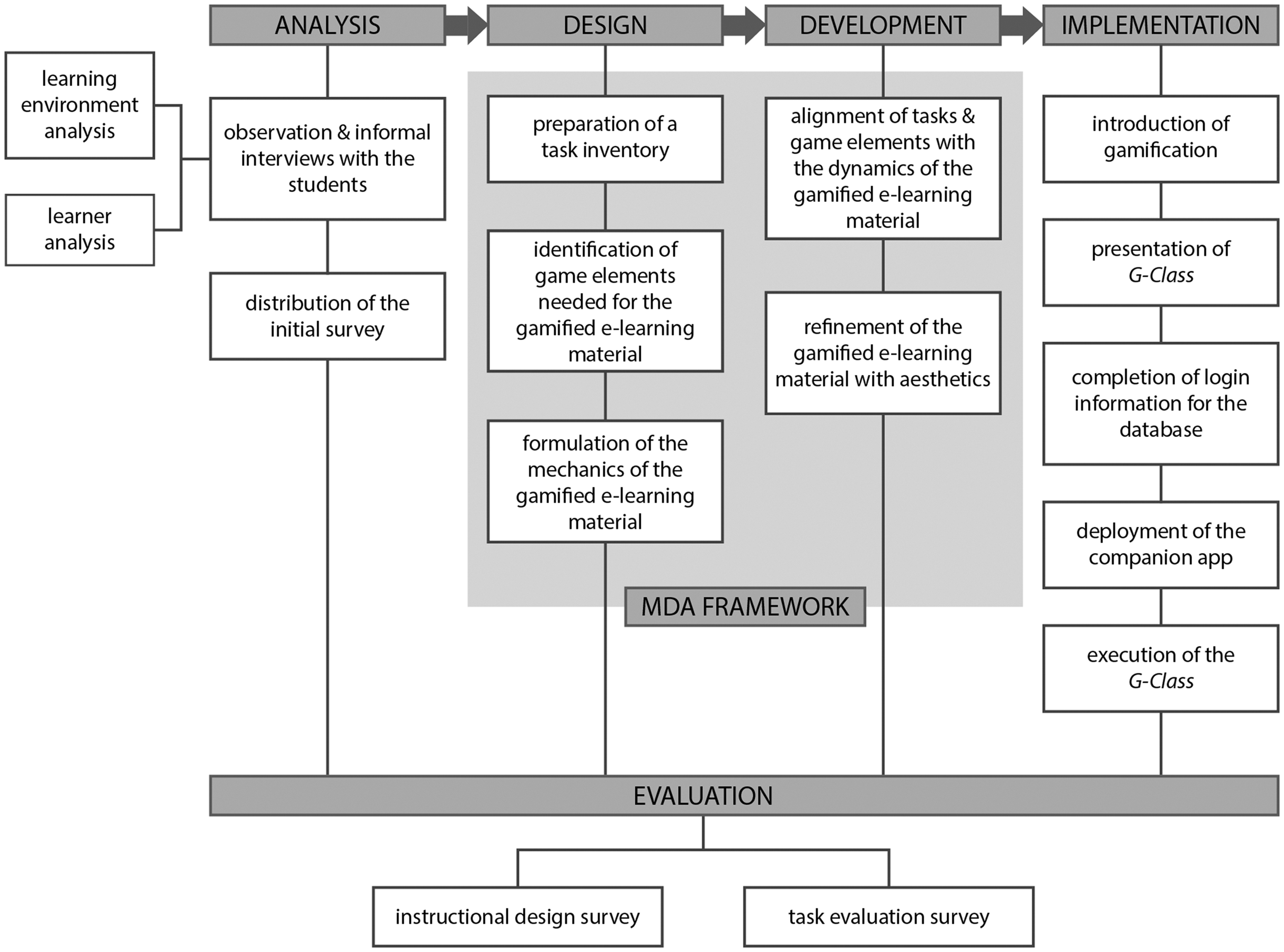
Flowchart showing the key activities in each phase of the ADDIE model and the MDA framework. MDA: Mechanics–Dynamics–Aesthetics.
Data analysis
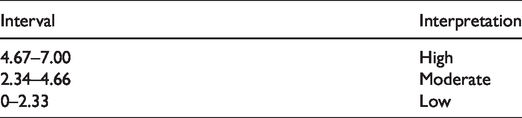
Since total enumeration of the sample group was included in the study, descriptive analysis of the data was done. All 30 students of the class participated in G-Class but three dropped out of school during the middle of semester resulting in a 90% rate of participation. Participants were first introduced to the idea of gamification and how G-Class will be implemented in class. All students chose to participate as they thought that it is a novel idea and they have not encountered a gamification class in their previous classes. Results were presented in frequency tables, percentages, and weighted means. Information gathered during the first phase of this study served as the basis for preparing the task inventory needed and for developing the gamified e-learning material. The modified module survey questionnaire and the task evaluation survey were utilized for data analysis. Responses from the modified module survey were presented as percentages and were then utilized to support their responses in the task evaluation survey. For the task evaluation survey from the IMI, weighted mean for each item and for each subscale was calculated and interpreted. The 7-point Likert scale was divided into three equal intervals for ease of interpretation and discussion, namely “low” for mean scores of 0–2.33, “moderate” for 2.34–4.66, and “high” for 4.67–7.00. Table 1 presents the intervals for interpreting the weighted means.
Intervals used for interpreting the computed weighted means.
Results
Based on observations and informal interviews with the participants regarding their involvement with their current subjects, it was observed that their motivation and engagement with the subject was a factor that should be addressed. Some instructors handling the participants also stated that class participation was relatively low, especially in those subjects which involve complex mathematical and scientific problems. With these, motivation and engagement had been identified as a gap in the performance of the participants. Anxiety with numbers, tardiness, and working with classmates were the observed factors that may be attributed to the motivation and engagement gap of the participants. These factors were used as one of the foundations for the development of the gamified e-learning material. Figure 4 presents the factors for motivation and engagement gap identified from the participants.
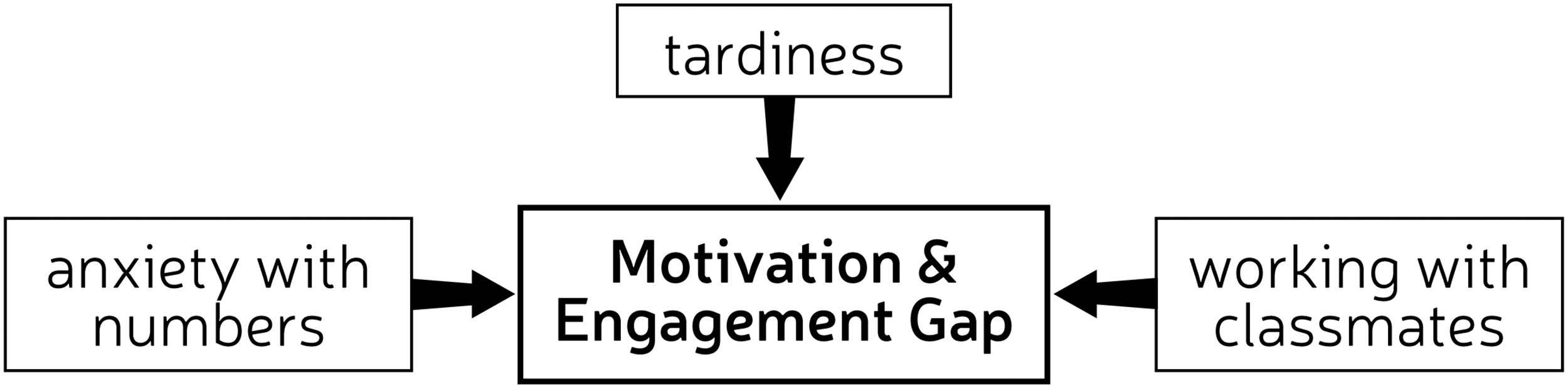
Observed factors for the motivation and engagement gap of the participants.
The class is composed of 60% male and 40% female and has an age range of 16–21 years old. In terms of their game exposure and habit, 93% of them play video or mobile games on a daily basis and that all of them are playing using their Android device. Forty-eight percent of the participants spend up to two hours per day playing mobile or video games. This led to the development of the companion application to be focused on Android devices for full compatibility although desktop version was also prepared for those who may want to access the application using their desktop computer or laptop.
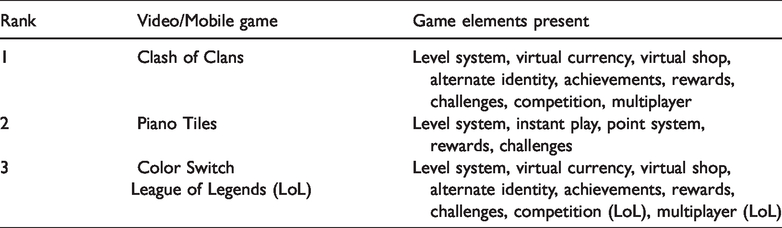
The video or mobile games they usually play were also taken into consideration for analysis. Top played games and their corresponding game elements were identified as shown in Table 2. The identified game elements were incorporated in the development of the companion application.
Top games played by the participants and the identified game elements in each game.
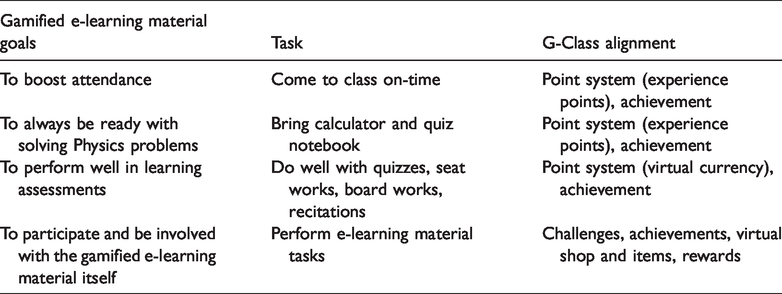
The mechanics phase of the MDA framework was utilized during design phase of the ADDIE model. A sample modified task inventory presented in Table 3 was done during this phase to align it with the principles of gamification. This served as guide for the development of the e-learning material. The identified tasks were aligned with G-Class to provide support on what and where to include tasks in G-Class.
Sample adjusted task inventory for the G-Class.
With the identified game elements present in the top played games and with the adjusted task inventory, G-Class was developed. Contents of the G-Class were presented visually through the creation of the companion application with the same name. It is composed of different sections such as the gameplay, G-Points, challenges, achievements, and G-Store. The gameplay section gives the overview of G-Class. G-Points section explains how participants can acquire the needed points, in the form of G-Exp and G-Coins, in order to appreciate and maximize G-Class. G-Exp points are needed for the participants to level up. The points can be acquired by performing simple tasks and completing challenges. One hundred G-Exp and completing a challenge are needed for a student to move up to another level. The maximum level that can be reached is level 5 having accumulating 500 G-Exp and performing at least five out of the six challenges.
Tasks related to their class that the participants can do are presented in challenges section. Tasks were designed to accommodate participants with different learning styles. Some of the challenges include recognizing the work of a renowned physicist by drawing or writing an article about the physicist and expressing their thoughts on Physics as part of their everyday life by composing a poem or taking a picture of a scenario showing how Physics affects their daily lives.
Achievements section, on the other hand, contains the list of possible rewards or badges participants can acquire upon performing or completing tasks or challenges. Task or challenges were a mixture of mundane activities such as having a calculator and coming to class on-time, and learning tasks such as performing well in a given quiz and answering in the recitation. Some of the achievements are Cool Geek by being on top 10 in two quizzes, and Master Challenger by completing at least five challenges in G-Class. Achievements have different levels of difficulty from being a Simple Achiever to being a Cool Achiever and then being a Master Achiever. This was conceptualized in order for all the students to gain achievements as it was intended to motivate and engage students with the G-Class.
With G-Store, participants can purchase items which can aid them in their examination. Items were carefully designed from the suggestions given by the participants and were given tiers and conditions for it to be used fairly. An item available in the G-Store is the Bulb of Clues which grants the user a clue on how to answer a problem solving question in the examination. The condition which the user should meet to use the Bulb of Clues is that the user should be at least level 2 and has 20 G-Coins. Other items include Spectacles of Notes, Hourglass of Time, Potion of Problems, Shoe of Friends, and Eraser of Mistakes. Each item has its own required G-Coins and conditions to be activated and used.
The G-Class companion application was then deployed to the participants. Participants were encouraged to look into application for them to understand the know-hows of G-Class. They were motivated to explore the application since it was designed to be updated weekly with exciting rewards. All remaining 27 participants have accessed the companion application, mainly to view new rewards and tasks. An example of a reward was giving away 30 G-Coins for the first three participants who can find the hidden button in the companion application. With the learning assessments and tasks done, participants earned corresponding G-Exp and/or G-Coins. Earned G-Exp and G-Coins were updated and stored in the database. A leaderboard containing updates on the status of the participants was weekly posted through the social networking site page and through a leaderboard posted inside the classroom. To establish and protect the identity of each participant, they were asked to have their own unique username. Their usernames were used in the leaderboards and that any concern regarding a particular participant was addressed using the username which they have provided. Leaderboard provided the participants an overall view of their performance as well as the performance of their fellow classmates.
In terms of content and learning objectives, design, interactivity, and usability, and alignment of learning outcomes, G-Class had positive ratings. Fifty-nine percent rated it as excellent, with the remaining 33 and 8% ratings as very good and good, respectively. Participants regarded the whole material with challenges, leaderboard, and items as the best parts of G-Class. They added that the ease of use and navigation, graphics, and proper sectioning made G-Class companion application stand out for them. Tasks or challenges presented in the material were reasonable and can be done by everyone as supported by 81% of the participants who strongly agreed with it and the other 19 who partly agreed with it. However, some argued that they found the challenges difficult.
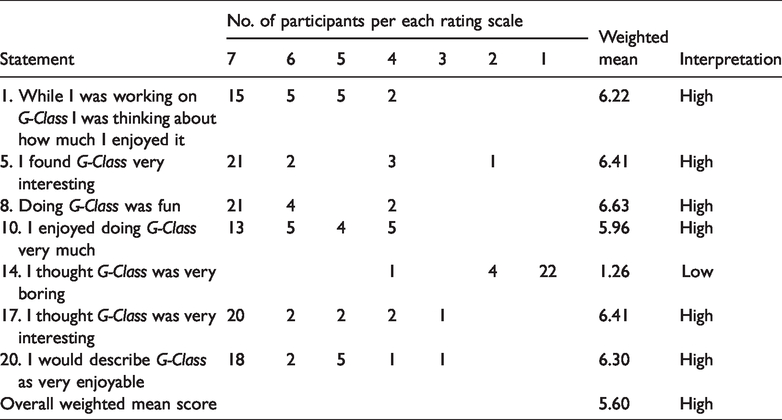
The task evaluation survey from the IMI, on the other hand, had four subscales—with the interest/enjoyment considered as measure of intrinsic motivation as self-report, perceived competence and perceived choice as positive predictors of intrinsic motivation, and the pressure/tension as a negative predictor. A high interest/enjoyment was interpreted from the participants as supported by the overall weighted mean score of 5.60 (Table 4). Some items in the survey are reverse or negative statements such as “I thought G-Class was very boring” that were included to verify the ratings for the other items. Thus, these items were expected to have the opposite rating than the other items.
Number of participants who rated the interest/enjoyment statements.
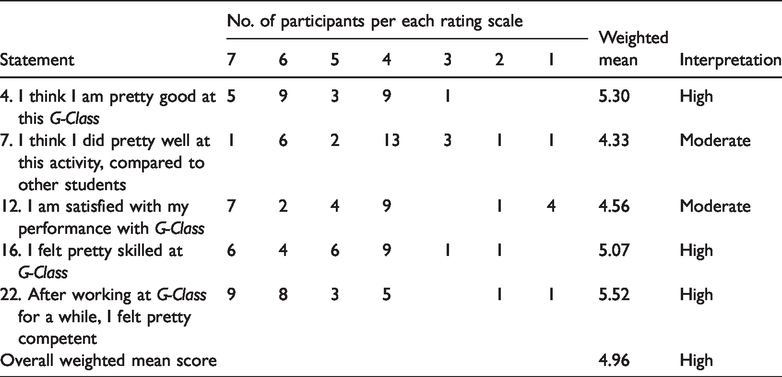
The gamified e-learning material also presented a high perceived competence among the participants with an overall weighted mean score of 4.96 as shown in Table 5. Although perceived competence produced a high rating, the ratings of the participants were spread throughout the seven scales indicating neutrality with some of the items in this subscale. Some players who see their standing as below or lower than the other players showed a decrease in their confidence and competence of the gamified activity (Hanus and Fox, 2015). Another factor that may be attributed to this result was that challenges might make them feel that they were not competent enough. They may have viewed some of the challenges as difficult resulting in a decreased perceived self-competence. Conversely, it should be noted that challenges were designed to cater to participants with different learning styles.
Number of participants who rated the perceived competence statements.
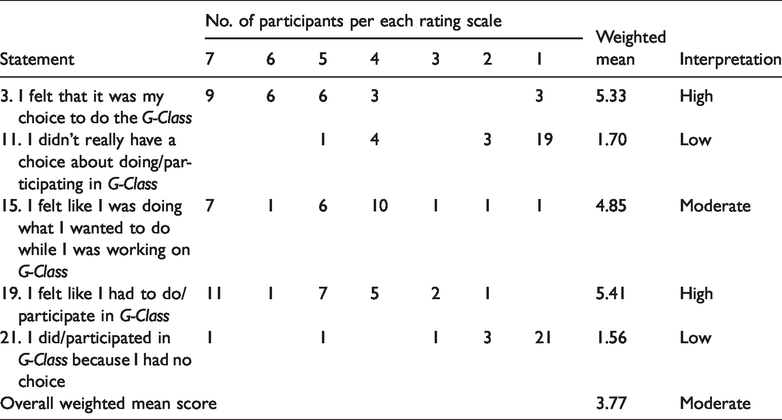
On the other hand, Table 6 shows perceived choice subscale which posted a moderate rating of overall weighted mean score of 3.77. The moderate rating for the perceived choice suggests that participants showed willingness to be part of the gamified e-learning experience. This may be due to the fact that gamification is a novel idea for them and that they readily accepted the idea. Incorporating game elements present in their preferred and most played games played a major role for this particular subscale.
Number of participants who rated the perceived choice statements.
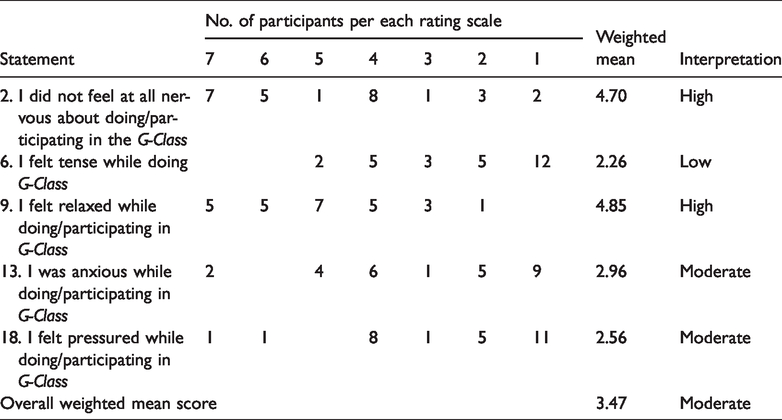
With 3.47 rating shown in Table 7, pressure/tension also posted a moderate rating. This suggests that participants felt some sense of pressure or tension while participating in G-Class. Participants confirmed that it was the challenges that made them feel pressured and tensed.
Number of participants who rated the pressure/tension statements.
Conclusion and recommendations
G-Class as a gamified e-learning material was developed and implemented in a methodical manner utilizing the ADDIE model of instructional design and the MDA framework of game design. The results of the survey received a positive acceptance from the participants. With the self-report measurement of the participants’ motivation, the e-learning material, to some extent, improved their engagement or motivation toward the activity.
The teaching–learning environment and experience change together with the rapid advancements in technology. With these advancements, new concepts and studies emerge to retain or improve the academic performance of the students. One of the new concepts in the field of education is the idea of incorporating game elements in learning situations, the gamification. As students are more and more exposed and hooked into video/mobile games, teachers and educators must take it as an opportunity, not as a threat, to grab the students’ attention in the learning process. By doing this, students may feel the excitement of a game in the classroom and that may eventually result in improving, if not increasing, students’ motivation toward a subject. By incorporating other elements of a game, student participation and engagement may also be improved. This will give the students the “enjoy and learn” feel toward a class that may lead to an improvement with the overall academic performance. Embracing new and innovative strategies in teaching may help improve the learning experience of the students. This concept of gamification will be effective as long as it is analyzed, developed, and implemented properly and carefully. Every aspect of a gamified e-learning material must be considered and taken into account for it to be successful.
Of course, participation of the students with the e-learning material will greatly contribute to its success. Although challenges in the e-learning material are not compulsory, completing all of the challenges is seriously encouraged. Students are challenged and encouraged to come out of their comfort zone (their learning style) to try and discover new things which they think they cannot do. It is through trial and discovery that may help them grow and improve their learning experience. Treating the e-learning material as part of their learning activity, and not as a game, may help them be on track with the learning objectives, not just of the e-learning material but also of the subject.
Since gamification is a relatively new school of thought in education, results of this study would be more valuable if done in a large group and with support of quantitative analysis. Different grade or year level of participants would also yield good results as it will show the extent of effectiveness of gamification in students with different learning preferences. Since the study aims that the developed e-learning material would be applicable to other subject, it is encouraged that this study may serve as a guide and may be modified to fit and be tested in other course subjects or topics.
The e-learning material itself still has a lot of room for improvement for future studies. The incorporation of the application proved to be advantageous to the study, thus it is an aspect of the e-learning material that may be further improved and given more attention. For example, a mobile or software application developer may be hired to better code and program the application to have a content management system wherein a teacher, even with no knowledge in programing, can easily edit the contents of the application to align it with his/her own class objectives and students. Due to restrictions with the span of implementation of this study, it is suggested that related and future studies be done, if possible, for the whole semester or school year. This is to see if the length of time affects its effectiveness. In cases that mobile phones and desktop computers are not accessible to students, an alternative for the companion application is needed to be developed and be conceptualized to further support the goals of gamification.
With regard to game elements, it will also be good to future researches if the effectiveness of each game element to be incorporated is measured and evaluated. Developing a standard measurement for each game element will be a big contribution to the field of gamification. With a developed or standardized measurement, a follow-up study of using the same e-learning material, and if possible with the same participants, is strongly recommended. This is to further assure and analyze the results objectively and to see if there is a deviation from the results of this study.
Footnotes
Declaration of Conflicting Interests
The author(s) declared no potential conflicts of interest with respect to the research, authorship, and/or publication of this article.
Funding
The author(s) received no financial support for the research, authorship, and/or publication of this article.
